 Keep
AC Blowing Warm Air? 7 Causes, the Checks in Order, and What Repairs Cost
 Daniel Mercer · Editor & Researcher·
Published November 16, 2026·
Updated November 16, 2026
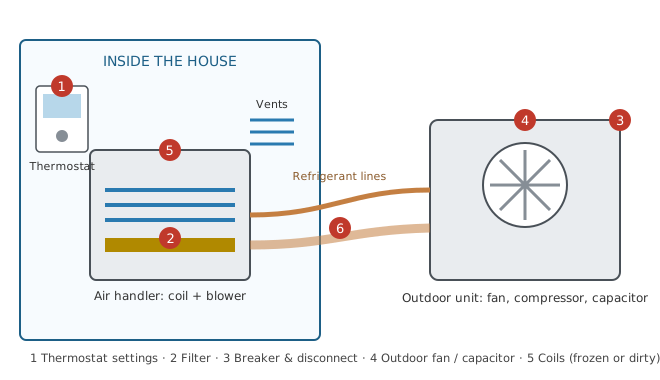
There's a particular misery to an air conditioner that runs and runs but never cools. The vents are blowing, the thermostat is dropping its demands, the electric meter is spinning — and the house stays warm. It feels like the system is mocking you, because in a sense it is: an AC is three machines pretending to be one, and yours has lost one of them while the other two keep up appearances.
Those three machines are the indoor blower, which moves your house's air; the indoor coil, where that air gives up its heat to cold refrigerant; and the outdoor unit, where the heat gets dumped outside. Warm air from the vents means the chain is broken at one link. The good news: the breaks happen at a short list of usual places, several of them free to check, and the outdoor unit will tell you a surprising amount if you know how to look at it — and listen.
Check 1: The thermostat (yes, again — it earns it)
Every HVAC guide starts here because every HVAC technician's day starts here too. Confirm three things: the mode says Cool (not Heat, not Off, and not a programme still running a spring schedule); the setpoint is at least 3 degrees below the current room temperature; and the fan is set to Auto, not On.
That last one is the sneaky cause of a very specific complaint: "the air feels warm between cycles." With the fan on On, the blower runs constantly, including all the time the compressor is off — pushing room-temperature air through the vents and convincing you the AC blows warm. On Auto, the blower runs only when the system is actively cooling. If your screen is blank or dim, batteries — same story as the furnace guide: a dying thermostat loses its calls before it loses its display.
Check 2: The filter — and the freeze it causes
Pull the air filter and hold it to the light. If you can't see light through it, replace it before you diagnose anything else, because a choked filter is upstream of the most theatrical failure in this guide: the frozen coil.
Here's the mechanism. The indoor coil cools by having warm house air blown across it. Starve that airflow — clogged filter, blocked returns, a blower struggling — and the coil's temperature falls below freezing. Moisture from the air condenses and freezes onto it. Ice insulates the coil and blocks airflow further, so the coil gets colder and the ice gets thicker, and within an hour or so you're looking at a block of ice where your cooling is supposed to happen, and vents blowing room-temperature air past it. ENERGY STAR's advice to check the filter monthly exists precisely because this cascade starts there.
If you find ice — on the coil (behind the air handler's access panel) or frosting the thick copper line outside — the procedure is always the same: turn the system off at the thermostat, set the fan to On to blow room air over the coil and speed the thaw, and wait two to four hours. Never chip the ice; the coil underneath is soft copper and aluminium, and a screwdriver slip turns a free fix into a coil replacement. Change the filter while you wait. Restart in Cool and watch: a coil that freezes again within a day, wearing a clean filter, is reporting a deeper cause — low refrigerant or a failing blower — and that's a service call.
Check 3: Two breakers, one disconnect
A central AC is really two appliances with two power supplies. The indoor unit (air handler or furnace blower) has its breaker; the outdoor unit has its own, usually a double-pole breaker, plus often a disconnect box on the wall beside the condenser.
This split explains the classic warm-air scenario: the outdoor breaker trips, the compressor and condenser fan stop, and the indoor blower — on its own healthy circuit — keeps cheerfully blowing uncooled air through the house. From the sofa, "the AC is running." Outside, it's silent.
Check both breakers. Reset a tripped one once. If it trips again, leave it off and call: a breaker that re-trips is an electrical fault announcing itself, and the announcement is the cheap version of the event. Also confirm the outdoor disconnect hasn't been pulled — disconnects get pulled during other work and during winter, and forgotten.
Check 4: Go outside and read the outdoor unit
This is the most informative minute of the whole diagnosis. Stand by the condenser with the system calling for cooling and sort what you find into one of four states:
Fan spinning, normal sound. The outdoor unit is working. Your problem is indoors or in the refrigerant: go back to the filter/ice checks, and if those are clean, the remaining suspects are a dirty outdoor coil (Check 5) or low refrigerant (Check 6).
Humming, but the fan isn't spinning. The signature of a failed capacitor — the component that gives the fan and compressor motors their starting shove. The motors are powered and trying, and humming is the sound of trying. Switch the system off: a motor left humming is a motor cooking itself. The capacitor is the single most common AC repair there is — a $15–$80 part, typically $150–$400 fitted — and heat is what kills them, which is why they so often die on the first 95-degree afternoon after surviving spring. One safety note that keeps this a pro job for most people: capacitors store an electrical charge even with the power off, and they must be discharged properly before handling. Technicians do it in seconds with the right habit; it's not the place to improvise.
Clicking, trying to start, giving up. Similar territory — capacitor, or the contactor (the relay that switches the outdoor unit on) worn or pitted, or the compressor itself struggling. A technician sorts these in minutes with a meter.
Completely silent and still. No power is arriving, or no call is arriving: back to Check 3's breakers and disconnect, then the thermostat's call, then a safety switch — many systems have a float switch in the condensate drain pan that kills the outdoor unit when the drain clogs and the pan fills. If your air handler sits in an attic or closet, find the drain pan: a pan full of water plus a silent system is the float switch doing its job, and the fix is clearing the drain line, not replacing parts.
The thermometer test: warm, or just weak?
"The air feels warm" is an opinion; one measurement turns it into evidence — and all you need is a thermometer that reads air temperature fast (a kitchen probe is fine). Run the system in Cool for 10–15 minutes, then take two readings: the return air, probe in the return grille's airstream or just inside the filter slot; and the supply air, probe in a vent near the air handler, left a full minute. Subtract supply from return: that's the split, the ΔT.
A healthy split is 16–22°F: return air at 78°F should leave the vents at about 56–62°F.
- Under roughly 10°F, outdoor unit running: air is moving; heat barely is — low charge, a tired compressor, coil trouble. Pro territory.
- 16–22°F, but the house stays warm: the AC itself is fine — suspect capacity, ducts, insulation, or a design day, none of them a repair bill.
- Over roughly 24°F: too much split is a fault — too little air crossing the coil: clogged filter, freezing coil, weakening blower. Back to Check 2.
Write both numbers down — "return 79, supply 66" is the most useful sentence you can say on a service call.
Check 5: The outdoor coil has to breathe
The outdoor unit's job is to dump your house's heat into outdoor air — on a 95-degree day, into air that barely wants it. Its coil is wrapped in thin aluminium fins, and those fins clog: grass clippings, cottonwood fluff, pollen, pet hair, dryer lint if the vent is nearby. Add shrubs or a fence crowding the unit (it wants about two feet of clear space around it and several feet above) and the system suffocates slowly: cooling fades over weeks, worst on the hottest afternoons, until the compressor overheats and trips out.
The homeowner fix is gentle: power off at the disconnect, clear the debris and the vegetation, and rinse the coil from the inside out with a garden hose at ordinary pressure — never a pressure washer, whose jet folds the soft fins flat and makes everything worse. If the fins are already matted with grime that a rinse won't shift, a technician's coil cleaning is a modest line item compared to what a suffocated compressor costs.
Check 6: Low refrigerant — the one you can't DIY, and shouldn't top up blindly
If the airflow is good, the coils are clean, the outdoor unit runs — and the air is still lukewarm, worsening gradually over weeks, perhaps with ice forming on the lines despite a clean filter — the likely story is a low refrigerant charge.
Understand one fact and the whole topic clears up: an air conditioner does not use up refrigerant. The refrigerant circulates in a sealed loop, forever. A low charge therefore means one thing — a leak — usually at a coil, a brazed joint or a valve. And the rules are strict: refrigerant for home AC can be bought and handled only by technicians certified under EPA Section 608, and deliberately venting it is prohibited.
So "just add some Freon" fails twice. Legally, it's not yours to add. Practically, adding charge to a leaking system without finding the leak is renting your cooling by the month — the charge escapes again, and you've paid twice. The honest repair sequence is: find the leak (electronic detector, dye, or nitrogen test), repair it, then recharge. Costs reflect that: a recharge alone runs roughly $200–$600 for R-410A (about $40–$90 per pound fitted; a full recharge of a typical 3-ton system can pass $1,000), leak repair plus recharge runs $200–$1,500 depending on where the leak hides, and older R-22 systems cost dramatically more for refrigerant alone — one of several reasons a leaking R-22 system often starts the replacement conversation. One current wrinkle worth knowing: new residential systems built since January 2025 use a newer refrigerant (R-454B) under the EPA's phasedown rules, so your system's refrigerant type — printed on the outdoor unit's data plate — now genuinely affects repair pricing. Read it before you call, and quote it to the company.
Check 7: Heat pump? Check the reversing valve
Furnace plus separate AC? Skip this check. A heat pump is one machine running in both directions, and the part that picks the direction is the reversing valve. When it sticks in the heating position — or its solenoid dies — the thermostat's call for cooling gets answered with heat: vents blowing genuinely hot air, which no other cause on this page produces. A valve stuck halfway gives feeble, lukewarm cooling that impersonates a low charge.
The check takes two minutes: stand outside while someone switches the thermostat from Cool to Heat and back. A healthy valve answers each switch with a distinct whoosh and clunk. Silence, plus hot air in Cool mode, indicts the valve or its solenoid. Second clue: in cooling, the thick insulated line at the outdoor unit should be cold and sweating — if it's hot, the system is running backwards.
Swapping it means opening the refrigerant circuit: a pro repair, typically $500–$1,200 fitted. Naming it on the phone — "heat pump, hot air in Cool, no valve sound" — saves a diagnostic that wanders through Checks 1 to 6.
Warm in one room only? That's not the AC — it's the air delivery
If the house cools but one room — classically a bedroom over the garage or the room at the end of the duct run — stays warm, resist the refrigerant conversation entirely. The system is demonstrably capable of making cold air; that room just isn't receiving its share. The suspects are local: a supply register closed or blocked by furniture; a damper in the duct (many systems have balancing dampers near the trunk) closed to that branch; a disconnected or crushed duct in the attic — surprisingly common after other trades have worked up there, and visible as a duct lying loose or a joint separated; or a room with no return path, where air can't get back out (a closed door with no undercut or return grille), so new air can't get in.
Walk the attic if you can do it safely, look at the duct serving that room, and check the register and damper first. Duct repairs range from trivial (reconnect and tape with proper foil tape — not the cloth "duct tape" that gives up in a season) to a few hundred dollars for a replaced run. But notice the category: this is carpentry-and-airflow, not a refrigerant job, and no amount of Freon will ever fix it.
The condensate drain: the small pipe that can shut everything down
Your AC wrings gallons of water out of the air on a humid day, and that water leaves through a slim PVC condensate drain line. The line grows algae and sludge, and when it clogs, the water backs up. Well-installed systems have a float switch in the drain pan that kills the system before water overflows into your ceiling or closet — which means a clogged drain presents exactly like a dead AC: everything stops, or the outdoor unit stops, with no obvious culprit.
Find the drain line where it exits the house (often near the outdoor unit) and where it leaves the air handler. A wet/dry vacuum held over the outside outlet for a few minutes pulls most clogs out backwards — a classic homeowner fix that works more often than it should. Pouring a cup of vinegar down the drain's access tee every month or two during cooling season keeps the algae down. If your system has a float switch, lift it gently and check the pan for standing water before you assume the switch itself has failed. And if the pan is full: the switch just saved you a ceiling. Clear the drain, dry the pan, and the system will usually restart itself.
What you're actually paying for in a diagnostic visit
Knowing what a competent diagnostic looks like helps you judge the one you get. On a warm-air call, a thorough technician will: measure the temperature split across the indoor coil (the 15–20°F figure from the FAQ); attach gauges to read refrigerant pressures and calculate superheat and subcooling — the numbers that actually reveal a low charge, as opposed to a guess from how the air feels; test the capacitor against its microfarad rating rather than eyeballing it; check the contactor and electrical connections; and inspect both coils and the drain. That process takes most of an hour, and it's why the $75–$200 diagnostic fee exists.
The red flags are the shortcuts: a technician who wants to sell you refrigerant without putting gauges on the system or mentioning a leak search; a compressor condemned without electrical tests; a quote written before anyone has been outside to the condenser. Warm air has at least seven distinct causes, and the cheap ones are common — a diagnosis that jumps straight to the expensive end of the list is a diagnosis you should get twice.
What the repairs cost in 2026
Typical fitted prices (parts plus labour) for a split system; region, access and warranty move a quote within its row, rarely out of it.
| Repair | Typical cost | What moves the price |
|---|---|---|
| Capacitor / contactor replacement | $150–$400 | The capacitor part is $15–$80; you're paying for the call-out |
| Condenser fan motor | $250–$650 | Motor size and access |
| Refrigerant recharge, R-410A | $200–$600 | $40–$90 per pound fitted, before leak work |
| Refrigerant recharge, R-22 | $800–$1,500+ | Phased out of production; scarcity sets the price |
| Leak repair + recharge | $200–$1,500 | Where the leak hides — a valve is cheap, a coil is not |
| Evaporator coil replacement | $800–$2,400 | Where unfixable leaks usually live |
| Compressor replacement | $1,200–$2,800 | Out of warranty; run the $5,000 rule below first |
Two patterns matter more than any row. First, refrigerant is priced by the pound but caused by the leak: only certified technicians may buy or handle it (EPA Section 608), and an honest quote pairs the gas with the leak search — a recharge without one is a subscription, not a repair. Second, the bottom rows are decision rows: on a system past ten years old, run the repair-or-replace maths before signing. Get the quote itemised — part, labour, refrigerant by the pound. A lump sum hides the lines where padding lives.
DIY or pro? Where the line actually sits
The boundary isn't skill — it's stored charge and statute law: DIY jobs are observation or housekeeping; pro jobs involve a component that can hurt you, or a substance only certificate-holders may touch.
| Job | Who | Why |
|---|---|---|
| Thermostat settings, batteries, filter changes | DIY | No tools, no risk |
| The thermometer ΔT test | DIY | It only measures; it touches nothing |
| Clearing debris, hosing the condenser coil | DIY | Power off first; hose only, never a pressure washer |
| Thawing a frozen coil (off, fan On, wait) | DIY | Patience is the whole procedure |
| Vacuuming out the condensate drain | DIY | The classic owner fix |
| Capacitor replacement | Pro | Stores a charge even with the power off |
| Anything involving refrigerant | Pro | EPA Section 608 certification is legally required |
| Compressor, coil, reversing valve | Pro | Sealed system, brazed joints, refrigerant handling |
If a job needs gauges, a refrigerant cylinder, or hands inside the cabinet, it's a pro job — the first mistake costs more than the call-out fee.
It has never cooled well on hot afternoons
One last pattern, different in kind: the system cools adequately at 85°F and loses the house at 98°F, and it has always done this. That's rarely a breakdown. It's capacity — an undersized unit for the house, leaky or uninsulated ducts in a hot attic bleeding the cooling away, or a house whose insulation and air sealing can't hold the cold. Repairs won't fix arithmetic. The productive steps are an energy audit (many utilities subsidise them), duct sealing, and attic insulation — unglamorous work that also lowers every future cooling bill — and, when replacement day comes, a proper load calculation rather than a like-for-like swap of the same undersized box.
The design-day exception: when a healthy AC "fails" at 101°F
One scenario deserves its own acquittal. Air conditioners are sized for a design temperature — roughly the hottest weather a location sees in all but about 1% of hours. For much of the country that figure sits in the low-to-mid 90s. On the handful of afternoons a year that blow past it — 100°F and climbing — a perfectly healthy, correctly sized system may run nonstop and still let the house drift two or three degrees above the setpoint, recovering by evening. That is not a breakdown; it's arithmetic, and every system in the neighbourhood is doing the same thing.
The tells that separate design-day drift from real trouble: the vent air is still properly cold (the 15–20°F split holds), the system cools fine on ordinary hot days, and the house recovers overnight. The wrong response is demanding a bigger unit — oversizing buys you the short-cycling and humidity problems described above, all summer, to win three afternoons a year. The right responses are the unglamorous ones: pre-cool the house a few degrees lower in the morning of a forecast extreme day, close blinds on sun-facing windows, keep the filter fresh, and let the system grind. If it doesn't recover by midnight, or the split has collapsed — back to the checks; that's a failure wearing a heat wave as camouflage.
The expensive end: compressor failure
If the technician's verdict is the compressor — the sealed heart of the outdoor unit, which cannot be opened and repaired in the field — you're at the big-number end of the table: typically $1,200–$2,800 out of warranty. At that point the decision is rarely about the compressor. It's the $5,000 rule: multiply the repair quote by the system's age. A $2,000 compressor in a 12-year-old system scores 24,000, far past the threshold — replacement usually wins, buying you a warranty, modern efficiency, and an end to the repair queue. The same repair under a parts warranty, where you pay labour only, flips the maths completely. Age, warranty status, and refrigerant type: those three facts, all readable off the data plate and your paperwork, decide this one — not the sales pitch in your kitchen.
Related pattern: it cools, but keeps switching on and off
If the air is cold but the system starts and stops every few minutes — short cycling — that's a different complaint with its own shortlist, and it wears a system out fast, so it deserves attention rather than tolerance. An oversized system is the built-in cause: too much capacity cools the air at the thermostat before it has dehumidified or evenly cooled the house, satisfies the thermostat, stops, and restarts ten minutes later — a sizing mistake that no repair cures. The fixable causes are more common: a thermostat in a bad spot (in the cold air's direct path, or in a sunbeam) satisfying or panicking early; a dirty filter or coil tripping the system off on its internal limits; low refrigerant dropping pressures until a safety switch cuts the compressor; and a failing capacitor letting the compressor start hard and drop out. If the cycling is new this season, treat it like the warm-air problem — something changed, and the same checks apply. If it has always cycled since installation day, suspect the sizing, and raise it at replacement time rather than paying to chase it.
Two special cases worth their own paragraph
Heat pump owners: if your "AC" is heating the house, that's the reversing valve — it outranks everything else on this page for you, so go straight to Check 7 above.
After a thunderstorm or power outage. Electrical surges are capacitor and control-board killers, and a system that worked before the storm and hums (or sits dead) after it has usually suffered an electrical casualty rather than a refrigerant one. Check the breakers first — surges trip them — and if the system needed a capacitor or board this time, ask the technician about a hard-start kit or surge protector for the outdoor unit. They're inexpensive compared to a second board, and in lightning country they pay for themselves the first summer.
Keep it from happening next summer
Almost everything in this guide is preventable or schedulable. The filter, monthly in cooling season, prevents the freeze. Two feet of clearance and a spring hose-down prevent the suffocation. A spring tune-up — when companies are quiet and capacitors get tested against their rating — converts the most common heat-wave breakdown into a planned $200 part swap in April. And the refrigerant leak, the one failure you can't prevent, at least announces itself early to anyone who notices the vents running a little less cold than last year and acts while it's still a leak repair rather than a compressor funeral.
When the air goes warm, then: thermostat, filter, breakers, and a walk outside to listen. Four checks, ten minutes — and if you do end up calling, you'll open with "the outdoor unit hums but the fan won't start," which is the kind of sentence that gets you the right part on the first truck.
Cost at a glance
| Item | Typical cost | Notes |
|---|---|---|
| HVAC diagnostic / service call | $75–$200 | Often credited toward the repair; ask before booking |
| Capacitor replacement | $150–$400 | The most common AC repair; the part itself is $15–$80 |
| Refrigerant recharge (R-410A) | $200–$600 | Roughly $40–$90 per pound fitted; a full 3-ton recharge can exceed $1,000 with leak detection |
| Refrigerant leak repair + recharge | $200–$1,500 | Depends where the leak is; coil leaks sit at the top of the range |
| Compressor replacement | $1,200–$2,800 | Out of warranty. On a system over 10 years old, this is usually a replace-the-system conversation |
Frequently asked questions
Why is my AC running but not cooling?
Because 'running' is three separate things: the indoor blower moving air, the outdoor fan spinning, and the compressor pumping refrigerant. Warm air means at least one of the three isn't doing its job — most often the outdoor unit is off (breaker, capacitor) while the blower keeps pushing air, or the coil is frozen or the refrigerant is low, so the air passes through without giving up its heat. The checks in this guide isolate which of the three has failed.
How cold should the air from my vents be?
Technicians measure the 'split': the difference between the air going into the return and the air coming out of a supply vent. A healthy system in cooling mode delivers air roughly 15–20°F cooler than the room air it took in. Much less than that — say, 8 degrees — means the system is moving air but not moving heat, and one of the causes in this guide is at work. You can approximate the test with a kitchen thermometer at a vent.
Can I just add refrigerant (Freon) myself?
No — legally or practically. Refrigerant for stationary air conditioners can only be bought and handled by EPA Section 608 certified technicians, and venting it is prohibited. More importantly, refrigerant isn't consumed like fuel: a system that's low has a leak, and topping it up without finding the leak buys you a few weeks or months before you're paying for the same recharge again. The honest repair is leak first, then recharge.
Why does my AC work in the morning but blow warm by afternoon?
Heat is stress-testing your system. A weakening capacitor often starts motors fine in the cool morning and fails on the first hot afternoon; a dirty condenser coil can shed the morning's mild heat load but not the peak afternoon load, until pressures climb and the compressor overheats or trips out; and a marginal refrigerant charge shows up worst when demand is highest. Afternoon-only failure is a real diagnostic clue — tell the technician, because the system may behave perfectly during a morning service visit.
Is it OK to keep running the AC if it's blowing warm?
Briefly, for diagnosis — but not for hours. If the coil is frozen, running the system can send liquid refrigerant back to the compressor, which is how a $300 problem becomes a $2,000 one. If the outdoor unit is humming without starting, the motors are cooking themselves. And a system that's simply not cooling is burning electricity for nothing. Do the ten-minute checks; if they don't explain it, switch it off and call.
How long do AC capacitors last?
Often 5–10 years, and heat is their enemy — which is why they so often die on the first brutal afternoon of summer, after surviving the mild weeks. There's no visible warning; the system works until the day the fan or compressor can't start. Some homeowners on older systems ask the technician to test the capacitor during a spring tune-up, when a weak reading gets it replaced on a schedule instead of during a heat wave at heat-wave prices.
Repair or replace? My AC is 12 years old and needs a compressor.
Use the $5,000 rule that many technicians quote: multiply the repair cost by the system's age in years. Over $5,000, replacement usually wins. A $2,000 compressor on a 12-year-old system scores 24,000 — deep in replace territory, especially since a 12-year-old unit likely runs R-410A or even R-22 and is well behind new equipment on efficiency. The same compressor under a parts warranty, costing you only labour, flips the answer back to repair.
Checked November 16, 2026. This guide is general information, not a substitute for a licensed professional.
Related guides
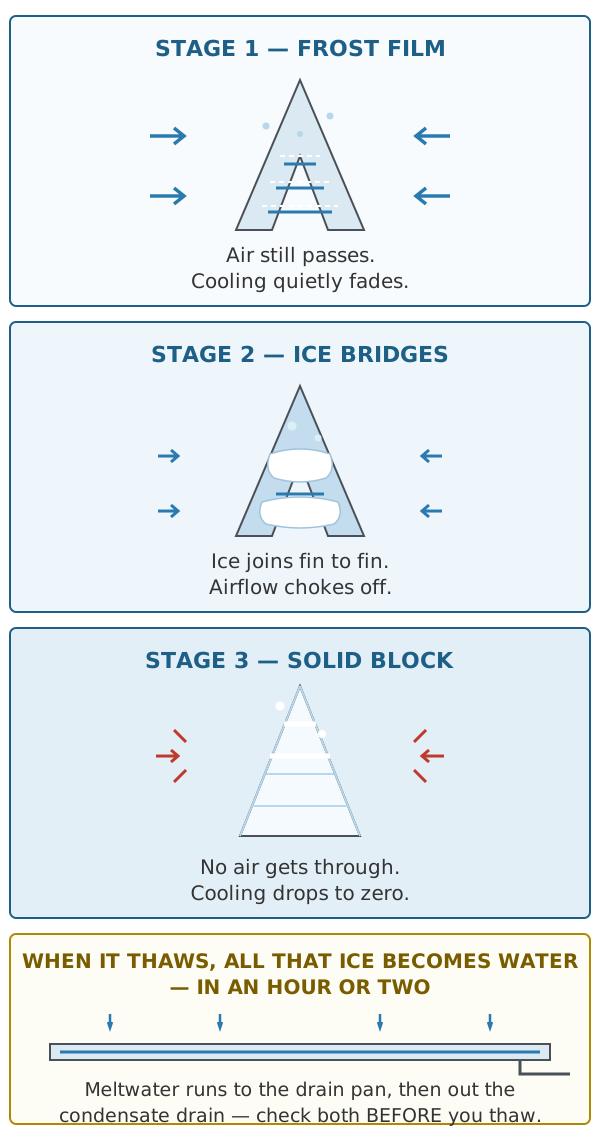
AC Frozen Up? Thaw It Fully, Then Prove Which of the Two Real Causes Did It
Ice on your AC coil means the system is starving for air or refrigerant. Thaw it fully first, then use the refreeze test in this guide to prove which cause you have before paying for a repair.
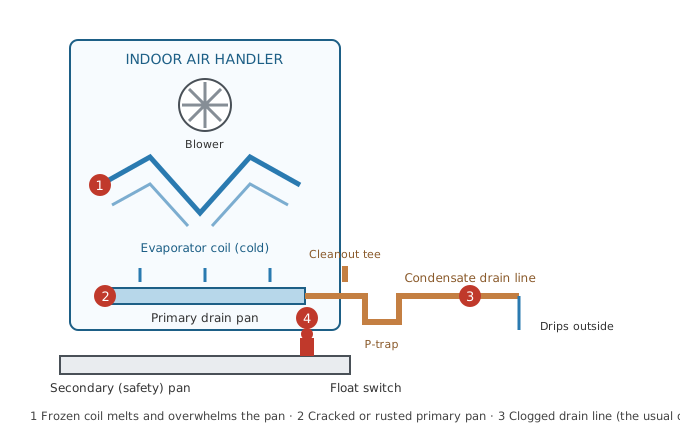
AC Leaking Water Inside: Find the Cause, Clear the Drain, Protect the Ceiling
Water pooling at the air handler or a stain spreading across the ceiling is usually a clogged condensate drain — a fix you can often do yourself with a wet/dry vac. Here is the order: stop the damage, trace the water path, clear the line, check the pans.
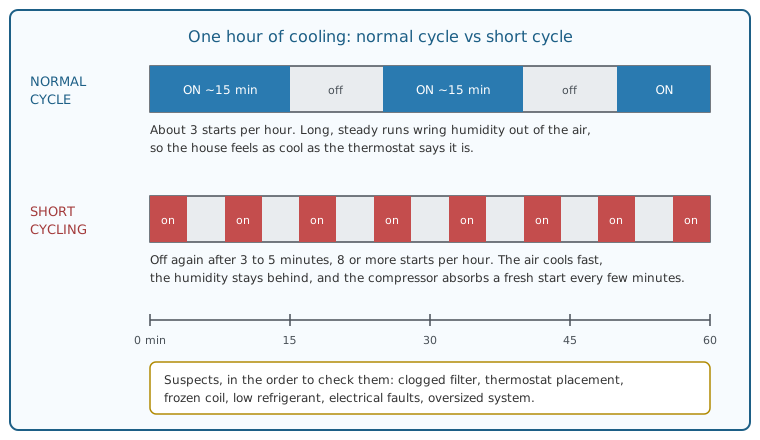
AC Short Cycling: Why Your AC Keeps Turning On and Off
Your AC starts, runs a few minutes, stops, and starts again — all day. Time it with a stopwatch, work through the causes in order, and learn which fixes are yours and which need a technician.