 Keep
Air in Your Water Lines: Why Faucets Sputter on a Well
 Daniel Mercer · Editor & Researcher·
Published November 16, 2026·
Updated November 16, 2026
It usually starts in the morning. You turn on the kitchen tap, half awake, and instead of water you get a cough — a spit, a hiss, a burst of air and spray that soaks the counter — and then, a few seconds later, perfectly normal water, as if nothing happened. By the time you've wiped up, the evidence is gone. Tomorrow it does it again.
If your house is on a private well, that morning sputter is one of the most common complaints there is — and one of the most useful, because a sputtering faucet is not a fault so much as a message. Air is getting into a system that should contain only water, and air can only enter in a handful of ways. When it happens, and which faucets do it, narrows the list down fast. The same cough can mean a $40 valve, a tired pressure tank, a well that is being asked for more than it can give, or gas dissolved in your groundwater that deserves a test. This guide works through each cause in the order you should check them, the tests you can run yourself with a glass of water and a tyre gauge, and what each fix actually costs when a professional does it.
One safety note before anything else, because it overrides all the diagnosis that follows: if the pump is running while the faucets are spitting air, turn the pump off at the breaker. A submersible pump is cooled by the water it moves. Pumping air, it overheats — and a burned-out pump turns a plumbing annoyance into the most expensive repair in this entire guide. Diagnose with the pump off if you have to. The water can wait an hour; the pump cannot un-burn itself.
The pattern is the diagnosis
Well systems are closed and pressurised, which makes them honest: air cannot appear from nowhere. It is either left over from the system being opened, sucked in through a leak, gulped by the pump when the water level falls to it, pushed in by a failing tank, or released from the water itself as dissolved gas. Five doors, and the timing of your sputter tells you which door is open.
When does it sputter?
- Once, right after plumbing work, a power cut, a new pump, or shocking the well — trapped air. The system was drained or opened, air got in, and it works its way out over a day or two of normal use. Harmless, and the only cause on this list that fixes itself.
- At the end of long water use — laundry plus showers, a sprinkler running for hours, filling a pool — the well is being drawn down. The pump is outrunning the aquifer, the water level in the well is falling toward the intake, and the sputter arrives when the level gets there.
- On the first draw after the water has sat — first thing in the morning, or after a day away — the water column is leaking back down the well between uses. A check valve, the drop pipe, or the pitless adapter is letting water escape, and air fills the space it leaves.
- Every time the pump starts, or constantly in short bursts — the same leak, further along, or a pressure tank whose air charge or bladder has failed, so the pump short-cycles and shoves air and pressure surges around the system.
- Constantly, at every tap, with water that looks milky or fizzy in a glass — dissolved gas. The water itself is carrying gas out of the ground, and it comes out of solution at your faucets.
Which faucets do it?
- All of them, hot and cold — the cause is at the well, the tank, or in the water itself. Systemic.
- Only the hot taps — look at the water heater, not the well. A failing anode rod or bacterial action in the tank can generate gas, and air expands out of hot water far more readily. That is a different article's problem, and a much cheaper one.
- One faucet only — the faucet. A faulty aerator or a local plumbing quirk. Unscrew the aerator, clean it, and you'll likely never think about it again.
Write the pattern down before you touch anything — when it sputters, which taps, what the house was doing just before. Two days of notes will save a well contractor an hour of guessing, and contractor hours are the expensive part of every fix in this guide.
Cause 1: Drawdown — the pumping level falls to the intake
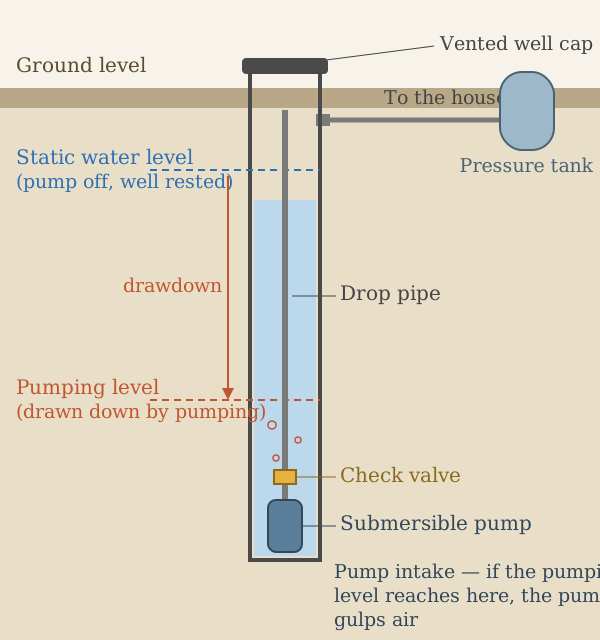
Every well has two water levels, and understanding them explains half of all sputtering. The static level is where the water sits inside the casing when the pump has been off and the well has rested — it's the level a driller measures and writes on your well record. The pumping level is where that surface falls to while the pump is running. The pump pulls water out of the well faster than the surrounding aquifer can flow back in, so a cone of lowered water forms around the well, and the level inside the casing drops. The gap between the two levels is the drawdown, and it is completely normal — every well does it. The question is only how far the level falls, and how close it gets to the pump.
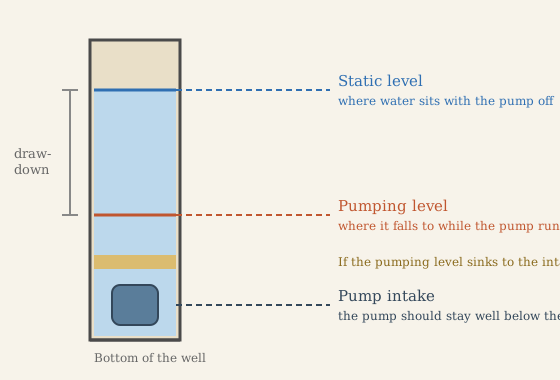
The submersible pump hangs in the well, typically set somewhere below the static level with room beneath it. As long as the pumping level stays comfortably above the pump's intake, the pump moves solid water and your faucets behave. But draw the well down far enough — a long shower on top of a laundry load on top of a sprinkler, a dry spell lowering the water table over weeks, a pump oversized for the well's yield, a screen slowly silting up and throttling the inflow — and the pumping level reaches the intake. The pump starts swallowing a mixture of air and water. That mixture is exactly what a sputtering faucet feels like: slugs of air arriving in bursts, pressure surging and falling, sometimes with a cough of sand or cloudy water alongside.
The signature of drawdown is that it is tied to volume, not rest. It appears at the end of heavy use, never at the start of the day, and it goes away after the well rests and the level recovers — an hour or two of no pumping and the system behaves perfectly again, which tempts owners to decide it fixed itself. It didn't; it just refilled. Other clues: the pump runs for unusually long stretches during the sputtering, pressure at the tap fades before the air starts, and the problem is worse in late summer or a drought, and worse every year as a marginal well ages.
Drawdown matters beyond the annoyance. A pump gulping air at the intake is a pump cavitating and running hot — vapour bubbles forming and collapsing against the impellers, the motor losing its water cooling. Occasional brief episodes during an exceptional day of water use are a stress the pump will survive. Daily drawdown is a countdown. The fixes depend on why the level falls so far, and they range from free (spread the laundry out, run the sprinkler on its own) to a pump-protection control that senses the load drop and rests the pump automatically, to lowering the pump deeper if the well has room below it — covered in the solutions section further down.
Cause 2: The column leaks back — check valve, drop pipe, pitless adapter
Between the pump at the bottom of your well and the pressure tank in your house stands a column of water inside the drop pipe, and that column is supposed to stay put when the pump stops. What holds it there is a check valve — a one-way valve, usually built into the pump's discharge or fitted just above it, sometimes with a second one further up the pipe. Water flows up through it; water cannot flow back down. That's the whole trick that lets your system hold pressure overnight.
Valves wear. A bit of grit wedges in the seat, the spring tires, the seal perishes — and the valve begins to leak, slowly. Now every time the pump stops, the column of water in the drop pipe drains back down into the well, a little or a lot depending on the size of the leak. The space it leaves behind fills with air. Next time the pump starts, before any water reaches your house, it has to push that entire slug of air up the pipe and through your plumbing. It comes out of the first faucet you open — as a sputter.
The same leak-back happens if the drop pipe itself is damaged. The pipe hangs in the well carrying the weight of the pump and a full column of water, flexing slightly at every start and stop for years. A coupling cracks, a pinhole opens above the water line, a section chafes through. Water escapes back into the well through the hole instead of rising to the house, and when the pump stops, the pipe above the hole drains and fills with air. A third member of this family is the pitless adapter — the fitting where the drop pipe turns sideways and exits through the casing wall underground on its way to the house. Its O-ring seal can fail, leaking water (and admitting air) at the top of the well.
The signature is rest, not volume: the first draw after the house has sat quiet — the morning tap is the classic — spits air, then runs clean, and stays clean until the next long pause. Supporting clues: the pump runs a little longer than it used to when it starts (it's refilling the pipe before it can build pressure); the pressure gauge, if you watch it with no water running, creeps slowly down over an hour or two; and in advanced cases the pump clicks on briefly at random times with nobody using water, because the leak-back has dropped the system pressure to the cut-in point. That last sign — a pump that starts for no reason — is the one to take most seriously, because a pump cycling against a leak all day is wearing itself out and running up your electric bill to do it.
On a shallow-well jet pump system, the same family appears in mirror image. The pump sits in the house and sucks water up a suction line, with a foot valve at the bottom holding prime. Any leak on that suction side — a cracked fitting, a tired foot valve — lets the pump pull air in directly under vacuum, and a jet pump that has lost prime sputters constantly rather than just in the morning. If your pump is in the basement and the sputtering never really stops, a suction-side leak is the first place a contractor will look.
Cause 3: The pressure tank — waterlogged, bladder failed, or air charge wrong
The pressure tank beside your well equipment is not a storage tank in the way most people picture. Inside a modern tank, a rubber bladder separates water (below) from a cushion of compressed air (above). The pump fills the tank and squeezes that air cushion; when you open a tap, the cushion pushes water out, so the pump doesn't have to start for every glass of water. The air charge is set with the system drained — it should read about 2 PSI below the pump's cut-in pressure, so 38 PSI on a 40/60 switch.
When the bladder tears or the air charge leaks away through the Schrader valve on top, the tank goes waterlogged: it fills almost entirely with water, the cushion vanishes, and the pump has to start the instant any water is drawn and stop the instant it isn't — on, off, on, off, sometimes several times a minute. That rapid cycling, called short cycling, slams pressure surges through the pipes, and those surges can push air pockets around the system and out of your faucets in bursts. The sputtering from a dying tank usually arrives with other evidence: the pump clicking on and off constantly, pressure at the shower pulsing, and a tank that sounds solid and heavy — thud, not ring — when you knock on its side.
Older galvanised tanks have no bladder at all. They rely on an air volume control (AVC) to maintain the cushion, and they err in both directions: too little air and the tank waterlogs; too much and the tank starts adding air to the water — those systems deliberately dissolve a little air, and a faulty AVC can overdo it until the faucets spit on every draw. If your tank is a plain steel cylinder with a small device and a thin tube on its side, that's the setup you have, and sputtering plus an AVC fault is a well-known pairing.
The tank is also the one cause on this list you can genuinely test and sometimes fix yourself in twenty minutes, with a tyre gauge and a drain valve — the test sequence further down walks through it. A tank whose bladder has failed can't be repaired; the air charge will not hold. Replacement is a half-day job for a contractor and lands at $350–$1,100 fitted depending on size.
Cause 4: Dissolved gas — the air was in the water all along
The last door is different from the others: nothing is broken, and nothing is leaking. Groundwater sits underground under pressure, in contact with gases produced by the geology around it — decaying organic matter, shale and coal seams, deep rock. Under that pressure, gases dissolve into the water invisibly, exactly the way carbon dioxide dissolves into a sealed bottle of soda. Methane, carbon dioxide, nitrogen, hydrogen sulfide — the water can carry a surprising load of them and look perfectly clear in the well.
Then you open a faucet. The pressure drops to atmospheric, the water can't hold its gas any more, and the gas comes out of solution as a cloud of micro-bubbles. In a glass, the water looks milky or fizzy — and the giveaway is that it clears from the bottom up over a minute or two as the bubbles rise and escape. (Sediment does the reverse: it settles, clearing from the top down.) At the tap, enough gas means sputtering and spitting at every faucet, hot and cold, all day, unrelated to rest or heavy use — because every gallon arrives pre-loaded.
How much this matters depends entirely on which gas it is, which is the subject of the next section. Carbon dioxide mostly fizzes and can make water slightly acidic over time. Nitrogen is inert and merely theatrical. Hydrogen sulfide announces itself unmistakably — the rotten-egg smell — and has its own guide on this site. Methane is the one that changes the conversation from plumbing to safety, not because it's toxic, but because of what it does after it leaves the water.
Methane and dissolved gas, done properly
Methane deserves its own section because it is the one cause in this guide where the wrong shrug can hurt someone — and also the one where panic is usually unnecessary. Both facts come from the same chemistry.
Where it comes from. Methane in well water is natural in many regions. It forms where organic matter decays without oxygen — in glacial sediments, shale, coal seams, buried peat — and it can also migrate from deeper gas-bearing rock, including around natural gas development. The Minnesota Department of Health notes that only a small share of wells contain methane at all (in Minnesota, likely under 1 percent, mostly wells in glacial sediments), but in gas country — parts of Pennsylvania, Ohio, West Virginia, New York — it is far more familiar. Your well doesn't have to be near a gas well to have it; the geology decides.
The hazard is in the air, not the glass. No study has linked drinking water containing methane to health effects, and no regulator sets a drinking-water limit for it — methane is not toxic. The danger begins when it leaves the water. Methane is lighter than air and rises; released into a confined, poorly ventilated space — a well pit, a basement, a small pump house, a water heater closet — it can accumulate. In air, methane ignites at concentrations between roughly 5 and 14–15 percent, and state health guidance warns that water containing as little as 1 mg/L of methane can build explosive levels if the gas is allowed to collect in a confined space. It can also displace oxygen: if the oxygen in a space falls low enough, a person walking in can lose consciousness without warning. This is why wells located in basements and well pits get special attention — the gas escapes from the water directly into the house's air.
The working thresholds. Guidance used by most state agencies, drawn from US Office of Surface Mining recommendations, is tiered by the concentration dissolved in the water:
- Below 10 mg/L — low concern. Monitor; make sure the well cap is vented and enclosed spaces around the wellhead are ventilated.
- 10–28 mg/L — act: vent the well casing to the outdoors, ventilate any enclosed space the water system passes through, and plan on aeration treatment.
- Above 28 mg/L — treat as immediately hazardous. Remedial action now: venting, aeration, possibly taking the well out of service until it's controlled.
How it is tested. Not with a home kit, and not from a sample you mail in a jam jar — methane escapes from water fast, and a badly taken sample reads low and reassures you wrongly. Accredited laboratories test for dissolved methane with a specialised collection: the sample bottle is often filled inverted, underwater, with no air bubble and no aeration, or collected by the lab's own staff at your home. Some labs use portable detectors to measure methane in the air of the wellhead space as well. If your sputtering comes with a gurgling or hissing wellhead and fizzy water at every tap, ask a certified lab for a dissolved methane test and tell them why — they'll handle the sampling protocol. While you're at it, follow the health departments' standing advice for gas-bearing wells: test for coliform bacteria and nitrate too, since the same geology and well conditions that admit gas can admit surface contamination.
The fix is venting and aeration, not filtering. Methane will not be removed by a sediment filter, a softener, or a carbon filter — it passes straight through all three. What works:
- A vented well cap. The simplest step, and required on new wells in many states: the cap vents the top of the casing so gas collecting there escapes outdoors instead of building up. Handles the wellhead side of the problem and suits low levels.
- Aeration. The standard treatment: the water is sprayed or cascaded through a vented tank so the gas escapes into air above the water, which is then vented outside the building. Aeration strips methane and, as a bonus, hydrogen sulfide and carbon dioxide too. Because aerated water leaves at atmospheric pressure, the system includes a small repressurisation pump to feed the house. Fitted cost: roughly $900–$2,800.
- A gas shroud or vented storage in higher-flow or unusual setups, designed by the contractor for the measured level.
Safety habits while you wait for a test result: keep the well pit or pump room ventilated, don't store the water system in a sealed closet, and if you ever smell gas strongly in a basement with a well in it — leave, and call the fire department or gas utility from outside. (Methane itself is odourless; a strong gas smell means something else is present too, and either way the response is the same.)
The solution: your test sequence, in order
Work through these in order — cheapest and most informative first. Together they separate all five causes, and you'll hand the contractor a diagnosis instead of a mystery.
Step 1 — Log the pattern (two days, free). Note when the sputtering happens: first draw of the day? End of heavy use? Every pump start? Constant? Which taps — all, hot only, one? What was the house doing just before? This single step usually names the family of causes before you touch a tool.
Step 2 — The glass test (two minutes, free). Fill a clear glass from the tap that's sputtering and watch it. Milky water that clears bottom-up within a couple of minutes = dissolved gas. Cloudiness that settles and clears top-down = sediment. Clear water with big intermittent burps = mechanical air — leaks or drawdown. If it's gas, skip to the methane section above and book a lab test.
Step 3 — The recovery test (one evening, free). If sputtering arrives at the end of heavy use, suspect drawdown. Rest the well completely for two to three hours — no laundry, no long showers — then run a tap hard for ten minutes. Smooth water that sputters again only after sustained use confirms a level problem: the well recovers at rest and falls under load. If instead it sputters on the first draw after the rest, the column is leaking back — Step 4 and 5 territory.
Step 4 — Watch the pressure gauge (fifteen minutes, free). Find the gauge near the pressure tank. With the pump off and nobody using water, note the reading and check it every fifteen minutes for an hour. Steady = the pressure side is holding. Creeping down = water is escaping somewhere — back down the well through the check valve or drop pipe, or out through a plumbing leak. Also watch a full cycle: pump cuts in around 40 PSI and out around 60 on a typical 40/60 switch. A pump that clicks on and off every few seconds is short-cycling — the tank, Step 5.
Step 5 — The tank test (twenty minutes, a tyre gauge). Kill the pump at the breaker. Open a tap and drain the system until the water stops. Now check the air pressure at the Schrader valve on top of the tank. It should read about 2 PSI below cut-in — 38 PSI for a 40/60 system. Reads near zero, or water spurts out of the valve = the bladder has failed and the tank is done. Rock the tank gently: a healthy tank is top-light; a waterlogged one is heavy all the way up. Knock down the side: ring at the top, thud at the bottom is normal; solid thud throughout is waterlogged. If the charge is merely low and no water comes from the valve, a pro (or a careful owner with a compressor) can recharge it — but a tank that loses its charge repeatedly has a leak and is on its way out.
Step 6 — Look at the wellhead (five minutes, free). Walk out to the well. Cap secure and vented? Any hissing or gurgling when the pump runs — gas, or air being drawn in? Wet ground or a sunken patch around the casing can mark a pitless adapter or underground line leaking. You won't fix anything here; you're gathering evidence and checking the one safety item — the vented cap.
With those six steps done, you know which family you're in. Everything after this point is a pro with a hoist, because every remaining fix lives down the well.
What the professional does — and how long it takes
Pulling the pump (the gateway to most fixes). For a check valve, drop pipe, or pump-depth problem, the contractor sets up a hoist or pulling machine over the well, disconnects the pitless adapter, and hauls the pump, pipe and cable up out of the casing, laying the pipe out across the yard as it comes. On a typical residential well this takes one to two hours up and the same back down; very deep wells take longer. It's also the moment of truth for diagnosis: the pipe is inspected along its whole length for cracks, chafed spots and bad couplings, and the check valve is tested directly rather than inferred.
Check valve replacement — about half a day, $350–$800. The valve itself is a $20–$60 part. You're paying for the pull. Most contractors replace the valve at the pump and inspect any inline valves while the string is out; if the pipe shows wear, replacing suspect sections now is far cheaper than pulling the pump again next year.
Drop pipe repair — half a day to a day, $500–$1,500. A cracked section is cut out and replaced, or the entire run is renewed if it's aged throughout. Price scales with depth — more pipe, more time — and with material. While it's out, a torque arrestor and cable guards (cheap parts that protect the new pipe) are worth the small extra.
Lowering the pump — half a day, $600–$1,800. The answer when drawdown is the problem and the well has depth to spare: the pump goes back in lower, with added drop pipe and cable, so its intake sits further below the pumping level. Two honest limits: the pump must stay off the bottom (in the sediment zone it will eat grit), and if the pump is already near the bottom, there is nowhere to lower it to — then the answers are managing water use, a pump-protection control that rests the pump when the level falls, or a conversation with a driller about the well's yield.
Pressure tank replacement — two to three hours, $350–$1,100. The only fix on this list that doesn't involve the well at all. The old tank is drained, swapped, the new one charged to 2 PSI below cut-in, and the system repressurised and checked for cycling. Size is the decision: a bigger tank means longer, healthier pump cycles, and if short cycling killed the old setup, upsizing now is money well spent.
Methane testing and aeration — test first, then a day's install, $900–$2,800. The lab result sets the design: vented cap alone at low levels, a spray aeration tank with a vent run outdoors and a repressurising pump at higher ones. Any contractor quoting aeration without a methane number in hand is guessing; get the test first.
What the fixes cost — and why the diagnosis is the cheap part
Line the five causes up against their bills and a pattern emerges: the parts are nearly free, and the labour of reaching them is the cost.
The five jobs, side by side:
- Check valve replacement — $350–$800. You're paying for pulling and resetting the pump; the valve itself is a $20–$60 part.
- Drop pipe repair or replacement — $500–$1,500. The pull, plus pipe by the foot at your well's depth.
- Lowering the pump — $600–$1,800. The pull, plus the added pipe and cable to set the pump deeper.
- Pressure tank replacement — $350–$1,100. The tank itself and two to three hours of plumbing; the only job here that never touches the well.
- Vented aeration system — $900–$2,800. The aerator tank, a repressurising pump and the outdoor vent run.
Three things follow from those figures. First, bundle work whenever the pump comes out of the well. If a contractor is pulling your pump for a check valve and the drop pipe is twenty years old, replacing the pipe on the same pull costs the pipe and a little time — versus a second $500-plus pull when it fails on its own. Ask, every time the string comes up: "What else down there is near the end of its life?"
Second, depth is destiny. The same repair on a 400-foot well costs meaningfully more than on a 120-foot well, in pipe, cable and hoist time. Quotes that seem high often just describe a deep well; quotes that seem low sometimes describe a contractor who hasn't asked how deep yours is. A contractor who quotes without asking about your well's depth and pump setting isn't quoting your job.
Third, the diagnostic visit is the best money in the whole problem. The pattern log from Step 1 of the test sequence, plus an hour of a contractor's pressure and cycling checks, converts a $1,500 guess into a $400 certainty. Every horror story in this category starts with parts being replaced in the wrong order — a new tank for a leaking check valve, a new pump for a waterlogged tank.
What not to do
Don't just keep bleeding the lines. Purging air from the faucets works — for a day. If the air is back tomorrow, something is feeding it in, and purging is the plumbing equivalent of mopping a floor under a running tap. Worse, it can hide the timeline: a check valve leak that sputters in March can be a pump-killing short-cycle by July, and months of cheerful purging erase your sense of how fast it's progressing.
Don't run the pump dry to "see if it clears." It won't, and every minute a submersible runs in air is a minute of overheating. If faucets are spitting and the pump is running, the breaker is your friend.
Don't ignore a pump that starts by itself. Random no-reason starts mean the system is losing pressure — water going somewhere it shouldn't. That symptom never stays small, and it inflates your electric bill the whole time it's growing.
Don't seal a gassy well. With dissolved methane, the instinct to cap everything tight is exactly backwards. Gas needs a way out that isn't your living space: vented cap, vented aerator, ventilation in the pump room. And don't try to filter methane out — no cartridge filter touches it; anyone selling you one for gas removal is selling you a placebo.
Don't flame-test a sputtering tap. The old party trick of holding a lighter to fizzy water to "check for gas" puts an ignition source at exactly the point where gas is leaving the water. The lab test exists; use it.
Just moved in? The benign version of this problem
If you've recently bought a house on a well — especially one that sat empty for weeks or months before the sale — expect some sputtering at first, and don't let it frighten you out of proportion. A well and plumbing system that sit unused collect air: the pressure tank's charge settles, small pockets gather at high points in the lines, the drop pipe may partly drain if the system was winterised or the power was off. The first days of normal use push that air out, tap by tap, in no particular order. It can take most of a week of showers and laundry cycles before the last high faucet in the house stops coughing.
The benign version has a clear shape: it is worst on day one and steadily better, it never comes with a pump running at odd hours, the pressure gauge holds steady overnight, and by the end of the first week or two it's gone. What is not benign: sputtering that's the same or worse in week three, sputtering that follows the morning/heavy-use patterns described earlier, fizzy-milky water that never clears up (that's gas, and a home inspection almost never tests for methane — worth a lab test of your own in gas country), or any pump behaviour that seems new. A house that sat empty can also hide the early stages of every real cause in this guide, because nobody was there to notice the pattern starting. Give it the two weeks; then run the test sequence.
Urgency, summarised
Today: the pump running while faucets spit air (breaker off, then diagnose); signs of methane — fizzy water at every tap plus a hissing or gurgling wellhead — combined with a well pit or basement well (ventilate, test, keep ignition sources away); a pump starting on its own several times a day; sputtering that has progressed to no water at all.
This week: a consistent morning sputter (leak-back — the fix is known and the pump is being worn meanwhile); short cycling at any level; drawdown sputtering that's happening on ordinary water use rather than exceptional days.
Watch it: a one-off burst after work on the system; sputtering in a house you've just moved into, improving day by day; an occasional cough at the very end of your single heaviest water day of the month — log it, and revisit if the pattern tightens.
Air in the lines is your well talking in one of the few languages it has. The sputter itself is cheap information. It's only expensive if you don't listen to what it's saying — because nearly every cause in this guide is a small repair now and a pump replacement later.
Cost at a glance
| Item | Typical cost | Notes |
|---|---|---|
| Check valve replacement | $350–$800 | The valve itself is a $20–$60 part; nearly all of the bill is pulling the pump to reach it |
| Drop pipe repair or replacement | $500–$1,500 | Pull the pump, replace the cracked section or the full run; deeper wells cost more in pipe and time |
| Lowering the pump in the well | $600–$1,800 | For drawdown problems; includes added drop pipe and cable. Not possible if the pump is already near the bottom |
| Pressure tank replacement | $350–$1,100 | Fitted, depending on tank size. A failed bladder cannot be repaired — the tank is replaced whole |
| Vented aeration system (for methane / dissolved gas) | $900–$2,800 | Fitted and vented outdoors. A simple vented well cap runs $75–$250 fitted and handles low gas levels |
Frequently asked questions
Why does my faucet sputter first thing in the morning, then run fine?
That timing is the signature of the water column leaking back down the well overnight. A check valve that no longer seals, a pinhole in the drop pipe, or a leaking pitless adapter lets the water in the pipe drain slowly back into the well while the house is quiet, and air takes its place. The first draw of the day pushes that slug of air out of the faucets; once the pipe is full of water again, everything runs normally until the next long rest. The fix is in the well — usually a new check valve or a drop pipe repair — not at the faucet.
Is air in my well water dangerous?
Ordinary air, no. Air that enters through a leak or gets gulped by the pump is harmless to drink and harmless to you — the risk is to the pump, not the person. The exception is dissolved gas. If the 'air' is actually methane coming out of the groundwater, the water is still not poisonous, but methane released into a confined space — a well pit, a basement, a small utility room — can reach explosive concentrations and can displace oxygen. Fizzy or milky water at every tap, constantly, is the pattern that needs a methane test rather than a shrug.
Why does my well water look milky, then clear from the bottom up?
That is dissolved gas, not dirt. Under pressure in the well and the pipes, gases like carbon dioxide, methane and nitrogen stay dissolved in the water, the way carbonation stays in a sealed soda bottle. At the faucet the pressure drops, the gas comes out as millions of tiny bubbles, and the glass looks milky. The bubbles rise, so the water clears from the bottom up over a minute or two. Sediment does the opposite — it settles and clears from the top down. The glass test is the quickest way to tell gas from grit.
Can air in the lines damage my well pump?
Yes, and this is the part worth acting on quickly. A submersible pump is cooled and lubricated by the water moving through it. When it gulps air — because the water level has dropped to its intake, or because it is refilling an empty drop pipe on every start — it runs hot, cavitates (vapour bubbles collapsing against the impellers), and wears far faster than it should. A pump that occasionally catches air at the end of a huge laundry day is being stressed; a pump that does it daily is being killed. If the pump is running while faucets spit air, turn it off at the breaker until you know why.
How do I get the air out of my water lines?
For one-off trapped air — after plumbing work, a power outage or a pump change — start at the faucet closest to the pressure tank and open it fully, then work through the house one faucet at a time, cold then hot, letting each run until the sputtering stops. That pushes the air out in an orderly way instead of scattering it. But purging only treats the symptom. If the sputtering is back the next morning or at the end of the next long shower, air is entering somewhere, and the job is to find the entry point, not to keep bleeding the lines.
Why does the sputtering only start after long showers or laundry?
Because the well is being drawn down. While the pump runs, it pulls water out of the well faster than the aquifer flows back in, so the water level inside the casing falls — sometimes a little, sometimes a lot. At the end of a long draw, the level reaches the pump's intake and the pump starts swallowing a mix of air and water. Give the well an hour's rest and the level recovers, which is why the problem seems to fix itself. The answers are to spread out water use, lower the pump if there is room below it, fit a pump-protection control that rests the pump, or — in a well whose yield has genuinely declined — talk to a driller about the well itself.
How much does it cost to fix a sputtering well?
It depends entirely on which cause you have, which is why the pattern matters. A pressure tank problem is a $350–$1,100 replacement. A failed check valve is a cheap part on an expensive job — $350–$800 — because the pump has to be pulled to reach it. A cracked drop pipe runs $500–$1,500. Lowering the pump to beat drawdown is $600–$1,800. Dissolved gas is handled with a vented cap ($75–$250) at low levels or a fitted aeration system ($900–$2,800) at higher ones. Diagnosis by a well contractor is usually folded into the repair quote.
Checked November 16, 2026. This guide is general information, not a substitute for a licensed professional.
Related guides
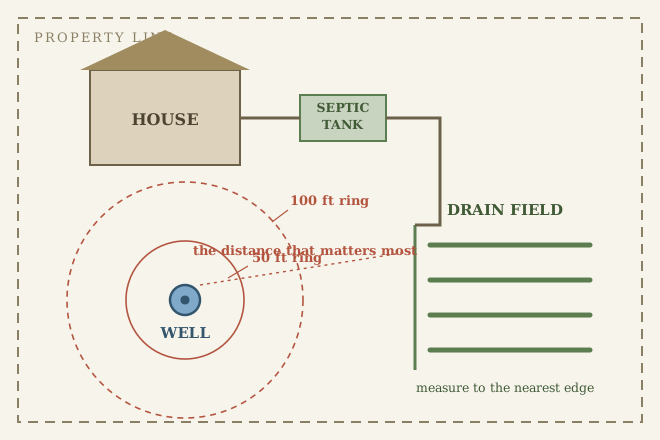
How Far Should a Well Be From a Septic Tank? Setbacks, Explained
Most states want 50 feet between a well and a septic tank and 100 feet to the drain field — but the field is the distance that actually protects your water. How to measure yours, and what to do if it comes up short.
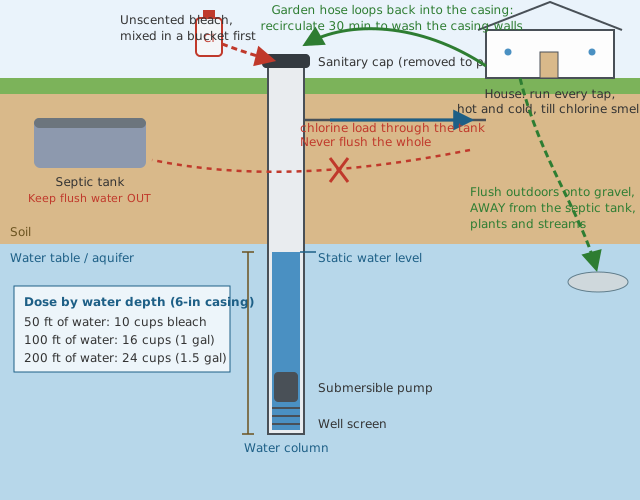
How to Shock Chlorinate a Well: Dose, Steps, and the Retest That Proves It Worked
The full shock chlorination procedure: work out your bleach dose from the well log, bypass the softener, recirculate, hold, flush without wrecking your septic, and retest at 10 to 14 days.
How to Test Your Well Water: What to Test, How Often, and What It Costs
Private wells aren't monitored by anyone but you. The EPA's annual four tests, the one-time baseline panel, how to take a proper sample, what results mean, and what testing costs.