 Keep
AC Short Cycling: Why Your AC Keeps Turning On and Off
 Daniel Mercer · Editor & Researcher·
Published November 16, 2026·
Updated November 16, 2026
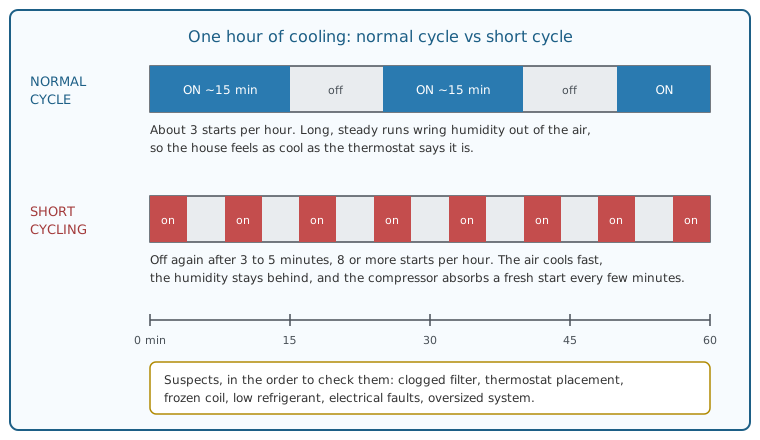
You notice it first by ear. The outdoor unit kicks on with its familiar thump and hum. You go back to what you were doing. A few minutes later, silence — and then, just as you've registered the silence, the thump and hum again. On, off. On, off. All afternoon. Meanwhile the house never quite gets there: the thermostat says the temperature is close to what you set, yet the air feels heavy and the rooms never settle into that dry, finished coolness a good system delivers.
That pattern has a name, short cycling, and it's one of the most useful symptoms in all of home cooling, because it is so measurable. You don't need gauges or training to confirm it. You need a phone stopwatch and half an hour. And once you've confirmed it, the list of things that cause it is short, ordered, and mostly checkable by the person who lives in the house — which, if you've recently bought the place, may be the first time anyone has actually paid attention to how this system behaves.
This guide works the way a good technician does: measure the pattern first, then walk the causes from the free and common to the expensive and rare, stopping at the exact point where the job stops being yours.
What a normal cycle actually looks like
An air conditioner is not meant to run in sprints. On a hot day, a correctly sized central system typically runs 10 to 20 minutes at a time, switches off for a while, and runs again — about two or three starts an hour. On the most brutal afternoon of the year it may run almost continuously for hours, and that's not a fault; that's the system at full stretch, exactly as designed. In mild weather, runs get shorter and rests get longer.
There are two reasons long runs are the goal, and both matter to you:
- Humidity removal takes time. For the first few minutes of a run, the indoor coil is still cooling down. Only once the coil is fully cold does moisture from the house air condense on it in real quantity and run down the drain. A system that quits at minute four has done the easy part (dropping air temperature, which is all the thermostat measures) and skipped the part that makes a house feel dry and comfortable.
- Starts are the wear. A compressor motor draws several times its normal running current in the instant of starting, and starting is when its lubrication is thinnest. A system starting three times an hour lives a very different life from one starting nine times an hour, even if their total run time is identical.
Short cycling is usually defined as cycles under about 10 minutes, and the severe cases are obvious: 3 to 7 minutes on, a few minutes off, repeated for hours. The temperature in the house hovers near the setting but the air stays clammy, the electric bill is suspiciously large for the comfort delivered, and the outdoor unit becomes the loudest appliance you own simply because you hear it start so often.
The stopwatch test: time it before you touch anything
Every guide lists the causes of short cycling. Almost none tells you to measure first — and the measurement is what turns a vague worry into a diagnosis you can hand to a technician, or use to fix the problem yourself. Do this before changing a single part.
- Pick a warm afternoon when the system is working steadily, not the first mild morning of the season.
- Set the thermostat to your normal cooling temperature and leave it there. Don't touch it during the test; you're observing, not helping.
- Open the stopwatch on your phone and stand where you can hear the outdoor unit, or watch the thermostat's cooling indicator.
- Log three numbers for 30 minutes: the time each run starts, the time it stops, and the time the next run starts. A scrap of paper with a column of times is fine.
- Read the pattern. Runs of 10 minutes or more with rests between them: normal, and your comfort problem lies elsewhere (humidity, ductwork, insulation). Runs consistently under 7 minutes, or more than about 5 starts in the half hour: confirmed short cycling. Runs of wildly varying length — 12 minutes, then 2, then 9 — point more toward a thermostat or control problem than a steady mechanical one.
Two more observations cost nothing and narrow the list further. First, check the air coming out of a supply vent during a run with the back of your hand, and note whether it feels properly cold or merely cool. Second, glance at the thicker of the two copper lines running into the outdoor unit: it should be cold and sweating on a hot day. If it's frosted white, or warm, write that down. A technician will ask about all three things — run length, vent air, line condition — and arriving with answers moves you to the front of the diagnosis.
If you have a smart thermostat, you also own a shortcut: most of them keep a runtime history in their app, showing how many hours the system ran each day and, on many models, a graph of individual cycles. A day's graph covered in thin spikes is short cycling drawn as a picture, and it lets you check weeks of behaviour in a minute instead of babysitting a stopwatch. It also gives you a before-and-after record when you change a filter or a setting — proof, not impressions, that the fix worked.
The causes, in the order to check them
The order below is deliberate: free before cheap, common before rare, and nothing that requires opening the outdoor unit's electrical compartment until the simple causes are cleared.
1. A clogged filter or strangled airflow
The indoor coil needs a strong, steady flow of warm house air across it to do its work. Choke that flow and the coil's temperature plunges below freezing, frost starts to build on it, and the system begins shutting itself down on a safety limit — or struggles in short, ineffective bursts. The usual choke points are a filter that has gone grey and matted (in a house you've just bought, assume the filter is older than anyone admits), too many supply vents closed in unused rooms, furniture parked over returns, and a return grille furred with dust.
This cause is first on the list because it's free to check and behind a remarkable share of cycling complaints. Hold the filter up to a light: if you can't see light through it, it was due weeks ago.
2. The thermostat: bad spot, bad settings, or dying
The thermostat is the system's only witness, and it can only report the temperature where it sits. If it sits in direct afternoon sun, on a wall that backs onto a hot attic or a kitchen range, or directly in the blast path of a supply vent, it will satisfy itself in minutes while the rest of the house is still warm — the system isn't malfunctioning, it's obeying a liar.
Settings matter too. Many thermostats have a cycle-rate or swing setting: how far the temperature may drift before the system restarts, and how many cycles per hour are allowed. Set too tight, the stat itself commands short, frequent runs. And plain failing hardware — a dying sensor, a loose wire at the wall plate — can drop the cooling call erratically, producing the irregular pattern the stopwatch test reveals.
3. A frozen indoor coil
Ice on the evaporator coil is both a cause and a messenger. Once frost coats the coil, air can barely pass, cooling collapses, pressures fall, and the system starts tripping its limits and cycling in short bursts. The visible signs: weak airflow from the vents, a hissing or bubbling sound some owners report, water around the indoor unit after a thaw, and frost or ice on the insulated copper line outside.
A coil freezes for only two underlying reasons: not enough air across it (cause 1, above) or not enough refrigerant in it (cause 4, below). Thawing it treats the symptom; the diagnosis isn't finished until you know which of the two froze it.
4. Low refrigerant, which means a leak
Refrigerant is not fuel. It circulates in a sealed loop and is never consumed, so a system that's low has a leak, full stop. As the charge falls, pressures drop, the coil runs too cold and may freeze, capacity falls off, and the controls begin cutting the compressor out on its low-pressure safety — producing short, feeble cycles that get shorter over weeks.
The timeline is the tell: airflow and thermostat problems usually appear suddenly or have always been there, while a leak announces itself as a slow decline — cycles shortening and cooling weakening over a month or two. Refrigerant work is legally restricted to EPA Section 608 certified technicians, and for good practical reasons beyond the law: topping up a leaking system without repairing the leak just schedules the same bill again.
5. Electrical faults: capacitor, contactor, and controls
Inside the outdoor unit's electrical compartment sit the parts that start and switch the compressor. A capacitor that's weakening can let the compressor start, run briefly, and drop out, or fail to keep it running under load. A contactor with pitted, burnt contacts can chatter or cut power intermittently. Either can produce cycling that looks mechanical but is really electrical — and both parts are inexpensive, though the work is not a DIY job: a capacitor can hold a dangerous charge even with the power disconnected.
A different electrical suspect sits indoors: the condensate float switch. If your air handler's drain backs up, this small safety device kills the system to prevent a ceiling full of water. A drain that's partially blocked can fill, trip the switch, drain slowly down, reset, and fill again — cycling the system off and on in a pattern that perfectly imitates an electrical fault. If your cycles are irregular and there's any sign of water near the indoor unit, this little switch deserves suspicion.
6. The system is simply too big for the house
The last cause is the one nobody wants to hear, and in a recently bought house it's more common than it should be. An oversized air conditioner has so much capacity that it blasts the thermostat to its setting in a few minutes and shuts off — then the temperature creeps back, and it blasts again. It short cycles not because anything is broken, but because it's doing its oversized job too fast. It has usually done it since the day it was installed, often because someone sized it by a square-footage rule of thumb, or replaced a 3-ton unit with a 4-ton "upgrade" as a favour.
The fingerprints: the cycling has always been there, in all weather; the house is cool but clammy; the equipment is noticeably large for the house's size and age; and every mechanical check comes back clean. The final part of this guide covers what to do with this verdict.
A note if your system is two-stage or variable-speed
Newer equipment complicates the stopwatch test, in a good way. Two-stage systems run much of the time on a low stage — longer, quieter, gentler cycles are the entire point — and variable-speed (inverter) systems may run almost continuously at very low output, ramping up and down rather than switching fully off. Neither pattern is short cycling, and neither should be "fixed." What still counts as a fault on these systems is the hard pattern: full stops every few minutes followed by full-power restarts, repeated for hours. If your runtime graph shows long low plateaus, your system is doing its job; if it shows a picket fence of short spikes, the causes above apply to you exactly as written.
The fix sequence: what to do, in order
Run these in order, and re-time the system after each step. Short cycling with several contributing causes is common — a tired filter plus a badly sited thermostat, say — and fixing them one at a time tells you which ones were actually guilty.
Step 1: Replace the filter and open the house up
Fit a fresh filter of the size and type the air handler specifies (the old one has its dimensions printed on the frame). Then walk the house: open every supply vent, including the ones in spare rooms — closing vents does not save money on a residential system, it raises duct pressure and starves the coil — and make sure returns aren't blocked by furniture, rugs or storage boxes. Run the system for an hour and re-time it. A surprising number of short-cycling stories end here.
Step 2: Interrogate the thermostat
Stand at the thermostat at the moment the system shuts off and ask what it knows. Is it in sunlight at that hour? Is a supply vent blowing across it? Does the room it's in feel cooler than the bedrooms? If the location is hopeless, you have two practical fixes: relocate the thermostat (a technician job involving low-voltage wiring, typically a few hundred dollars), or replace it with a model that uses remote room sensors and averages them, or simply reads the sensor in the room you care about — often the cheaper and better answer, with no new wiring.
While you're there, check the settings. If your thermostat offers a cycle-rate or swing adjustment, the factory default is right for most systems; if a previous owner set it to the tightest option, widening the swing slightly lengthens cycles at the cost of a degree or so of temperature drift. And if the pattern from your stopwatch test was erratic rather than steady, mention a possible failing thermostat or loose connection when you call — it changes what the technician brings.
Step 3: If there's ice, thaw it properly
Found frost on the line or ice at the coil? Switch the thermostat from Cool to Off, and set the fan from Auto to On. The fan melts the coil with house air; expect the thaw to take 2 to 4 hours, longer for a solid block. Put a towel down and check the drain pan and the area around the air handler as it melts — a thaw produces a lot of water at once, and a blocked drain will announce itself now rather than during the next cycle. Do not chip at the ice, and do not restart cooling "to test it" while ice remains; running a frozen system can send liquid refrigerant back to the compressor, which is how a nuisance becomes a replacement.
Once thawed, with a new filter in place, restart and re-time. If the system now cycles normally, airflow was the culprit and you're done. If it freezes again within a day or two with clean airflow, the cause is refrigerant, and the next step is a phone call, not another thaw.
Step 4: Rinse the outdoor coil and clear its air
Outside, the condenser needs to breathe too. With the power off at the disconnect, clear anything within about two feet of the unit — shrubs, fencing, stored items — and if the coil fins are visibly matted with cottonwood, dust or grass, rinse them gently from the inside out with a garden hose on a soft spray. Never a pressure washer; the fins fold if you look at them wrong, and folded fins are worse than dirty ones. This step more often fixes overheating shutdowns on hot afternoons than true short cycling, but it costs twenty minutes and rules out a contributing cause.
Step 5: Check the condensate drain
Find where the air handler's drain line exits — usually a small PVC pipe near the outdoor unit or a floor drain. If it drips sluggishly or not at all during a long run, the line is partially blocked, and the float switch may be cycling your system. A wet/dry vacuum on the outside end of the line will often pull the blockage out. This is also the moment to note whether your system even has a float switch; if it doesn't, ask about adding one at the next service visit. They cost little and exist to prevent the most expensive water damage an AC can cause.
After any step that changes something, re-run the stopwatch test for a full half hour before moving on. Cycling problems love company, and the re-test is how you find out whether you fixed the whole problem or only its loudest half.
The stop-point
Stop and call a technician when: the system freezes again after a thaw with a clean filter; the copper line is warm or the vent air barely cool; the breaker trips, ever; you hear a loud buzzing from the outdoor unit without the fan or compressor starting; or the cycles are under five minutes with all five steps done. Everything past this point involves refrigerant, stored electrical charge, or pressure readings — a technician's territory, and genuinely not a place to learn by doing.
What the technician does that you can't
Knowing the professional's sequence helps you judge the visit you're paying for. A competent diagnostic for short cycling usually runs like this:
- Gauge pressures and temperatures. Manifold gauges plus superheat and subcooling measurements tell the technician whether the refrigerant charge is right and whether the metering device is behaving. This is the test that separates "low charge" from "airflow" with certainty instead of opinion.
- Leak search. If the charge is low, an electronic leak detector, UV dye or a nitrogen pressure test finds where it's going. The honest repair order is leak first, then recharge — a quote that skips the search is a quote for doing it twice.
- Electrical testing. Capacitor microfarad readings against the part's rating, contactor contact inspection, and compressor amp draw. These are measured verdicts, not guesses, and a good tech will show you the numbers.
- The sizing conversation. If everything mechanical checks out, the technician should raise capacity: comparing the equipment's tonnage against the house using a Manual J load calculation — the ACCA's room-by-room method that accounts for windows, insulation, orientation and climate, rather than square footage alone. The Department of Energy's guidance is blunt that equipment should be selected from a real load calculation, and that oversized equipment short cycles and dehumidifies poorly. If a tech pronounces your system oversized, ask what the Manual J number is; if there isn't one, the verdict is an opinion.
Whatever the verdict, ask for the readings in writing on the invoice: pressures, superheat and subcooling, the capacitor's measured value against its rating. Numbers on paper do two things. They let a second company confirm or challenge the diagnosis without starting over, and they become part of your house's record — genuinely useful when you sell, and when the next problem appears and someone asks what the system was doing last time.
Why this matters more than it looks
Short cycling is easy to live with for a summer, which is exactly how it does its damage.
The compressor. Compressors are built to run, not to start. Every start slams the motor with several times its running current and a moment of poor lubrication. A system starting nine times an hour instead of three accumulates that punishment three times as fast, runs hotter between starts, and ages in fast-forward. Compressor replacement runs $1,200–$2,800 out of warranty — and on an older system it usually triggers a full replacement conversation. The cheap symptom and the expensive failure are the same story, a few seasons apart.
The bill. An air conditioner reaches its rated efficiency only after several minutes of steady running, once pressures and coil temperatures stabilise. A short-cycling system lives permanently in the inefficient warm-up phase, paying full price for partial cooling — while also failing to dehumidify, which tempts you to set the thermostat lower, which costs more again. Owners commonly describe the result as "the AC runs all day and the house is still sticky," with a bill to match.
The comfort. Temperature swings widen, humidity stays high, and rooms far from the thermostat — which cools fastest and stops the cycle — never catch up. A useful yardstick: indoor relative humidity in summer should sit roughly between 45% and 55%. A cheap hygrometer that reads 60% or more in a house whose AC "runs all day" is telling you the cycles are too short to dry the air, whatever the thermostat claims about temperature. If your primary complaint is a clammy house rather than a warm one, short cycling should be the first suspect you test.
What the fixes cost
The cost table at the top of this guide gives the ranges; the shape of them is worth understanding. Diagnosis is $75–$200, frequently credited toward the repair if you proceed. The electrical wear parts — capacitor and contactor — are cheap parts ($15–$80) inside a $150–$450 fitted price, because what you're buying is the diagnosis and the electrical work, not the component. Thermostat work runs $150–$500 depending on whether it's a like-for-like swap, a sensor-based upgrade, or a full relocation with new wire. Refrigerant work is where costs open up: finding and repairing a leak and recharging the system runs $400–$1,500 or more, with the location of the leak deciding everything — a valve or joint is a modest job; a leaking coil is not.
And the oversized verdict has its own price list, covered next.
If the verdict is "too big": living with an oversized system
Start with the reassurance: an oversized system is not dangerous, and it will cool your house. It will just do it in sprints, with clammy air, higher bills and a harder-worked compressor. Your options, in order of cost:
- Lengthen cycles from the thermostat. A wider swing setting, or a smart thermostat configured for longer minimum run times, can stretch cycles meaningfully. It's a workaround, not a cure, but it's nearly free.
- Add a whole-home dehumidifier ($1,300–$2,800 installed). This attacks the comfort problem directly: the dehumidifier handles moisture on its own schedule, so the AC's short runs stop mattering as much. For a healthy oversized system with years of life left, this is often the smart money.
- Right-size at replacement, and only then. When the system eventually dies, this is your one chance to fix the root cause. Insist the replacement is sized from a Manual J calculation, and be suspicious of any quote that simply matches or exceeds the old tonnage — installers' instinct to round up is how the problem was created. A correctly sized replacement will run longer, quieter cycles, dehumidify properly, and usually costs no more than the oversized one it replaces; smaller equipment is often cheaper.
One more first-owner note: if you bought the house recently and the system has clearly always short cycled, check any paperwork from the sale for the equipment's install date and tonnage, and look at the outdoor unit's data plate yourself. The model number encodes the nominal capacity, and knowing whether you have, say, a 4-ton unit on a modest house arms you for every conversation that follows.
Keeping it from coming back
Most short cycling is either a maintenance debt or a settings drift, and both are preventable once you know the pattern exists. Change the filter on the schedule the manufacturer suggests — monthly for thin one-inch filters in cooling season is a fair default, sooner with pets or dust — and write the date on the frame so the next change isn't a guess. Keep vents open and returns clear as a standing rule, not a cleanup project. Once a year, ideally in spring before the first heat wave, have the system serviced: coil cleaning, electrical testing including that capacitor reading, and a drain flush are the items that catch next summer's cycling problem while it's still cheap. And after any power outage or thermostat battery change, glance at the cycle settings — more than one "mystery" short-cycling case is a thermostat that reset itself to a tight swing while nobody was looking. Finally, keep your stopwatch notes or a screenshot of the runtime graph with your house paperwork. The next owner, or the next technician, will thank you — and if the pattern ever returns, you'll know within a day instead of a season.
When to stop running it
Short cycling is a "diagnose this week" problem, not a midnight emergency — with four exceptions. Switch the system off and call if the breaker trips more than once; if you smell burning or see scorch marks at the outdoor unit; if ice has formed on the lines and returns after a proper thaw; or if cycles drop under five minutes and the house is heating up anyway during dangerous heat, especially with elderly people, infants, or anyone with medical needs at home — at that point it's a cooling emergency wearing a cycling costume.
Otherwise, do the free work first: time it, filter it, open the vents, question the thermostat, thaw it if it's frozen. A remarkable share of short-cycling systems are one clogged filter away from behaving — and the ones that aren't will tell you, through your stopwatch notes, exactly which professional conversation to have.
Cost at a glance
| Item | Typical cost | Notes |
|---|---|---|
| HVAC diagnostic / service call | $75–$200 | Often credited toward the repair; ask before booking |
| Capacitor or contactor replacement | $150–$450 | The parts are cheap ($15–$80); you're paying for the diagnosis and the electrical work |
| Thermostat replacement or relocation / remote sensor | $150–$500 | A remote-sensor thermostat that averages rooms often fixes a bad-location problem without new wiring |
| Leak detection, repair and recharge | $400–$1,500+ | Depends on where the leak is; a leaking coil sits at the top of the range |
| Whole-home dehumidifier (oversizing workaround) | $1,300–$2,800 | The practical fix when an oversized system is otherwise healthy and replacement isn't due |
Frequently asked questions
How long should my AC run each cycle?
On a hot day, a correctly sized system runs 10–20 minutes at a time, rests, and runs again — roughly 2–3 starts an hour. On the very hottest afternoons it may run nearly continuously, and that's healthy. In mild weather the runs are shorter. The pattern that matters is consistency: cycles of 3–7 minutes that repeat all day, in any weather, are short cycling, and something on the cause list is producing them.
Can short cycling damage my air conditioner?
Yes, and the compressor pays for it. A compressor draws several times its running current for a moment at every start, and the start is also when lubrication is thinnest. A system starting 8–10 times an hour instead of 2–3 accumulates start wear three to four times as fast, runs hotter, and never settles into its efficient steady state. Short cycling that goes on for seasons is a common prelude to a compressor failure that costs $1,200–$2,800 — which is why a symptom that looks like a nuisance deserves a diagnosis.
Can a dirty filter really make an AC turn on and off?
Really. The indoor coil needs a strong flow of warm house air across it. A clogged filter (or too many closed vents) starves that flow, the coil's temperature falls below freezing, frost builds, and the system shuts down on its low-pressure or temperature safety — or the ice simply chokes cooling until the thermostat's behaviour turns erratic. It's the first check because it's free, takes two minutes, and is behind a large share of cycling complaints.
Why is my house cool but clammy even though the AC runs all day?
Because removing humidity takes time, and short cycles don't give it time. In the first minutes of a run the coil is still cooling down; only once it's fully cold does moisture condense on it in quantity and drain away. A system that stops every 4 minutes spends its life in the warm-up phase: it drops the air temperature — which is all the thermostat measures — and quits before the dehumidifying phase does much. The result is a house at 72°F that feels sticky, which is the signature comfort complaint of an oversized or short-cycling system.
Can the thermostat itself cause short cycling?
Yes, in three ways. Location: a thermostat in direct sun, over a heat-producing appliance, or in the blast of a supply vent reads a temperature that isn't the room's and satisfies itself in minutes. Settings: some thermostats let you set the cycle rate or temperature swing, and too tight a swing means constant short runs. And failing hardware: a dying thermostat or a loose wire can drop the cooling call erratically. All three are worth checking before anyone opens the outdoor unit, because they're cheap to fix and easy to overlook.
What does it cost to fix AC short cycling?
It depends entirely on which cause your timing test points to. The filter, vent and thaw fixes cost nothing. A capacitor or contactor runs $150–$450 fitted. A thermostat replacement or relocation is $150–$500. A refrigerant leak found, repaired and recharged is $400–$1,500 or more. And if the verdict is an oversized system, the realistic options are a whole-home dehumidifier ($1,300–$2,800) or right-sizing at replacement time. The diagnostic visit that sorts it out is typically $75–$200, often credited toward the repair.
My AC has short cycled since we moved in. Should I worry?
Take it seriously but don't panic. A system that has 'always done this' in a house you just bought is the classic fingerprint of an oversized unit — a previous owner or a rushed installer fitted more tonnage than the house needs, often by a square-footage rule of thumb. Confirm it with the timing test, rule out the cheap causes anyway (filters and thermostats don't care how long you've lived there), and then plan: live with a dehumidifier workaround now, and insist on a Manual J load calculation — a real room-by-room measurement — when the system is eventually replaced, so the next one is the right size.
Checked November 16, 2026. This guide is general information, not a substitute for a licensed professional.
Related guides
AC Blowing Warm Air? 7 Causes, the Checks in Order, and What Repairs Cost
Your AC runs but the air isn't cold. Start with the thermostat and filter, then learn to read the outdoor unit — humming, silent, or iced over — before you pay for a diagnosis.
AC Frozen Up? Thaw It Fully, Then Prove Which of the Two Real Causes Did It
Ice on your AC coil means the system is starving for air or refrigerant. Thaw it fully first, then use the refreeze test in this guide to prove which cause you have before paying for a repair.
AC Leaking Water Inside: Find the Cause, Clear the Drain, Protect the Ceiling
Water pooling at the air handler or a stain spreading across the ceiling is usually a clogged condensate drain — a fix you can often do yourself with a wet/dry vac. Here is the order: stop the damage, trace the water path, clear the line, check the pans.