 Keep
Are Gutter Guards Worth It? Costs by Type, Break-Even Math, and the Homes That Should Skip Them
 Daniel Mercer · Editor & Researcher·
Published November 16, 2026·
Updated November 16, 2026
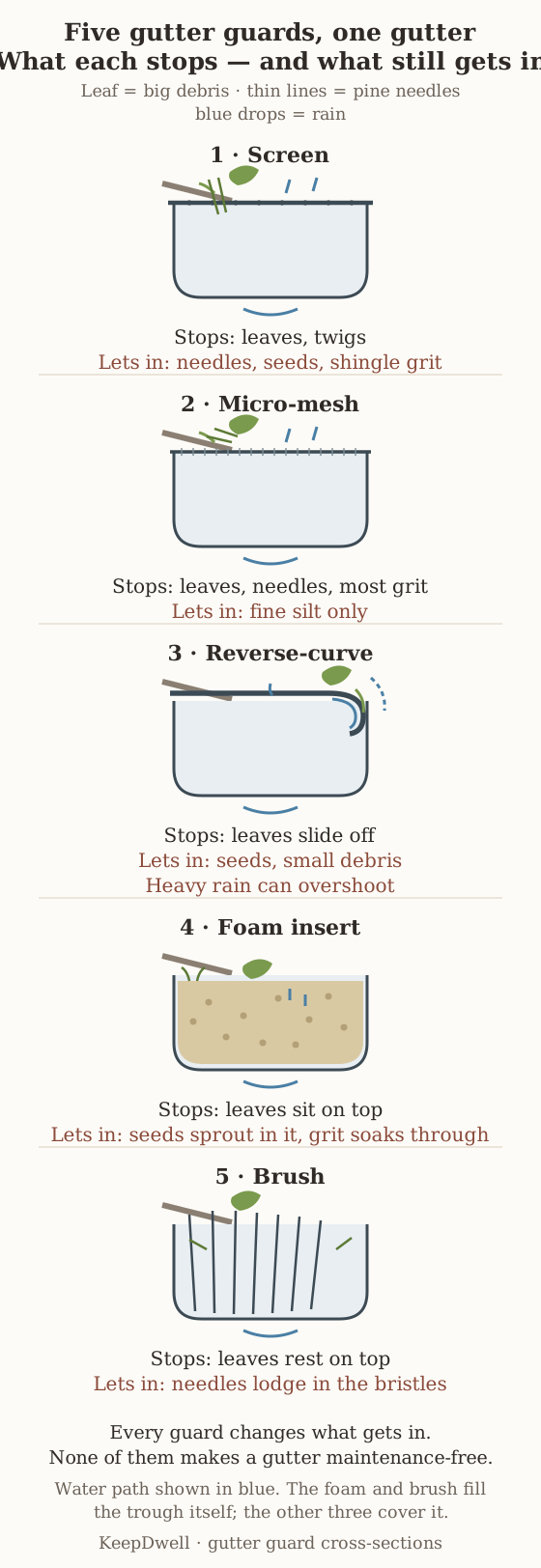
The pitch arrives in your mailbox, at a home show, or across your own kitchen table: never clean your gutters again. A crew fits sleek covers over your gutters, the ladder goes back in the garage forever, and one of homeownership's grubbiest chores is deleted from your life. The quote, when it comes, can be anywhere from $900 to $7,000 for the same roofline, which tells you the first true thing about this market: you are not buying a commodity, you're buying into a sales process as much as a product.
So, are gutter guards worth it? For a first-time homeowner staring at a first autumn of leaves, the honest answer is: sometimes, clearly — and the difference between the houses where they pay and the houses where they don't is arithmetic you can do on one page. This guide does that arithmetic with you. It compares the five guard types by what they actually stop, prices each one DIY and installed, works the break-even math for three different houses, and names the homes that should skip guards entirely and keep the money.
What gutter guards actually do (and what they don't)
Start with the physics, because every disappointment with gutter guards comes from expecting them to repeal it.
A guard is a filter placed where roof water enters the gutter. Its job is to sort the flow: water in, debris out. Every design is a compromise between two failure modes. Make the openings big and water pours through freely in any storm, but so do seeds, needles and grit. Make the openings tiny and almost nothing solid gets in, but in a hard downpour some water sheets across the surface and over the edge instead of entering. There is no design that wins both ends of that trade at once, which is why five different types survive in the market: each picks a different point on the compromise.
What guards genuinely do:
- They keep the big, dam-forming debris out. Leaves, twigs, blossom clusters and roof-nesting material are what mat together, block the trough and choke downspout outlets. Every decent guard stops most of that, and that is a real win: it's the clog that overflows, not the silt.
- They change the cleaning job, not delete it. Instead of scooping a full trough by hand several times a year, you're brushing a surface, rinsing a mesh, or pulling a much lighter accumulation every year or two.
- They keep debris out of the downspouts, which are the hardest part of the system to clear and the part most likely to need a professional call when they pack solid.
What they don't do:
- They don't stop fine material. Shingle grit washes off every roof, seeds and pollen fall everywhere, and silt settles wherever water slows down. Under any guard, a layer of fine muck builds in the trough over the years and eventually needs removing.
- They don't clean themselves. Debris that can't get in mostly sits on top instead, where it mats, holds moisture against the roof edge, and grows seedlings in spring. Somebody still has to shift it.
- They don't fix other problems. A sagging gutter pools water behind any guard. An undersized gutter overflows in a storm no matter what's on top of it. Guards are a filter, not a repair.
Hold onto one sentence through everything that follows: a guard changes what gets in, and therefore how often and how hard you clean — nothing on the market makes a gutter maintenance-free. Every claim, quote and guarantee you meet should be tested against that sentence.
The five types, honestly compared
1. Screen guards: the cheap sieve
The oldest and simplest design: a sheet of plastic or metal mesh, punched or woven with holes a few millimetres across, that clips onto the gutter or slides under the first row of shingles. Water falls through the holes; leaves, too big to fit, mostly stay on top and blow away.
What it stops: leaves, twigs, and the general large debris that forms dams. What it lets through: everything smaller than the holes, which is a longer list than the packaging suggests — maple seeds and helicopters spear in nose-first and stick, pine needles slide through lengthwise, and shingle grit passes freely and builds up in the trough below.
Failure modes: debris mats flat on top of the screen and has to be brushed off, especially under oaks in spring. Cheap plastic screens go brittle in sunlight and crack within a few years; screens can also sag or bow into the gutter under a wet debris load, opening gaps at the edges that debris funnels into.
Lifespan: roughly 3–7 years for plastic, 10 or more for aluminium. Best for: light-to-moderate leaf fall, tight budgets, and owners happy to treat the product as semi-disposable.
2. Micro-mesh guards: the fine filter
A frame, usually aluminium, carrying a stainless-steel mesh woven so fine it feels like fabric. The openings are small enough that even pine needles and most shingle grit can't pass; water is drawn through by surface tension, and debris lies on top until wind or a brush removes it.
What it stops: more than any other type — leaves, needles, seeds, grit, even most roof sand. What it lets through: water, plus a slow accumulation of the finest silt and pollen, which over years can film over the mesh itself.
Failure modes: that film is the main one. In heavy pollen country the mesh can glaze and start shedding storm water over the edge until someone brushes or rinses it — a quick job, but it means the "fit and forget" promise is really "fit and brush occasionally." In valleys, where two roof slopes concentrate a storm's worth of water into one fast stream, even clean mesh can be overwhelmed and overshoot.
Lifespan: 20 years or more for stainless mesh on an aluminium frame — the longest of the five. Best for: pine neighbourhoods (it's the only type that truly handles needles), heavy mixed tree cover, and owners who want the longest gap between interventions.
3. Reverse-curve guards: the water slide
A solid cover, usually aluminium, that arches over the gutter and curls back at the front edge. Rain flowing off the roof follows the curve by surface tension and drops through a narrow slot into the gutter; leaves, unable to make the turn, continue off the edge and fall to the ground. It's the design most premium brands are built around.
What it stops: leaves, very well — the shedding action is genuinely good in ordinary rain. What it lets through: the slot admits more than the demonstrations suggest. Seeds, small grit and insects enter, wasps and hornets find the sheltered channel underneath attractive, and once small debris is inside, the solid cover makes the gutter the hardest of all five types to inspect and clean.
Failure modes: overshoot. In a heavy downpour, or where a valley dumps a concentrated stream, water's momentum beats surface tension and it launches off the nose of the curve onto the ground below — the guard works beautifully in the rain it was demonstrated in and fails in the rain you actually get twice a year. The covers are also visible from the ground as a distinct band at the roofline, which some owners dislike, and they typically must be colour-matched to the gutter.
Lifespan: 10–20 years for the aluminium cover. Best for: big-leaf trees (oaks, maples) in moderate-rainfall climates, on homes where the roofline appearance is acceptable and valleys are few or fitted with splash diverters.
4. Foam inserts: the sponge in the trough
Triangular wedges of porous polyurethane foam that sit inside the gutter, filling it. Water soaks through the foam and flows beneath it to the downspout; leaves land on the flat top surface and are supposed to dry out and blow away.
What it stops: large leaves, in the sense that they can't sink into the gutter. What it lets through — and keeps: this is the weakest design of the five, and it isn't close. Seeds lodge in the foam's pores and sprout; grit soaks in and stays; the foam itself holds moisture against the gutter constantly. In sunny climates the foam degrades and crumbles, and in freezing climates a saturated foam wedge can freeze into a solid block that water simply runs over.
Failure modes: becoming the clog. Within a few seasons many foam inserts are less a filter than a long, damp planter filling the trough. Removing them at end of life is a filthy job.
Lifespan: 3–5 years, the shortest here. Best for: honestly, very few situations — a short-term fix on a lightly treed rental, perhaps. For a home you plan to keep, the cheapness is an illusion created by ignoring the replacement cycle.
5. Brush guards: the bottle brush
A long cylinder of stiff bristles, like an oversized bottle brush, laid in the gutter. Leaves land on the bristles and rest there; water flows through the open core beneath.
What it stops: large leaves from entering and matting, and it does keep the channel passable longer than an open gutter. What it lets through: needles and small debris don't just pass the brush — they lodge in it, woven between bristles where nothing blows them out. Seeds germinate in the debris the brush holds.
Failure modes: the brush becomes a debris rack. Cleaning day means hauling each section out, shaking and picking it clean, and putting it back — a job roughly as pleasant as cleaning the gutter was. Bristles mat down with age and the sections can harbour nesting insects.
Lifespan: around 5–10 years. Best for: owners whose problem is a few big-leaf trees and who want the simplest possible install (there is none — you just lay it in). Under pines, avoid entirely.
What each type costs: DIY and installed
The full cost table is at the top of this guide; here's how to read it. A typical single-family home has 125–200 linear feet of gutter — measure yours or take it from a cleaning invoice, because every guard quote you'll ever get is built on that number, and it's worth knowing before a salesperson "measures" it generously.
Angi's 2026 figures put professionally installed guards at $6–$13 per linear foot for mainstream products, with the average whole job at $1,521. By type, reverse-curve covers install at $3.50–$6.50/ft and micro-mesh averages about $9/ft. DIY material from a home centre inverts some of that: screens can cost under a dollar a foot, foam and brush $2–$5/ft, and quality micro-mesh kits $2–$5/ft — your ladder time is the labour line.
Then there's the top of the market. National premium brands, sold by in-home sales crews, run $20–$45 per foot installed; figures cited by This Old House put them near $40/ft, which is $6,000 for a 150-foot roofline — for a product whose working surface is, in most cases, a fine mesh not fundamentally different from the $9/ft local install. What the extra money buys is real but specific: a national guarantee, a transferable warranty, and a financing package. Whether that's worth four times the price is a question the break-even section answers with numbers instead of adjectives.
One more cost nobody quotes you: removal. When the roof is replaced, guards come off and go back on, and some installers charge for it; when guards reach end of life, disposing of 150 feet of crumbled foam or matted brush is your problem. Neither is large, but both belong in a whole-life comparison against the humble alternative — paying for cleaning, which has no removal cost because there's nothing to remove.
Before you price anything, check what you're fitting guards to. Most products are made for the standard 5-inch K-style gutter that hangs on most North American homes. If your house has oversized 6-inch gutters — increasingly common on steep or large roofs — the product choice narrows and prices rise, because the covers must span a wider trough. Half-round and copper gutters narrow it further: many guards simply aren't made for them, and the ones that are come from specialists at specialist prices. Look at your gutter profile from the ladder or a photo before you shop, because a salesperson quoting a standard price for a non-standard gutter is quoting a surprise for later.
The break-even math, worked properly
This is the section the sales presentation hopes you never do. The logic is simple:
Payback years = installed cost of guards ÷ (what cleaning costs you now per year − what cleaning still costs you with guards per year)
Note the subtraction. Guards don't reduce cleaning cost to zero; they reduce it. Any calculation that divides guard cost by your full cleaning bill is rigged, and it's the calculation on the glossy brochure.
First, your cleaning baseline. Professional cleaning in 2026 averages about $170 a visit nationally (Angi's range runs roughly $120–$235 for a one-storey home, $180–$360 for two storeys). DIY cleaning costs $0 in cash and a Saturday on a ladder. Now work three houses:
House A — heavy oak canopy, two storeys, owner pays for cleaning. Four mature oaks overhang the roof. Gutters need cleaning three times a year at $200 a visit: $600/year. Fit stainless micro-mesh, installed at $9/ft for 160 ft: $1,440. With guards, one light professional clean a year at $180 keeps the mesh brushed and the trough checked: saving $420/year. Payback: about 3.4 years, on a product with a 20-year life, and the owner also stops paying for the riskiest chore on the house three times a year. Clear win.
House B — moderate trees, one storey, owner pays for cleaning. A couple of maples at the corners. Cleaning twice a year at $170: $340/year. Same micro-mesh at $1,440 installed. With guards, cleaning drops to once a year at $170: saving $170/year. Payback: about 8.5 years — within the product's life, so not a loss, but a weak return that evaporates if you sell the house in five years or the mesh needs a repair. Marginal; the same owner fitting $3/ft DIY aluminium screen ($480) and accepting its shorter life reaches payback in under 3 years. The cheaper product wins this house.
House C — light trees, one storey, owner cleans it themselves. A young subdivision, one small tree, gutters cleaned twice a year from the owner's own ladder at $0 cash. Any guard's cash payback is never — you cannot recover a purchase price from a bill you don't pay. The only honest case for guards here is buying back time and ladder risk, which may be worth $480 to you, but it is a lifestyle purchase, not an investment, and a $6,000 premium system is indefensible on these numbers.
Now run House A again with the premium quote: $40/ft × 160 ft = $6,400, saving the same $420/year. Payback: over 15 years — longer than many owners stay in a home, and it only works at all because House A's cleaning bill is huge. The premium price doesn't change the physics or the savings; it just stretches the payback until it snaps.
Storeys deserve one more line in this math, because they move a house between categories. A two-storey version of House B doesn't pay $170 a cleaning — it pays $250–$360, because the crew is working higher with bigger ladders. At $300 twice a year, dropping to one visit saves $300 annually and the same $1,440 micro-mesh pays back in under five years instead of eight and a half. Height is expensive to clean and dangerous to DIY, so the taller your house, the more the arithmetic tilts toward guards — and the less the "just clean them yourself" alternative honestly applies. Run your own numbers with your own cleaning quote, not a national average: the whole decision lives in the gap between your current annual cleaning spend and your post-guard one.
The pattern to remember: guards pay back in proportion to what cleaning costs you now. Tree cover sets the frequency, storeys set the price per visit, and DIY sets the price to zero — three facts about your house, none of which the salesperson's national-average chart knows.
The homes that should skip them (and the ones that shouldn't wait)
Skip guards if:
- Few trees reach your roof. If leaves aren't landing on the roof in quantity, the gutter's enemy is grit and time, and a cheap twice-a-year clean handles it. Guards solve a debris problem you don't have.
- You clean them yourself, easily and safely. One storey, a good ladder, ground that's flat around the house, and no objection to the chore: your cleaning cost is zero dollars, so payback is never, full stop.
- You're replacing the gutters or roof soon. Guards are sized and fitted to the existing gutter; new gutters or a re-roof will disturb or waste them. Do the big job first, then decide with the new roofline in place.
- Your roof warranty is young and the install would disturb shingles. If the only fitting method on offer lifts or fastens through the first shingle course, the warranty risk can outweigh years of cleaning savings. (Fascia- or lip-mounted systems avoid this; see below.)
- Your real problem is ice dams. Guards do not fix ice dams and can give meltwater a frozen shelf to spill from. Spend the money on attic air sealing and insulation first — that's the actual cure — and revisit guards after.
- You plan to move within a few years. Guards rarely return their cost in a sale price; buyers don't pay a premium for them. Unless your cleaning bills are extreme, the payback clock won't finish before you leave.
Guards genuinely pay if:
- Heavy canopy overhangs the roof — oaks dropping leaves and spring tassels, maples dropping seeds, or a pine stand (micro-mesh only). High debris volume is what makes cleaning frequent, and frequency is what makes guards cheap by comparison.
- Ladder access is dangerous or impossible. Two or three storeys, a house on a slope where the downhill side is effectively three storeys, or any owner who shouldn't be on a ladder at all. Here the guard isn't competing with $170 cleanings; it's competing with an injury, and the math changes completely.
- You own a rental. Every cleaning is a paid call-out plus a scheduling problem with tenants. Cutting visits from three a year to one is a real, bankable saving, and guards reduce the overflow damage that turns into repair bills and complaints.
- You simply will not clean them. Be honest: a clogged gutter damages fascia, walls and foundations. If the realistic alternative to guards is not cleaning but neglect, guards win against neglect every time — a guard that's 80% effective beats a cleaning schedule that's 0% followed.
Installation realities the brochure skips
How it attaches matters as much as what it is. The best-fitting guards either screw to the gutter's front lip, clip under the drip edge, or fasten to the fascia — none of which touches the roof covering. The questionable method slides the guard's back edge up under the first course of shingles. Done carefully, that's usually harmless; done by a rushed crew, it breaks the shingles' sealant bond, lifts tabs against the wind, and can void the shingle manufacturer's warranty, which typically requires the roof to be installed and left per its instructions. Ask, in writing, which method your quote uses. On a roof with warranty years left, insist on a no-shingle-contact fit.
Overshoot is a storm problem, not a drizzle problem. Every guard type is demonstrated, in showrooms and videos, under a garden-hose rain. Your gutters must perform in the two or three genuine downpours a year, when a steep roof delivers water fast and a valley concentrates two slopes into one stream. Reverse-curve covers overshoot first, fouled micro-mesh second. If your roof has valleys dumping into short gutter runs, ask what the installer does about it — the correct answers are splash guards or diverters at the valley, a larger-capacity section, or a different guard type on that run. "It'll be fine" is not an answer.
Pitch and angle. Micro-mesh works best installed at an angle matching the roof slope, so debris slides and water sheets correctly; laid flat on a shallow-pitch house it holds debris like a shelf. Screens laid flat have the same issue. A good installer talks about your roof's pitch unprompted; a bad one doesn't know it matters.
Ice climates, honestly. In snow country, expect a sheet of ice to form over any guard in mid-winter and meltwater to run off the front edge on sunny thaw days. That's cosmetic compared to a true ice dam, but it can drip onto steps and refreeze — if your gutter line sits over a front walk, mention it. Metal covers also make the gutter harder to thaw or inspect in winter. None of this rules guards out in the north — micro-mesh is sold heavily in New England — but it should be a known trade, not a January surprise.
Your gutters must deserve guards. Guards freeze the current state of the system in place: they go over gutters that should first be cleaned, re-sloped if they pool, resealed at leaking joints, and firmly hung. A quote that doesn't include cleaning and minor correction before fitting is a quote for trapping today's problems under a cover.
Cleaning day, after guards: what the reduced chore actually looks like
Since no guard ends maintenance, it helps to know what the remaining maintenance is — because it differs by type, and it's part of what you're buying. With micro-mesh, the annual job is brushing or hosing the surface from a ladder (or with a telescoping brush from the ground on a one-storey home) to clear the pollen film and stuck needles, plus opening one section every few years to check the trough. With screens, you're lifting sections to scoop the grit that sifted through — less often than an open gutter, but the same kind of dirty. Reverse-curve covers make inspection hardest: plan on removing a panel or two at the downspout ends every couple of years to check what's crept in through the slot. Foam and brush come out section by section to be shaken, picked clean or replaced — the chore most similar to the one you were trying to escape. None of this is the full scoop-and-haul of an open gutter full of leaf sludge, and that difference is real. Just price your chosen type's version of it into the decision, because "reduced maintenance" is a spectrum, and foam sits at the wrong end of it.
What to ask an installer, and how to read the guarantee
Get at least two quotes, one of them from a local gutter company rather than a national sales brand, and ask every bidder the same questions:
- How many linear feet are you quoting, and how did you measure? Compare it with your own number. Inflated footage is the oldest trick in this trade.
- How does it attach — and does anything touch or lift my shingles? Get the answer in writing.
- What maintenance does the manufacturer still require, and how often? The honest answer is a number of years between cleanings, not "none."
- What exactly does the no-clog guarantee promise? Read it. Most guarantee that the gutter won't clog internally, and the remedy is a free cleaning visit — not a refund, and not compensation if an overflow damages your fascia in the meantime. Many also exclude the guard's surface clogging, which is the kind that actually happens.
- Who honours the warranty if you close? A 25-year guarantee from a franchise that opened last spring is worth the paper it's printed on. A manufacturer warranty on the material is separate from the installer's performance promise — know which you're holding.
- Is the warranty transferable to the next owner, and does it need registering? Transferability is one of the premium brands' genuine selling points; if you're paying for it, make sure the paperwork actually delivers it.
- What happens at re-roofing time? Who removes and refits the guards, and at what cost?
Red flags, any one of which should end the conversation: a quote that's only valid today, a discount that requires a same-day signature, a refusal to state the per-foot price, and the phrase "you'll never think about your gutters again."
The verdict: a three-question test
You don't need a salesperson to decide this. You need three answers about your own house:
- What falls on your roof? Heavy leaves or needles, several times a year → guards are a live candidate. Light, occasional debris → they're a solution shopping for a problem.
- What does a cleaning cost you — in money or in ladder risk? $400+ a year in paid cleanings, or a roofline you shouldn't be climbing → the payback is real and short. Free, safe, DIY cleaning → the payback is never, and anything you buy is a convenience purchase.
- How long will you keep both the house and the guards? Payback must land well inside the shorter of your stay and the product's realistic life — not its warranty headline.
If your answers are heavy debris, expensive cleaning, long stay: fit stainless micro-mesh from a local installer at a single-digit price per foot, budget one light cleaning a year, and you'll come out ahead within about four years. If your answers point the other way, keep your money, clean the gutters twice a year, and revisit the question when the trees — or your knees — change. That's the whole secret of this industry: the product is fine. It's the match between product and house that decides whether it was worth it.
Cost at a glance
| Item | Typical cost | Notes |
|---|---|---|
| Screen guards (plastic or aluminium) | DIY $0.50–$3/ft · Installed $5–$8/ft | The cheap end of the market. Plastic screens go brittle in sun within a few years; aluminium lasts longer. Both let seeds and grit through the holes |
| Micro-mesh guards (stainless steel) | DIY $2–$5/ft · Installed $7–$13/ft | Angi 2026: about $9/ft installed on average, $1,000–$1,350 per 150 ft. The finest filter of the five — the only type that reliably stops pine needles |
| Reverse-curve (surface-tension) covers | Installed $3.50–$6.50/ft | Angi 2026 range; $550–$1,000 per 150 ft. Solid aluminium cover, water follows the curve into a slot. Rarely sold as a true DIY product |
| Foam or brush inserts | DIY $2–$5/ft · Almost never pro-installed | Sold by the box at home centres. Cheapest to buy, shortest-lived: foam typically needs replacing in 3–5 years, sooner in strong sun |
| Premium branded systems (national sales brands) | Installed $20–$45/ft | This Old House-cited figures put national brands near $40/ft — $3,000–$6,750 for 150 ft. You are paying for the sales process and the guarantee paperwork as much as the metal |
Frequently asked questions
Do gutter guards mean I never have to clean my gutters again?
No, and any installer who promises that is the first reason to walk away. Every guard type lets something through: screens pass seeds and shingle grit, foam and brush trap debris inside themselves, and even micro-mesh accumulates a layer of fine silt over the years. What guards change is the schedule and the mess — from scooping out a full trough two to four times a year to a lighter annual or every-other-year clean, often done from the top with a brush or hose instead of by hand. Budget for that reduced cleaning in your break-even math, because it never goes to zero.
Which gutter guard is best for pine needles?
Micro-mesh, and it isn't close. Pine needles are thin enough to slip through screen holes, spear into foam, and lodge permanently in brush bristles — brush guards under pines become needle storage. A stainless micro-mesh has openings fine enough that needles lie on top of it and mostly blow or wash off. Two cautions: the mesh itself needs an occasional brush or rinse because pollen and fine silt can film over it, and in a heavy downpour a fouled mesh can shed water over the edge. Keep it brushed and it is the one type that genuinely changes life in a pine neighbourhood.
How much do gutter guards cost per foot, installed?
Angi's 2026 data puts professionally installed guards at $6–$13 per linear foot for mainstream products, with a national average job of $1,521. By type: reverse-curve covers run $3.50–$6.50/ft installed, micro-mesh about $9/ft. At the extremes, DIY screen material costs under $1/ft at a home centre, while national premium brands installed by their own sales crews reach $20–$45/ft — around $40/ft in This Old House-cited figures. For a typical home with 125–200 ft of gutter, that spread means the same roofline can be quoted anywhere from a few hundred dollars to over $6,000.
Do gutter guards cause ice dams?
Guards don't cause ice dams — heat leaking from a poorly insulated, poorly sealed attic melts snow on the roof, and that meltwater refreezing at the cold eave is the dam; University of Minnesota Extension guidance is consistent on the cause. What guards can do in a cold climate is give ice a flat shelf to sit on at the eave and make an existing dam problem more visible: a frozen sheet over mesh or a reverse-curve cover sends meltwater over the front edge instead of into the gutter. If your house already grows ice dams, fix the attic air sealing and insulation first, then choose guards — don't expect guards to fix the dam, and don't let a salesperson blame or credit them for it.
Can installing gutter guards void my roof warranty?
It can, depending on how they're fitted. Guards that slide under the first course of shingles are usually fine, but installers who lift shingles carelessly, break the sealant bond, or drive fasteners through the shingle layer can put you in breach of the shingle manufacturer's installation terms — and a disturbed first course is also a leak risk in wind-driven rain. Safer fits screw to the gutter's front lip or the fascia and never touch the roof covering. Before signing, ask exactly how the product attaches, get it in writing, and if your roof is still under a manufacturer warranty, check the warranty terms or ask the roofer who installed it. This matters most on newer roofs with decades of warranty left.
How long do gutter guards last?
It tracks price closely. Plastic screens embrittle in sunlight and often need replacing in 3–7 years. Foam inserts degrade fastest of all — 3–5 years is typical, less under intense sun, and they come out in crumbling pieces. Brush guards last around 5–10 years before the bristles mat down. Aluminium screens and reverse-curve covers commonly run 10–20 years. Stainless micro-mesh on an aluminium frame is the long-life option at 20 years or more, which is why its higher price per foot can still win the long arithmetic. When you run break-even math, compare the payback period against the realistic life of that specific product, not the warranty headline.
Are premium gutter guard systems worth the extra money?
Usually not on performance alone. The hardware in a $40/ft national-brand system and a $9/ft local micro-mesh install is more similar than the price gap suggests — what the premium buys is a long performance guarantee, a transferable warranty, and a company that (in theory) answers the phone in fifteen years. The fine print matters more than the brochure: most 'lifetime no-clog' guarantees promise free cleaning if the gutter clogs, not a refund, and they often exclude the surface of the guard itself. If the guarantee is the reason you're paying five times more, read what it actually promises, check how long the local franchise has existed, and get a like-for-like local quote before deciding. For most homes, mid-priced micro-mesh installed by a local gutter company is the value peak.
Checked November 16, 2026. This guide is general information, not a substitute for a licensed professional.
Related guides
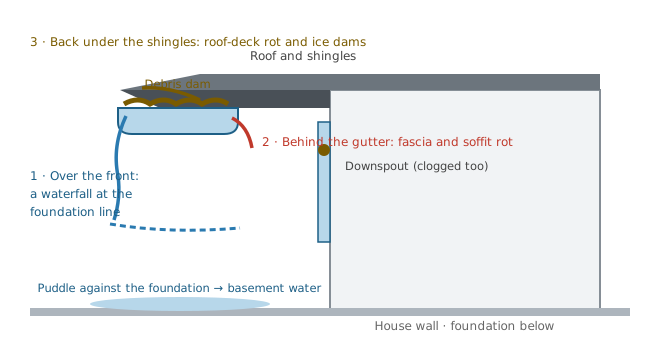
How Often Should You Clean Your Gutters? The Schedule, the Signs You're Late, and What It Costs
Twice a year is the baseline — but your trees decide the real number. The damage chain a clogged gutter sets off, how to clean safely, honest 2026 costs, and whether gutter guards are worth it.
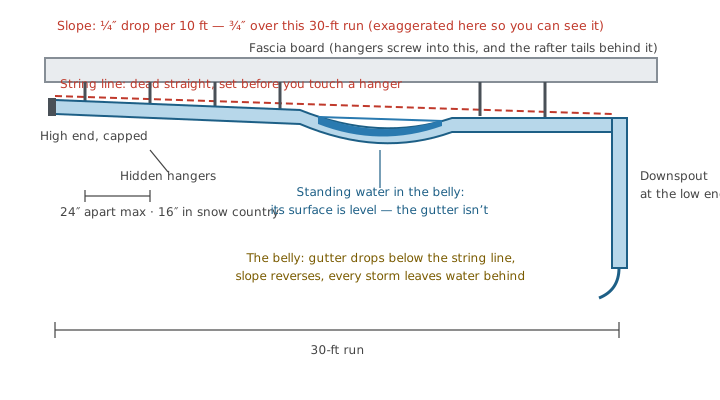
How to Fix Sagging Gutters: Replace Spikes With Screws, Add Hangers, and Reset the Slope
A sagging gutter is a slope problem, a fastener problem, or a rotten-fascia problem — and each has a different fix. The string-line test, the spike-to-hanger conversion, full slope reset, real 2026 costs, and the rehang-or-replace decision.
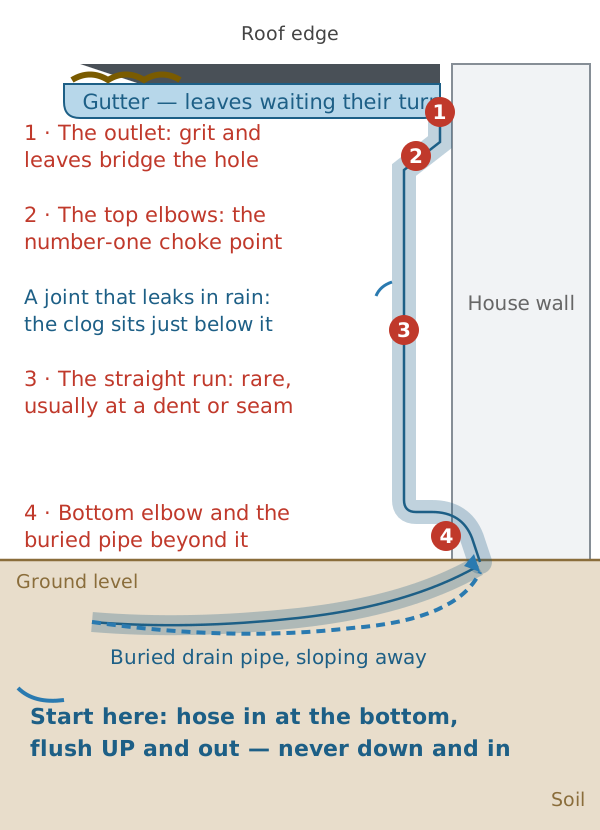
Downspout Clogged? How to Find the Blockage From the Ground and Clear It Without Packing It Tighter
The gutter looks clean but one corner pours over in every rain. Locate the clog from the ground with the tap test, clear it in the right direction (bottom up, never blasted deeper), take elbows apart when you must, and tell when the blockage is in the buried drain.