 Keep
How Often Should You Clean Your Gutters? The Schedule, the Signs You're Late, and What It Costs
 Daniel Mercer · Editor & Researcher·
Published November 16, 2026·
Updated November 16, 2026
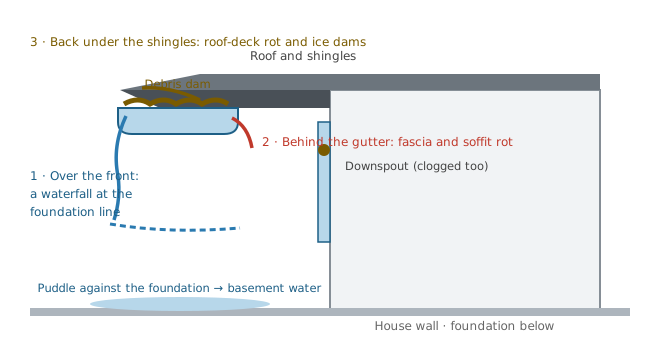
Of all the maintenance jobs on a house, gutter cleaning has the worst ratio of effort to respect. It's dirty, it's up a ladder, and when it's done well, nothing looks different. So it slides — a season, then a year, then until the spring someone notices water pouring off the roof edge like a waterfall feature the house never ordered. By then the gutters have been quietly re-routing your roof's water into your fascia, your walls and your foundation for months.
The job matters more than it looks, because gutters aren't really about the roof. A 1,000-square-foot roof in a one-inch rainstorm sheds roughly 600 gallons of water. The gutter system's whole purpose is to catch that water at the edge and deliver it, politely, to a downspout that lets it out several feet from your foundation. Everything in this guide — the schedule, the signs, the costs — is about keeping that one delivery route open.
The schedule: twice a year, set by your trees
The standard answer is twice a year, and the timing is not arbitrary:
Late spring — after the trees finish their spring drop: pollen tassels, seed pods, maple helicopters, blossom fall. Spring debris is fine debris. It doesn't dam the gutter so much as wash into the downspouts and pack their elbows, which is why the spring clean is as much a downspout flow test as a gutter scoop.
Late autumn — after the leaves are down and before the first hard freeze. This is the critical one. A gutter going into winter full of wet leaves holds water at the roof's edge, where freeze-thaw cycles work it into ice — feeding ice dams, splitting seams with expansion, and loading the brackets with a weight of ice and sodden debris they were never sized for. If you clean only once a year, clean in autumn, and know you're accepting the downspout risk in spring.
Then adjust for your actual property. Heavy tree cover overhanging the roof — oaks, maples — pushes you to three times, adding a mid-autumn clean in leaf season. Pine trees are their own category: needles fall year-round, slip through most guards, and mat into dense dams, so pine-neighbourhood homes often need three to four cleanings. Storm-prone regions earn an extra check after any debris-throwing storm. And the honest minimum: a house with almost no trees still gets wind-blown debris, shingle grit and the occasional bird's nest, so "no trees" means the standard twice — not zero.
Your frequency, in one table
"Twice a year" is an average wearing a uniform. What your house actually needs depends on two things you can check in five minutes: how much tree canopy hangs over the roof, and how steep the roof is. Pitch matters because a steep roof is a slide — everything that lands on it travels down into the gutter quickly and completely — while a shallow roof holds debris on the surface longer, then delivers it mixed with grit. Find your row, then your column:
| Tree cover over the roof | Low pitch (up to 4/12) | Moderate pitch (5/12–8/12) | Steep pitch (9/12 and up) |
|---|---|---|---|
| None overhanging, few nearby | 2 a year | 2 a year | 2 a year |
| Some overhang — a tree or two reaching the eaves | 2–3 a year | 3 a year | 3 a year |
| Heavy deciduous canopy (oak, maple) | 3 a year | 3 a year | 3–4 a year |
| Pines overhead or next door | 3–4 a year | 4 a year | 4 a year |
| Good guards fitted (any cover) | 1 + a mid-year check | 1 + a mid-year check | 1–2 a year |
Two notes on using the table honestly. First, judge tree cover by the canopy over the roof planes, not by the size of your yard: one oak whose branches reach the eaves will out-debris a woodland fifty feet away, though wind narrows the difference and a storm can rewrite any row overnight — which is why the post-storm check sits outside the table entirely. Second, pitch is rise over run — a 6/12 roof climbs six inches for every horizontal foot — and if you don't know yours, a phone inclinometer app held against a rafter in the attic, or against the roof edge from the ladder, gets you close enough for this table. If your house straddles two rows — deciduous canopy on one slope, pines on another — clean to the worse row. The gutters share downspouts, and the worst slope sets the whole system's real schedule.
The signs you're already late
Gutters announce their state from the ground, if you watch during rain — which is the one time most people don't. Walk out in a moderate storm, or check these traces afterward:
- Water sheeting over the front edge — the definitive sign. The channel or the downspout is dammed and the gutter has become a waterfall aimed at your foundation.
- Plants growing out of the gutter — seedlings in the debris mean the leaves have composted into actual soil. You are not weeks late; you are seasons late.
- Sagging sections or a gutter pulling away from the fascia — wet debris and standing water are heavy, and a gutter full of both can weigh several pounds per foot. Sagging also destroys the slope (below), so a sagging gutter stays a puddle even after cleaning until it's re-hung.
- Dark streaks ("tiger stripes") down the gutter face and stains on the siding below — the record of chronic overflow, written in dirt.
- Peeling paint or soft spots on fascia and soffit — overflow has been running behind the gutter and the wood is going.
- Puddles and eroded soil along the foundation after rain — the water is landing exactly where the system exists to keep it from landing.
- Birds, squirrels or insect life at the roofline — debris is nesting material and standing water breeds mosquitoes; a busy gutter is a clogged gutter.
- Big icicles and an ice ridge at the eaves in winter — in cold climates, last autumn's clog announcing itself in its most damaging form.
What the water does instead: the damage chain
A clogged gutter doesn't just fail to help; it actively re-plumbs your house's water to the worst places. Follow one storm's worth:
At the roof edge, standing water and sodden debris sit against the fascia board and the first course of shingles. Wood that stays damp rots — fascia first, then the soffit, then the edge of the roof deck itself, and in humid climates a single season of saturation can start it. Water that backs up under the shingle edge (helped by wind, helped more by ice) starts the interior leak story from our roof guide.
Down the wall, overflow runs behind siding or saturates it, finding window frames and joints, wetting wall cavities that were built to stay dry. The visible evidence is peeling paint and staining; the invisible part is rot in the sheathing and framing, which announces itself years later and costs like it.
At the ground, the roof's entire rainfall lands in a trench along the foundation instead of at a downspout outlet away from the house. Saturated soil presses water against basement walls (hydrostatic pressure is patient and strong), erodes the grade that should slope away, and in freezing climates works moisture into foundation cracks and widens them winter by winter. A meaningful share of "my basement suddenly leaks" stories begin, two years earlier, as a gutter nobody cleaned. The EPA's own moisture guidance lists keeping gutters cleaned and repaired among the basic defences — unglamorous company for a chore, but telling.
And the gutter itself dies early: standing water rusts steel, corrodes aluminium at the seams, splits joints in freeze-thaw, and bends brackets under load. Clean gutters are a decades-long system; neglected ones are a replacement quote.
Cleaning day: the full procedure, start to finish
Hire it or climb it, this is the job done properly — the same sequence a good crew runs, written out so a first-timer can follow it step by step and a hirer can check a finished visit against it. None of the equipment is exotic and none of the steps are hard. The quality is in the order, and in not skipping the unglamorous steps at the end.
The kit: everything on the ground before anyone climbs
Assemble it all first, because every forgotten item is an extra ladder trip. You need: a sturdy ladder rated for your weight plus tools; work gloves — gutter edges and hidden screw tips cut, and old debris can hold glass, nails and worse; a gutter scoop or plastic trowel (metal scrapers gouge the coating off the trough); a bucket with a wire hook that hangs from a ladder rung, or a ground tarp if you'd rather drop debris and rake it up after; a garden hose with a spray nozzle, long enough to reach the far gutter from the tap; a plumber's snake or drain auger for the downspouts; a short spirit level — a torpedo level rides in the trough fine; gutter sealant and a few spare hangers and screws for touch-ups; and safety glasses for the flushing stage, which throws grit backwards. One optional extra earns its money: a ladder stabiliser (stand-off), which braces the ladder against the wall and keeps its weight off the gutter itself. Leaning a ladder directly on a gutter is how gutters get crushed and how ladders slide.
The ladder rules
This is the safety core of the whole guide, and it is not decoration:
- Set the ladder on firm, level ground — a board under the feet on soft soil — at roughly a 4-to-1 angle: the base one foot out for every four feet of height.
- The ladder must extend three feet above the gutter line, so you work level with the gutter — never climbing above it, never reaching down from above it.
- Never overreach. Your belt buckle stays between the rails. When the work moves, you climb down and move the ladder. Most gutter falls are reaching falls.
- Nothing in your hands while climbing. Tools ride in the bucket on its hook, hoisted after you or handed up by your helper.
- A helper foots the ladder and stays within earshot. If you don't have one, that is information — hire the job.
- Dry rungs, no wind, no rain, no frost. And if the run is two storeys up or the ground slopes away from the house, stop here and read the hire-it section below: the procedure that follows is written for the one-storey case.
The procedure
- Stage the run. Pick one gutter run and start at one end of it. Ladder up, bucket hooked beside you, scoop in hand, helper below.
- Scoop the trough. Work away from the downspout, not toward it — scooping toward the outlet pushes loose debris into the downspout opening and manufactures the clog you came up here to prevent. Scoop into the bucket; when it fills, lower it or drop it to the helper rather than carrying it down one-handed.
- Clear behind the hangers as you pass them. Debris packs behind straps and fasteners and holds moisture against the fascia all season; a scoop's-width behind each one is part of the job.
- Move the ladder, and repeat. Short moves, every few feet of trough. This is the slow part and the safe part, and they are the same part.
- Flush the trough. From the far end, run the hose along the gutter toward the downspout. The water carries off the fine grit the scoop left behind — and, more usefully, it shows you how the run drains: where it hesitates, where it pools, where it spills.
- Prove the downspout. Watch the outlet at ground level: a clear downspout delivers a strong, steady stream. If it dribbles, clear it in this order: (a) full hose pressure down from the top, held for a minute; (b) flush upward from the bottom outlet, which often blows the plug straight back out of the top; (c) run the plumber's snake down from the top, working it through the elbow; (d) if it still holds, take out the screws on the top elbow, remove it, and clear it by hand — the elbow is where spring's fine debris packs, and this step ends almost every stubborn case. Refit it, flush again, and confirm the stream before you move on.
- Check the slope. Lay the level in the clean trough, or simply watch the flush water: it should keep moving toward the downspout, with no standing pool left a minute after the hose stops. The target is about a quarter inch of fall per 10 feet (the slope section below goes deeper). A pool that stays is a re-hanging note for the repair list — more scooping will never fix it.
- Leak-check the seams and corners. With water running, walk the ground line and look up: drips from joints, corners and end caps show clearly against the wet run. Mark each one — a phone photo from below works. Sealant only holds on a clean, dry seam, so note them now and seal on a dry day, or hand the list to the crew.
- Touch up what's loose while you're there. Tighten backed-out screws, swap a failed spike for a screwed hidden hanger, re-secure a loose downspout strap. Five minutes each, and they are the difference between a cleaning and a maintenance visit.
- Finish at the exits. Back at ground level, confirm every downspout discharges onto a splash block or an extension carrying water at least 4–6 feet from the foundation, with the outlet unburied and unblocked. A clean gutter emptying at the wall is a job half done — and this last step is the cheapest foundation protection in the entire house.
Timing, so you can plan the Saturday: a first-timer on a one-storey house should budget two to three hours, including setup and the downspout fight. A practised DIYer does the same house in about an hour. A professional crew, ladders already off the truck, is typically done in 30 to 60 minutes. If any cleaning — yours or a hired one — took fifteen minutes, steps 5 through 10 did not happen.
If a crew is doing it instead
The steps don't change when you hire the job out — only who climbs. A proper crew runs the same sequence: scoop or vacuum the troughs, flush them, prove every downspout, check the exits. Before they start, settle the one question that separates a full job from a partial one: is downspout clearing included, or is it an add-on? The cost table at the top of this guide prices it both ways, and a clean trough over a blocked downspout still overflows in the first real rain. Expect a one-storey house to take the crew 30 to 60 minutes and a two-storey house an hour or more; the clock is a rough quality gauge all by itself.
What you add, as the customer, is the verification pass before you pay. Run a hose into the longest gutter yourself and watch every downspout outlet run strong and clear. Look up at the corners and seams they reported sealing and check for drips while the water runs. Ask for the ladder photos of anything they flagged — a tired seam, a loose hanger, a soft fascia board — because those photos are now your repair list, and your evidence if a follow-up quote arrives. Confirm the bagged debris is leaving with them, not blown across your beds. A crew that genuinely ran steps 1 through 10 will sail through every one of those checks, and most good ones expect them. A fifteen-minute visit will not — and now you know exactly which steps to name when you ask what was skipped.
The repairs that ride along with cleaning
Cleaning day is when the system's small failures get found, and most of them are cheap precisely because someone is already up there. Leaking corners and seams get cleaned, dried and resealed with gutter sealant — a tube of sealant and twenty minutes, against a drip that stains siding all year. Loose fasteners are the quiet epidemic: older gutters hang on long spikes that work loose from the fascia over years, opening the gap that lets water run behind; the modern fix is replacing spikes with hidden hangers screwed into the rafter tails, a permanent upgrade done a section at a time. End caps and downspout straps work loose and are trivially re-secured. A section that's rusted through or crushed (ladder damage is the classic) gets replaced by the linear foot. Professional gutter repair overall averages around $300 nationally (typical range roughly $220–$400), and the smart way to buy it is exactly this: discovered during a cleaning, itemised in photos, priced per item — not as a vague "gutter service" line. Keep a simple rule: cleaning finds it, photos prove it, and anything structural (fascia rot, a run that needs re-hanging for slope) gets its own quote rather than a same-day upsell.
When clean gutters still overflow: the sizing problem
Occasionally a gutter overflows in heavy rain the week after a thorough cleaning, and the owner concludes the cleaning was botched. Sometimes the truth is capacity. The standard residential gutter is a 5-inch K-style; large roof planes, steep pitches that accelerate water, and long runs to a single downspout can deliver more water in a downpour than a 5-inch channel and a 2×3-inch downspout can carry. The water sheets over the front in exactly the storms that matter most. The fixes are mechanical, not hygienic: 6-inch gutters (they carry roughly 40% more water) on the big slopes, 3×4-inch downspouts, or an added downspout to split a long run. A gutter company can calculate your roof's drainage load properly, but the field test is simple: clean gutters + overflow only in the heaviest rain + a big steep roof plane above = suspect sizing before you suspect the cleaner. This is also the one case where gutter guards can make things worse if chosen badly — a surface-tension helmet on an already marginal system can overshoot in a deluge — so sizing comes before accessories.
The slope nobody thinks about
Gutters are not level; they're supposed to be almost level — a gentle pitch of about a quarter inch of fall per 10 feet toward the downspout. Too flat or back-pitched (from a sagging bracket, a settled house, a careless install), and the trough holds a permanent puddle that breeds mosquitoes, rusts the metal, and overflows at the low end in any real rain — even freshly cleaned. During your flush step, standing water that refuses to move is a slope finding, not a cleaning failure: the fix is re-hanging that run with the pitch restored, a modest professional job that permanently demotes that section from your problem list.
Gutter guards: the honest version
Guards exist because the chore is real, and the category deserves better than its sales pitches. The types, briefly: screens (coarse mesh, cheapest, stop leaves but pass seeds and needles), micro-mesh (fine stainless mesh, the current best general-purpose answer, stops nearly everything but can hold a film of grit and pollen that needs an occasional brush or rinse), surface-tension helmets (solid covers that curve water in and shed debris — effective, the priciest, and the most sensitive to roof pitch and heavy-rain overshoot), and foam/brush inserts (sit in the trough; cheap, and they themselves become the debris trap within a few years).
The arithmetic from the cost table: typical mesh systems at $6–$13 a foot put a 150–200-foot house at roughly $1,200–$1,600 installed (premium branded systems reach far higher — shop the category, not the brand night on TV). Against professional cleaning at ~$170 a visit, guards pay back in about eight cleanings — three years for a pine-shadowed house cleaning quarterly, the better part of a decade for a twice-a-year house, never-quite for a DIY cleaner. What no guard does is end maintenance: silt and grit accumulate under every system, seedlings root in it, and the standing advice is a cleaning or at least a check every year or two even with guards. Buy them to cut frequency and ladder trips, sized to your trees — micro-mesh under pines and fine-seeding trees, screens where the debris is big leaves — and treat "never clean again" as the tell of a pitch to walk away from.
The ten-year maths: what each route actually costs
Per-visit prices hide the real comparison, because the three routes spend money on completely different clocks. So here is the same typical house — 150 to 200 feet of gutter, on the standard twice-a-year schedule — costed every way over ten years. Your house will move the numbers; it won't change the shape of the answer.
| Route | Year one | Each year after | 10-year cash total |
|---|---|---|---|
| DIY, twice a year | $60–$120 in tools (ladder already owned) | $10–$25 — bags, sealant, gloves | $150–$350 |
| Professional, twice a year | $290–$500 | $290–$500 | $2,900–$5,000 |
| Professional, 3–4 times a year (heavy trees) | $540–$1,100 | $540–$1,100 | $5,400–$11,000 |
| Guards fitted + one professional clean a year | $1,200–$1,600 installed, plus a $145–$250 clean | $145–$250 | $2,650–$3,900 |
| Guards fitted + DIY annual check | $1,200–$1,600 installed, plus tools | $10–$25 | $1,300–$1,850 |
Read the table the way the decision actually presents itself. If you are a twice-a-year house, professional cleaning and guards-plus-cleaning land within a few hundred dollars of each other across a whole decade — so that choice isn't really financial. It's whether you'd rather write a modest cheque twice a year or a large one once, and how much you trust a guard system on your particular roof. If you are a three-or-four-times house, the maths flips hard: guards pay for themselves in roughly three years, and the ten-year saving runs into thousands — which is why the guard conversation belongs to the pine-and-oak houses and not to the open-lot ones. And if you DIY, the cash column is nearly a rounding error; the true price of that row is two to six hours a year of your time plus the ladder risk set out in the safety rules above, and no table can hold that number for you. One more line belongs in every version of this maths, whichever row you choose: the cleaning is also an inspection. A $300 seam-and-fascia repair caught from the ladder is the same failure as a $2,000 rotted roof-deck repair caught from the attic a year later. The difference is purely which visit found it — and only the cleaned houses get the cheap version.
Hire it or climb: deciding honestly
The professional product here is not really cleanliness — it's a person who is insured, practised and equipped being on the ladder instead of you, plus trained eyes on your fascia, seams and slope while they're up there. Hire it when the house is two storeys or more, the ground slopes, the roofline is awkward, or your ladder confidence is anything less than total; at $145–$360 for most homes, it is among the cheapest risk transfers in home maintenance. DIY it when it's one storey, firm ground, a good ladder and a helper — and observe the safety rules in the FAQ as if they were the point of the exercise, because statistically, they are. Either way, get the downspout flow check and the discharge extensions included in the job; a quote that covers only the troughs is a quote for two-thirds of the system.
What a professional visit should actually include
Since most readers will hire this out at least sometimes, know what the good version looks like so you can spot the drive-by version. A proper service removes debris from all troughs (by hand or with a ground-based gutter vacuum — both legitimate; be wary of the crew whose entire method is a leaf blower on the roof, which relocates debris into the downspouts and the garden), flushes and proves every downspout, rinses the troughs, and reports the system's condition — seams, hangers, slope, fascia — ideally with photos from the ladder, which any reputable outfit now takes as a matter of routine. The bagged debris leaves with them or lands where you agreed, not blown across your beds. Two upsells deserve a raised eyebrow: gutter whitening (scrubbing the tiger stripes off the outside) is pure cosmetics — harmless, sometimes wanted, never structural; and guard pitches delivered at the door with same-day discounts — the product may be fine, but the arithmetic in this guide should be run at your kitchen table, not on your doorstep with a clipboard. Get the cleaning as a priced, standalone service; let everything else be a separate, considered purchase.
Regional notes: the same gutters, different enemies
Pacific Northwest: the enemy is moss and the near-permanent damp. Debris stays wet, moss colonises the trough and the roof edge, and the cleaning rhythm leans on the wet season's start and end. Southwest: many homes have partial guttering or none (tile roofs, scuppers, canales), and what exists fills with wind-blown dust that turns to mud in the monsoon — one pre-monsoon clean matters more than any calendar rule. Florida and the Gulf: growth is year-round, the debris is as much biological as botanical, and the pre-hurricane-season check (June) doubles as a drainage audit before the storms that test it. Northeast and upper Midwest: the autumn clean is a freeze deadline, not a preference, and ice is the auditor of every shortcut. Clay-soil regions anywhere: foundation stakes are higher, because expansive clay plus gutter overflow at the wall is the classic recipe for foundation movement — downspout extensions earn their keep double here. The national schedule is a starting point; your climate writes the final version.
The tree conversation
Finally, the debris has a source, and sometimes the source can be negotiated with. Trimming branches back so nothing overhangs the roof — a gap of roughly 6–10 feet — cuts the leaf and needle load dramatically, removes the squirrel highway to your roof, stops branches scuffing shingles in storms, and lets sun dry the roof edge after rain. It doesn't change the twice-a-year baseline (wind delivers the neighbourhood's leaves impartially), but it can demote a three-or-four-times house back to two. It's an arborist's job when the branches are large or high — which is to say, it's the same ladder logic as the gutters themselves: know which heights are yours.
What your gutters are made of (and why it changes the maintenance)
Aluminium is the default for a reason: it doesn't rust, it's light, it takes paint, and a well-kept aluminium system lasts 20 years or more. Its enemies are dents (ladders leaned on it are the classic) and seam corrosion where debris holds moisture against the metal. Galvanised steel is stronger and cheaper but lives on its coating: once standing water and debris scratch through to the steel, rust starts at exactly the wettest points — the trough bottom and seams — and steel systems in neglectful homes rust out years before aluminium would. Vinyl is the DIY-store option: it never rusts and it's cheap, but it turns brittle in cold and UV, cracks at joints, and sags in heat under debris loads — a short-lived system that punishes skipped cleanings fastest of all. Copper is the 50-year, premium end: it patinas green, solders beautifully, and outlives the roof — and its maintenance is the same list as everyone else's, because debris dams copper exactly as it dams vinyl. Across all materials, seamless gutters (formed on site to the exact run length) remove most of the leak points that sectional gutters carry every ten feet — worth specifying at replacement time, and one more reason a cleaning that reseals five seams is telling you something about the system's age.
The first-year audit: inheriting gutters you know nothing about
If you've just bought the house, your gutters came with no manual and no history — so run this audit in your first month, ideally during or just after rain. Count the downspouts against the roof: a very long run or a big roof plane served by one small downspout is a sizing flag (see the capacity section). Flow-test with a hose on a dry day: run water into the far end of each gutter and watch the downspout outlet — strong and clear is a pass; slow or tea-coloured means a downspout is already packing. Follow every downspout to its exit and confirm it discharges at least 4–6 feet from the foundation, not into a buried pipe you can't verify (buried drains clog invisibly; if the exit can't be found, that's a finding, not a detail). Read the walls for history: tiger stripes, fascia stains and eroded soil lines are the previous owner's maintenance record, written on the house. Check the attic and basement after the next real storm — your first leak evidence will arrive on the water's schedule, not yours. And ask the seller, through the agent if needed, when the gutters were last cleaned and whether guards are fitted and of what type; the answer calibrates whether your first cleaning is routine or archaeological. An hour of this in month one converts an unknown system into a known one, which is the entire first-year project in miniature.
Put it on the house calendar
Gutters fail by calendar, so beat them with one. Anchor the cleans to events you can't miss: the autumn clean when the last leaves drop (before the first freeze, if your climate has one), the spring clean when the seed fall ends — the same weekends you swap the furnace filter and check the AC, if you keep a seasonal rhythm. Write the dates on the house log next to the water-heater flush and the septic pumping, and note what you found: which downspout clogs first, which corner leaks, which section sags. Two years of those notes and you know your house's drainage the way you know its noises — and the waterfall at the foundation, the rotted fascia and the wet basement become stories about other people's houses.
Cost at a glance
| Item | Typical cost | Notes |
|---|---|---|
| Professional cleaning — 1-storey home | $145–$250 | Angi 2026 data (37,000+ projects): national average job ≈ $168, typical range $119–$234 |
| Professional cleaning — 2-storey home | $180–$360 | Priced at roughly $0.95–$2.25 per linear foot; most homes have 125–200 ft of gutter |
| Downspout unclogging (add-on) | $25–$75 each | Ask if it's included — a clear trough with a blocked downspout still overflows |
| Gutter guards, professionally installed | $6–$13 per linear foot (screens/mesh) | Premium branded systems can reach ~$40/ft. Guards reduce cleaning to roughly annual; they don't eliminate it |
| DIY cleaning (ladder, scoop, hose) | Your Saturday | Tools under $50 if you own a ladder — the real price is the fall risk, priced in the safety section |
| Full gutter replacement (seamless aluminium) | $1,600–$2,400 | Angi 2026 average ≈ $1,900 for a typical home — the benchmark when a repair-heavy system's remaining life stops adding up |
Frequently asked questions
How many times a year should gutters be cleaned?
Twice for most homes — late spring and late autumn — rising to three or four under heavy tree cover, near pine trees (needles fall year-round and mat into dams), or in storm-prone regions that dump debris in single events. Once a year is rarely enough even with few trees, because spring seed and pollen fall plus autumn leaves give you two debris seasons, not one. Homes with good gutter guards typically settle at one thorough cleaning a year plus a glance in between. When in doubt, let the overflow test decide: if water sheets over the edge in a moderate rain, the schedule is wrong regardless of what it says.
What happens if you never clean your gutters?
A chain reaction with a predictable order. Debris dams the channel, so rain overflows at the roofline instead of exiting at the ground. That water rots the fascia board behind the gutter and the edge of the roof deck, runs behind siding into the wall, and lands in a trench at the foundation — saturating soil, raising hydrostatic pressure on basement walls, and eroding the grade that should shed water. The debris itself composts into soil that grows plants, hosts mosquitoes and nesting pests, and gets heavy enough to pull the gutter off the house. In winter the trapped water freezes and feeds ice dams. Nothing on that list is cheap, and all of it starts as a $170 cleaning.
Are gutter guards worth it?
Sometimes — run your own arithmetic. Guards (screens or micro-mesh) run about $6–$13 per linear foot installed for typical systems, premium brands up to ~$40/ft: call it $1,200–$1,600 for a typical screened house, against ~$170 per professional cleaning. If your home needs cleaning three or four times a year (heavy trees, pines), guards that cut you to one annual clean can pay back in roughly three years and save the ladder risk forever. If you're a twice-a-year house, payback stretches past a decade and the case is weaker. Either way, guards are a reduction, not an exemption: fine debris and shingle grit still accumulate beneath them, seeds sprout in the silt, and most guard systems still want a cleaning every year or two. Any installer who says 'never clean again' is selling, not informing.
Can clogged gutters really cause basement water and foundation problems?
Yes — gutters are a foundation system wearing a roof accessory's clothes. Their entire job is to collect the roof's water (a 1,000 sq ft roof sheds roughly 600 gallons in a one-inch rain) and deliver it to a downspout that discharges away from the house. A clogged gutter instead pours that water off the edge in a curtain, exactly at the foundation line, storm after storm. Saturated soil against the wall raises the pressure that pushes water through cracks and joints, erodes the soil supporting the footing's edge, and in freeze-thaw climates works water into foundation cracks and widens them. If your basement gets wet after rain, our basement guide starts where this one ends — but check the gutters and downspout extensions first, because they're the cheapest suspect on the list.
When is the best time of year to clean gutters?
Late autumn is the non-negotiable one: after the leaves are down, before freeze-up. A gutter entering winter full of wet debris holds water at the roof edge where it freezes, feeds ice dams, and can split seams and pull brackets with ice weight. The second cleaning belongs in late spring, after the seed, pollen and blossom drop finishes — spring debris is finer, washes into downspouts, and clogs them from inside, which is why the spring clean should always include a downspout flow check. In storm regions, add a check after any storm that filled the yard with branches; it filled the gutters too.
How do I know if the clog is in the downspout?
The gutter overflows while the trough itself looks fairly clear, or one downspout produces a trickle — or nothing — while its neighbours pour. During rain, watch the downspout outlets: each should run a strong stream. On a dry day, run a hose into the gutter at the far end from the downspout and watch what arrives below; a slow, tea-coloured dribble means the downspout's elbow (the usual choke point, right at the top) is packed. Clearing it means a plumber's snake, a hose flushed upward from the bottom, or removing the elbow screws and clearing it by hand — messy, straightforward, and included in most professional cleanings if you ask.
Is it safe to clean gutters myself?
It can be, on a one-storey home, with the right habits — and it's genuinely risky beyond that. Ladder falls send hundreds of thousands of Americans to treatment every year, and gutter cleaning is a classic setup for them: reaching sideways, wet rungs, a bucket in one hand. The rules that keep it safe: a sturdy ladder on firm, level ground, set at the proper angle, extending three feet above the gutter line; move the ladder constantly instead of leaning; a helper footing the ladder and handing things up; never in wind, rain or on frosty rungs; and nothing in your hands while climbing. If any of that isn't available — two storeys, sloped ground, a roof you'd have to step onto — the $170–$300 professional price is buying you the risk transfer, and it's worth it.
Checked November 16, 2026. This guide is general information, not a substitute for a licensed professional.
Related guides
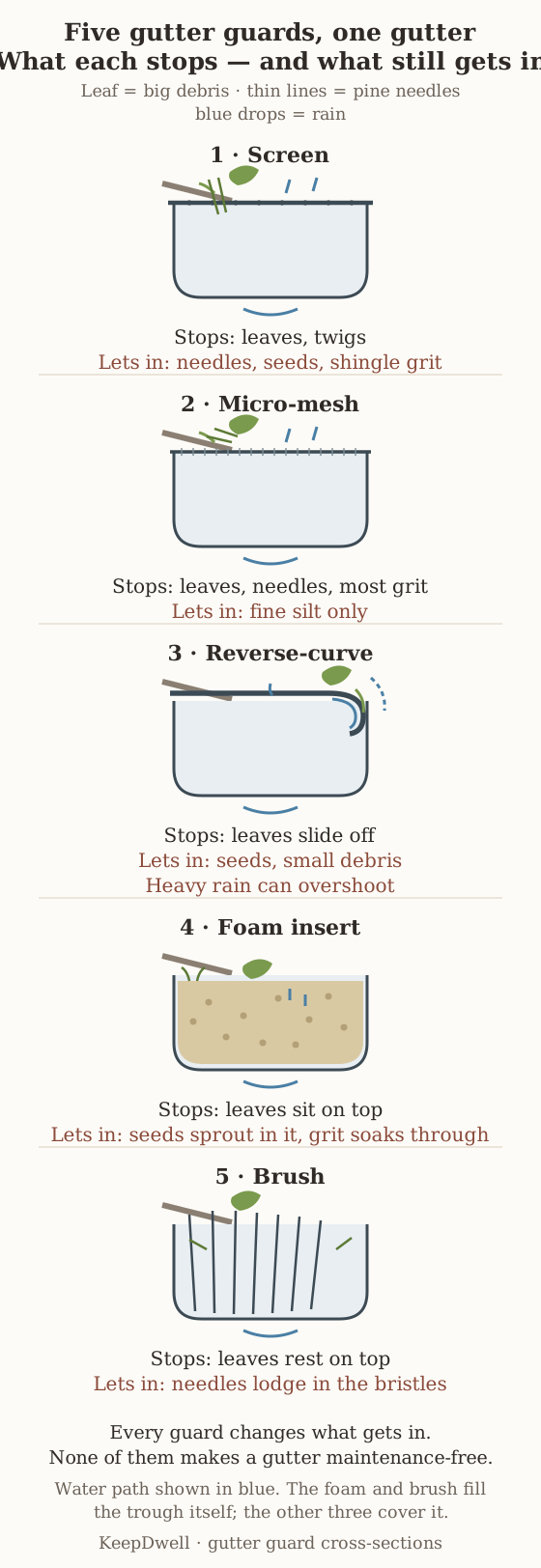
Are Gutter Guards Worth It? Costs by Type, Break-Even Math, and the Homes That Should Skip Them
Gutter guards cost $6–$13 a foot installed, premium systems ten times the DIY price. The honest break-even math by tree cover, what each type really stops, and the homes that should skip them entirely.
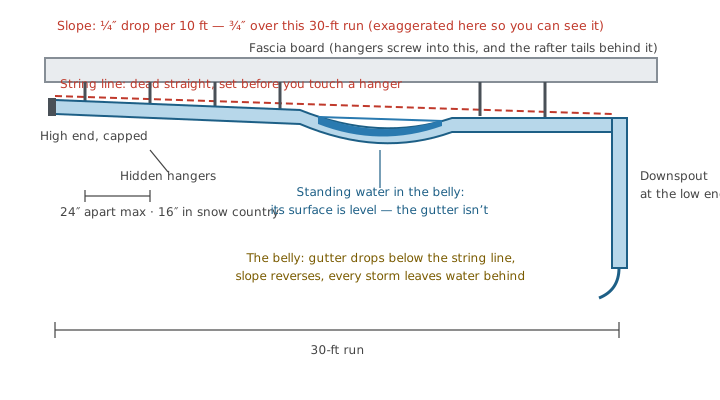
How to Fix Sagging Gutters: Replace Spikes With Screws, Add Hangers, and Reset the Slope
A sagging gutter is a slope problem, a fastener problem, or a rotten-fascia problem — and each has a different fix. The string-line test, the spike-to-hanger conversion, full slope reset, real 2026 costs, and the rehang-or-replace decision.
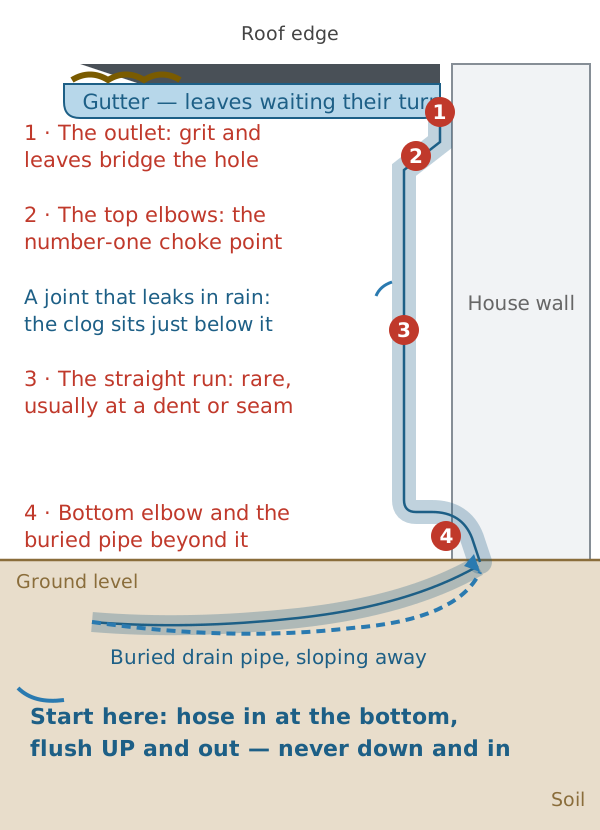
Downspout Clogged? How to Find the Blockage From the Ground and Clear It Without Packing It Tighter
The gutter looks clean but one corner pours over in every rain. Locate the clog from the ground with the tap test, clear it in the right direction (bottom up, never blasted deeper), take elbows apart when you must, and tell when the blockage is in the buried drain.