 Keep
How Often Should You Pump Your Septic Tank? (By Tank Size & Household)
 Daniel Mercer · Editor & Researcher·
Published November 16, 2026·
Updated November 16, 2026
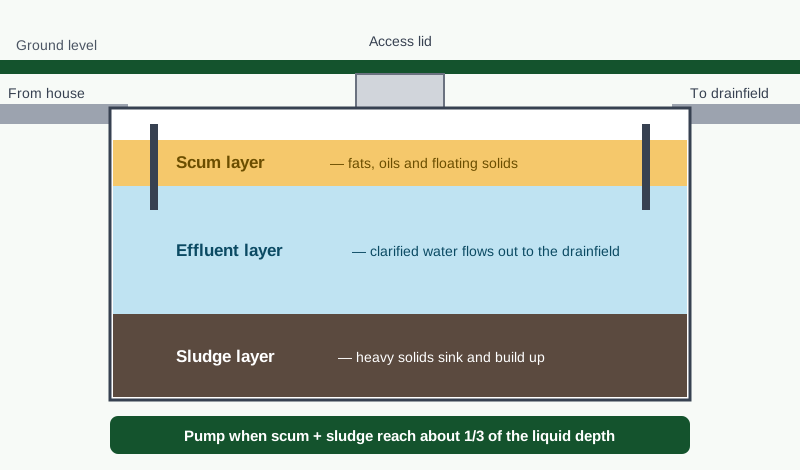
Ask ten septic owners how often a tank needs pumping and you'll hear "every three to five years" nine times. That range comes from the U.S. EPA, and it's a decent answer for an average house. The trouble is that almost nobody owns the average house. A retired couple on a 1,500-gallon tank and a family of six on a 750-gallon tank both get told "three to five years" — yet the couple could safely wait a decade and the family is overdue before year two.
Your real interval comes from two numbers you can pin down today: the size of your tank and the number of people using it. This guide gives you the EPA-based table, the measurement that overrules the table when the two disagree, and the handful of habits that quietly cut your interval in half.
The short version, before the table
The EPA's baseline guidance has two parts. First, have the system inspected by a septic professional at least every three years — more often if your system has pumps, floats or an aerobic treatment unit, which usually means a service contract with yearly visits. Second, expect to pump every three to five years under typical conditions.
"Typical conditions" is doing a lot of work in that sentence. The table below is the same data the EPA publishes in its homeowner guidance, worked out from how fast sludge and scum actually accumulate. Find your tank size, move across to your household size, and you'll have a number that fits your house instead of everybody's house.
Pumping intervals by tank size and household size
Estimated years between pumpings, for a year-round home with no garbage disposal. Source: EPA homeowner guidance (the Mancl pumping model), as republished by university extension services.
| Tank size | 1 person | 2 people | 3 people | 4 people | 5 people | 6 people |
|---|---|---|---|---|---|---|
| 750 gal | 9.1 yrs | 4.2 yrs | 2.6 yrs | 1.8 yrs | 1.3 yrs | 1.0 yrs |
| 1,000 gal | 12.4 yrs | 5.9 yrs | 3.7 yrs | 2.6 yrs | 2.0 yrs | 1.5 yrs |
| 1,250 gal | 15.6 yrs | 7.5 yrs | 4.8 yrs | 3.4 yrs | 2.6 yrs | 2.0 yrs |
| 1,500 gal | 18.9 yrs | 9.1 yrs | 5.9 yrs | 4.2 yrs | 3.3 yrs | 2.6 yrs |
| 2,000 gal | 25.4 yrs | 12.4 yrs | 8.0 yrs | 5.9 yrs | 4.5 yrs | 3.7 yrs |
Three things worth noticing in those numbers.
Household size matters more than anything else. The same 1,000-gallon tank lasts one person over twelve years and six people about eighteen months. Every person in a home sends roughly 70 gallons of wastewater a day through the system, and the solids in that water are what you're paying to remove.
Small tanks punish big families. If your household has grown — kids, a parent moving in, a finished basement with a new bathroom — but the tank hasn't, your old schedule no longer applies. A 750-gallon tank under a six-person house needs attention roughly every year, which is also a sign the system itself is undersized for how it's being used.
Very long intervals still need inspections. A one-person household on a big tank may not need pumping for a decade, but baffles corrode, lids crack and roots find pipes on their own schedule. The three-year inspection habit is what catches those problems while they're still cheap.
Don't know your tank size? Four ways to find out
You can't use the table without this number, and "the previous owner said it was big" is not a number. In rough order of effort:
- Your closing paperwork. Home inspection reports and seller disclosures often list the tank size, and some states require a septic inspection at sale that records it.
- The last pumping invoice. Pumping companies record how many gallons they hauled away. If a previous owner left receipts — check the folder of house documents, the garage wall, wherever the furnace filter sizes live — the gallons pumped are a strong clue to the tank's working size.
- County or health department records. The original permit and as-built drawing usually state the tank size, its location and the drainfield layout. Many counties will hand over a copy for a small fee, and it's worth having regardless: knowing where everything sits beats probing the yard with a rod.
- Measure it at the next service visit. With the lid open, a pumper can measure the tank's internal length, width and liquid depth and calculate the volume on the spot. Ask them to write the size on your invoice, and your guessing days are over.
If nobody can tell you anything, the working assumption for a three-bedroom home is 1,000 gallons, four bedrooms usually means 1,250 — but treat those as placeholders until a record or a tape measure confirms them.
The measurement that overrules the calendar
Here's the part most "every 3–5 years" advice skips: the calendar is an estimate, but the tank itself keeps score. Inside your tank, three layers form. Solids that sink become sludge at the bottom. Grease and floatables become scum at the top. Between them sits clarified liquid — effluent — which is the only layer that should ever leave through the outlet to your drainfield.
Pumping is due when the two solid layers crowd out the liquid layer. The criteria used in EPA homeowner materials are specific:
- Pump when the bottom of the scum layer is within 6 inches of the bottom of the outlet pipe, or
- when the top of the sludge layer is within 12 inches of the outlet, or
- when sludge and scum together occupy roughly a third of the liquid depth (you'll also see this stated as 25–33%).
The authorities don't land on exactly the same figure — EPA homeowner materials work out to roughly 25–30%, its 2002 design manual uses 30%, and some state codes, Wisconsin's among them, set the trigger at a full third of the liquid depth. Same instruction, different rulers: once the solids are anywhere near a third, book the truck.
Past those lines, solids start escaping with the effluent. They don't dissolve out in the drainfield — they accumulate in the soil pores and form a clogging mat, and that is the failure that costs real money.
This is why the smart move at any service visit is to ask one question: "What were the scum and sludge depths?" A pumper measures both layers before pumping, in minutes, with a core sampler or a wrapped pole. Get the numbers written on your invoice. Two visits of measurements tell you your tank's actual fill rate, which is better information than any table — including the one above.
A caution if you check the levels yourself: work from the surface, through the inspection ports or an opened lid, and never lean into the tank or reach inside. The gases in a septic tank can overcome a person without warning. Looking and measuring with a long pole is fine; entering a tank, ever, is not.
When the law sets your interval, not the tank
Everything above assumes the schedule is yours to choose. For a sizeable minority of owners, it isn't.
Most states set no pumping calendar for an ordinary house. But three kinds of rules override the table where they apply:
- Point-of-sale inspection laws. Massachusetts' Title 5 is the best-known: a septic system must be inspected when the property is sold, and a failed inspection can force repairs before or shortly after closing. A number of other states and counties have similar transfer rules — which is why "when was it last pumped?" belongs on every buyer's question list.
- Watershed protection rules. In Virginia's Chesapeake Bay Preservation Area, septic tanks must be pumped or inspected at least once every five years — whether they look like they need it or not — to protect the bay. Other watershed districts set their own cycles.
- Municipal and county programs. Some towns and counties run mandatory schedules of their own, commonly a pumping or an inspection every three years, with notices mailed to owners and proof of service filed by a licensed pumper.
The pattern: where a rule exists, it usually mandates the inspection on a schedule; pumping follows when the inspection — or the one-third measurement — says so. The law sets the check-up; the tank still sets the pump-out.
Finding out which world you live in takes one call to your county health or environmental department: ask whether a mandatory program covers your address, and whether a transfer inspection will apply when you sell. If you're on a legal schedule, write that date next to your measured interval and obey whichever comes first.
Five things that shorten your interval (and two that stretch it)
The table assumes average water use and no garbage disposal. Real houses drift from average in predictable ways.
A garbage disposal is the big one. Ground food waste doesn't break down the way human waste does, and the EPA puts the extra solids load at up to 50%. Run a disposal daily and the honest adjustment is to cut every interval in the table roughly in half — the family of four on a 1,000-gallon tank drops from 2.6 years to somewhere near 18 months. Some households instead stop using the disposal for anything but scraps that escape the trash, which buys most of that time back.
Water volume is the second lever. The table is built on ordinary use; a house that runs the washer daily for six people, fills a soaking tub every night, or hosts a long line of guests is filling the tank faster than the headcount suggests. A leaking toilet deserves special mention: a flapper leak can send hundreds of extra gallons a day into the tank, stirring up solids and pushing them toward the field. Fixing it is a two-dollar part and one of the cheapest septic protections there is.
Hot tubs and water softeners add surges. Draining a hot tub into the septic system dumps hundreds of gallons at once and can flush solids straight through. Many installers route hot tub drainage elsewhere for exactly this reason. Water softener backwash is a smaller, recurring surge; modern demand-initiated softeners backwash far less often than old timer models.
System type changes the service rhythm. Everything above describes a conventional gravity system. If you have an aerobic treatment unit, a pump chamber, or effluent filters, the maintenance picture is different: filters need cleaning (often at pumping, sometimes between), pumps and floats need checking, and many counties require a maintenance contract for aerobic units. The tank still gets pumped on roughly the same solids schedule, but the inspection side is annual, not every three years.
What stretches the interval: fewer people than the house was built for, low-flow fixtures that genuinely cut daily gallons, and spreading laundry across the week instead of doing seven loads on Saturday — the tank handles a steady flow far better than a flood. None of these change the solids math dramatically, but together they can add a year or more.
Worked examples: the maths for houses the table doesn't fit
The table stops at six people and 2,000 gallons, and real houses wander outside it. The model underneath is simple enough to extend: the interval scales roughly with tank size divided by the number of people. Double the people, halve the time; double the tank, double the time.
Eight people, 1,500-gallon tank. The table's nearest cell — six people on 1,500 gallons — reads 2.6 years. Scale by the headcount: 2.6 × (6 ÷ 8) ≈ 1.95 years, so call it every two years. Now add a garbage disposal in daily use and apply its adjustment on top — roughly two-thirds of the interval — and you're at about every 15–16 months. A house this full should be measured at every visit; the margin for error is thin.
Two people, 2,500-gallon tank. Scale up from the 2,000-gallon row: two people there get 12.4 years, and the bigger tank stretches that by 2,500 ÷ 2,000, to roughly 15 years. Don't actually run fifteen years between looks inside the tank, though — baffles corrode, lids crack and filters clog on their own clock. Treat the long interval as permission to pump rarely, not to inspect rarely: keep the three-year inspection, let the measurements confirm the layers are growing as slowly as the maths predicts, and pump when they approach the one-third line.
A cabin used about 70 nights a year, four people, 1,000-gallon tank. Full-time, that household's interval is 2.6 years. But the tank only works when somebody's there: 70 nights is about 19% of the year, so the calendar stretches by roughly 1 ÷ 0.19 — a fill that takes 2.6 years of full-time use takes around 13–14 years of cabin time. Have the layers measured every two to three years, pump on the measurement, and ignore the calendar.
Then replace the table with your own number. After two pump-outs you own something better than any chart: your tank's measured fill rate. Say your tank's liquid depth is 48 inches, so the one-third threshold is 16 inches of combined sludge and scum. The tank was pumped clean, and at the next visit, three years later, the combined layers measured 9 inches — a fill rate of 3 inches a year. From empty, you would reach the threshold in 16 ÷ 3 ≈ 5.3 years. Book the next pumping at about four and a half years, keeping a safety margin, and write the rate — inches per year — on your record card. From then on, the question in this guide's title is one you've already answered with your own data.
Signs you're already overdue
A tank that needs pumping rarely announces it politely, and the earliest signs are easy to blame on something else. In rough order of appearance:
- Several drains slow down at once. One slow sink is a clog in that sink's line. Every drain in the house slowing together points downstream — at the tank or beyond it.
- Gurgling. Toilets and drains that gurgle or bubble when water runs elsewhere are moving air around liquid that can't get away fast enough.
- Odor. Sewage smell near the tank or drainfield, or at floor drains inside, means gases or effluent are ending up somewhere they shouldn't.
- A suspiciously green stripe. Grass over the drainfield that grows faster and greener than the rest of the lawn is being fertilized from below. So is soggy ground or standing water over the field when it hasn't rained.
- Backup at the lowest fixture. Sewage appearing in a basement shower or floor drain is the end of the list, not the beginning. Stop running water and call the same day.
Any one of these on a tank with an unknown service history should move "schedule pumping" from the someday list to this week. Our guide to the signs of a full septic tank walks through how to tell a full tank from a simple clog — the fixes and the bills are very different.
Pumping day, step by step: what happens, what to watch, what to check
Pumping is the pumper's job, but verifying it is yours — and verification is the difference between a tank that was actually emptied and one that was merely visited. A pumping visit is closer to a delivery than a construction project. Here is how it should run, in order.
Before the truck arrives
- Clear the way in. Move cars off the tank and the drainfield, unlock gates, and keep pets and kids inside. If you know where the lids are, mark them. If you don't, have your records — permit, as-built drawing, last invoice — ready to hand over; locating from paper beats probing the yard.
- Ease off the water that morning. No laundry marathon, no string of long showers, no draining the hot tub into the system. A calmer tank lets the layers settle so the measurements read true.
- Decide on risers in advance. If your lids are buried, this visit — with the holes already dug — is the cheapest moment you'll ever get to add risers. Get the price before the day, not while standing over an open tank.
While the tank is open
- Measurements come first. Before anything is pumped, the technician measures the scum and sludge layers. Ask for both numbers out loud and watch them written down. Those two figures are the entire basis for your next interval — a visit that skips them is guesswork with a truck.
- Pumping happens through the manholes, not the inspection ports. The small ports are for looking and measuring; the full-size access holes are how sludge actually comes out. Two compartments? Both get pumped — confirm it before the hose goes in.
- The tank comes out empty. Liquid, scum and sludge all leave, and the technician may backwash a little water to loosen solids settled in the corners. What remains should be an empty tank — not a tidier layer of the same sludge you paid to remove.
- Baffles and filter get checked while there's access. The outlet baffle or effluent filter is pulled, rinsed and shown to you. A cracked baffle or a filter choked with solids is cheaper to deal with now than after it has passed solids to the field — and this is the one moment cracks, corrosion and root intrusion can be spotted at all.
After the truck leaves
- Read the paperwork before you file it. A complete invoice or service report shows the date, the gallons removed, the tank size, the scum and sludge depths measured before pumping, baffle and filter condition, any repairs recommended, and a suggested next-service date. If a field is blank, ask for it on the spot.
- Turn the measurement into your next date. File the depths with your house records — the thirty-second system in the final section of this guide — and set the reminder now.
The whole visit typically runs 30 to 60 minutes once the lids are exposed; digging down to buried lids is the variable, and usually the worst of it.
If the measurement says "not yet." Sometimes the layers come back thin and pumping today buys you little. That is what an inspection-only visit is for — roughly $150–$350 for the measurements and a condition report without the pump-out. Play it one of two ways. If the lids are already open, the truck is already there and your service history is unknown, pumping anyway costs little extra and resets your clock to a known zero. If the numbers are low and your records are solid, take the written depths, set a recheck date from your measured fill rate, and wait. What you shouldn't accept is a verdict of "looks fine" with no numbers attached.
What it costs, and what moves the price
The cost table at the top of this guide gives the national picture: a standard pump-out of a 1,000-gallon tank typically runs $300–$600, with a national average around $430. Where you land in that range depends on tank size, how deep and findable the lids are, local disposal fees (which vary a lot by county), and how overdue the tank is — sludge that has sat for a decade compacts and takes longer to remove.
The number to hold it against is the alternative. A drainfield that fails because solids reached it is not cleaned; it's replaced, and replacement commonly runs $15,000–$20,000 depending on soil, size and state rules. Pumping is the cheapest insurance in the entire system: a few hundred dollars every few years, against the single most expensive repair a septic owner can face. Framed that way, arguing about whether your interval is 2.6 years or 3 is missing the point — the expensive mistake is not pumping a little early, it's pumping years late.
Pumping, cleaning, inspecting — three words that get mixed up
Homeowners use these interchangeably, and so do some companies' websites, but they're three different jobs.
Pumping is what this guide is about: a vacuum truck removes everything in the tank — liquid, sludge and scum. Cleaning goes a step further: the technician also washes down the tank walls and floor and clears the inlet and outlet baffles, so the tank is genuinely empty rather than mostly empty. For a routine visit on a healthy tank, pumping is enough; cleaning earns its extra cost on tanks that were neglected, where compacted sludge clings to the bottom and a standard pump-out leaves a layer behind. Inspecting removes nothing at all. It's the measurement visit: layer depths, baffle condition, filter condition, looking for cracks, leaks and signs of drainfield trouble.
The practical takeaway: when you book, say which one you're buying. A cheap "pumping" quote that turns out to be a partial pump — some operators historically pumped only the liquid and left the solids, a practice called "pumping the top" — is no bargain at all, because the sludge you paid to remove is still down there. Ask directly: "Do you pump the tank completely empty, including the sludge?" A reputable company answers yes without blinking, and the measured depths on your invoice will prove it.
Does the season matter?
More than most people expect, and mostly for access rather than biology. Your tank doesn't care what month it is — the bacteria work year-round and the layers build at the same rate. What changes with the seasons is everything above ground.
Spring and early summer are the sweet spot in cold climates: the ground has thawed, so digging to buried lids is easy, the yard isn't yet in full garden mode, and companies aren't yet buried in their busiest season. Winter pumping is absolutely possible — pumpers work all year — but frozen ground over buried lids means more digging time and sometimes a wait for a thaw if the lids can't be found. Risers erase most of this problem, which is another point in their favour.
The one season-based warning that matters: if your interval comes due in the autumn and your winters are severe, don't let it slide "until spring" out of habit. An overdue tank doesn't pause for winter, and a backup during the coldest week of the year, with family visiting, is the worst version of this job. Book it while the ground is still workable.
Part-time homes: judge by use, not the calendar
The table assumes a house that's lived in all year. A cabin used on summer weekends, a snowbird's winter home, or a short-term rental lives a different life, and the calendar misleads in both directions.
For a lightly used second home, the honest method is the measurement, not the date. Have the layers checked every couple of years; a tank serving six weekends a year may take a decade to fill, and pumping a nearly empty tank buys you nothing. For a rental, lean the other way: guests don't moderate their water use, occupancy can exceed the bedroom count, and you won't be there to notice the early warning signs. Rentals on septic generally belong on the shorter end of their table row, with inspections between seasons.
Either way, write down occupancy when you record a service. "Pumped June 2026, sludge at 10 inches after a summer of weekend use by four" is information you can schedule from. "Pumped 2026" is not.
Just bought the house? The inherited-tank protocol
If you've just bought a home with a septic system and no trustworthy records, your job in the first ninety days is to manufacture one honest baseline measurement. In order:
Days 1–14: hunt the paper. Start with your closing documents and the seller's disclosure — tank size and a last service date are sometimes right there. Then contact the county health or environmental department and ask for the permit and as-built drawing for your address — most send it free or for a small fee, and it shows the tank's size, location and the drainfield layout. Ask the seller — through your agent, if needed — one direct question: which company serviced the system, and when? Pumpers keep records by address, and one phone call can recover years of history.
Days 15–45: open it up once, properly. Book an inspection with pumping, not an inspection alone. With an unknown history, the working assumption is that the tank is due; an inspection that ends with "pump it soon anyway" just buys the same truck twice. Have the technician confirm the tank's size and construction, measure both layers before pumping, and check the baffles and any effluent filter while the tank is empty and everything is visible. Photograph the open tank and the lid locations. If the lids are buried and digging was a project, price risers now, while the holes are open.
Days 45–90: set your own clock. Write the record card — the four items in the final section below — using this visit as day zero: date, confirmed size, layer depths, condition. Read your row in the table with your actual household size, adjust for the measurements, and put the next date on the calendar. Then walk the drainfield once to learn its boundaries, and keep cars and construction off it from day one — a field crushed in your first summer is a five-figure welcome gift.
Ninety days in, you stop being the owner who inherited a mystery and become the owner with the best records on the street — exactly the position you want to be in when it's your turn to sell.
Keep the record, and the guessing stops
The households that struggle with septic scheduling are the ones relying on memory. It takes thirty seconds to fix that permanently. After each visit, note four things — on the invoice, in a notes app, or on a card taped inside the cabinet under the kitchen sink:
- Date of service, and the company that did it
- Tank size (confirmed, not assumed)
- Scum and sludge depths measured before pumping
- The next due date, from the table, adjusted by those measurements
Then put the next date where you'll actually see it — a calendar reminder for the spring of the due year works well, since booking in spring beats discovering a problem with a house full of holiday guests. Septic companies also get slammed before real-estate closings and around the holidays; an unhurried appointment in a quiet month is easier to get and sometimes cheaper.
That's the whole system: find your two numbers, read your row in the table, verify with a measurement at each visit, and write it down. Do that, and "how often should I pump?" stops being a question you search for — it becomes a date you already know.
Cost at a glance
| Item | Typical cost | Notes |
|---|---|---|
| Septic tank pumping (1,000 gal) | $300–$600 | National average ≈ $430; varies by state, access and disposal fees |
| Septic tank pumping (1,500 gal) | $350–$700 | Larger tanks cost more to empty; two-compartment tanks take longer |
| Full system inspection | $150–$350 | Often discounted when bundled with pumping |
| Riser installation (per access lid) | $300–$600 | One-time cost; brings the lid to the surface so you never pay for digging again |
Frequently asked questions
Can a septic tank go 10 or 20 years without pumping?
Some do — a single person on a 1,500-gallon tank can legitimately go a decade or more. But a family tank that has simply been ignored for 20 years is a gamble, not a schedule. Sludge keeps building whether anyone opens the lid or not, and once it reaches the outlet, solids start moving into the drainfield, where the damage is measured in five figures. If you don't know when yours was last pumped, get it inspected and measured rather than guessing.
Can I pump my own septic tank?
In most places, no. Pumping requires a vacuum truck and the waste must be hauled to an approved disposal or treatment facility; many states and counties also require a licensed pumper. There is a safety reason on top of the legal one: septic tanks hold gases that can knock a person out in seconds, and nobody should ever lean into or enter a tank. What you can safely do yourself is open the inspection ports or lid from the surface and measure the scum and sludge layers with a long pole or a sludge sampler.
How do I find out what size my septic tank is?
Start with paperwork: the permit and as-built drawing at your county health department, the home inspection report from when you bought the house, or the invoice from the last pumping — pumpers record the gallons they removed. No paperwork? A service company can measure the tank's length, width and liquid depth at the next visit and work the size out from the dimensions. Tanks installed for a 3-bedroom home are commonly 1,000 gallons, but treat that as a guess until it's confirmed.
Do septic additives mean I can pump less often?
No. The EPA's position is that a normal household system already contains the bacteria it needs, and additives have not been shown to reduce how often a tank needs pumping. Nothing digests sludge away to zero — the solids that settle have to leave in a truck eventually. Additives are at best an unnecessary expense; some can do harm by breaking up the scum layer and letting solids wash toward the drainfield.
Should I pump the tank before selling my house?
It depends on your state and county — some require a septic inspection, and sometimes a pump-out, at property transfer, and many buyers or lenders ask for one anyway. Even where it isn't required, a recent pumping and inspection receipt is cheap reassurance for a buyer and removes a negotiation lever. Check your local health department's transfer rules before listing.
How long does a pumping visit take?
Usually 30 to 60 minutes once the lids are exposed. Most of the variation is digging: if your lids are buried deep and nobody knows exactly where they are, finding and uncovering them can take longer than the pumping itself. This is why so many pumpers recommend risers — after the first visit, access takes minutes.
We just bought the house and have no records. When should we pump?
Book an inspection with pumping in your first year and treat whatever the pumper finds as your baseline. Ask them to measure and write down the scum and sludge depths, the tank size and its condition, then set your next date from the table in this guide using your household size. From that visit on, you'll never have to guess again.
Checked November 16, 2026. This guide is general information, not a substitute for a licensed professional.
Related guides
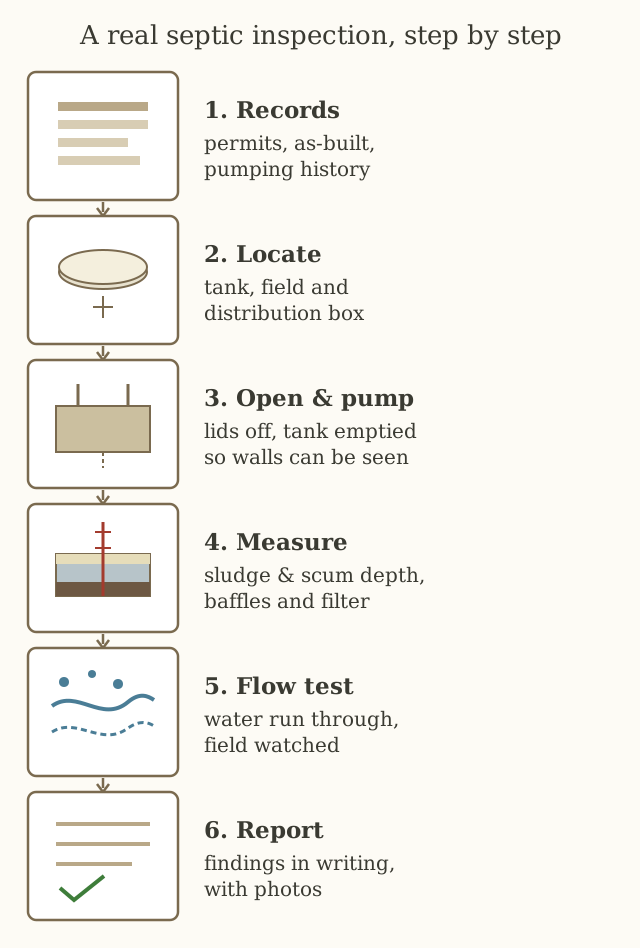
Buying a House With a Septic System? The Inspection That Can Save You $20,000
A standard home inspection barely touches the septic system. Here's what a real septic inspection includes, what it costs, the records to demand, and the contract wording that protects you.
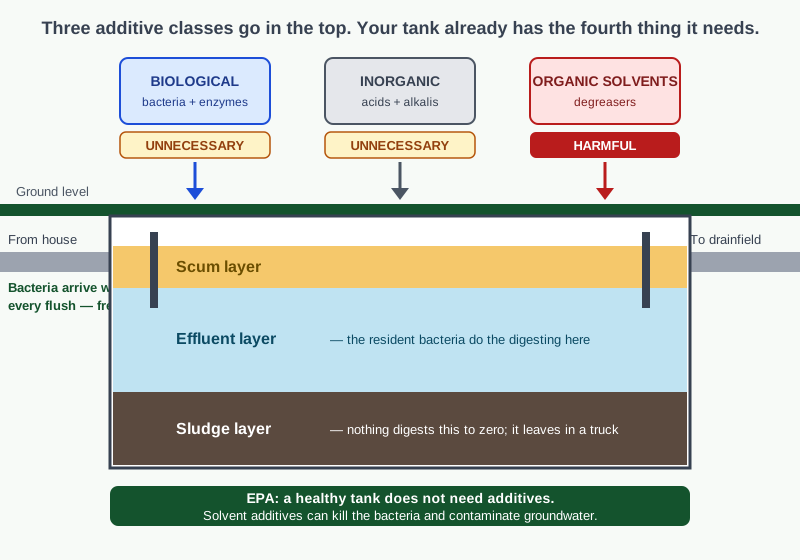
Do Septic Tank Additives Work? What the EPA and the Studies Actually Found
The EPA does not recommend septic additives, a 48-tank double-blind study found no measurable benefit, and one additive class is actively harmful. The evidence, the money maths, and the one narrow exception.
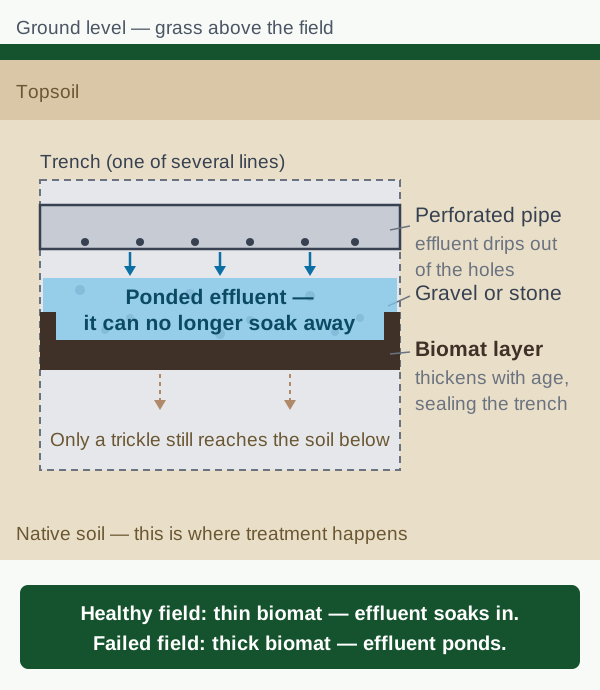
Drain Field Failure Signs: Soggy Ground, Green Stripes and Surfacing Effluent
A failing drain field announces itself in the yard first: lush green stripes, spongy ground, odors, then standing water. The early vs late signs, the look-alikes that aren't failure, a homeowner diagnosis sequence, and what repair or replacement really costs.