 Keep
Do Septic Tank Additives Work? What the EPA and the Studies Actually Found
 Daniel Mercer · Editor & Researcher·
Published November 16, 2026·
Updated November 16, 2026
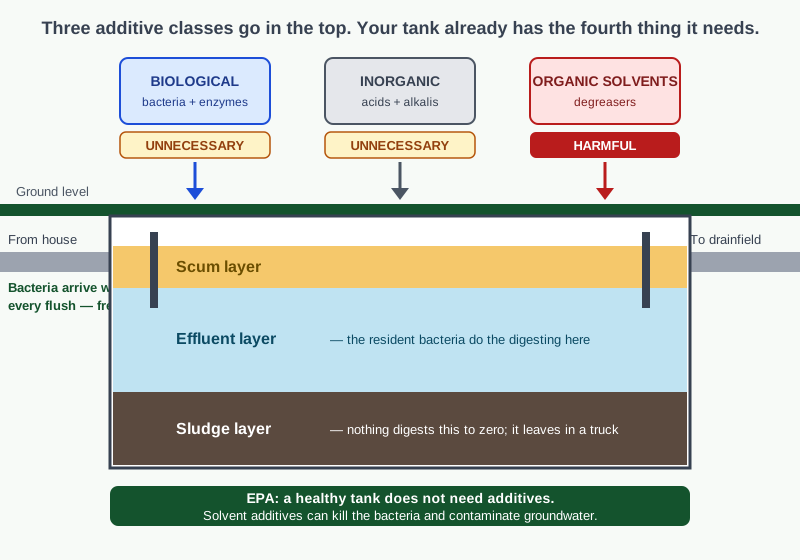
Stand in the plumbing aisle of any hardware store and you will find a small shelf of boxes and jugs promising to keep your septic tank healthy: a dose a month, flush it and forget it, never worry about your system again. If you have just bought a house with a septic tank, that shelf is aimed directly at you. You did not grow up with this system, nobody handed you a manual at closing, and the one thing you know for certain is that a septic failure costs more than most cars you have owned. A ten-dollar box that promises to prevent it feels less like a purchase and more like insurance.
So the honest question deserves an honest, sourced answer: do septic tank additives actually work? This guide goes through the three classes of products on that shelf, what the EPA's current fact sheet says, what the best field study ever run on the question found, and what the habit costs over a decade next to the maintenance it claims to replace. The short version is at the top of this page. Here is the evidence underneath it.
Why the products sell: fear plus a ritual
Nothing about the additive shelf is an accident. Septic systems are buried, silent and unfamiliar, and the failure mode is spectacular: sewage in the yard or the basement, and a replacement bill in the tens of thousands. Against that background fear, a monthly additive offers two things that have nothing to do with bacteria.
The first is a ritual that feels like maintenance. Real septic maintenance is unglamorous and infrequent: an inspection every few years, a pump truck every three to five, and daily water discipline nobody sees. A packet you flush on the first of the month feels like doing something. It has a schedule, a box that empties, a subscription that renews. It converts an invisible underground process into a visible household chore, and chores feel responsible whether or not they accomplish anything.
The second is the suggestion that the expensive thing is optional. Marketing in this category leans hard on phrases like "helps break down solids" and "supports a healthy system", which sit one short step away from the conclusion the buyer draws on their own: maybe this stretches the time between pump-outs, maybe it prevents the big failure. That implication is where the money is, and it is exactly the claim the evidence does not support, as the study results below show.
None of this makes the buyers foolish. It makes the products well-aimed. The fix is not willpower; it is knowing what is already happening inside your tank for free.
What is actually inside the tank (and why it does not need help)
A septic tank is not a sterile box waiting to be inoculated. It is a warm, dark, constantly fed fermentation vessel, and the feedstock arrives pre-loaded. Human waste carries an enormous bacterial population, on the order of billions of organisms per gram, and every flush delivers a fresh shipment of exactly the species that digest human waste, because they just came from digesting it. Washington State University Extension makes the comparison bluntly: the amount of bacteria or enzyme in an additive dose is small compared with the bacteria already present in a working tank, which is why a dose provides little if any benefit.
Inside the tank, those bacteria do two jobs. They digest a portion of the solids, converting some of it to liquid and gas, and they maintain the separation the whole design depends on: heavy solids sink into the sludge layer, grease and floatables rise into the scum layer, and clarified liquid, the effluent, flows out the middle to the drainfield. What the bacteria cannot do, and no product can change, is make the indigestible fraction disappear. Sludge and scum accumulate steadily, and when together they take up about a third of the tank's liquid depth, the tank needs pumping. That is not a malfunction the right packet could prevent. It is the arithmetic of the design.
The three classes of additives, and the verdict on each
Everything on the shelf falls into three families, and lumping them together is how both the marketing and the scare stories mislead. They are different chemistries with different verdicts.
1. Biological additives: bacteria and enzymes. The RID-X class. These are freeze-dried or liquid cultures of bacteria, sometimes with enzymes, yeasts or fungi, sold as monthly maintenance doses. The enzymes are real chemistry: they can break certain compounds into smaller pieces. The problem is redundancy. The tank already holds a vast, self-renewing population of the same organisms, replenished by every flush, and enzymes produced by the resident bacteria are already present in quantities a packet cannot meaningfully add to. Verdict: unnecessary. Not dangerous, not useful; a subscription to something your household manufactures free.
2. Inorganic compounds: strong acids and alkalis. Caustic openers and chemical treatments built on compounds like sulfuric acid, caustic soda or hydrogen peroxide. These do not feed the tank's biology; they attack the clog or the solids chemically, and they are indiscriminate about what else they attack: pipe joints, seals, concrete, and the bacterial colony itself. Hydrogen peroxide treatments deserve a specific mention because they were marketed as the "oxygenating" option, and were found to degrade the structure of drainfield soil, the one part of the system you cannot afford to damage; Washington State bans them. Verdict: unnecessary, and harsher than any problem they claim to solve.
3. Organic solvents: degreasers. The genuinely harmful class. Solvent-based products dissolve grease, which sounds like exactly what a scum layer needs, until you follow the grease. Dissolved and broken-up scum does not vanish; it washes out of the tank with the effluent and re-solidifies in the drainfield soil, clogging the pores the field depends on. Meanwhile the solvents themselves can kill the tank's bacteria on contact and, being mobile toxic compounds, can travel with the effluent through the soil toward groundwater. Verdict: harmful. This is the class behind the state restrictions, and the one to keep out of your system entirely.
What the evidence actually says
Three independent authorities have examined this category, and they land in the same place.
The EPA's position. The EPA's Septic Tank Additives Fact Sheet (publication 830-F-24-003, updated in September 2024) states it directly: "Commercially available microbiological and enzyme additives are not necessary for a septic system to function properly when treating domestic wastewater." The agency does not recommend additives, and it gives three reasons: potentially harmful impacts, that they are unnecessary for operation, and limited research behind the claims. Its homeowner guidance adds the practical corollary: there is no scientific evidence that additives extend a system's life or reduce how often a tank needs pumping.
The Minnesota study. The strongest evidence is not an opinion at all. University of Minnesota researchers ran the most rigorous field test in this category: 48 septic tanks, double-blind, over twelve months, with sludge accumulation and bacterial populations measured quarterly, comparing tanks dosed with bacterial additives against a control group that received nothing. The conclusion, in the study's own words: "No significant, positive long-term additive treatment effects occurred across all maintenance levels." The treated tanks' bacterial populations were statistically identical to the untreated controls, and their sludge built up at the same rate. Kansas State University research reached the same result, and a peer-reviewed study in the Journal of Environmental Health (Pradhan et al., 2011) found additives did not measurably improve effluent quality either. When the treated group and the do-nothing group finish in a dead heat across every measurement, the product's contribution is zero by definition.
The state rules. Regulators have acted on the harmful end of the shelf. Washington State has, since 1996, made it illegal to sell or use any septic additive the Department of Health has not reviewed and placed on its approved list. Two things about that list are worth understanding. First, the review asks only whether the ingredients are unlikely to harm the system, groundwater or human health. Second, the state says explicitly that being listed is not an endorsement that the product works. Several other states, including Montana, Delaware, Rhode Island and Connecticut, restrict or ban specific chemical additive categories. And the baseline fact for the whole country: no state requires any homeowner to use additives, ever.
Put the three together and the picture is consistent from every direction. The regulator says unnecessary. The controlled study says no measurable effect. The states that looked hardest restricted the chemical end of the category. What is left holding up the shelf is marketing.
"But my neighbour swears by them"
Every additive conversation eventually produces a testimonial: someone who has dosed monthly for a decade and never had a problem. The Minnesota study is the answer to the testimonial, because the study is what you get when you run hundreds of testimonials at once with the guessing removed. Three traps make individual stories unreliable here.
The first is survivorship. A well-built system on good soil, pumped on schedule, can run for decades with nothing added at all. Its owner, dosing faithfully, credits the packet for what the design, the soil and the pump truck did. You never hear the matching stories from owners whose systems failed while dosing, because nobody frames that as a testimonial.
The second is the bundled habit. People who buy additives tend to be people who maintain things: they also pump on time, fix leaks, and keep cars off the drainfield. The additive is the most visible item in a bundle of good behaviour, so it collects the credit for all of it.
The third is the tank that was never in trouble. A healthy system produces no symptoms whether you dose it or not, so every quiet month feels like evidence. The control tanks in Minnesota were quiet for twelve months too, on nothing at all. Quiet is what a healthy tank does. It is not a result the product can claim.
None of this means your neighbour is lying. It means his experience, like everyone's, cannot separate the packet from everything else he does, and the one experiment that could separate them already has.
The money table nobody builds
Additive marketing works one month at a time, because a monthly price is the smallest possible way to state the cost. Run the same habit over the horizons a septic system actually lives on, and set it next to the maintenance it claims to replace, and the trade looks different.
| Spending path | 5 years | 10 years | What you actually get |
|---|---|---|---|
| Monthly biological additive at $10/month | $600 | $1,200 | No measured change in sludge, bacteria or pumping interval |
| Monthly biological additive at $15/month | $900 | $1,800 | The same nothing, at the premium tier |
| Pumping a 1,000-gallon tank on schedule | $300–$600 per visit | Roughly 2–3 visits | The solids physically removed; the drainfield protected |
| Inspection every 3 years | $150–$350 per visit | Roughly 3 visits | Early warning on baffles, filters and field health |
A decade of the mid-priced habit, $1,200 to $1,800, buys two to four complete pump-outs, or an inspection at every recommended interval with money left over. And here is the part the comparison usually hides: the additive buyer still owes the pumping bill. The study tanks on additives filled at the same rate as the controls, so the habit does not buy a longer interval, a skipped visit, or a smaller invoice. It buys a parallel expense stacked on top of the identical maintenance schedule, forever, in exchange for a ritual.
The subscription model deserves a word of its own, because it is where the category's real business sits. Auto-ship programmes convert a one-time moment of new-owner anxiety into a permanent monthly charge, and they are deliberately easier to start than to stop. Notice, too, who does not sell this way: your pumper. The companies that empty tanks for a living see the inside of dosed and undosed systems side by side, and the industry's service model remains the inspection and the pump-out, not the packet. When the people who would profit from a monthly product mostly decline to sell you one, that is information.
Framed as insurance, it fails the same way. Insurance pays out when the bad thing happens. The bad thing here is a drainfield destroyed by solids that should have been pumped out, and additives do not reduce that risk by any measured amount; the solvent class increases it. The only spending that actually lowers the risk is the unglamorous pair in the bottom rows of the table.
The one exception: restarting a tank whose biology was knocked out
Everything above is about topping up a working tank, which is pointless. There is a different situation, and honesty requires giving it its full weight: a tank whose bacterial colony has been genuinely knocked down is not a working tank, and in that narrow window a single biological dose is defensible. It will not outperform simply using the system normally, since every flush reseeds the colony anyway, but it is cheap, harmless, and can plausibly shorten the recovery by days. The cases are specific:
- A heavy course of antibiotics in the household. Strong or prolonged antibiotics pass through the patient and keep working on the tank's bacteria on arrival. A household member on weeks of high-dose treatment is the classic case.
- A large accidental bleach or antibacterial dump. A spilled bottle of bleach poured down a drain to dispose of it, an over-chlorinated cleaning binge, or a malfunctioning water treatment system discharging heavily chlorinated backwash into the septic line.
- A house vacant six months or more. No flow means no food. A system that sat through a long vacancy, an estate sale or a slow renovation restarts with a starved, thinned-out colony.
- Immediately after a pump-out. The truck removes the sludge and scum, and with them a large share of the resident population. The tank restarts from a much smaller base than usual.
The protocol, if you do it: buy one biological product, bacteria or bacteria-and-enzyme, from the first class on the shelf, not a chemical, not a solvent, and nothing with a subscription attached. Dose it once, in the evening, flushed through a toilet so it travels the full line, and then simply use the house normally: regular flushes, normal showers, laundry spread through the week. Do not repeat the dose monthly "to keep it going"; the flushes are keeping it going. If the event was a chemical dump, the dose matters less than stopping the source: reroute the softener backwash if that was the culprit, and never dispose of bleach or solvents through a drain again. Within a few weeks of normal use the colony is rebuilt either way, which is precisely why this exception is a one-time ten-to-twenty-five-dollar decision and not a programme.
How a knocked-out tank actually behaves, so you can tell the difference. A system whose biology is genuinely suppressed usually shows it at the drainfield end, not with drama in the house: effluent leaving the tank carries more undigested solids than it should, odours appear around the tank or field that were not there before, and in an aerobic treatment unit the manufacturer-specified checks start failing. It follows an identifiable insult, one of the four cases above, rather than appearing out of nowhere. A tank that gurgles, drains slowly or backs up is telling a different story entirely, about volume, clogs or a failing field, and no dose of bacteria answers it. If you cannot point to the insult, you are not in the exception; you are in the symptom chapter, and the right purchase is an inspection, not a packet.
What this exception is not: it is not a treatment for a smelly system, slow drains, gurgling, or any other symptom. Those point at a full tank, a clog, a failing field or a venting problem, and an additive poured over a symptom at best delays the diagnosis. At worst, if the product is a solvent, it converts a diagnosis into a replacement.
Reading the label: the names that mark the dangerous class
Since the three classes share a shelf and similar packaging, the ingredient list is the only reliable sorting tool. You are looking for the vocabulary of the solvent and harsh-chemical classes:
- Solvent names: methylene chloride, trichloroethylene (TCE), toluene, benzene, naphthalene, petroleum distillates, or the vaguer "degreaser", "solvent-based" or "dissolves grease fast" on the front panel. Any of these means put it back. This is the class that kills tank bacteria, mobilises the scum layer into the drainfield, and travels.
- Harsh inorganic names: sulfuric acid, sodium hydroxide (caustic soda, lye), hydrochloric acid, and hydrogen peroxide in treatment-strength products. Marketed as openers and oxygenators; hard on pipes, seals, soil structure and the bacterial colony alike.
- The safe-to-ignore class: products listing only bacteria cultures (often Bacillus species), enzymes such as amylase, lipase or protease, yeast or fungi. These are the unnecessary-but-harmless family. You do not need them, but they are not the ones regulators worry about.
The front of the box needs decoding too, because the vocabulary there is unregulated. "Septic-safe" has no official definition and no certifying body behind it; it is a claim the manufacturer prints, not a standard the product met. "Natural" is no protection either: several of the harshest traditional drain chemicals are simple, naturally occurring compounds, and arsenic is natural. "Enzyme" sounds gentle and biological, and enzyme products are indeed in the harmless class, but remember what the study found: harmless and helpful are different findings, and only the first one is supported. The claims worth treating as a warning rather than a promise are the aggressive ones: "dissolves", "opens", "burns through", "industrial strength". On a septic system, the products that boast about force are the ones whose force does not stop at the clog.
The stakes of the solvent class deserve one more sentence, because this site's readers are exactly the people it hits twice. A solvent additive that leaves the tank rides the effluent into the drainfield, and from there the path of water is down. If your drinking water comes from a well on the same property, and especially if that well sits downhill or downgradient of the drainfield, you are introducing mobile toxic compounds into your own aquifer and calling it maintenance. The EPA's concern about additives and groundwater is not abstract for a septic-and-well household; it is a description of your plumbing.
What to do instead: where the money actually works
The EPA's maintenance guidance for a septic system reduces to three habits, and unlike the additive shelf, each one has a mechanism you can verify:
- Inspect on schedule. A professional inspection at least every three years (annually for systems with pumps, floats or aerobic units) measures the scum and sludge layers, checks baffles and effluent filters, and watches the drainfield. It is the only way problems get found while they are still three-figure problems.
- Pump on the measurement, not the marketing. Expect every three to five years for a typical household, sooner or later by tank size and headcount, and always when sludge and scum together approach a third of the liquid depth. Our guide to how often you should pump your septic tank works through the EPA interval table by tank size and household, and the one-third rule that overrules the calendar.
- Practise water discipline. Spread laundry across the week instead of running seven loads on Saturday, fix the flapper leak that sends hundreds of extra gallons a day into the tank, keep roof and surface water off the drainfield, and keep the genuinely harmful chemistry, solvents, degreasers, paint, antibacterial dumps, out of the drains entirely. A tank asked to handle a steady, reasonable flow outlasts a tank that gets flooded and poisoned in rotation.
Redirect the additive budget to the first two and you have not given anything up. You have traded a ritual that measured zero in a double-blind study for the only two services that have ever been shown to keep a system alive.
One last habit ties the three together, and it costs nothing: keep the record. Note each inspection and pump-out, the measured scum and sludge depths, and the next due date, on a card with the house paperwork. The owners who get talked into additive subscriptions are usually the ones with no records, because a system with no history feels like a system at risk. A system with a written history is just a schedule, and schedules do not need luck, rituals or packets to stay on track.
The bottom line
Do septic tank additives work? The biological ones add bacteria to a tank that receives billions with every flush, and in the best test ever run on them they changed nothing that could be measured. The inorganic ones are harsh chemistry in search of a problem. The solvent ones are worse than nothing: they attack the biology, the scum layer and, potentially, your groundwater. The EPA does not recommend any of them, and the states that reviewed the category most carefully restricted it. Keep the ten dollars a month. Spend it, a few years apart, on the truck and the inspection, and let the tank do what it was already doing.
Cost at a glance
| Item | Typical cost | Notes |
|---|---|---|
| Monthly biological additive habit | $60–$180 per year | A typical monthly dose at $5–$15; $300–$900 over 5 years and $600–$1,800 over 10, and the tank still needs pumping on schedule |
| One-time biological restart dose | $10–$25 | The only purchase this guide endorses, and only for the recovery cases: after heavy antibiotics, a bleach dump, long vacancy, or right after a pump-out |
| Septic tank pumping (1,000 gal) | $300–$600 | The service additives claim to stretch or replace. It cannot be replaced: solids leave in a truck or they do not leave |
| Full system inspection | $150–$350 | Where the additive budget does real work: catches baffle, filter and drainfield trouble while it is still cheap |
| Drainfield replacement | $15,000–$20,000 | The failure additives are marketed as preventing. What actually prevents it is pumping and inspection discipline |
Frequently asked questions
Does RID-X actually help a septic tank, or is it a waste of money?
For a healthy, working tank it is a waste of money, and that is not just an opinion: the University of Minnesota's double-blind study of 48 septic tanks found that tanks dosed with bacterial additives accumulated sludge at the same rate and carried the same bacterial populations as tanks that received nothing at all. The reason is arithmetic. Every flush delivers a fresh load of gut bacteria to the tank, in quantities that dwarf a monthly packet. The EPA's position matches the study: additives are not necessary for a properly functioning system. RID-X-style products are not dangerous in the way solvent additives are; they are simply selling you bacteria your household already supplies for free.
Can septic additives replace pumping?
No, and this is the most expensive misunderstanding in the whole category. A portion of everything that enters the tank cannot be digested at all: it settles as sludge or floats as scum, and it accumulates no matter what bacteria are present. Bacteria break down some solids, but they do not make mass disappear. The accumulated layer has exactly two exits: a vacuum truck, or your drainfield, where it clogs the soil and turns a $300–$600 pumping bill into a five-figure drainfield replacement. Any product that implies it can eliminate pumping is claiming something no study has ever shown.
Are septic tank additives harmful?
It depends entirely on which of the three classes you mean. Biological additives (bacteria and enzymes) are mostly harmless, just unnecessary. Inorganic compounds, strong acids and alkalis sold as openers or cleaners, are harsh chemistry that can damage pipes, seals and the tank's biology. Organic solvents and degreasers are the genuinely dangerous class: they can kill the bacteria the system depends on, dissolve and break up the scum layer so solids wash into the drainfield, and carry toxic compounds through the soil toward groundwater. Read the ingredient list before anything goes down a drain; the label-decoding section of this guide lists the names that mark the dangerous class.
What exactly does the EPA say about septic additives?
The EPA does not recommend them. Its Septic Tank Additives Fact Sheet (publication 830-F-24-003, updated September 2024) states that commercially available microbiological and enzyme additives are not necessary for a septic system to function properly when treating domestic wastewater, and gives three reasons for not recommending additives generally: potentially harmful impacts, that they are unnecessary for operation, and limited research supporting the claims made for them. The EPA's homeowner guidance says the same thing in shorter form: a normally used system already contains all the bacteria it needs.
Are septic additives illegal in any states?
Some are restricted, and Washington State is the strictest example. Since 1996 it has been illegal there to sell or use a septic additive that has not been reviewed by the state Department of Health and placed on its approved list. Note what approval means, though: the state reviews whether ingredients are unlikely to harm the system, groundwater or human health, and says explicitly that listing is not an endorsement that the product works. Several other states, including Montana, Delaware, Rhode Island and Connecticut, have restricted or banned specific chemical additive categories, and hydrogen peroxide treatments are banned in Washington after being shown to degrade drainfield soil structure. No state requires homeowners to use additives.
When, if ever, is a septic additive actually worth using?
In one narrow situation: restarting the biology of a tank that has been knocked out rather than topping up a tank that is working. The defensible cases are a heavy course of antibiotics in the household, a large accidental bleach or antibacterial dump into the system, a house that has stood vacant for six months or more so the bacterial colony has starved down, and immediately after a pump-out, when the tank starts empty. Even then it is a single biological dose, bacteria or bacteria-and-enzyme, not a monthly subscription, and normal flushing would rebuild the colony on its own within weeks anyway. The full protocol is in this guide.
I already bought a year's supply. Should I throw it away?
Split the answer by class. If what you bought is a biological product, bacteria or enzymes, using it up is harmless; just do not renew it, and put the money toward your pumping fund instead. If anything on the shelf is a chemical opener, degreaser or solvent product, do not pour it into the system to use it up: that is the class that can damage the tank's biology and reach groundwater. Take it to your county household hazardous waste collection instead, the same trip you would make with old paint and solvents. Either way, cancel any auto-ship. The subscription is the product; the packet is almost incidental.
Checked November 16, 2026. This guide is general information, not a substitute for a licensed professional.
Related guides
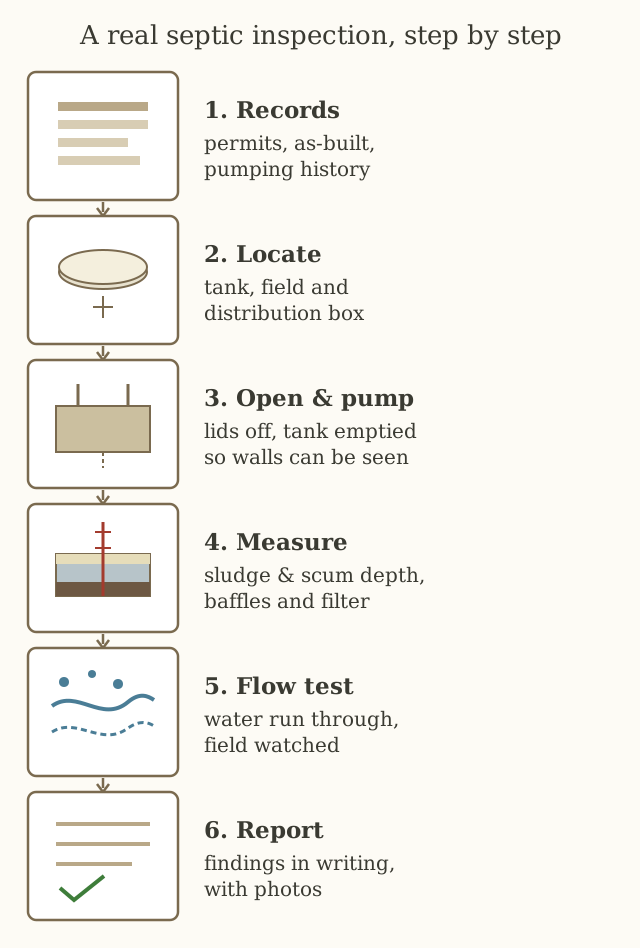
Buying a House With a Septic System? The Inspection That Can Save You $20,000
A standard home inspection barely touches the septic system. Here's what a real septic inspection includes, what it costs, the records to demand, and the contract wording that protects you.
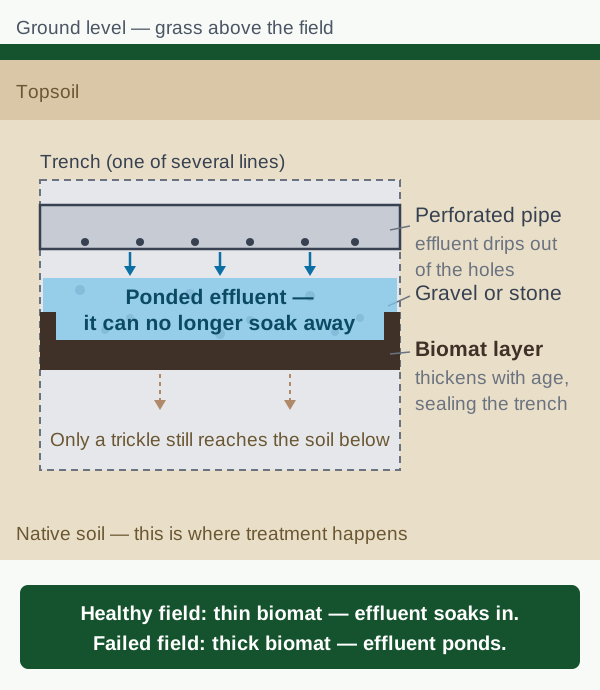
Drain Field Failure Signs: Soggy Ground, Green Stripes and Surfacing Effluent
A failing drain field announces itself in the yard first: lush green stripes, spongy ground, odors, then standing water. The early vs late signs, the look-alikes that aren't failure, a homeowner diagnosis sequence, and what repair or replacement really costs.
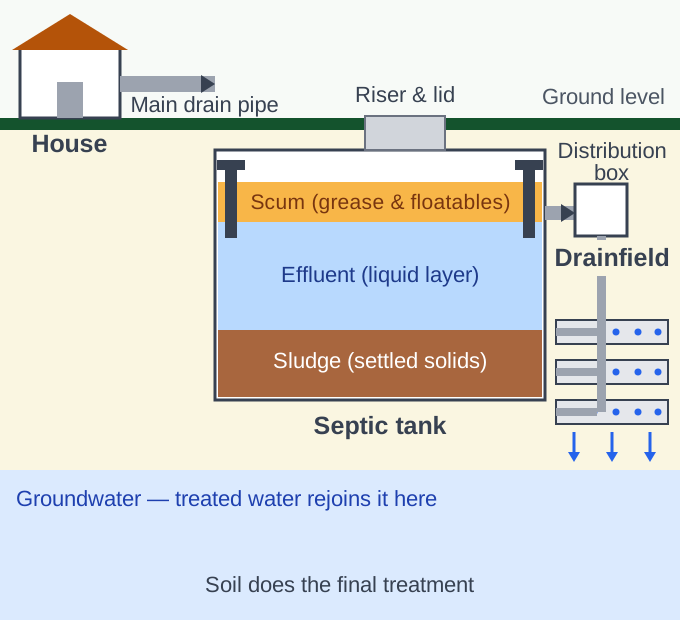
Septic System 101: How It Works, What the Parts Do, What the First Year Costs
Bought a house with a septic system and no manual? Follow one flush through the tank, baffles, filter and drainfield, learn to identify which system type you own, and see what the first year should actually cost.