 Keep
Septic System 101: How It Works, What the Parts Do, What the First Year Costs
 Daniel Mercer · Editor & Researcher·
Published November 16, 2026·
Updated November 16, 2026
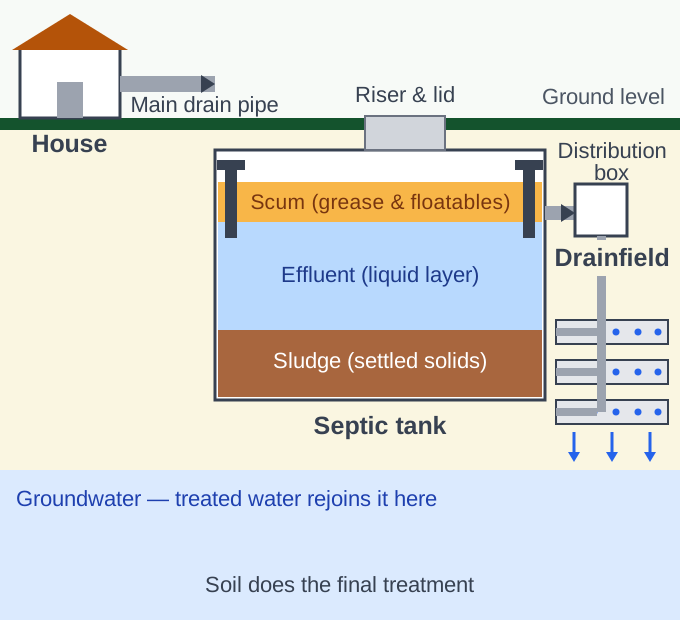
When you buy a house on a septic system, nobody hands you a manual. The seller leaves, the previous owner's knowledge leaves with them, and somewhere under your new lawn sits a buried treatment plant that you now own outright — every pipe, every layer of sludge, every future repair bill. About one in five American homes runs on one of these systems, roughly 21 million households, and a surprising number of their owners couldn't point to where the tank is.
That gap in knowledge is where the expensive mistakes come from. Septic systems are not fragile, but they are unforgiving of neglect and ignorance in a few specific ways: drive a truck over the drainfield and you can crush it; ignore the tank for fifteen years and solids can destroy the field; plant a willow in the wrong spot and its roots will find the pipes. Every one of those mistakes is preventable once you understand what the system is doing down there.
So let's do the thing nobody did at closing. We'll follow a single flush from your bathroom to the groundwater, part by part, so you can see what each component does and what it looks like when it starts to fail. Then we'll identify which type of system you actually own, deal honestly with cesspools, and finish with the first-year routine and budget — what a normal year of ownership costs, and what a neglected one costs instead.
The journey of one flush
Leaving the house: the main drain pipe
Everything starts with one pipe. Every toilet, shower, sink, dishwasher and washing machine in your house drains into a single main line, and that line exits through the foundation and runs — gently downhill, on a conventional system — to the septic tank. This is the first of the four main components the EPA counts in a typical system: a pipe from the home, a septic tank, a drainfield, and the soil.
The main drain pipe has no treatment job at all. Its job is transport, and its failure is simple and memorable: a clog or a collapsed section (tree roots are the usual suspect in older lines) backs sewage up toward the lowest fixtures in the house. If you ever get a backup that affects every drain at once, this pipe and the tank are where the story starts.
Inside the tank: settling, floating, and the three layers
The tank is a buried, watertight box, typically 1,000 to 1,500 gallons for a family home, made of concrete, fiberglass or polyethylene (heavy-duty plastic). Wastewater enters at one end and, because the tank holds it quietly for a day or more, it separates by weight into three layers:
- Sludge — the solids that sink to the bottom. Bacteria living in the tank digest some of this material, which is why the layer grows more slowly than you'd expect, but they never digest all of it. What's left has to be pumped out, physically, by a truck.
- Scum — the layer that floats: oils, grease, soap residues and anything lighter than water, including the odd bit of plastic that should never have been flushed.
- Effluent — the relatively clear liquid layer in the middle. This is the only layer that is supposed to leave the tank.
That separation is the tank's entire job, and it's a genuinely important one. A tank is not where your wastewater gets clean — it's where it gets sorted, so that the solids stay behind and only liquid moves on to the part of the system that does the real treatment.
Two small fittings guard the exit. Baffles — walls or T-shaped pipes at the inlet and outlet — keep the scum layer from drifting toward the outlet and stop sludge from being stirred up when new water rushes in. Many tanks are divided into two compartments, with the first doing most of the settling. And on most systems installed or serviced in the last couple of decades, an effluent filter sits in the outlet baffle: a plastic screen that catches fine solids before they can leave. It is the last line of defence for your drainfield, and it is also, when clogged, a common and cheap-to-fix cause of slow drains.
Here's the close-up of the tank and its fittings:
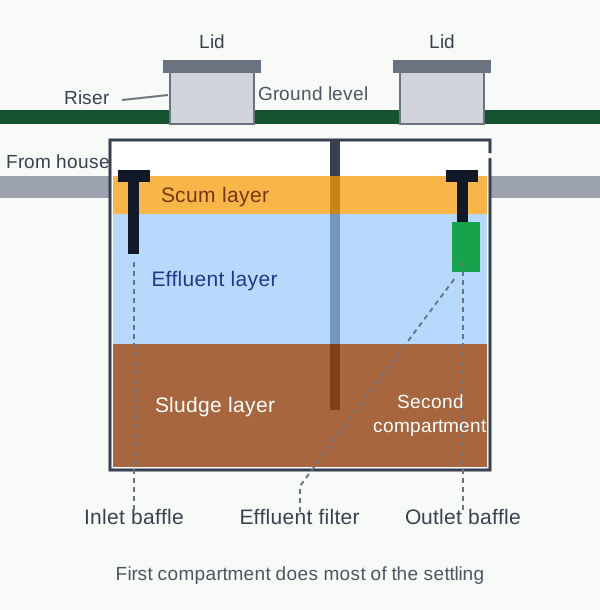
Modern tanks have risers — vertical access tubes that bring the lids up to ground level, so the tank can be inspected and pumped without digging. Older tanks often have lids buried six inches to two feet down, which is why the first pumping visit to an older house sometimes involves a treasure hunt with a probe rod and a shovel.
Out of the tank: distribution
Effluent leaves the tank through the outlet every time new wastewater pushes in — the system works on displacement, one gallon in, one gallon out. On many systems it passes through a distribution box, a small concrete or plastic box that splits the flow evenly among the drainfield's trenches. Even splitting matters: if one trench gets everything, that patch of soil gets overloaded while the rest sits idle, and overloaded soil fails early.
Some systems skip the box and run a single line to the field, and some use a pump instead of gravity — a pump chamber (sometimes a second tank) with a float switch that doses effluent out to a field that sits uphill or needs even, pressurised distribution. If your yard has a control panel with an alarm on it, a pump of some kind is part of your system.
The drainfield and the soil: where treatment actually happens
The drainfield — also called a leach field or soil absorption field — is a network of perforated pipes laid in shallow trenches, typically in gravel or in gravel-free plastic chambers, a foot or two below the surface. Effluent seeps out of the perforations, spreads across the trench bottom, and trickles down through the soil.
This is the stage that makes the whole thing a treatment system rather than just a storage problem. Unsaturated soil is full of microbes, and as wastewater moves slowly through a few feet of it, those microbes digest or trap most of the harmful bacteria, viruses and nutrients — phosphorus binds to soil particles, nitrogen is taken up or converted, and pathogens die off or are filtered out. By the time the water reaches the groundwater below, it has been cleaned by the ground itself.
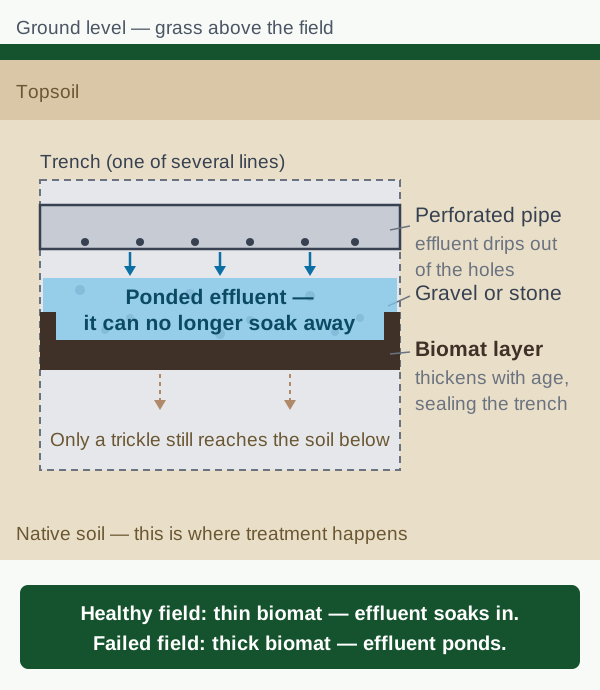
It also explains the drainfield's one great vulnerability. The soil can only treat what it can absorb slowly, and the treatment happens in a living layer that gradually accumulates a biological mat (the "biomat") where effluent meets soil. Send the field too much water, or worse, send it solids that escaped an unpumped tank, and that layer clogs. A clogged field doesn't get cleaned — it gets replaced, and that's the five-figure job every part of this guide is quietly trying to help you avoid.
How long the whole journey takes
People are often surprised by the timescale. The flush itself reaches the tank in seconds. But the water that leaves your tank today is not the water that entered today: because the tank works by displacement, the effluent pushed out to the field is water that entered a day or more ago and has been sitting quietly separating in the meantime. That holding period — roughly 24 to 48 hours in a properly sized tank — is called retention time, and it's what makes the separation work. A tank that's too small for the household, or a household that pushes far more water than the system was designed for, shortens retention: water rushes through, solids don't have time to settle or float, and material that should have stayed in the tank gets carried toward the field.
In the soil, the journey slows down further, and slow is exactly right. Effluent may take days to move through the treatment zone beneath the trenches, and that pace is what gives soil microbes time to do their work and pathogens time to die off before the water reaches groundwater or a nearby well. Nearly every failure mode in a septic system is, at bottom, a speed problem: too much water, moving too fast, through a stage that needed it slow. Keep that one idea and most of the maintenance rules in this guide explain themselves.
What each part does — and what its failure looks like
Knowing the parts is more useful when you know their failure signatures, because septic problems announce themselves early if you know what you're noticing:
- Main drain pipe. Failure looks like: every fixture in the house draining slowly or backing up together, sometimes with gurgling. Often roots or a partial clog rather than the tank itself.
- Tank. Failure looks like: nothing, for years — that's the trap. A tank that isn't pumped fills with sludge and scum until the layers reach the outlet, and then solids start leaving for the field. The tank rarely "breaks"; it silently stops protecting everything downstream.
- Baffles. A rotted or fallen baffle (older concrete baffles can crumble) lets scum drift into the outlet. Symptom: solids and grease appearing where they shouldn't, and a field that starts struggling years ahead of schedule.
- Effluent filter. Failure is the friendly kind: the filter clogs with fine solids, drains slow down, and cleaning or rinsing the filter fixes it. This is the one failure you want — it's the filter doing its job and asking for attention.
- Distribution box. Failure looks like: one strip of the field lush and soggy while the rest looks normal. The box has tilted or a line has blocked, and one trench is taking the whole load.
- Pump and floats (if fitted). Failure looks like: an alarm sounding, a high-water level in the pump chamber, or — with no alarm — a backup. Pumps are the main mechanical wear item in any system that has one.
- Drainfield. Failure looks like: persistently soggy ground over the field, sewage odour outdoors, unusually green stripes of grass along the trenches, effluent surfacing, and drains that back up even though the tank has been pumped. This is the expensive one, and it's almost always the end of a long chain of neglect rather than a sudden event.
Notice the pattern: nearly every cheap problem is upstream, and nearly every expensive one is the field. The whole economics of septic ownership is keeping the cheap parts maintained so the expensive part never gets hurt.
Which system do you actually own? The identification walkthrough
"Septic system" is a family name, not a single design. The five types below cover the overwhelming majority of homes, and they differ a lot in what they cost to run and what they ask of you. Here's each one, followed by how to work out which is yours.
Conventional gravity system
The classic and still the most common: house line, tank, drainfield, soil, everything moving downhill by gravity. No pumps, no power, no moving parts. It needs decent soil that drains at a moderate rate and enough yard for the field. Installed cost when new is the lowest of any type — roughly $3,000 to $12,000 depending on state and tank size. Running cost is the lowest too: inspections, pumping, and nothing else.
Chamber system
A conventional system whose drainfield trenches use connected plastic chambers instead of gravel-filled trenches. The treatment is identical — the chambers just create an open space for effluent to contact the soil, and they're lighter and faster to install than hauling gravel. If you have one, your maintenance is exactly the same as conventional. Installed cost runs roughly $5,000 to $13,000.
Aerobic treatment unit (ATU)
An aerobic system adds a powered treatment step: a blower or air pump pushes oxygen into a treatment chamber, and oxygen-loving bacteria break waste down much further than a standard tank can. The cleaner effluent then goes to a field, or in some designs is disinfected and sprayed onto the yard through sprinklers. ATUs are required in some areas with poor soil, small lots or sensitive waterways. They cost more — roughly $10,000 to $22,000 installed — and they come with obligations: electricity around the clock and, in most places, a service contract with regular professional visits, together running about $200 to $600 a year. If you own one, the service contract isn't optional decoration; some counties require it and will ask for proof.
Mound system
When the natural soil is too shallow, drains too slowly, or the water table sits too high, the field gets built above ground instead: effluent is pumped up into an engineered mound of sand with drain lines inside it, the sand does the treatment the native soil can't, and the water finishes its journey in the ground below. You'll know this one on sight — it's the long, grassed, deliberately-shaped hill in the yard that isn't landscaping. Mounds run roughly $10,000 to $25,000 installed and include a pump, so they use power and have an alarm.
Sand filter system
A sand filter adds an intermediate polishing step: effluent from the tank is pumped over a bed of graded sand (buried, or occasionally open), trickles through it for an extra round of treatment, and then goes to the drainfield. They're used where soil or site conditions demand cleaner effluent than a tank alone produces. Installed cost is roughly $7,000 to $28,000 depending on design, and the pump and filter bed add maintenance a conventional system doesn't have.
The five-minute identification walk
Now put it together, in this order:
- Check the paperwork first. Your county health department holds the permit and usually an "as-built" drawing for your system. That document names the type, the tank size, and where everything is buried. It is the single most useful page of paperwork in your house file, and it is free to ask for.
- Look for a raised mound. A long, grassed, obviously artificial hill with the rest of the yard flat around it: mound system.
- Look for electricity. A control panel on an exterior wall or post, an alarm, a small blower humming near a lid, or sprinkler heads arranged over part of the yard: aerobic system (with spray irrigation, in the sprinkler case). A panel and alarm with no blower and no mound usually means a pump system — conventional treatment, pumped distribution.
- Count the lids. Two or three lids in a line over the tank is normal. A separate smaller lid or tank downhill of the main one suggests a pump chamber.
- Nothing but flat yard and buried lids? Conventional gravity — or a chamber system, which looks identical from the surface. The permit tells you which; from a maintenance standpoint, it doesn't matter, because you look after them the same way.
Write down what you conclude, with the date. That note goes in the system file you're about to start.
The tank in more detail: sizes, materials and compartments
Since the tank is the part you'll pay to service most often, it earns a closer look.
Size is set by the house, not by preference: codes typically size a tank by bedroom count, on the logic that bedrooms predict occupants. A three-bedroom home commonly has a 1,000-gallon tank; four bedrooms usually means 1,250 gallons; five, 1,500. Bigger is genuinely better here — a larger tank gives longer retention time and more storage room for sludge and scum between pumpings, which is why two otherwise identical houses can have quite different pumping intervals.
Material affects lifespan and what can go wrong. Concrete is the traditional choice: heavy, durable, and good for 40 years or more, though older concrete can deteriorate from the inside — gases in the tank form mild acids that slowly attack the concrete above the waterline, which is one reason baffles on old concrete tanks crumble. Fiberglass and polyethylene tanks don't corrode and are far lighter (which matters on sites a crane truck can't reach), but they must be bedded and backfilled carefully at installation, and a plastic tank that is pumped completely empty in very high groundwater can, in rare cases, actually float up out of the ground if it isn't anchored or refilled promptly — one more reason pumping is a professional's job rather than a rental-pump weekend project. Steel tanks exist on some older properties and are the shortest-lived of all; a rusting steel tank is a replacement conversation, not a repair.
Compartments divide the tank's work. In a two-compartment tank — the modern standard in most areas — the first compartment catches the great majority of sludge and scum, and the second polishes the effluent further before it leaves. Single-compartment tanks do the same job less completely. When your tank is pumped, both compartments need emptying; a pumper who only opens one lid and calls it done has done half the job, and it's worth asking, politely, whether both sides were pumped.
Finally, the lids and risers deserve respect rather than a passing mention. Tank openings are covered with heavy concrete or secured plastic lids because the inside of a tank is genuinely lethal — the gases generated by decomposition can overcome a person in seconds, without warning smell at dangerous concentrations. Never lean into an open tank, never enter one for any reason, and treat a cracked or unsecured lid as an urgent repair, especially with children or pets in the yard. Risers with lockable or bolted lids are the modern answer: safe, and easy for the pumper.
A word about cesspools, because older houses have them
If your house predates modern septic codes — and plenty of first homes do — what you have might not be a septic system at all. A cesspool is a pit, usually a cylinder of stacked concrete rings, brick or block with open joints, that receives raw sewage directly. Liquid seeps out through the walls and bottom into the surrounding soil; solids accumulate in the pit and are pumped occasionally. There is no tank doing separation, no baffles, no effluent filter, and effectively no treatment stage — the soil around the pit gets raw wastewater, which is exactly what modern systems are designed to prevent.
Cesspools were standard practice in many areas into the mid-twentieth century, and thousands are still in daily use. But the regulatory direction is one-way: they're banned for new construction nearly everywhere, some states and counties require them to be upgraded to a full system when a property is sold or a renovation is permitted, and a cesspool that starts failing (and they do — the surrounding soil eventually clogs) generally cannot be replaced with another cesspool. The upgrade is a full system installation, at full system prices.
How do you tell? The paperwork, again: permits will say "cesspool" plainly. Physically, a cesspool is usually a single pit with one lid rather than a tank with compartments, and there's no separate drainfield. If you discover you own one, don't panic — many work for years — but do budget and plan for its eventual replacement, and ask your health department what triggers apply in your area, especially before you list the house for sale or pull a permit for an addition. An honest conversation with the county now beats a surprise condition imposed by a buyer's lender later.
The first-year routine: your solution, season by season
Here is the good news buried in all of the above: a septic system asks very little of you, provided you do the little it asks. This is the routine for your first year of ownership — after the first year, it mostly repeats.
Once, at the start: the baseline
- Get the documents. Permit, as-built drawing, any pumping or service receipts the seller left. Call the county health department if the file is empty — they often have records going back to installation.
- Find everything physically. Tank lids, the field's location, any control panel. Probe gently or hire the pumper to locate lids on the first visit. Mark the spots.
- Book a baseline inspection with pumping. Ask the technician to measure the sludge and scum layers, check baffles and the effluent filter, look at the distribution box if there is one, and tell you the tank's size and material. You are buying a starting point: from this visit on, your schedule is based on measurements, not guesses.
- Photograph it all. Lids uncovered, the panel, the field from a fixed spot. Date the photos. Future-you, standing in the yard in year four wondering where exactly that second lid was, will be grateful.
Each season: the ten-minute walk
Four times a year, walk the system. It takes ten minutes and catches almost everything early:
- Over the field: look for soggy patches that don't match the weather, sewage odour, or stripes of grass growing noticeably lusher than the rest of the lawn. In winter, a patch that melts first or stays oddly green deserves a note too.
- At the tank: check that lids are secure (a damaged lid is a genuine safety hazard, not a cosmetic issue — a child or pet must never be able to shift one), and note any settling or erosion over the tank.
- At the panel (if you have one): confirm the alarm is on and hasn't tripped, and that the blower on an aerobic system is running.
- In the house: note slow drains, gurgling, or a toilet that has started behaving differently. One fixture is usually a plumbing issue; every fixture at once points at the system.
Write down anything you notice, even if it turns out to be nothing. A dated note that says "wet patch after three days of rain, gone in two days" is exactly the evidence that separates a rain event from a failing field.
The pumping calendar logic
Pumping is the one recurring expense that protects everything else, so it deserves a clear rule rather than a vague intention. The EPA's baseline: inspect at least every three years, and expect to pump every three to five years for a typical household. The measurement overrules the calendar: pump when the sludge and scum layers together occupy about a third of the tank's liquid depth — or sooner if the bottom of the scum layer gets within about six inches of the outlet, or the top of the sludge within about a foot. Your pumper measures both layers at every visit, which is why the inspection and the pumping belong together.
Your actual interval scales with tank size and household size. A 1,000-gallon tank serving four people is ready in roughly two and a half years; the same tank serving two people can go nearly six. A garbage disposal shortens any of these numbers — it loads the tank with food solids that mostly end up as sludge — so if you run one daily, plan toward the short end of your range. When in doubt, the measurement decides: it's a five-minute check with a sludge sampler, and it's the difference between a schedule and a guess.
The record you keep
One folder, physical or digital, containing: the permit and as-built, every pumping and service receipt, the measurements from each visit, your seasonal notes and photos, and the name of your pumper and service company. This folder does three jobs. It runs your maintenance schedule. It proves care to an insurer or a health department if questions ever arise. And when you sell, it is a genuine asset — a documented system reassures buyers and their lenders in a way that "we never had any problems" never will.
The first-year cost budget, honestly
The costTable at the top of this guide lists the pieces; here's how they add up in practice, and how the number changes with the type of system you identified earlier.
A conventional or chamber system, normally maintained: your first year includes the baseline inspection and pumping (say $450–$900 combined, depending on tank size, state and whether lids needed digging), plus essentially nothing else. In the years after, the recurring cost is the pumping share — a pump-out every three to five years works out to roughly $100–$200 a year set aside. That is the whole budget. Septic ownership, on a gravity system, is cheap precisely because there is nothing to run.
An aerobic system: add the service contract and electricity, $200–$600 a year, every year, plus the same pumping and inspection costs. This surprises new owners who budgeted for a conventional system, and it's one more reason the identification walk matters — the running cost of your system depends on which one you actually own.
A pumped or mound system: conventional costs plus a pump that will eventually need replacing (a few hundred to over a thousand dollars, typically after a decade or more of service) and the small electricity cost of running it. Not a first-year worry, but worth knowing it's in the future.
Now the neglected version, for contrast. Skip pumping for a decade and the tank sends solids to the field; the field clogs; the repair is a new drainfield at several thousand dollars on a kind day and a full system replacement — $5,000 to $20,000-plus for conventional, well beyond that for mound or aerobic designs — on a bad one. Add a sewage backup cleanup inside the house if it gets that far. Every figure in that paragraph was preventable by the $100–$200-a-year version. There is no cheaper insurance in home ownership than a pumping schedule.
One more first-year line item that isn't in the table because it varies too much: risers. If your tank lids are buried and your pumper had to dig, installing risers to bring access to the surface (roughly $300–$600 per lid, once) pays for itself by the second or third visit and makes every future inspection faster and cheaper. Ask about it at the baseline visit, while the lids are already uncovered.
The rules that keep it alive
Everything above reduces to a handful of habits. These are the ones that determine whether your system is a boring, invisible utility for thirty years or a recurring emergency.
Spread the water out. The field treats water at the rate soil can absorb it, so volume spikes are the enemy. Run full loads rather than half loads, but don't run five loads of laundry in one afternoon; spread them across the week. Fix leaks promptly — a toilet that runs silently can send hundreds of extra gallons a day into a system sized for a household, not a car wash. The EPA's framing is simple: the more water a household conserves, the less the system has to handle, and the longer everything lasts.
Flush only the three Ps. Pee, poop and toilet paper. Wipes — including every product labelled "flushable," which means only that it clears the toilet, not that it breaks down — are the single most common thing pumpers pull out of tanks that were never designed to receive them. Grease goes in a can, not the drain. Coffee grounds, cat litter, paper towels, chemicals and solvents beyond ordinary household use: out. Your tank's bacteria are the workforce; don't poison them and don't bury them in material they can't process.
Skip the additives. The EPA's position is that a normally used system already contains the bacteria it needs, and additives have not been shown to extend the time between pumpings. Nothing digests sludge to nothing — what settles must eventually leave in a truck. Save the money.
Protect the field. No vehicles, no parking, no structures, no pools, no livestock on the drainfield — the soil must stay uncompacted and the pipes uncrushed. Plant grass over it and nothing deeper-rooted: tree and shrub roots seek out the moisture and nutrients in those trenches and will invade the pipes, so keep trees well away, and if you're choosing plantings, ask which species are safe at what distance. Divert roof drains, sump pumps and surface water away from the field, too — extra water that never went through a fixture still counts against the soil's capacity.
Know your alarms. If your system has a panel, that alarm is the system asking for help — usually high water in a pump chamber. Silence it, cut back water use hard, and call your service company the same day. An alarm ignored for a weekend is how a fixable pump problem becomes a backup into the house.
What a professional inspection actually involves
Since the inspection is the appointment your whole schedule hangs on, it helps to know what a thorough one looks like — so you can tell the difference between a real inspection and a quick look down the hole. A proper inspection typically includes: locating and uncovering the tank lids; measuring the scum and sludge layers (the numbers that drive your pumping decision); checking the baffles and cleaning or checking the effluent filter; inspecting the tank for cracks, corrosion or root intrusion; checking the distribution box for level and even flow, where one is fitted; exercising any pumps, floats and alarms; and walking the drainfield for surfacing, odour or lush growth. For an aerobic system, add the blower, the treatment chamber and the disinfection step if fitted. You should come away with written measurements and a condition summary, not just a verbal "looks fine." If the report is thin, ask for the numbers — a good service company measures as a matter of routine and won't mind.
Three situations that change the rules slightly
A garbage disposal. It doesn't disqualify you from anything, but it loads the tank with ground food solids, which mostly become sludge. Homes with disposals should pump more often — treat your interval as roughly a third shorter than the table suggests — and some designers simply specify a larger tank when a disposal is planned.
A water softener. Softener backwash sends a periodic slug of salty water into the system. Modern guidance is generally reassuring for a properly sized system, but on older or marginal systems that extra volume is worth mentioning to your service company; some owners route backwash away from the septic system where local rules allow. Either way, don't let a softener regenerate more often than its settings require.
Guests, parties and full houses. A system sized for three people that hosts ten for a week is being asked to do double shifts. Nothing breaks instantly — the tank and field have some reserve — but stagger showers and laundry during the visit, and if a big gathering is a regular event at your house, mention it when your pumping interval is set. Conversely, a house that sits empty for months (a seasonal property) gives its system a rest, which fields generally appreciate; just expect the bacteria to take a short while to get back to full strength when you return.
Winter, wet weather and power cuts
Three conditions worry new owners more than they should. Here's what actually happens in each.
Winter. A working septic system doesn't freeze under normal use — wastewater arrives warm, the tank sits below the frost line, and bacterial activity generates a little heat of its own. The systems that freeze are usually ones that sat unused (a vacant house with no warm water flowing), or shallow lines with a slow drip feeding them a trickle that can freeze in the pipe. A healthy layer of snow is insulation, not a problem; grass cover over the field helps too. If a house will sit empty through a cold winter, ask your pumper about precautions before you leave rather than after a line freezes.
Wet weather. Heavy rain raises the water table and saturates the soil around the field, which temporarily shrinks the field's capacity to accept effluent. The right response is simply to ease off: spread laundry out, take shorter showers, and wait. A field that looks soggy during a week of rain and recovers when the weather dries is behaving normally; a field that stays soggy through dry weather is the one that needs a professional look. This is also why surface water management matters — a downspout discharging next to the field is adding rain to soil that is already busy.
Power cuts. A conventional gravity system doesn't notice them at all; it has nothing to plug in. Pumped and aerobic systems do: the pump can't move effluent, and the aerobic blower stops. For a short outage, just use water sparingly — the tanks have storage capacity for exactly this. For a long one, conserve seriously, because once the pump chamber fills, the alarm sounds and the next stop is a backup. When power returns, an aerobic system may need a day or so of normal use to settle back into rhythm. If your area loses power often and your system depends on it, a conversation with your service company about alarms and backup options is worth having in your first year, not during the outage.
The point of all of this: boring is good
A closing thought, because it's the one that reframes septic ownership for most new owners. A septic system is not like a roof or a furnace, wearing visibly toward a replacement you can watch coming. It is a quiet piece of infrastructure that should give you nothing to think about — no smells, no soggy lawn, no sounds, no surprises — for decades, in exchange for an inspection habit, a pumping schedule and a bit of water discipline.
So the goal of your first year is not to become a septic expert. It's to reach the state where the system is boring: you know where it is, you know which type it is, you have a baseline measurement and a date for the next one, and there's a folder with the paperwork. Everything in this guide exists to get you to that state. Once you're there, ownership costs you ten minutes a season and a modest line in the budget — and the small treatment plant under your lawn will do the rest, invisibly, the way it was designed to.
Cost at a glance
| Item | Typical cost | Notes |
|---|---|---|
| Baseline inspection (first year) | $150–$350 | A full inspection with sludge/scum measurement; often discounted when bundled with pumping. A dedicated transfer or certification inspection can run $300–$600 |
| Pumping — your yearly share | $100–$200/yr | A pump-out costs roughly $300–$700 every 3–5 years depending on tank size and state; spread over the interval, budget about this much per year |
| Effluent filter cleaning | $0 DIY / $75–$150 pro | Rinse the filter when the tank is pumped, or yearly on some systems; many pumpers include it in the visit |
| Aerobic system service + electricity | $200–$600/yr | Only if you own an aerobic treatment unit (ATU): annual service contract plus the blower's electricity. Conventional gravity systems use no power at all |
| Records, map and small supplies | $0–$50 | A folder for permits and receipts, a photo record of lid locations, flags or a sketch — the cheapest insurance in this whole guide |
Frequently asked questions
How does a septic system actually clean the water?
In two stages. The tank does the separating: solids sink, grease floats, and bacteria in the tank break down some of the organic matter. The soil does the real cleaning. As effluent trickles slowly through several feet of unsaturated soil under the drainfield, microbes living in that soil digest or trap most of the remaining bacteria, viruses and nutrients. By the time the water reaches groundwater, it has been filtered by the ground itself. This is why the soil — not the tank — is the most important part of the system, and why protecting the drainfield matters more than anything you put in the tank.
How long does a septic system last?
A well-maintained conventional system typically serves 25–40 years. The tank itself lasts longest — concrete tanks commonly go 40 years or more, while fiberglass and plastic tanks are also rated for decades. The drainfield is usually the first part to wear out, often somewhere in the 20–30 year range, because the soil's treatment layer slowly clogs over time. Pumping on schedule, spreading out water use and keeping vehicles off the field are what push a system toward the long end of those ranges.
Can I tell what type of septic system I have without digging?
Usually, yes. Start with paperwork: the permit and as-built drawing at your county health department name the system type and show the layout. Then walk the yard. A raised, grassed mound points to a mound system. A control panel, an alarm, a small blower or lids with a spray pattern in the yard point to an aerobic system. A flat field, two buried lids and no electrical anything almost always means a conventional gravity system — the most common type in the country.
What is a cesspool, and is it the same as a septic system?
No. A cesspool is an older, simpler pit — usually a lined hole in the ground — that collects sewage and lets liquid seep out directly, with no tank separation and no real treatment stage. They were common before modern codes and are now banned for new construction in most states; some states require them to be upgraded when a property is sold. If your older house has one, plan on replacing it with a proper system rather than maintaining it indefinitely.
Does a septic system need electricity?
A conventional gravity system needs none at all — wastewater moves downhill from the house to the tank to the field, which is also why these systems keep working through a power cut. Systems that do use power are the ones with pumps or blowers: aerobic treatment units, mound systems with a dosing pump, and pumped drainfields on sloped lots. If yours has a control panel, that panel and its alarm are part of the system and need power to protect you.
What should never go into a septic system?
The short list: wipes of any kind (including ones labelled flushable), grease and cooking oil, chemicals and solvents beyond normal household amounts, cigarette butts, coffee grounds, cat litter, paper towels and anything else that doesn't break down the way toilet paper does. The rule that covers almost everything is the EPA's: only flush the three Ps — pee, poop and (toilet) paper. A garbage disposal also loads the tank with extra solids and shortens your pumping interval, so use it sparingly if you have one.
We just bought the house and know nothing about the system. What first?
Three things in your first year. First, get the paperwork: ask your county health department for the permit and as-built drawing, which tell you the system type, tank size and where everything sits. Second, book a baseline inspection — ideally with pumping — and ask the technician to measure the sludge and scum layers, check the baffles and filter, and write down what they find. Third, start a simple record: dates, gallons pumped, measurements and a photo of the lids before they're covered again. That file is your maintenance schedule and, one day, a selling point.
Checked November 16, 2026. This guide is general information, not a substitute for a licensed professional.
Related guides
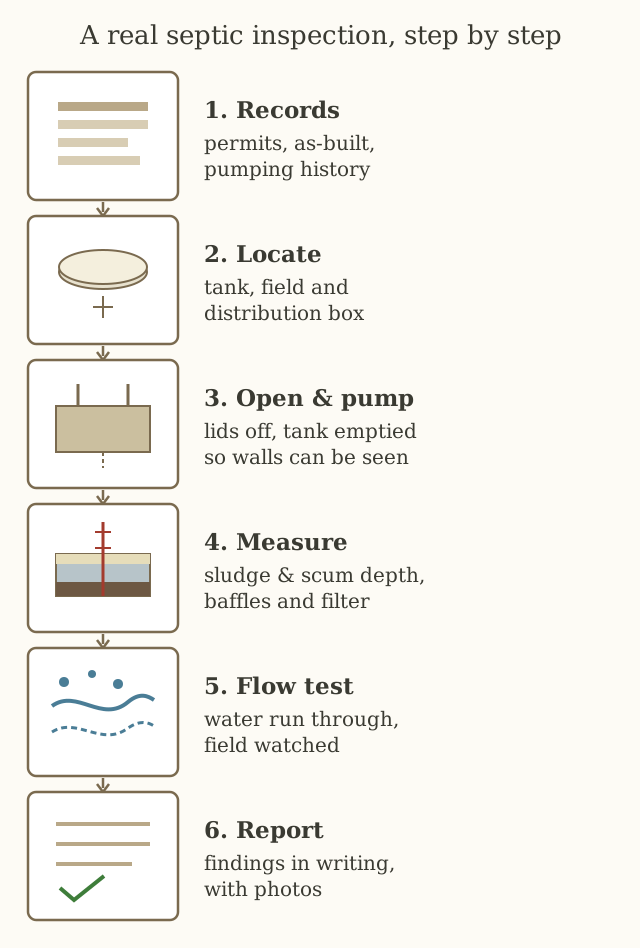
Buying a House With a Septic System? The Inspection That Can Save You $20,000
A standard home inspection barely touches the septic system. Here's what a real septic inspection includes, what it costs, the records to demand, and the contract wording that protects you.
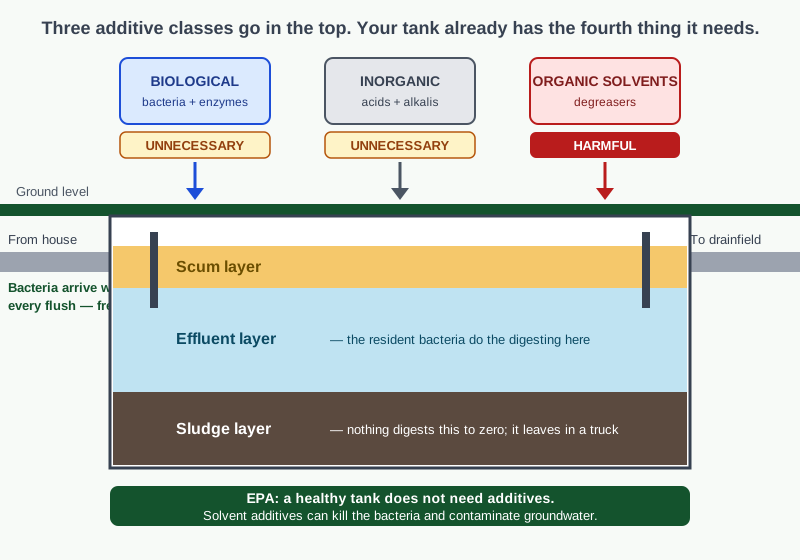
Do Septic Tank Additives Work? What the EPA and the Studies Actually Found
The EPA does not recommend septic additives, a 48-tank double-blind study found no measurable benefit, and one additive class is actively harmful. The evidence, the money maths, and the one narrow exception.
Drain Field Failure Signs: Soggy Ground, Green Stripes and Surfacing Effluent
A failing drain field announces itself in the yard first: lush green stripes, spongy ground, odors, then standing water. The early vs late signs, the look-alikes that aren't failure, a homeowner diagnosis sequence, and what repair or replacement really costs.