 Keep
Buying a House With a Septic System? The Inspection That Can Save You $20,000
 Daniel Mercer · Editor & Researcher·
Published November 16, 2026·
Updated November 16, 2026
Every other major system in the house you're about to buy gets looked at. The roof gets climbed on. The furnace gets fired up. The electrical panel gets opened, the water gets run, the foundation gets stared at by a person with a flashlight and strong opinions. Then there's the septic system — a buried tank, a buried field, and several thousand gallons a year of your household's wastewater — and at most closings, nobody with any qualifications has looked at it at all.
That's not because it's unimportant. A septic system is the only major component of a house that can fail in a way that costs $15,000 to $30,000, makes the yard unusable, and — in the worst cases — leaves you unable to flush a toilet in the home you just bought. It's because it's underground, and out of sight has a way of becoming out of the contract.
This guide is the manual for the one appointment that fixes that: the dedicated septic inspection. What it actually involves, what the cheap substitutes miss, which records to demand from the seller, what to write into your offer, and what your options are if the news is bad. If you're a first-time buyer looking at a home on septic, this is the cheapest insurance in the entire transaction — and it only works if you order it before you close.
Why your home inspection does not cover this
The most dangerous sentence in a septic home purchase is "the home inspection came back fine." It probably did — about the things a home inspector is there to check.
A general home inspection is a visual survey of the house's accessible systems. On the plumbing side, the inspector runs taps, flushes toilets, checks for leaks under sinks, and notes slow drains. Some will walk the yard and note lush grass or odours over the drain field. That is the entire septic portion. They do not uncover the tank. They do not open it. They do not measure what's inside it, inspect its baffles, or test how the drain field handles a real load of water. In most states they aren't licensed to do any of that, and their contract usually excludes it in writing — it's worth reading the exclusion, because it's often the first time a buyer learns the septic system was never actually evaluated.
The gap matters because of where septic failures live. A tank with a cracked wall, a rotted-out baffle, or sludge built up to the outlet looks exactly like a healthy tank from the surface: the grass grows, the toilets flush, the drains drain. The problems are inside a sealed concrete box and inside the soil of the drain field, and the only way to see them is to open the box and test the soil's behaviour under load. Everything else is guessing, and guessing is what the seller is hoping you'll do.
The dye test: what it proves and what it doesn't
If anyone in the transaction offers you a dye test as reassurance, understand exactly what you're being handed. In a dye test, the inspector flushes a strong fluorescent dye into the system, runs water, and then walks the property looking for dye surfacing in the yard, a ditch, or a nearby waterway.
A dye test can prove one thing: that effluent is actively escaping to the surface — a system already in open failure. That's worth knowing, but it's the septic equivalent of confirming a car has crashed by looking at the wreck. What a dye test cannot tell you:
- How full the tank is. Sludge and scum levels — the single best predictor of near-term trouble — aren't measured.
- Whether the tank is sound. Cracks, corrosion, and root intrusion stay invisible.
- Whether the baffles survive. A missing outlet baffle is silently feeding solids to the drain field and shortening its life; dye flows past it without comment.
- Whether the field is nearly done. A drain field can pass a dye test in a dry week and fail under real household load in a wet month. Dye can also fail to surface in frozen or rain-saturated ground even when the system is in trouble, producing a false pass.
Inspectors charge roughly $75–$250 for a dye test as an add-on, and some include it in a full inspection. As one data point among many, fine. As the inspection itself, it is not enough to buy a house on.
The real inspection, step by step
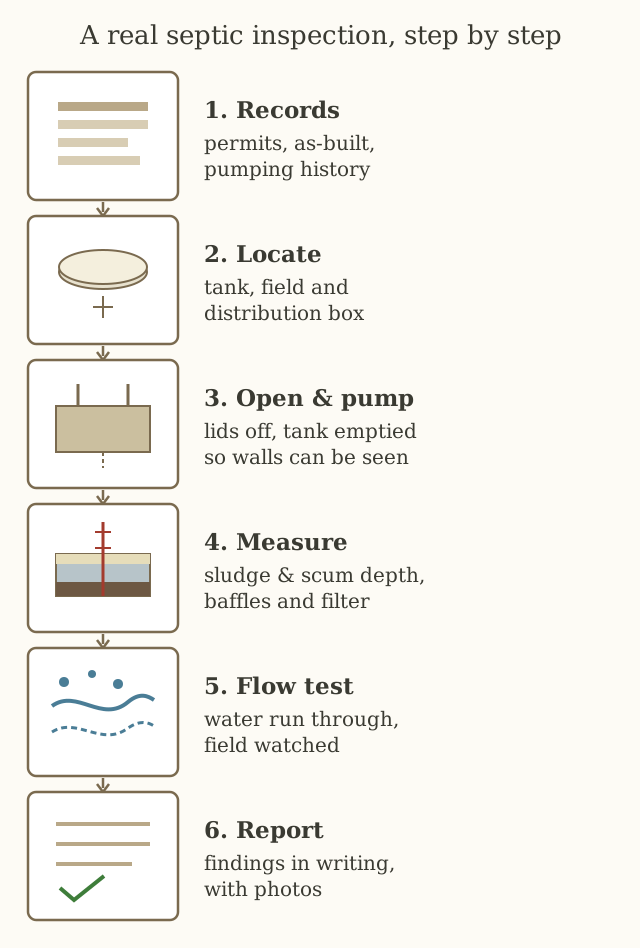
A proper pre-purchase septic inspection is done by a licensed septic inspector or a pumping company that does transfer inspections, and it takes roughly two to three hours on site. Here is what should happen, in order — if the company you're booking doesn't do most of this, book a different company.
1. Records and permits first. The inspection starts on paper. The inspector reviews whatever exists: the original installation permit, the as-built drawing showing where the tank and field actually sit, the system's age and design size, and any repair permits since. In many counties the health department holds these records, and a good inspector pulls them or tells you how to. A system with no paperwork at all is itself a finding — it may predate permits entirely, which tells you something about its age.
2. Locate everything. Tank, distribution box, and drain field all get physically located — with the as-built, a probe, a flushable transmitter, or plain experience. You would be surprised how many owners genuinely don't know where their tank is. The inspector marks the components, notes access (are there risers bringing the lids to the surface, or will every future service start with digging?), and checks setbacks from wells, property lines, and water bodies.
3. Open the tank and pump it. This is the step that separates an inspection from a walk-around. The lids come off, and in a transfer inspection the tank is normally pumped empty — often billed separately at $250–$500, sometimes bundled. Pumping isn't just maintenance; it's the only way to see the tank's interior walls and floor, where cracks, corrosion, and root intrusion actually show. An inspector who measures levels but won't pump is leaving the structural question unanswered.
4. Measure the layers, check the parts. Before pumping, the inspector measures the scum layer on top and the sludge layer on the bottom — traditionally with a long core-sampling pole nicknamed a sludge judge. Those numbers tell the maintenance story of the house: layers approaching the outlet mean a system that hasn't been pumped on schedule and has been sending solids where they don't belong. Inside the tank, the inspector checks the inlet and outlet baffles or tees, and the effluent filter if one is fitted — a broken outlet baffle is one of the most common findings and one of the most consequential, because it lets solids escape into the drain field and clog it.
5. Run a flow test and read the field. Water is run through the system at a meaningful volume — a hydraulic load test — while the inspector watches how the system responds: does the tank level behave, does anything back up, does effluent surface anywhere? Then the drain field gets walked and probed: ponding, spongy or saturated soil, sewage odour, and the tell-tale stripes of overly lush green grass over the lines. The distribution box, if accessible, is opened to confirm effluent is splitting evenly among the field lines instead of drowning one and starving the rest.
6. Get it in writing. The deliverable is a written report: component locations and condition, layer measurements, what's working, what's failing, what's near the end of its life, and — ideally — photos. This document is not a formality. It is the evidence your contingency, your repair request, your lender, and in some states your board of health all run on. Verbal reassurance is worth nothing at a closing table; a signed report is worth a great deal.
The records to demand — and the questions to ask
The inspection tells you what the system is today. The records tell you how it got there, and sellers of homes on septic should expect to produce them. Ask for these through your agent, in writing, early — ideally before or alongside scheduling the inspection:
- The installation permit and as-built drawing. Confirms the system's age, size, type, and permitted bedroom count. That last number matters: a system permitted for three bedrooms serving a house now marketed as five is a system being asked to do more than it was built for.
- Pumping receipts or a maintenance log. The EPA's baseline guidance is inspection at least every three years and pumping every three to five for a typical household. A seller who produces a decade of regular receipts is showing you a maintained system. A seller who has "never had it pumped in twelve years, never had a problem" is telling you the drain field has been eating the difference.
- Repair permits and invoices. Repairs aren't disqualifying — tanks get new baffles, fields get rested or extended — but you want them documented and permitted, not whispered about.
- Any past inspection reports, including, in Massachusetts, a previous Title 5 report and how old it is.
- The disclosure statement. Most states require sellers to disclose known septic defects. Compare what it says against what the inspection finds; gaps between the two are negotiating information.
Questions worth asking the seller directly: How old is the system? When was it last pumped, and by whom? Has it ever backed up, been repaired, or failed an inspection? Are there any components you don't use — a garbage disposal, a water softener, a basement bathroom added later? Have you ever been notified by the health department about the system? Honest sellers answer these easily. Evasive answers are also an answer.
The buyer's checklist
Pin this to the fridge from offer to closing. Short lines, in order:
- ☐ Confirm the home is on septic (not sewer) — and find out the system's age
- ☐ Pull county health department records: permit, as-built, repair history
- ☐ Request seller's pumping receipts and any past inspection reports
- ☐ Book a licensed septic inspector — full inspection, tank opened
- ☐ Confirm the tank will be pumped during the inspection
- ☐ Add a camera scope if the system is older or trees are near the lines
- ☐ Write a septic contingency into the contract (see below)
- ☐ Attend the inspection if you can; photograph component locations
- ☐ Read the written report before your contingency deadline
- ☐ Get repair estimates in writing for anything the report flags
- ☐ Confirm your lender's septic requirements (FHA/VA/USDA especially)
- ☐ Negotiate repair, credit, or escrow — before the deadline, not after
- ☐ After closing: file the report, note the tank location, calendar the next pumping
Cesspool, or septic system? Why the difference changes the deal
Older homes — especially pre-1970s construction in the Northeast and older rural properties everywhere — may not have a septic system at all. They may have a cesspool: a single lined pit that receives everything, with no separate tank for settling and no real drain field. Effluent essentially leaches directly from the pit into the surrounding soil. Some old properties have hybrids or undocumented arrangements that defy tidy labels.
This matters at purchase for three reasons. First, performance and risk: cesspools provide far less treatment than a tank-and-field system and are much more likely to contaminate groundwater — which is why regulators dislike them. Second, the rules: some jurisdictions require a cesspool to be upgraded to a full system at transfer or on failure, full stop; Massachusetts Title 5, for example, treats cesspools as systems that must be upgraded in defined circumstances, and some states and counties ban new cesspools outright. Third, the money: if the "septic system" in the listing is actually a cesspool, you may not be budgeting for a repair — you may be budgeting for an entire new system, designed and permitted from scratch.
The inspection resolves the question definitively, which is one more reason the records matter: a property with no permit on file is a property where "septic" on the listing sheet is an assumption, not a fact. If the home turns out to have a cesspool, don't panic and don't proceed on autopilot — price the upgrade into the negotiation with real quotes, and check whether your lender will even fund the purchase before it's addressed.
The money: $500 of inspection against $20,000 of surprise
Let's put the numbers side by side, because this is the entire argument.
The inspection side: $300–$600 for a full inspection, $500–$900 for a thorough transfer inspection with pumping and a written report, plus a few hundred more if you add a camera scope. Call it, worst case, around a thousand dollars — on a purchase of several hundred thousand.
The surprise side: drain field repairs commonly run $5,000–$20,000. A full system replacement runs $15,000–$30,000 or more once you count design, permits, excavation, and restoring the yard. And those are the planned prices. The unplanned version — the system fails in your first winter, sewage backs up into the house, and you're hiring whoever can come Thursday — costs more in money and considerably more in misery. There is also a quieter cost: a house with a known failed system and no documentation is harder to sell later, because the next buyer's inspector will find what yours didn't.
There's a middle outcome worth knowing about, too: the inspection finds a system that works but is old, or a tank that needs a baffle and a pumping rather than a replacement. That report converts directly into a credit request or a small price adjustment. Inspections that "only" find maintenance items routinely pay for themselves at the negotiating table.
The contingency clause — and what to hand your agent
An inspection without a contingency is just expensive knowledge. The contingency is the contract language that gives the findings consequences: the right to renegotiate, require repairs, or exit with your deposit if the system fails. Septic sometimes hides inside a general inspection contingency, but relying on that is risky — general contingencies can be read to cover only what the general inspector examines, and the general inspector doesn't examine the septic. Ask for it explicitly.
Example wording, to hand to your agent or real estate attorney and adapt to your state's forms (this is a starting draft, not legal advice):
"This agreement is contingent upon a satisfactory inspection of the property's septic system by a licensed septic inspector of Buyer's choosing, to be completed within [14] days of acceptance. If the inspection reveals that the system is failed, failing, or requires repairs estimated at more than $[amount], Buyer may, at Buyer's option: (a) request that Seller complete repairs or provide a credit at closing; (b) agree to an escrow holdback sufficient to complete the repairs; or (c) terminate this agreement and receive a refund of all deposits if the parties cannot agree on (a) or (b) within [5] days of Buyer's notice."
Two details in there do real work. The dollar threshold stops a $150 filter cleaning from becoming a walk-away trigger while keeping real failures covered. And the deadline discipline matters: septic findings that arrive after your contingency expires are findings you own.
When the seller refuses
It happens — a hot market, an "as-is" listing, a seller who says the system "works fine" and won't allow the tank to be opened. Be clear-eyed about what refusal means: the seller is asking you to accept an uninspected underground system worth up to $30,000 on faith. Your honest options:
- Pay for the inspection yourself and ask only for access. Most refusals are about cost and hassle, not access. Offering to cover the fee and the pumping removes both objections.
- Lean on the lender. If you're using FHA, VA, or USDA financing, the lender's requirements may force the issue — a seller who wants your loan to close has to let the system be evaluated.
- Check whether the law is already on your side. In Massachusetts and a few other states and counties, a point-of-sale inspection is mandatory regardless of what the seller prefers.
- Adjust the price for the unknown, or walk. If you truly cannot inspect, the rational move is to price the risk in — a discount sized to a real possibility of replacement — or to decline the house. There will be other houses. There is only one version of buying a failed drain field at full price, and it is not a good story.
Lenders and the law: when the inspection isn't optional
Even where no state law applies, your financing might make the decision for you. Government-backed loans carry their own septic rules. FHA financing requires the system to be functional and to meet local health codes, and looks for adequate separation between the septic system and any well — typically at least 50 feet, with many local codes requiring 100. VA loans similarly expect evidence that the system is maintained and compliant with local health requirements. USDA rural loans come with their own habitability standards. In practice, the appraiser or lender can require an inspection, a repair, or an escrow before funding, and a non-functional system will stop an FHA or VA purchase outright. Conventional lenders are often less prescriptive — which means the responsibility lands back on you.
State and local point-of-sale laws are the other layer, and they're a patchwork:
- Massachusetts (Title 5) is the strictest model and the one to understand even if you live elsewhere. Under Title 5 of the state environmental code, a system must be inspected within two years before a transfer of title — or within six months after, if weather genuinely prevents it — by a MassDEP-approved inspector, with the report going to the buyer and the local board of health. A pass is valid two years, or three with documented annual pumping. The law notably does not require the system to pass for the sale to proceed — but a failure reshapes the deal, because most lenders won't fund until the system is upgraded or repair money is escrowed, commonly at 1.5 times the estimated cost. Certain transfers are exempt, including those between spouses, parents and children, and full siblings, and refinancing never triggers the requirement.
- New Jersey has point-of-sale inspection requirements in parts of the state, and its statewide real estate guidance treats septic evaluation as a standard part of transfers in septic areas.
- Indiana, Minnesota, and parts of Maryland also mandate inspections at transfer, each with its own forms and timelines.
Everywhere else, the default is disclosure only: the seller must tell you what they know, and finding out the rest is your job. Rules change and county requirements vary, so verify the current requirement with your health department or attorney — then, wherever you land, the practical advice is identical: get the inspection whether or not anyone makes you.
Edge cases: vacant houses and winter closings
Two situations bend the normal rules, and both are common in exactly the older, rural housing stock where septic systems live.
The house has been sitting empty. A septic system is a biological process, and a vacant house starves it: no water flow, no waste, bacteria die back. An empty house can also hide problems — drains that appear fine because nobody is using them, a drain field that looks rested and healthy because it hasn't been asked to do anything in eight months. Tell the inspector the house is vacant and for how long. A good one will run a proper hydraulic load test to simulate real occupancy rather than accepting a quiet system at face value, and the report should note the vacancy so nobody mistakes "no problems observed" for "proven under load."
You're buying in winter. Frozen ground and snow cover can make a complete inspection physically impossible — you cannot probe a drain field through a foot of frost or find surfacing effluent under snow. Massachusetts handles this explicitly: if weather prevents the Title 5 inspection, it may be completed within six months after the transfer, with the obligation documented. Elsewhere, the standard tools are an escrow holdback sized to a worst-case finding, or a contract clause obligating a spring inspection with a pre-agreed remedy. What you should not do is simply waive the inspection because the season is inconvenient — winter is precisely when a marginal system, fed by holiday guests and frozen soil, chooses to fail.
After you own it: set your baseline
Say the inspection is clean and the house is yours. The first year is when you convert the previous owner's system into your system, with your own records:
- Keep the inspection report forever. It has the component locations, sizes, and condition notes that every future pumper and inspector will ask about. Photograph the yard with the tank and field marked before the flags and paint fade.
- Pump on the inspector's recommendation, not a guess. If the report gave a date or a layer measurement, calendar from it. If the tank was pumped during the inspection, you start with a known-empty tank and a clean three-to-five-year clock — the best baseline a septic owner ever gets.
- Learn your system's habits. Note where the field is and keep vehicles, sheds, and new plantings off it. Know what an effluent filter is and whether you have one. Put the pumping company's number in your phone now, not during a backup.
- Keep every receipt. Your maintenance file is, years from now, a selling asset — the same records you demanded are the ones a future buyer will pay a premium to see.
Choosing the inspector — and what to ask when you book
Not every company that pumps tanks does transfer inspections, and not every "inspection" being sold is the real thing. When you call, you're hiring for a purchase decision, so book it like one:
- Licensing. Ask whether the inspector is licensed or certified for septic inspections in your state or county. In Massachusetts, only MassDEP-approved inspectors can perform a valid Title 5 inspection — anyone else's report doesn't count. Elsewhere, a licensed pumper or certified inspector with real-estate transfer experience is what you want.
- "Will you open the tank?" This is the screening question. If the answer is no, or the quote describes a visual inspection only, you're being sold the $100–$250 walk-around. Thank them and call the next company.
- "Does the price include pumping?" Get this in writing before the visit. Pumping billed separately is normal; pumping discovered to be extra while the inspector is standing in the yard is how a $400 inspection becomes a $900 one without anyone technically lying.
- "Do I get a written report with photos and measurements?" The report is the product. Confirm you'll receive component locations, sludge and scum measurements, and condition notes — the document your lender and your negotiating position depend on.
- Timing. Ask how quickly they can come. Inspection periods are short — often 7 to 15 days — and good inspectors book out. Call the septic company the same day your offer is accepted, not after the general inspection comes back.
If the seller has a regular pumping company, that's a reasonable place to start — they know the system — but you are under no obligation to use them, and for a purchase, an inspector with no prior relationship to the seller is arguably the cleaner choice.
Reading the report: what "failed" actually means
Inspection reports scare first-time buyers partly because the vocabulary is blunt. A system described as "failed" is not necessarily a system that has stopped working — in regulatory language, it usually means the system no longer meets the standard it is judged against, which can be anything from sewage surfacing in the yard (genuinely dire) to a component that predates current code (often manageable). Read findings in three tiers:
- Failed and urgent. Surfacing effluent, sewage backing up into the house, a collapsed or leaking tank, a drain field that won't accept water. This is the $10,000–$30,000 tier, and it's what the contingency exists for: repair before closing, escrow at roughly 1.5 times the estimate, a major credit, or walking away.
- Deficient but working. A cracked baffle, a missing effluent filter, a distribution box that's out of level, sludge at pumping depth. The system functions; the bill is hundreds to a few thousand dollars, and these items are routine negotiating material — often handled as a modest credit or a seller-completed repair.
- Old but passing. The system meets standards and works, but it's 25 or 30 years old and near the end of its design life. Nobody owes you a discount for a system that passes, but you owe yourself a budget: start a replacement fund the day you move in, and you'll never face the emergency version of this expense.
The middle skill is keeping the tiers separate. Sellers will describe tier-one findings in tier-three language ("it's an old system, they all say that"), and an occasional inspector's report will make a tier-two baffle sound like a catastrophe. Get a written repair estimate for anything flagged — real numbers end arguments that adjectives start.
The bottom line
A septic system is not a reason to avoid a house. Hundreds of thousands of homes run on them for decades with nothing more dramatic than a pumping truck every few years. It is a reason to insist on one appointment: a licensed inspector, an opened tank, measured layers, a walked field, and a written report — all inside your contingency window, all for roughly the cost of a single month of the mortgage you're about to sign.
Everything in this transaction is negotiable until closing and nothing is negotiable after it. The inspection is how you find out which side of that line the $20,000 problem sits on. Order it early, write the contingency, read the report, and then buy the house with your eyes open.
Cost at a glance
| Item | Typical cost | Notes |
|---|---|---|
| Full septic inspection (tank opened, layers measured, field checked) | $300–$600 | A basic visual-only check runs $100–$250 but never opens the tank — not enough for a purchase |
| Real-estate transfer inspection with pumping and written report | $500–$900 | What most buyers actually need; the report is your negotiating document |
| Pumping the tank during the inspection | $250–$500 | Often billed separately; an emptied tank is the only way to see cracks in the walls and floor |
| Camera scope of the lines | $200–$500 | Add-on; worth it on older systems to check for root intrusion and collapsed pipe |
| What you're protecting against: drain field repair / full replacement | $5,000–$20,000 / $15,000–$30,000+ | The exposure the inspection exists to find before closing, not after |
Frequently asked questions
Is a septic inspection part of a standard home inspection?
No. A general home inspector will run water, flush toilets, and look for slow drains or odours, but they do not open the tank, measure sludge and scum, or evaluate the drain field — and in most states they aren't licensed to. Septic evaluation is a separate service from a licensed septic inspector or pumper, with its own fee. Assume it is not covered until you've booked it yourself.
How much does a septic inspection cost when buying a house?
A full inspection with the tank opened and levels measured runs about $300–$600 nationally. A thorough real-estate transfer inspection — pumping included, written report provided — typically lands at $500–$900. A visual-only check is cheaper at $100–$250, but it never opens the tank, so it can miss exactly the failures you're trying to catch.
Is a dye test enough to check a septic system before buying?
No. A dye test flushes coloured dye through the system and watches for it surfacing in the yard. It can catch a system that is already failing badly and actively surfacing effluent, but it says nothing about sludge levels, cracked tank walls, broken baffles, or a drain field that is two years from failure. Dye can also fail to surface in frozen or saturated ground even when a problem exists. It's an add-on, not an inspection.
Who pays for the septic inspection — buyer or seller?
It's negotiable, and local custom varies. In most states the buyer orders and pays for it during the inspection period, the same as the general inspection. Massachusetts is an exception: under Title 5 the seller is responsible for having the system inspected before transfer. Either way, what matters is that it happens and that you get the written report — argue about the $500 later if you have to.
What happens if the septic system fails the inspection?
You have options, and your contract decides which ones. Common outcomes: the seller repairs or replaces the system before closing, gives you a credit or price reduction, or puts repair money in escrow — lenders often require a holdback of around 1.5 times the estimated repair cost. If your contract has a septic contingency, you can also walk away and keep your deposit. Without one, a failed system can become a very expensive lesson.
Do FHA, VA, or USDA loans require anything special for septic systems?
Yes — government-backed lenders require the system to be functional and compliant with local health codes, and an appraiser who spots a problem can stop the loan until it's resolved. FHA also looks at separation distance between the septic system and any well on the property (typically at least 50 feet, though local codes often require 100). A non-functional system will not pass with FHA or VA financing, which is why sellers in those deals usually have to fix it or escrow the repair.
How long is a septic inspection good for?
For your own maintenance, the EPA recommends inspecting at least every three years. For a sale, it depends on the jurisdiction: a passing Massachusetts Title 5 inspection is valid for two years, and stretches to three if the system is pumped annually with records to prove it. If the seller waves an inspection report at you, check its date — an old pass may no longer be valid, and a lot of pumping history can hide behind it either way.
Checked November 16, 2026. This guide is general information, not a substitute for a licensed professional.
Related guides
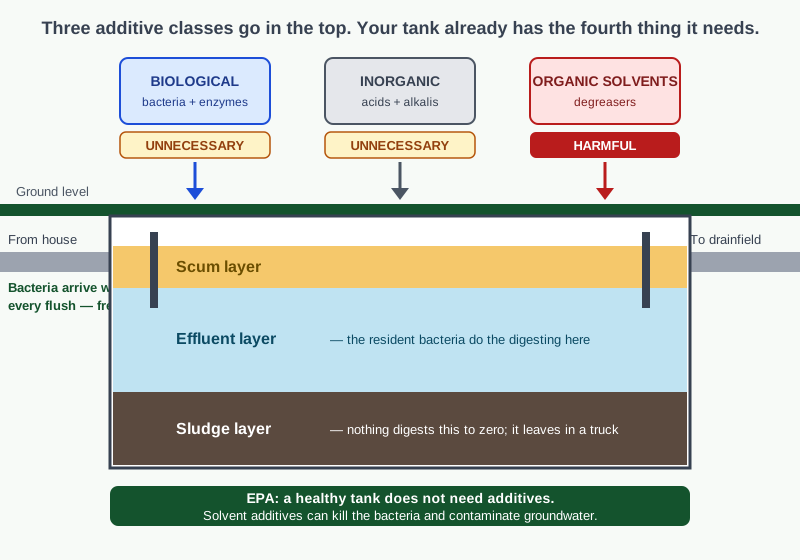
Do Septic Tank Additives Work? What the EPA and the Studies Actually Found
The EPA does not recommend septic additives, a 48-tank double-blind study found no measurable benefit, and one additive class is actively harmful. The evidence, the money maths, and the one narrow exception.
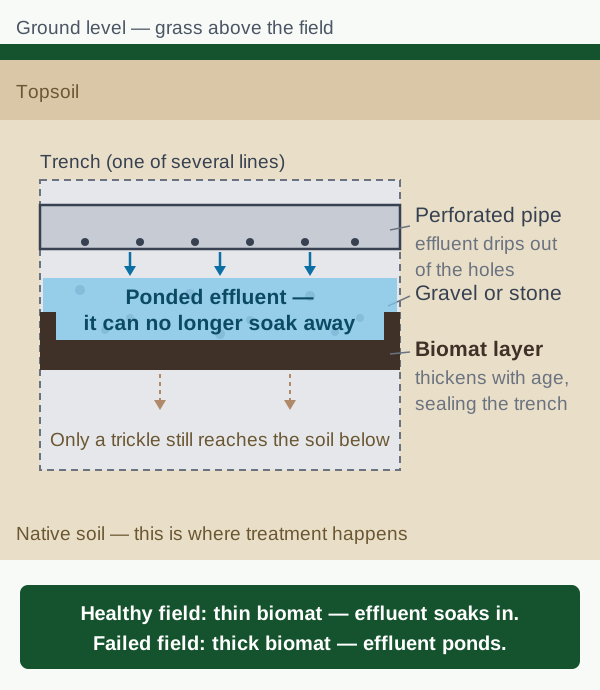
Drain Field Failure Signs: Soggy Ground, Green Stripes and Surfacing Effluent
A failing drain field announces itself in the yard first: lush green stripes, spongy ground, odors, then standing water. The early vs late signs, the look-alikes that aren't failure, a homeowner diagnosis sequence, and what repair or replacement really costs.
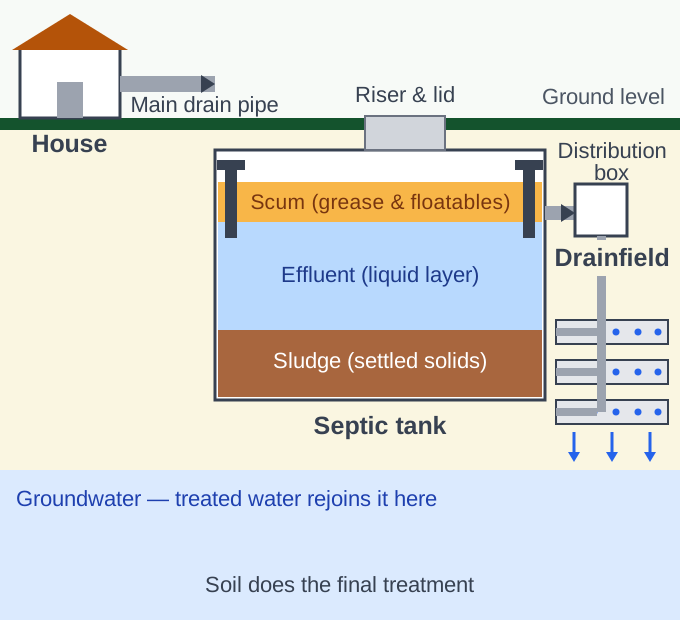
Septic System 101: How It Works, What the Parts Do, What the First Year Costs
Bought a house with a septic system and no manual? Follow one flush through the tank, baffles, filter and drainfield, learn to identify which system type you own, and see what the first year should actually cost.