 Keep
Breaker Keeps Tripping? Read the Timing, Do the Maths, Know When to Stop Resetting
 Daniel Mercer · Editor & Researcher·
Published November 16, 2026·
Updated November 16, 2026
The lights go out in half the kitchen. You walk to the panel, find the breaker sitting in its sheepish middle position, flip it back on, and everything works — until tomorrow, or until the kettle and the toaster next agree to run together. A tripping breaker is the most common electrical symptom in any house, and it's widely misunderstood in one specific way: the breaker is almost never the problem. It's a guard reporting a condition on the circuit it protects. Fire the guard and the condition remains — unguarded.
This guide is about reading the report. A breaker trip carries real diagnostic information, and most of it is in one observation you can make for free: when it trips.
The four things a trip can mean
Overload. The circuit is asked to carry more current than it's rated for, sustained long enough for the breaker's thermal element to heat and open. This is the commonest cause by far, the only one that's mostly benign, and the only one you can often fix by rearranging your own appliances. Signature: trips after minutes of running, when loads stack up.
Short circuit. A hot wire touches a neutral (or another hot) directly — in a damaged cord, a failed appliance, a crushed cable in a wall. Current doesn't rise; it detonates, and the breaker's magnetic element opens it in a fraction of a second. Signature: instant trip, often with a snap, sometimes a smell or a mark at the culprit.
Ground fault. Current leaks out of the intended path to ground — through moisture, deteriorated insulation, a metal appliance case. A standard breaker notices only if the leak is enormous; that's why GFCI protection exists, sensing leakage as small as 5 milliamps. Signature: the GFCI outlet or breaker trips, often around water, weather, or one ageing appliance.
Arc fault. Current jumps a gap — a loose terminal screw, a wire nicked by a drywall screw, a cord crushed under furniture — making a small, sustained spark that draws too little current to bother a standard breaker but exactly enough to start a fire in the wrong material. AFCI breakers listen for the arc's electrical signature. Signature: trips that seem random, or that follow one tool or one outlet's use.
Read the timing before you touch anything
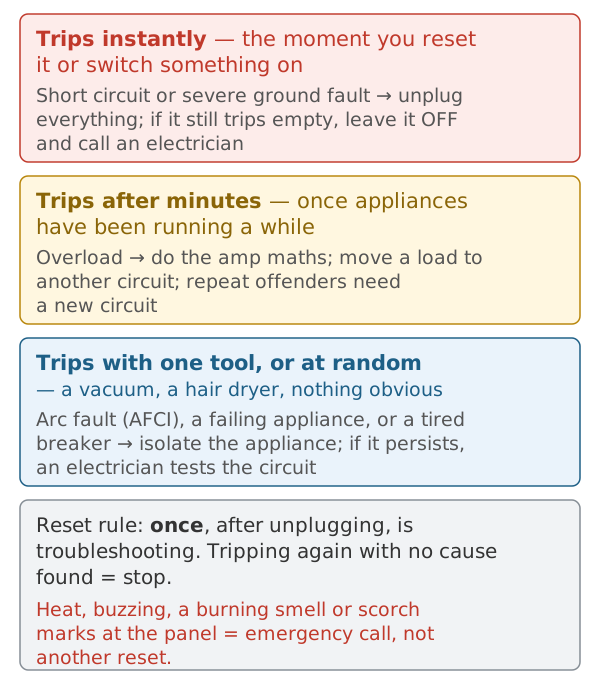
Breakers trip on a curve, and the curve is the diagnosis. Published figures for typical breakers put it roughly: at 135% of rating, a trip takes around half an hour; at 250%, about a minute; at 500%, about ten seconds; a dead short is faster than you can see. So:
- Instant trip on reset, or the moment something switches on → short circuit or severe ground fault. Not an overload — overloads physically cannot act that fast.
- Trip after 2–20 minutes of things running → overload, near-certain. Something is summing past the rating and the breaker is heating on schedule.
- Trip at an appliance's start (pump kicks, AC starts) → suspect the starting surge of a motor on a loaded circuit, or the appliance itself failing.
- Trip with one specific appliance, wherever you plug it in → the appliance. The house is innocent.
- Trip with nothing you can identify, on an AFCI circuit → the breaker heard arcing: a loose connection somewhere is the serious possibility to eliminate.
The same diagnosis as a table — the version to screenshot before you start:
| When it trips | What the pattern means | Most likely cause | The fix / next step |
|---|---|---|---|
| Instantly on reset, everything unplugged | A fault in the fixed wiring itself | Short circuit, severe ground fault, or a failed breaker | Leave it OFF and do not reset again — electrician. This pattern never resolves itself |
| Instantly, the moment one appliance switches on | That appliance faults the instant it draws current | Short or ground fault inside the appliance | Unplug it, test the circuit empty; if it holds, retire or repair the appliance, not the house |
| After seconds to ~20 minutes under load | The breaker's thermal element heating on its published curve | Overload — loads summing past the rating | Do the amp maths below; move or stagger a load, or give the repeat offender a dedicated circuit |
| Exactly when a motor starts (pump, AC, compressor) | A starting surge, several times running current, lands on a loaded circuit | Surge plus load, or a motor beginning to fail | Check what else shares the circuit; if it trips even alone, the appliance needs a technician |
| Only with one specific appliance, on any circuit | The trip follows the appliance, not the wiring | Failing appliance — or a brushed motor impersonating an arc on an AFCI | Confirm on a second circuit, then repair or replace the appliance |
| Randomly, no load pattern, on an AFCI circuit | The breaker is hearing arc signatures | Loose terminal or nicked wire — or a motor appliance faking it | Run the one-appliance test; if nothing explains it, an electrician hunts the connection |
Write the pattern down — time, what was running, how fast it tripped. Three lines of notes turn an electrician's $125–$500 diagnostic visit from exploration into confirmation.
Before you touch the panel: the safety protocol
Everything a homeowner does in this guide happens at the panel, so the rules for standing in front of one get their own block, before any procedure:
- The door is your boundary. Open the panel door and work the breaker handles: that's homeowner territory. The flat cover behind the door — the dead-front — comes off only for an electrician. Behind it sit the bus bars and the service lugs — which stay live even with the main breaker off, fed directly from the meter. No switch in your house makes the inside of that panel safe.
- Dry everything. Dry hands, dry floor, no standing in water or on damp concrete in bare feet. If the floor is wet, the panel waits.
- Rubber-soled shoes on, metal off. No rings, watches, bracelets or dangling necklaces near the panel; metal finds terminals.
- Light and stance. Work with a flashlight or headlamp, never by feel, and stand slightly to the side when you reset a breaker — if a fault lets go, it lets go outward.
- One hand, and never force. Flip handles with one hand. A handle that resists or won't latch is information, not a challenge — stop.
- Never hold a breaker ON. If it trips, it has voted. Holding or taping the handle defeats the circuit's only protection.
- Heat, smell, sound or scorch marks end the session. A warm panel, buzzing breaker, burning smell or discoloured handle — hands off entirely, and the next touch is an electrician's.
Follow them, and the isolation test below is a reasonable homeowner task. Skip them, and it isn't.
The fifteen-minute isolation test
This is the whole of legitimate DIY diagnosis, and it's genuinely sufficient for most trips:
- Unplug everything on the circuit. Every cord, including the charger you forgot and the lamp in the next room that shares it. Switch off hard-wired items on the circuit too.
- Reset properly, once. A tripped breaker sits in a middle position and will not reset from there: push the handle firmly to OFF first, then to ON. It should click and hold.
- If it trips instantly with the circuit empty — stop. The fault is in the fixed wiring or the breaker itself. Leave it off. This is now an electrician's diagnosis, and every further reset is just re-striking the fault.
- If it holds, restore loads one at a time, minutes apart. The single item that trips it instantly is faulty — retire it. The combination that trips it after minutes is an overload — do the maths below.
- If it holds with everything back on, the original event was likely a transient stack of loads; log it and move on, but a second episode earns the full investigation.
Overload maths: the 80% rule and the space heater
Overload is arithmetic, so let's do it. A circuit's rating is its ceiling, but loads that run for hours ("continuous" loads, in code language) are budgeted at 80% of the breaker: a 15-amp circuit carries 12 amps continuously; a 20-amp circuit, 16. Convert any appliance with amps = watts ÷ 120 (US voltage):
- Space heater: 1,500 W → 12.5 A — the entire continuous budget of a 15-amp circuit, alone.
- Hair dryer: 1,500–1,875 W → 12.5–15.6 A — same story, in the bathroom.
- Microwave: 1,000–1,500 W → 8–12.5 A. Kettle and toaster: ~1,500 W each.
- Window AC: 500–1,200 W → 4–10 A. Vacuum: ~1,200 W → 10 A.
Now the classic scenes solve themselves: the heater plus anything on a 15-amp circuit is an overload in waiting; the microwave plus the toaster is a kitchen designed by optimism in an era of smaller appliances. The fixes in order: move a load to a circuit with headroom (you need to know what shares each circuit — see the mapping section), stagger the pair that collides, or, for a repeat offender like a heater or microwave, have an electrician pull a dedicated circuit — the permanent, few-hundred-dollar cure. What never appears on this list: a bigger breaker. The FAQ explains why that idea can burn a house.
When the breaker itself is the fault
Breakers are mechanical devices with springs and contacts, and they age — especially ones that have spent decades cycling, or cleared repeated hard faults. A tired breaker can trip below its rating, on loads the circuit should carry: the signature is a trip pattern that makes no arithmetic sense (trips at 8 amps on a 15-amp breaker, trips faster over months, handle feels soft or won't latch crisply). The electrician's confirmation is measurement, not vibes: a clamp meter on the circuit showing actual current at the moment of the trip. Replacement is the cheapest professional job in this guide — $100–$260 installed — and like-for-like in brand, type and rating is essential, since breakers are listed for specific panels. If your "tripping problem" evaporates with a new breaker, it was never a wiring problem at all.
The panels that can't be trusted
One section of this guide overrides all the diagnosis above: if your panel is a Federal Pacific Stab-Lok or a Zinsco, the conversation is not about the tripping breaker — it's about replacement. Both were installed in millions of homes, both have documented failure modes that testing has quantified (up to one in four Stab-Lok breakers failing to trip on overload in a 3,000-breaker test), and both fail in the worst direction: silently, by not tripping. Inspectors flag them, many insurers ask about them by name, and electricians will — correctly — steer any panel work toward replacement ($1,300–$3,000 typical for a modern 200-amp panel). Check your panel's label today, whatever brought you to this guide; it's the highest-value ten seconds in the article.
Map your panel: the first-year job that pays forever
Every diagnosis in this guide assumes you know which breaker feeds what — knowledge most houses keep in the form of a pencilled panel schedule that's half wrong. Spend one hour, once, doing it right: two people, two phones, one lamp. Switch breakers off one at a time and record everything that dies — outlets, lights, appliances, the furnace, the well pump — including the surprises (the bathroom outlet on the kitchen circuit, the garage on a bedroom's). Write the final map on the panel door and keep a copy with the house documents. You will use it during every future outage, every appliance purchase, every electrician visit ("it's the circuit labelled 14, it feeds the kitchen counter and the dining room"), and it converts the isolation test from archaeology into procedure. While you're at the panel: press the TEST button on every GFCI and AFCI breaker and outlet (monthly is the manufacturers' advice; realistically, do it when you map and twice a year after), and note any breaker that's warm, discoloured or buzzing to the electrician list — those observations are the panel's own maintenance log.
The circuits your house should have (and why older houses trip more)
Modern electrical code assumes a load landscape that older houses were never wired for, and much chronic tripping is simply a 1960s circuit map meeting 2026 appliances. Current practice gives dedicated or heavily-reserved circuits to: the kitchen countertops (two 20-amp small-appliance circuits), the microwave, the dishwasher and disposal, the bathroom outlets (20-amp), the laundry, the refrigerator (usually its own), the furnace and AC (always dedicated), the sump pump, and the garage. A house wired when the kitchen's entire load was a toaster and a percolator may run the microwave, kettle, air fryer and fridge off one 15-amp circuit and a prayer — and its breaker trips are not faults at all; they're the panel reporting that the house has outgrown its wiring. If your trips cluster in the kitchen of an older home, the honest fix is rarely diagnosis: it's adding the circuits the house should have had, which is also the upgrade buyers and inspectors notice. This is the one overload pattern where "just move the load" has nowhere to move it to.
The hidden GFCI: when the breaker is innocent
A special case that generates endless confusion: outlets dead in a bathroom or kitchen, breaker untripped, nothing apparently wrong. Somewhere upstream on that circuit sits a GFCI outlet that has tripped — and it protects every outlet downstream of it, including ones in other rooms. Houses accumulate these in odd places: the GFCI for both bathrooms may live in one of them, or in the garage, or on an exterior outlet by the door. The hunt is a rite of passage: check every GFCI outlet in the house — bathrooms, kitchen, garage, basement, outside — for a popped RESET button, press TEST then RESET, and watch the dead outlets resurrect. Two lessons ride along. First, one GFCI protecting a chain is code-legal and common, so "the outlet has no GFCI" doesn't mean the circuit has none. Second, if that GFCI trips repeatedly with nothing obvious plugged in, it's reporting the same ground-fault story as a GFCI breaker — moisture or a leaking appliance downstream — and it deserves the isolation test, not just another press of the button.
Main breaker trips and the too-small service
Everything above concerns branch breakers — one circuit among many. The main breaker tripping is a different animal: the whole house goes dark because the total load exceeded the service size. Houses with 60-amp or 100-amp services — standard for their eras — now host loads their builders never imagined: central AC, electric ranges and dryers, EV chargers, hot tubs, workshops. A main that trips on a summer evening with the AC, oven, dryer and car charger all running is reporting arithmetic at the service level, and the remedies are load management (don't run the dryer while the car charges), a load-management device, or the service upgrade to 200 amps priced in the table. An electrician's load calculation — a formal tally of your house's demand — is what sizes that decision properly, and it's a required part of any legitimate upgrade quote. Note the boundary: a main breaker that trips without heavy load, or a panel that's warm at rest, skips the arithmetic conversation entirely and goes straight to the emergency list.
Storms, surges and nuisance trips
A breaker that trips during thunderstorms may be responding to real events: lightning-induced surges and utility switching transients can trip sensitive breakers — especially AFCI and GFCI types — and a pump or well system working through a storm cycles hard enough to find every marginal load. One storm trip is weather; a breaker that trips in every storm, or that started tripping after a nearby lightning strike, deserves an electrician's look, because surge damage to breakers and appliance electronics is real and cumulative. The broader defence is a whole-house surge protector mounted at the panel — a few hundred dollars installed, sacrificial by design, and increasingly required by code on new panel work. It won't stop trips caused by overloads, but it eats the transients that age everything downstream of it.
What the electrician actually does (so you know what you're buying)
A proper tripping-breaker diagnosis is measurement, not panel-staring. Expect some combination of: a clamp meter on the circuit to read the actual current when it trips (this single number separates overload from fault from tired breaker); insulation-resistance testing to find a conductor leaking where it shouldn't; a thermal camera or careful hand finding the connection that's heating under load; torque checks on breaker and neutral lugs, because connections loosen over years of thermal cycling and a loose lug is both an arc source and a classic AFCI-trip cause; and a panel health read — brand, age, heat discolouration, corrosion, double-tapped breakers (two circuits forced onto one breaker, a common handyman legacy and a code violation that manufactures overloads). If your diagnostic visit produces none of these and ends with a quote for a new panel, you have bought an opinion, not a diagnosis — get the second one.
Know your breakers by sight
Open the panel door (just the door — nothing in this guide involves removing the cover) and learn the cast. A standard breaker is a plain switch with an amp number on the handle: thermal-magnetic protection, the overload and short-circuit guard. A GFCI breaker adds a TEST button and often a curled white pigtail wire visible at the panel's edge — it's protecting its whole circuit from ground faults, the panel-level version of the bathroom outlet. An AFCI breaker also carries a TEST button (the two are told apart by their labels, and dual-function breakers combine both protections in one body — increasingly the default in new work). Tandem breakers squeeze two circuits into one slot's space; they're legitimate only in panels listed for them, in the slots designated for them — tandems forced into an unlisted panel are a classic unpermitted expansion that overheats the bus, and an electrician spotting them will have opinions. And the main breaker, usually at the top or bottom, larger than everything else, is the house's master switch and service ceiling in one. Knowing which type tripped tells you which section of this guide you're in before you've diagnosed anything: a TEST-button breaker that trips is a protection event (fault or arc), not a capacity event, until proven otherwise.
Keep a trip log (the cheapest diagnostic instrument you own)
Electricians diagnose patterns, and patterns need data. Tape an index card inside the panel door and log every trip: date and time, what was running, how the trip behaved (instant / after minutes / at a start), and what you did. Three entries usually convict someone — the Tuesday-evening overlap of the dryer and the water heater, the vacuum that trips two different AFCI circuits, the trip that only happens when it rains (a ground fault with a weather dependency, pointing outside or at a damp junction). The log also disciplines the response: one unexplained trip gets noted and watched; two get the isolation test; a pattern gets the electrician, with the card as the briefing document. Houses talk. The trip log is how you take dictation.
Extension cords and power strips: the overload multipliers
Half the overloads in older homes are manufactured at the outlet, by the furniture layout. An extension cord is a temporary device with a permanent failure mode: it lets a load live far from its circuit's home, so a heater ends up sharing a bedroom circuit with everything else in the room — and a cord's own gauge is often thinner than the wall wiring it extends, which makes the cord the weakest, hottest link. Space heaters on extension cords are a specifically warned-against combination in every manufacturer's manual for exactly this reason: 12.5 amps through a light-duty cord, coiled under a rug, is a fire recipe with no breaker setting that saves it (the breaker sees a legal load; the cord experiences an illegal one). Power strips multiply outlets, not capacity — six sockets on a strip still sum into the same 15 amps, and a strip with a TV, console, heater and chargers is an overload with good cable management. The rules that keep this section boring: heaters and other big loads plug directly into wall outlets, on circuits you've counted; cords are for temporary, supervised, light-duty use; and a room that chronically needs strips and cords is telling you it needs an electrician to add outlets on a proper circuit — a modest job that permanently retires the problem.
A note for 1965–1973 houses: aluminium branch wiring
If your home was built or extended during the aluminium-wiring era, tripping breakers carry an extra possible meaning. Aluminium branch wiring itself is not the villain of legend, but its connections are maintenance items: aluminium expands and creeps differently from copper, and terminations at outlets, switches and breakers loosen over decades — and a loose termination is precisely an arcing, heating fault of the kind AFCI breakers now report and standard breakers ignore until it's serious. The tells: warm switch or outlet plates, flickering on one circuit, intermittent trips with no load logic, devices marked for copper only. The fixes are specialist work — approved connectors and devices rated for aluminium (CO/ALR), or pigtailing by an electrician who knows the approved methods — and a house with aluminium wiring plus unexplained trips should get that electrician sooner rather than later. It's also a disclosure and insurance topic in many markets, one more reason the panel map and trip log from this guide are worth keeping with the house papers.
Trips that start right after something changed
The most informative trip of all is the first one after a change, because the change is the prime suspect. A new appliance brings a new load profile: the replacement AC or heat pump whose starting surge is shaped differently from the old unit's, the bigger microwave on the same tired circuit, the freezer added to a garage circuit that also feeds the door opener and the holiday lights. Recent electrical work — a new outlet, a moved switch, a ceiling fan swapped in — can leave a nicked conductor or a loose terminal that announces itself days later as an AFCI trip or an intermittent short. And renovation debris is real: a drywall screw through a cable is the classic latent fault, energised and harmless until vibration or load makes it arc. The rule is simple and saves diagnostic money: when trips begin, ask "what changed this month?" before asking "what's broken?" — and tell the electrician the answer in the first minute of the call.
What each fix costs: the decision table
Nobody else writing about this symptom publishes prices, so here is the full ladder in one place — 2026 US ranges:
| Job | Typical price | When it's the right spend | Notes |
|---|---|---|---|
| Electrician diagnostic visit | $125–$500 | Any trip you can't explain after the isolation test | Often credited toward the repair; you're buying measurements, not a guess |
| Replace one breaker | $100–$260 | Clamp meter proves the breaker trips below its rating | Parts $5–$40 standard, $35–$70+ AFCI/GFCI; the rest is safe panel work. Like-for-like brand and type only |
| New dedicated circuit | $300–$800 | One heavy appliance chronically overloads a shared circuit | Short accessible runs price low; long runs through finished walls price high. Permit usually required |
| Panel upgrade to 200 amps | $1,300–$3,000 | Panel is full, service is 60–100 amps with main trips, or the panel is a problem brand | Angi's 2026 average is ≈$1,600; working life 25–40 years; permit and utility coordination in a proper quote |
| Full service upgrade (meter, mast, utility work) | $2,500–$5,000+ | The service itself, not just the panel, is undersized or deteriorated | The utility's side drives price and timeline; get the load calculation in writing |
The decision logic is simple. Repair when the panel is sound, has spare slots, and the fault is isolated: one tired breaker, one overloaded circuit, one bad appliance. That's most houses; the bill stays in the hundreds. Upgrade when the constraint is the box itself — no spare slots, a main tripping under normal modern load, visible heat or corrosion, or a Federal Pacific or Zinsco badge. Treat an upgrade quote that arrives before any measurement with suspicion — a proper diagnosis tells you which rung of the ladder you're actually on.
When it's the electrician, and what to hand them
Call rather than continue when: the breaker trips empty, trips instantly without an identified appliance, won't hold a reset, or comes with heat, buzzing, smell or scorch marks anywhere; when an AFCI trips persistently with no appliance explanation (loose connections hide in walls and device boxes, and finding them is instrument work); when the same fault appears on two circuits; or when the panel is one of the named problem brands. Arrive at that call with your notes — timing, loads, what the isolation test showed, the panel brand — and you'll buy a diagnosis instead of a fishing expedition. The economics of this whole topic are unusually kind: the diagnosis is mostly free, the commonest fix is rearranging plugs, the next is a $100–$260 breaker, and the expensive items on the table (dedicated circuits, panel work) are permanent upgrades rather than repeat repairs. The only genuinely costly response to a tripping breaker is the free one — flipping it back on, unexamined, for the fortieth time.
Cost at a glance
| Item | Typical cost | Notes |
|---|---|---|
| Electrician diagnostic visit | $125–$500 | What you pay to have the fault found properly with test instruments instead of guesses |
| Replace one breaker (professional) | $100–$260 | The breaker itself is $5–$40 standard, $35–$70+ for AFCI/GFCI types; you're paying for panel work done safely |
| New dedicated circuit (e.g. for a microwave or heater) | Typically a few hundred dollars | The permanent cure for a chronic overload — one heavy appliance gets its own circuit |
| Panel upgrade to 200-amp service | $1,300–$3,000 | Angi 2026 average ≈ $1,600 for a panel upgrade; full service upgrades with utility work run higher. Only needed for capacity, not for one tripping breaker |
Frequently asked questions
Is it dangerous if a breaker keeps tripping?
The tripping itself is protection working — the danger is in what it's protecting you from, and in defeating it. A breaker that trips occasionally under an obvious heavy load is doing arithmetic, not signalling doom. The dangerous patterns are: tripping instantly with nothing plugged in (an active fault in the wiring), tripping alongside heat, buzzing or a burning smell (energy going somewhere it shouldn't, as heat), and any breaker that has been repeatedly reset into an unfound fault — each reset re-energises the fault, and faults inside walls are how electrical fires start. US fire data attributes tens of thousands of house fires a year to electrical faults; the breaker's whole existence is to keep your house out of that statistic. Respect the message and it's a safety device; silence it and it's a countdown.
Can I just install a bigger breaker so it stops tripping?
No — this is the single most dangerous 'fix' in home electrical work, and it's worth understanding why. The breaker is not sized to your appliances; it's sized to the wire in the wall. A 15-amp breaker protects 14-gauge wire; a 20-amp breaker protects 12-gauge. Fit a 20-amp breaker on 14-gauge wire and the wire becomes the fuse: it will carry 18 amps happily, heating inside the wall, ageing its insulation, until something fails — with the breaker watching silently, because as far as it knows, 18 is under 20. If a circuit genuinely needs more capacity, the fix is a new circuit pulled in the correct wire gauge by an electrician. The breaker is cheap; the wire is the system.
Why does the breaker trip when I run the vacuum or hair dryer?
Usually arithmetic plus inrush. A hair dryer is typically 1,500–1,875 watts — 12.5 to 15.6 amps by itself — on what is often a 15- or 20-amp bathroom or bedroom circuit that also carries lights and whatever else is running. The dryer alone can consume the circuit's entire continuous budget, and the trip arrives a minute or two in, as the breaker's thermal element heats: the classic overload signature. With vacuums there's a second suspect: an AFCI breaker may trip on the vacuum's motor, because brushed motors make small arcs as a normal part of running, and older or cheaper motors make arc-like signatures the breaker can't distinguish from a dangerous arc. If a standard breaker trips with the dryer, it's load. If an AFCI trips only with one motor appliance, try the appliance on another AFCI circuit: if the trip follows the appliance, the appliance is the story; if it stays with the circuit, call an electrician to check the wiring the AFCI is watching.
What is the difference between AFCI and GFCI, and why does mine trip?
They guard against different ways electricity hurts people. A GFCI (ground-fault) watches for current leaking out of the circuit — through water, a damaged cord, or a person — and cuts power at about 5 milliamps of leakage, far below what you'd feel as a serious shock. GFCI trips usually mean moisture, a failing appliance with leakage (old fridges and washing machines are classics), or a genuinely dangerous fault near water. An AFCI (arc-fault) watches the shape of the current for the signature of arcing — a loose terminal, a nicked wire, a crushed cord sparking inside a wall — a fire risk that produces too little current to trip a standard breaker. AFCI trips mean the breaker heard something arc-shaped: a real loose connection (call an electrician), or a motor appliance impersonating one (test as above). Neither device trips for fun, and a replacement that 'fixes' the tripping by removing the protection has fixed nothing.
How many times can I reset a breaker?
Once, properly, after you've unplugged the circuit and looked for the obvious cause — that's troubleshooting. If it trips again with no cause identified, the correct number of further resets is zero until the cause is found: leave it off and diagnose or call. Each reset into a short or arc fault dumps energy into the fault location, and breakers themselves are not rated for endless fault interruption — a breaker that has cleared many hard faults can itself be weakened by the experience, which is one reason 'the breaker is just old' is sometimes the true diagnosis. Treat the handle like a fire alarm, not a snooze button.
My panel is Federal Pacific (or Zinsco). Does that matter?
Yes — these are the two names home inspectors flag on sight. Federal Pacific Stab-Lok panels were installed in millions of homes from the 1950s onward, and testing of thousands of Stab-Lok breakers (a 2017 test of over 3,000) found up to one in four failing to trip on overload — the one job the device exists for. Zinsco panels have their own documented failure modes, including breakers that can appear off while the circuit stays live. Neither panel announces its failure in advance; they fail silently, at the moment of overload. If your home has either, budget for a panel replacement ($1,300–$3,000 typical) as a safety project rather than a repair, get an electrician's written assessment, and know that some insurers ask about these panels by name. A tripping breaker is annoying; a breaker that never trips is the hazard.
Why does the breaker trip at the same time every day?
Because loads have schedules, and the trip is reporting one. The usual script: the water heater recovering after morning showers, the space heater cycling, the well pump or AC starting — two heavy loads that individually fit the circuit (or the service) overlap at a predictable hour and sum past the limit. Motor loads add a twist: a pump or compressor draws a brief starting surge several times its running current, so the trip lands exactly at a start, not during the run. The fix is detective work with the panel schedule: log what's running when it trips for two or three days, and the pattern will name the pair. Solutions range from free (the heater moves to a different circuit) to a dedicated circuit for the repeat offender — but it starts with the log, not a guess.
Checked November 16, 2026. This guide is general information, not a substitute for a licensed professional.
Related guides
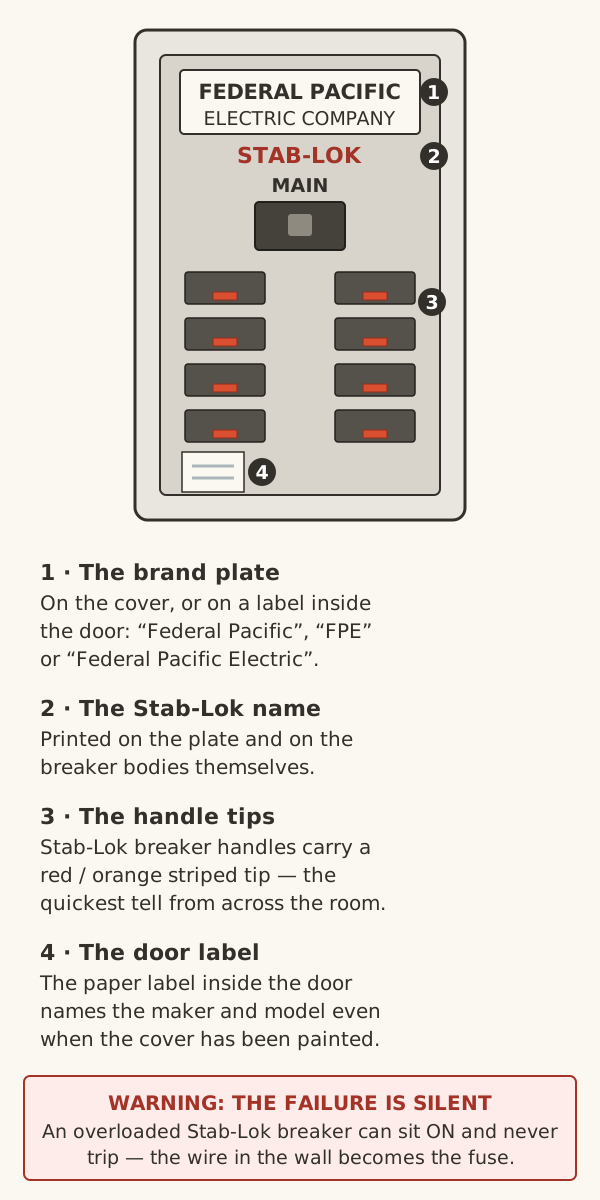
Federal Pacific Panel? Why Stab-Lok Breakers Are a Replace-Now Problem
Federal Pacific Stab-Lok panels sit in millions of 1950s–80s homes. How to identify one in five minutes, what the CPSC testing and the New Jersey court actually found, why insurers refuse these panels, and what a replacement involves and costs in 2026.
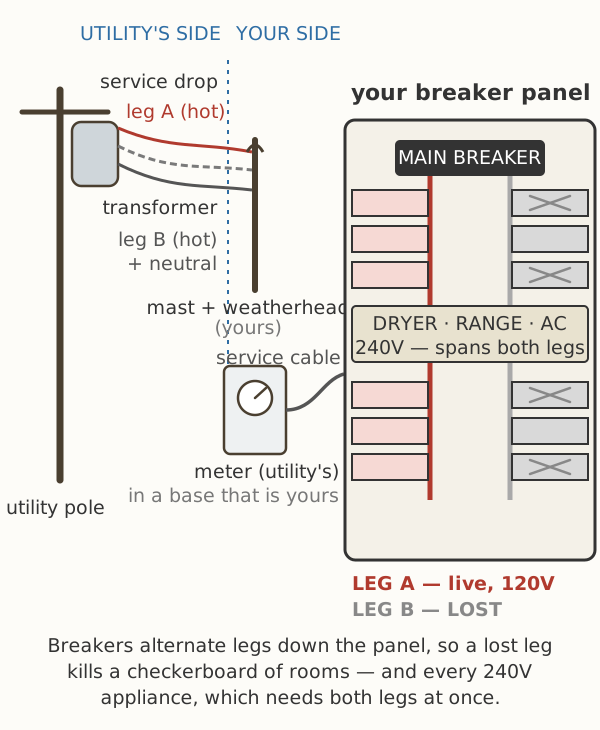
Half the House Has No Power: Lost Leg, Lost Neutral, or Just a Breaker?
Half the rooms are dead, no breaker has tripped, and the dryer won't run. The checkerboard pattern, the bright-and-dim test that means 'unplug things now', who pays for what — utility versus you — and 2026 electrician costs.