 Keep
Federal Pacific Panel? Why Stab-Lok Breakers Are a Replace-Now Problem
 Daniel Mercer · Editor & Researcher·
Published November 16, 2026·
Updated November 16, 2026
Most owners meet this panel the same way: a line in a home inspection report, written in the flat tone inspectors save for the things that matter. "Federal Pacific Stab-Lok panel. Recommend evaluation by a licensed electrician." Sometimes the inspector says it out loud instead, standing in the basement with a flashlight: that's one of the bad ones.
If that line is in your report, or if the house you grew up visiting has had the same grey box on the wall since the seventies, this guide is the full picture: how to confirm what you have, what the official record actually says (it is more careful, and more damning, than the internet version), why your insurance company cares as much as your electrician does, and exactly what replacing the panel involves, costs, and should look like on paper before you sign anything.
The short version
A circuit breaker has one job: when a circuit carries more current than the wire can safely handle, the breaker opens and the current stops. Every other component in your electrical system trusts it to do that. Federal Pacific's Stab-Lok breakers, installed in millions of American homes from the early 1950s through the 1980s, have a documented record of not doing it: staying closed through overloads that should have tripped them, leaving the wire in the wall to take the heat the breaker was hired to take. That is why the fix is not a repair. You cannot adjust, clean, or selectively replace your way to a trustworthy Stab-Lok panel, because the unreliability is built into the design of the breakers and their connection to the panel. The fix is a new panel, and this is a "plan it and book it" problem, not a "sleep elsewhere tonight" problem, provided the panel shows no active warning signs.
How to tell if you have one: the five-minute check
You need a flashlight and no tools, and you do not need to remove the panel cover or touch anything that carries current. Work through these four checks in order; any one of them can settle it.
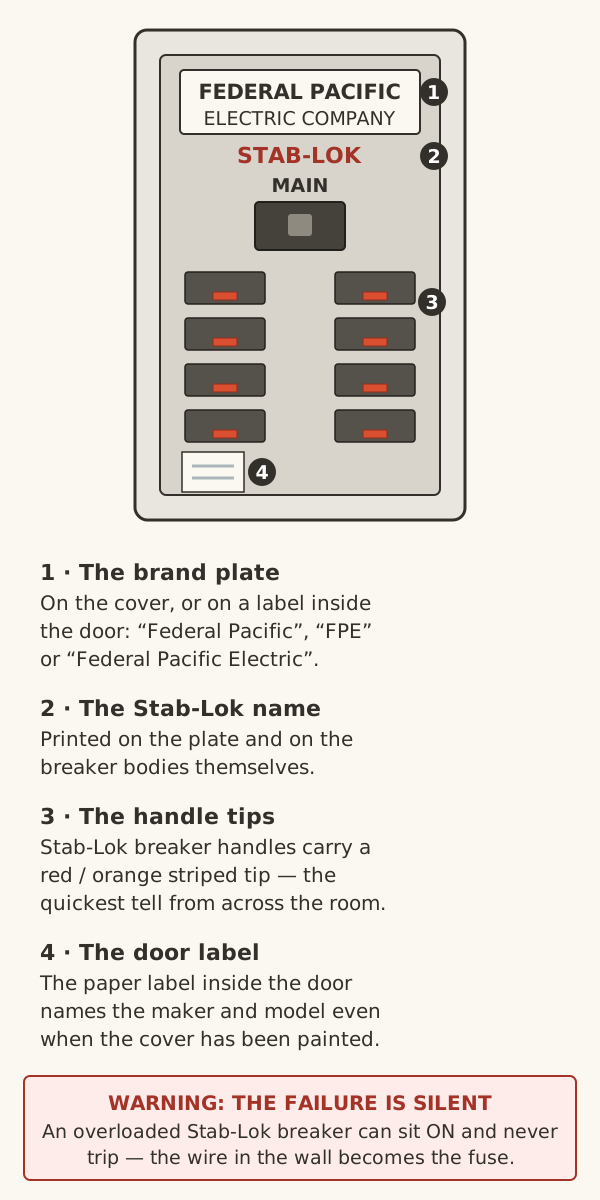
1. Read the cover. Many Federal Pacific panels carry the maker's name on a plate on the front of the cover or stamped into the cover itself: "Federal Pacific", "FPE", or "Federal Pacific Electric". Covers get painted, swapped, and scuffed over forty years, so a blank cover proves nothing either way. Move on to the label.
2. Open the door and read the paper label. The inside of the panel door usually carries a paper or foil label with the manufacturer's name, the model, and the circuit directory. This label survives paint jobs that hide the cover, and it is the single most reliable identification on the panel. If it names Federal Pacific or FPE, you have your answer.
3. Look for the word Stab-Lok. Stab-Lok was Federal Pacific's breaker line, and the name is printed on the panel plate and on the breaker bodies themselves. "Stab-Lok" on the breakers means the panel is Federal Pacific's system even if every other label has worn away, because the breakers and the panel bus were designed as a matched set.
4. Check the breaker handle tips. Stab-Lok breakers have a look you can spot from the doorway once you know it: slim breaker bodies in two columns, with handles carrying a distinctive red or orange striped tip. On a forty-year-old panel the colours fade, but the striped tip pattern is still usually visible under a flashlight.
Two supporting clues, neither conclusive alone: the house was built, or its electrical service was last replaced, between the early 1950s and the late 1980s; and a previous inspection report, appraisal, or insurance document already mentions the panel by name. If you are still unsure after the four checks, take a clear photo of the door label and the breaker rows and send it to an electrician. Identification from a photo is routine, quick, and usually free, because the electrician is hoping to quote the replacement.
One caution that applies to every panel, not just this one: identification stops at reading labels. Do not remove the inner cover (the dead-front) to look for more labels. Behind it are the service conductors, which remain live even with the main breaker off, and they are unforgiving of a slipped hand or a dropped screwdriver.
Why this panel is different: a breaker that may not break
Every house has components that wear out, and most worn components announce themselves: the water heater rumbles, the furnace short-cycles, the roof leaks. The Stab-Lok problem is worse than wear, and quieter. It is a protection device that can fail silently and in advance, sitting in your basement for decades in a state where it would not trip if it had to, giving no sign of that state until the day an overloaded circuit tests it.
The mechanism, in brief. A breaker trips two ways: a thermal element that bends and opens the contacts when sustained overload heats it, and a magnetic element that snaps it open instantly on a short circuit. For the trip to protect anything, the calibration has to be right: trip at the rated current, every time, after years of service. The documented Stab-Lok failures are calibration failures and connection failures. Breakers that should trip at 135% of their rating sit there, closed, carrying the overload while the conductor insulation cooks. And the breaker's namesake connection, the stab where it plugs onto the panel's bus bar, can loosen and make poor contact, which generates heat at the back of the panel, out of sight, even at normal loads.
Notice what that means for the usual owner instincts. You cannot test your way to confidence: switching a breaker off and on proves the handle moves, not that it will trip at the right current. You cannot point to forty quiet years as evidence of safety, either. A breaker that has never faced a serious overload has never been examined; the quiet years only prove the exam never happened. And the failure, when it comes, does not look like a failure. The lights stay on. That is the whole problem: the circuit keeps working while its protection is absent, and the first symptom may be the smell of hot insulation inside a wall.
What doing nothing actually looks like
It is worth walking through the event this panel mishandles, because it is not exotic. A winter evening: a space heater running in a bedroom, a second heater or a hair dryer joining it on the same circuit, perhaps a microwave cycling downstairs. The circuit's load climbs past its rating and stays there. In a healthy panel, the breaker's thermal element heats on the same curve as the wire, wins the race, and opens the circuit; you lose the room's power and gain a minor annoyance. In a Stab-Lok panel with a breaker from the failing share of the population, nothing opens. The current keeps flowing, the conductor inside the wall heats past the temperature its insulation was rated for, and the insulation ages, cracks, and eventually exposes conductor to whatever is nearest: framing timber, insulation, dust. That process can smoulder for a long time before it flames, which is one reason these failures are hard to count after the fact.
Nothing about that evening requires recklessness. Nobody defeated a safety device or ran an industrial load off a bedroom outlet; the household simply used ordinary appliances in an ordinary combination, in a house whose protection turned out to be decorative. That is the honest case for treating replacement as scheduled maintenance rather than an optional upgrade. The panel is not one component among many that might fail. It is the component every other failure depends on.
What the studies and the CPSC actually found
This topic attracts exaggeration in both directions: sales pages that call every Stab-Lok panel a fire already burning, and forum posts that call the whole thing a racket invented by electricians. The documented record is narrower than the first and much worse than the second. Here it is, in the order it happened.
1980: the company reports itself. In June 1980, the company that then owned Federal Pacific told the US Consumer Product Safety Commission that many FPE breakers did not meet Underwriters Laboratories (UL) requirements, even though the breakers carried UL labels. That admission is the root of everything after it: the safety certification on the product could not be taken at face value, so the question became what independent testing would show.
1980–1983: the CPSC investigation and the contracted testing. The CPSC opened a formal investigation and commissioned laboratory testing of Stab-Lok breakers against the UL 489 calibration standard they were supposed to meet. The testing, performed under contract by engineer Jesse Aronstein's team, examined 122 two-pole breakers. The results were not marginal. Tested as pairs at 135% of rated current, about a quarter of the breakers failed to trip before any mechanical wear. Tested pole by pole, the failure rate at the same overload ran past half, and rose further after the breakers had been operated through hundreds of cycles, the way a real breaker is used over years. The report also recorded breakers that overheated to the point of charring their own casings without tripping. Aronstein's later independent testing, and a peer-reviewed analysis he co-authored, kept finding failure rates in the same territory, roughly 28% in the series insurers most often cite. For calibration: a modern breaker failing a UL calibration test at all is a scandal. A product line failing at one-in-four is not a quality-control problem; it is the design's record.
March 1983: the investigation closes, without a recall and without a clearance. After about two years, the CPSC closed the investigation. It confirmed that Stab-Lok breakers failed certain UL calibration test requirements, but said the data available was insufficient to accept or refute the manufacturer's position that the breakers posed no hazard, and that gathering conclusive data would cost several million dollars it did not have. No recall was issued. Crucially, the agency did not find the panels safe, and when it revised its closing statement in 2011 it repeated that it had made no determination on safety. Anyone who tells you "the government cleared these panels" is describing a document that does not exist.
2002: the New Jersey court finding. In a class action under New Jersey's Consumer Fraud Act, a New Jersey court found that Federal Pacific had knowingly and purposefully distributed circuit breakers that were not tested to meet the UL standards their labels claimed. That is a finding about the labelling and the testing, not a ruling that every installed panel will cause a fire, and it should be quoted as exactly what it is. Combined with the CPSC record, though, it removes the last comfortable theory, that the breakers were properly certified and merely aged badly.
The fire estimates, labelled as estimates. Aronstein and a co-author have estimated, in work presented to the IEEE, that failures of these breakers are associated with roughly 2,800 house fires a year in the United States, along with deaths and tens of millions of dollars in property damage. Insurers citing that figure add, correctly, that the true number is impossible to know: a fire started by an untripped overload rarely leaves evidence that names the breaker. Treat 2,800 as a reasoned engineering estimate, not a count. You do not need it to be exact for the decision to make sense. A protection device with a documented one-in-four failure rate in government-contracted testing has already told you what to do.
The cousin panel: Zinsco, and the names it hides behind
While you are reading labels, check for the other name inspectors flag on sight. Zinsco panels fail differently: their breakers clip onto an aluminium bus bar, the clips can loosen and arc, and in the worst cases a breaker fuses to the bus, after which it cannot trip at all. Zinsco breakers have also been documented appearing off while the circuit they feed remains live. Zinsco panels were additionally sold under the Sylvania and GTE-Sylvania names, so a panel badged Sylvania from that era deserves the same suspicion and the same photo-to-an-electrician check; do not assume the different badge means a different, safer design. Two more names earn an honourable mention in inspection reports, Challenger and Bulldog Pushmatic, and the practical rule covers all of them: if an inspector or insurer names your panel, the conversation is about replacement, and the identification and cost guidance in this guide applies in the same ranges.
Insurance and resale: the second problem with this panel
Suppose you set the fire question aside entirely. The panel still costs you, because the insurance industry made its own decision about Stab-Lok years ago and acts on it at the least convenient moments.
Coverage. Federal Pacific Stab-Lok and Zinsco are the two panel names that recur in insurer underwriting guidance. Depending on the carrier and the state, the outcomes include: declining to write a new policy on the home, refusing renewal of an existing one, or writing the policy on condition that the panel is replaced within a set window, often a few weeks to a few months after purchase. Many long-held policies have never been reviewed, which is why owners are blindsided precisely when coverage is being re-examined: a purchase, a refinance, a switch to a cheaper carrier, or a claim that brings an adjuster into the basement. A replacement condition is a hard deadline, not a suggestion: miss it and you can find the policy cancelled, which then becomes its own disclosure problem with the next carrier.
Resale and disclosure. When you sell, the panel will be found again: by the buyer's inspector, by the buyer's insurer, and increasingly by the buyer's lender's requirements downstream of both. In most states, a known defect of this kind belongs on the seller's disclosure form, and "the inspector flagged it when we bought the house" makes it unambiguously known. Owners who replace the panel before listing convert a negotiation lever for the buyer into a non-issue, and keep the paperwork: the permit, the inspection sign-off, and the electrician's invoice are exactly the documents a buyer's insurer wants to see. Owners who leave it should expect the cost to come out of the price anyway, usually with a margin for the buyer's trouble.
Found at inspection? The home-buying playbook
If the panel surfaced in the inspection of a house you are buying, you are in the strongest position you will ever be in on this issue, and the order of operations matters.
- Get the replacement quoted before closing. Have an electrician price the swap, like-for-like and with a 200-amp upgrade, in writing. A real number turns the panel from a scary adjective into a negotiable figure.
- Get insurance quotes before closing, not after. Ask each carrier directly whether the panel is acceptable, acceptable with a replacement condition, or a refusal. A refusal discovered after closing, with a mortgage requiring continuous coverage, is a crisis; discovered before closing, it is a negotiating fact.
- Negotiate a credit at the quoted figure. Sellers routinely credit documented, inspector-flagged safety items. The electrician's written quote from step 1 is the document that makes the ask stick.
- Budget the swap for the first season, and book it early. If your insurer imposed a replacement window, that deadline outranks every other project on the list. If it did not, the first year is still the right horizon; this is not the item to let slide behind cosmetic work.
- Keep the file. Inspection report, quote, insurer correspondence, and later the permit and final invoice. That file is what you hand to your insurer now and to your buyer eventually.
The solution: what to do, in order
While the panel is still in service: the interim rules
Replacement takes weeks to arrange, and the panel has to carry the house in the meantime. These rules shrink the risk in the interval; none of them makes the panel trustworthy, and they are not a substitute for the swap.
- Spread heavy loads out. The scenario this panel handles worst is stacked continuous load: the space heater, the dryer, and the oven sharing an already busy period. Run big loads one at a time where you can, and avoid piling them onto a single circuit.
- Be strict with space heaters. A space heater is the classic overload appliance: maximum draw, sustained for hours, often on an ageing circuit. On a Stab-Lok panel, never run one unattended or overnight, and treat a heater that has ever tripped, or failed to trip, its circuit as a stop sign.
- Learn the warning signs and act on them the day they appear. Buzzing or sizzling at the panel, a breaker hot to the touch, a burning or fishy smell, scorch marks, or a breaker that feels loose or will not stay reset all mean the schedule accelerates from months to days. Our guide "Buzzing, Sizzling, or a Burning Smell at the Breaker Panel: What to Do First" sorts those signs by danger and gives the safe owner actions for each.
- Keep detection current. With the panel's protection in doubt, working smoke alarms on every level and outside sleeping areas are not a generic reminder; they are the backup system for the failed one. Test them monthly while this panel is in service.
- Do not "exercise" the breakers as a test. Flipping breakers off and on proves the handles move. It tells you nothing about whether they will trip at the right current, and repeated operation was one of the wear factors that made test results worse, not better.
Step 1: the electrician's evaluation
Book a licensed electrician for a panel evaluation, and be clear about what you are buying: not a sales visit, a written assessment. A proper evaluation confirms the panel's identity and condition from the labels and the breaker rows, checks for the visible secondary problems that change the scope (heat discolouration, corrosion, a damaged bus, doubled-up circuits, a panel that is also undersized or full), and establishes whether a like-for-like swap suffices or whether the service itself needs upgrading. The output you want is a short written report: what the panel is, what condition it is in, and what replacement involves at your house. That document is what your insurer reads, what a seller's agent cannot argue with, and what turns three competing quotes into comparable bids for the same job. Expect $125–$500, frequently credited toward the replacement if the same firm does the work.
Use the assessment actively, not just as paperwork. Send the same written scope to two or three electricians and ask each to price that scope, itemised the way the quote checklist below sets out. Bids gathered against one shared description are the only bids that can be honestly compared, and the exercise routinely separates the firm that has planned your job from the firm that has priced a generic one.
Step 2: the replacement, step by step
A panel replacement is a one-day production with several parties, and knowing the sequence tells you whether a quote has actually planned the job.
- Permit pulled. The electrician obtains the electrical permit from your local authority. Unpermitted panel work is a recurring discovery at resale and a legitimate insurer complaint; the permit is part of the job, not an optional extra.
- Utility disconnect scheduled. The power company must disconnect the service at the meter or the drop, because the conductors feeding the panel cannot be switched off from inside the house. The electrician coordinates this; scheduling the utility is often what sets the date.
- Power off, old panel out. On the day, the house goes dark for roughly six to ten hours. The old panel is removed, and the service conductors and every branch circuit are transferred to the new panel. This is also when related defects get fixed: a damaged meter base or mast, tired service cable, missing grounding.
- New panel landed and labelled. Every circuit is reconnected to a new breaker of the correct type, including AFCI or GFCI breakers where current code requires them for the rooms those circuits serve, and the circuit directory is written out in full. A new panel with a blank or wrong directory is an unfinished job.
- Inspection. The local inspector examines the work and signs it off. Only then is the job code-complete.
- Utility reconnect. The power company restores service and reseals the meter. You get your house back with a panel whose breakers have current, verifiable listings, and a paper trail.
Plan the day like a power outage you chose: fridge and freezer stay shut (a closed freezer holds safe temperatures far longer than the job takes, provided it starts cold and full), phones and a power bank charged the night before, laptops and any medical devices with battery needs planned around the gap, the garage door's manual release located in case you need the car, and the alarm system's battery backup checked, since panels and alarms dislike surprises equally. If anyone in the house works from home, that is a library or office day. Tell the neighbours on the same transformer nothing at all; the disconnect affects only your service, which is precisely why the utility has to schedule it.
What the written quote must include
Get quotes in writing and compare them line by line, because the headline spread between bids is usually scope, not greed. A complete quote states: the new panel's brand, amperage, and space count; the breaker schedule, including how many AFCI/GFCI breakers and their cost; whether surge protection for the whole service is included (current code requires a surge device on dwelling service replacements in many jurisdictions, and it belongs in the price, not in a day-of upsell); the permit fee and who books the inspection; the utility disconnect and reconnect, and who coordinates it; explicit treatment of the meter base, mast, and service cable, either included or named as priced extras if found deficient; full circuit labelling; haul-away of the old panel; and the warranty on parts and labour. A quote that is just a number and a date is asking you to discover its exclusions mid-job, with the power off.
What it costs
| Job | Typical price (2026) | Notes |
|---|---|---|
| Electrician evaluation and written assessment | $125–$500 | The document insurers and buyers' agents act on; often credited toward the replacement |
| Full panel replacement, same amperage | $2,000–$4,500 | New panel and breakers, permit, inspection, utility coordination in a proper quote |
| Replacement with a 200-amp service upgrade | $5,500–$7,000 | Adds meter base, mast and service cable work; chosen when the old service is also undersized |
| Breaker-only replacement (not a fix) | $100–$260 per breaker | A stopgap for a visibly failed breaker; the panel remains flagged by inspectors and insurers |
Where a given house lands in the replacement range depends on access (a panel in open basement wall prices lower than one buried in finished joinery), on how much associated hardware is tired, and on local permit and labour costs. The decision between the two replacement rows deserves one honest paragraph: same-amperage replacement is the right spend when the existing service genuinely meets the house's needs, and it fully resolves the safety and insurance problem. The 200-amp upgrade costs more because it is a different, larger job, and it earns its premium in houses adding an EV charger, a heat pump, or a hot tub in the next few years. What neither row tolerates is delay dressed up as savings: the breaker-only row buys nothing but time, and it does not even buy the insurer's agreement.
DIY or pro: there is no DIY version of this job
Identification is yours: labels, handles, a flashlight, five minutes. Everything beyond that belongs to a licensed electrician, and the reason is specific rather than ceremonial. The conductors that feed your main breaker come straight from the meter and have no switch on your side of it; they are live during the entire job, in the exact space hands and tools are working, and they carry enough energy to make a single slip fatal. Add the permit, the utility coordination, and the inspection, plus the fact that insurers and future buyers will ask for the paperwork, and even an owner fully capable of wiring a room addition should hire this one out. Your DIY contribution is the valuable part anyway: identifying the panel, getting the written evaluation, comparing itemised quotes, and keeping the file.
How urgent is it, honestly?
Not panic, and not someday. A silent, cool, symptom-free Stab-Lok panel does not require you to move out or to pay emergency rates tonight; these panels have carried houses for decades, and the risk is statistical rather than scheduled. But the same record that rules out panic rules out deferral: the protection is unverifiable, the failure is invisible, and the trend only runs one way as contacts age and household loads grow. The right posture is the one you would take with a roof at the end of its life: get the written assessment within weeks, choose the contractor, and put the replacement on this year's calendar, sooner if your insurer sets a date and immediately if any warning sign appears. Our guide "Breaker Keeps Tripping? Read the Timing, Do the Maths, Know When to Stop Resetting" makes the closing point from the other direction: a breaker that trips is a guard doing its job. The Federal Pacific problem is the guard who may never show up at all. Replace the guard, keep the paperwork, and this becomes one of the few major house problems that, once fixed, stays fixed for the next forty years.
Cost at a glance
| Item | Typical cost | Notes |
|---|---|---|
| Electrician evaluation and written assessment | $125–$500 | The document insurers and buyers' agents actually act on; often credited toward the replacement if the same firm does the work |
| Full panel replacement, same amperage | $2,000–$4,500 | New panel and breakers, permit, inspection and utility disconnect/reconnect coordination in a proper quote |
| Replacement with a 200-amp service upgrade | $5,500–$7,000 | Adds meter base, mast and service cable work; the common choice when the old panel is also undersized for modern loads |
| Breaker-only replacement (not a fix) | $100–$260 per breaker | A dead Stab-Lok breaker can be swapped, but the design is the problem; insurers generally still require full panel replacement |
Frequently asked questions
How can I tell if my panel is Federal Pacific?
You do not need to open anything or touch a wire. Look for the maker's name in three places: the plate on the front of the panel cover, the paper label stuck inside the door, and the breakers themselves. You are looking for 'Federal Pacific', 'FPE' or 'Federal Pacific Electric', and for the word 'Stab-Lok', which is printed on the plate and on the breaker bodies. The fastest tell from across the room is the breakers' handles: Stab-Lok handles carry a distinctive red or orange striped tip. The houses to suspect are those built or rewired between the early 1950s and the late 1980s. If the cover has been painted over, the inside-door label usually survives. Take a photo of the label and the breaker rows; that photo is all an electrician or insurer needs to confirm it.
Was the Federal Pacific panel ever recalled?
No, and the distinction matters. The US Consumer Product Safety Commission opened an investigation in 1980, after Federal Pacific's then-owner told the agency that many of its breakers did not meet the UL requirements their labels claimed. Testing under that investigation confirmed that Stab-Lok breakers failed UL calibration requirements, especially two-pole breakers. In March 1983 the CPSC closed the investigation without a recall, saying its budget could not support the further study needed and that the data it had was insufficient to settle the hazard question either way. It never declared the panels safe, and a 2011 revision of its closing statement repeated that it had made no safety determination. Separately, in 2002 a New Jersey court found that Federal Pacific had knowingly distributed breakers that were not tested to the UL standards on their labels. So: no recall, but no clean bill of health either, and a court finding of mislabelled safety testing.
Can I just replace the Stab-Lok breakers with new breakers?
It sounds like the cheap fix, and electricians get asked weekly. It does not work as a cure, for two reasons. First, the failure record belongs to the Stab-Lok system as a whole: the breakers and the way they stab onto the panel's bus bar. Poor, loosening contact at that connection is part of the documented problem, and new breakers on a decades-old bus inherit it. Second, the people whose opinion costs you money, insurers and home inspectors, treat the panel itself as the defect. A panel full of replacement breakers still gets flagged on an inspection report and still triggers insurer refusals. If a single breaker has visibly failed, an electrician may swap it as a stopgap, but budget and plan on the panel replacement; the stopgap does not change the insurance or resale picture at all.
Will my insurance company really refuse to cover a house with a Federal Pacific panel?
Some will, yes. Federal Pacific Stab-Lok and Zinsco are the two panel names that recur in insurer underwriting guidance: carriers have declined new policies, refused renewals, or written the policy only on condition the panel is replaced within a set period, commonly shortly after purchase. It varies by carrier and by state, and plenty of long-standing policies have never been asked, which is why owners are often blindsided at exactly the wrong moment: a new purchase, a refinance, or a switch to a cheaper carrier. The practical moves are to ask your insurer directly, in writing, before you close on a house with one of these panels, and to treat a replacement condition as a hard deadline, because a lapsed or voided policy is a far bigger problem than the panel. If one carrier refuses, an independent agent can often place the risk with another, usually on the strength of a booked replacement date.
How much does it cost to replace a Federal Pacific panel, and how long does it take?
For a like-for-like replacement at the same amperage, owners typically pay $2,000–$4,500 in 2026, including the new panel and breakers, the permit, the inspection and the utility disconnect and reconnect. If the job grows into a 200-amp service upgrade, with a new meter base, mast and service cable, the range is $5,500–$7,000. The work itself usually takes one working day: power is off for roughly six to ten hours while the old panel comes out and the new one is landed, labelled and inspected, so plan the fridge, the freezer and your workday around it. An electrician's evaluation beforehand runs $125–$500 and is often credited toward the job. Get the quote itemised, and make sure it states the panel brand and capacity, the breaker types, and who handles the permit and the utility scheduling.
Is it safe to keep living with a Stab-Lok panel while I save up for the replacement?
It is a managed risk rather than an emergency, and millions of these panels are still in service. Manage it actively. Spread heavy loads across circuits instead of stacking them, be cautious with space heaters and other big continuous loads on this panel, and never ignore the warning signs: buzzing or sizzling at the panel, a breaker that is hot to the touch, a burning or fishy smell, scorch marks, or a breaker that feels loose. Any of those moves the job from 'this year' to 'this week'. Keep smoke alarms current and tested, since the panel's own protection is the thing in doubt. Then schedule the replacement like any other known end-of-life system: a roof with five years left is not a crisis, but nobody budgets it for 'someday'. This panel has no years left; it is already past the point where its protection can be trusted.
What about Zinsco or Sylvania panels? Same problem?
Same verdict, different mechanism. Zinsco panels, also sold under the Sylvania and GTE-Sylvania names, use breakers that clip onto an aluminium bus bar. The clips can loosen and arc, and in the worst documented cases the breaker fuses to the bus, after which it cannot trip at all. Zinsco breakers can also appear to be off while the circuit they feed is still live, which is a nasty surprise for anyone working on that circuit. Home inspectors flag Zinsco and Sylvania panels on sight, insurers treat them much like Federal Pacific, and the fix is the same: full panel replacement, in the same cost ranges. If your label says Sylvania, do not assume it is a different, safer panel; check whether the breakers are the Zinsco design or get an electrician to confirm from a photo.
Checked November 16, 2026. This guide is general information, not a substitute for a licensed professional.
Related guides
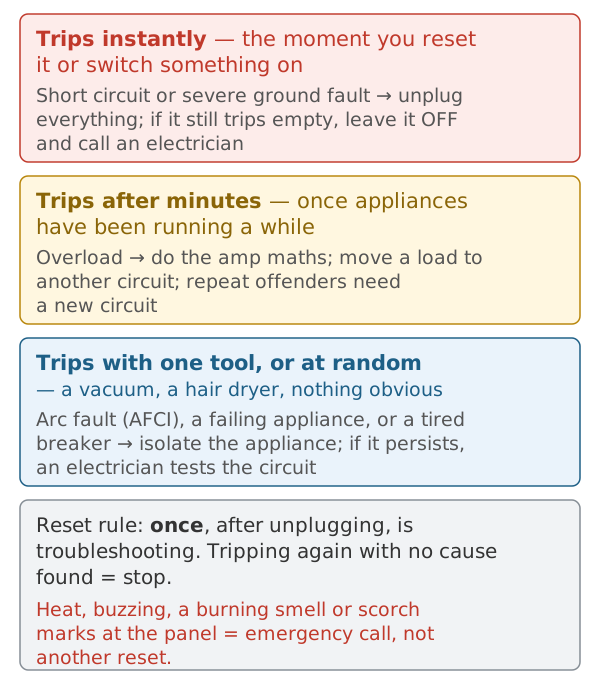
Breaker Keeps Tripping? Read the Timing, Do the Maths, Know When to Stop Resetting
Instant trip, delayed trip, trip with one appliance — each pattern is a different fault. The 15-minute isolation test, the 80% rule, space-heater maths, AFCI/GFCI trips, the panels that can't be trusted, and 2026 electrician costs.
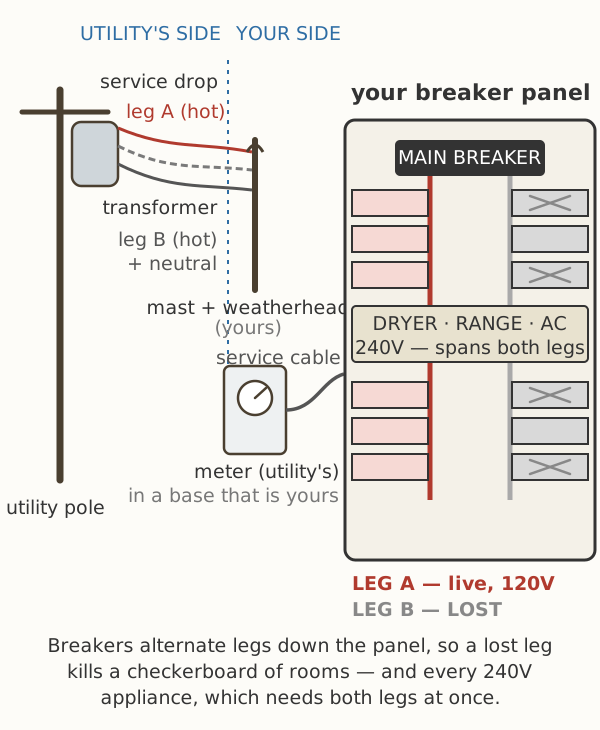
Half the House Has No Power: Lost Leg, Lost Neutral, or Just a Breaker?
Half the rooms are dead, no breaker has tripped, and the dryer won't run. The checkerboard pattern, the bright-and-dim test that means 'unplug things now', who pays for what — utility versus you — and 2026 electrician costs.