 Keep
Half the House Has No Power: Lost Leg, Lost Neutral, or Just a Breaker?
 Daniel Mercer · Editor & Researcher·
Published November 16, 2026·
Updated November 16, 2026
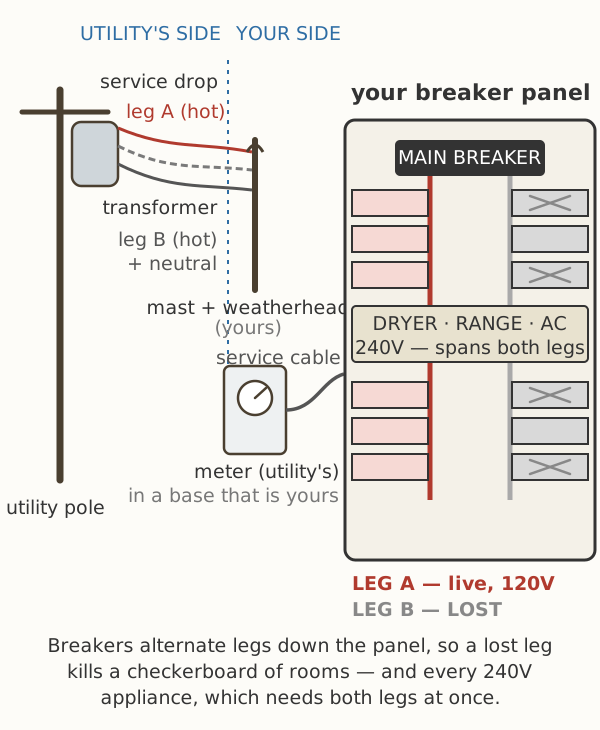
The kitchen lights work. The living room is dark. The bedroom is fine, the bathroom is dead, and the dryer — which was halfway through a load — has stopped with the clothes still warm and wet. You go to the panel expecting the usual culprit and find every breaker sitting exactly where it should be, none of them tripped. That combination, half a house dead with no breaker tripped, is one of the most specific symptoms in home electrical work. It almost never means a fault inside your walls. It means the supply itself has arrived broken: your house is being fed half a service.
This guide is about reading that symptom properly, because it contains three different problems wearing the same disguise. One is small and cheap. One is somebody else's problem and free to fix — if you phone the right people first. And one is a genuine emergency that can quietly destroy your electronics while you are deciding whether to worry. Telling them apart takes about ten minutes and no tools beyond a flashlight and your eyes.
Safety first: the bright-and-dim warning
Before any diagnosis, one observation decides whether this is an inconvenience or an emergency. Walk through the rooms that still have power and look at the lights.
If the working rooms look completely normal — normal brightness, steady, nothing flickering — you have the stable version of this problem, and you can work through the checks below calmly.
If, instead, some lights are noticeably brighter than they should be while others are dim, or brightness shifts when something switches on elsewhere in the house — a lamp flaring as the fridge starts, a room dimming when the kettle runs — stop diagnosing. That is the signature of a lost neutral, and it is actively dangerous to everything plugged in. Here is the ten-minute protection sequence:
- Unplug the electronics you care about. Televisions, computers, game consoles, chargers, anything with a control board — a modern washer, dryer, range and fridge all qualify. Not switch off: unplug, or switch off their breakers. Power strips and standby modes do not protect against overvoltage.
- Switch off the 240V appliances at their breakers (dryer, range, AC, electric water heater). Motors and compressors are damaged by the wrong voltage in both directions.
- Turn off the main breaker. This disconnects the house from a supply that is actively misbehaving. It is the one panel action that is always safe for a homeowner: it is designed to be operated by you.
- Call the power company and report a suspected lost neutral, using those words, and call an electrician the same day.
Why the urgency: with the neutral gone, one side of your house can sit at 150 volts or more for hours. Refrigerator compressors, appliance control boards and anything with a power supply on that side are being cooked, and they fail not all at once but one by one through the evening. Owners who wait until morning often meet a repair bill measured in appliances. The sequence above costs ten minutes and prevents nearly all of it.
The rest of this guide assumes the stable version — no bright lights, no burning smell, no buzzing. If any of those appear at any point, you are back in the paragraph above.
How your house is fed: two legs and a referee
Everything in this problem follows from one fact about how North American homes are supplied, and once you see it, the weird pattern of dead rooms stops being weird.
Your utility delivers split-phase power: two hot wires, called legs, plus a neutral. Each leg carries 120 volts measured against the neutral. Measured against each other, the two legs give 240 volts. Ordinary circuits — lights, outlets, the fridge — run on one leg at 120V. Big appliances — dryer, range, AC, electric water heater — connect across both legs for 240V.
Inside your panel, the branch breakers alternate: this row on leg A, the next on leg B, all the way down. That is why the diagram at the top of this page matters. When one leg fails, the dead circuits are not one side of the house or one floor — they are every other row of the panel, which maps to a checkerboard of rooms that looks random until you know the pattern. The kitchen works and the living room doesn't; upstairs is fine except one bedroom. Owners waste hours looking for what those rooms have in common. What they have in common is a bus bar.
The neutral's job is subtler. It is the reference point that holds each leg at its proper 120 volts, carrying the difference between the two legs' loads back to the transformer. Think of the legs as two teams pulling on a rope with the neutral as the referee holding the middle at zero. Lose a leg and one team simply has no power. Lose the referee and the middle point wanders: whichever side is pulling less gets dragged up in voltage, the harder-working side sags, and the split moves every time anything switches on. That wandering is the bright-and-dim effect, and it is why a lost neutral is a different class of problem from a lost leg — not just missing power, but wrong power, delivered to everything still connected.
Keep the three failure pictures separate in your mind, because the rest of the diagnosis is just sorting your house into one of them:
- A single circuit fault — one room or one run of outlets dead, everything else normal, 240V appliances fine.
- A lost leg — a checkerboard of dead rooms, all 240V appliances dead, the working rooms perfectly normal.
- A lost neutral — almost everything sort of works, but wrongly: bright lights here, dim lights there, motors humming and struggling, electronics behaving strangely.
The three causes, in order of size
Cause 1: Just a breaker — the small version
Sometimes "half the house" is an exaggeration produced by one big circuit. A failed or tripped breaker feeding a subpanel, a large multi-wire circuit, or simply the circuit that happens to carry a whole floor's outlets in an older house can darken several rooms at once. The tells that you are in this smaller world:
- The dead area is contiguous — one floor, one wing, one room and its neighbour — rather than scattered across the house.
- The 240V appliances work normally. This is the decisive test. A dryer that heats and tumbles properly proves both legs are present in the panel, which rules out every service-level fault in one observation.
- Looking closely at the panel, one breaker is in its tripped middle position, or feels loose and warm, or the dead circuit comes back when it is reset (fully off, then on).
A breaker can also fail without tripping — an old breaker whose contacts have given up will simply stop passing power to its circuit. If one circuit is dead, its breaker shows no trip, and a reset changes nothing, a failed breaker is a fair suspicion. That diagnosis and the reset discipline around it are covered in depth in our guide Breaker Keeps Tripping, including the panels whose breakers cannot be trusted at all. Replacing a like-for-like branch breaker is the one repair in this whole article that sits anywhere near homeowner territory, and even it means working inside a live panel: the bus behind the breakers stays energised with the main off, which is why most owners reasonably hire it out for $100–$260.
Cause 2: A lost leg — half a service
This is the classic half-house outage. One of the two hot legs has been interrupted somewhere between the transformer and your main breaker, and everything fed by that leg — roughly half your circuits, in the checkerboard pattern, plus every 240V appliance — is dead. The working half behaves completely normally, because for it, nothing is wrong.
A leg can be lost at any point along the service path:
- At the pole or transformer — a blown transformer fuse or a damaged connection, classic storm and falling-limb damage. Utility's side, utility's repair.
- In the service drop — the wires from the pole to your house, or the underground service lateral. A drop pulled loose by a tree, a connection corroded over decades, a dig-in on a buried lateral.
- At the weatherhead and mast — where the drop attaches to your house. Storms bend masts and tear these connections; this is the boundary where storm damage often lands on the owner's side of the bill.
- In the meter base — the lugs that grip the meter can loosen and overheat over years of thermal cycling until the connection burns open. The meter itself is the utility's; the base it plugs into is yours.
- At the main breaker or panel bus — a failing main breaker losing one pole, or a damaged bus connection. Yours, and an electrician's job.
Note what is not on that list: anything inside your walls. A lost leg is never a branch-circuit fault, which is why resetting branch breakers changes nothing and why the pattern ignores room boundaries.
One extra behaviour worth knowing: a lost leg can be intermittent. A connection that is barely hanging on may carry power in cool weather and open up when the afternoon load heats it, so the same rooms die every hot evening and resurrect overnight. If your half-house outage comes and goes with temperature or with heavy appliance use, say so on the phone — it points everyone straight at a failing connection rather than a clean break.
Cause 3: A lost neutral — the dangerous one
The neutral can fail at the same list of places: the transformer connection, the drop, the weatherhead, the meter base, or the neutral bar in your panel. It produces a subtler and worse failure, because power keeps flowing — at the wrong voltages.
With the neutral reference gone, your two legs sit in series across 240 volts and divide it according to load. Run the maths on a realistic moment: if the leg A side of the house is drawing lightly (a few lamps and a television) while leg B is working hard (a space heater and the fridge), leg B's heavy load drags its voltage down toward 70 or 80 volts while leg A's climbs toward 160 or 170. Swap which loads are on and the voltages swap with them. Nothing in the house gets a stable supply; everything gets a share of a moving split.
The damage pattern follows the voltage. On the high side, electronics and appliance control boards are destroyed by sustained overvoltage — sometimes in minutes, sometimes over an evening of quiet cooking. On the low side, motors strain: a fridge compressor hums, overheats and fails to start; a well pump or AC compressor labours and can burn out. And at the failure point itself, the loose or corroded neutral connection is often arcing and heating, which is a fire risk in its own right, at the meter or in the panel.
This is why the bright-and-dim test sits at the top of this article, and why "some lights bright, some dim" should be reported to the utility in exactly those words. Dispatchers and electricians both treat that phrase as a priority signal, because everyone in the trade knows what it does to a house left connected overnight.
The owner's diagnosis: fifteen minutes, in order
You cannot repair a service fault, but you can arrive at the right phone call with the right information, and that routinely saves a paid diagnostic visit or a day of waiting. Work in this order and stop where told.
Step 1 — Map the pattern. Walk the house and note which rooms and outlets are dead. Scattered, non-adjacent rooms across different floors means service-level. One contiguous area means circuit-level. Write it down; both the utility and the electrician will ask.
Step 2 — Check the big appliances. Try the dryer or the range. Dead or feeble 240V appliances confirm both legs are not present (or the neutral is bad). Working 240V appliances rule the service out and send you back to Cause 1.
Step 3 — Do the bright-and-dim check. On the working circuits, watch the lights while someone runs a heavy load — a kettle, a hair dryer, the microwave. Brightness that climbs or dives in response is the lost-neutral signature. If you see it, stop here, run the protection sequence from the top of this article, and make both phone calls.
Step 4 — One reset of the main breaker, once. If the pattern looks like a clean lost leg with no bright-dim behaviour, switch the main breaker fully off and back on, one time. A main breaker with a failing pole occasionally re-seats and restores the leg — and if it does, still report it, because a main that dropped a leg once is announcing its retirement. If nothing changes, leave everything as it is. Repeated resetting into a bad connection adds heat to exactly the spot that is failing. Hard stop: if the main breaker feels hot, buzzes, resists moving, or you see any scorching or smell anything burning around the panel, do not reset anything. That is an electrician-and-utility call with the word "burning" in it.
Step 5 — Look outside, touch nothing. Three observations, all made from the ground with your eyes. First, the neighbours: are other houses dark or half-dark? A shared pattern means the utility already owns the problem. Second, the service drop and mast: is a wire down, a drop hanging lower than it used to, a mast bent after a storm? Third, the meter: is its display alive (on a digital meter), and does anything at the meter base look scorched or smell hot? A dead meter display with a half-live house is a useful clue that one leg never arrives. Hard stop: the meter base, the mast connections and the drop are never homeowner-touchable, at any height, with any tool. Look, photograph, report.
Step 6 — Make the calls in the right order. Utility first, with your findings: "Partial power. These rooms are out, the dryer is dead, no lights are bright, the neighbours are fine" is a complete report that gets the right crew rolling. Then, if the utility clears their side, the electrician, with the same report.
Who owns what: the responsibility map
The single most valuable fact in this article is that a lost leg or neutral is free to repair surprisingly often, because so much of the service path belongs to the utility. The dividing line, with small regional variations, runs like this:
The utility owns and repairs, at no charge to you:
- The transformer on the pole and its fuses and connections
- The overhead service drop, or the underground service lateral, up to where it connects at your house
- The meter itself — the glass or digital unit that measures your usage
- Their connections at the weatherhead splice, on overhead services
You own, and pay an electrician to repair:
- The mast and weatherhead the drop attaches to
- The meter base — the box the utility's meter plugs into (the confusing one: their meter, your socket)
- The service entrance cable from the meter base to your panel
- The main breaker, the panel, its bus bars and neutral bar
- Everything downstream of the panel, as always
Two consequences follow. First, the order of phone calls is a financial decision, not just a technical one: an electrician who finds a utility-side fault will still bill you for the visit, while a utility crew that finds the fault on your side costs you nothing but time. Utility first is the cheap sequence in both directions.
Second, storm damage often splits across the line. The classic case is a limb that tears down the drop (utility's repair) while bending your mast and ripping out your meter base (your repair). The utility will not reconnect a repaired drop to a damaged mast — your side must be fixed, and in many jurisdictions inspected, before they re-energise. Knowing this on day one, and getting the electrician booked while the utility is still working through its outage list, is how some houses get power back days ahead of their neighbours after a big storm.
What the electrician actually tests
If the utility has cleared their side, the electrician's job is to walk the voltage down your side of the path until it disappears. In practice the visit looks like this:
- Voltage at the panel, under load. A meter across the main breaker's output: leg A to neutral, leg B to neutral, leg to leg. A healthy service reads roughly 120 / 120 / 240. A leg reading near zero, or a pair of readings that add to 240 but sit at something like 170 / 70, names the fault type immediately — lost leg versus lost neutral — before a single cover comes off.
- The same readings at the meter base. If the bad voltage is present at the meter, the fault is at or above it; if the meter reads clean and the panel does not, the service cable or main breaker between them is the story.
- Lugs and connections, inspected. Meter base lugs, main breaker terminals and the neutral bar get checked for the physical evidence of a failing connection: looseness, corrosion, discoloured metal, melted insulation, the particular rainbow tarnish of overheated copper or aluminium. Most lost-leg and lost-neutral faults on the owner's side announce themselves to the eye once the right cover is off — which only a licensed electrician, with the meter pulled by the utility where required, should be doing.
- The main breaker itself. A main that has lost one pole internally is replaced, not repaired. Because the meter must usually be pulled to make the panel safe for that work, the job involves utility scheduling — a same-day diagnosis often becomes a repair appointment a day or two out, and a good electrician will tell you that up front rather than discovering it with your panel open.
Ask for the findings in the form you can reuse: which component, which side of the meter, and the readings. If the fault turns out to be intermittent, a written record of "leg B at 0 volts at the panel, 120 at the meter, 6 p.m., hot day" is what turns a second visit from a fresh mystery into a confirmation.
The costs, honestly sorted
The frontmatter table gives the ranges; here is how they behave in real life. The diagnostic visit ($125–$500) is the gate everything else passes through, unless the utility solves it free. Many companies credit the diagnostic fee toward their own repair, which makes the real choice not whether to diagnose but whose repair quote the credit locks you into — worth one question on the phone.
A failed main breaker ($250–$700 fitted) is the most common owner-side bill for a clean lost leg: the part is a large-frame breaker, the labour includes utility coordination, and the price climbs on older panels where the main is obsolete or integrated. A meter base or service cable ($500–$1,500) is the storm-and-corrosion bill: more parts, a permit in most areas, and an inspection before reconnection. The expensive outcome is panel replacement ($1,300–$3,000), which arrives when a loose connection has been heating long enough to damage the bus or neutral bar — the panel is no longer a box with a bad part in it, but a damaged assembly. That progression, from a $0 utility splice to a $3,000 panel, is the financial argument for treating half-house power loss as a this-week problem rather than a someday one: the fault that is free or cheap today is frequently the fault that cooks a panel by next season.
One more cost that belongs in the open: appliance damage from a lost neutral. If the neutral failed on the utility's side, many utilities run a claims process for damaged appliances and electronics — file promptly, keep the failed items until the claim is assessed, and get the electrician's or utility crew's written note that a neutral failure occurred. If the failure was on your side of the meter, the claim conversation is with your homeowner's insurer instead, and the answer varies by policy. Either way, the documentation habit is the same, and it starts with the ten-minute protection sequence: unplugging things early is both the cheapest insurance and the best evidence that you acted reasonably.
DIY versus pro: where the line sits
This problem draws the DIY line more sharply than most. Everything in the diagnosis section — mapping, observing, one main-breaker reset, looking at the meter from the ground — is safe, free and genuinely useful. Everything in the repair is on the far side of the line, for a concrete reason: the conductors between the transformer and your main breaker cannot be switched off from inside your house. The main breaker protects everything after it; the service conductors before it are live whenever the utility is connected, at currents limited only by the transformer. Add that meter bases are sealed utility territory in most places, and the conclusion is not timidity but physics: lost legs and lost neutrals are utility-and-electrician work, full stop.
The homeowner's real contribution to this repair is speed and information. Owners who map the pattern, run the bright-and-dim check, protect their electronics and make the calls in the right order routinely get this fixed a day sooner and one diagnostic visit cheaper than owners who reset breakers for an evening and hope.
Living on half a house while you wait
Repairs to service equipment rarely happen the hour you call — meter pulls, permits and utility scheduling see to that — so most owners spend a night or two on a half-live house. Some rules for doing that safely:
- Keep the surviving leg lightly loaded. Half your panel working does not mean the other half's capacity moved over. Run one heavy appliance at a time on the working circuits, and keep space heaters off entirely if you can: a heater is the single biggest load you can add, and it will be running on connections that are already part of a fault story.
- Protect the fridge first. If the refrigerator is on a dead circuit, it is a food-safety clock, not an electrical problem: keep the door shut (a closed fridge holds safe temperatures for roughly four hours, a full freezer for about two days) and move it to a working outlet with a single heavy-duty extension cord only if the run is short and the cord is rated for the load — never a chain of cords, and never through a doorway that pinches it.
- Medical equipment outranks everything. If anyone in the house depends on powered medical equipment, tell the utility exactly that when you call. Most utilities keep a medical-priority register for restoration and will treat a partial outage at a registered address with a seriousness a normal call does not get.
- Never backfeed. If you own a generator, this is the fault where it stays in the garage unless it is connected through a proper transfer switch or interlock installed beforehand. Plugging a generator into a dryer outlet or panel during a service fault can energise the very conductors the utility crew is about to handle, and it can feed power into a damaged neutral in ways that hurt people in other houses. A generator powering a fridge and a lamp through extension cords, run outdoors and away from windows, is the safe version.
- Photograph everything. The dead rooms, the meter, any visible damage at the mast, the appliances that failed. Ten photos taken tonight are the foundation of the utility claim or insurance conversation later, and they cost nothing.
How urgent is it, really?
Sort your situation into one of three lanes:
- Now, tonight: bright or wandering lights, buzzing at the panel or meter, a burning smell, heat or scorch marks anywhere near the service equipment, or a main breaker that will not hold. Protection sequence, main breaker off, utility and electrician called as an emergency.
- Today or tomorrow: a clean lost leg — checkerboard of dead rooms, dead 240V appliances, working side completely normal, no smells or sounds. Switch off the 240V appliances, call the utility, and live on the working half carefully (space heaters on the surviving leg are how a stable situation gets worse; keep loads modest).
- This week, booked properly: one circuit dead with everything else normal and 240V appliances healthy — the small version. Diagnose it as a circuit fault, use the reset discipline from the Breaker Keeps Tripping guide, and book an electrician if the circuit stays dead or the breaker will not hold.
What never belongs on the list is "ignore it." A service connection that has begun to fail does not heal, does not stabilise, and does not stay politely at its current level of damage. It heats, it corrodes further, and it chooses the next storm, heat wave or cold snap — the moment of maximum load and minimum electrician availability — to finish failing. Half a house with no power is the service asking for help at a reasonable hour. Answer it then.
Cost at a glance
| Item | Typical cost | Notes |
|---|---|---|
| Utility-side repair (their drop, their connections, their transformer) | $0 | If the lost leg or neutral is on the utility's side of the meter, the power company repairs it at no charge — which is why they get the first phone call |
| Electrician diagnostic visit | $125–$500 | Meter and panel voltage tests under load to find exactly where the leg or neutral is lost; often credited toward the repair |
| Main breaker replacement | $250–$700 | The large-frame main breaker plus labour; usually needs the utility to pull the meter, so expect scheduling, not a same-hour fix |
| Meter base or service cable replacement | $500–$1,500 | Burned lugs or a failed service entrance cable — owner-side parts, permit and utility coordination typically included in the quote |
| Full panel replacement (bus or neutral bar damaged) | $1,300–$3,000 | The outcome when heat from a loose connection has damaged the panel itself; Angi's 2026 average for a panel upgrade is around $1,600 |
Frequently asked questions
Why is half my house without power when no breaker has tripped?
Because the fault is upstream of the breakers. Your breakers guard individual circuits, but the whole panel is fed by two 120V legs. If one leg fails — at the utility's transformer, in the service drop, at the meter base, or at the main breaker — every circuit fed by that leg goes dead at once, and no branch breaker trips because none of those circuits has a fault: they simply have no supply. Breakers alternate between the two legs as they run down the panel, which is why the dead rooms look scattered rather than forming one half of the house. The matching clue is your 240V appliances: a dryer, range or AC needs both legs at once, so a lost leg kills them too, while a single tripped breaker never does.
Should I call the power company or an electrician first?
The power company, almost always. Utilities check their side — the transformer, the service drop and their connections up to the meter — at no charge, and a lost leg or lost neutral is on their side often enough (especially after storms, wind, or a neighbourhood outage) that paying an electrician to discover that is money wasted. Describe it precisely on the call: 'partial power, half the house out, possible lost leg' gets a different response than a generic outage report. If the utility confirms their side is delivering both legs and a sound neutral, then call an electrician: the fault is in your meter base, service cable, main breaker or panel, and that is owner-side work. The one exception: if you smell burning at the panel or see scorch marks, treat it as an emergency first and a billing question second.
Why are some of my lights brighter than normal and others dim?
That pattern is the signature of a lost or failing neutral, and it is the urgent version of this problem. The neutral is the reference that holds each of your two legs at 120 volts. Lose it, and the two halves of the house end up wired in series across 240 volts, dividing that voltage according to whatever happens to be switched on. The lightly loaded side can climb to 150 volts or more while the other side sags — and the split moves every time a load changes, which is why brightness wanders. One leg's electronics get cooked by overvoltage while the other side's motors strain and hum on undervoltage. Unplug electronics and anything with a control board, switch off the main breaker, and call the utility and an electrician the same day. Do not wait to see if it settles: it does not settle, it destroys things at random until it is repaired.
Why won't my dryer, oven or AC run when only half the house is out?
Because those appliances are not 120V loads with an extra wire — they genuinely run on 240 volts, which exists only between the two legs. With one leg lost, the voltage between them collapses, so a dryer may tumble weakly with no heat, an oven may glow faintly or do nothing, and an AC compressor will hum, strain or refuse to start. Running them in this state is hard on motors and compressors, so switch 240V appliances off at their breakers until the service is repaired. Their behaviour is also your best free diagnostic: dead 240V appliances plus a checkerboard of dead rooms means a service-level fault (lost leg or neutral), while dead 240V appliances are impossible from a single tripped branch breaker.
How much does it cost to fix half-house power loss?
Anywhere from nothing to about $3,000, and the spread is mostly about whose side of the meter the fault is on. Utility-side failures — a blown transformer fuse, a damaged service drop, a failed connection at the pole — are repaired by the power company free. On your side, expect $125–$500 for an electrician's diagnostic visit, $250–$700 if the main breaker itself has failed, $500–$1,500 for a meter base or service cable replacement, and $1,300–$3,000 if heat damage means the whole panel goes. Storms complicate the bill in one specific way: if your mast or meter base is damaged, the utility will not reconnect their (free) service until your side is repaired and, in many areas, inspected — so the electrician's part of a storm repair is rarely optional or postponable.
Can I fix a lost leg myself?
No — and this is one of the clearest lines in home electrical work. The fault sits somewhere between the utility's transformer and your main breaker: the service drop, the connections at the weatherhead, the meter base lugs, the main breaker or the panel bus. Those conductors are live whenever the utility is connected, they cannot be switched off by anything in your house, and the meter base is sealed utility territory in most jurisdictions. What you can and should do yourself is the diagnosis: map the dead rooms, try one proper reset of the main breaker, look (without touching) for damage at the mast or meter, check whether neighbours are affected, and note whether any lights run bright. That five-minute report makes both the utility call and the electrician's visit dramatically more efficient. Then let the people with the insulated tools do the touching.
The power came back after an outage but only half the house works. What happened?
This is a recognised storm pattern. When a neighbourhood is re-energised, a connection that was already weakened — by years of heating and cooling cycles at the weatherhead, meter base or pole — can let go under the returning load, and nothing on the utility's side notices, because the house is drawing power again, just wrongly. What arrives is partial power: one leg missing, or a neutral that failed at the moment of restoration. Report it to the utility as partial power after restoration, not as a fresh outage, and mention any bright-or-dim lights, because an open neutral in this situation is quietly damaging appliances across the neighbourhood's restored homes, not just yours. Until it is fixed, the lost-neutral rules apply: unplug electronics, switch off 240V appliances, and do not assume the working half of the house is safe to use normally.
Checked November 16, 2026. This guide is general information, not a substitute for a licensed professional.
Related guides
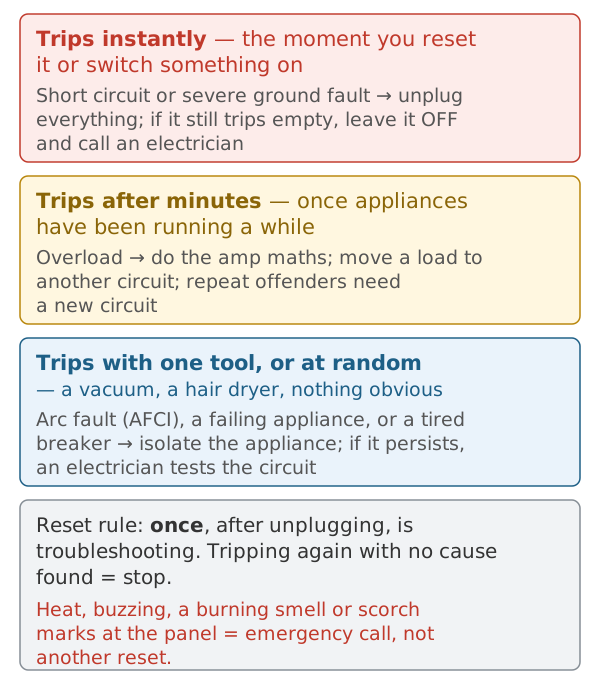
Breaker Keeps Tripping? Read the Timing, Do the Maths, Know When to Stop Resetting
Instant trip, delayed trip, trip with one appliance — each pattern is a different fault. The 15-minute isolation test, the 80% rule, space-heater maths, AFCI/GFCI trips, the panels that can't be trusted, and 2026 electrician costs.
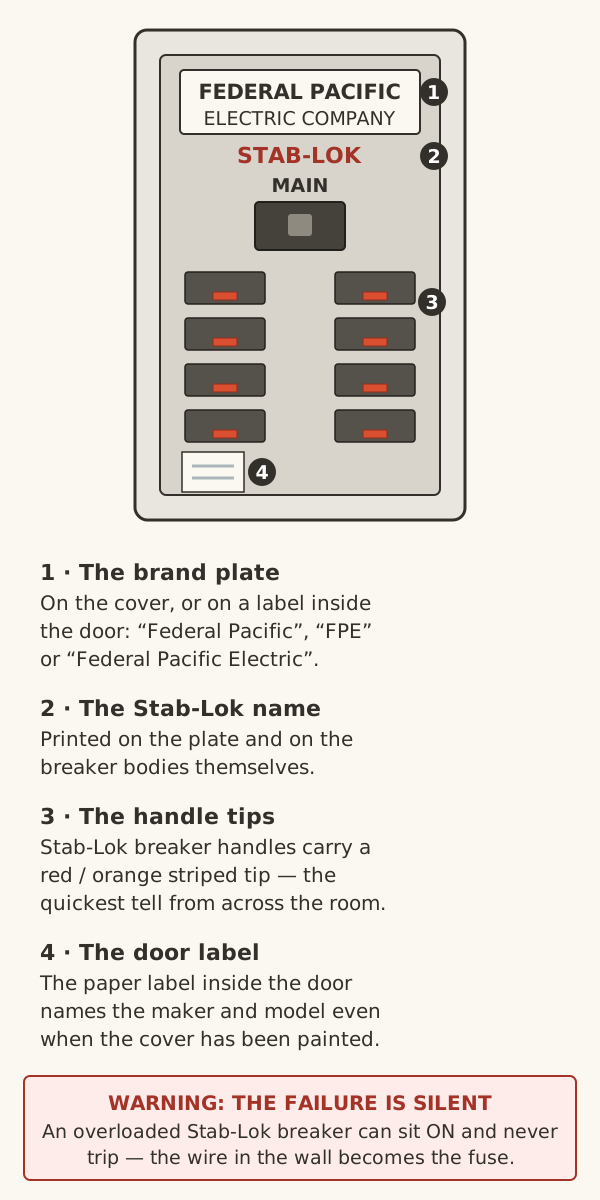
Federal Pacific Panel? Why Stab-Lok Breakers Are a Replace-Now Problem
Federal Pacific Stab-Lok panels sit in millions of 1950s–80s homes. How to identify one in five minutes, what the CPSC testing and the New Jersey court actually found, why insurers refuse these panels, and what a replacement involves and costs in 2026.