 Keep
Heat Pump Blowing Cold Air in Heat Mode? What's Normal, What's a Fault
 Daniel Mercer · Editor & Researcher·
Published November 16, 2026·
Updated November 16, 2026
It usually happens on the first properly cold evening of the year. You hold your hand over a vent, expecting the reassuring blast you remember from every furnace you have ever lived with, and what you get feels like air conditioning. The thermostat says HEAT. The house, confusingly, is not getting colder — or is it? By the time you have stood there for a minute, hand hovering, you have already decided something expensive is broken.
Hold that thought. "My heat pump is blowing cold air" is the single most common heat pump complaint there is, and it is also the one most often reported about a machine that is working exactly as designed. That is not a reason to wave it away: sometimes the air really is cold, and the causes range from a thermostat setting to a failed compressor. It is a reason to measure before you panic, because with a heat pump, your hand is a liar and a cheap thermometer is the truth. This guide starts with the two-minute test that settles the question, then walks through the three scenarios that produce genuinely cold air, what you can check yourself in each one, where your part of the job ends, and what the real faults cost to fix.
First, the uncomfortable truth: heat pump heat feels cold
A furnace heats by making fire (or an electric element nearly as hot), and it shows. Supply air from a gas furnace typically leaves the vent at 120–140°F — hotter than your body, unmistakably hot on your skin, the blast every ex-furnace owner is calibrated to expect.
A heat pump does not make heat that way. It moves heat, gathering it from the outdoor air and releasing it indoors, and the arithmetic of moving heat produces gentler air. Carrier puts typical heat pump supply air at 85–100°F; Trane says 85–93°F; across brands and weather, the working range is roughly 85–105°F. That air is genuinely heating your house — it is 15 to 30 degrees warmer than the room it enters.
But your skin is at about 91°F on the surface and your core is 98.6°F, and air at 90°F moving across your hand carries heat away from it. The sensation is coolness. It is the same reason a 90°F swimming pool feels chilly: the water is warm, you are warmer, and moving fluid makes the exchange fast. So the hand-over-the-vent test, which works fine for a furnace, misfires completely on a heat pump. Owners condemn healthy systems with it every winter, and technicians have a name for the service call that results: they check the system, find nothing, and write some version of "operating normally" on the invoice you paid for.
None of this means your cold air is imaginary. It means the question "is it cold?" has to be answered with a number, not a feeling. That takes two minutes and one thermometer.
The register thermometer test: the two-minute measurement that settles it
Any thermometer that reads air temperature works: a kitchen probe thermometer, an indoor-outdoor thermometer with a probe, an infrared thermometer pointed into the vent (close range, it reads the duct metal as much as the air, but close enough for this verdict), even a basic dial thermometer from a hardware store. Here is the whole procedure.
- Let the system run for at least 10 minutes first. Supply temperature takes a few minutes to stabilize after startup, and a reading taken in the first minute measures a cold duct, not the system. If the thermostat shows AUX or the system has just kicked on, wait.
- Pick the supply vent closest to the air handler — usually the strongest, warmest register in the house, often in a hallway or the room nearest the indoor unit. The closest vent loses the least heat on the way and gives the most honest reading.
- Hold the thermometer in the airstream for a full minute or two, until the reading stops climbing. Write the number down.
- Now measure the room air away from any vent — or simply read the temperature on your thermostat. Write that down too.
- Compare. Supply air should be 15–30°F warmer than the room. In a 70°F house, a vent reading of 88–100°F is a heating system doing its job. A vent reading at or below room temperature means the system is adding no heat at that moment.
Read the verdict off the numbers:
| Vent reading (70°F room) | What it means | Where to go next |
|---|---|---|
| 88–105°F | Normal heat pump heat — it only feels cold | Nothing is broken; read the calibration section below |
| 78–87°F | Weak heat — system heating poorly, or caught mid-defrost | Wait 15 minutes and retest; if it stays low, work through scenario 3 and the capacity causes |
| 70–77°F | Room-temperature air — blower moving air, no heat being added | Defrost in progress, fan set to ON, or the outdoor unit is not running |
| Below 70°F | The system is actively cooling your house | Scenario 2 — thermostat mode or reversing valve |
One timing warning before you act on a low reading: if you happened to test during a defrost cycle, you measured the one interval in the hour when the system is supposed to blow cool air. If the outdoor unit is steaming, the outdoor fan has stopped, or the cool blast has been going for less than 15 minutes, wait for warm air to return and test again. The test is only meaningful on a system in a steady heating run.
That is the whole fork in the road. A good reading ends the investigation (and the rest of this guide explains why your system feels the way it does). A bad reading means one of three scenarios is playing out — and each has its own causes, its own checks, and its own bill.
Scenario 1: The defrost blast — cold air that is supposed to happen
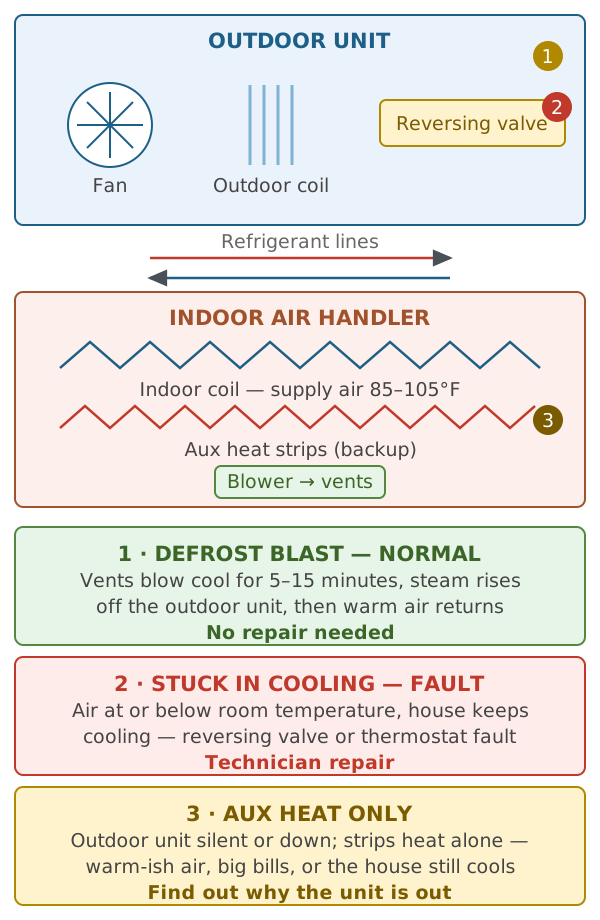
In heating mode, your outdoor coil runs colder than the outdoor air, so moisture freezes on it. To clear that frost, every so often the heat pump briefly reverses itself and runs as an air conditioner: hot refrigerant melts the coil clean, and for those minutes the indoor coil is doing the opposite of heating. Manufacturers design around this — the backup heat strips are supposed to switch on during defrost precisely so the vents do not blow cold air on you — but on many systems the tempering is partial, the strips lag, or a strip bank is quietly out of service, and you feel a distinct cool draft.
A normal defrost has a signature you can verify from your porch:
- It lasts 5–15 minutes, then warm air returns on its own.
- The outdoor fan stops while the compressor keeps running — the unit sounds different, not dead.
- Steam rises off the outdoor unit as the frost melts — a dramatic white cloud that is meltwater evaporating, not smoke.
- You may hear a whoosh or click as the reversing valve shifts, at the start and again at the end.
- It happens every 30–90 minutes of heating runtime in frosty weather, most often in the damp band around 25–40°F.
If your cold air matches that pattern, you have watched a defrost cycle, and the correct repair is none. This guide's companion piece, "Heat Pump Icing Up? What's Normal Frost, What's a Problem, and What to Do," covers the frost side of the story in full: how much frost is normal, what the cycle should clear, and the quarter-inch rule for telling weather from failure.
Defrost stops being normal in three ways. If the cool blasts come far more often than hourly, or a single one stretches past 20 minutes, the system may be defrosting on a hair trigger or struggling to finish — a sensor or control-board complaint. If frost and ice on the outdoor unit visibly build up through the day instead of melting off each cycle, defrost is losing, and that is the icing fault covered in the companion guide. And if the defrost draft is not just cool but bitter, with the house temperature dropping during every cycle, your backup strips may not be tempering at all — which is scenario 3's territory, because strip failures hide exactly here.
Your move for scenario 1: time it. Note when the cold air starts, step outside and confirm the steam and the stopped fan, and note when warm air returns. Under 15 minutes with steam outside is a closed case.
Scenario 2: The system is actually cooling — thermostat first, reversing valve second
This is the scenario where the air is not cool-ish but cold: at or below room temperature, the house steadily losing ground, the outdoor unit behaving exactly as it does in July. The system is not failing to heat. It is successfully cooling, in January, because something has told it to or trapped it there.
Check the thermostat before anything else, because the most common cause is embarrassingly simple. Is the mode actually set to HEAT? Thermostats get bumped, guests "help," children explore. Is the fan set to ON instead of AUTO? Fan ON runs the blower around the clock, including between heating cycles, pushing unheated air that feels like a fault — Carrier lists both of these at the top of its own troubleshooting for exactly this complaint. Set the mode to HEAT, the fan to AUTO, raise the setpoint a few degrees, and give it 15 minutes.
Then consider the thermostat swap trap, the first-time-owner special. If you replaced the thermostat yourself this autumn — a common early project in a new house — and the cold air problem dates from around then, suspect the installation before the machine. A heat pump's reversing valve is controlled by a wire on the thermostat's O/B terminal, and brands disagree about which state means heat: most energize the valve for cooling, a minority (Rheem and Ruud are the classic examples) energize it for heating. A thermostat configured for the wrong convention does everything backwards — calls for heat, gets cooling. The fix is a settings change (the O/B or "reversing valve" option in the installer menu) or a wiring correction, not a new valve. If your old thermostat worked and the new one brought this problem with it, that is your answer nine times out of ten.
If the thermostat is innocent, the reversing valve is the prime suspect. The valve is the sliding gate inside the outdoor unit that reverses refrigerant flow to swap the system between heating and cooling. When it sticks — mechanically jammed mid-travel, or its electrical solenoid coil burned out so it can no longer shift — the system is trapped in whichever mode it last occupied. The classic history: it cooled beautifully all summer, the first cold night arrived, and it has blown cold air ever since, because the valve never made the trip to heating. A valve stuck partway is subtler: weak heat, lukewarm vents, a system that seems to try. Either way, the vent thermometer tells you the system is cooling or nearly so, and the outdoor unit gives it away too — in cooling mode it exhausts warm air from its top fan in the middle of winter, the reverse of what heating mode produces.
One more member of this scenario deserves a mention because it mimics the valve: a failed defrost control or a board fault that parks the system in the wrong state, and on some systems a thermostat wired so the cooling call is energized by mistake. The owner's evidence cannot separate these — and does not need to. Your job is to establish "it is genuinely cooling," rule out the thermostat settings and the fan, and hand a technician a clean symptom.
Your move for scenario 2: mode to HEAT, fan to AUTO, 15 minutes, retest with the thermometer. Still at or below room temperature? Stop there. Do not open the outdoor unit: the valve, its solenoid and the refrigerant circuit are sealed-system work, and poking at them converts a diagnosis into a bigger repair. If the house is cooling and the weather is cold, switch to Emergency Heat to hold the house, and make the call.
Scenario 3: The outdoor unit is down and the strips are carrying the house — or failing to
Every heat pump with electric backup has a second heating system hiding in the air handler: resistance heat strips, the same technology as a toaster, staged in banks that switch on when the heat pump needs help. When the outdoor unit stops working — tripped breaker, failed capacitor or compressor, a control fault — the thermostat quietly leans on the strips. What reaches your vents then depends on how much strip capacity is healthy.
If all the strips work, the air can feel deceptively fine: warm, sometimes warmer than heat pump air. The tells are elsewhere. The thermostat shows AUX (or EM HEAT) nearly all the time. The outdoor unit is silent or never runs while the house stays warm. And the electric bill does the real reporting: strip heat costs roughly two to three times as much per hour as the heat pump delivering the same warmth, so a month of strips-only heating lands like a second mortgage payment. Plenty of owners discover a dead outdoor unit from the bill, weeks after the failure, because the house never got cold.
If only some of the strip capacity works — one bank's element burned out, a sequencer that no longer brings its stage on, a tripped strip breaker inside the air handler — the picture muddies: air that is warm-ish but weak, a house that holds temperature on mild days and slides on cold ones, vents that test in the ambiguous high-70s to mid-80s. This is also the hidden partner in scenario 1: strips that cannot temper defrost make every defrost feel like a breakdown.
And if the strips are entirely out — both banks failed, or a control problem — the house simply cools while the blower pushes air across a dead indoor coil, which reads at the vent as plain cold.
Your checks for scenario 3 are observation, not repair. Stand by the outdoor unit during a heating call: is it running at all? Check the breaker panel for a tripped heat pump breaker (reset it once; if it trips again, leave it and call — a breaker that re-trips is reporting a fault, not asking for persistence). Read the thermostat: AUX showing during a mild afternoon, or EM HEAT selected at all, is evidence worth writing down. Note whether the outdoor unit runs but sounds labored, ices abnormally fast, or starts and stops in short bursts.
The blurry middle: weak heat that is not any single scenario
Some cold-air complaints land between the scenarios, and they share a theme: the system heats, just not enough.
- Low refrigerant. A slow leak drops the system's capacity week by week. The vent air slides from the high 90s into the 80s, runs get longer, frost builds faster than defrost prefers. Refrigerant is never consumed; low charge always means a leak, and the honest repair is finding and fixing it before recharging.
- Strangled airflow. A clogged filter, blocked returns or a filthy indoor coil cut the air volume that carries heat to your rooms. The air that does arrive may test warm at the nearest vent while distant rooms stay cold — and low airflow frosts coils faster, feeding the defrost problem. The filter is a five-minute check and the cheapest fix on this page.
- Deep cold doing arithmetic. Below your home's balance point — often somewhere in the 25–35°F region for an average house and system — the heat pump alone cannot match the heat the house loses, by design. Strips are supposed to join in, runs get long, and supply air sits at the cooler end of its range. That is the system working as engineered. What is not normal is losing ground at temperatures the house handled in previous winters; capacity that shrinks year over year is a fault developing, usually refrigerant or strips.
- Duct losses. Long duct runs through a vented attic or crawl space shed heat on the way. The vent nearest the air handler tests fine and the far bedroom blows lukewarm. If one or two rooms are the whole complaint while the test vent reads well, suspect the journey, not the machine.
What changes when it gets properly cold
Everything above shifts a gear when the temperature drops into the low 20s and below, and owners who judge a heat pump by its mild-weather manners misread this too.
Capacity falls off a cliff that is really a slope. A conventional heat pump that delivers its full rated heat at 47°F may deliver roughly two-thirds of it at 25°F and around half near 10°F — the machine is healthy; there is simply less heat in each cubic foot of outdoor air, and it has to work longer to gather the same total. (Cold-climate models are engineered to flatten that slope, holding most of their capacity well below zero, which is why the same complaint means different things on different equipment.) Longer runs are the visible result: a heat pump running nearly continuously through a cold snap, with the vents at the cooler end of their range and the strips joining in for stretches, is frequently a system doing exactly what its designer intended.
Two practical consequences follow. First, the thermometer test still works, but read it fairly: judge the rise over room temperature rather than expecting a number from a mild October afternoon, and expect the rise to sit at the modest end while the strips share the load. Second, defrost behaves counterintuitively — the worst frosting weather is the damp band around freezing, not deep cold, because very cold air holds very little moisture. A unit that frosted and steamed its way through a wet 30°F week may run almost frost-free at 12°F. Owners who learned "steam means it's working" in November sometimes worry in January that defrost has quit; usually the weather just dried out.
The verdict line in deep cold is the same as everywhere else in this guide: is the house holding its temperature? Holding, even with long runs and AUX showing for stretches, is the system coping. Losing ground at temperatures it handled last winter is capacity going missing — refrigerant, strips or compressor health — and that is a call.
Recalibrating: unlearning furnace instincts
If this is your first winter in a heat pump house — and for many readers it is, because the system came with the home you just bought — part of the problem is calibration, and it is worth naming plainly. You arrived with furnace instincts: heat should arrive in hot blasts, silence between cycles means rest, and a hand over the vent is a reliable instrument. A heat pump inverts all three. It heats in long, gentle runs because moving heat steadily is more efficient than blasting it; it may run most of the day in cold weather without anything being wrong; and its output sits deliberately below skin temperature, so your most trusted gauge reads it as broken.
The owners who settle in fastest learn their own system's normal the way you learn a new car's sounds. In the first mild week, take the vent temperature once and write it on a card by the thermostat, with the outdoor temperature beside it. Note what a defrost looks like from your porch, once, so the second time is recognition instead of alarm. Check where your thermostat shows AUX, so the indicator means something when you see it. None of this is maintenance; it is literacy. The payoff is that when something genuinely changes — and with any machine, something eventually does — you will spot it in a day instead of at the next electric bill, and you will describe it to a technician in numbers instead of dread.
The owner's checklist, in order
Everything above condenses into one ordered pass. Do these in sequence and stop where the list tells you to stop.
- Thermostat: mode on HEAT, fan on AUTO, setpoint raised 3–4 degrees above the room temperature so the call for heat is unambiguous. If the thermostat is one you installed yourself this season, put a mental asterisk by it.
- Wait for a steady run, at least 10 minutes, then run the register thermometer test at the nearest supply vent and compare with room temperature.
- Good reading (15–30°F rise)? You are done. The system is heating; the sensation was skin, not machinery.
- Low reading? Check the clock and the yard. Is this a defrost — steam, stopped outdoor fan, under 15 minutes? Wait it out and retest in steady heat.
- Still low? Read the thermostat display. AUX on constantly, or EM HEAT selected, points at scenario 3 or a thermostat someone switched. Note it; do not "fix" EM HEAT by switching back until you know the outdoor unit can run.
- Step outside. Is the outdoor unit running? In heating it should hum, its fan should spin, and the air off the top should feel cold. Warm air off the top in winter means it thinks it is summer — scenario 2. Silence means scenario 3: check its breaker once.
- Check the filter and glance at the indoor unit for anything obviously wrong — a drain pan overflowing, a switch off at the air handler.
- Stop here. Everything past this line — valve, solenoid, refrigerant, strips, compressor — is sealed-system or high-current work. Your deliverable to the technician is the evidence: the two thermometer numbers, how long the cold air lasts, what the thermostat displayed, and whether the outdoor unit ran.
What the technician tests, scenario by scenario
Knowing the pro's sequence helps you judge the visit you are paying for. For a system stuck in cooling, the tech confirms the thermostat's call, checks for voltage at the reversing valve solenoid, and listens and feels for the valve shifting — temperature differences across the valve's tubes tell whether refrigerant actually changed direction. A coil with no voltage points back at controls or wiring; a coil with voltage and a valve that will not move condemns the valve. For a down outdoor unit: capacitor and contactor first (the cheap, common failures), then compressor windings and amp draw, then the control board. For weak heat and strip questions: refrigerant pressures and temperatures to judge charge, a leak search if the charge is low, and amp draws on each strip bank to prove every stage is actually heating — the test that finds the silently dead bank no vent thermometer can isolate. Expect the diagnostic to run $75–$300 depending on your market, usually credited toward the repair if you proceed.
What the real faults cost
The cost table at the top of this guide covers the five repairs that account for nearly every genuinely-cold-air bill. Read it with two distinctions in mind. First, solenoid versus valve: the reversing valve's electrical coil is a $150–$600 repair, while the valve body means refrigerant recovery, brazing and a recharge at $600–$1,800 — a quote should say which one failed, and on a system past 12 years old the valve-body quote deserves a comparison against replacing the system. Second, recharge versus repair: a refrigerant top-up without a leak repair is money spent on a leak that is still leaking, so the $450–$1,600 line is leak repair and recharge together. The strip repair at $150–$600 is the quiet bargain of the list — it is often the true fix behind a complaint that arrived wearing the heat pump's name. And remember what is not in the table: the defrost blast and the feels-cold-but-isn't cases, which cost a thermometer and fifteen minutes.
So: your toolbox or a phone call?
Yours, entirely: the thermometer test, thermostat mode and fan settings, the defrost timing observation, the filter, one breaker reset, and the outdoor-unit observation walk. Those steps resolve the majority of these complaints, because the majority are not faults. The phone call starts the moment the system is proven to be cooling in earnest, the outdoor unit will not run, a breaker re-trips, or the house is losing ground in weather it used to handle. Refrigerant work is legally restricted to certified technicians, strip circuits carry currents that do not forgive mistakes, and a reversing valve is brazed into a sealed system — none of that is a judgment on your competence, just the honest border of the job.
How urgent is it, really?
Run the thermometer first, because the number sets the clock. A healthy reading means no clock at all. A defrost pattern means a diary entry, not a service call — unless the ice is winning, in which case our guide to a heat pump icing up has the thresholds. A system genuinely cooling the house, or a dead outdoor unit with the strips carrying you, earns a call within a day or so in cold weather — sooner if a hard freeze is forecast, because a house with no working heat is a house whose pipes join the problem list. Use Emergency Heat as the bridge it was designed to be, accept the temporary cost, and let the technician find a system whose symptoms you can already describe in numbers. That description — two temperatures, a duration, and what the outdoor unit was doing — is the difference between a diagnosis and a fishing expedition, and it is the one part of this repair that only the person who lives with the machine can supply.
Cost at a glance
| Item | Typical cost | Notes |
|---|---|---|
| HVAC diagnostic / service call | $75–$300 | Higher in big-city markets; often credited toward the repair |
| Reversing valve solenoid (coil only) | $150–$600 | The electrical coil that shifts the valve; far cheaper than the valve itself — always ask which one failed |
| Reversing valve replacement | $600–$1,800 | Requires refrigerant recovery, brazing and a recharge; on a 12+ year-old unit, compare with system replacement |
| Refrigerant leak repair and recharge | $450–$1,600 | Depends on where the leak is and how much refrigerant the system holds; a top-up without a leak repair will not last |
| Aux heat strip or sequencer repair | $150–$600 | One failed strip bank or a stuck sequencer; often the hidden cause when the heat pump gets blamed |
Frequently asked questions
Why is my heat pump blowing cold air when the heat is on?
There are three usual answers, and only two of them are faults. First, it may not be cold at all: a healthy heat pump supplies air at 85–105°F, which feels cool against 98.6°F skin even though it is heating the house. Second, the system may be in a defrost cycle, which blows cool air for 5–15 minutes while it melts frost off the outdoor coil — normal, and it ends on its own. Third, something is genuinely wrong: the thermostat is set to cool or the reversing valve is stuck so the system is cooling in earnest, or the outdoor unit has stopped and the backup heat strips are carrying the house (or failing to). A thermometer at the vent separates the three in two minutes.
What temperature should the air from my vents be with a heat pump?
Typically 85–105°F at the supply vent while heating — Carrier cites roughly 85–100°F, compared with 120–140°F from a gas furnace. The more useful check is the rise over room temperature: supply air should run about 15–30°F warmer than the air going back into the return. If the room is 70°F and the vent delivers 92°F, the heat pump is heating, whatever your hand tells you. If the vent delivers air at or below the room temperature, the system is not adding heat at that moment — either it is mid-defrost or it has a fault.
How long should the cold air during defrost last?
A defrost cycle normally runs 5–15 minutes, and on most systems it happens every 30–90 minutes of heating runtime in frosty weather. The cold blast at the vents is usually shorter than the full cycle, because the backup heat strips switch on to take the chill off the air. Warning signs that defrost is not working properly: cold blasts far more often than hourly, a cycle that never seems to end, or frost and ice on the outdoor unit that visibly build up through the day instead of melting away.
Can the thermostat make a heat pump blow cold air?
Yes, three ways. The obvious one is the mode: set to Cool instead of Heat, the system will happily cool in January. The quieter one is the fan setting — Fan ON runs the blower between heating cycles, pushing room-temperature air that feels cold. The trap for new owners is a do-it-yourself thermostat swap: heat pump thermostats energize the reversing valve through a wire (the O/B terminal), and if that setting is wrong for your brand, the system does the opposite of what you ask — cooling when set to heat. If the cold air started the week you changed the thermostat, suspect the wiring and settings before you suspect the machine.
Why does my heat pump struggle and blow cooler air in very cold weather?
Because there is less heat to harvest. A heat pump moves heat from outdoor air, and as the temperature falls its output falls with it — a unit that easily heats your house at 40°F may deliver only half to two-thirds of that heat at 15°F, and the supply air comes out at the cooler end of its range. Below your home's balance point, the backup heat strips are supposed to make up the difference, so longer runs and more strip use in a cold snap are expected. What is not expected is the house losing ground at temperatures it handled fine in previous winters — that points to low refrigerant, failing strips or another fault reducing capacity.
Should I switch to Emergency Heat when the vents blow cold?
Only if the cold air is a real fault and the house is getting cold. Emergency Heat turns the outdoor unit off and heats with the backup strips alone. That is the right move when the outdoor unit is down, iced solid, making alarming noises, or the system is genuinely cooling the house — it keeps you warm while you wait for a technician. It is the wrong move for a defrost blast or for air that merely feels cool, because strip heat costs roughly two to three times as much per hour as heat pump heat. If you find the thermostat has been on Emergency Heat for weeks, that is also a diagnosis: the heat pump has been out of service the whole time.
How can I tell if my reversing valve is bad?
The classic signature is a system that cools perfectly all summer but will not heat in winter, or heats but cannot cool — the valve is stuck on one side of its travel. Other clues: genuinely cold air (at or below room temperature) that does not warm up after 15–20 minutes, the outdoor unit blowing warm air out of the top in winter just as it does in summer, and a whoosh or click at the outdoor unit when you switch modes that no longer happens. Sometimes only the valve's electrical solenoid coil has failed, a $150–$600 repair, rather than the valve body itself at $600–$1,800. A technician confirms it by checking for voltage at the coil and temperature differences across the valve; it is not a part to condemn from the vent temperature alone.
Checked November 16, 2026. This guide is general information, not a substitute for a licensed professional.
Related guides
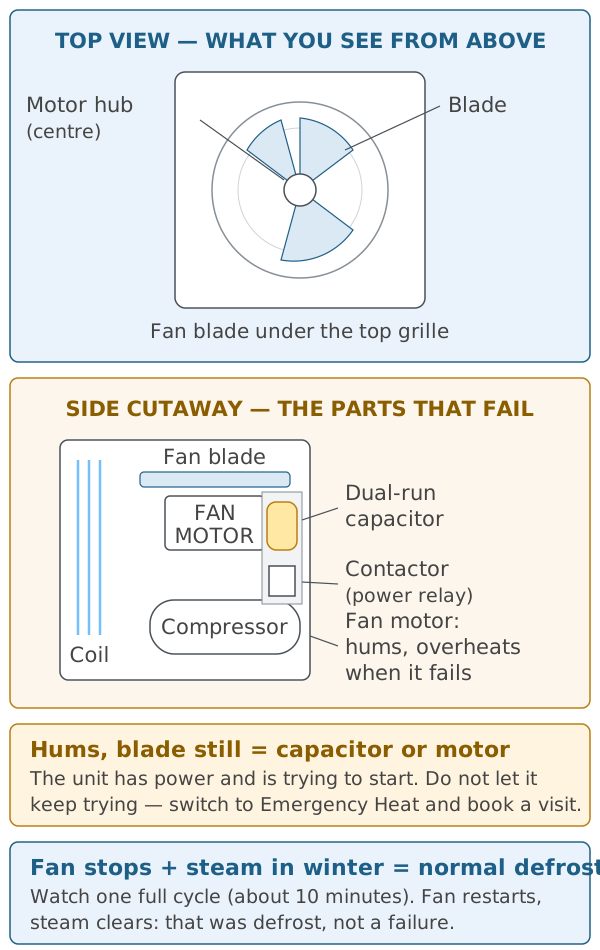
Heat Pump Fan Not Spinning? Find the Cause Before the Compressor Overheats
Your heat pump is humming but the outdoor fan won't spin. The 10-minute defrost test that rules out a false alarm, a sound-by-sound triage table, the safe checks you can do yourself, what each real cause costs to fix, and the one rule that protects your compressor.
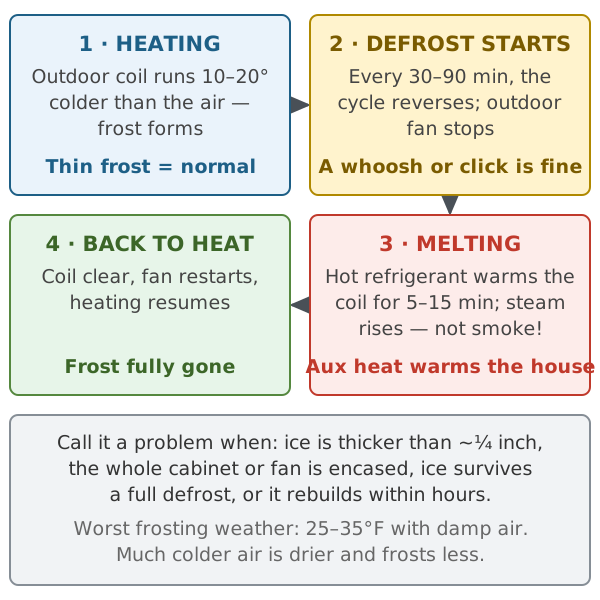
Heat Pump Icing Up? What's Normal Frost, What's a Problem, and What to Do
A frosty heat pump in winter is usually doing its job. Solid ice that never melts is not. How the defrost cycle works, the causes when it can't keep up, safe steps, and repair costs.
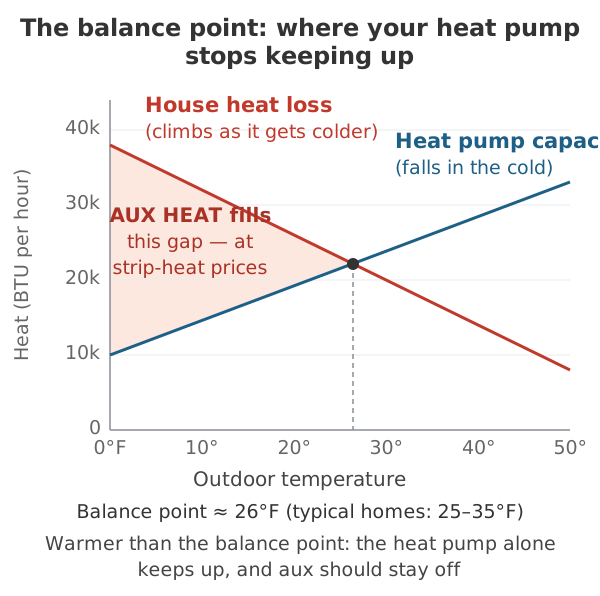
Heat Pump Can't Keep Up in Cold Weather? Balance Point, Backup Heat, and When It's Actually Broken
Set to 70, sitting at 64, and the heat pump hasn't stopped all night. Below your system's balance point that's physics, not a breakdown. Here's the worked example, the two-hour test that tells normal from broken, and what each real fault costs.