 Keep
Heat Pump Icing Up? What's Normal Frost, What's a Problem, and What to Do
 Daniel Mercer · Editor & Researcher·
Published November 16, 2026·
Updated November 16, 2026
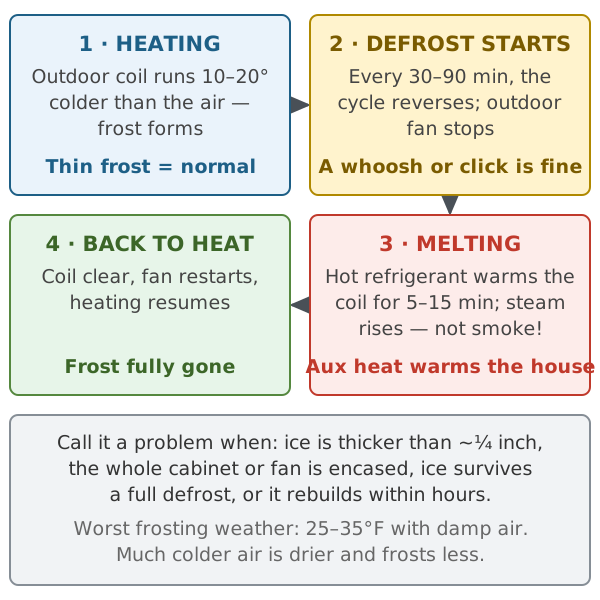
The first time you see your heat pump wearing a coat of white frost, with steam about to pour off it, it looks like a breakdown in progress. For a heat pump, it's usually just Tuesday. No other home system is so routinely mistaken for broken while working perfectly — or so often genuinely broken while its owner waves it off as "just frost." This guide is about telling the two apart, because the line between them is clear once you know how the machine manages ice.
Why a heat pump frosts at all (it's physics, not failure)
In heating mode, your heat pump does something that still sounds like a trick: it extracts heat from outdoor air and moves it inside. It does this by making the outdoor coil colder than the air around it — manufacturers like Trane put the coil at 10 to 20 degrees below the outdoor temperature — so heat flows from the air into the refrigerant.
Now the consequence writes itself. If it's 38°F outside, the coil surface may be sitting at 20°F. Moisture in the air touches that surface and freezes. Frost on the coil in cold, damp weather isn't a symptom; it's the visible proof the machine is absorbing heat. A heat pump that never frosted in a damp January would be the suspicious one.
Left alone, though, frost would insulate the coil and choke the airflow until heating stopped. So the system defrosts itself.
The defrost cycle: what normal looks and sounds like
Every so often — on many systems every 30 to 90 minutes of heating runtime, triggered by a timer, a coil sensor, or both — the heat pump briefly reverses itself into cooling mode. Hot refrigerant floods the outdoor coil, and the frost melts off in 5 to 15 minutes. Meanwhile the outdoor fan stops (it's not needed and would blow the warmth away), and the backup heat usually kicks in indoors so the vents don't blow cold air on you.
From the yard, a defrost cycle looks like this: a click or whoosh as the reversing valve shifts, the fan stops, the frost visibly melts, and a cloud of steam rises off the unit — dramatic enough that "my heat pump is on fire" is a real category of service call. Then the fan restarts and heating resumes, coil clean.
The verdict rule is simple: frost that comes and goes on this cycle is normal; ice that accumulates through it is not. Carrier's working threshold is a layer generally under a quarter inch. Past that — ice coating most of the coil, wrapping the fan blades, climbing the cabinet, or building an iceberg at the base — the defrost system is losing, and something on the cause list below is beating it.
Normal frost or a fault? The quick-reference table
Everything above compresses into one table:
| What you see | Normal or fault | What to do |
|---|---|---|
| Thin, even frost that melts away during defrost | Normal | Nothing — this is the machine working |
| A cloud of steam for 5–15 minutes, outdoor fan stopped | Normal — a defrost cycle running | Nothing; wait for the fan to restart |
| Heavier frost than usual in damp 25–35°F weather | Normal | Nothing; note the pattern |
| Ice thicker than a quarter inch that is still there after a defrost | Fault | Run the four checks below; call if still growing tomorrow |
| Ice in bands, or cleared at the bottom but surviving at the top | Fault — defrost ending early (sensor or board) | Photograph it and book a technician |
| A thick block of ice at the base, coil above mostly clear | Fault — meltwater refreezing (drainage) | Not urgent; raise it at the next visit |
| Fan blades trapped in ice, or the whole cabinet sheathed | Fault — defrost has lost | Switch to Emergency Heat and call the same day |
| Ice plus a tripped breaker, grinding or a fan that will not turn | Fault — stop | Switch the system off and call |
Your checks first: the four causes you can see from the yard
1. Snow, leaves and clearance. The coil can't absorb heat from air it can't reach. Snow drifted or shovelled against the unit, autumn leaves packed into the coil face, a fence or shrubs closing in — all of it accelerates icing. Keep 18–24 inches clear around the unit, brush snow off the top and sides after storms (gently — the fins underneath are soft), and never, ever wrap or cover a heat pump for the winter. Covers trap moisture and starve airflow, and they cause the exact freeze-ups their owners bought them to prevent.
2. The indoor filter. Airflow is a system-wide story: a clogged indoor filter reduces the air moving across the indoor coil, which unbalances the whole refrigerant circuit and can contribute to outdoor icing. It's the same filter from our furnace and AC guides, and it's a two-minute check. If it's grey, change it before you diagnose further.
3. Water dripping onto the unit. Look up. A gutter overflowing or dripping directly onto the outdoor unit, or meltwater from a roof edge, pours water onto a coil that is below freezing — the defrost cycle can melt frost, but it can't keep up with a continuous supply of new water. Icicles hanging off the unit's top edge are the tell. Fixing the gutter is a homeowner job, and on some houses it's the entire cure.
4. A unit that sits too low or can't drain. Defrost produces meltwater every cycle, and that water has to escape before the next freeze. A unit sitting in a puddle of its own meltwater — pad sunk, base pan drains blocked, unit level with the ground in snow country — builds an ice shell from the bottom up, cycle by cycle. In snowy regions, installers raise heat pumps on stands or a raised pad for exactly this reason. If your unit's base is entombed in ice while the coil looks reasonable, drainage is your suspect, and it's a conversation to have with a technician before next winter rather than mid-crisis.
The technician's list: when defrost itself is broken
If airflow is clear, the filter is clean, nothing drips on the unit, and ice still wins, the failure is inside the defrost system. These are the usual components, in the order technicians test them:
Defrost sensor or thermostat. A small sensor strapped to the outdoor coil tells the control board the coil's temperature — when to start defrosting and when the ice is gone. If it fails or drifts, the board flies blind: defrost never starts, or starts and stops before the ice is cleared. Lennox calls failed defrost controls one of the most common causes of severe freeze-ups, and the sensor is the cheapest part of that system: typically $100–$450 fitted.
Defrost control board. The board runs the whole sequence — timing, sensing, switching the reversing valve, stopping the fan, calling the backup heat. A dead board means no defrost at all, and a confused one can mean defrosts that come constantly (wasting energy and heating your yard) or never. Replacement typically runs $200–$900, most often $300–$700.
Outdoor fan motor. If the fan isn't moving air across the coil during heating, frost forms faster and the meltwater handling goes wrong; a fan that ices in place — blades visibly trapped — has usually been failing or stopped for a while. Fan motors are mid-range repairs, a few hundred dollars and up.
Reversing valve. The valve that flips the system between heating, cooling and defrost can stick — sometimes from its solenoid coil failing (a $150–$600 repair), sometimes the valve body itself ($600–$1,800, because the refrigerant circuit must be opened, recovered and recharged). A stuck valve has a signature beyond ice: a system that cools when you ask for heat, or heats feebly in both modes, is telling you the valve isn't travelling.
Low refrigerant. Covered in the FAQ below: a low charge makes the coil run colder than designed, so frost builds faster than defrost can clear it — and the fix is a leak repair plus recharge, never a blind top-up.
What the repairs cost
Here is the fuller picture, with what the money actually buys. Prices are fitted prices — part, labour and testing; big-city rates run higher, and inverter-system boards can exceed the top of these ranges.
| Repair | Typical cost | What the technician does, and how long it takes |
|---|---|---|
| Defrost sensor / thermostat | $100–$450 | Tests the old sensor against its temperature chart, fits the replacement, forces a defrost to confirm. Under an hour |
| Defrost control board | $200–$900 | Swaps the board, then runs a forced defrost and watches the full sequence. About 1–2 hours |
| Outdoor fan motor | $300–$700 | Replaces the motor (and usually its capacitor) and checks the blade. 1–2 hours; a bent blade adds parts cost |
| Reversing valve solenoid (coil only) | $150–$600 | Tests and replaces the coil without opening the refrigerant circuit. Under an hour — confirm the quote is for the coil, not the valve |
| Reversing valve | $600–$1,800 | Recovers the refrigerant, brazes in the new valve, pressure-tests and recharges by weight. Half a day's work |
| Refrigerant leak repair and recharge | $500–$1,500+ | Finds and repairs the leak, evacuates and recharges by weight. Cost swings with leak location and refrigerant type |
Three things to insist on when the quote arrives. The part and the labour should be separate lines — a lump sum hides which half of a valve job you are paying for. Any refrigerant charge should state the type and weight added; "topped it up" with no leak search buys a problem that returns by spring. And ask what warranty covers the new part — one year on parts is standard.
The decision rule from earlier applies with full force: on a system past twelve years old, a reversing-valve or refrigerant-circuit quote deserves the replacement quote beside it before you sign.
What to do right now if yours is encased
Sequence matters more than heroics:
- Check the simple four above — clearance, filter, dripping water, obvious damage.
- Watch one defrost opportunity. If frost is moderate and the system is still heating the house, give it an hour of runtime and look again. Frost that has visibly retreated is a system coping; ice that has grown is a system losing.
- If the unit is encased — fan trapped, cabinet sheathed, house cooling — switch the thermostat to Emergency Heat and call. Emergency Heat runs your backup heat (usually electric strips) and rests the heat pump before ice damages the fan or coil. It costs more per hour — roughly two to three times heat-pump heat — which is a fine price for a day and a bad one for a month.
- Do not chip, pry or hammer the ice, and do not pour hot water over the coil. The coil's fins and tubes are delicate; puncturing one converts a $300 defrost repair into a coil replacement, and thermal shock from boiling water can crack cold components. If a technician wants the unit thawed before working, they'll do it their way.
What not to do — each of these makes it worse
Every winter, well-meant rescue attempts convert mid-range repairs into four-figure ones:
- Never chip, pry, hammer or scrape the ice off. The coil is soft aluminium fins wrapped around thin copper tubing. A screwdriver through the fin pack can puncture a tube — and a punctured coil means the most expensive outcome on the cost table above, caused by the owner, in the driveway, in four minutes.
- Never cover the unit while it can still run — no tarp, no plywood lean-to, no purpose-bought winter cover during the heating season. A heat pump heats by moving outdoor air; a cover starves that airflow and traps shed moisture, so the unit ices faster sheltered than in the open. Covers cause the freeze-ups they are sold to prevent.
- Don't keep forcing defrost cycles by hand. Triggering one from the control panel is a legitimate diagnostic — technicians do exactly that. But forcing cycle after cycle to babysit a unit through the week is not a workaround: each forced defrost stops your heating and calls the expensive strip heat, while the failed sensor or board goes on failing. If a unit only stays clear when you stand over it, it is already broken.
- Don't pour hot or boiling water over the coil (it belongs on this list too): thermal shock can crack cold components, and most of the water refreezes in the fin pack, adding to the ice.
The pattern behind all four: the ice is the symptom, and attacking it — chipping, drowning, hiding, melting it on a loop — damages the machine or disguises the fault while it grows. The defrost system, Emergency Heat and a technician are the only three tools that fix anything.
Timed defrost vs demand defrost: why some units steam every half hour
Not all defrost systems are equally smart, and knowing which kind you have explains a lot of "wasteful" behaviour that is actually normal-for-its-generation.
Older and simpler heat pumps use timed defrost: the control board starts a defrost every 30, 60 or 90 minutes of compressor runtime whenever the coil sensor says it's cold enough to possibly have frost — whether frost is actually there or not. On a dry, bitter day, such a system may steam away several times with barely anything to melt. That's not a fault; it's a dumb-but-reliable strategy, and its cost is a little wasted energy and a few minutes of backup heat each time.
Newer systems use demand defrost: the board compares the coil temperature against the outdoor air temperature. A clean coil tracks the air closely; a frosted coil, insulated by its ice layer, drifts further away — and that growing gap is the board's signal that frost is real and worth melting. Demand systems defrost less often, only when needed, and typically end the cycle when the coil reaches a set termination temperature rather than when a timer expires.
Why you care: a unit that defrosts frequently in damp, near-freezing weather is almost certainly behaving correctly under either system. A unit that never defrosts in a wet 30°F week, or one that defrosts every few minutes back-to-back without heating in between, is reporting a control problem under either system too. Frequency alone isn't the verdict — whether the ice is winning is.
Reading the ice: where it sits tells you the cause
Before you call, look at the pattern of the ice. Technicians do, because different failures frost differently:
- An even shell over the whole coil, growing daily — defrost isn't happening at all, or isn't being triggered. Board, sensor, or a reversing valve that never shifts.
- Ice that clears at the bottom but survives at the top (or in bands) — defrost starts but terminates early, before the melt finishes. Sensor placement or calibration, or a board ending the cycle on temperature it misreads.
- A thick block at the base, coil above mostly clear — meltwater refreezing. Drainage: blocked base-pan drains, a sunk pad, a unit sitting too low for its snow climate.
- Ice concentrated on one section of coil — uneven refrigerant distribution or a section of coil damaged or oil-logged; a technician's diagnosis, not a defrost part.
- Fan blades iced or the top grille caked, coil relatively clean — water arriving from above (gutter, roof edge) or a fan that stopped and let snow settle and freeze in place.
A phone photo of the ice pattern, taken before anything melts or gets cleared, is genuinely useful to the company you call — it can put the right part on the truck.
The electric bill is often the first witness
Many icing failures are discovered at the meter, not the unit. The chain goes: ice insulates the coil → the heat pump extracts less heat and runs longer → it calls the backup heat to make up the difference → and electric resistance heat, running for hours, costs two to three times heat-pump heat. A January bill dramatically above last January's, in similar weather, with the house slightly less comfortable, is an icing (or defrost) problem until proven otherwise.
One distinction keeps you from chasing a ghost: below a certain outdoor temperature — the system's balance point, often somewhere in the 25–40°F range depending on the house and equipment — the heat pump legitimately can't carry the house alone, and auxiliary heat supplements it by design. High bills during a genuine cold snap, with a clear coil, are physics. High bills with a frosted-solid unit are a repair.
What Emergency Heat actually costs per day
"Emergency Heat costs more" is easy to say and hard to budget by, so here is the arithmetic nobody in this topic usually bothers to print.
Electric strip heat converts electricity to heat at 100% efficiency — which sounds good and isn't, because a heat pump moves heat instead of making it, delivering two to three units of heat per unit of electricity. Your strips are probably a 10 or 15 kW kit (the size is on the air handler's data plate). Multiply kilowatts by the hours the strips run and by your rate — around 17¢ per kWh is a fair US average.
Worked examples, at 17¢/kWh:
| Weather while you wait | Strip heat (Em Heat) | The same days on a working heat pump |
|---|---|---|
| A damp 35°F day, 10 kW strips cycling half the time | roughly $20/day | roughly $7–$10/day |
| A cold 20°F day, strips running most of the day | roughly $30–$35/day | roughly $12–$15/day |
| A bitter 5°F day, 15 kW strips running near-continuously | roughly $45–$60/day | roughly $18–$25/day (with some aux help, by design) |
Read as a budget for waiting, they sort the decision cleanly. A weekend on Emergency Heat while a sensor is ordered costs perhaps $30–$60 extra — annoying, and absolutely the right call against running an encased unit. A month of it is $600–$1,200 burned on heat alone — more than the board, sensor and fan motor on the cost table combined, spent on delay. That is the real deadline behind "call this week": not the ice, but the meter.
When the weather simply wins for a day
Honesty requires one exception to everything above: freezing rain and heavy wet snow can overwhelm a healthy defrost system. Lennox lists long spells of freezing rain, sleet or heavy wet snow among the conditions that ice a unit beyond defrost's capacity — rain landing on a below-freezing coil freezes on contact faster than any cycle can clear it. During such an event, the right move is Emergency Heat, patience, and a look after the weather breaks: a healthy system, once the rain stops, will usually clear itself over a few cycles. If it doesn't — if the shell persists into fair weather — you're back on the cause list, and the storm was the occasion, not the explanation.
Ductless mini-splits ice too
Everything here applies to ductless systems as well — an outdoor mini-split unit is a heat pump with the same defrost logic — with two practical differences. First, their outdoor units are often mounted on wall brackets or low stands where drainage and clearance were afterthoughts, so the base-refreeze pattern is especially common. Second, indoor mini-split heads have their own condensate arrangements, and a summer drainage fault indoors is a separate problem from winter coil ice outdoors. Don't let a technician conflate them, and don't let anyone tell you ductless systems "don't defrost" — they do, steam and all.
Ice in summer is a different article
Everything above is about the outdoor unit in winter. If it's July and you find ice on the refrigerant lines or the indoor coil, that's an air-conditioning freeze-up — different causes (airflow and refrigerant again, but on the cooling side), covered in our AC blowing warm air guide. The shared DNA is real (both are airflow-and-charge stories), but don't let anyone sell you a "defrost board" for a summer freeze.
What happens if you just leave it iced
A frosted unit is inefficient; a fully iced unit is being damaged in slow motion, and the damage list explains why "switch to Emergency Heat and call" beats "see if it sorts itself out":
- The fan is at risk. Ice bridging from the coil to the fan blades or grille can freeze the blade in place. When the motor tries to start against that load — or when a chunk breaks loose into a spinning blade — motors burn out and blades bend. A defrost sensor repair becomes a sensor plus a fan motor.
- The compressor works harder for less. An insulated coil means low suction pressure and long runtimes; the compressor runs hot and long on every cycle, wearing the most expensive component in the system to deliver heat the house never receives.
- The coil itself can be crushed. Ice expands as it accumulates between fins, and repeated freeze-growth can deform the soft aluminium fin pack — permanently reducing the coil's ability to transfer heat even after the ice is gone.
- Your backup heat is paying for all of it. Every hour the iced heat pump fails to heat, the resistance strips do the job at two to three times the cost. A week of "leaving it" can cost more in electricity than the sensor that caused it.
None of this happens from one frosty morning. It happens from weeks of an ice shell being treated as weather. The pattern to respect is accumulation: ice that is more today than yesterday, on a unit whose defrost you've never once seen steam, is a system asking for help in the only language it has.
What a good diagnostic visit looks like
On an icing call, expect the technician to do more than glance at the ice. A thorough visit includes: forcing a defrost cycle manually at the board and watching whether it initiates, runs and terminates correctly; testing the coil sensor's resistance against its temperature chart; checking the reversing valve's shift and its solenoid; confirming the outdoor fan's operation and the capacitor behind it; and, if the defrost system passes, putting gauges on to check the refrigerant charge — because low charge is the cause that hides behind "defrost seems fine." Ask, before they leave, which component failed and what the ice pattern told them; the good ones answer in one sentence, and it will match the pattern section above. And if the verdict is a reversing valve or a compressor on a system past twelve years old, get the replacement quote next to the repair quote — the same $5,000-rule maths from our AC guide applies, and any honest company will show you both numbers without being asked twice.
How cold is too cold? The question every heat pump owner eventually asks
Sooner or later a bitter night prompts the forum question: should my heat pump even be running at 5°F? The honest answer has two halves. Can it run? Almost certainly yes — a heat pump extracts heat from cold air the way a refrigerator extracts heat from its cabinet, and modern units, especially cold-climate models, are built to operate well below zero, delivering reduced but real heat. There is no outdoor temperature at which running the machine harms it merely by being cold.
Should it be the thing heating you? That's economics, not mechanics. As temperatures fall, the heat pump's output and efficiency decline while your house's heat loss climbs; where the lines cross — the balance point discussed above — the backup heat starts supplementing, and below some point the strips may carry most of the load. Some older systems were installed with an outdoor thermostat that locks the compressor out below a set temperature and hands over to backup entirely; many modern systems just blend. What you should not do is switch to Emergency Heat pre-emptively on a cold forecast "to give the pump a rest": the pump doesn't need rest, and if it can still produce heat at two to three times the strips' efficiency, every hour on Em Heat is money spent for nothing. Let the system blend as designed; reserve Emergency Heat for a pump that is iced, broken or silent.
Keeping it clear all winter
Heat pumps reward a small amount of seasonal attention. Before the cold: clear the clearance zone, clean the coil gently if it's furred with debris, change the filter, and fix the gutter you noticed dripping in October. During the cold: after each significant snow, walk out and brush the unit off and dig its breathing room back — two minutes with a broom, while the neighbours' units suffocate. And once a winter, on a frosty morning, watch a defrost cycle happen: fan stops, steam rises, coil clears, fan restarts. Knowing what healthy looks like is what turns next year's "is that normal?" into a five-second glance.
Because that's the real skill this guide is selling. Frost is the heat pump's normal winter coat; the defrost cycle is how it takes the coat off, several times a day, all by itself. Your job is only to notice the winter it stops being able to — and by then, you'll know exactly which list to start down.
One modern help is worth switching on if you have it: many smart thermostats can alert you when auxiliary heat runs beyond a threshold you set — say, more than a few hours in a day. Since runaway aux heat is the financial shadow of an icing failure, that alert is often the earliest warning you'll get, arriving days before the ice shell is visible from the kitchen window. Set it in autumn, while you're thinking about it, and let the thermostat do the watching on the mornings you'd rather not walk out to the unit in your slippers.
And after any freezing-rain event, once the weather breaks, give the unit one deliberate look even if the house feels fine: a shell acquired during the storm should be visibly retreating within a day of normal operation. Ice that's exactly as thick on the second fair day as the first has stopped being weather — it's the defrost system asking for the visit described above, and the photo you take that morning is the one to send the company when you call.
Cost at a glance
| Item | Typical cost | Notes |
|---|---|---|
| HVAC diagnostic / service call | $75–$300 | Higher in big-city markets; often credited toward the repair |
| Defrost sensor / thermostat replacement | $100–$450 | A small part that causes a large share of defrost failures |
| Defrost control board replacement | $200–$900 | Most commonly $300–$700; the other usual suspect when defrost never starts |
| Reversing valve solenoid (coil only) | $150–$600 | Much cheaper than the valve itself — always ask which one failed |
| Reversing valve replacement | $600–$1,800 | Requires refrigerant recovery and brazing; on a 12+ year-old unit, compare with replacement |
Frequently asked questions
Is it normal for a heat pump to have ice on it in winter?
Frost, yes; a solid shell of ice, no. In heating mode the outdoor coil absorbs heat from the air and runs 10–20°F colder than the outdoor temperature, so moisture freezes on it even when the air is in the low 40s. Manufacturers treat a thin, even layer — Carrier says generally under a quarter inch — as normal, because the defrost cycle removes it every 30–90 minutes. Thick ice, ice covering the fan or cabinet, or ice that survives defrost cycles is a fault, not weather.
Why is steam coming from my heat pump? Is it smoke?
It's steam, and it's the most reassuring sight in this whole topic. During defrost, hot refrigerant melts the frost off the cold coil in a few minutes, and the meltwater evaporates into cold air as a cloud of white steam. The outdoor fan stops at the same time, which makes it look even more dramatic. Steam for 5–15 minutes followed by the fan restarting is a defrost cycle working exactly as designed. Actual smoke, a burning smell, or steam that never stops is different — switch off and call.
Should I pour hot water on a frozen heat pump?
No. Sudden hot water on a frozen coil risks thermal shock damage to the coil and refrigerant lines, and the water you pour mostly refreezes and adds to the problem. Equally, never chip, pry or scrape ice off: the coil fins and tubing bend and puncture easily, and a punctured coil converts a defrost repair into a four-figure one. Let the defrost cycle or a technician handle the ice; if the unit is encased and the house is cooling, switch to Emergency Heat and make the call.
Can I cover my heat pump in winter to protect it?
Not while it can run — and a heat pump runs all winter. Covers, tarps and plywood shelters trap moisture and starve the unit of airflow, which accelerates icing; manufacturers warn against them during the heating season. (A breathable cover in summer, while the unit is off for months, is a different matter in some climates.) What actually protects a winter heat pump is clearance: 18–24 inches of open space around it, snow cleared after storms, and no gutter dripping onto it.
What is Emergency Heat, and when should I use it?
Emergency Heat (often labelled Em Heat on the thermostat) turns the heat pump off and heats the house with the backup system — usually electric resistance strips, sometimes a furnace in a dual-fuel setup. It's there for exactly the situation in this guide: the heat pump is encased, broken or defrosting constantly, and the house needs heat anyway. Use it without guilt while you wait for the technician, but know that electric strip heat costs roughly two to three times as much per hour as heat pump heat, so it's a bridge, not a lifestyle. If you discover you've been on Emergency Heat for a month, that's also a diagnosis: your heat pump has been out of the game the whole time.
Why does my heat pump ice up more in some winters than others?
Frost needs moisture as much as cold. The worst icing weather is the band around 25–35°F with damp air, freezing fog or wet snow — there's plenty of water in the air and the coil is well below freezing. Much colder weather (single digits and below) often frosts less, because very cold air holds little moisture. A mild, humid winter can be harder on a heat pump than a bitter, dry one, which is why 'it never did this last year' is weather data, not proof the unit changed.
Will low refrigerant make a heat pump ice up?
Yes — it's one of the classic causes. A low charge drops the coil's temperature and pressure further than design, so frost forms faster and thicker than the defrost cycle can clear. And as with air conditioners, refrigerant is never 'used up': a low charge means a leak, and the correct repair is finding and fixing the leak, then recharging — by a certified technician, since refrigerant handling is regulated. A unit that ices worse and heats less week by week, with clear airflow, has refrigerant on its suspect list.
Checked November 16, 2026. This guide is general information, not a substitute for a licensed professional.
Related guides
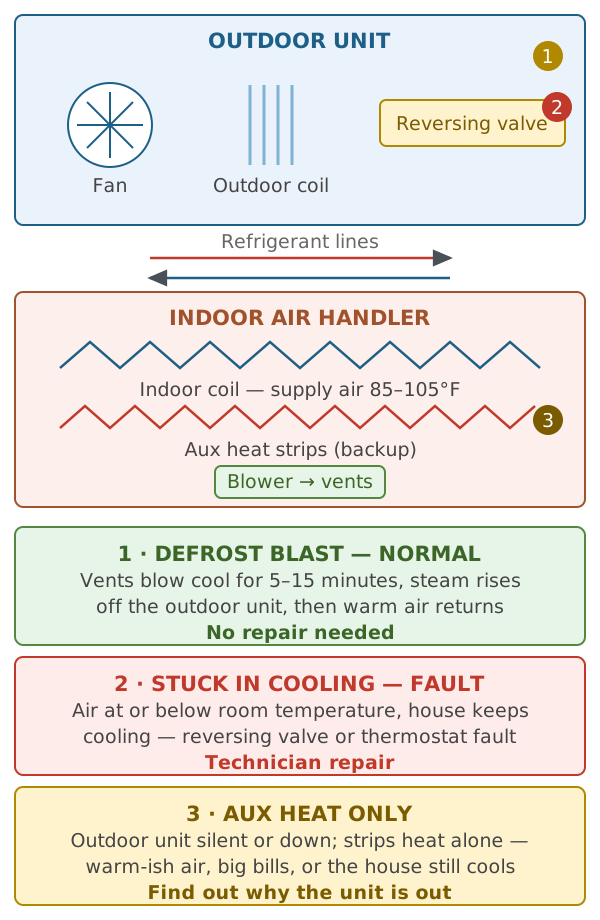
Heat Pump Blowing Cold Air in Heat Mode? What's Normal, What's a Fault
Cool air from the vents in heating season is the most common heat pump scare — and often not a fault at all. The 2-minute thermometer test, the three real scenarios behind cold air, owner checks, and what the repairs cost.
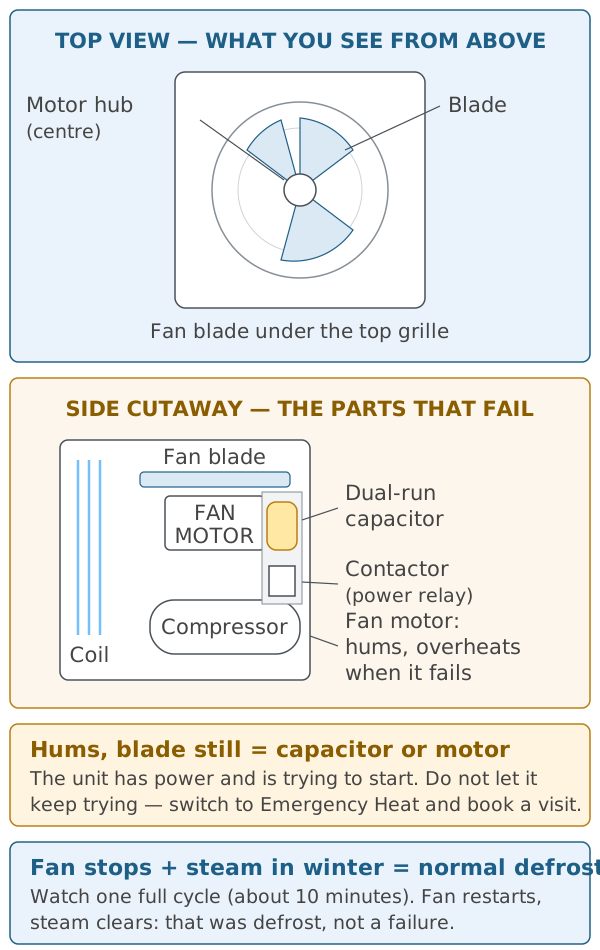
Heat Pump Fan Not Spinning? Find the Cause Before the Compressor Overheats
Your heat pump is humming but the outdoor fan won't spin. The 10-minute defrost test that rules out a false alarm, a sound-by-sound triage table, the safe checks you can do yourself, what each real cause costs to fix, and the one rule that protects your compressor.
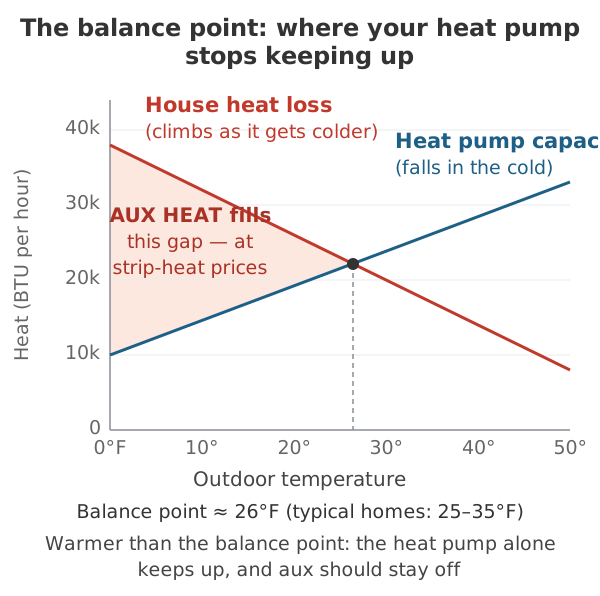
Heat Pump Can't Keep Up in Cold Weather? Balance Point, Backup Heat, and When It's Actually Broken
Set to 70, sitting at 64, and the heat pump hasn't stopped all night. Below your system's balance point that's physics, not a breakdown. Here's the worked example, the two-hour test that tells normal from broken, and what each real fault costs.