 Keep
Heat Pump Can't Keep Up in Cold Weather? Balance Point, Backup Heat, and When It's Actually Broken
 Daniel Mercer · Editor & Researcher·
Published November 16, 2026·
Updated November 16, 2026
It's 11 p.m. on the coldest night since you bought the house. The thermostat is set to 70. The little display says 64 — and an hour ago it said 65. The outdoor unit has not stopped running since sometime in the afternoon; you can hear it through the wall, steady and unhurried, doing what sounds like its best. The vents are blowing, the air feels lukewarm at most, and every instinct you own is telling you the same thing: it's broken, it's dying, and it's going to finish dying at 2 a.m. in single-digit cold with the pipes listening.
Maybe. Or maybe nothing is broken at all, and you've just met the single most misunderstood fact about heat pumps: in serious cold, a healthy system can run flat out, around the clock, and still lose ground — slowly, measurably, a degree or two at a time — because the contest it's in is rigged by physics. Which of those two situations you're in matters enormously. One costs you a service call you didn't need. The other, ignored, costs you a compressor or a burst pipe. This guide gives you the concept that separates them (the balance point, with real numbers), a two-hour test you can run tonight with a notebook, and the fingerprints of the four faults that genuinely do cause this — so when you do call, you already know what the technician should find.
One boundary before we start: this guide is about the gap — the house losing ground hour by hour in a cold snap. If your puzzle is that the vent air itself feels cold, that's a different diagnosis, covered in "Heat Pump Blowing Cold Air in Heat Mode? What's Normal, What's a Fault". If the unit simply never stops and the temperature is fine, that's "Heat Pump Running Constantly: When Nonstop Is Normal — and When It Isn't". Here, the temperature is the problem.
The balance point: two lines moving in opposite directions
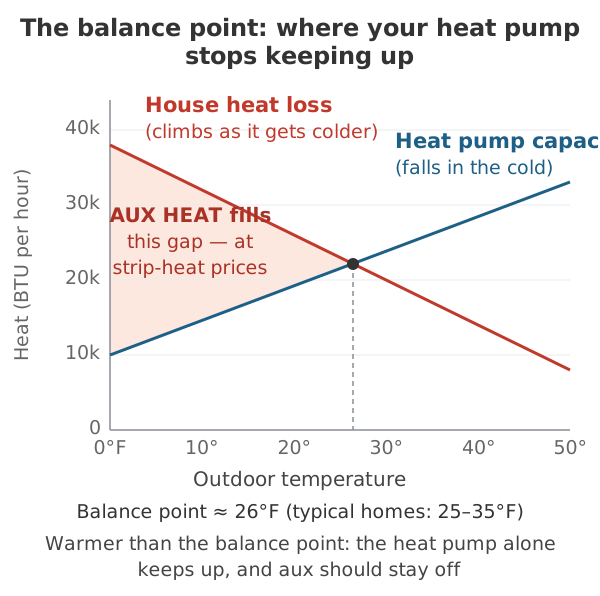
Everything about this topic is one picture. Draw the outdoor temperature along the bottom. Now draw two lines.
Line one: what your house loses. A house loses heat through its walls, roof, windows and leaks at a rate proportional to how much colder it is outside than in. Hold the inside at 70°F and every degree the outside drops adds roughly the same slice of loss. Plot it and you get a line that climbs steadily as the weather gets colder.
Line two: what your heat pump makes. A heat pump doesn't manufacture heat; it harvests it from the outdoor air, and there is less to harvest the colder that air gets. A conventional unit rated at 36,000 BTU/h on a 47°F day delivers roughly 60% of that — about 21,600 BTU/h — at 17°F. Plot it and you get a line that falls steadily as the weather gets colder.
Where the two lines cross is the balance point. Above it, the heat pump makes more heat than the house loses, so it cycles on and off and the thermostat is satisfied. At the crossing, it runs nonstop and just barely holds. Below it, the house loses more than the pump can make, every hour, and the difference has to come from somewhere — that somewhere is your backup heat, and the wedge between the lines is exactly what the backup has to supply.
The worked example: one ordinary house, one ordinary 3-ton unit
Abstractions don't help at 11 p.m., so here is a concrete, typical case. Take a reasonably insulated house of about 1,800 square feet that loses roughly 590 BTU of heat per hour for every degree of difference between inside and out — a fair figure for an average existing home. And take a typical conventional 3-ton heat pump: 36,000 BTU/h at the standard 47°F rating point, about 21,600 BTU/h at the 17°F rating point. Hold the thermostat at 70°F and walk down the thermometer:
- 47°F outside: the house loses about 13,600 BTU/h; the pump can make 36,000. It loafs — short, lazy cycles, long rests. This is the weather heat pumps are sold in.
- 37°F outside: the house loses about 19,500 BTU/h; the pump makes about 31,200. Still a comfortable surplus. Cycles get longer, the house holds easily, and you'd never think about your heating system.
- 26°F outside: the house loses about 26,000 BTU/h; the pump makes about 26,000. This is this system's balance point. The unit now runs continuously — not because it's failing, but because every BTU it makes is spoken for the moment it's made. The house holds 70°F, with nothing to spare.
- 17°F outside: the house loses about 31,300 BTU/h; the pump makes 21,600. There's a shortfall of roughly 9,700 BTU/h — about 2.8 kW of electric strip heat. The thermostat stages the strips in and out to cover it. The house still holds, but part of its heat now arrives at strip prices.
- 5°F outside: the house loses about 38,400 BTU/h; the pump makes roughly 15,800. The shortfall is about 22,600 BTU/h — around 6.6 kW of strips. If the strip kit is a 5 kW bank, or one bank of a bigger kit has quietly died, the maths no longer closes, and the indoor temperature begins its slow slide: 68, 66, 64.
Read that last line again, because it's the whole article in miniature. The slide at 5°F required no breakdown at all — just a cold enough night meeting a finite backup. And notice what the balance point is not: it is not a property of the heat pump alone. It's the crossing of your unit's line and your house's line, which is why your neighbour's identical-looking system cruises through weather that has yours slipping. His house line sits lower.
Two honest qualifications. First, real capacity curves bend rather than running perfectly straight between the rating points, and real houses leak in gusts, not in straight lines — treat the numbers as a faithful sketch, not a lab report. Second, your system's balance point could sit anywhere in a wide band: roughly 25–35°F covers most conventional systems in average houses, a tight new house can push it toward 20°F, and a cold-climate unit (covered below) can push it under 0°F. What you can measure, without any instruments, is whether yours has moved. That's the test, two sections down.
Why the vent air feels lukewarm while all this is happening
One observation poisons more cold-night diagnoses than any other, so it gets sixty seconds here. A heat pump in heating mode delivers supply air at roughly 90–110°F — building scientist Allison Bailes is the source most often cited for that range — and human skin sits at about 91–93°F on the surface. Air at 95°F is genuinely heating your house while feeling, against your hand, like a cool breeze. A furnace, by contrast, blows 120–140°F air and feels like heating. So on the very nights when your heat pump is working hardest, its output feels the least convincing. Feel is not data; the thermometer on the wall is data. The full treatment of vent temperature — when cool-feeling air really does mean a fault — is in "Heat Pump Blowing Cold Air in Heat Mode? What's Normal, What's a Fault", and it deserves its own read on a calmer evening.
The setpoint-gap test: two hours and a notebook
You don't need gauges to learn which side of the balance point your problem lives on. You need one cold evening, a thermometer you trust, and the discipline not to touch the thermostat. Run it like this:
- Pick your evening. A night forecast to sit at or below the temperatures where you've noticed the problem. Note the outdoor temperature at the start — the reading from a thermometer outside your own house is best; a weather app for your town is acceptable.
- Set the thermostat to your normal setting and leave it there. Say 70°F. Do not bump it to 74 "to help it catch up" — raising the setting adds no capacity whatsoever, and on most thermostats a big gap between room temperature and setting is exactly what triggers the strip heat, which muddies the test.
- Record the indoor temperature at hour zero, hour one and hour two. The thermostat's own reading is serviceable; a cheap room thermometer on an interior wall of the room you care about is better, because thermostats live on sheltered interior walls and can flatter the house.
- Keep conditions ordinary. Normal doors, normal cooking. Note two things alongside the numbers: whether the AUX indicator is lit when you check, and whether the outdoor unit is running steadily.
- Note the outdoor temperature again at the end. You're comparing the house's behaviour against a stated temperature, not against "a cold night".
Now read the result — this is the decision rule the whole test exists for:
- It holds. Indoor temperature within about a degree of where it started across the two hours, at or near the setting. Your combined system — pump plus whatever aux it chose to use — is covering the house's losses at that outdoor temperature. If the weather was mild (above about 35–40°F), that's simply a healthy system. If the weather was deep cold and aux cycled to hold the line, that's the design working. Either way: no fault indicated.
- It creeps. Down one to three degrees over two hours, then seeming to level off. In weather well below your balance point, with aux running, this is the signature of a combined system that's slightly short — an undersized strip kit, a very leaky house, or an extreme night doing extreme-night things. Not an emergency; worth improving on the house side and mentioning at the next service. But if it creeps like this in mild weather — above 35–40°F — it is not physics. A healthy heat pump has a large surplus at those temperatures. Creeping there means lost capacity, and it earns a service call.
- It falls. A degree an hour or more, steadily, with no sign of levelling — or any fall at all while the thermostat shows aux or emergency heat running flat out. The system is not merely at its limit; something in it is not delivering what the controls believe it is. A dead strip bank, a serious charge problem, a valve fault. This is a fault until a technician proves otherwise.
And one comparison that outranks all three readings: last winter. Your balance point is a thing you can feel retrospectively. If the house held 70°F through a 15°F night last January and slips at 27°F this year, your lines have moved — the house didn't change, the weather isn't worse, so the capacity went somewhere. A moved balance point is the single most useful sentence you can say to a technician, because it converts "it's cold, isn't that normal?" into "find the lost capacity".
Emergency heat: the straight answer
Somewhere around the second hour of watching the temperature slip, most owners find the thermostat's EM HEAT setting and have the same thought: the backup is the strong stuff — just switch to that. It feels decisive. It is, mostly, a way to pay more for the same cold house. Here is the honest version.
Emergency heat does not add the strips to the heat pump. It replaces the heat pump with the strips: the compressor is locked out and the air handler heats with resistance elements alone. Price that out with the figures from the companion guide on aux heat ("AUX Heat Keeps Coming On? Why Your Electric Bill Just Spiked"): a typical 10 kW strip bank at an electricity price of 18.4¢/kWh costs about $1.84 for every hour it runs, against roughly $0.74 an hour for the heat pump — and remember, below the balance point the heat pump's contribution is the majority of your heat. Switching to emergency heat throws that majority away and asks the minority to do everything. If the house was slipping with both running, it will slip faster on strips alone, at two and a half times the running cost. Owners who ride out a cold month on emergency heat discover the arithmetic on the bill: twelve hours a day of strip runtime is around $22 a day, $660 a month, at that rate.
Meanwhile, the thing you actually wanted — the strips helping — was already available without touching anything. The thermostat stages aux heat in automatically when the heat pump can't close the gap. That is aux's entire job. You do not need to invite it; you need to check that it came, which is one glance at the AUX indicator during your log test.
So when is emergency heat the right call? In exactly the situations it was named for: the heat pump is broken, encased in ice it can't clear, making noises that say stop, or tripping its breaker — and you need heat while a repair is arranged. Hours to a few days, as a bridge. And one diagnostic footnote: if you switch to emergency heat and the house still loses ground in weather that isn't extreme, you have learned something valuable — the shortfall lives in the strips or the house, not the heat pump. Tell the technician that, too.
Sometimes the house is the problem
Return to the chart for a moment. Your heat pump's line is fixed by its model and its health. Your house's line is not fixed at all — it's set by how fast the building leaks heat, and it is the only line in this story you can actually move. Every item below raises the loss line, steepens the slide, and drags your balance point up into weather you'd otherwise sail through.
Duct leakage is the big one. If your ducts run through an unheated attic or crawlspace — and in a great many existing houses they do — every leak in them dumps air you paid to heat into a space you don't live in, and the system's return side pulls replacement air in through the house's cracks, pre-chilled. Work the arithmetic as an illustration: if a quarter of the air handler's output never reaches a register, then at 26°F your unit's 26,000 BTU/h arrives indoors as about 19,500 — which is the output this example system makes at roughly 37°F. In other words, leaky ducts can hand you the balance point of a system a full size smaller. Duct sealing is unglamorous, invisible and one of the few repairs that moves the chart itself.
Insulation and air sealing set the slope. A thin attic insulation layer, unsealed attic hatches and penetrations, and gaps around the rim joist all steepen the loss line. You feel their absence most precisely on balance-point nights: they're the difference between a house whose line crosses at 26°F and the same house crossing at 33°F. Nobody's favourite purchase, but unlike a bigger heat pump, they lower the loss line in every hour of every winter, in cooling season too.
Distribution faults masquerade as capacity faults. A clogged filter strangles airflow across the indoor coil and cuts delivered heat before it starts — change it before you conclude anything, it's the two-minute check. Closed or blocked registers in the rooms that feel coldest, a duct run that's come apart in the crawlspace (a classic: one room arctic, the crawlspace toasty), a crushed flex run. The tell is geography: if one room slips and the rest of the house holds, your problem is distribution, not capacity — no refrigerant charge on earth fixes a disconnected duct, and no technician should sell you one for it.
The practical order, then, before any equipment conclusion: filter, registers, a look at the accessible duct joints, and the log test. The house-side causes carry the same weight as the equipment faults in the next section, and two of them are cheaper than a service call.
When it really is broken: four faults and their fingerprints
Suppose the log test says falls, or the balance point has plainly moved since last winter. The lost capacity is almost always one of these four, and each one signs its work differently in your log — which is why the notebook matters.
Low refrigerant charge. Heat pumps don't consume refrigerant; a low charge means a leak, full stop. The fingerprint is the moved balance point itself: runs that used to be comfortable at 25°F now need aux, the system holds in weather it once cruised through and slips in weather it once held. In the shoulder seasons you may also have seen the outdoor coil or the fat copper line icing when neighbouring systems weren't. In the log, the fall is smooth and weather-proportional — the pump is simply smaller than it used to be, at every temperature.
A failing reversing valve. The valve that flips the system between heating and cooling can stick partway or fail to shift completely, sending some of your heat the wrong way. Its fingerprint is inconsistency: capacity that comes and goes, episodes of noticeably cool vent air in heat mode that resolve on their own, a system that was fine on Tuesday and hopeless on Thursday at the same temperature. If the solenoid coil alone has failed, the repair is modest; if the valve body itself is stuck, it's sealed-system surgery — hence the wide cost range in the table.
A defrost board or sensor fault. In heating weather the outdoor coil frosts, and the defrost control melts that frost off in short cycles. A board or sensor failing in one direction defrosts far too often — and every defrost is a pause in heating with the strips covering, capacity bled away ten minutes at a time. Failing in the other direction, it never defrosts at all: the coil ices into a solid block, air can't get through it, and output falls off a cliff. The fingerprint is in the weather pattern — the gap is worst on damp, near-freezing days (heavy frost weather, low 30s and high humidity) rather than on the coldest, driest nights. If your worst nights are the foggy 31°F ones, put this fault at the top of the list you hand the technician.
A dead strip bank. The quietest fault of the four. The thermostat calls for aux, the AUX light glows, warm air comes out — and the house still slips in deep cold, because one bank of the strip kit has failed open and the top-up is half the size the controls assume. The fingerprint: everything behaves normally until the weather gets genuinely cold, and the emergency-heat experiment described above fails too — the house can't hold on strips alone in weather it should manage. A clamp meter settles it in minutes; each bank should draw its rated current when called.
Notice what isn't on this list: age, by itself. An old system that holds its historical balance point is an old system working. Capacity that matches last year's is the baseline; it's the change that convicts.
Cold-climate heat pumps, and the below-zero question
If your house sits in a genuinely cold state, you may have read that modern cold-climate heat pumps have abolished everything in this guide. They haven't — they've moved it, which for most owners amounts to the same mercy.
The distinction is in the capacity line. Where a conventional unit keeps about 60% of its rated output at 17°F, a unit carrying ENERGY STAR's cold-climate designation must still deliver at least 70% of its 47°F rated capacity at 5°F, at a coefficient of performance of at least 1.75 — and the Maryland Energy Administration's heat pump guidance describes cold-climate models performing down to −15°F. Run our example house against a unit like that and the crossing doesn't happen at 26°F; it happens in the single digits, or below zero in a tight house. The US Department of Energy's heat pump guidance makes the same point from the other side: equipment selection for the climate is what decides whether a heat pump is a whole heating system or a part-time one.
Two honest caveats. First, a cold-climate unit still has a balance point — on the coldest night of the decade, in a leaky house, it can still slip a degree, and that night proves nothing except arithmetic. Second, if your conventional system is young and healthy, its 30°F balance point is not a defect to be corrected by replacement; it's a characteristic to be understood, and possibly softened with duct sealing and insulation. The cold-climate upgrade earns its money when a system is at end of life anyway — then, in a cold climate, it's the single decision that changes every future January.
What a good technician measures
When you call, you're buying measurements, not opinions. A proper diagnostic for "can't keep up" takes about an hour and produces numbers:
- Delivered capacity. A temperature split measured across the indoor air handler, combined with airflow, converts to the BTU/h the system is actually delivering — which can be compared, on the spot, against what the rating plate says it should deliver at that day's outdoor temperature. This single comparison sorts your problem into physics (delivered matches rated; the house is the story) or fault (delivered is well under rated; the equipment is).
- Refrigerant charge, properly. Pressures interpreted as superheat and subcooling against the manufacturer's chart — not a shrug and a top-up. If the charge is low, a leak search (electronic detector, UV dye, or both) before any refrigerant goes in, and the charge weighed in to spec.
- Strip banks, individually. A clamp meter on each bank: rated amps when the thermostat calls, zero when it doesn't. This is the dead-bank test, and it takes minutes.
- Defrost, forced and watched. A defrost cycle initiated at the board, observed to start and terminate correctly, with the sensor's resistance checked against its specification.
The written quote that follows should include: the failed part named, and how it was proven; parts and labour priced separately; the refrigerant type and quantity if any is to be charged; whether the diagnostic fee is credited against the repair; the warranty on the work; and — whenever the repair is valve- or compressor-scale money on a system past its twelfth year or so — the replacement figure on the same page, so the repair-or-replace decision is yours to make with both numbers in front of you. A quote that says "system weak, recommend replacement" without a delivered-capacity number on it is not a diagnosis. Get the measurement from someone else.
What the fixes cost
The cost table at the top of this guide is the short version; the pattern underneath it is this. The diagnostic itself, $75–$300, is the cheapest information in home ownership — it converts a frightening night into a named part. The defrost board or sensor, at $250–$700, is the fault most disproportionate to its symptom: a modest board can bleed capacity all winter. Strip banks and sequencers, $300–$800, are similarly plain parts with an outsized effect, because they are the difference between a balance point that's theoretical and one that bites. The reversing valve is the wide range — $800–$2,000 — because the job means recovering the refrigerant, brazing in the new valve, evacuating and recharging; when only the solenoid coil has failed, the same symptom costs $250–$550, which is why the diagnosis has to name which failure you have. And the refrigerant row, $450–$1,500, carries the warning from the table: a recharge without a leak repair buys you one season and the same bill again. Against all of these, price the do-nothing option honestly — a winter of emergency-heat bridging and doubled electric bills can outspend the defrost board by February.
DIY or pro — and how urgent is it?
Yours: the log test, the filter, the registers, the honest outdoor thermometer, watching whether the AUX light comes when it should, and the discipline to leave EM HEAT alone unless the pump itself is down. That is a complete and genuinely useful first pass — by the end of it you will know which side of the chart your problem lives on, and you'll hand the technician a log instead of a feeling.
The technician's: everything measured, everything refrigerant, everything inside the air handler's electrical compartment, and the reversing valve in all its forms. The stored pressures and charges in that circuit are not owner-serviceable, and every fault in the last section but one announces itself through measurements you can't take with a notebook.
On urgency, sort by the log, not by the fear. Holding within a few degrees on a brutal night, aux cycling: no urgency at all — read the cold-climate section, consider the duct sealing, sleep. Creeping in mild weather, or a balance point that's plainly moved since last winter: this week, while the symptom is reproducible and the weather is cooperating with the diagnosis. Falling steadily despite aux, or falling on emergency heat, or no heat in sub-freezing weather: today. The pipes in your exterior walls are also doing a setpoint-gap test of their own on nights like that, and theirs ends at 32°F.
Cost at a glance
| Item | Typical cost | Notes |
|---|---|---|
| HVAC diagnostic / service call | $75–$300 | The visit that measures capacity and finds which side of the chart your problem is on; often credited toward the repair |
| Refrigerant leak search, repair and recharge | $450–$1,500 | For the balance point that has crept up since last winter; a recharge without a leak repair is a subscription, not a fix |
| Reversing valve replacement | $800–$2,000 | Includes recovering and recharging the refrigerant; a failed solenoid coil alone is a smaller job at $250–$550 |
| Defrost control board or sensor | $250–$700 | For defrosts that come too often, or a coil that ices over and never clears |
| Heat strip kit (one bank) or sequencer | $300–$800 | For the house that still slips in deep cold while the thermostat insists aux is running |
Frequently asked questions
At what outdoor temperature does a heat pump stop keeping up?
There is no universal number, because the stopping point is a property of your house and your unit together: it is the balance point, the outdoor temperature where the heat pump's output exactly equals the heat your house is losing. For a typical conventional heat pump in a typical house it lands around 25–35°F. Below it, the heat pump doesn't stop — it runs continuously at full output and the backup heat covers the growing shortfall. A well-insulated house or a cold-climate unit pushes the point much lower; a leaky house or an ageing unit pulls it higher. What matters diagnostically is whether yours has moved since last winter.
Why does my house slowly get colder on very cold nights even though the heat pump never stops?
Because nonstop is what a heat pump is supposed to do in deep cold — and it still may not be enough. As the outdoor temperature falls, the house loses heat faster while the heat pump produces less of it; past the balance point there is a real, growing shortfall every hour. The thermostat should bring in aux heat to close it. If the house still slips a degree or two and then stabilises on the coldest night of the year, that's an undersized top-up meeting an extreme night. If it slips in ordinary cold, or slips further every hour, something on the equipment side has reduced capacity — low refrigerant, a dead strip bank, a defrost fault — and the test in this guide will show you which pattern you have.
Should I switch to emergency heat when it's below freezing?
Not as a routine response to cold, no. Emergency heat (EM HEAT) switches the heat pump off entirely and heats with the electric strips alone — roughly $1.84 an hour for a typical 10 kW bank at 18.4¢/kWh, versus about $0.74 an hour for the heat pump. Your thermostat already stages the strips in automatically as aux heat when they're needed, while keeping the cheaper heat pump heat in the mix. Emergency heat is for a heat pump that is broken, iced over, or shouldn't run while you wait for a repair. If you find EM HEAT selected and don't remember choosing it, a previous owner may have left it there after a breakdown — it happens constantly in newly bought houses.
Why is my aux heat running all the time in cold weather?
Below your balance point, frequent aux heat is the design: the strips cycle to cover the shortfall between what the heat pump can produce and what the house is losing, and on the coldest nights they may run more than they're off. It becomes a finding when aux runs in mild weather, when it runs constantly yet the house still loses ground (a strip bank may be dead while the thermostat thinks it's helping), or when the electric bill says the strips carried the house for weeks. The companion guide, "AUX Heat Keeps Coming On? Why Your Electric Bill Just Spiked", works through the settings, habits and stuck-part faults behind aux overuse in detail.
Is my heat pump undersized, or is something broken?
Compare against last winter, not against your hopes. A system that held 70°F at 15°F last January and slips at 28°F this year has lost capacity — that's a fault (low charge, a failing valve, a dead strip bank), because neither the house nor the weather changed category. A system that has always slipped a couple of degrees on the two or three coldest nights of the year, and recovers by morning, is showing you its sizing and its balance point — physics, possibly improvable with duct sealing and insulation, but not a breakdown. The two-hour log test in this guide, run on a cold evening, tells you which of the two you're looking at.
Do cold-climate heat pumps really work below 0°F?
Yes — within limits that are worth stating precisely. To carry ENERGY STAR's cold-climate designation, a heat pump must still deliver at least 70% of its rated 47°F capacity at 5°F, at a COP of at least 1.75, and manufacturers such as those listed by the Maryland Energy Administration rate cold-climate models for operation down to −15°F or below. That moves the balance point dramatically — into the single digits or below zero in a reasonably tight house. It does not abolish the balance point: on the coldest night of the decade, a cold-climate system in a leaky house can still slip a degree or two, and that's the same physics, just at a much lower temperature.
Is it bad for a heat pump to run nonstop in cold weather?
No. Heat pumps are built for long, steady runs — in cold weather a healthy system may run around the clock for days, and that steady operation is gentler on the equipment than constant starting and stopping, as well as being how it squeezes the most heat from each kilowatt-hour. Nonstop running only becomes information when it's paired with a falling indoor temperature, which is the setpoint gap this guide is about. The companion guide, "Heat Pump Running Constantly: When Nonstop Is Normal — and When It Isn't", covers the runtime question on its own, including the mild-weather cases where nonstop really is a symptom.
Checked November 16, 2026. This guide is general information, not a substitute for a licensed professional.
Related guides
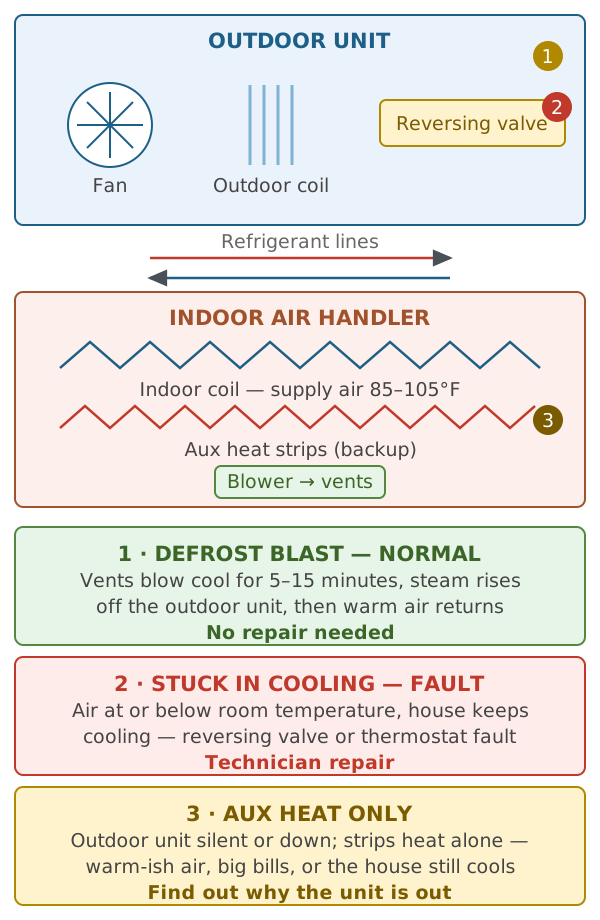
Heat Pump Blowing Cold Air in Heat Mode? What's Normal, What's a Fault
Cool air from the vents in heating season is the most common heat pump scare — and often not a fault at all. The 2-minute thermometer test, the three real scenarios behind cold air, owner checks, and what the repairs cost.
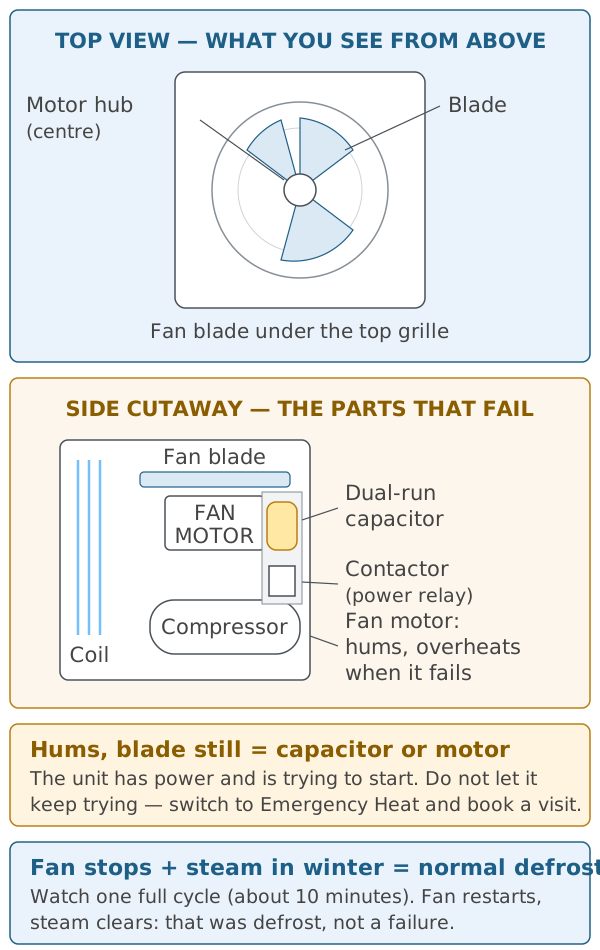
Heat Pump Fan Not Spinning? Find the Cause Before the Compressor Overheats
Your heat pump is humming but the outdoor fan won't spin. The 10-minute defrost test that rules out a false alarm, a sound-by-sound triage table, the safe checks you can do yourself, what each real cause costs to fix, and the one rule that protects your compressor.
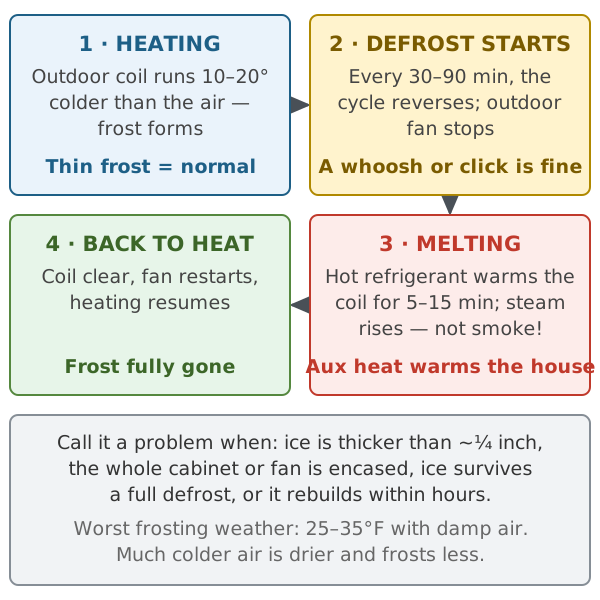
Heat Pump Icing Up? What's Normal Frost, What's a Problem, and What to Do
A frosty heat pump in winter is usually doing its job. Solid ice that never melts is not. How the defrost cycle works, the causes when it can't keep up, safe steps, and repair costs.