 Keep
Furnace Won't Turn On? 9 Checks Before You Call a Technician
 Daniel Mercer · Editor & Researcher·
Published November 16, 2026·
Updated November 16, 2026
The house goes cold overnight. The thermostat is lit, the vents are silent, and your first thought is a four-figure repair bill. Before you assume the worst, know the statistic technicians repeat every autumn: a large share of no-heat calls — by one company's count, about a third of the "dead furnace" calls on the first cold morning — turn out to be something on a short homeowner checklist. A setting. A switch. A filter. Not a broken furnace.
There's also a reason so many furnaces fail on the first cold morning specifically. Your furnace sat idle for five months, and five idle months is time enough for a flame sensor to oxidise, a filter to load up with summer dust, a condensate line to grow a plug of algae, and wasps to build in the intake pipe. The furnace didn't break in October. It broke quietly in July, and October is when you found out.
Work through the checks below in order — they're arranged the way a technician works, cheapest and most common first. But before any of them, the safety box.
Stop first if: gas smell or CO alarm
If you smell rotten eggs anywhere in the house, stop. Don't touch the thermostat, don't flip switches, don't go looking for the leak. Get everyone out and call your gas utility's emergency line or 911 from outside. The same applies if your carbon monoxide alarm sounds: CO has no smell and no colour, and the alarm is the only warning you'll get. Everything else in this guide can wait for a cold house; those two cannot.
One more boundary before we start. The checks below involve looking, switching, cleaning filters and reading lights. They do not involve opening gas lines, bypassing safety switches, or reaching into the burner compartment. That line — between observing the furnace and working on its combustion side — is where homeowner troubleshooting ends.
How a furnace starts (so you can hear where yours stops)
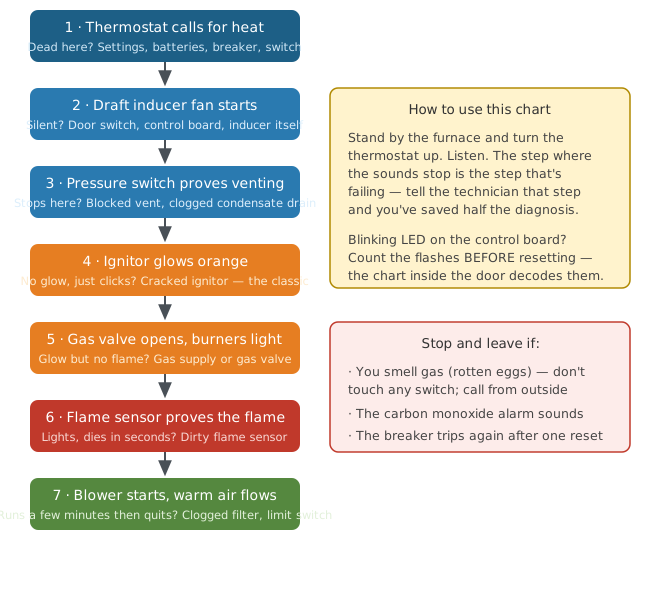
A modern gas furnace doesn't just "turn on." It runs a strict sequence, and every step has to prove itself before the next is allowed:
- The thermostat calls for heat.
- The draft inducer — a small fan — starts, to clear the vent and establish draft.
- A pressure switch confirms the vent is actually moving air.
- The ignitor (a ceramic element) glows orange-hot.
- The gas valve opens and the burners light.
- The flame sensor proves within seconds that a real flame exists.
- After a short warm-up, the blower starts and warm air reaches the rooms.
Here's the diagnostic trick: stand next to the furnace, have someone turn the thermostat up, and listen. The sounds follow the sequence — a hum and whir (inducer), a pause, a glow you may see through the sight glass, a soft whoomp of burners, then the blower. The step where the sounds stop is the step that's failing. "It clicks but never lights" and "it lights but dies in five seconds" are different diseases with different cures, and you can tell them apart from outside the cabinet. The diagram at the top of this guide maps each stop-point to its usual suspect.
Start with the symptom: a 60-second triage
If your symptom already points at one check, start there instead of at the top. Match what you see and hear to a row, and come back to the full list only if that check doesn't solve things.
| What you see and hear | Go to | Likely fix |
|---|---|---|
| Total silence: no hum, no clicks, nothing at all | Checks 1 and 2 | A thermostat setting, the service switch, the breaker, or an unseated blower door. Usually free. |
| Inducer hums, then clicking, but a flame never appears | Check 8, and Check 4 for gas | A cracked ignitor, or the gas shut-off closed. |
| Burners light, then die after 3 to 10 seconds, over and over | Check 7 | A dirty flame sensor that can't prove the flame. |
| Runs a few minutes, shuts off, tries again a while later | Check 3 | A clogged filter overheating the furnace and tripping the high-limit switch. |
| The blower blows, but the air never warms up | Fan setting first, then Check 5 | Fan set to ON instead of AUTO, or a lockout. |
| A red light blinking in a repeating pattern behind the door window | Check 5 | Whatever the code names. Read it before resetting anything. |
| Gurgling sounds, water in or under the unit, won't start | Check 9 | A blocked condensate drain on a high-efficiency model. |
If two rows fit, start with the cheaper fix.
Check 1: The thermostat — the champion of fake breakdowns
This fixes more "broken furnace" calls than everything else on the list combined, and it costs nothing.
- Mode. Is it actually set to Heat? Not Cool, not Off, not a programme that's still in summer mode. In households where more than one person touches the thermostat, this is embarrassingly common.
- Setpoint. The target temperature must be above the current room temperature — set it 3–5 degrees higher for the test. A thermostat set to 66 in a 68-degree room is a furnace working exactly as designed.
- Batteries. If the thermostat runs on batteries, replace them even if the display still lights. Weak batteries often lose the ability to send the heating call before the screen goes fully blank. A completely dark display on a battery model is dead batteries until proven otherwise.
- Schedule. Programmable thermostats have minds of their own: a weekday programme holding the house at 62 while you're home sick will feel exactly like a broken furnace. Override with a temporary hold at a high temperature for the test.
Check 2: The furnace switch and the breaker
Your furnace has two power cut-offs, and either one kills it completely.
The service switch is mounted on or near the furnace and looks — unhelpfully — exactly like a light switch. It exists so technicians can cut power at the unit. It also gets flipped by people looking for a light, by kids, and during other repairs. Make sure it's on.
The breaker is in your electrical panel, labelled Furnace or Air Handler. A tripped breaker sits in the middle position. Reset it once: fully off, then on. If it trips again immediately, stop — a breaker that re-trips is reporting an electrical fault, and repeated resetting is how small faults become fires. That's a technician call (and possibly an electrician).
While you're at the furnace, check the blower door. Many furnaces have an interlock switch behind the access panel: if the panel was removed for a filter change and not seated fully, the switch stays open and the furnace will not run at all — deliberately. Push the panel firmly into place and try again. This one has embarrassed more than a few homeowners in front of a technician they paid $150 to visit.
Check 3: The air filter — the slow-motion shutdown
Pull the filter. If you can't remember when it last looked clean, hold it up to a light: a filter you can't see light through is a filter the furnace can't breathe through.
Here's the mechanism, because it explains a whole family of symptoms. Starved of airflow, the heat exchanger gets too hot. A safety device — the high-limit switch — shuts the burners off before damage is done. The furnace cools, the switch resets, the furnace fires again, overheats again. Runs for a few minutes, shuts off, repeats. That's short cycling, and a clogged filter is its most common cause. Keep it up long enough and many furnaces lock out completely, at which point the filter has graduated from "runs badly" to "won't turn on" — the exact complaint you started with.
Fit a clean filter (note the airflow arrow; it points toward the furnace) and try again. The Department of Energy's guidance is to check the filter monthly during heating season and replace it when it looks dirty — for most homes, every 1–3 months. It is the cheapest maintenance in the entire heating system and prevents the most service calls.
Two filter details that trip people up. First, write your filter's size on the furnace with a marker the day you learn it — sizes like 16×25×1 live on the filter's frame, and every homeowner eventually stands in a shop aisle trying to remember one. Second, resist the urge to buy the highest-rated filter on the shelf. Filters carry a MERV rating for how much they catch; very high ratings also restrict airflow more, and on an older furnace with a modest blower, an over-achieving filter can cause the same limit-switch trips as a dirty one. For most homes, MERV 8–11 is the sweet spot — real filtration without strangling the system.
Check 4: Is the gas actually on?
If the furnace tries to start — inducer runs, ignitor glows — but the burners never light, walk the gas line. There's a shut-off valve on the gas pipe near the furnace; its handle should run parallel to the pipe (parallel = open, perpendicular = closed). Valves get closed during summer appliance work and never reopened. Also glance at any other gas appliance — if the water heater or stove is out too, the problem is upstream: the meter, or the utility. (And if you closed nothing and smell gas, you're back in the safety box at the top of this page.)
Older furnace with a standing pilot? If the pilot light is out, most manufacturers print relighting instructions on a label inside the access panel — follow them exactly. A pilot that lights but won't stay lit after a try or two usually means a failing thermocouple, the small sensor that proves the pilot flame to the gas valve. That one's a technician job; repeated relighting attempts won't fix it.
Check 5: Read the error code before you reset anything
Modern furnaces diagnose themselves and report through a blinking LED on the control board, visible through a small window in the blower door. The blink pattern is a code — three flashes, pause, repeat — and a chart on the inside of the door translates it: ignition lockout, pressure switch stuck open, limit switch open, flame lost, and so on.
Do this before any reset, because resetting clears the code and the furnace's memory of its worst moment. Count the flashes carefully (long and short blinks both count — the chart explains the format), photograph the chart with your phone, and if you end up calling, open with "it's flashing three times, which the chart says is pressure switch." You've just handed the technician a head start, and head starts are billable time you don't pay for.
The blink patterns owners actually see
Every brand prints its own chart, and your door chart always wins. But the same handful of faults generate most codes owners ever meet:
- Ignition failure (often worded as "ignition lockout"). The furnace tried to light, couldn't prove a flame, and gave up. An umbrella code, not a part: it points at the ignitor (Check 8), the flame sensor (Check 7) or the gas supply (Check 4).
- Pressure switch stuck open. The vent couldn't prove it's moving air. Check the outdoor intake and exhaust pipes for blockages first (Check 9): a snowdrift causes this code far more often than a dead switch.
- Pressure switch stuck closed. The switch reports airflow before the inducer even runs. Usually the switch itself or its thin rubber hose; a technician diagnosis.
- High-limit switch open. The furnace overheated and shut down for safety. Treat it as the filter code until proven otherwise: airflow first (Check 3), then call if it repeats with a clean filter.
- Flame rollout, or flame sensed when there should be none. Stop-and-call codes. Don't keep resetting a furnace reporting either; both describe fire or gas somewhere it shouldn't be.
Formats differ by brand. Many furnaces (Goodman's are typical) repeat a single count: flashes, pause, the same flashes again. Carrier and Bryant use two-digit codes instead: short flashes give the first digit, long flashes the second. Three short and three long reads as code 33, a limit fault on their chart; 34 is their ignition-proving fault, 31 a pressure-switch fault.
Tip: film the blinking light for twenty seconds rather than counting while cold and annoyed. The video is what you read at leisure, quote on the phone, and show the technician.
Check 6: The lockout reset — once
If the furnace tried to ignite three times without success, the control board locks it out for a period (often about an hour) as a safety measure. To clear it: turn the service switch off for 30 seconds, then back on. Then watch and listen through one full start attempt, using the sequence from the diagram.
If it fires and keeps running, you're warm — but book a service visit anyway if it happens twice in a season. A furnace that locks out once has told you something is marginal: a sensor near the edge, an ignitor weakening. Lockouts that return immediately mean the cause is still present, and cycling power repeatedly won't cure it.
Check 7: Lights for a few seconds, then dies — the flame sensor
This is probably the single most common genuine repair in the no-heat world. The burners light with a satisfying whoomp — then, 3 to 10 seconds later, shut off. The blower may run a little. Then the whole cycle tries again.
The flame sensor is a thin metal rod sitting in the burner flame. Flame passing over it generates a tiny electrical signal that tells the control board "yes, we have fire, keep the gas on." Over a season or two, the rod coats with oxidation and carbon. The signal fades. The board, unable to prove a flame exists, does the only safe thing: closes the gas valve. From the board's point of view, your furnace has been lighting gas with no flame at all, and it is right to refuse.
The fix is unglamorous: the sensor comes out with one screw, gets polished with fine emery cloth or a scouring pad until the metal is bright, and goes back in. Technicians charge roughly $80–$350 for the visit and the work; the part itself, if it needs replacing rather than cleaning, is under $30. Experienced homeowners do clean their own sensors — power off, one screw, gentle hand — but if the description "rod in the burner compartment" gives you any pause, this is a cheap professional job and a good first service call to build a relationship with a local company.
Check 8: Clicks but never lights — the ignitor
The mirror-image symptom: inducer hums, a pause, a click… another try… clicks again… and eventually silence. No flame ever appears. On a furnace with a hot surface ignitor, this pattern indicts the ignitor itself.
The ignitor is a small ceramic element that glows orange-hot — over 1,000°F — to light the gas directly. Every cycle heats it and cools it, and thermal cycling eventually cracks it, the way a light bulb filament gives up. Lifespan is typically 5–10 years, there's no maintenance that extends it, and when it goes, it goes completely: the furnace will try, click, and fail forever.
Through the sight glass you may be able to see whether the ignitor glows during a start attempt. Glow + no flame points at gas supply (Check 4). No glow + clicking points at the ignitor or the board that powers it. Replacement runs $150–$450 professionally; the part is $30–$80. It's a defined, bounded repair — if a quote for a simple ignitor swap comes back dramatically higher, get a second one.
Check 9: High-efficiency furnace? Check the water
If your furnace vents through plastic PVC pipes instead of a metal flue, it's a condensing (high-efficiency) model, and it produces water as it runs — several gallons a day in cold weather. That water leaves through a condensate drain, and if the drain or its trap clogs with algae and sediment, a safety switch shuts the furnace down to prevent a flood. Symptoms: a furnace that won't start at all, or stops mid-cycle, sometimes with a gurgling sound and water visible in or under the unit.
Look for the clear plastic drain tubing, check for standing water in the drain pan, and clear obvious blockages at accessible fittings. While you're outside, check the intake and exhaust pipes where they exit the house: snow drifts, mulch, leaves and insect nests blocking those pipes will stop a furnace just as dead (the pressure switch in step 3 of the sequence refuses to prove a blocked vent). This is a two-minute check that has ended many service calls before they started.
The nine checks as one procedure, and the line where you stop
New to the house? Three things to locate before you need them: the service switch (on the furnace's side or a nearby joist), the filter slot (blower cabinet base or a hall return grille), and the gas shut-off (on the pipe a few feet from the unit).
Run the checks as gates, in order. Fix what you find at each gate, retry once, and move on only if it's still dead:
- Safety gate. Gas smell or a CO alarm ends the procedure: out of the house, call from outside.
- Call gate. Thermostat on Heat, setpoint above room temperature, batteries fresh (Check 1).
- Power gate. Service switch on, breaker holding, blower door seated (Check 2).
- Air gate. Filter clean enough to see light through (Check 3).
- Fuel gate. Gas valve parallel to the pipe; pilot lit on older units (Check 4).
- Listen gate. Read the error code, reset once, note where the start-up sequence stops (Checks 5 and 6).
- Pattern gate. Lights-then-dies: flame sensor. Clicks-but-never-lights: ignitor (Checks 7 and 8).
- Water and vent gate. High-efficiency unit: condensate drain clear, outdoor pipes unblocked (Check 9).
Here is the stop-and-call line. Everything above it is looking, switching and cleaning. Stop and call when: the code names rollout, a board fault or flame where it shouldn't be; the breaker trips again after one reset; the furnace locks out a second time; you smell gas at the unit itself; or the fix means opening the burner compartment or touching the gas valve, board wiring or heat exchanger. Past that line you're not troubleshooting, you're doing combustion work, and that's what the licence is for.
When you call, have five things ready: the brand and model (rating plate inside the door), its rough age, the error code you counted or filmed, where the start-up sequence stopped, and when the filter was last changed. A caller with those facts gets triaged faster and quoted more accurately.
Related symptom: the blower runs, but the air is cold
A furnace that blows unheated air feels like a different problem, but it shares most of the same causes — and adds one embarrassingly simple one. Check the thermostat's fan setting: if it's set to ON rather than AUTO, the blower runs continuously whether the burners are firing or not, so between heating cycles you're circulating room-temperature air and calling it "cold air from the vents." Flip it to AUTO and see if the air turns warm when the burners run.
If the fan is on AUTO and the air never warms, the blower is running without a fire — which usually means the furnace attempted ignition, failed, and is in a lockout or a limit state (the blower often runs to cool the unit down or clear it out). You're back in the sequence: read the error code, then work Checks 5–8. And if the air starts warm and fades to cool within minutes, that's the limit-switch pattern — Check 3's clogged filter is suspect number one.
Not a gas furnace? Two short detours
Oil furnace with a red reset button. If your oil burner won't start, you'll find a red reset button on the burner control, and pressing it once is the standard homeowner move. Press it once only. Each press pumps more oil into the combustion chamber; if the burner still doesn't fire, that oil is sitting there unburned, and a later successful ignition can light all of it at once — a puffback at best. One press, no flame, call the technician. Also check the obvious: an oil tank gauge reading empty has ended more "breakdowns" than any failed part.
Electric furnace. No flame, no gas, no ignitor — instead, heating elements switched by sequencers, plus the same blower, filter and limit-switch logic as a gas unit. Your checklist shrinks to power (electric furnaces often have two breakers, or breakers on the unit itself), thermostat, filter, and door switch. If some rooms heat and others don't, one element or sequencer in the stack has failed while the rest work — a bounded, diagnosable repair. Beyond the power and filter checks, electric furnaces go to the technician quickly, because the interesting parts all carry serious voltage.
What the repairs cost, honestly
If the checklist didn't save you, here's the landscape you're hiring into (the table at the top has the detail). The diagnostic visit itself runs $75–$200, usually credited toward the repair if you proceed — always ask, before booking, whether it is. The two most common repairs, flame sensor and ignitor, land between roughly $80 and $450 fitted, and both are same-visit fixes if the truck stocks the part, which it usually does. From there the numbers climb: pressure switches a few hundred, control boards $300–$1,200, blower motors $400–$1,500. The same landscape as a table (fitted prices: part, labour and call-out combined):
| Repair | Typical fitted cost | Time on site |
|---|---|---|
| Diagnostic / service call | $75–$200 | 30–60 minutes |
| Flame sensor clean or replace | $80–$350 | Under an hour |
| Hot surface ignitor replacement | $150–$450 | Under an hour |
| Pressure switch replacement | $150–$400 | About an hour |
| Draft inducer motor replacement | $300–$800 | 1–2 hours |
| Control board replacement | $300–$1,200 | 1–2 hours |
| Blower motor replacement | $400–$1,500 | 2–3 hours |
Two reading notes. First, the wide ranges are mostly brand and access: a board for a common furnace sits at the low end, a proprietary board or a variable-speed ECM blower at the high end. Second, a quote well above its row isn't automatically a rip-off (after-hours calls add real money in January), but do ask for it broken into part, labour and call-out, and get a second quote if the job isn't urgent.
The number that should change your thinking is the heat exchanger. At $1,000–$3,000+ — and as a carbon monoxide risk when cracked — it's the one diagnosis where "repair or replace the whole furnace?" becomes a real conversation, especially past the 15-year mark. Any company that gives you that news should show you the crack or the CO readings and put the diagnosis in writing; any company that won't, gets a second opinion from you before it gets your money.
The carbon monoxide paragraph — read this one even if you skim
A furnace that won't start is an inconvenience. The reason this section exists is the furnace that starts but burns wrong. A cracked heat exchanger or a blocked flue can let carbon monoxide — colourless, odourless, and undetectable by any human sense — into the house's air. You cannot smell it, and its early symptoms (headache, dizziness, nausea, a flu that mysteriously lifts when you leave the house and returns when you come home) are designed to be misread.
So, non-negotiables for any house with a fuel-burning furnace: a CO alarm on every level and outside the sleeping areas, tested monthly, replaced at its printed expiry (sensors die in 5–10 years whether or not the test button still beeps). If the alarm sounds, or several people (or pets) feel ill together with the heat running: get everyone outside and call emergency services or the gas utility from outdoors — do not open windows and investigate, do not run around unplugging things. And treat the visual warnings with respect: a lazy yellow burner flame instead of a crisp blue one, soot streaks around the furnace's front, or a flue pipe that's rusted, sagging or disconnected are all "call today" findings, found free during the Check 4 look at the unit. No heating tip in this guide outranks this paragraph.
Repair or replace: the furnace maths
If the diagnosis lands on a real part, the last question is whether the furnace deserves it. The framework mirrors the one in our AC guide, with furnace numbers: a flame sensor, ignitor, pressure switch or thermostat ($150–$500) is a repair on almost any furnace worth having. A blower motor or control board ($400–$1,200) is a repair on a furnace under about twelve years old and a genuine conversation past fifteen. A cracked heat exchanger ends the conversation at any age — it's a replacement-only verdict (and the one finding where a second opinion is worth paying for, because it condemns the whole unit). A gas valve on a twenty-year-old furnace usually joins the replacement side of the ledger too.
Underneath the maths sits the age curve: furnaces are typically rated for 15–20 years, and the repair curve bends sharply upward in the last third — each fix is reasonable alone, and together they're a subscription to a dying machine. If you've paid for two significant repairs in three winters on a furnace past fifteen, price the replacement before authorising the third. The new unit's efficiency (an 80% furnace replaced by a 96% condensing model cuts the gas bill for heating by roughly a sixth) belongs in that comparison too — it's the only repair on the list that pays you back monthly.
The ten-minute version, for next time
Tape this order inside your head — it's the whole guide on an index card:
- Thermostat: Heat mode, setpoint above room temp, fresh batteries.
- Furnace switch on; breaker untripped; blower door seated.
- Filter: if it's grey, it's guilty until proven innocent.
- Gas valve open; pilot lit (older furnaces).
- Error code: count the flashes before resetting.
- Reset once. Listen to the sequence and note where it stops.
- Lights-then-dies = flame sensor. Clicks-no-light = ignitor.
- High-efficiency model? Condensate drain and outdoor vent pipes.
- Still dead? Call — and open with what you observed. "Inducer runs, ignitor glows, burners light for five seconds then quit, code is two flashes" is a sentence that saves real money.
Most furnaces that "won't turn on" are one dirty filter, one dead battery or one tired sensor away from heating your house. Work the list, and the odds are good your repair bill this winter is the price of a filter.
Cost at a glance
| Item | Typical cost | Notes |
|---|---|---|
| HVAC diagnostic / service call | $75–$200 | Usually credited toward the repair if you go ahead; after-hours calls run higher |
| Flame sensor clean or replace | $80–$350 | The most common no-heat repair of all; the part itself is under $30 |
| Hot surface ignitor replacement | $150–$450 | Part alone is $30–$80 — the rest is labour and the service call |
| Control board replacement | $300–$1,200 | Wide range by brand; get the board's diagnosis in writing |
| Blower motor replacement | $400–$1,500 | Standard motors at the low end, variable-speed ECM at the high end |
Frequently asked questions
Why is my furnace completely dead — no sound at all?
Total silence means no power or no call for heat. Work the chain: thermostat display blank or batteries dead; thermostat not actually set to Heat; the furnace's own service switch turned off (it looks like a light switch and gets flipped by mistake); a tripped breaker; or a blower door that isn't seated, which opens an interlock switch and cuts power by design. One of those five explains most 'completely dead' furnaces.
My furnace lights, then shuts off after a few seconds. What's wrong?
That pattern has a name and a usual culprit: the burners light, run for roughly 3–10 seconds, and shut down, over and over. The flame sensor — a metal rod in the flame's path — is coated with oxidation and can't prove to the control board that a flame exists, so the board closes the gas valve for safety. Cleaning or replacing the sensor is the most common no-heat repair technicians make, typically $80–$350 fitted, and the part itself costs under $30.
How do I reset my furnace?
Turn the furnace service switch (or its breaker) off, wait 30 seconds, and turn it back on. That clears most lockouts. Do it once. If the furnace locks out again, the fault that caused the lockout is still there — repeated resets don't fix dirty sensors, cracked ignitors or blocked drains, and on some faults they add wear. Before you reset, check the control board's blinking LED and count the flashes: that error code is the furnace telling you what's wrong, and resetting erases it.
What does the blinking light on my furnace mean?
It's an error code. The control board blinks in a pattern — say, three flashes, a pause, three flashes — and a chart printed inside the blower door (or in the manual) translates the pattern: ignition failure, pressure switch fault, limit switch open, flame loss and so on. Count carefully, photograph the chart, and tell the technician the code when you call. It can cut the diagnostic time — and sometimes the bill — significantly.
Can a dirty filter really stop a furnace from running?
Yes, and it's one of the most common causes. A clogged filter starves the furnace of airflow, the heat exchanger overheats, and a safety device called the high-limit switch shuts the burners down. The furnace cools, tries again, overheats again — and after repeated trips many furnaces lock out entirely. If your furnace starts, runs a few minutes and quits, pull the filter before you pay for a diagnosis. If it's grey and matted, you've likely found your problem for the price of a new filter.
How long do furnace ignitors last?
Hot surface ignitors typically last somewhere in the 5–10 year range. They glow white-hot on every heating cycle and cool again afterwards, and that thermal cycling eventually cracks the ceramic element. There's no maintenance that extends their life; they're a wear part, like brake pads. When one fails, the furnace's inducer runs, you hear clicking, but the burners never light — the signature pattern.
Is it worth repairing an old furnace, or should I replace it?
The common rule of thumb: if the furnace is over 15 years old and the repair costs more than about a third of a replacement, lean toward replacing — especially if the failed part is the heat exchanger or blower motor. For a younger furnace, or any repair under a few hundred dollars (sensors, ignitors, switches), repair almost always wins. A cracked heat exchanger is the exception at any age: it's a carbon monoxide risk, and most technicians will recommend replacement rather than repair.
Checked November 16, 2026. This guide is general information, not a substitute for a licensed professional.
Related guides
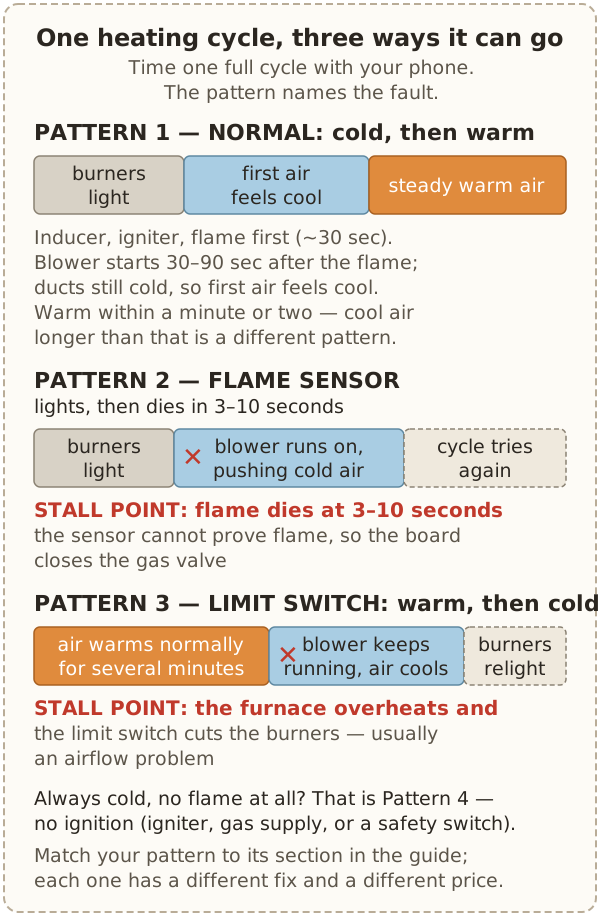
Furnace Blowing Cold Air? Read the Pattern First — Cold-Then-Warm, Always Cold, or Warm-Then-Cold
A furnace that runs but blows cold is not one problem — it is four, and the timing pattern tells you which. Cold-then-warm is normal, lights-then-dies in seconds is the flame sensor, warm-then-cold is the limit switch, always cold is no ignition. Checks, fixes and US repair costs for each.
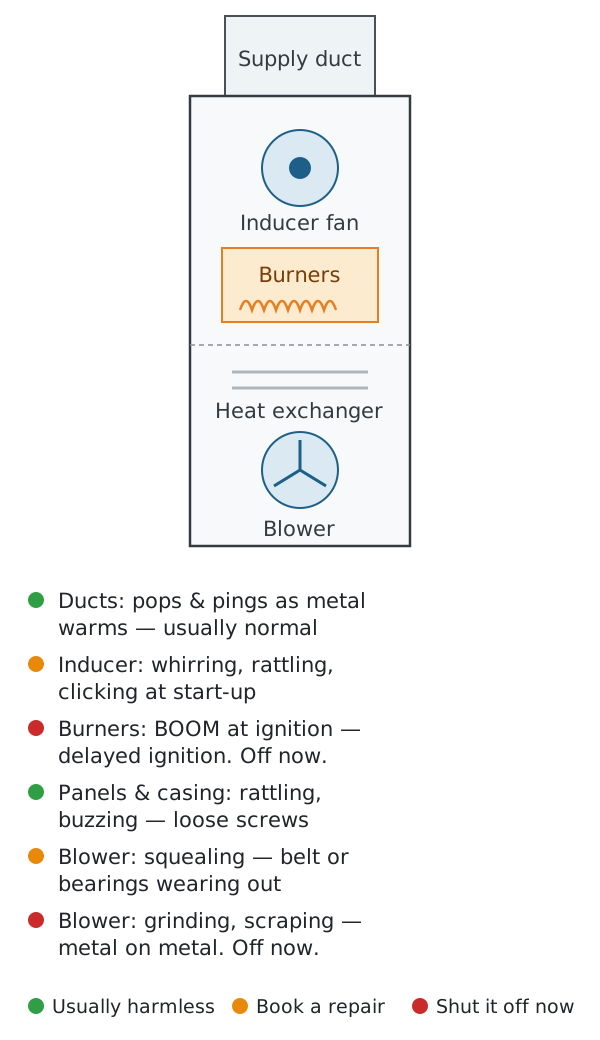
Furnace Making Noise? What Each Sound Means — and the Three That Mean Shut It Off Now
A bang, squeal, rattle or hum is your furnace telling you where it hurts. Decode each sound by where it comes from, learn the three that mean switch off immediately, and see what each fix costs.
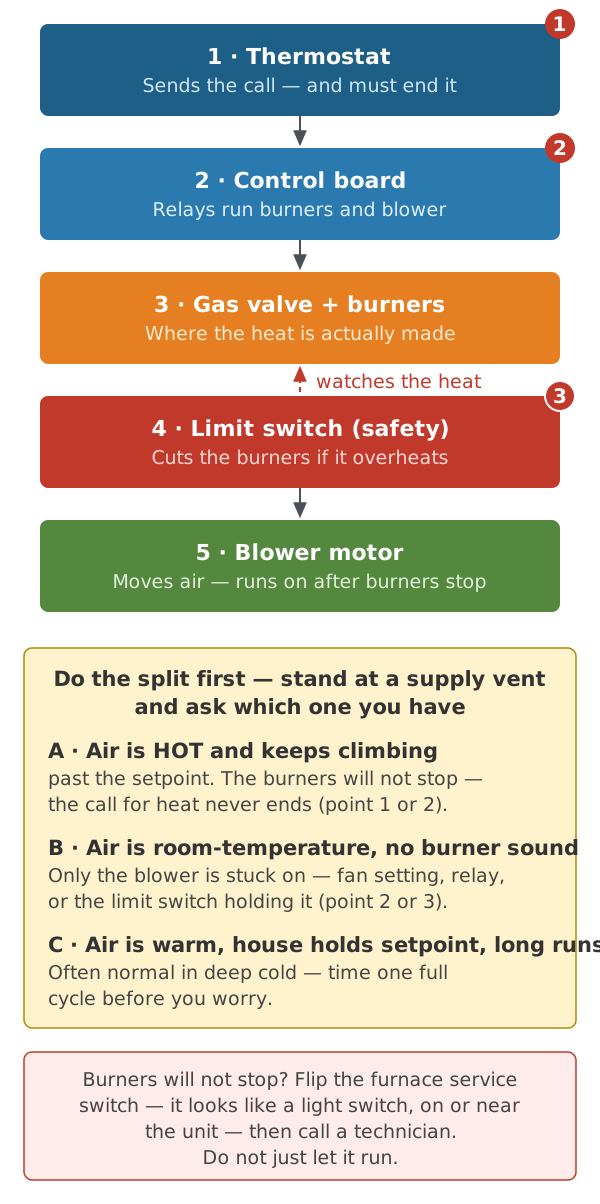
Furnace Won't Shut Off? Split It First: Burners, Blower, or Just Long Cycles
A furnace that never stops is three different problems wearing one name. Do the vent test to split them — burners stuck on, blower stuck on, or normal long cycles in deep cold — then work the right checks.