 Keep
Furnace Blowing Cold Air? Read the Pattern First — Cold-Then-Warm, Always Cold, or Warm-Then-Cold
 Daniel Mercer · Editor & Researcher·
Published November 16, 2026·
Updated November 16, 2026
The vents are blowing. You can stand under one and feel the air moving, hear the furnace running downstairs — and the house is getting colder, not warmer. For a first-time owner this is one of the most frightening furnace symptoms, because it sounds expensive: the machine runs, so it cannot be a fuse or a dead thermostat, yet it produces no heat. Surely something major has failed.
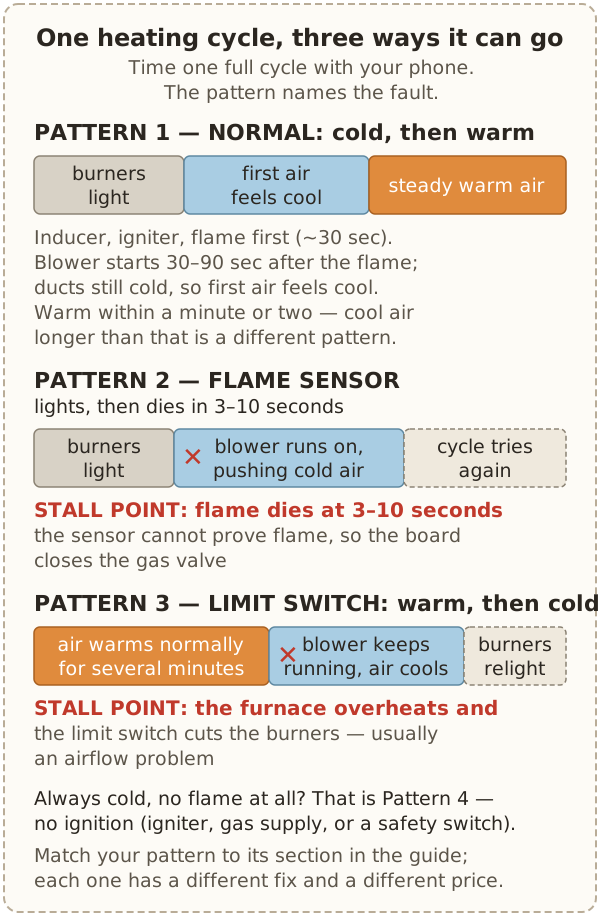
Usually it has not. A furnace that runs but blows cold is rarely one problem. It is four different problems wearing the same symptom, and they separate cleanly if you do one thing before touching anything: time a full cycle and watch the pattern. Does the air start cold and turn warm? Is it cold from the first second to the last? Does it heat properly for a few minutes and then fade? Or do the burners light, flare for a few seconds and die? Each pattern has a different cause, a different fix and a different price — and one of them is not a fault at all.
Two quick detours before we start. If your furnace does nothing — no blower, no sounds, no attempt — that is a different failure, covered in our guide "Furnace Won't Turn On? 9 Checks Before You Call a Technician." And if the box in your basement is actually a heat pump rather than a furnace, cold-feeling air in heat mode has its own normal explanations; start with "Heat Pump Blowing Cold Air in Heat Mode? What's Normal, What's a Fault." Everyone else: set a timer on your phone and read on.
Check zero: the thermostat, before anything else
The single most common cause of "my furnace blows cold air" is not inside the furnace. It is a thermostat setting — the fan switch set to ON instead of AUTO.
On AUTO, the blower runs only while the furnace is making heat. On ON, the blower runs constantly, around the clock, whether the burners are lit or not. Between heating cycles it pushes ordinary room air through ducts that run through your cold attic, crawlspace or garage wall, and that air arrives at the vent noticeably cool. Moving air also feels colder on skin than still air at the same temperature. Put together, a house with the fan on ON feels exactly like a furnace that has stopped heating — while the furnace is, in fact, working perfectly.
Check the rest of the thermostat while you are standing there. The mode must say HEAT, not COOL and not FAN ONLY. The setpoint needs to be a few degrees above the current room temperature to force a complete cycle you can observe — if it is set below room temperature, the furnace is simply obeying you. If your thermostat uses batteries, replace them: a weak battery can drop the heating call mid-cycle in ways that look exactly like a furnace fault. And if you have a programmable thermostat, check the schedule before you condemn the equipment — a setback period you did not program, inherited from the previous owner, has sent more than one new homeowner shopping for a furnace repair they did not need.
If the fan was on ON, switch it to AUTO, raise the setpoint, and give the house one full cycle. For a large share of readers, this guide just ended.
Is the burner actually firing? Learn the start-up sequence
Every diagnosis in this guide hangs on one question: during a heating cycle, does a flame ever exist? You answer it by standing next to the furnace with the setpoint raised and listening to a healthy start-up, because a gas furnace starts in a strict order, and the step where the sequence stalls is the fault.
- The inducer starts. Within seconds of the thermostat calling for heat, a small fan inside the furnace begins to hum. Its job is to pull combustion air in and push exhaust gases up the flue, proving the vent path is clear before any gas flows.
- The pressure switch closes. A sensor confirms the inducer is moving air properly. On a high-efficiency furnace this is also where a blocked condensate drain can stop the show, as you will see below.
- The igniter glows. Through the small round sight glass on the burner door (many furnaces have one; do not remove doors with the power on to look) you may see an orange glow build over 10–20 seconds. That is the hot-surface igniter heating up. Spark-ignition models click instead.
- The burners light. The gas valve clicks, and the burners catch with a soft whoosh. Through the sight glass the flame should be steady and mostly blue. This is the moment the furnace starts making heat.
- The blower waits, then starts. The main blower deliberately stays off for roughly 30–90 seconds while the heat exchanger warms, so the first air pushed into your ducts is warm rather than a cold blast. Then the blower starts and runs until the thermostat is satisfied.
That whole sequence takes about a minute. Now compare what your furnace does against the four patterns below. You only need your phone's stopwatch and one full cycle of patience.
The four patterns, and what each one means
Pattern 1 — Cold, then warm: normal. The air from the vents feels cool for the first minute or two after the blower starts, then warms and stays warm until the cycle ends. This is a healthy furnace. Two things create the cool start: the air that sat in your ducts between cycles is at attic or crawlspace temperature and has to be pushed out first, and the blower delay, while helpful, is timed for the heat exchanger, not for the far end of a long duct run. If the air is fully warm within about two minutes of the blower starting, you do not have a furnace problem. If the house also cools between cycles, revisit Check Zero — that is the fan-ON signature.
Pattern 2 — Lights, then dies in 3–10 seconds: flame sensor. You hear the burners catch — the whoosh, maybe a glimpse of flame — and then, almost immediately, they shut off. The blower keeps running or starts anyway, pushing cold air. The furnace retries, sometimes several times, then gives up until the next call. A flame sensor that cannot prove flame is the cause so often that technicians test it first on this pattern. Full explanation below.
Pattern 3 — Warm, then cold: limit switch. The furnace starts correctly and heats well for several minutes — long enough for you to relax — then the air from the vents fades to cool while the blower keeps running. After a pause, the burners relight and the pattern repeats. The furnace is overheating and its high-limit switch is cutting the burners to protect the heat exchanger, leaving the blower to move air that is no longer being heated. This is an airflow problem until proven otherwise.
Pattern 4 — Always cold, no flame at all: no ignition. The inducer hums, the blower may run, but the burners never light — no whoosh, no glow that leads anywhere, no heat at any point. Something in the ignition chain has failed, or the furnace has no fuel to light, or a safety switch has locked the sequence before the gas valve. This pattern has the longest cause list, and it is where the fuel checks below earn their place.
The causes, in the order your pattern points to them
The flame sensor: a dirty rod that cries wolf
The flame sensor is a thin metal rod mounted in the path of the burner flame, wired back to the control board. Once the burners light, the flame itself carries a tiny electrical current to that rod — micro-amps, but enough. That current is the board's proof that flame exists and it is safe to keep the gas valve open. No proof within a few seconds, and the board closes the valve. It is a well-designed safety system with one weakness: the rod slowly coats with carbon and oxidation from years of sitting in a flame, and a coated rod cannot pass the current even though the flame is right there. The furnace lights, the board sees nothing, the gas shuts off at the 3–10 second mark, and the blower — which does not know any of this — delivers cold air to your vents.
This is why Pattern 2 is the best news on this page: the fix is cleaning a rod, not replacing a furnace. It is also why the pattern is so consistent. A sensor does not fail intermittently at random intervals; it fails at the same few-seconds mark, every cycle, which is exactly the rhythm to listen for.
The limit switch: your furnace is overheating, and airflow is why
A furnace is designed to move a specific volume of air across its heat exchanger. When that airflow falls — a clogged filter, return vents blocked by furniture or rugs, too many supply registers closed, a weakening blower — the exchanger gets hotter than it should. The high-limit switch watches its temperature and, past a set point, cuts the burners off. The blower keeps running to cool the exchanger down, which is why the vents blow cool air mid-cycle. Once temperatures fall, the burners relight, overheat again, and trip again: Pattern 3, repeating all day.
Two consequences follow. First, the limit switch is the messenger, not the disease — replacing the switch without restoring airflow produces a new switch that trips the same way, and repeated overheating is genuinely hard on a heat exchanger, the most expensive part of the furnace. Second, a switch that has tripped hundreds of times can itself wear out and start tripping early or fail outright, at which point it does need replacing alongside the airflow fix. Start with the filter: it is the cause often enough that no technician will look further until it is ruled out. Our guide "How Often to Change Your HVAC Filter (It Depends on the Filter You Have)" covers how fast each filter type loads up, because a filter that looks merely dusty can already be restricting flow.
No ignition: the igniter, the safeties, and the fuel
Pattern 4 breaks into three sub-questions. Did the igniter work? On most furnaces built in the last three decades, ignition is a hot-surface igniter — a small ceramic element that glows orange-hot. Ceramic cracks with age and thermal cycles, and a cracked igniter is the most common single cause of a furnace that runs but never lights. Spark-ignition models fail at the electrode or the spark module instead. Either way: no glow or no spark, no flame, cold air.
Did a safety stop the sequence? The pressure switch must prove the vent is clear before ignition is allowed, so a blocked flue, a failed inducer or a cracked vacuum hose all present as Pattern 4. High-efficiency (condensing) furnaces add a trap most owners have never heard of: they produce liquid condensate as they run, and if the condensate drain or trap clogs, a safety switch shuts the burners down — the furnace was protecting your floor from a water leak, and the symptom you got was cold air. A full drain pan under an attic unit trips a similar float switch.
Is there fuel? A manual gas valve at the furnace can be left off after other work (the handle should sit parallel to the pipe). Beyond the house, supply interruptions happen: a meter issue, utility work on the street. And that brings up the split the cause lists usually skip.
The fuel-type split: propane, oil and electric traps
Propane furnaces behave exactly like natural-gas ones, with one addition: the tank. An empty or near-empty propane tank produces a furnace that tries, fails to light, and blows cold — and new owners who have never lived with delivered fuel routinely miss that the gauge on the tank outside is the first thing to check. In very cold weather a nearly empty tank can also fail to vaporise fuel fast enough at peak draw. Check the gauge before you check anything mechanical.
Oil furnaces have the famous red reset button on the burner control, and one rule that matters: press it once, only once. Each press pumps more oil into the combustion chamber; pressing it repeatedly loads the chamber with unburned oil that can ignite all at once when the burner finally fires. If one press does not start it, the tank gauge is the next check (an oil tank run dry also needs the line bled by a technician), and after that it is a service call, not a second press.
Electric furnaces have no flame at all: heating elements staged by a sequencer do the work. When one element or one stage of the sequencer fails, the furnace still blows — but the air is lukewarm rather than hot, and the house slowly loses ground on cold days. Owners describe it as "blowing cold," and the pattern test still helps: air that is consistently tepid rather than cycling hot-and-cold is the electric signature, and the fix is a pro job on the elements or sequencer.
Duct problems: when only part of the house is cold
One more pattern hides inside all four: the furnace heats, most vents blow warm, but one room or one end of the house gets cool air. That is not a furnace fault at all — it is a delivery fault. A duct run in the attic or crawlspace has disconnected at a joint, been crushed, or had its damper closed, and the air arriving at that register has either leaked out along the way or travelled so slowly through a cold space that it gave up its heat. The test is simple comparison: hold your hand (or a cheap thermometer) at each register during a heating cycle. Uniformly warm except one zone means ducts. Uniformly cold everywhere means go back to the patterns above.
The identity check: is it actually a heat pump?
One cause of "cold air" is not a fault in any equipment — it is a mistaken identity. Many first-time owners inherit a heat pump and reasonably call it a furnace, but a heat pump in heating mode delivers supply air at roughly 85–95°F: genuinely warm, yet below skin temperature, so the air at the vent feels cool to a hand even while it is heating the house perfectly well. The pattern test exposes it: the air temperature never cycles, never fades and never dies — it is simply, steadily, less hot than a gas furnace's blast. A heat pump also runs a defrost cycle in cold weather, during which it briefly blows cool air indoors while the outdoor unit steams and melts its frost; a few minutes of that, a few times a day in a cold snap, is normal operation, not a breakdown.
The giveaways are outside and on the thermostat: a heat pump has an outdoor unit that runs in winter (a furnace's air-conditioning condenser does not), and the thermostat usually offers an AUX or EMERGENCY HEAT setting. If that describes your house, the furnace patterns in this guide do not apply — start instead with "Heat Pump Blowing Cold Air in Heat Mode? What's Normal, What's a Fault," and if your electric bills have jumped while the system leans on its backup heat, "AUX Heat Keeps Coming On? Why Your Electric Bill Just Spiked" covers that failure in full.
The diagnosis sequence, on one page
Everything above compresses into three observations, taken in order during a single cycle:
- Fan setting. Thermostat fan on AUTO, mode on HEAT, setpoint raised. If the fan was on ON and the house now heats normally, you are done.
- Does a flame appear? Listen for the whoosh and watch for the glow through the sight glass. No flame at all means ignition, safeties or fuel — Pattern 4.
- How long does the heat last? Flame dies within 3–10 seconds: flame sensor. Heat runs for minutes, then fades while the blower continues: limit switch and airflow. Heat never fades and only the start is cool: normal.
Write down which one you saw. It decides which of the fixes below applies, and if you end up calling a technician, it is the most useful sentence you can give them. Resist the urge to skip ahead: owners who start by replacing parts at random routinely buy an igniter for a flame-sensor fault, or a thermostat for a fan setting, and learn the pattern method afterwards anyway — at retail price.
The DIY stage: what you can fix yourself, in full
Work in this order — it follows the sequence above, cheapest and likeliest first.
Step 1 — Correct the thermostat and re-test. Fan to AUTO, mode to HEAT, setpoint four or five degrees above room temperature. Run one full cycle and time it. A surprising number of cold-air calls end here, and re-testing after each step below is what tells you which step fixed it.
Step 2 — Deal with the filter and the vents. Pull the filter and hold it up to a light. If you cannot see light through it, or it is grey and matted, replace it now — do not shake it out and put it back; a loaded filter does not recover. Then walk the house: every return grille uncovered, and supply registers open. Closing registers to "push" air elsewhere unbalances the system and feeds exactly the overheating that trips limit switches. If your pattern was warm-then-cold, run a full cycle on the new filter before going any further.
Step 3 — Clean the flame sensor (Pattern 2 only). This is the one hands-on repair in this guide, and it is a recognised owner job — with firm safety rules. Turn the furnace off at its power switch and at the breaker, and let it cool completely. The sensor is a slim metal rod, usually held by a single screw, mounted in front of one of the burners with a single wire running from it. Remove the screw, slide the rod out, and polish the rod gently with a fine abrasive pad or fine sandpaper until the metal is bright — you are removing an invisible insulating film, not grinding the part down. Handle it by its ceramic base, reseat it, replace the screw, restore power, and test a cycle. Do not touch the neighbouring igniter if you can see it: the ceramic is brittle and skin oils shorten its life. If the pattern survives a clean sensor, the sensor itself or its wiring has failed, and that is a replacement.
Step 4 — Check the fuel you can see. Gas valve handle at the furnace parallel to the pipe means open. Propane: read the tank gauge; under about 20 percent in cold weather, call your supplier before you call a furnace company. Oil: check the tank gauge, and if the burner locked out, one press of the reset — once — with the rule from the fuel section above. Electric: check the furnace's breaker and any fused disconnect; a half-tripped breaker can leave the blower powered and the elements dead, which is precisely a runs-but-blows-cold furnace.
Step 5 — Look at the condensate line (high-efficiency furnaces). If your furnace has white PVC venting and a small drain line or pump, check that the line is not kinked, the trap is not visibly clogged, and the pump reservoir is not full and stagnant. Clearing an accessible trap and confirming the pump runs are owner-level tasks; a furnace that starts heating again afterwards has told you its own diagnosis.
When to stop. Stop immediately for a smell of gas — do not touch switches, leave, and call the utility from outside. Stop if you find a cracked heat exchanger suspicion (soot, a flame that wavers oddly when the blower starts), standing water inside the cabinet, or anything that requires opening the gas piping. Those are not caution for its own sake; they are the boundary of what this guide covers.
The pro stage: what a technician does that you cannot
A good technician follows the same patterns, but with instruments. The flame sensor gets a micro-amp reading that proves whether it is passing signal or not, rather than a guess. The igniter is tested for resistance and hairline cracks invisible from the doorway. A limit switch is checked for continuity and trip temperature, and — the part that separates a real repair from a parts swap — the technician measures the furnace's temperature rise and static pressure to find why it overheated. Gas valves and control boards are diagnosed with a meter at the terminals, and the board's own error codes, flashed through the sight glass, narrow the sequence stall to a component.
The common jobs, once diagnosed, are mostly short: a flame sensor or igniter swap is typically 30–60 minutes, a limit switch similar, a gas valve or control board one to two hours including safety checks and a full test cycle. Duct repairs vary with access — rejoining a disconnected run in an open crawlspace is quick work; the same run above a finished ceiling is not.
A quote for any of this should include four things, and you should ask for whichever is missing: the diagnostic fee stated separately, and whether it is credited toward the repair; the part and labour itemised, not a single lump sum; the warranty on the part (aftermarket sensors often carry a year; control boards vary by brand); and, for any limit-switch job, what caused the overheating and what in the quote fixes it. A quote to replace a limit switch with no mention of airflow is a quote for doing the job twice.
What the fix costs
The table above lays out the ranges; the shape of the bill is worth understanding. Cold-air faults are concentrated at the cheap end of furnace repairs, because the parts that cause them — a sensor rod, an igniter, a filter — are small. Most calls land between $80 and $400 all-in. The two exceptions sit at the ends of the pattern list: a gas valve or control board ($200–$700) behind a stubborn no-ignition fault, and duct repair, which is priced by access rather than by parts. Against all of it, weigh the diagnostic fee — roughly $75–$150, commonly credited if you proceed — and the after-hours premium: emergency and weekend calls can multiply labour by one and a half to three times, which is a practical reason to run this guide's half-hour of checks before deciding the call cannot wait until morning. It can also be a reason not to wait, as the next section explains.
DIY or pro: the honest split
Do it yourself, confidently: the thermostat correction, the filter, opening returns and registers, the fuel-gauge checks, and the flame-sensor cleaning — that set covers the majority of cold-air furnaces, and none of it touches the gas supply. Call a pro for: anything involving the gas valve or gas piping; the control board; a limit switch (because the cause, not the switch, is the job); oil-burner work beyond the single reset press; electric elements and sequencers; and any fault that survives the DIY stage unchanged. The pattern you timed is your contribution to the pro job — hand it over, and the paid diagnosis starts halfway done.
How urgent is it, really?
Cold air in mild weather is an inconvenience you can work through methodically. Cold air in a freeze is a different category. A house that cannot hold temperature in sub-freezing weather puts its plumbing at risk: pipes in exterior walls and unheated spaces can freeze and split within hours in a hard cold snap, and a split pipe discovered at thaw is a flood, not a repair. If your checks do not restore heat and the forecast is below freezing, treat it as a same-day service call, keep cabinet doors under sinks open, let a vulnerable faucet drip, and know where your main water shutoff is before you need it. Our guide "Frozen Pipes? Thaw Them Safely — and Catch the Split Before It Floods the House" covers the protection and the thaw in full. One more standing rule: a malfunctioning furnace of any pattern deserves a working carbon monoxide alarm in the house — not because cold air signals CO, but because a furnace under repair is a furnace you should be monitoring properly.
The bottom line
Do not guess at a furnace that blows cold, and do not let anyone else guess at it either. Set the fan to AUTO, then time one cycle: cool-then-warm is normal, lights-then-dies in seconds is the flame sensor, warm-then-cold is overheating and airflow, and always-cold is ignition, safeties or fuel. Half of those outcomes are a setting, a filter or a cleaned sensor rod away from fixed — and the other half arrive at the technician's door with the diagnosis already half done, which is the cheapest way any repair ever starts.
Cost at a glance
| Item | Typical cost | Notes |
|---|---|---|
| Thermostat fan setting corrected (ON changed to AUTO) | $0 | The most common cause of all. With the fan set to ON, the blower pushes unheated air between heating cycles and the house feels like the furnace is broken |
| Replacement air filter, 1-inch pleated | $10–$30 | A clogged filter is the usual trigger behind limit-switch trips. Buy the size printed on the old filter's frame; a deep media filter costs more but lasts 6–12 months |
| Flame sensor cleaned or replaced (pro visit) | $80–$250 | Cleaning is often all it needs and is a fair DIY job; the part itself is only $10–$25, so most of this range is the diagnostic visit it rides on |
| Hot-surface igniter or limit switch replaced (pro) | $150–$400 | The igniter is the most common no-ignition failure and usually lands mid-range; a limit switch part is cheap ($100–$300 fitted) but the airflow cause has to be fixed with it |
| Gas valve or control board replaced (pro) | $200–$700 | The big-ticket end of this symptom. Get the part number and the part's warranty in writing — board prices vary widely by brand |
Frequently asked questions
Is it normal for a furnace to blow cold air at first?
Yes — briefly. The blower is deliberately delayed 30–90 seconds after the burners light so the heat exchanger warms first, and the air already sitting in cold ducts has to be pushed out before warm air arrives. A minute or two of cool air at the start of a cycle is a healthy furnace. What is not normal: air that never warms, air that warms and then goes cold mid-cycle, or cool air blowing between cycles — that last one is usually the thermostat fan set to ON.
Why do the burners light, then go out after a few seconds?
That 3–10 second pattern is the flame sensor's signature. The burners light, but the sensor — a metal rod sitting in the flame — is coated in carbon and cannot prove to the control board that flame exists. The board does the safe thing and closes the gas valve. The blower, which had already started, keeps running and pushes cold air. Cleaning the sensor rod with a fine abrasive pad restores the signal in most cases; it is one of the cheapest furnace fixes there is.
Can a dirty filter make my furnace blow cold air?
Yes, by an indirect route. A clogged filter starves airflow, the heat exchanger overheats, and the high-limit switch shuts the burners off to protect it — while the blower keeps running to cool things down. From the vent, that feels like a furnace that heats for a few minutes and then blows cold, over and over. The filter is the first thing to check on that pattern, and blocked or closed return vents cause the same trip. If the pattern continues on a clean filter with returns open, the limit switch itself or the blower needs a technician.
Should the thermostat fan be set to ON or AUTO?
AUTO, for heating. On AUTO the blower runs only when the furnace is producing heat. On ON the blower runs constantly — including all the time between heating cycles, when it pushes room-temperature air through cold ducts. Moving air also feels cooler on skin than still air, so a house on fan-ON can feel like the furnace blows cold even though it heats normally. ON has legitimate uses for air circulation and filtration in summer; in heating season it is the first thing to check when the complaint is cold air.
Why does my furnace blow cold air between heating cycles?
Almost always the fan setting. With the thermostat fan on ON, the blower never stops, so between burner cycles it circulates unheated air — and that air passes through ducts in cold attics, crawlspaces or exterior walls, arriving cooler than the room. Switch to AUTO and the 'between cycles' air stops entirely. If the blower runs on for a minute or two after the burners stop and then shuts off, that is the normal blower off-delay finishing the cycle, not a fault.
What should I check before calling for furnace repair?
Four things, in this order. One: the thermostat — mode on HEAT, fan on AUTO, setpoint a few degrees above the room temperature, fresh batteries. Two: the filter — pull it and hold it to the light; grey and matted means replace it now. Three: time one full cycle and note the pattern — no flame at all, flame dying in seconds, or heat that fades after minutes. Four: the fuel — gas valve handle parallel to the pipe, propane tank gauge above empty, oil tank not run dry. Tell the technician the pattern when you call; it can cut the diagnostic time you are billed for.
How much does it cost to fix a furnace that is blowing cold air?
Anywhere from nothing to about $700, and the pattern predicts the bill. A thermostat setting is free and a filter is $10–$30. A flame-sensor cleaning or replacement runs $80–$250, an igniter $150–$400, a limit switch $100–$300, and a gas valve or control board $200–$700. On top of the repair itself, expect a diagnostic fee of roughly $75–$150, which many companies credit toward the repair if you go ahead. Most cold-air calls land in the $80–$400 band.
Checked November 16, 2026. This guide is general information, not a substitute for a licensed professional.
Related guides
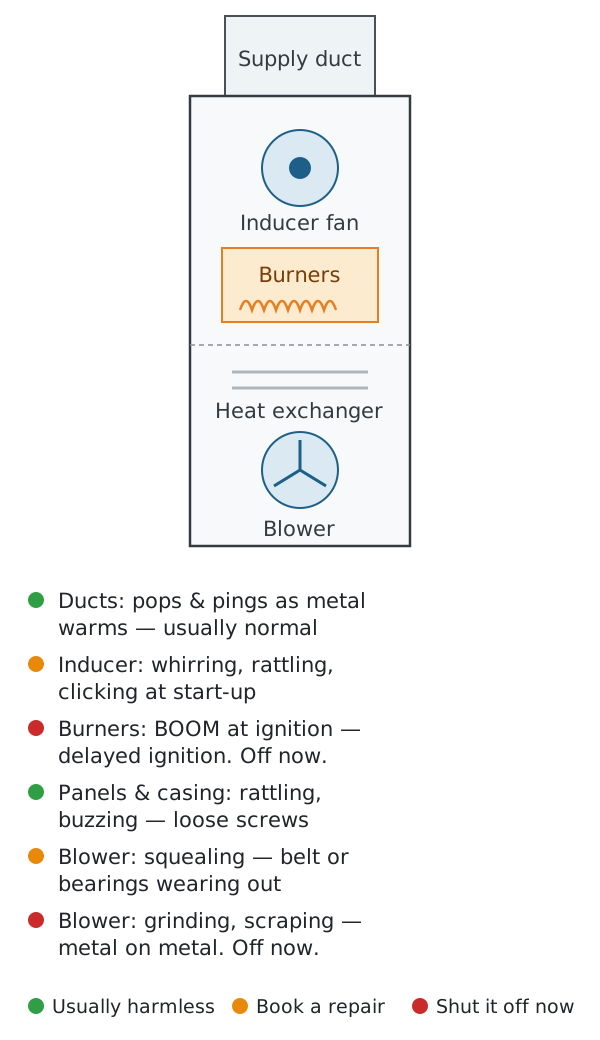
Furnace Making Noise? What Each Sound Means — and the Three That Mean Shut It Off Now
A bang, squeal, rattle or hum is your furnace telling you where it hurts. Decode each sound by where it comes from, learn the three that mean switch off immediately, and see what each fix costs.
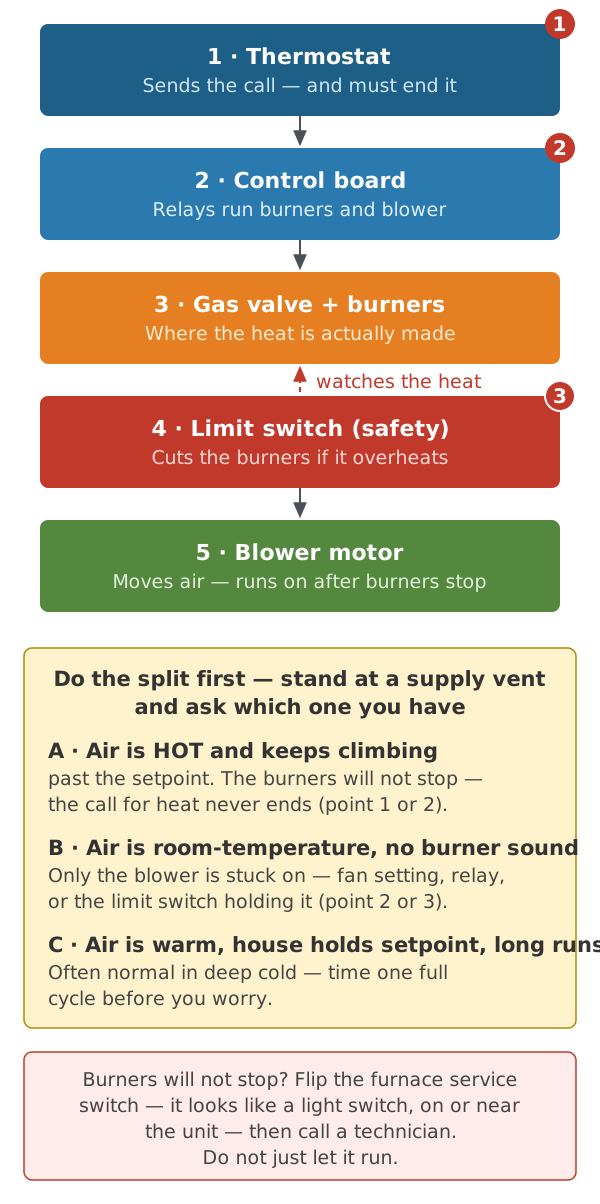
Furnace Won't Shut Off? Split It First: Burners, Blower, or Just Long Cycles
A furnace that never stops is three different problems wearing one name. Do the vent test to split them — burners stuck on, blower stuck on, or normal long cycles in deep cold — then work the right checks.
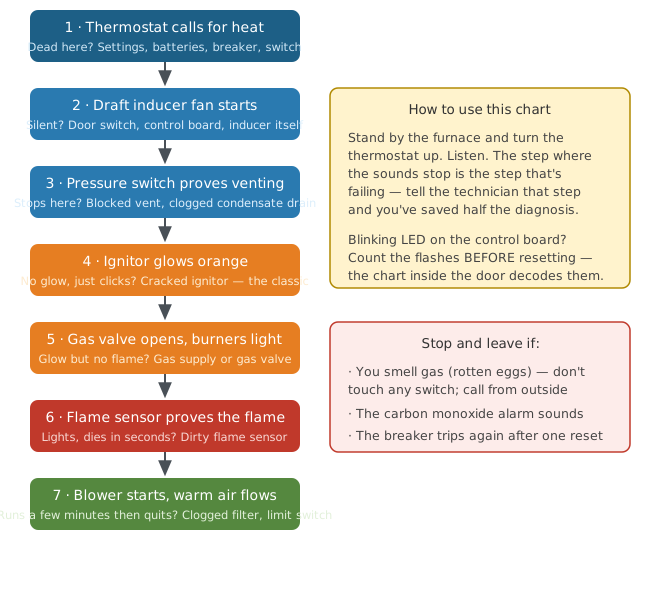
Furnace Won't Turn On? 9 Checks Before You Call a Technician
No heat? Work through the same checks a technician starts with — thermostat, switch, breaker, filter, error codes — and learn the start-up sequence so you can hear exactly where your furnace stops.