 Keep
Furnace Won't Shut Off? Split It First: Burners, Blower, or Just Long Cycles
 Daniel Mercer · Editor & Researcher·
Published November 16, 2026·
Updated November 16, 2026
It starts as a background awareness. The furnace kicked on this morning, and at some point you realise you have not heard it stop. Not once. The vents are still breathing warm air at lunch, the house is a degree or two past where you set it, and by evening the blower has been running so long that the silence when it finally cuts out — if it does — feels louder than the noise.
A furnace that won't shut off frightens people in a particular way, because it feels like a machine that has escaped its controls. Sometimes it has. But "it never stops" is not one problem. It is three different problems wearing the same name, with three different price tags — one of them is free to fix, one of them is a genuine call-a-technician fault, and one of them is not a fault at all but a furnace doing exactly what it was sized to do on a cold day.
So before you touch a single setting, do the split. It takes one minute, it costs nothing, and every check after it depends on getting it right.
Stop it now if the burners won't stop
One branch of this problem does not wait. If the air from the vents is hot, the house is climbing past the thermostat setting, and the burners show no sign of cycling off, the furnace is relying entirely on its limit switch — a safety device — to keep it from overheating. That is not a state to sleep on.
Stop the unit at its service switch. It looks like an ordinary light switch, mounted on the side of the furnace or on a nearby wall or joist, sometimes with a red cover plate. Flip it off and the whole furnace loses power: burners, blower, everything. If you cannot find it, the furnace's breaker in your electrical panel does the same job. Then call a technician and leave the furnace off until it has been seen.
Two things not to do. Do not close the gas valve as a routine stop — that is for gas emergencies, not control faults. And do not restart the furnace "to see if it does it again" and then leave the house. A control fault that welded itself shut once will do it again.
Everything else in this guide — the blower-only branch and the long-cycle branch — can be worked through calmly, in order, with the furnace running.
The split: three problems, one vent test
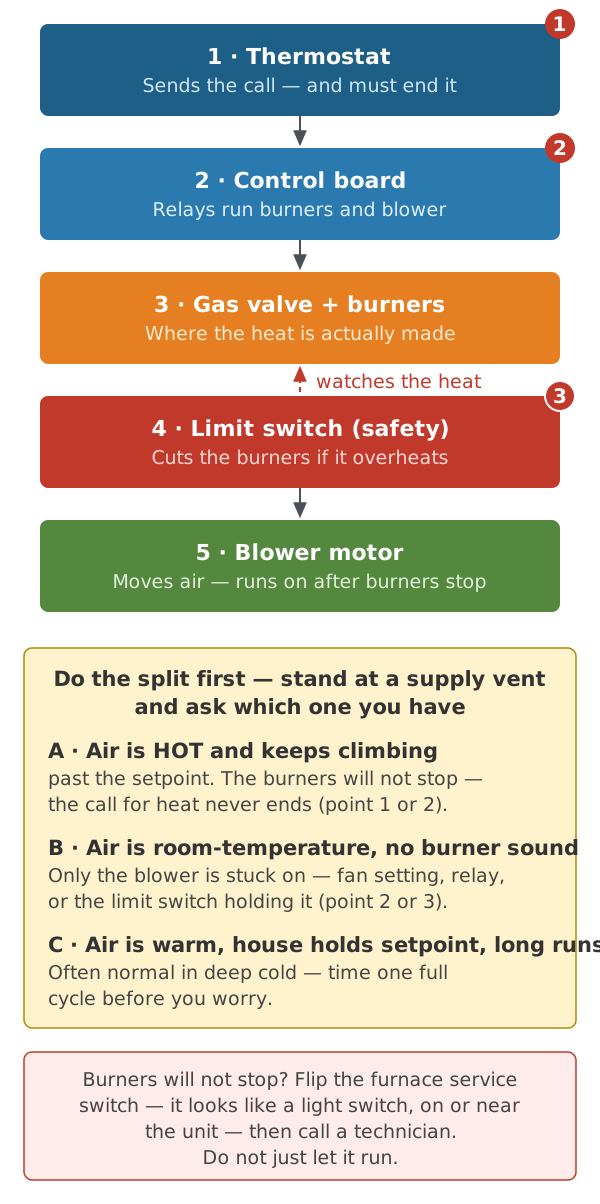
Stand at a supply vent — the ones that blow — while the furnace is doing its never-ending run, and answer three questions. Is the air hot, warm, or room temperature? Can you hear the burners (a low roar or rumble from the furnace, distinct from the whoosh of moving air)? And what is the house temperature doing compared with the thermostat setting?
| What the vent tells you | Branch | What it means |
|---|---|---|
| Air is hot, house is climbing past the setpoint, burners audible for long stretches | A — Burners won't stop | The call for heat never ends, or the board never obeys the end of it. Thermostat or control fault. |
| Air is room temperature, no burner sound, house at or below setpoint | B — Blower won't stop | The burners stopped correctly. Only the fan is stuck on: a setting, a relay, or a safety doing its job. |
| Air is warm, house holds the setpoint, runs are long but do end | C — Long cycles | Usually a furnace keeping up in deep cold, or a two-stage unit running on low fire. Often normal. |
The diagram at the top of this guide shows why the split works. Heat in a furnace travels a chain: the thermostat calls, the control board relays the call, the gas valve opens and the burners fire, the limit switch watches the temperature, and the blower moves the air. Each branch of the problem is the chain stuck at a different link, and the numbered points on the diagram are the three places it physically sticks. Branch A is stuck at the start of the chain — the call itself. Branch B is stuck at the end — the blower. Branch C is not stuck at all.
If your symptom straddles two branches — say, the blower runs constantly and the burners cycle more than they should — start with Branch B's first check anyway. It is free, and it is the most common cause of the whole complaint.
Branch A: the burners won't stop
In this branch the house overheats. The thermostat says 70, the room is 74 and rising, and the furnace keeps firing. Something in the chain is telling the burners to run, continuously, and the message never changes. Work through the causes in this order, because they run from the thermostat backwards.
A thermostat that has failed closed. A thermostat is, at heart, a switch: it closes a circuit to call for heat and opens it when the room is warm enough. Switches wear, contacts stick, and electronic thermostats can fail with their heat relay welded shut. The furnace is then obeying a call that never ends, because electrically the call never ends. The giveaway: you turn the thermostat down five degrees, or switch it to Off, and the burners keep firing anyway. A control that no longer controls anything has told you where the fault lives.
A shorted thermostat wire. The thin cable between thermostat and furnace carries the heat call on one wire (usually labelled W). If that wire's insulation is damaged — pinched behind the thermostat, gnawed, or nicked during other work — and it touches the power wire, the furnace receives a permanent call that bypasses the thermostat entirely. The signature is the same as a failed thermostat: switching the thermostat off changes nothing. Pulling the thermostat off its wall plate is the quick divider here: if the furnace still runs with the thermostat removed from the circuit, the fault is in the wiring or the board, not the thermostat.
A thermostat reading the room wrong. Some runaway furnaces are simply being lied to. A thermostat on a cold outside wall, in a draught, or with a failed internal sensor may believe the room is 64 when it is 72, and it will call for heat honestly and endlessly. If the furnace does eventually shut off — just far past where you expected — suspect the reading before the hardware. Compare the thermostat's displayed temperature with a thermometer in the middle of the room.
A welded relay on the control board. The board takes the thermostat's low-voltage call and switches the real power to the gas valve circuit through relays. A relay whose contacts have welded closed passes power whether the board commands it or not. This is the deepest cause in the branch, and the one you cannot test from outside the cabinet: it needs a meter, the wiring diagram, and a technician. Its signature is a furnace that runs with the thermostat removed and the thermostat wires disconnected at the board — at that point the board is the only thing left that can be giving the order.
What about the limit switch? Owners often ask whether the limit switch should have stopped all this. It should, and in a Branch A furnace it usually is — silently. The limit switch cuts the burners when the heat exchanger gets too hot, lets things cool, and then the still-active call fires them again. From the room, that can look like very long cycles rather than a truly continuous burn. That is the safety net working as a thermostat, a job it was never meant to do full-time, and every trip is thermal stress on the heat exchanger. It is a reason to get the real fault fixed promptly, not a reason to relax.
Branch B: only the blower won't stop
This is the common branch, and the least serious. The burners behave: they fire, the house warms, they shut down on the thermostat's word. But the blower — the big fan that moves air through the ducts — never stops. The vents sigh room-temperature air all day and all night.
Check the fan setting first, because it is the champion cause. Every thermostat has a fan switch: AUTO or ON. On AUTO, the blower runs only when the furnace is heating or the air conditioner is cooling. On ON, the blower runs continuously, by design, forever. Trane states plainly that this setting is the most common reason behind "my furnace won't shut off" calls. People flip it during a party to circulate air, a cleaner knocks it, a guest fiddles. If yours says ON, move it to AUTO and your repair is finished and free. Give the furnace a few minutes to complete its cool-down run before you judge the result.
A limit switch holding the blower on. Here is the branch's subtle cause, and it connects back to the safety system. On many furnaces, when the limit switch trips because the furnace overheated, the control board responds by running the blower continuously to cool the heat exchanger down — and keeps it running while the limit stays open. A blower that started running nonstop after a period of the furnace behaving oddly is often a blower doing cooling duty for a furnace that overheated. The root cause is then whatever overheated it: a clogged filter is the classic, followed by closed or blocked vents and returns. Fix the airflow, and in many cases the limit resets, the blower stops, and the furnace returns to normal. If the limit switch itself has failed open and never resets, the blower runs forever and the burners may refuse to fire at all — the furnace has locked itself into cool-down mode permanently, and the switch needs replacing.
A stuck fan relay. The blower, like the burners, is switched by a relay on the control board (older furnaces use a separate fan control or a temperature-operated fan switch in the plenum). A welded relay delivers power to the motor regardless of commands. The divider test: fan switch on AUTO, thermostat set well below room temperature or switched off entirely, and the blower still runs an hour later with the furnace stone cold. At that point the command chain is saying stop in every way it can, and the relay is not listening.
The blower-off delay is not this. One normal behaviour gets misreported as Branch B constantly. When a heating cycle ends, the blower is supposed to run on for a minute or three, harvesting the heat left in the exchanger. That run-on is timed on the control board and ends on its own. Branch B is when the blower is still going twenty minutes later, and an hour after that. Time it before you worry about it.
Older furnaces: the combined fan-and-limit control. If your furnace is older — roughly pre-1990s designs, and plenty are still running — it may not have a modern control board at all. Instead, a single mechanical control mounted in the plenum does both jobs in this branch: one side switches the blower on and off based on plenum temperature, the other is the limit that cuts the burners. On these units a blower that will not stop is often that control's fan side sticking, drifting out of calibration, or having been knocked to a manual setting — some have a small switch or pull-out button that puts the fan on continuous duty for summer air circulation, and it gets left there, sometimes by a previous owner, sometimes years ago. If your furnace has a silvery box in the duct above it with a dial inside, that is the device, and a blower that never stops on an older furnace points there first. It is still technician territory to test and replace, but naming it on the phone tells the company to send someone comfortable with older equipment.
Branch C: long cycles that are probably normal
Some owners land on this page with a furnace that is not faulty at all. It runs and runs — forty minutes, an hour — but the house sits exactly at the setpoint, the burners do stop eventually, and nothing is overheating. Three ordinary explanations cover most of these.
Deep cold is the furnace's design point. A correctly sized furnace is chosen to just hold your setpoint on close to the coldest night your area normally sees. On ordinary winter days it cycles on and off with plenty of spare capacity. On the coldest days, it has no spare capacity: the house is losing heat exactly as fast as the furnace can replace it, so the furnace runs nearly continuously and holds the temperature by the skin of its teeth. That is not a fault; it is the sizing working. The test is the one from the split: if the house holds the setpoint, the furnace is keeping up. If the house is losing ground — set to 70, sitting at 66, still falling — the furnace is running nonstop and failing, which is a different problem (lost capacity, a failing component, or heavy duct leakage) for a technician after the snap.
Two-stage and modulating furnaces are built to run long. If your furnace is a two-stage or modulating model, long runs are its normal voice. These units deliberately fire at a reduced rate — 60–70% of full output on low stage — for long stretches, because a long, gentle run heats more evenly and efficiently than short blasts of full fire. A first winter in a house with one can feel wrong if you are used to an old single-stage furnace's rhythm of blast, silence, blast. Check the model before you diagnose it: if it is two-stage, a quiet, near-constant low burn in cold weather is the feature you paid for.
The house can make cycles long, too. A furnace heats the house; the house's heat loss sets how long that takes. Leaky ductwork in an unheated attic or crawlspace can waste a large share of the warm air before it reaches a room, so the furnace runs long to compensate. So can a house with thin insulation, single-pane windows, or returns that are blocked and starving the system of air. These are not furnace faults and a furnace repair will not fix them — but they are worth knowing about, because the fix (duct sealing, an unblocked return) is a house fix, and it shortens every cycle from then on. If your furnace has always run long since you moved in, in mild weather as well as cold, the house and the ducts are the place to look.
Your first winter in the house has no baseline. Every judgement in this branch depends on knowing what normal sounds like for this furnace in this house, and a first-time owner in their first winter does not have that yet. A furnace that runs longer than the one in your old rental may simply be a smaller unit in a bigger house. Before you spend money on a diagnosis, give it one cold week of observation: does it hold the setpoint, does it stop sometimes, is the house comfortable? If the answer to all three is yes, you have not got a fault — you have got a baseline, and now you know it for next year.
The morning recovery run fools almost everyone. If you use a night setback — thermostat drops to 62 overnight, back to 70 at six in the morning — the furnace's longest run of the day will be that recovery, and it is supposed to be. The furnace has to replace a whole night of lost heat at once, in the coldest hour of the day, and a long, steady burn is the efficient way to do it. Owners regularly report this as "it ran for two hours straight this morning," and on its own it is not a symptom. It only joins this guide if the recovery runs are getting longer week by week at the same temperatures, or the house stops reaching the morning setpoint at all — that drift is the early shape of lost capacity, and it is worth a service visit in autumn rather than a breakdown call in January.
Short cycling is the opposite problem — do not confuse them. A short-cycling furnace starts and stops every few minutes, never completing a cycle. That is a different fault family (overheating, flame sensing, oversizing) with different checks, and some of it overlaps our guide to a furnace that won't turn on, where the same limit switch and filter appear from the other side. If your furnace runs for hours, you are in the right guide; if it runs for three minutes at a time, you want that one.
The owner's checks, in order
These are the checks to work through once you know your branch. They are ordered cheapest and most common first, and every one of them is done from outside the furnace cabinet.
- Do the vent split. Hot air and climbing temperature (Branch A), room-temperature air only (Branch B), or warm air and a held setpoint (Branch C). Write down what you found — it is also exactly what a technician will ask you on the phone.
- Fan switch to AUTO. If it was on ON, wait ten minutes and see whether the blower stops. Solved, free, embarrassingly often.
- Challenge the thermostat. Turn the setpoint five degrees below the room temperature. A healthy system should end the call within a cycle. If the burners keep firing regardless, turn the thermostat to Off. Still firing? The fault has narrowed to the thermostat, its wiring, or the board.
- Compare temperatures. Put a thermometer in the middle of the main room and compare it with the thermostat's reading. A gap of more than a couple of degrees points at a misreading thermostat — wrong wall, draught, or a dying sensor.
- Pull the filter. Especially for Branch B. A grey, matted filter overheats the furnace, trips the limit switch, and can leave the blower running in cool-down mode long afterwards. Fit a clean filter and give the system a full cycle to reset before judging.
- Walk the vents and returns. Supply vents closed in unused rooms and a return blocked by furniture both starve airflow and feed the same overheat pattern. Open them all for the test. Your system was balanced with them open.
- Time one full cycle. Branch C only. Note when the burners light, when they stop, and whether the house holds its temperature through the coldest part of the night. A furnace that holds the setpoint through a cold snap has passed the only test that matters.
If the burners will not stop at any point during these checks, stop working the list: service switch off, and make the call described below.
What the technician tests, branch by branch
Knowing what the visit involves helps you judge the quote — and a good technician will walk this same split, just with instruments.
Branch A (burners won't stop): the technician removes the thermostat from the circuit to divide thermostat faults from board faults, then checks the thermostat wiring for a short between the power and heat-call wires. If the call persists with the wiring disconnected at the board, the board's relay is condemned by elimination and the board is replaced. Expect the diagnosis to take under an hour; the parts decision is the cost, not the detective work.
Branch B (blower won't stop): the fan relay on the board is tested for welded contacts, and the limit switch is tested for continuity and correct operation with a meter — is it open because the furnace genuinely overheated, or open because it failed? The technician should also find why it overheated if it did: filter state, blower speed, temperature rise across the furnace measured against the rating plate. A quote that replaces the limit switch without an airflow answer is a quote for doing the job twice.
Branch C (long cycles): if the house is losing ground, the technician checks the furnace's output side — gas pressure, temperature rise, blower performance — and may inspect the ductwork for disconnections and leakage. If the furnace itself tests healthy, the honest answer is a house answer: duct sealing, insulation, or a sizing conversation, not a furnace part.
Whatever the branch, the quote should name the failed component, state whether the diagnostic fee is credited, and — for any limit-switch work — say what caused the trips. Those three things are the difference between a repair and a guess.
What it costs — including the cost of doing nothing
The repair costs are in the table above this article's FAQ section, and the pattern in them is worth noticing: the earlier in the chain the fault sits, the cheaper it is. A thermostat is a few hundred dollars fitted and nothing if the fault was only its fan setting. A limit switch is $150–$250. A control board is the expensive end of this problem, $200–$400 for a basic board and more for the communicating boards in high-end furnaces — still far short of blower motor or replacement-furnace money.
Doing nothing has a price too, and in Branch B you can calculate it. A typical furnace blower draws somewhere around 300–500 watts. Take 400 watts as a middle figure: running 24 hours a day, that is about 9.6 kilowatt-hours daily, roughly 290 kilowatt-hours a month. At typical US residential electricity prices, that lands near $45–$60 a month — spent moving room-temperature air in circles, on top of the wear on a motor that is now running three to four times the hours it was built to run each day. In Branch A the maths is worse and not only financial: the gas is burning continuously as well, and the heat exchanger is living at temperatures it was designed to visit, not inhabit.
DIY or call a pro?
Everything in the checks list above is yours to do: settings, thermostat replacement if you are comfortable matching the wires (photograph them first, and kill the power at the service switch while you work — some thermostats carry live low-voltage wiring and a short can blow the board's fuse or the board), filters, vents, and cycle timing. A thermostat swap is the deepest sensible DIY here, and it genuinely fixes a share of Branch A furnaces.
Past that line, stop. The control board, the limit switch and anything in the gas train are the furnace's safety system, and the failure mode of a wrong repair is not a furnace that still runs too long — it is a furnace whose safety no longer works. Never jumper, bypass or tape down a limit switch to keep a furnace running, under any circumstances, even "just for tonight." A furnace stopped at the service switch and a cold house for one night is an inconvenience. A bypassed limit switch is how furnaces crack heat exchangers and fill houses with carbon monoxide.
Before you call: the two-minute log
Whichever branch sent you to the phone, two minutes of notes will shorten the visit and sometimes the bill. Technicians diagnose this fault by pattern, and you have been living with the pattern for days.
Note the branch from your vent test, and what the air felt like. Note what the thermostat is set to and what the room actually reads. Note what happens when you turn the thermostat to Off — burners stop or keep firing, blower stops or keeps blowing — because that single observation divides the fault tree in half. Note when it started, and what changed around then: a new thermostat, a filter that went months too long, a cold snap, work done near the furnace. And if the furnace has a sight glass on the blower door, note the blinking pattern of the control board's LED before anyone resets anything — count the flashes, because that code is the furnace's own statement of what it thinks is wrong, and resetting erases it.
Hand that to the technician and you have done the first half of the diagnosis from your sofa.
How urgent is it, really?
- Branch A — burners won't stop: same-day. Stop the furnace at the service switch now and call. Do not run it unattended or overnight.
- Branch B — blower won't stop: this week. It is not dangerous, but at roughly $45–$60 a month in wasted electricity plus motor wear, it is quietly billing you for every day it waits. If the blower followed overheating behaviour, move it up the list — the airflow cause needs finding.
- Branch C — long cycles, house holding temperature: no urgency at all. Watch it through the cold weather, keep the filter fresh, and only escalate if the house starts losing ground against the setpoint.
A furnace that runs too long is, in the end, a furnace that is telling you where it hurts — at the thermostat, at the board, at a safety switch doing overtime, or nowhere at all. Do the split first, and you will already know more about it than most people who phone for help. That one minute at the vent is the cheapest diagnostic in this entire guide.
Cost at a glance
| Item | Typical cost | Notes |
|---|---|---|
| HVAC diagnostic / service call | $75–$200 | Usually credited toward the repair if you go ahead; after-hours calls run higher |
| Thermostat replacement (fitted) | $150–$350 | The thermostat itself is $20–$250 if you fit a basic model yourself; smart models sit at the top |
| Limit switch replacement | $150–$250 | The part is cheap; the cost is the diagnosis that proves it failed rather than doing its job |
| Control board / fan relay replacement | $200–$400 | Basic single-stage boards; communicating and variable-speed boards run higher |
| Blower motor replacement | $400–$1,500 | Only if the motor itself has failed; standard motors low end, variable-speed ECM high end |
Frequently asked questions
Why won't my furnace turn off when the house reaches the set temperature?
Work out which half is stuck. If the burners keep firing and the house climbs past the setpoint, the call for heat is never ending: the usual causes are a thermostat that has failed closed, a thermostat wire shorted to the heat wire, a mis-set or faulty thermostat sensor reading the room colder than it is, or a relay on the control board welded shut. If only the fan keeps blowing room-temperature air, the burners have stopped correctly and the fault is in the blower circuit — the fan setting, a stuck fan relay, or a limit switch holding the blower on because the furnace overheated earlier.
The fan runs constantly but the air isn't warm. What's happening?
That is the blower-only branch, and it is the most common version of this problem. First check the thermostat's fan switch: set to ON, the blower runs 24 hours a day by design, and Trane names this the single most common cause of a 'furnace that won't shut off' call. It should be on AUTO. If it already is, the likely causes are a fan relay stuck closed on the control board, or a limit switch that opened during an overheat event and is holding the blower on to cool the furnace down — which usually points back to a clogged filter or blocked vents.
Is it normal for a furnace to run almost non-stop in very cold weather?
Yes, within limits. A furnace is sized to just barely keep up on the coldest expected day for your area, so on a genuinely bitter day it may run nearly continuously and that is the design working, not a fault. The test is the thermostat: if the house is holding the set temperature, the furnace is keeping up and long cycles are normal. If the house is falling behind the setpoint despite nonstop running, something is wrong — lost capacity, duct leakage, or a house losing heat faster than it should — and that deserves a technician visit once the cold snap passes.
Can I just switch the furnace off at the breaker if it won't stop?
You can, and if the burners will not stop it is the right move — but use the furnace's own service switch first if you can reach it. It looks like an ordinary light switch, usually on the side of the furnace or on a nearby wall or ceiling joist, and it cuts power to the whole unit. The breaker does the same job. What you should not do is close the gas valve as a routine stop or pull wires inside the cabinet. And once you have stopped a runaway furnace, leave it off and call a technician rather than restarting it to see what happens.
Is a furnace that runs all the time dangerous?
It depends on the branch. A blower running alone is not dangerous — it is just expensive and wears the motor. Burners that will not stop are a real concern: the furnace's limit switch should cycle the burners off if the heat exchanger overheats, so a furnace that overheats the house is relying on one safety device doing all the work. Repeated overheating is also hard on the heat exchanger itself. Treat runaway burners as a same-day call, stop the unit at the service switch, and do not run it unattended until it has been looked at.
How much does it cost to fix a furnace that won't shut off?
The most common fix costs nothing: the fan switch moved from ON to AUTO. A replacement thermostat fitted by a technician runs about $150–$350. A failed limit switch is typically $150–$250 fitted, and a control board with a welded relay about $200–$400 for a basic board, more for communicating models. Expect a $75–$200 diagnostic visit on top if the cause is not obvious, usually credited toward the repair. Get the failed part named in writing before you approve board-level work.
Why does the blower keep running for a few minutes after the burners stop?
That is normal, and it has a purpose. When the thermostat is satisfied, the burners shut down first, but the heat exchanger is still holding a lot of heat. The blower keeps running for a set period — often 60 to 180 seconds, set on the control board — to push that leftover heat into your rooms instead of wasting it, and to cool the exchanger down gently. It only becomes a fault when the blower never stops at all, long after the furnace has gone cold.
Checked November 16, 2026. This guide is general information, not a substitute for a licensed professional.
Related guides
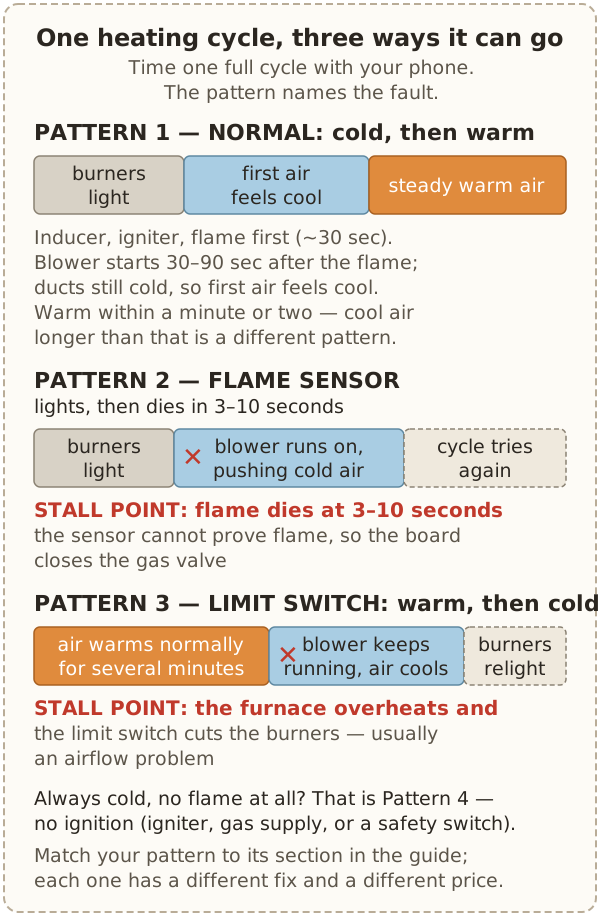
Furnace Blowing Cold Air? Read the Pattern First — Cold-Then-Warm, Always Cold, or Warm-Then-Cold
A furnace that runs but blows cold is not one problem — it is four, and the timing pattern tells you which. Cold-then-warm is normal, lights-then-dies in seconds is the flame sensor, warm-then-cold is the limit switch, always cold is no ignition. Checks, fixes and US repair costs for each.
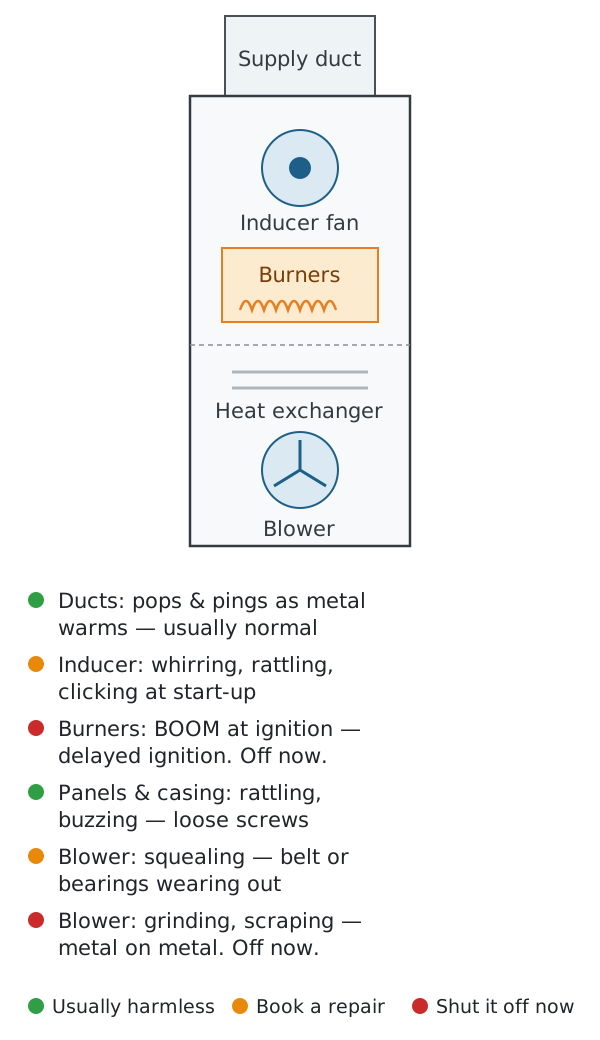
Furnace Making Noise? What Each Sound Means — and the Three That Mean Shut It Off Now
A bang, squeal, rattle or hum is your furnace telling you where it hurts. Decode each sound by where it comes from, learn the three that mean switch off immediately, and see what each fix costs.
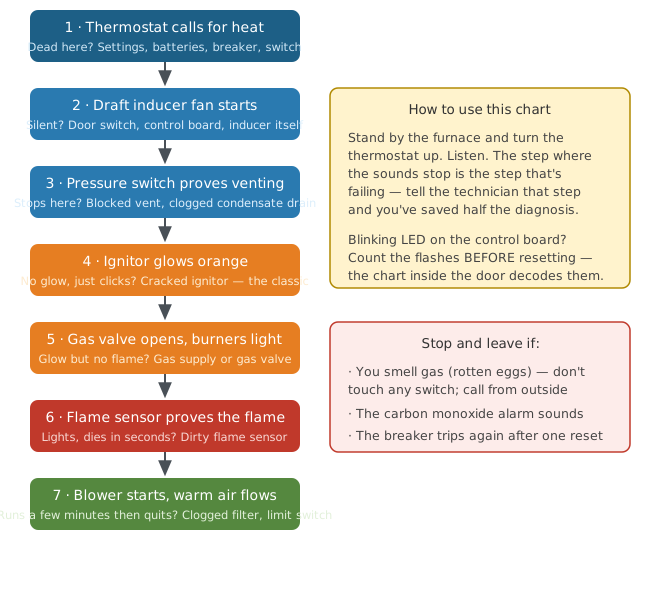
Furnace Won't Turn On? 9 Checks Before You Call a Technician
No heat? Work through the same checks a technician starts with — thermostat, switch, breaker, filter, error codes — and learn the start-up sequence so you can hear exactly where your furnace stops.