 Keep
Furnace Making Noise? What Each Sound Means — and the Three That Mean Shut It Off Now
 Daniel Mercer · Editor & Researcher·
Published November 16, 2026·
Updated November 16, 2026
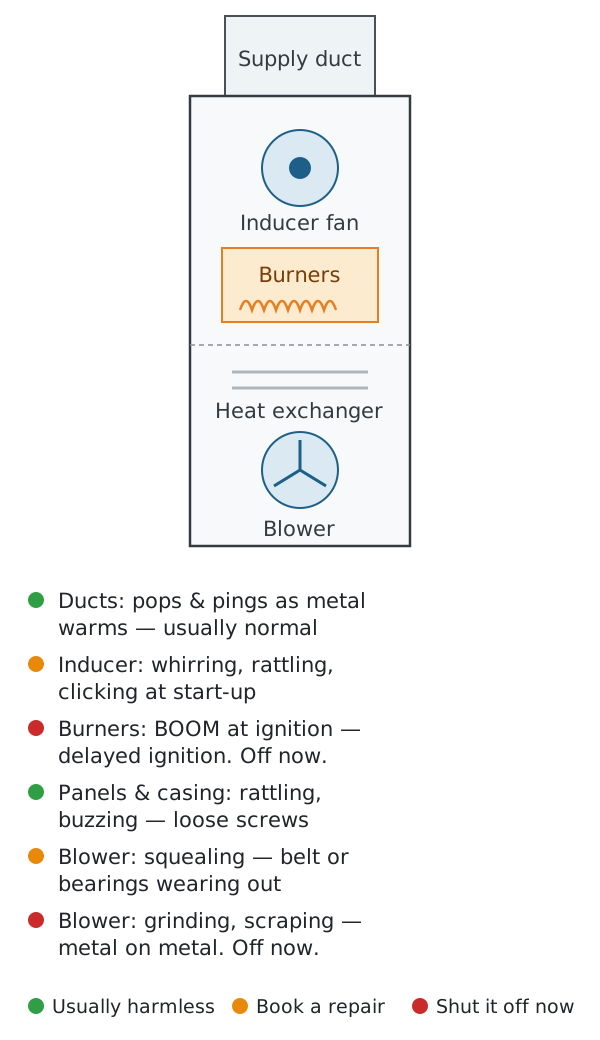
The first cold night in a new house has a soundtrack, and most new owners do not know a single note of it. The thermostat clicks. Something whirs. Something whooshes. The ducts tick like a cooling car engine, the blower settles into a roar, and you lie in bed wondering whether any of that is supposed to happen — and whether the noise that just started is the beginning of a $1,000 repair or just what furnaces sound like.
Here is the idea that makes furnace noises manageable: a sound is a location. Your furnace is a metal box containing a handful of moving parts, and each part can only make a few sounds. The burners live low in the cabinet, the inducer fan sits above them, the blower sits at the bottom, and the ductwork carries whatever happens out to every room. When owners search "furnace making noise," the sound is all they have — but once you match the sound to the part that makes it, you usually have the diagnosis, the urgency, and a fair idea of the bill.
That is how this guide is organised: sound by sound, part by part, with the fix and the price for each. Three of the sounds get their own warning section, because they mean switch the furnace off and stop using it until a technician has seen it. Everything else is either a cheap owner fix or a book-it-this-week repair.
One boundary before we start. This guide begins where our furnace won't turn on guide ends: that post walks the normal start-up sequence step by step so you can hear where a dead furnace stops. Here, the furnace runs — it just runs wrong, loudly. If yours will not start at all, start there. If yours starts and complains, read on.
First, learn what your furnace normally sounds like: the one-cycle test
Every sound below is judged against a baseline, and if you moved in recently, you do not have one yet. So build it. On a quiet evening, turn the thermostat up a few degrees and stand by the furnace for one full cycle, phone in hand. A healthy gas furnace runs a fixed sequence, and each stage has a sound:
- Click. The thermostat calls for heat and the control board answers.
- Whir. The draft inducer — a small fan high in the cabinet — spins up to clear the vent. Thirty seconds or so of light fan noise.
- Click, glow, whoosh. The ignitor glows, the gas valve opens, and the burners light with a soft whoosh, like a gas hob turned up.
- Roar. A minute or two later the main blower comes on and warm air moves. This is the loudest part of the cycle, and it should be a steady rush, not a scream.
- Ticks and pings. The ductwork expands as hot air hits cold metal. Light ticking at start-up and again as ducts cool after shutdown is sheet metal being sheet metal.
Note what you heard and when. That log is worth money later: technicians charge by the visit, and "it squeals for the first minute after the blower starts, then stops" points at bearings in a way "it makes a noise" never will. The rest of this guide assumes you have done this once, so you can place your noise inside the cycle. When a sound happens is half the diagnosis.
Boom or bang at ignition: delayed ignition
What you hear: a thump, boom or small bang from the cabinet in the first seconds of the cycle, sometimes strong enough to feel through the floor or rattle the blower door. Some owners describe a "whoomph" that makes the whole furnace shudder.
What it means: the burners are lighting late. On a clean furnace, gas flows and ignites almost instantly, and the flame spreads smoothly from burner to burner. When the burner ports and crossover channels are coated with dirt, rust and corrosion — the normal grime of a furnace that has not been serviced in years — the flame takes a second or two to travel. Gas keeps flowing the whole time. When ignition finally catches, that accumulated gas burns all at once. The boom is a small, contained explosion, and it happens inside a steel box that was designed for a controlled flame, not a pressure pulse.
Why it matters: each boom flexes the heat exchanger, the steel barrier between the flame and your household air. Steel that flexes thousands of times eventually cracks, and a cracked heat exchanger can leak carbon monoxide into the air the blower sends to your bedrooms. Delayed ignition is also self-worsening: every rough ignition shakes more debris loose onto the burners.
The check: stand back from the furnace (do not open the burner compartment) and watch through the sight glass if your furnace has one. The flame should be steady and mostly blue. A flame that rolls, billows or lifts noisily at light-off confirms a rough ignition. Note whether the boom happens on every cycle or only the first of the day — either way, this is not a wait-and-see fault.
The fix: a technician removes and cleans the burner assembly, checks the ignitor and flame sensor, and verifies gas pressure. This is not an owner job: it involves the gas train, and a burner put back slightly wrong lights worse than a dirty one. Book it promptly and stop running the furnace in the meantime if the bangs are strong. If they are mild, most technicians will still tell you the same thing — this fault does not heal, and the repair is cheapest before the heat exchanger pays for it.
Two different bangs: ignition boom versus duct oil-canning
Owners regularly pay for a burner diagnosis on a duct problem, and vice versa, because both faults announce themselves as a bang. They are easy to separate once you know what to time.
The ignition boom happens at the very start of the cycle, from inside the cabinet, in the seconds when the burners light — before the blower comes on. It may repeat at every start. That is the delayed-ignition fault covered above, and it is the dangerous one.
The duct bang — technicians call it oil-canning — happens later: a minute or two after the blower starts, or shortly after it stops, and it comes from the ductwork itself rather than the cabinet. A wide, flat section of duct flexes inward under the blower's pressure and then pops back out as pressure equalises, exactly like the bottom of an old oil can. It is startling and it is harmless to the furnace: no gas, no flame, no heat exchanger involved. It is also worse in some weather than others, because cold duct metal is stiffer.
The timing test settles it. Bang before the blower starts: burners, call a technician, stop using the furnace. Bang after the blower is running, localised to one stretch of duct you can point at: sheet metal, and the fix is a cross-break (a shallow crease pressed into the panel to stiffen it), an added brace, or a section of flexible connector — a ductwork job, not a furnace repair. If you cannot place the sound, run the one-cycle test again and write down the second the bang lands relative to the blower. That single observation is the whole diagnosis.
Squealing or screeching: a belt or bearings giving up
What you hear: a high-pitched squeal, scream or chirp that tracks the blower — it starts when the blower starts, changes pitch as the blower changes speed, and stops when the blower stops. It may last the whole cycle or only the first cold minute.
What it means: something on the air side is slipping or running dry. Furnaces built before roughly the 2000s often drive the blower with a rubber belt, and an old belt glazes, cracks and slips on its pulleys — that slip is the squeal. Newer furnaces drive the blower directly from the motor shaft, which removes the belt but not the bearings: motor and blower-wheel bearings that lose their lubrication or wear out announce themselves the same way. A squeal that fades as the furnace warms up is the classic early stage; the bearing or belt is worst when cold and dry.
The check: time the sound against the cycle. Squeal only while the blower runs equals blower side. A short squeal in the first thirty seconds, before the blower starts, points instead at the inducer fan's bearings — a smaller motor, a similar story. If your furnace has a belt (look for it in the manual or through the blower door slots), a squeal plus a faint smell of hot rubber settles it.
The fix: a belt is a cheap part and a quick swap, but the tension and alignment have to be right or the new belt squeals too — most owners let the technician do it on the same visit as a service. Bearings are not serviced separately on modern motors; a squealing direct-drive motor is replaced as a unit. Do not spray lubricant into the blower hoping to quiet it: most modern bearings are sealed, oil mist coats the wheel and collects dust, and the squeal returns in weeks on a dirtier blower.
Grinding or scraping: metal touching metal that should not touch
What you hear: grinding, scraping, or a metal-on-metal screech from low in the cabinet while the blower runs — the sound of something rotating that is no longer rotating true.
What it means: the blower wheel (the squirrel-cage fan that moves your air) has come loose on its shaft, cracked, or shifted until its blades kiss the housing as they spin. Or the motor bearings have worn past squealing into grinding, letting the shaft wobble. Either way, parts that were never meant to touch are touching, and every cycle machines a little more metal away.
Why it matters: this is the fastest-escalating sound on the list. A loose wheel can tear itself apart and take the motor and housing with it; a wobbling shaft destroys the motor it is attached to. A repair that was "blower wheel, refitted" on Monday can be "wheel, motor and housing" by the end of the month.
The fix: there is not one, at owner level. Switch the furnace off at the service switch and leave it off. Tell the technician "grinding from the blower" when you call — it is a phrase that gets you treated as urgent, because it should.
Rattling: usually loose metal, occasionally something loose inside
What you hear: a rattle, buzz or vibration that may come and go with the blower speed, sometimes loudest at start-up and shutdown.
What it means: start with the boring answer, because it is usually right: a panel screw has backed out, the blower door is sitting slightly loose in its frame, or a duct joint vibrates against a joist when the blower hits a certain speed. Sheet metal is a drum, and a furnace is full of it. Less innocent causes exist: a loose blower wheel set screw can rattle before it graduates to scraping, debris (a screw, a scrap of metal, a child's small toy near a return) can sit in the blower housing, and a failing inducer fan can rattle from its own worn bearings.
The check: with the furnace running, press a gloved hand firmly against each cabinet panel and the blower door in turn. If the rattle stops under your hand, you have found it — a panel problem, not a furnace problem. Then check the duct run near the furnace: a palm on each joint while the blower runs will find a vibrating seam. If the rattle survives both tests and clearly comes from inside the cabinet, treat it as internal and book a visit.
The fix: panels and doors are owner territory and get their own steps in the fix section below. Internal rattles are a technician job, because the difference between "loose screw in the housing" and "blower wheel working loose" is a look inside you should not take with the gas connected and the wheel spinning.
Clicking: the normal soundtrack, and the pattern that is a fault
What you hear: clicks — and the question is never whether a furnace clicks, but how, when, and what follows.
What is normal: the thermostat clicks when it calls for heat. Relays on the control board click as the sequence advances. The gas valve clicks open. After shutdown, cooling ducts tick. A furnace with no clicks at all would be the strange one.
What is a fault: clicking that repeats in a pattern with nothing after it. Click, pause, click, pause — the board is attempting ignition and failing, then retrying until it locks out. The usual suspects are a cracked hot-surface ignitor (the board calls for glow that never comes), a flame sensor too dirty to prove the flame it just lit, or a pressure switch that will not close because the vent or condensate drain is blocked. A different fault pattern is rapid chattering from a relay, which can mean low voltage or a board on its way out.
The check: count what a cycle does. Burners light then die within seconds, over and over, points at the flame sensor. Inducer runs, clicks happen, burners never light at all points at the ignitor or pressure switch. Then read the board's blinking LED through the sight window and count the flashes against the chart inside the blower door — the furnace has already diagnosed itself, and that code is the first thing a technician will ask for. (Our furnace won't turn on guide walks through reading error codes in full.)
The fix: sensor and ignitor work sits at the border of DIY; on a gas appliance, most owners are better served paying for the visit and watching how it is done. What you should not do is reset the furnace repeatedly to keep it limping — each lockout has a cause, and resets erase the error code that names it.
Humming: power is arriving, motion is not
What you hear: a low hum or buzz from the cabinet. Two very different faults share this sound, and the airflow tells them apart.
The normal one: a soft, steady hum with warm air moving normally is the transformer and motor doing ordinary work. Many furnaces hum faintly their whole lives. File it under baseline.
The fault: a loud hum or buzz and no air moving, or air that starts weakly and dies. The blower motor is being told to run and cannot turn. The most common reason is a failed run capacitor — the small can-shaped part that gives the motor its starting push — and the second is a seized motor or a blower wheel jammed by debris. A motor stalled under power draws heavy current and heats up; left humming, it can cook its own windings and turn a capacitor-priced repair into a motor-priced one. Switch it off.
The check: set the thermostat fan control to ON with the heat off. If the blower still only hums, the fault is in the blower circuit, not the heating sequence. Either way, the repair is a part swap inside the cabinet — capacitor first, motor if the capacitor tests fine — and that is technician work around mains voltage and a part that can hold a charge.
Whistling: the furnace is fine, the air cannot get through
What you hear: a whistle, hiss or high rushing note at the furnace or at certain vents, worst when the blower runs at full speed.
What it means: air is being forced through a gap too small for it. The furnace itself rarely whistles; the air path does. The league table of causes: a filter so clogged (or so restrictive) that air squeezes around its edges, too many supply vents closed, a return grille blocked by furniture or a rug, or ductwork that was undersized or has partly crushed. Whistling is the sound of static pressure — the blower working against a straw.
Why it matters beyond the noise: a starved blower moves less air across the heat exchanger, so the furnace runs hotter, trips its high-limit switch more often, and cycles shorter. Months of that is hard on the heat exchanger and on your gas bill. The whistle is the cheapest warning the system gives you.
The check and fix: pull the filter and run one cycle without it. If the whistle drops, fit a clean filter of the type the manual specifies and note the date — most whistling furnaces are simply overdue. Then walk the house and open every supply vent, and clear anything sitting on or in front of return grilles. If the whistle survives a clean filter and open vents, the duct system itself needs a professional look.
The three sounds that mean shut it off now
Most furnace noises are scheduling problems. These three are safety problems, and the reasoning is the same in each case: the sound tells you something inside is happening that the furnace was not built to contain for long.
1. A boom or bang at ignition. Delayed ignition means unburned gas is accumulating and then going off in a pressure pulse, cycle after cycle. The pulse works on the heat exchanger, and the heat exchanger is the only thing between combustion gas and your family's air. Off, and a technician before it runs again.
2. Grinding or metal scraping. Rotating parts are destroying each other. Left running, a blower failure can scatter debris through the cabinet and, in the worst case, jam a motor into an overheating stall. Off at the service switch.
3. Any noise plus a gas smell, or a carbon monoxide alarm sounding. This is not a furnace diagnosis at all. Do not troubleshoot, do not open doors, do not flip switches beyond turning the furnace off if you can do it on your way past. Get everyone out, then call your gas utility's emergency line or 911 from outside. Carbon monoxide is odourless — the alarm is the only warning you get, and a noisy furnace with a cracked heat exchanger is one of the ways it gets into a house.
For the first two, "off" means the furnace's own service switch (it looks like a light switch, usually on or near the cabinet) or the thermostat set to Off. Then call, and describe the sound in the words used here — "booming at ignition" and "grinding from the blower" both move you up a dispatcher's list, honestly earned.
The fixes you can safely do yourself
Everything in this section happens outside the cabinet's sealed compartments, with no gas parts touched and no wiring disturbed. If a step needs the burner or blower compartment opened beyond the filter and door panels your manual shows you, it is not in this section.
Fix 1: The filter — five minutes, and it cures whistles and half the cycling noises.
- Switch the thermostat to Off and let the blower stop.
- Find the filter slot (usually at the blower cabinet or behind the main return grille) and slide the old filter out, noting the airflow arrow direction.
- Hold it up to a light. If you cannot see light through it, it was overdue.
- Slide the new filter in, arrow pointing toward the furnace, and write the date on the frame.
- Run a full cycle and listen. Whistle gone, longer steadier cycles: done.
Fix 2: Panel and door rattles — a screwdriver and ten minutes.
- With the furnace running, use the palm test from the rattling section to find the panel that buzzes.
- Switch the furnace off at the service switch.
- Tighten every screw on that panel in a cross pattern, snug rather than forced — sheet-metal screws strip easily.
- Check the blower door: it should sit flush and be held by its screws or latches on all sides. A door resting slightly crooked is the single most common rattle in a new owner's house, often left that way by the last filter change.
- Switch back on and listen through a cycle.
Fix 3: Duct joints you can reach — foil tape, not duct tape.
- In the basement or utility space, run a hand along the accessible duct seams near the furnace while the blower runs; a tick or rattle often comes with a faint puff of air at a loose joint.
- Switch the system off, clean the joint with a dry cloth, and seal it with aluminium foil HVAC tape, burnishing it down with the back of a spoon so it bonds.
- For a joint that physically knocks against a joist, a strip of foam tape between metal and wood ends the percussion.
- Despite the name, cloth duct tape is the wrong product here: its adhesive dries out in heated air and it peels within a season or two. Foil tape or mastic is the permanent version.
Fix 4: Open the house back up. Walk every room and open supply vents that are closed or buried under furniture, and pull rugs and sofas off return grilles. Owners close vents in unused rooms to "save heat"; on most systems that raises pressure, adds whistle and limit trips, and saves nothing.
What the technician does for everything else
For the sounds beyond panels and filters, a good service visit follows a set order, and knowing it tells you whether your quote makes sense. The technician will listen to a full cycle first — your sound log speeds this up — then shut the furnace down and open it. Burner work means pulling the burner assembly out for cleaning and inspection, checking the ignitor's resistance and the flame sensor's condition, and verifying gas pressure at the valve. Blower work means testing the capacitor with a meter, checking the wheel for play and damage, and measuring the motor's current draw against its rating plate. Inducer problems are usually a motor swap once the vent itself is proven clear.
Ask for three things on the invoice: the fault found, in writing; any error codes the board had stored; and the condition of the heat exchanger, which a competent technician inspects on any visit involving ignition noise. If a quote jumps straight to a new furnace on the strength of a squeal, get a second opinion — squeals are parts, not furnaces.
What the repairs cost
The cost table at the top of this guide is the short version; the pattern underneath it is worth understanding. Noise repairs divide cleanly by part: air-side parts (capacitor, belt, motor) and fire-side parts (burners, ignitor, sensor) both cluster in the low hundreds, and the diagnostic fee is usually credited if you proceed. The bills that reach four figures almost never start as four-figure faults — they start as a boom ignored until the heat exchanger cracked, or a hum ignored until the motor burned out. With noisy furnaces, the calendar is the cost multiplier.
DIY or call a pro?
Do it yourself: the filter, panel screws, the blower door reseat, accessible duct sealing, opening vents, and the listening log. Call a pro: anything involving burners, the gas valve, the ignitor or flame sensor, the capacitor, belts and motors — in short, anything inside the sealed compartments or on the gas train. The dividing line is not skill; it is that the fire-side faults on this list sit next to carbon monoxide and gas risks, and the parts are cheap enough that the visit, not the part, is what you are paying for. Pay for the visit.
How urgent is it, really?
Boom, grinding, or noise with a gas smell or CO alarm: today, furnace off. Loud hum with no airflow: off, and call within the day — the motor is cooking while it hums. Squeal or screech: book within the week; it will not heal, and the part is cheapest before it seizes. Rattle you cannot pin to a panel: within the week. Panel rattle, duct ticks, a whistle cured by a filter: your own pace — but write the date down, because a sound that changes character is information.
Your first winter with this furnace: build the baseline
If you bought the house this year, you inherited a furnace whose normal you have never heard — and every guide, this one included, judges noises against a normal you do not have yet. Close that gap deliberately in your first month of heating season:
- Record one healthy cycle. Phone audio, standing at the furnace, thermostat turned up on a mild day. Two minutes. This is your reference recording for every future "has it always sounded like that?"
- Keep a sound log. A note on the phone is enough: date, the sound in your words, when in the cycle it happened, and whether the flame (if you can see it) looked steady blue. Three lines per entry.
- Note the furnace's age. The rating plate inside the cabinet gives model, serial and usually a manufacture date. Age changes the meaning of sounds: a squeal on a six-year-old furnace is a part wearing early; the same squeal at twenty years is a system at the end of its design life, and the repair-versus-replace conversation changes with it.
- Hand the log over. When a technician does come — for any reason — show them the log and the recording. Owners who can say "the rattle started in the second week of November, only on the first cycle of the morning" get faster, cheaper diagnoses than owners who say "it's been making a noise."
A furnace talks constantly. The owners who hear it earliest are the ones who pay the least to keep it running — and the ones who know, without lying awake about it, which sound means switch it off now.
Cost at a glance
| Item | Typical cost | Notes |
|---|---|---|
| HVAC diagnostic / service call | $75–$200 | Usually credited toward the repair; a sound log and error code can shorten the visit |
| Burner cleaning and ignition service | $150–$400 | The standard fix for booming delayed ignition; includes ignitor and flame sensor check |
| Blower capacitor replacement | $120–$300 | The usual cure for a loud hum with no airflow; the part itself is $10–$30 |
| Blower belt replacement | $100–$250 | Older belt-drive blowers only; squeal often stops the day the belt is changed |
| Blower motor replacement | $400–$1,500 | Grinding and seized motors land here; variable-speed ECM motors sit at the top end |
Frequently asked questions
Is it normal for a furnace to make noise when it starts?
Some noise is built in. A healthy start-up sounds like this: a soft click from the thermostat, a whir as the inducer fan spins up, a click or two from the control board, a whoosh as the burners light, then the steady rush of the blower. Ductwork often ticks or pings as the metal warms and expands. What is not normal: a boom, a squeal, grinding, loud rattling, or a hum with no air moving. Those are the sounds this guide decodes.
Why does my furnace bang when it turns on?
A bang or boom at the moment of ignition is usually delayed ignition. Dirt and corrosion on the burners slow the spread of flame from one burner to the next, so gas keeps flowing for a second or two before it all lights at once — a small explosion inside the firebox. Each boom flexes the heat exchanger, and repeated booms can crack it, which is a carbon monoxide risk. Switch the furnace off and book a burner cleaning; do not keep running it to see if it stops.
What does a squealing furnace mean?
A high-pitched squeal or screech that rises with the blower almost always comes from the air side, not the fire side. On older furnaces it is a worn, glazed blower belt slipping on its pulleys. On any furnace it can be blower motor bearings running dry or wearing out. A squeal that appears for the first minute and fades is an early warning; a constant screech is a motor asking to be replaced before it seizes.
Why does my furnace keep clicking?
Occasional clicks are the control board, relays and gas valve doing their jobs. Clicking becomes a fault when it repeats without the burners lighting: the board is trying to ignite, failing, and trying again. Causes include a cracked ignitor, a dirty flame sensor, or a pressure switch that will not prove venting. If the clicking ends in lockout, count the blinking LED code on the board before you reset anything — that code names the failed step.
Is a humming furnace dangerous?
A soft hum from the transformer is normal. A loud hum or buzz with no airflow is not: the motor is receiving power but cannot turn, usually because of a failed capacitor or a seized blower. A stalled motor draws heavy current and overheats, so switch the furnace off rather than letting it sit there humming. A capacitor swap is one of the cheaper repairs ($120–$300 fitted); a motor left stalled can burn out and cost several times more.
Can a dirty filter make my furnace noisy?
Yes, in two ways. A clogged filter starves the blower, and the furnace answers with whistling or roaring as air forces its way around the blockage. The same airflow starvation makes the heat exchanger overheat, so the burners shut down and relight more often — more clicks, more whooshes, more duct pings per hour. Pulling the filter is the cheapest noise test there is: if the whistle fades with a clean filter fitted, you have found your fault.
How much does it cost to fix a noisy furnace?
It depends entirely on which sound. Panel screws and a filter cost almost nothing. A diagnostic visit runs $75–$200. The common per-sound repairs: burner cleaning $150–$400, capacitor $120–$300, belt $100–$250, blower motor $400–$1,500. The expensive outcomes are the ones ignored — a cracked heat exchanger from months of ignition booms, or a burned-out motor from weeks of humming.
Checked November 16, 2026. This guide is general information, not a substitute for a licensed professional.
Related guides
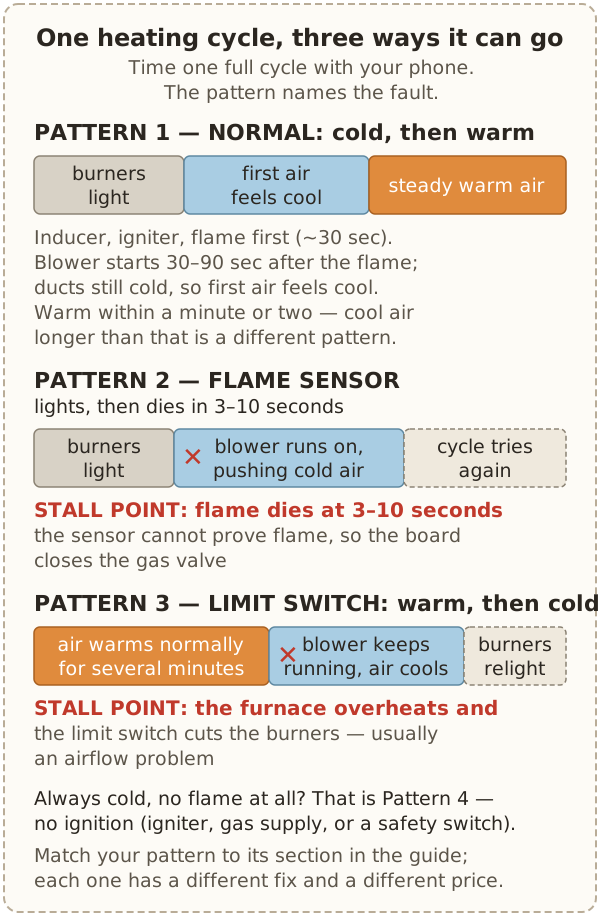
Furnace Blowing Cold Air? Read the Pattern First — Cold-Then-Warm, Always Cold, or Warm-Then-Cold
A furnace that runs but blows cold is not one problem — it is four, and the timing pattern tells you which. Cold-then-warm is normal, lights-then-dies in seconds is the flame sensor, warm-then-cold is the limit switch, always cold is no ignition. Checks, fixes and US repair costs for each.
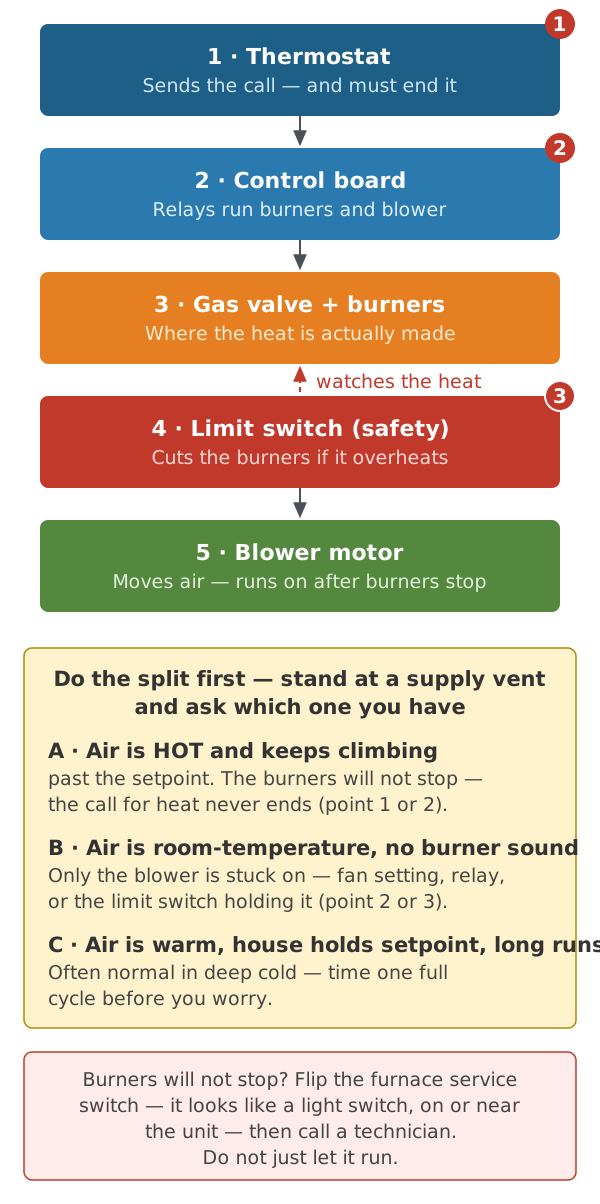
Furnace Won't Shut Off? Split It First: Burners, Blower, or Just Long Cycles
A furnace that never stops is three different problems wearing one name. Do the vent test to split them — burners stuck on, blower stuck on, or normal long cycles in deep cold — then work the right checks.
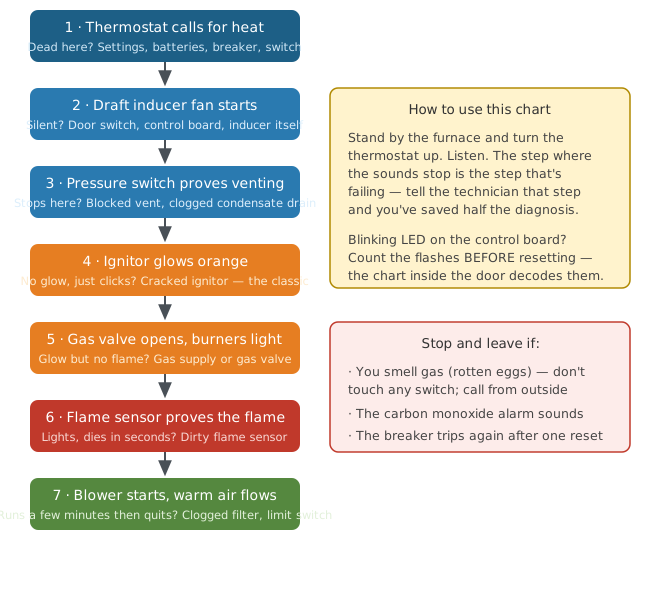
Furnace Won't Turn On? 9 Checks Before You Call a Technician
No heat? Work through the same checks a technician starts with — thermostat, switch, breaker, filter, error codes — and learn the start-up sequence so you can hear exactly where your furnace stops.