 Keep
Drain Field Failure Signs: Soggy Ground, Green Stripes and Surfacing Effluent
 Daniel Mercer · Editor & Researcher·
Published November 16, 2026·
Updated November 16, 2026
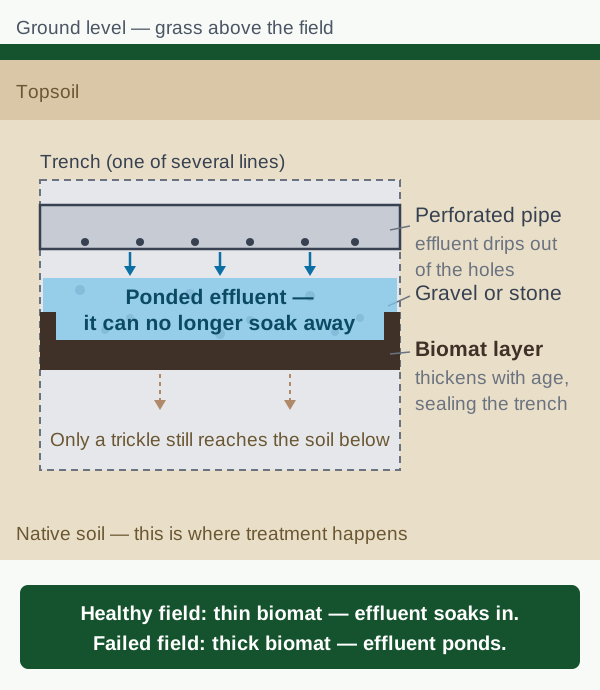
If your septic system is going to fail, it will almost certainly be the drain field that goes — and it will tell your yard before it tells your house. Long before sewage backs up into a shower, the field starts leaving evidence outside: a stripe of grass that grows suspiciously well, a patch of ground that stays soft underfoot, a smell that drifts across the lawn on still mornings. Most owners walk past those signs for months because each one, on its own, looks like nothing. Together, in the right order, they are a diagnosis.
This guide walks through those signs in the order they usually appear, separates real failure from the three look-alikes that imitate it, and gives you a diagnosis sequence you can run yourself with dry shoes and a phone camera. It also covers what a professional does to confirm failure, what can still be saved, and — since almost nobody publishes this on one page — what each stage of the problem actually costs.
What the drain field does, and the layer that decides its life
The septic tank gets the attention, but the tank is only the halfway point. Its job is separation: solids sink, grease floats, and the liquid in between — effluent — flows out to the drain field. The field is where treatment actually happens. A network of perforated pipes, usually laid in gravel-filled trenches, spreads the effluent out and lets it seep slowly into the soil. As it percolates down, the soil filters out solids and a community of microbes breaks down bacteria, viruses and nutrients. By the time that water reaches groundwater, it has been genuinely cleaned. A working field is invisible: no wet ground, no smell, no sign at the surface at all.
The key player is a layer most owners never hear about until it fails: the biomat. Within the first few years of use, a dark, jelly-like mat of bacteria and organic material forms where effluent meets soil, along the bottom and lower sides of each trench. A thin biomat is normal and even useful — it slows the effluent down and does part of the treatment. The problem is that the biomat never stops growing. Fed by a normal household it thickens slowly over decades. Fed by solids escaping an overdue tank, or by far more water than the field was designed for, it thickens fast. Eventually it can seal the trench floor almost completely, so effluent ponds in the gravel instead of soaking away. That is what "failure" physically is: not a broken pipe, but a clogged soil interface.
This is why fields have a lifespan even when nothing is ever done wrong. Most conventional drain fields last 15–25 years; a well-kept field in good soil runs 20–30. The EPA advises owners to start planning an upgrade once a system passes 25–30 years, precisely because that is the age at which the biomat can thicken enough to restrict flow. Neglect compresses the timeline brutally: a tank that goes unpumped sends solids downstream, and skipped pumping is behind most premature field failures — by some EPA SepticSmart estimates, the majority of them. A field that dies at 10 years has almost always been fed something it shouldn't have.
The signs, in the order they usually appear
Failure is gradual, and the signs escalate in a fairly predictable sequence. Where your yard sits on this list tells you roughly how much time you have.
Early signs — the field is struggling, not finished
Stripes of lush, green grass over the lines. The earliest and most useful sign. Effluent that can no longer soak down sits shallow, and the grass above the trenches gets watered and fertilised with nitrogen and phosphorus from below. The result is a visible pattern: greener, taller, faster-growing grass in straight lines or a defined patch, while the rest of the lawn looks ordinary. Healthy fields do not fertilise the grass above them. If the stripes are obvious in a dry spell, when nothing else in the yard is thriving, pay attention.
Ground that stays spongy after the weather dries. Walk the field two or three days after the last rain. Soil over a struggling field feels soft and springy underfoot and holds moisture far longer than the ground around it, because it is saturated from beneath, not from the sky. This is an early-to-mid sign: absorption is slowing, but the effluent is still mostly below the surface.
A sewage smell that comes and goes. Faint, intermittent, strongest in the morning, after laundry day, or after several showers in a row — then gone. That pattern means effluent is close enough to the surface for its gases to escape when the system is loaded, and disperses when the load stops. A constant smell is worse; a smell that tracks your water use is the field telling you it is at capacity.
Drains that slow down, recover, then slow again. Early saturation shows up indoors as a cycle: drains run slowly after heavy use, then behave normally again after a quiet night. Owners usually blame a partial clog, and plunging seems to "fix" it. What actually happened is the field caught up overnight. When the slow-downs start arriving more often and recovering more slowly, the field is losing ground.
Late signs — the field has effectively failed
Standing water over the field. Puddles or muddy patches sitting above the trenches, especially when it has not rained, mean effluent is reaching the surface faster than the soil takes it — or not taking it at all. Every gallon you use now adds to what is already ponded.
Surfacing effluent. Dark, grey or blackish water breaking out over the field, usually with a strong sewage odor. This is partially treated sewage at the surface: a health hazard for kids, pets and any nearby well, and in many counties a violation the health department can order fixed. This is the end of the line for watch-and-wait.
Gurgling, then backups, indoors. When the field accepts almost nothing, the tank backs up, and the house feels it: drains gurgle as air is displaced, the lowest fixtures drain last and worst, and eventually sewage appears in a basement floor drain, a low shower or a toilet. By the time the problem is unmistakable indoors, the field has usually been failing outdoors for a long while.
How much time do you have?
Owners always ask some version of this, and the honest answer is that it depends on which sign you are looking at — the sequence above is also a rough clock. A field showing only green stripes and intermittent odor is usually in the early stage of saturation: many run for months to a few years in that state, and that whole period is your window to get inspected, rest the field and repair what is repairable. Spongy ground that persists through dry weather, and drains cycling between slow and normal, mean the margin is mostly gone — the field keeps up only when you are gentle with it, and a holiday weekend of guests and laundry can push it over. Standing water or surfacing effluent means the clock has run out; the field is not absorbing at all, and from here the problem only moves in one direction, into the house.
Two variables speed the clock up. The first is age: a 25-year-old field showing early signs is much closer to the end than a 10-year-old showing the same signs, because its biomat has decades of growth behind it. The second is load — a household that has grown, a new water softener, a finished basement bathroom. A field rarely fails from one bad week; it fails when a shrinking capacity meets a growing demand, and the crossing point is when the signs start.
The look-alikes: three problems that imitate a failing field
Here is the part that saves people money. Several cheaper faults produce a picture nearly identical to field failure — and one of them is just weather. Replacing a field that was never the problem is a five-figure mistake, so separate these first.
Rain saturation. A drain field moves water into unsaturated soil. After days of heavy rain, or when the water table rises in a wet season, the soil is already full and effluent has nowhere to go: soggy ground, slow drains, even a backup, with a perfectly sound field underneath. The tell is timing. Weather saturation tracks the rain and clears within a day or two of dry weather returning. The EPA's advice for this situation is restraint, not repair: reduce water use until the soil drains. If your symptoms only ever appear in wet weeks and vanish in dry ones, suspect the weather before the field.
A full tank pushing the problem downstream. When a tank goes years past its pumping date, sludge and scum crowd out the liquid layer, and solids start escaping toward the field. The result — slow drains, odors, a struggling field — looks like failure, but the field may recover completely once the tank is pumped and a clogged effluent filter is cleaned. This is where the single most useful test in this guide comes in: a failed field does not get better when the tank is emptied. Pump the tank, note the date, and run the house at normal water use. If symptoms stay away for months, the problem was upstream. If they return within days to a couple of weeks, the field itself is not accepting water, and the shorter the interval, the stronger the signal.
A broken line, crushed lateral or failed distribution box. One damaged component can flood part of a field while the rest is healthy — and a flooded section shows the same wet ground and lush grass as general failure. The clue is geography: look-alike damage is usually localised, one wet area or one stripe, while biomat failure tends to show across the whole field. A shifted or broken distribution box can also send most of the flow to one line and drown it while its neighbours sit dry. These are mechanical repairs in the $1,000–$5,000 range, not a replacement.
One more separator worth remembering: location. Anything you can see or smell in the yard has already travelled past the tank, so outdoor symptoms belong to the field or the line to it. Symptoms confined to the house — one slow sink, one gurgling toilet — have not yet proved anything about the field at all.
The homeowner diagnosis sequence
You cannot confirm failure from the surface — that takes excavation, below. But you can arrive at a professional's visit with the answer mostly narrowed down, which saves you paying for guesswork. Run these steps in order, ideally over one to two weeks.
1. Find the field and walk it dry. You need to know where the field actually is: check the as-built drawing from your county health department, or work it out from the tank's location and the direction of the outlet line. Then walk the whole area after at least two dry days, in shoes you don't mind getting damp. You are mapping, not just looking.
2. Run the spongy test. Press your weight onto one heel, over the trenches and then on ordinary lawn for comparison. Ground over a failing field feels distinctly softer and bouncier, and may leave a wet footprint. Note exactly where the softness is: everywhere, or one patch? Whole-field softness points to the biomat; one patch points to a line or distribution problem.
3. Read the stripe pattern. Photograph the grass from a height or a second-storey window if you can — the pattern is easier to see from above. Straight, evenly spaced stripes follow the trench layout and mean effluent is shallow along the lines. One lush area near a single point suggests a leak or break instead. Grass that is lush but over dry, firm ground is a weaker signal; lush and spongy together is a strong one.
4. Photograph and date everything. Take dated photos of wet spots, stripes and any surfacing water, and note the weather and your water use alongside: guests this weekend? Four loads of laundry Saturday? Symptoms that follow load and fade with rest mean a field at its limit; symptoms that persist at normal use in dry weather mean a field past it. This record is genuinely useful — a good septic pro will ask exactly these questions, and "it was wet sometime last month" is much harder to work with than a dated sequence.
5. Run the pump-and-watch test, if the tank is due. If your tank hasn't been pumped in three-plus years, get it pumped and the effluent filter cleaned, tell the pumper what you've been seeing, and then watch the ten days after. As covered above, what happens next separates an upstream problem from a failed field better than any single inspection.
6. Cut water while you wait for answers. Whatever the cause turns out to be, a struggling field recovers fastest when it is loaded least. Spread laundry across the week, fix running toilets and dripping taps, and hold off on guests-and-bathtub weekends until you know where you stand. This is not a cure — it is how you keep a borderline field from tipping into surfacing while you arrange help.
What a professional does to confirm it
A proper confirmation visit is methodical, and it is worth knowing the steps so you can tell a real evaluation from a sales pitch. Expect the pro to start at the tank: opening it, measuring the sludge and scum layers, and checking whether the liquid level is normal. A tank level that sits above the outlet pipe tells them effluent is backing up from the field; a normal level with a full-of-solids tank points upstream instead. They will clean or check the effluent filter and inspect the baffles, because a blocked filter imitates field failure faithfully.
Next comes the distribution box, which splits flow between the lines. A box that is cracked, tilted or clogged can drown one line and starve the rest. Then, the decisive step: test pits. The pro digs small holes at the trenches to look directly at the soil interface — how thick and black the biomat is, whether effluent is ponded in the gravel, and how the soil below behaves. Ponded liquid sitting in the trench hours after the house has been quiet, over a thick sealed biomat, is the finding that confirms failure. A camera run through the lines is used where a break, root mass or crushed section is suspected; it answers pipe questions, not soil ones. Some companies add a hydraulic load test — running a measured volume of water through the system and watching how the field responds — which is most useful in property sales.
What you should get at the end is a finding, not just a quote: which component failed, over what area, and whether the soil still absorbs anywhere. Anyone who quotes a full replacement from the driveway, without opening the tank or digging a single pit, is skipping the part where cheaper answers get ruled out.
What can still be saved — and what is done
If the diagnosis lands early, there is real room to act. A field that is overloaded but not yet sealed can recover ground with rest and water discipline: sharply reduced flow for weeks to months lets the biomat dry, crack and partially break down, and some systems are built with two fields and a diversion valve precisely so one side can rest while the other works. If your home has a dual field, ask whether it has ever been switched — some never have. Localised damage is fixable outright: a distribution box replaced, one lateral repaired or jetted clear of roots, a crushed section dug up and renewed, typically in the $1,000–$5,000 band.
Two popular fixes deserve honesty rather than hope. Jetting — blasting the laterals clean with high-pressure water — is a legitimate repair for lines clogged with solids or roots, and it costs a few hundred dollars. But it cleans the pipes. If the soil interface beyond the pipe wall is sealed with biomat, jetting changes nothing for long, and a company selling it as a cure for a sealed field is selling you a delay. Additives and rejuvenation treatments split the same way. The EPA does not recommend additives for routine care, and none dissolves a mature biomat. Mechanical soil fracturing or aeration can buy roughly one to three years on a field whose biomat is still young — sometimes a rational purchase, if it lets you plan and save for replacement on your own schedule. On a field that is already surfacing effluent across its whole area, it is money spent postponing the same bill.
And when a field is done, it is done: soil sealed across all the trenches, effluent at the surface, symptoms returning within days of any intervention. At that point the honest options are replacement on the same site if the soil and setbacks allow, a new field on a fresh area of the lot, or an engineered system where the site is difficult. The good news inside the bad news is that a new field, protected from the start, is a 20–30-year asset — the rest of this guide is about making sure the next one, or the one you still have, gets that life.
What it costs, stage by stage
The figures in the cost table on this page follow the sequence of the problem. Diagnosis is cheap relative to everything downstream: $150–$500 for a proper inspection that opens the tank, measures the layers and checks the filter and distribution box. Spend that before anything else, because every later decision depends on its findings. Repairs for localised, mechanical faults — jetting, a distribution box, one lateral, soil fracturing — run $1,000–$5,000. Full field replacement is the five-figure conversation: $3,000–$15,000 for most homes, reaching $20,000 and beyond in high-cost areas or where an engineered design is required. Replacing the whole system, tank and field together, runs $10,000–$30,000.
Two things move these numbers more than any others. The first is when you act: the difference between catching a field at the repair stage and replacing it is routinely $10,000, which is the entire financial argument for learning the early signs. The second is your site — soil type, water table, lot size and local permitting decide whether a straightforward replacement is even available to you. Get the inspection first, and get replacement quotes itemised: site evaluation, permit, excavation, and the field itself should be separate lines you can compare.
Protecting the field you have
Everything that shortens a field's life is, to a degree, controllable. Water load is the biggest lever: the field was sized for a design flow, and chronic overload can cut its life by a third or more. Spread laundry out, fix leaks promptly — a running toilet can send hundreds of extra gallons a day to the field — and be thoughtful about water-heavy additions like hot tubs and water softeners, whose backwash cycles discharge in surges. Solids discipline is the second lever: pump the tank on schedule, keep the effluent filter clean, and keep grease, wipes and garbage-disposal overload out of the system, because everything that reaches the field feeds the biomat.
Above ground, protect the soil itself. Never drive or park on the field — vehicle weight compacts the soil and can crush pipes, and compacted soil absorbs poorly even with a healthy biomat. Keep trees and thirsty shrubs well away; roots seek the moisture in the trenches and can fill a line in a few seasons. Plant only grass over the field, and grade the surface — and aim roof gutters, downspouts and sump pumps — so surface water drains away from the area. A field that also has to absorb your roof's runoff is a field doing two jobs and ageing at twice the rate.
When to stop reading and call today
Most of this guide is about a problem that develops over months, and most of it can be handled with an inspection booked inside a few weeks. Three findings change that. Surfacing effluent — dark water breaking out over the field — means untreated sewage is at the surface: keep people and pets off it, cut water use to the minimum, and call today. Standing water over the field in dry weather is the same message one step earlier; the field has stopped accepting water entirely. And sewage backing up into the house is an emergency by any definition: stop all water use and get a septic professional out now, not after the weekend.
Everything short of that — the stripes, the spongy patch, the smell that comes and goes — is the field asking for attention while attention is still cheap. That is the whole opportunity here. A drain field rarely fails in secret. It fails in the yard, in plain sight, over months — and the owners who learn to read those signs are the ones who pay for inspections and repairs instead of replacements.
Cost at a glance
| Item | Typical cost | Notes |
|---|---|---|
| Professional inspection & diagnosis | $150–$500 | Tank opened, sludge/scum measured, effluent filter and distribution box checked; always the first spend |
| Lateral jetting / line cleaning | $200–$900 | Clears clogged or root-fouled lines; only helps if the soil still absorbs — it cannot unseal a biomat |
| Field repair (distribution box, one lateral, soil fracturing) | $1,000–$5,000 | For localised, mechanical problems on a field whose soil still works |
| Drain field replacement | $3,000–$15,000 | Most homes; high-cost areas and engineered systems can reach $20,000+ |
| Full system replacement (tank + field) | $10,000–$30,000 | When the tank is also at end of life; mound and advanced systems run higher |
Frequently asked questions
Can a failed drain field be repaired, or is replacement the only option?
It depends on what actually failed. Mechanical problems — a clogged or root-filled lateral, a broken distribution box, one crushed line — can usually be repaired for $1,000–$5,000. What repair cannot fix is soil that has sealed over with a mature biomat across the whole field; no jetting or treatment reverses that for long. Age is the rough guide: under about 15 years, a localised problem is usually repairable; past 25, start planning for replacement even if a small fix works today.
How long does a drain field last?
Most conventional fields last 15–25 years, and a well-kept one in decent soil runs 20–30. The EPA advises owners to start planning an upgrade once a system passes 25–30 years, because that is when the biomat naturally thickens enough to restrict flow. The biggest life-shortener is an under-pumped tank sending solids into the field — skipped pumping is behind most premature failures — followed by chronic water overload, vehicle traffic and tree roots.
My yard is only wet after heavy rain. Is the field failing?
Not necessarily. Saturated soil produces every outdoor sign of failure — soggy ground, slow drains, even backups — while the field itself is sound, because effluent has nowhere to go when the ground is already full of water. The difference is timing: weather saturation clears within a day or two of the rain stopping. If the ground over the field is still spongy after several dry days, or the wetness keeps returning in dry spells, that points at the field itself.
Does pumping the tank fix a failing drain field?
No — and that is actually the most useful test you have. Pumping empties the tank, not the soil. If your symptoms disappear after a pump-out and stay away for months, the problem was upstream: a full tank, a clogged filter, a blocked line. If slow drains and wet ground return within days or a couple of weeks at normal water use, the field is not accepting water, and no amount of pumping will change that.
Do septic additives or field rejuvenation treatments work?
Treat them as a gamble, not a fix. The EPA does not recommend additives for routine care, and no additive dissolves a mature biomat. Mechanical rejuvenation — soil fracturing or aeration — can buy roughly one to three years on a field whose biomat is still immature, which is sometimes worth it to plan and save for replacement. On a fully sealed field it is money spent postponing the same bill. Get the soil assessed before paying for any of it.
Is effluent surfacing in the yard dangerous?
Yes. What reaches the surface is only partially treated sewage; it can carry E. coli, viruses and nitrates, and it can reach wells and neighbouring groundwater. Keep children and pets off the area, don't mow through standing effluent, wash anything that contacts it, and cut your water use to slow it down. In many counties surfacing effluent is also a code violation the health department can require you to fix, so a prompt call protects you twice.
We just bought this house. How do I find the drain field, and how old is it?
Start with the paperwork: your county health department usually holds the permit and the as-built drawing, which shows the tank and field layout and the install date. The seller's pumping and inspection records help too. On the ground, look for the pattern this guide describes — in dry weather the field area often shows as greener stripes, and the tank lids or risers mark the start of the run. A septic company can also locate everything with a probe or transmitter at an inspection visit, and tell you the system's age from its construction.
Checked November 16, 2026. This guide is general information, not a substitute for a licensed professional.
Related guides
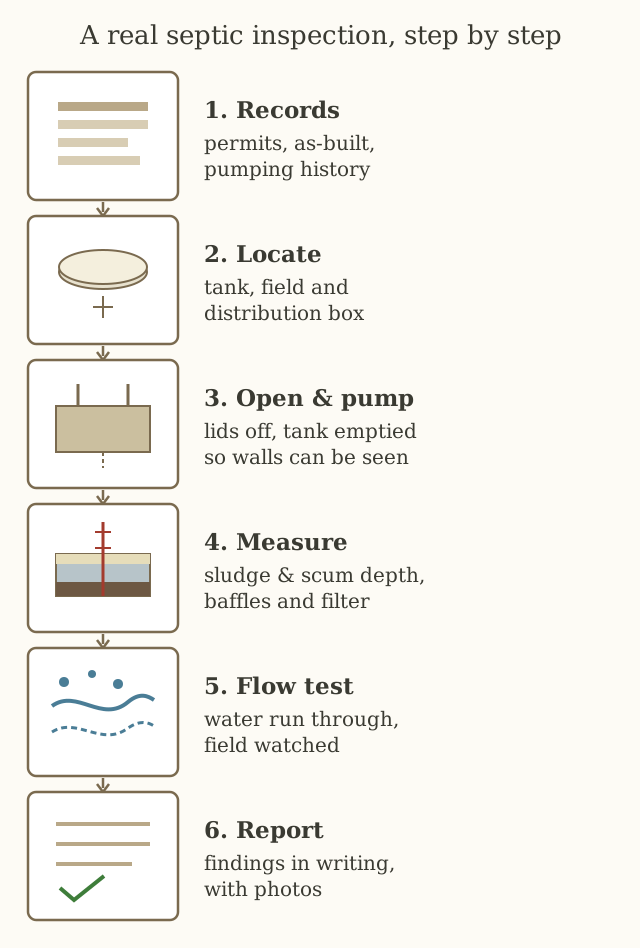
Buying a House With a Septic System? The Inspection That Can Save You $20,000
A standard home inspection barely touches the septic system. Here's what a real septic inspection includes, what it costs, the records to demand, and the contract wording that protects you.
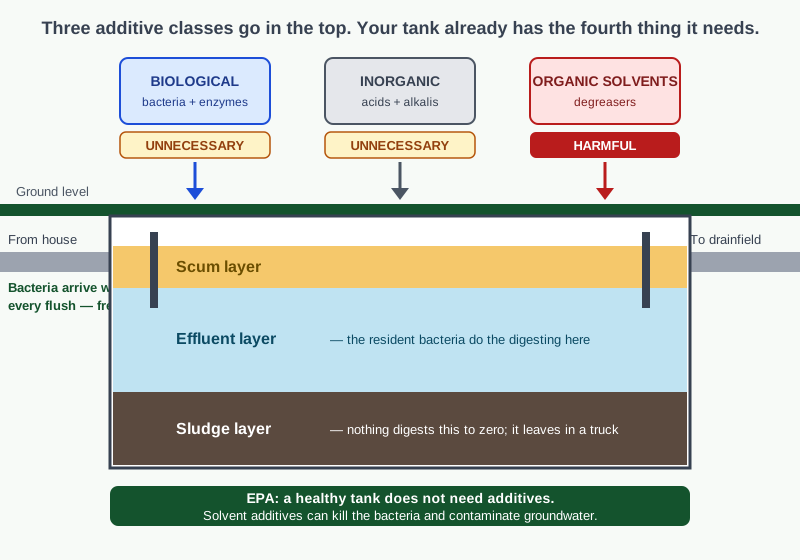
Do Septic Tank Additives Work? What the EPA and the Studies Actually Found
The EPA does not recommend septic additives, a 48-tank double-blind study found no measurable benefit, and one additive class is actively harmful. The evidence, the money maths, and the one narrow exception.
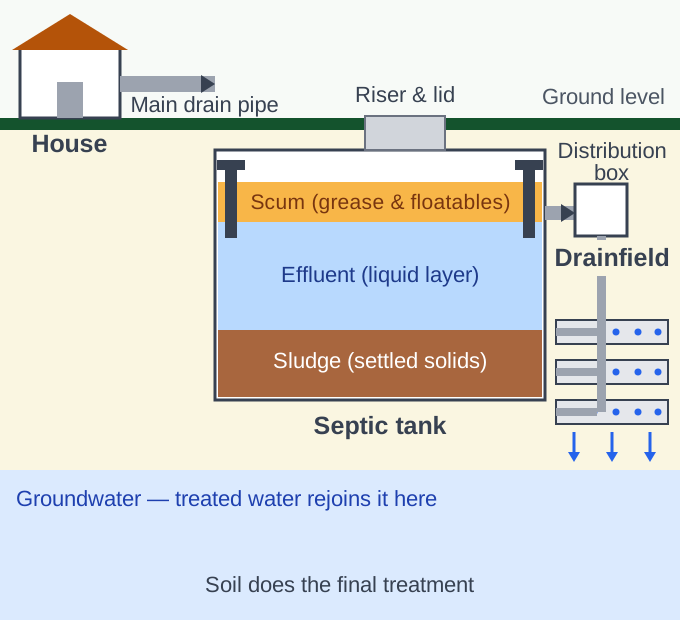
Septic System 101: How It Works, What the Parts Do, What the First Year Costs
Bought a house with a septic system and no manual? Follow one flush through the tank, baffles, filter and drainfield, learn to identify which system type you own, and see what the first year should actually cost.