 Keep
Basement Waterproofing Cost: What Each Method Really Costs
 Daniel Mercer · Editor & Researcher·
Published November 16, 2026·
Updated November 16, 2026
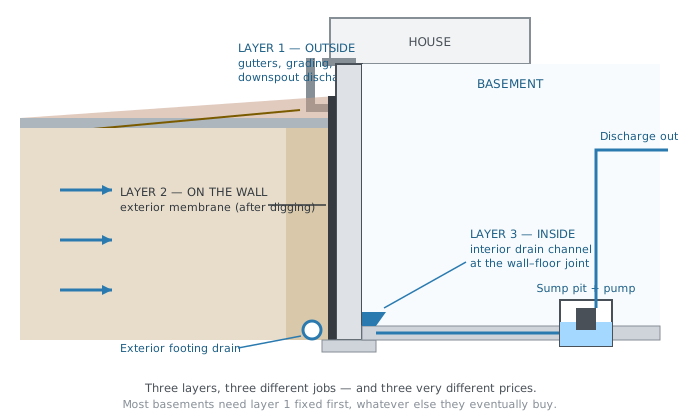
Ask three waterproofing companies what it costs to waterproof a basement and you can collect three answers: $495, $6,800 and $24,000. All three can be honest numbers. That is because "waterproofing" is not one job — it is at least five different jobs, sold under one word, and the spread between them is not markup. It is scope. A tube-and-trowel coating job, a single crack repair, a perimeter drain system and a full exterior excavation share almost nothing except the customer.
That is also why the most expensive mistake in this category is not overpaying for a system. It is buying the wrong system entirely: the full-perimeter drain sold for a leak that one downspout caused, the coating sold against water arriving under pressure, the exterior dig sold for a problem that lives at the floor joint. This guide prices each method on its own terms — what it does, what it cannot do, what it cost in 2026 and what moves the number — and then shows you how to read a quote the way a contractor wrote it. If you have not yet worked out where your water comes in, read our companion guide, "Basement Water After Rain? Read Where It Comes In, Then Fix It in the Right Order," first. Diagnosis decides the method; the method decides the price. Everything below assumes you know which pattern you have.
The method map: five jobs wearing one name
Layer 1 — Surface water management: gutters, grading, downspout discharge. Not waterproofing at all, technically — it is keeping roof and yard water away from the foundation so the wall never has to resist it. Gutters that don't overflow, downspouts that discharge at least 4–5 feet from the wall (further if the grade is flat), and soil that falls away from the house — the residential code minimum is 6 inches of fall in the first 10 feet. This layer is cheap, unglamorous, and responsible for a startling share of "waterproofing" problems. Every method below works better after this one is fixed, and many basements need nothing else.
Layer 2 — Crack injection. A leaking crack in a poured concrete wall is filled from inside by injecting polyurethane (flexible, water-reactive, the default for active leaks) or epoxy (rigid, structural, for cracks that also matter to strength) under pressure through ports set along the crack. Done properly it seals that crack permanently. It does exactly one thing: it fixes a crack that is the entry point. It does nothing for water arriving at the floor joint, through the floor, or through a block wall's mortar joints — and it is sold against all of those, regularly, by people who should know better.
Layer 3 — Interior coatings and sealers. Cementitious coatings and "waterproof paints" applied to the inside face of the wall. These are damp-proofing: they slow vapour transmission and can tame a wall that feels damp or grows surface efflorescence. What they cannot do is hold back liquid water under hydrostatic pressure, because the pressure is behind the wall pushing the coating off it — the negative-side problem. Blistering and peeling within a season or two is the usual outcome on an actively leaking wall. Legitimate as a finishing layer; fraudulent as a cure.
Layer 4 — Interior drain tile and sump: managing water from inside. A channel or perforated pipe is set in a trench cut around the inside perimeter of the floor, at the level of the footing, and routed to a sump pit. Water arriving at the wall–floor joint (the cove joint) or up through the floor is collected before it spreads, and a pump discharges it outside. This is water management, not waterproofing in the strict sense: the wall still admits water, but the system intercepts it and relieves the pressure that drives it. It is the industry's workhorse for cove-joint and water-table problems because it works regardless of what is outside the wall — decks, porches, additions and property lines included. A baseboard channel system is the lighter cousin: a hollow baseboard glued at the joint that collects seepage without cutting the floor, cheaper and less capable.
Layer 5 — Exterior excavation and membrane: stopping water at the wall. The crew digs down the outside of the foundation to the footing, cleans the wall, repairs cracks, applies a membrane (sheet or liquid-applied), protects it with drainage board, installs or replaces the footing drain, backfills with washed stone and soil, and restores the surface. This is the only method that truly waterproofs — water never touches the concrete. It also protects the wall itself from decades of water migration. It costs what it costs mostly because of the digging and the putting-back: whatever sits above that wall — deck, patio, porch, landscaping, air-conditioning unit — has to move and return.
Keep the layers in order. They are not alternatives on a menu so much as a sequence: each cheaper layer, done properly, either solves the problem or proves the next one is necessary.
Match the method to the diagnosis, not to the salesman
The single most useful sentence in basement waterproofing is this: the entry point picks the method. Contractors who sell one system will diagnose every basement as needing that system. Use the pattern instead:
| Where the water appears | What it usually means | Method that matches | Method that wastes money |
|---|---|---|---|
| One corner, or under one wall section | Surface water dumped at that spot | Gutters, downspout extension, regrading that corner | Any interior system |
| A streak down one wall crack | A leaking poured-wall crack | Crack injection | Coating the whole wall |
| A line along the wall–floor joint, much of the perimeter | Hydrostatic pressure at the cove joint | Interior drain tile + sump (after surface fixes) | Crack injection; interior paint |
| Up through cracks in the middle of the floor | A rising water table under the slab | Interior drain tile + sump | Grading alone; coatings |
| Through the wall itself, high up or mid-wall | Water standing against the wall outside | Exterior membrane (or fix the surface source first) | Interior drain alone leaves the wall wet |
| Damp wall, no liquid water, no rain pattern | Often condensation, not a leak | Dehumidification, insulation — after the foil test | Any waterproofing at all |
Two consequences follow. First, a company that quotes before asking where the water appears — or without wanting to see it wet — is quoting its product, not your problem. Second, if your pattern is a corner or a crack, a five-figure system quote is not a "better" version of the fix; it is a different fix for a problem you do not have.
What each method really costs in 2026
The figures below synthesise the major published 2026 cost data — Angi's project database (5,780 verified jobs, updated October 2026) and HomeGuide's contractor pricing as compiled in current cost guides — cross-checked against each other. Where the sources disagree, the disagreement itself is information, and it is flagged.
The headline numbers, handled with care
Angi puts the typical basement waterproofing spend at $2,461–$8,207, averaging $5,247. HomeGuide's ranges for full systems sit higher: $6,000–$12,000 for interior systems and $10,000–$18,000 for exterior. Both are defensible, because they are counting different baskets. Angi's average folds in every small job its marketplace sells — coatings, single cracks, one-wall fixes — alongside full systems. HomeGuide is pricing complete systems. When a salesperson quotes you "the national average is about five thousand" in support of a $5,000 proposal, ask which basket your job is in. The average is a property of the dataset, not of your basement.
Angi also publishes a $3–$10 per square foot figure, which circulates everywhere. It is nearly useless for comparison shopping, because the trade does not actually price that way: drains are bid by the linear foot of wall, membranes by the square foot of wall, and crack injection per crack. Insist on the unit your method is really sold in.
Surface fixes: gutters, grading, downspouts — $50 to $3,000
- Downspout extensions: $15–$40 each above ground; a buried downspout line run to a proper outlet typically brings a full project's drainage work to $200–$2,000.
- Gutter repair or replacement where it is part of the problem: roughly $4–$40 per linear foot depending on material and whether it is repair or new.
- Regrading: a DIY weekend with delivered soil is $50–$600 for most houses. A contractor regrade — machine work, proper compaction in lifts, reseeding or sod — runs $500–$3,000.
This is the only layer where the cheap version and the expensive version do the same job. Soil sloped away from the house does not care what you paid for it.
Crack injection — $250 to $800 per crack
A professional polyurethane injection of a standard poured-wall crack typically runs $250–$800. Published ranges for epoxy injection run higher — Angi lists $800–$1,500 per crack — reflecting epoxy's structural framing and slower process. DIY polyurethane kits with ports and resin run $100–$200 per crack. What moves the price: crack length, whether the wall is finished (access panels or drywall removal), and whether the crack has been previously patched with hydraulic cement or caulk that now has to come out. What should not move it: a "per crack discount" that mysteriously requires injecting four cracks you have never seen leak.
Interior coatings and sealers — $500 to $1,000
Angi prices foundation coatings at $500–$1,000 for a full project, with waterproofing paint at $1–$8 per square foot. As established above, buy these for damp, not for leaks. If a coating is quoted at system money — several thousand dollars — you are no longer buying paint; you are buying a sales organisation.
Baseboard channel systems — around $30 per linear foot
The glue-down baseboard alternative to trenched drain tile is priced around $25–$40 per linear foot. It suits some cove-joint seepage in unfinished basements and block walls where floor cutting is impractical. It collects less, handles less volume, and its lifespan rides on adhesive and preparation. Reasonable as a budget answer to a modest problem; oversold as the equal of a trenched system.
Interior drain tile + sump — $4,000 to $17,000
The workhorse system. Published per-foot pricing for the drain itself runs from about $40–$85 per linear foot (HomeGuide-based compilations) up to $60–$120 per linear foot (Angi's weeping-tile figures). Whole-job ranges: $4,000–$17,000 for a full perimeter in most guides, with HomeGuide's typical full-system band at $6,000–$12,000.
Do the perimeter maths for your own house, because this is where quotes become comparable. A 30-by-40-foot house has about 140 linear feet of basement perimeter. At $50 a foot the drain is $7,000; at $85 it is $11,900; at $120 it is $16,800. Add the sump package — pit, pump, check valve, discharge line — at $600–$2,500 installed, and a battery backup at $200–$600. When two bids for the same basement differ by $6,000, this arithmetic usually finds the difference: different footage assumptions, different sump specifications, or finished-floor restoration included in one and silent in the other.
Exterior excavation and membrane — $10,000 to $18,000+
The membrane itself is almost a rounding error: liquid-applied membrane runs $3–$6 per square foot of wall, sheet membrane $1,500–$3,000 per project in Angi's data, and excavation is priced at $50–$200 per cubic yard. The total lands at $10,000–$18,000+ because the job is mostly earthmoving and restoration: digging a trench the full height of your foundation along the wall, working around utilities, hauling spoil, backfilling with washed stone, and then rebuilding whatever lived above the dig — the deck, the patio, the garden, the driveway edge, the AC pad. An unobstructed wall on a house with good machine access can price near the bottom of the range; the same wall under a wraparound deck can double it. Partial exterior work — one wall only — is sometimes the smart buy when the water pattern is truly one-sided and access is easy.
What actually drives your number
- Perimeter and size. Drain systems scale with linear feet, not floor area. Two basements of equal square footage with different shapes have different prices.
- Finished versus unfinished. Cutting and restoring a trench in a bare concrete utility basement is one job; doing it through finished flooring, built-ins and a bathroom is another, and the restoration is often where the honest money hides.
- Depth to the footing. A full-depth basement in a northern frost climate means a deeper trench, inside or out, than a shallow southern foundation.
- Access. Machine access outside, or hand-digging between houses. Inside: can the crew get a wheelbarrow route, or does everything move in buckets?
- Concrete. Thick, reinforced or double-poured floors cut slower and cost more to break and repatch.
- Discharge. Where does the pumped water go? A short run to daylight is cheap; a long buried line, a dry well, or a municipal connection with a permit is not.
- Region. Labour is the majority of every system price, and it varies by market as much as any construction trade — which is why a Denver or Portland average tells you little about a St. Louis quote, and vice versa. Angi's own city pages for 2026 show averages from about $3,248 (St. Louis) to $4,425 (Denver) for the mixed basket of jobs.
- Permits and inspection. Some jurisdictions permit interior drainage or require specific discharge arrangements. Permit fees are small; unpermitted discharge to a sanitary sewer can be illegal and is worth asking about directly.
The order-of-operations rule: cheap proof before expensive systems
However the quotes land, the buying order does not change, and it is the most valuable rule in this guide:
- Fix the surface first. Gutters sealed and sloped, downspouts extended well away from the wall, soil regraded to fall 6 inches in the first 10 feet, window wells cleaned and covered. Cost: tens to a few thousand dollars.
- Live through real rain. Not a hose test — actual storms, ideally a wet season. A large share of basements stop here, permanently.
- Fix the point defects. The one leaking crack gets injected. The one bad corner gets its drainage corrected.
- Only then price systems — interior drain for pressure patterns, exterior for through-wall water — with a diagnosis that has survived contact with steps 1 to 3.
Every reputable contractor will accept this order, because it costs them nothing: if the cheap fixes work, you were never their customer, and if they don't, you are now a proven customer. Every contractor who argues against it — who explains that grading "won't fix your problem" before checking whether your downspouts discharge against the wall — is telling you the order threatens the sale. A system installed over unfixed surface problems also underperforms: a sump pump fighting roof water that never needed to arrive will cycle itself to an early death, and the warranty claim will meet the phrase "excessive inflow."
There is one legitimate exception: if you are about to finish the basement, the calculus flips. Finishing over an unproven basement risks the finishes, so the system decision moves earlier — but the surface fixes still come first, because they are cheap, fast, and make any system behind the new walls a backup rather than a front line.
Reading a quote like a contractor wrote it
A waterproofing quote is a construction document, and most homeowners sign one without ever seeing the parts that determine what they bought. Get every serious bid in writing, itemised. A legitimate bid for an interior system should state, in plain figures:
- Linear feet of drain being installed — and which walls. "Full perimeter" should mean a number.
- Trench and channel specification: pipe or channel type, washed stone around it, and how the trench is closed (concrete thickness restored over the system).
- Sump specification: basin size, pump horsepower and brand class, check valve, and the discharge route — where the water exits and how far from the foundation it lands.
- Backup provision: battery backup included, offered, or absent. Its absence on a quote for a storm-driven problem deserves a direct question.
- Wall treatment, if any: is a wall membrane or panel included to route wall seepage down to the drain, or is the drain alone being sold?
- Restoration: what floor, trim and finish is put back, and to what standard — "concrete restored, finishes by owner" is a real and material line.
- Permit and inspection: who pulls them, and whether they are in the price.
- Warranty terms in writing: duration, whose lifetime, transfer terms and fees, what is excluded, and what the remedy is — repair of the system, or something more.
- Exclusions: mould remediation, belongings, landscaping, electrical work for the pump circuit — the things the price is not.
For an exterior bid, add: excavation depth (to the footing, stated), membrane product by name, drainage board, new footing drain or reuse of the existing one, backfill material (washed stone to what height), utility locating, and surface restoration itemised separately from the waterproofing itself — because restoration is where exterior bids diverge most and compare worst.
The standard upsells, named
- The full perimeter for a one-wall leak. If water enters along one wall and the bid covers all four, ask the bidder to walk you around the dry walls and explain the evidence there. Sometimes there is a real answer — a shared water table, a planned finish. Often there is a shrug. Perimeter is priced by the foot; the upsell is priced by the shrug.
- The second sump. Large or L-shaped basements can genuinely need two pits. A second pump proposed for a modest rectangle usually needs a hydraulic explanation, not a brochure.
- Coating as a system add-on. A sealer line item riding on top of a drain system, at four figures, for a wall the system already manages.
- The mould panic package. Mould found during inspection is real and worth handling, but remediation is a separately priced trade with its own protocols. Bundling it into the waterproofing contract at a frightened markup is a classic.
- The upgraded everything. Bigger pump, channel instead of pipe, premium membrane — each may be worth it; each should carry its own price and reason so you can decline it individually.
Sales tactics that should slow you down
- The expiring discount. "This price is good if you sign tonight" — construction materials and labour do not reprice at midnight. The discount exists to prevent the second and third quotes you were about to get. Get them anyway.
- Scare framing. Language about your foundation "failing," your family breathing poison, or your house becoming unsellable — delivered before any measurement has been taken. Real structural danger exists (see the urgency note at the top of this guide) and real engineers diagnose it without adjectives.
- The staged drop. A first price of $24,000 that becomes $14,000 after a phone call to a "manager." The second number was the price; the first was a test of whether you would pay it. Remember that when the same company explains its warranty.
- The unmarked truck problem. Not a disqualifier, but verify the basics: a licence where your jurisdiction requires one, insurance, a physical address, and a company history longer than its warranty's first chapter.
Get three bids for any system. Compare them on the checklist above, not on the totals: three bids for "waterproofing" are routinely three different jobs, and the cheapest is often the one that quietly omitted the backup pump, the restoration, or half the perimeter.
Warranties: the most valuable line in the contract, read last by everyone
In this trade the warranty is not a bonus; for a system buried under your floor, it is a substantial part of what you are buying. Learn the vocabulary before you sign.
"Lifetime" — whose? The three common meanings are the lifetime of the structure, the duration of your ownership, and (in the fine print of less reputable outfits) the lifetime of the product or company. A structure-lifetime warranty from an established firm is a real asset. An ownership warranty dies the day you sell — precisely when it would have been worth money to you.
Transferable — on what terms? The good versions transfer to a buyer automatically or on registration. The common traps: a transfer fee (a few hundred dollars is typical), a deadline — transfer paperwork filed within 30 or 60 days of closing, after which the warranty lapses — and a requirement that the original contract and payment records accompany the transfer. If you are buying a house with a "lifetime transferable warranty," ask for the actual warranty document during the purchase, and calendar the transfer deadline the day you close. This is free value that evaporates on a technicality in a large number of real sales.
What is actually warranted? Read the remedy. Standard wording promises that the treated area will not leak through the installed system and that the company will repair the system if it does. It does not promise to replace your carpet, your drywall or your stored furniture, and it excludes water arriving by routes the system was never built to handle — over the top of the wall, through a window well, from a plumbing failure. None of that is sinister; all of it surprises people who read "lifetime dry basement guarantee" as an insurance policy.
Who stands behind it? A warranty is a promise from a company, enforceable only while the company exists and answers the phone. Weight a 25-year warranty from a firm with a 30-year local history above a lifetime warranty from a firm founded during the last housing boom. Ask how warranty claims are handled, and ask for the claim phone number — then keep it with your house documents, not in a kitchen drawer.
Interior or exterior: the decision framework
With costs and contracts understood, the choice between the two system families is mostly situational:
- Water at the cove joint or up through the floor (pressure patterns): interior drain and sump is the standard answer. Exterior work does not relieve pressure under the slab as directly, and costs far more to try.
- Water through the wall itself, especially mid-wall or in a block wall weeping across its face: exterior membrane addresses the actual route. An interior system will manage the symptom while the wall stays wet — acceptable to many owners, wrong for a wall you intend to keep dry inside a finished space.
- A basement you are about to finish expensively: exterior, if the budget and access allow, because the wall itself stays dry behind your finishes; or interior with a wall membrane system, honestly understood as management. Never finish over an unmanaged wall.
- Access blocked outside — decks, porches, additions, a shared driveway, the neighbour's fence on the line: interior wins by default. This is its structural advantage and a large reason it dominates the market.
- The ground is already open — a sewer line replacement, a foundation repair, an addition excavation: exterior waterproofing added to an open trench is dramatically cheaper than as a standalone dig. If any excavation is in your five-year plan, sequence the waterproofing with it.
- Selling within a few years: the interior system with a clean, transferable warranty usually returns more of its cost in buyer confidence than the exterior system's invisible excellence. Buyers can be shown a warranty document; they cannot be shown a membrane.
- Protecting the foundation itself — an old stone or block foundation deteriorating from water migration: exterior is the method that treats the wall, not just the basement. For a stone foundation, note that interior trench systems require specialist care and some companies will not install them at all; get bids from firms that name stone foundations in their experience.
And one hybrid worth knowing: partial exterior — excavating and membraning the one wall that takes the weather or holds the bad grade — combined with interior drainage elsewhere, is a legitimate design that single-system companies rarely propose, because it is two smaller jobs instead of one big one.
What waterproofing does to your home's value — and its paperwork
First-time owners meet waterproofing from both sides of a closing table, so it is worth being precise about both.
As a seller: a dry basement with documents is worth money, mostly by removing fear. The file that sells is boring and complete: the contract, the warranty with its transfer terms, the paid invoice, and — strongest of all — a few years of dry history through real storms. Disclosure law in most states requires you to reveal known water intrusion and known fixes; the waterproofing file turns a disclosure from a confession into evidence of diligence. What does not work: describing the basement as "waterproofed" when the work was a coating, or letting a transferable warranty lapse because nobody filed the transfer. Handle the transfer paperwork as part of the sale, the way you would an appliance warranty.
As a buyer: the basement's history is a question set, asked before closing, while the answers are still free:
- Has the basement ever had water? When, how much, and by which route — the seller's disclosure is the start, not the end.
- What system was installed, by whom, and where are the contract and warranty? Is the warranty transferable, what is the deadline, and is there a fee?
- Is there a sump pump? When was it last replaced, and is there a battery backup? (A pump's age is printed on it or its label more often than owners realise.)
- Are there signs the history is longer than the story — tide lines on the foundation, efflorescence low on the walls, a dehumidifier plumbed to run constantly, fresh paint on the bottom two feet of wall only?
- Was any of the work permitted and inspected where your jurisdiction requires it?
A professionally installed, warrantied system in the disclosure package is a positive: it means the known problem has a known, maintained answer. An evasive answer about a visibly damp basement is worth more negotiation than any single line in an inspection report.
The appraisal reality: appraisers generally treat a dry basement as the baseline condition of a house, not an upgrade, so waterproofing rarely appraises back its full cost as added value. Its financial return shows up elsewhere — in the offers that don't get discounted for fear, in the sale that doesn't die at inspection, and in the years of usable, finishable space the system protects. Buy it for those reasons and the maths works. Buy it as a value-adding renovation and it will disappoint you.
Financing and phasing: paying for a system without overpaying
A five-figure waterproofing job lands on most households as an unplanned capital expense, which is exactly the moment financing offers multiply. Read them with the same suspicion as the quote itself.
- Contractor-arranged financing is convenient and frequently expensive. The questions that matter: is it a true fixed APR, or a deferred-interest promotion ("no interest if paid in 12 months") in which interest accrues from day one and lands in full if a balance remains at the deadline? What is the rate after any promotional period? Is there a dealer fee folded into your contract price for taking the financing at all?
- Home equity products (HELOC or a home-equity loan) usually beat contractor paper on rate for owners with equity and time to arrange them — days to weeks, which the order-of-operations rule conveniently provides: surface fixes first, financing arranged while the basement proves itself.
- Phasing the work is the financing nobody sells. The sequence in this guide is already a payment plan: surface fixes this season for hundreds, a crack for hundreds more, and a system next year only if the water insists. Within system work, honest phasing exists too — the worst walls first, the sump and discharge done once at full specification — but insist that any phase stands on its own if you stop there. A half-perimeter drain that only works when phase two is purchased is not a phase; it is a deposit.
- Insurance will not rescue this bill. Seepage and groundwater are maintenance exclusions in standard policies, as the FAQ covers. Municipal money is the exception worth ten minutes: some cities subsidise backwater valves or drainage work connected to sewer surcharging, usually with pre-approval required before work begins.
The honest DIY ledger
Your own labour is worth the most at the two ends of the price ladder. At the cheap end you can do nearly everything: gutters, extensions, grading, window wells, monitoring, even a careful injection kit on a clean poured-wall crack. At the expensive end your labour changes form — it becomes the diagnosis, the three bids, the itemised checklist, and the refusal to sign under time pressure — and it is worth more per hour than any trench you could dig. The middle is where owners get hurt: a rented jackhammer and a weekend can open a floor, but the system that goes into it has to be right in slope, stone, fabric, sump sizing and discharge, and the concrete has to go back over it. Hire the middle. Do the ends yourself.
Worked examples: three basements, three honest budgets
Abstract ranges are hard to sign against, so here are the guide's figures applied to three recognisable houses.
The one-corner ranch. A 1950s ranch, water at one corner after storms, traced to a downspout discharging at the foundation and soil settled into a dip. Budget: two downspout extensions and a buried line to daylight ($300–$900), a yard of soil and seed for the corner ($75–$200), gutter resealing at the corner joint ($0–$150). Total: roughly $400–$1,250, mostly DIY-able. This is the basement most likely to be quoted a $9,000 interior system by a company that never went outside.
The cove-joint colonial. A 30-by-40-foot two-storey, unfinished basement, water along most of the wall–floor joint in wet springs, surface fixes done and proven insufficient. Interior drain on 140 linear feet at $50–$85 a foot: $7,000–$11,900. Sump pit, pump and discharge: $900–$1,800 of that specification. Battery backup: $300–$500. Total: roughly $8,000–$13,500 depending on region and concrete — squarely inside the published bands, and any quote far outside them in either direction should have to explain itself line by line.
The finished basement that must stay dry. A block-wall house, water weeping through one long wall, a finished basement behind it, clear machine access outside. Exterior excavation of one 40-foot wall to the footing, membrane at $3–$6 per square foot of wall (about 280 square feet: $840–$1,680 of material), new footing drain, stone backfill, surface restoration. Total for the single wall: typically $6,000–$11,000 of a full-perimeter exterior price that would run $12,000–$20,000. The lesson cuts both ways: partial exterior work on the guilty wall is a legitimate, money-saving design — and "full exterior" quotes for a one-wall problem deserve the same scrutiny as full-perimeter interior ones.
What an installation actually looks like, day by day
Owners sign system contracts without any picture of the week their basement becomes a construction site. The reality, for planning purposes:
An interior system on an average perimeter is usually two to three working days. Day one is noise and dust: the floor strip along the walls is broken out with jackhammers, rubble leaves in buckets, and the trench is dug to the footing. Day two sets the drain and stone, digs the sump pit, installs the pump and runs the discharge. Concrete goes back over the trench at the end of day two or on day three, and then cures — plan on keeping weight and storage off the new strip for several days. Everything stored within a few feet of the walls has to move first; budget your own evening for that, or pay for it in the bid. The house remains liveable throughout, but the basement is a worksite and the dust control in the contract (plastic, fan exhaust) is worth one explicit conversation.
An exterior job runs three to five days for a full perimeter, longer for one difficult wall. Excavation is fast and dramatic; the slow parts are wall preparation, membrane curing windows in cold or wet weather, and restoration. You will lose the use of whatever borders the dug walls — the deck chairs, the garden, possibly the driveway — and weather can stretch the schedule, because membranes dislike being applied to wet walls. Ask, before signing, what happens if the trench stands open through a storm: the honest answer involves pumps, tarps and sequencing the dig in sections.
What waterproofing will not fix
A final boundary, because money is wasted here too. Waterproofing systems address water arriving through the foundation from the ground. They do nothing for a plumbing leak above or within the basement (test: does it appear in dry weather, and does the water meter move with everything off?), nothing for sewer backup rising through a floor drain (that is a backwater valve on the sewer line, a different trade and often a subsidised one), and nothing for condensation — summer humidity condensing on cold walls and pipes, which the foil test in our companion guide separates from true seepage in a day. A contractor who quotes a drain system against a dry-weather leak has misdiagnosed it, accidentally or otherwise. Match the trade to the water.
Ten questions that sort the bidders
Ask every company the same ten, in the same order, and write the answers on the bid itself. The pattern of answers separates contractors from sales organisations faster than any review site.
- Where exactly is my water coming in, and how do you know? (A diagnosis before a product.)
- What happens if we fix the gutters and grading first and wait a season? (The honest answer costs them a sale and earns them the job.)
- How many linear feet are you installing, on which walls, and what is the per-foot rate?
- What pump, what basin, what discharge route — and is a battery backup in this price?
- What comes out of my basement, what goes back, and to what finish standard?
- Who pulls the permit, and is the discharge legal where it lands?
- Show me the warranty document — whose lifetime, what remedy, what transfer terms and deadline?
- What does this price exclude?
- How long has the company operated under this name, and who services warranty claims?
- Will you put the answers to 1–9 in the contract? (Everything before this question is a conversation; this one makes it a commitment.)
Pulling the numbers together
| Method | Typical 2026 cost | What you are really buying |
|---|---|---|
| Gutters, extensions, grading | $50–$3,000 | Water never reaching the wall |
| Crack injection | $250–$800 per crack | One crack, sealed permanently |
| Interior coatings | $500–$1,000 | Damp control — not leak control |
| Baseboard channel | ~$30 per linear foot | Light cove-joint collection, no floor cutting |
| Interior drain tile + sump | $4,000–$17,000 (~$40–$120/ft) | Pressure relieved, water managed from inside |
| Exterior membrane + footing drain | $10,000–$18,000+ | Water stopped at the wall, wall protected |
The cheapest waterproofing is the diagnosis. A basement whose water has been read correctly — corner, crack, joint or wall — spends its money once, on the method that matches. A basement priced by the person selling the most expensive interpretation of it spends twice: once on the wrong system, and once, a wet season later, on the right one. Fix the surface first, demand the itemised quote, read the warranty's fine print before the headline, and let the water itself cast the deciding vote. And keep the file — contract, warranty, invoice, photographs of the work in progress — in your house documents. A waterproofing system you can prove is worth more than one you can only describe, to an insurer, to a buyer, and to the version of you standing in a wet basement at 2 a.m. trying to remember what was installed, where, and by whom.
Cost at a glance
| Item | Typical cost | Notes |
|---|---|---|
| Gutters, downspout extensions, grading corrections | $50–$3,000 | Extensions $15–$40 each; DIY regrading is soil and seed, a pro regrade with buried downspout lines runs $500–$3,000 |
| Crack injection (polyurethane or epoxy) | $250–$800 per crack | Contractor price for a standard poured-wall crack; DIY kits $100–$200; only works when the crack is the true entry point |
| Interior sealers and waterproof coatings | $500–$1,000 | Damp-proofing, not waterproofing — manages vapour and mild damp, will not hold back liquid water under pressure |
| Interior drain tile + sump pump (full perimeter) | $4,000–$17,000 | About $40–$120 per linear foot installed; sump pit, pump and discharge included in most bids; battery backup adds $200–$600 |
| Exterior waterproofing (excavate, membrane, footing drain) | $10,000–$18,000+ | Membrane itself is $3–$6 per square foot of wall; the digging, access and restoring decks/landscaping are most of the bill |
| Battery backup sump pump (add-on) | $200–$600 | The line item that decides whether the system works in the storm that knocks the power out |
Frequently asked questions
What is the average cost of basement waterproofing in 2026?
Angi's 2026 figure, built from 5,780 verified projects, is an average of $5,247, with most homeowners paying between $2,461 and $8,207. Treat that average as a description of the market, not a prediction for your house: it blends $300 coating jobs, $500 crack repairs and $15,000 exterior systems into one number. The useful question is never 'what does waterproofing cost' but 'what does the method my diagnosis needs cost' — and those answers run from $250–$800 for crack injection to $4,000–$17,000 for an interior drain system to $10,000–$18,000 or more for exterior excavation and membrane.
Is interior or exterior waterproofing cheaper?
Interior, usually by a wide margin — a full interior drain-and-sump system typically runs $4,000–$17,000 against $10,000–$18,000+ for exterior excavation, membrane and new footing drainage. But they are not the same product at two prices. The interior system manages water that has already reached the wall: it collects it at the floor joint and pumps it out, and the wall still gets wet behind the channel. The exterior system stops water at the outside face of the wall and protects the concrete itself. For cove-joint and rising-water-table problems, interior is the industry workhorse and usually the right buy. For water coming through the wall, or a basement you intend to finish and keep completely dry, exterior earns its premium — especially if the ground is being opened for other work anyway.
How much does an interior drain system cost per linear foot?
Published 2026 ranges run from about $40 to $120 per linear foot installed, which is why whole-job quotes for the same basement can differ by thousands. Where you land in the range depends on the perimeter being trenched, whether the floor is thick or reinforced concrete, how much finished material has to come out and go back, the sump and discharge specification, and your region's labour rates. A 30-by-40-foot basement has roughly 140 linear feet of perimeter: at $50 a foot that is $7,000 of drain before the sump package; at $100 a foot it is $14,000. When a quote arrives as one lump sum, ask for the linear footage and the per-foot rate — it is the fastest way to compare two bids for what is supposed to be the same job.
Does homeowners insurance pay for basement waterproofing?
Almost never for waterproofing itself. Standard homeowners policies treat seepage, groundwater and gradual water intrusion as maintenance, and maintenance is the owner's bill. What policies sometimes cover is sudden, accidental water damage — a burst pipe, for example — and many offer a separate sewer-backup or water-backup rider, typically with a modest limit, that covers damage from water backing up through drains. Flood insurance is a separate product again and covers rising surface water, not a damp wall. Read your policy before you need it, and if a contractor suggests describing a waterproofing system as something else on a claim, walk away: that is insurance fraud, and it is also a reliable sign of how the company does business.
Is a lifetime waterproofing warranty really for a lifetime?
It depends whose lifetime, and the contract decides. In this trade, 'lifetime' usually means one of three things: the lifetime of the structure, the period you own the home, or the lifetime of the company — and only the paperwork tells you which. Transferable warranties pass to the next owner, sometimes free, sometimes for a fee, and often only if the transfer is registered within a set number of days after the sale; miss the window and the warranty can quietly die at closing. Also read what the warranty promises: most guarantee a dry basement in the treated area and promise repair of the system, not compensation for damaged belongings or finishes. A warranty from a company that has been in business two years is a weaker asset than a shorter warranty from one that has been around for thirty.
Can I waterproof my basement myself?
Parts of it, yes — and they happen to be the parts that fix the most basements. Gutter cleaning and repair, downspout extensions that discharge at least 4–5 feet from the wall, regrading soil so it falls 6 inches in the first 10 feet, window-well covers, and careful polyurethane crack-injection kits ($100–$200) are all realistic owner jobs. Interior coatings are DIY too, as long as you understand they damp-proof rather than waterproof. What is not realistic DIY: cutting a trench around your floor slab, excavating to the footing, or installing drainage at production quality. The smart division of labour is to do the surface work yourself, prove whether the basement dries, and hire out only the system work that remains necessary.
Will waterproofing increase my home's value?
It protects value more reliably than it adds it. A documented, warrantied dry basement removes the single biggest objection a buyer and their inspector can raise, and a transferable warranty with paperwork is a genuine selling asset. An undocumented wet history does the opposite: sellers are generally required to disclose known water problems, and a basement that floods without a fix is priced accordingly by every buyer who learns about it. What waterproofing rarely does is return its full cost as a higher sale price dollar-for-dollar — appraisers treat a dry basement as the expected condition, not an upgrade. Buy the system for the years you will live over it, and keep every document for the day you sell.
Checked November 16, 2026. This guide is general information, not a substitute for a licensed professional.
Related guides
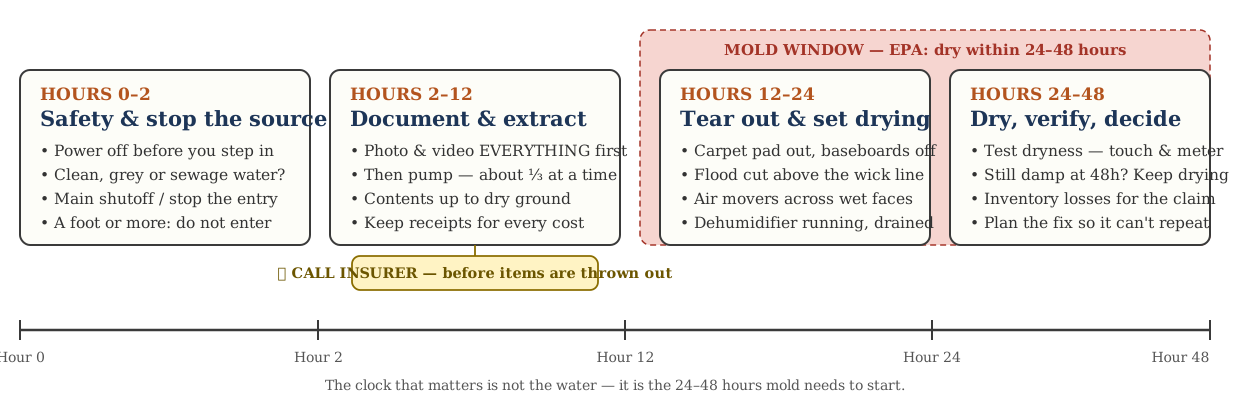
Basement Flooded? The First-48-Hours Playbook: Safety, Pumping, Drying, and Insurance
Standing water in the basement is an order-of-operations problem. The safety rules for hour one, how to document for insurance before you move anything, why you pump in stages, what to tear out, how to dry against the EPA's 24–48-hour mold window, and when the pros are mandatory.
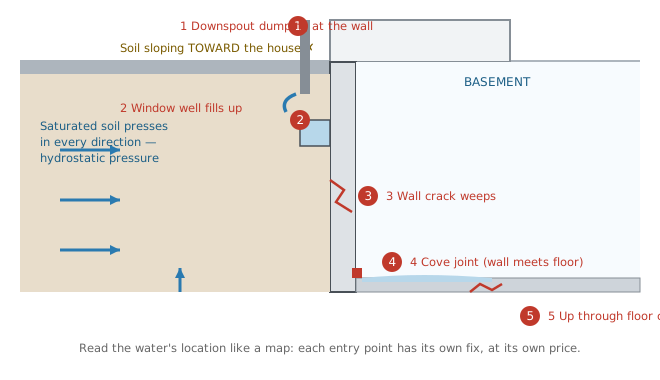
Basement Water After Rain? Read Where It Comes In, Then Fix It in the Right Order
Water at the cove joint, through a crack, up through the floor — each location is a different diagnosis with a different price. The outside-in fix order, hydrostatic pressure explained, sump pumps, and 2026 waterproofing costs.
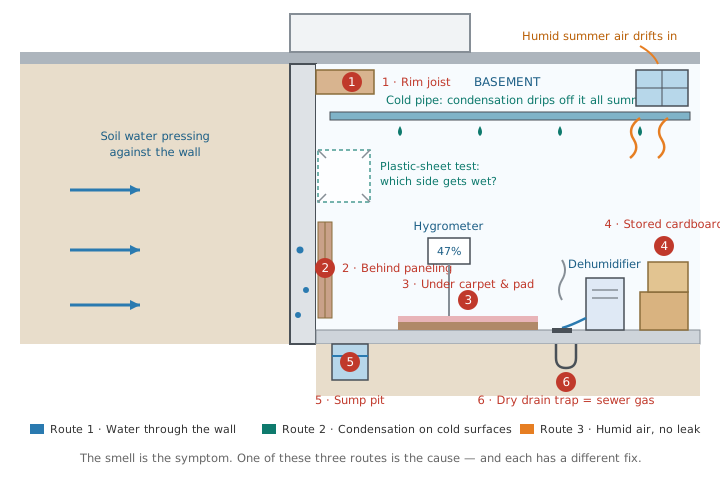
Musty Basement Smell: Find the Moisture Source First, Then Kill the Smell for Good
A musty basement smell is mould and mildew exhaling — and it always points at moisture somewhere. The room-by-room hunt, the dry drain-trap mimic that fools everyone, the humidity band the EPA wants, dehumidifier sizing, and when a pro is worth it.