 Keep
How Far Should a Well Be From a Septic Tank? Setbacks, Explained
 Daniel Mercer · Editor & Researcher·
Published November 16, 2026·
Updated November 16, 2026
If your house runs on a well and a septic system, your yard holds two holes that have to live together for decades: one that pulls drinking water out of the ground, and one that puts your household's wastewater back into it. The distance between them is not a building-code nicety. It is the main thing standing between your kitchen tap and the bacteria and nitrate in your own sewage — and if you just bought the house, nobody may ever have told you what that distance is, or whether yours is enough.
This guide gives you the numbers most states actually use, corrects the one misunderstanding that makes people measure the wrong gap, shows you how to measure your own layout with a tape and a trip to the county records office, and lays out — cheapest first — what to do if your well and septic system turn out to be closer than they should be.
The headline answer — and the correction that matters
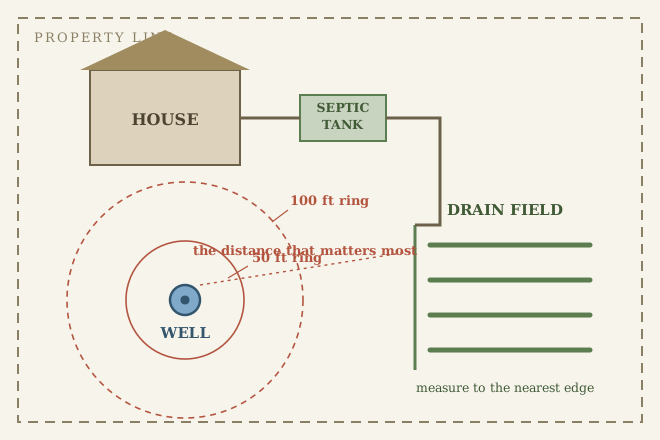
The short version, which holds in most of the country: at least 50 feet between a well and a septic tank, and at least 100 feet between a well and the drain field. The EPA's onsite wastewater guidance lands in the same place, recommending roughly 50 to 100 feet between septic components and a private well.
Now the correction. When people ask "how far should a well be from a septic tank," they picture the tank as the dangerous part. It mostly isn't. A septic tank is a sealed, watertight box. Liquid sits in it, solids settle and float, and almost nothing leaves except through the outlet pipe — a healthy tank leaks about as much as a bathtub does. The drain field is different by design: it is a network of perforated pipes whose entire job is to release partially treated wastewater into the soil, a little at a time, across a wide area. That release is supposed to happen. The soil finishes the treatment as the water percolates down.
So the distance that does the real protective work is well to drain field — which is exactly why most states set the field's setback at double the tank's. A yard where the well sits 60 feet from the tank passes the tank rule easily, but if that same well is 45 feet from the nearest field trench, it fails the rule that matters. Measure both, but judge your layout by the field.
Two more details belong with the headline numbers. First, distances are measured horizontally, at ground level, from the well to the nearest edge of the tank or field — not center to center. Second, these are minimums for a standard private well. Public water supply wells get far bigger buffers (100 to 200 feet in most schemes), and several states tighten the numbers for shallow or poorly cased wells, which we'll get to below.
Why the rule exists: what the soil is doing for you
A setback is really a travel-time rule. Effluent leaving a drain field trench carries bacteria, viruses and nitrate. As that water moves down and sideways through unsaturated soil, three things happen: the soil physically strains out organisms, microbes in the soil outcompete and kill many of them, and time finishes the job — most pathogens die off if the journey takes long enough. Distance buys that journey. Fifty to a hundred feet of decent soil is, for most sites, enough travel time for bacteria and viruses to drop to harmless levels before the water can reach a well's intake zone.
Nitrate is the exception, and it's worth knowing why. Nitrate dissolves and travels with groundwater almost without slowing down, and soil does little to remove it. Distance dilutes it rather than eliminating it. That's why a well can pass a bacteria test and still run high on nitrate — the two contaminants behave differently, and it's why the standard advice for any well near a septic system is to test for both coliform bacteria and nitrate, not just whichever one a basic kit includes. Viruses sit between the two: smaller than bacteria and harder to strain out, but they die off with time, which is another reason the rules buy distance rather than relying on filtration alone.
The other half of the rule is the well itself. A modern drilled well has steel or PVC casing sealed with grout down through the surface layers, so it draws water from deeper down and surface contamination can't simply run down the outside of the pipe. An old dug well, a buried well head, or a cracked cap throws that protection away — contamination doesn't need to travel through soil at all if it can pour straight into the top of the well. Keep that in mind when we get to the fix-it ladder: on real properties, a bad cap at a legal distance causes more trouble than a good well at a short one.
What the states actually require
There is no federal setback for private wells. Your state writes the minimums, and your county health department — which issues the permits and keeps the records — can and often does require more. The table below pulls real numbers from state rules and official guidance so you can see the spread. Read your own state's row as a starting point, not a verdict.
| State | Well to tank | Well to drain field | Worth knowing |
|---|---|---|---|
| Minnesota | 50 ft | 50 ft | A "sensitive" well — under 50 ft of watertight casing — must double both distances |
| New York | 50 ft | 100 ft | Seepage pit 150 ft, cesspool 200 ft; add 50% if the well draws water from less than 50 ft down |
| New Jersey | 50 ft | 100 ft | Seepage pit and cesspool both 150 ft |
| Washington | 50 ft | 100 ft | The well rule sets 50 ft for tanks and chambers, 100 ft for other contamination sources |
| Indiana | 50 ft | 50 ft | Commercial wells 100 ft; public supply wells 200 ft |
| Wisconsin | 25 ft | 50 ft | Among the most lenient for private wells — counties may still be stricter |
| Ohio | 50 ft | 50 ft | One figure covers any sewage-system component |
| Pennsylvania | 50 ft (guidance) | 100 ft (guidance) | No statewide private-well siting standard; Penn State Extension advises these distances and local rules apply |
Three lessons fall out of the table. First, 50 and 100 are the center of gravity — if you remember two numbers, remember those. Second, the exceptions cut both ways: Wisconsin's 25-foot tank setback would be illegal to build new just across the line in Minnesota if the well happened to be a sensitive one, and New York's cesspool distance (200 feet) is four times its tank distance. Third, several states quietly grade the rule by well construction — Minnesota's sensitive-well doubling and New York's shallow-aquifer multiplier both say the same thing: the worse the well, the more distance it needs.
And one honest warning: the county layer is real. Counties with sandy soil, high water tables or dense lakefront lots routinely enforce more than the state floor, and separation distances are generally not waived just because a lot is small. Before you drill, dig or buy, one call to the county health department gets you the numbers that apply to your parcel — that call is free and it is the only version of the rule with your address on it.
Three things that change what the numbers mean
The table gives you distances. Whether a given distance is actually enough on your land depends on three things the tape measure can't see.
Soil. Effluent treatment happens in the soil, and soils are not equal. Clay and loam slow water down and filter well — 100 feet through clay is a long, effective journey. Sand and gravel let water move fast with little filtering, which is why sandy counties and lakeshore districts so often enforce more than the state minimum, and why a legal 100-foot setback in sand deserves more respect for the testing schedule than the same distance in clay. Fractured bedrock is the worst case: water can travel through cracks with almost no treatment at all, and health departments in bedrock country know it.
Direction of flow. Groundwater moves, and it does not always move the way the surface suggests. The protective arrangement is a well that sits upgradient of the septic system, so the natural flow of groundwater runs from the well toward the field. A well downgradient of its field is drinking, in part, whatever the field releases — distance still helps, but it is fighting the current. Surface slope is a reasonable first guess at groundwater direction; the well driller's log and the county's records sometimes say more. This is also why "my neighbor's well is the same distance and he's fine" proves less than it sounds: his well may be upgradient of his field and yours may not be.
What the wastewater goes into. The setbacks above assume a tank feeding a soil absorption field. Older and simpler disposal methods get much bigger numbers because they release wastewater with far less treatment. New York wants 150 feet from a seepage pit and 200 feet from a cesspool; New Jersey sets both at 150. If your property — or the one you're buying — still runs on a cesspool or a seepage pit rather than a tank and field, the generous end of the range is the one that applies to you, and replacement with a modern system is usually a matter of when, not if.
One more layout counts, and owners forget it: your neighbor's system. Setback rules are written around contamination sources, not property ownership. If your well sits near the lot line and your neighbor's drain field sits just across it, the distance between them matters exactly as much as the distance to your own field — and your neighbor's replacement permit will be judged against your well, just as yours is judged against theirs. It's one more reason to know where everything is before anyone starts digging.
Solution, part 1: measure your own layout
Most first-time owners of a well-and-septic house have never seen either component. The tank is buried, the field is just lawn, and the well head may be a pipe cap in the yard or hidden in a pit. Here is the sequence that turns "somewhere out back" into two numbers you can compare against your state's table.
Step 1 — Find the well head. Look for a steel or PVC pipe sticking 8 to 18 inches out of the ground, usually with a rounded cap, often somewhere between the house and the road or near a pressure tank line. Check the basement or crawlspace first if your well is a two-line jet setup, and check any outbuildings. If there's a concrete pit or a fake rock in the yard, look under it — buried and pitted well heads are common on older properties and matter later in this guide.
Step 2 — Get the paperwork before you dig. Your county health department or environmental office usually holds the septic permit file for your parcel: an as-built drawing or site plan showing where the tank and field were installed, often with distances to the house and lot lines already on it. The well should have a completion report or driller's log on file with the state or county, giving its location, depth and casing. Your closing documents and seller's disclosure may include both. An hour of records beats a weekend of probing.
Step 3 — Find the tank and field on the ground. With the as-built in hand, pace or tape from the house to the tank location — the tank usually sits 10 to 25 feet from the foundation on the side where the main drain leaves. A thin metal probe rod pushed into soft soil can confirm the tank lid (you'll feel concrete or fiberglass a foot or two down). The field is harder: look for the greenest strip of lawn in dry weather, a slight depression or swale, or a series of shallow inspection ports. In winter, the field is often where snow melts first. Mark the nearest edge of the field, not its middle.
Step 4 — Measure the two distances. Run a long tape (or a measuring wheel, or the measure tool on a satellite map for a first estimate) from the well head to the nearest edge of the tank, then from the well head to the nearest edge of the field. Write both numbers down with the date. Compare them against your state's row in the table above, keeping in mind your county may require more.
If the records don't exist — a genuinely common situation with older rural homes — you have three escalating options. A septic installer or inspector can locate the tank and field with a probe, a camera run down the line, or a flushable transmitter sonde for a few hundred dollars, usually folded into a pumping or inspection visit. Your state may also hold a well log under a previous owner's name or an old parcel number. And if the system's location is truly unknown, that itself is worth knowing before you build a deck, park an RV or plant a tree over what might be the drain field.
Three measurement mistakes to avoid while you do this. Don't measure to the middle of the drain field — the rule runs to its nearest trench, and on a big field the difference can be 20 feet. Don't measure from the house or the pressure tank; the setback starts at the well head itself, which is sometimes a surprising distance from where the water enters the house. And don't trust a single satellite-map measurement to the last foot — aerial imagery is offset by a few feet here and there, which is fine for a first estimate and not fine for deciding whether you made 100 feet or 97. When the number is close, the tape on the ground is the referee.
Solution, part 2: the fix-it ladder, cheapest first
Say the tape delivers bad news: 38 feet to the field where your state wants 100. Before you price a new well, work the ladder. Most close layouts are managed, not rebuilt — because what actually protects your family is safe water at the tap, and there are several ways to get there.
Rung 1 — Test the water now, then on a schedule ($40–$150 per test). A state-certified lab test for coliform bacteria and nitrate tells you whether the short distance is a paperwork problem or a water problem. Many layouts that violate modern setbacks have delivered clean tests for decades, thanks to soil, slope and good casing. If yours tests clean, put it on an annual rhythm — bacteria and nitrate every year — and keep the results. If it fails, disinfect the well, retest, and climb the ladder.
Rung 2 — Fix the well's own defenses ($150–$600). Inspect the top of the well like an enemy would. The cap should be a sealed sanitary cap, vermin-proof, with no gaps; the casing should extend above grade and the ground should slope away from it; there should be no pit flooding around the head. A cracked cap, a buried well head sitting in a wet pit, or casing rusted through at ground level lets surface water — including runoff that has crossed your septic field — pour straight in, bypassing all that protective soil. A driller can replace a cap, repair casing and regrade the area for a few hundred dollars, and this rung fixes the majority of real contamination cases at any distance.
Rung 3 — Raise and extend the casing ($500–$2,000). If the well head is buried or in a pit, having a driller extend the casing to bring it above grade, with a proper pitless adapter and sanitary seal, removes the single worst feature an old well can have. Deepening casing or adding grout through a confining layer costs more and depends on geology, but it moves a well out of the "sensitive" category that triggers doubled setbacks in states like Minnesota.
Rung 4 — Treat the water at the house ($800–$2,500 for UV). Ultraviolet disinfection kills bacteria and viruses in the water as it enters the house, and it is the standard engineered answer when a layout can't be changed. Know its limit: UV does nothing for nitrate. Nitrate needs reverse osmosis at a drinking tap or an ion-exchange system for the whole house. Treatment is a legitimate, code-recognized layer of protection — several states explicitly allow reduced confidence in distance when approved treatment is installed — but it is a machine with a lamp to change and a power bill, not a one-time fix you can forget.
Rung 5 — Move something ($5,500 and up). Sometimes the answer really is relocation, and the choice is usually between moving the field and moving the well. A new drain field needs suitable soil and a permitted site, and on a small or built-out lot there may be nowhere legal to put it. A new drilled well typically runs $5,500 to $15,000 depending on depth, and full forced relocations of septic components have run from $5,000 to well past $30,000 in bad cases. This rung usually arrives attached to an event — a failed system being replaced, a new well being drilled, a permit pulled — rather than as a standalone project, because at replacement time the new work must meet current setbacks anyway.
Notice what the ladder implies: distance is one layer among several. Soil, slope, casing depth, a sealed cap, testing and treatment all multiply together. A 60-foot layout with a deep, well-cased, upgradient well and clean annual tests is a safer household water supply than a 100-foot layout with a buried well head in a pit and water nobody has tested since 2009.
Buying, selling, and the grandfather question
Almost every too-close layout in America is legal. Setback rules bind the work being permitted — a new well, a new system, a replacement field — not the existing arrangement quietly doing its job. A system installed to the code of its day is grandfathered, and nobody from the county is going to arrive with a tape measure and an order to dig. What grandfathering does not do is guarantee the water is fine; it just means the obligation is yours rather than the county's. The ladder above is how owners discharge it.
Where the layout does become official business is at a sale. Disclosure forms in most states ask what you know about the well and septic system, and "the well is 38 feet from the drain field and the last test was in 2019" is a worse answer than "38 feet, tested annually, results clean, UV installed in 2024." On top of disclosure, many states and counties require a septic inspection, a water test, or both at transfer, and FHA, VA and USDA mortgages require the well water to meet bacteria and nitrate standards no matter what the tape measure says. A failed test in the middle of a closing typically buys treatment, a price credit, or a delay — all negotiated under time pressure. Testing every year on your own schedule is how you make sure that negotiation never happens to you, and if you're the buyer, asking for the septic as-built, the well log and a current water test before closing is the cheapest due diligence in the whole transaction.
How urgent is this, honestly?
If your system was legally installed, your water tests clean, and your well cap and casing are sound, a short setback is a manage-and-monitor item: test annually, keep records, and fold setback compliance into any future well or septic work. It does not need this month's money.
It moves up the list fast if any of these are true: a coliform test comes back positive, nitrate is climbing year over year, the well head is buried or sitting in a wet pit, the well sits downhill from the field, or you're planning a replacement system, a new well, an addition that changes the septic load, or a sale within a year or two. In those cases, start at rung 1 this week — a $40–$150 lab test converts an argument about distances into a fact about your water, and every decision after that gets easier.
Cost at a glance
| Item | Typical cost | Notes |
|---|---|---|
| Lab water test — coliform bacteria and nitrate | $40–$150 | The first move when a layout is close; repeat annually |
| Well cap, casing and sanitary seal repair | $150–$600 | Fixes the most common real-world entry route for contamination |
| Casing extension — raising a buried well head above grade | $500–$2,000 | Price climbs with digging depth and pit removal |
| UV disinfection system, installed | $800–$2,500 | Kills bacteria at the tap; does nothing for nitrate — that takes reverse osmosis or ion exchange |
| New well drilled to replace a badly sited one | $5,500–$15,000 | Depth drives it; full system relocations can run $5,000–$30,000+ in forced cases |
Frequently asked questions
What is the minimum distance between a well and a septic tank?
In most states, 50 feet from the tank and 100 feet from the drain field. Some states use 50 feet for both (Minnesota, Indiana, Ohio), Wisconsin allows 25 feet to the tank and 50 to the field for private wells, and a few require 100 feet from everything. There is no federal standard, so your state rule is the floor and your county health department can require more.
Is the distance measured to the septic tank or the drain field?
Both have their own setback, and you measure each one from the well to the nearest edge of that component — not to its center. The field's number is usually the bigger one because the field is where effluent actually enters the soil. If you only check one distance, check the well-to-field distance.
My well is only 40 feet from the drain field. Do I have to move something?
Usually not right away. A system installed legally under the rules of its time is normally grandfathered — the setback binds new construction, replacements and permits, not your existing daily use. What you should do now is test the water for coliform bacteria and nitrate, fix any cap or casing problems, and retest every year. Moving something becomes necessary if tests keep failing, if you replace the system, or if a sale or permit forces the issue.
Should the well be uphill or downhill from the septic system?
Uphill — or, more precisely, upgradient, so groundwater flows from the well toward the septic system and not the reverse. Surface slope is a clue, but groundwater does not always follow the surface. A well downslope of a drain field at a legal distance can be riskier than a closer well that sits upgradient with good casing, which is why distance is only one part of the picture.
Does a deeper well make a short distance safer?
It helps, and the rules say so. Minnesota doubles its setbacks for a 'sensitive' well — one with less than 50 feet of watertight casing — because shallow, poorly cased wells are the vulnerable ones. A deep well cased through a clay layer draws from a protected aquifer and resists surface contamination far better. But depth reduces risk; it does not waive the setback for new work.
Who sets the setback — the state or the county?
Both, in layers. There is no federal setback for private wells. Your state health or environmental agency writes the minimum distances, and your county or local health department issues the permits, keeps the records and can enforce stricter local distances. When the two disagree, the stricter number wins. One call to the county health department settles which numbers apply to your parcel.
Will a too-close well and septic layout show up when I sell the house?
It can. Many states require a septic inspection or a water test at transfer, and FHA, VA and USDA loans require the well water to pass coliform and nitrate testing regardless of distance. A failed test mid-sale usually means treatment, a credit, or a delayed closing while the problem is fixed — which is why testing on your own schedule, years before you sell, is the cheaper path.
Checked November 16, 2026. This guide is general information, not a substitute for a licensed professional.
Related guides
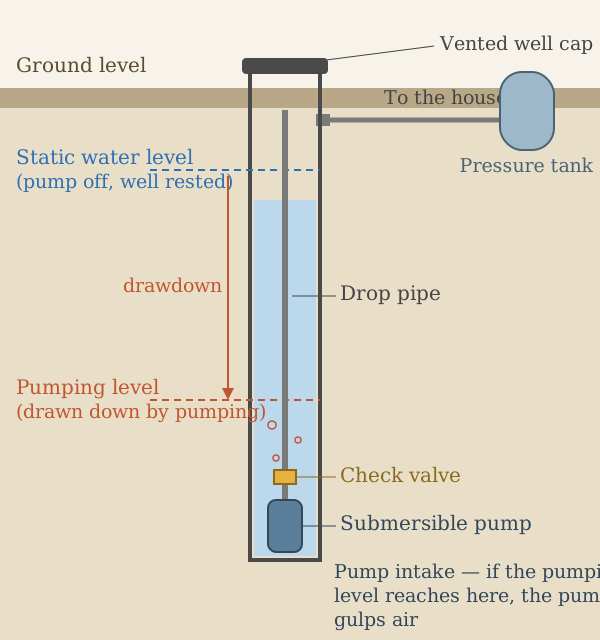
Air in Your Water Lines: Why Faucets Sputter on a Well
A sputtering faucet on well water is a symptom with a short list of causes — drawdown, a leaking check valve or drop pipe, a tired pressure tank, or dissolved gas. How the timing of the sputter tells you which one, the tests to run, and what each fix costs.
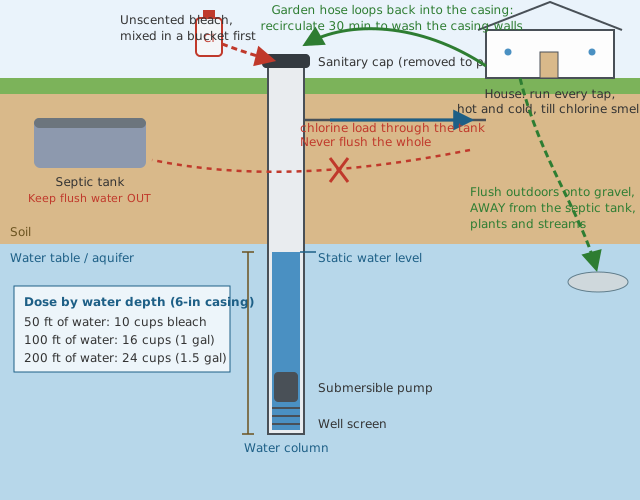
How to Shock Chlorinate a Well: Dose, Steps, and the Retest That Proves It Worked
The full shock chlorination procedure: work out your bleach dose from the well log, bypass the softener, recirculate, hold, flush without wrecking your septic, and retest at 10 to 14 days.
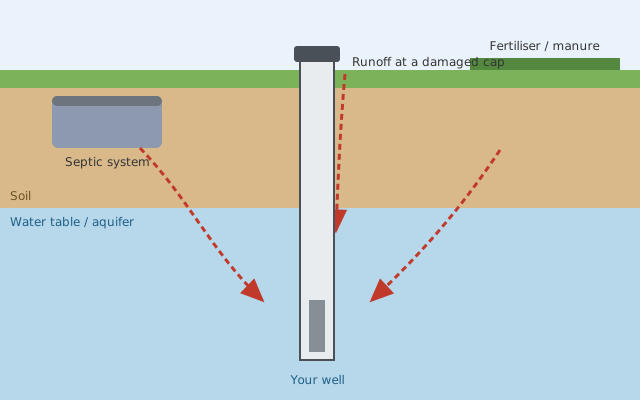
How to Test Your Well Water: What to Test, How Often, and What It Costs
Private wells aren't monitored by anyone but you. The EPA's annual four tests, the one-time baseline panel, how to take a proper sample, what results mean, and what testing costs.