 Keep
How to Test Your Well Water: What to Test, How Often, and What It Costs
 Daniel Mercer · Editor & Researcher·
Published November 16, 2026·
Updated November 16, 2026
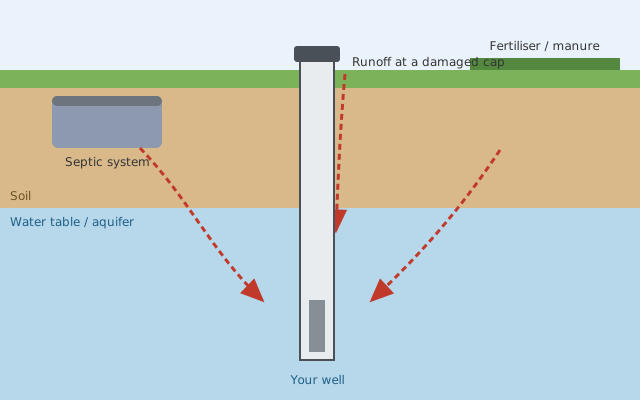
Here is the fact that surprises almost every first-time well owner: nobody is watching your water. If you grew up on city water, a utility tested it constantly, by law, and treated it before it reached your tap. A private well has no utility, no treatment plant and no testing schedule. More than 43 million Americans drink from private wells, and for every one of them, the entire quality-control department is the person who owns the house.
That sounds alarming until you see the actual job. It's one lab test a year, a fuller panel every few years, and a few extra tests when life throws specific events at your well. This guide lays out exactly what to test, when, how to take a sample that a lab can trust, what the results actually mean, and what it all costs.
First, a sense of why the annual habit matters. In 2025, a Virginia Tech extension program tested 2,254 private wells across Virginia. Coliform bacteria turned up in 32.6% of them, E. coli in 4.6%, and lead above healthy levels in 7.6%. These weren't neglected wells in one bad county — they were ordinary homes whose owners mostly believed their water was fine. A third of them were wrong, and none of them could have known by looking at a glass of water.
The annual four: what to test every single year
The EPA and CDC point to the same short list for every private well, every year. Four tests, one sample, one lab visit.
Total coliform bacteria. This is the headline test. Coliforms are a broad family of bacteria found in soil, surface water and the gut of every warm-blooded animal. Most strains won't make you sick. Their value is as an indicator: coliforms should not be inside a properly sealed well at all, so if they show up, there is a pathway — a cracked cap, a failing casing seal, flooding over the wellhead, a septic system too close or failing nearby. Whatever else can travel that pathway is the real concern, including E. coli, which labs report separately from the same sample. The standard for both is simple: absent. Any positive result deserves a response (more on that below).
Nitrates. Nitrate comes from fertiliser, manure and — awkwardly — septic systems, possibly including your own. It is the contaminant with the sharpest edge for one specific group: infants under six months. High nitrate interferes with how a baby's blood carries oxygen, a condition called methemoglobinemia, or blue baby syndrome. The EPA's drinking water limit is 10 mg/L measured as nitrogen, and it's a limit written with babies in mind. Adults tolerate considerably more, which is why a result that's unremarkable for you still matters enormously if there's a pregnancy or a newborn in the house. Boiling does not remove nitrate; it concentrates it.
Total dissolved solids (TDS). A catch-all measurement of everything dissolved in the water — minerals, salts, metals. TDS itself is mostly a nuisance gauge (taste, scaling, staining) with a secondary guideline of 500 mg/L, but its real value is as a tripwire: a well whose TDS suddenly jumps from 280 to 640 has changed, and the change is worth investigating even before you know what changed.
pH. How acidic or alkaline the water is. The comfortable range is 6.5–8.5. Acidic water (below 6.5) is corrosive — it slowly dissolves copper and, in older homes, lead solder and lead pipes, which is how a house can have a lead problem that lives in its plumbing rather than its aquifer. pH is also the number every treatment decision depends on, so labs bundle it in.
That's the whole annual obligation. Four tests, typically one bottle, and at many county health departments the bacteria-and-nitrate core of it is free or nearly so.
The baseline panel: what to add when you're starting from zero
If you've just bought the house, just drilled the well, or have no test history at all, one annual panel isn't the right first step. You want a baseline — a wider snapshot that tells you what kind of water your aquifer serves and what your plumbing adds to it. Beyond the annual four, a baseline panel usually adds:
- Hardness, iron and manganese — the nuisance trio. They stain fixtures orange and black, wreck laundry and taste metallic. Not health threats at typical levels, but they decide whether you need treatment equipment, and they explain half the "something's wrong with my water" calls well owners make.
- Lead — almost always from the house, not the ground: lead service lines, lead solder (common before 1986), brass fixtures. Because it leaches from plumbing, the lab may ask for a first-draw sample — water that's sat in the pipes overnight, taken before any flushing. A flushed sample can look clean while the water you actually drink first thing in the morning is not.
- Arsenic — a geology question. Arsenic occurs naturally in bedrock and shows up in well water in parts of New England, the upper Midwest, the Southwest and scattered aquifers elsewhere. The EPA limit is 10 micrograms per litre (0.010 mg/L). It's tasteless, it's a long-term health risk, and the only way to know is to test. Once, at minimum; your state health department can tell you whether your area warrants repeat testing.
- Anything your location suggests — the next section.
A baseline like this typically runs $150–$400 at a certified lab. You only pay it once; afterwards, the cheap annual four plus a repeat of the wider panel every three to five years keeps the picture current.
Just bought the house? The zero-history baseline
This matters most when the house is new to you and the well has no paper trail — no old reports, no idea when anyone last tested. Treat the first months as building the record from zero:
- During the inspection period: order bacteria and nitrate at minimum. Results land while you can still negotiate and become page one of your file.
- The first week: if the house sat vacant, have the well disinfected and a bacteria sample taken before the family drinks from it — idle wells grow bacteria in the plumbing. Order the full baseline panel too.
- The first month: make the health-department call about local add-ons and run any that apply. If lead wasn't in the panel, take a first-draw sample now.
- Months two and three: retest anything borderline, while the details are fresh.
From there you drop into the normal rhythm — annual four, baseline refresh every three to five years — with a year-zero for every future result to be compared against.
Read your surroundings: the local add-on tests
Groundwater is local. Two wells a mile apart can serve completely different water, and what surrounds your well decides what else belongs on your test list. Walk the map around your house — literally, in your head, a half-mile in each direction:
- Farmland, lawns, golf courses → nitrate (already covered) and, in intensive farming areas, pesticides. Ask your health department which ones are used locally; labs test for specific compounds, not "pesticides" in general.
- Livestock → bacteria and nitrate, tested more often than once a year if animals are kept close to the well.
- A gas station, dry cleaner, or any old industrial site → volatile organic compounds (VOCs) — solvents and fuel components that migrate through groundwater and are a genuine health concern at low levels.
- Mining, past or present → metals: lead, cadmium, arsenic and others, depending on what was mined.
- Radon country → radon in water. Radon is mostly a soil-gas issue, but in granitic regions it dissolves into groundwater too. Your state radon office knows whether your county is on the list.
- Your own septic system → it's part of the map too. A well and a septic system coexist on most rural lots, safely, when both are properly sited and maintained. A failing septic system up-gradient of your well is one of the classic routes to a positive bacteria or nitrate result — which is why a sudden change in either test should prompt a look at the septic side as well as the well.
Your county health department is the shortcut through all of this. They know the local geology, the local land use and the local failure patterns, and most will happily tell a new well owner "in this county, test for X and Y as well." That phone call is free and it is the highest-value step in this entire guide.
Your well's construction changes its risks
Two wells on the same road can need different testing habits, because how a well is built decides what can get into it.
Dug and bored wells — the wide, shallow wells (often under 50 feet) common on older properties — draw from near the surface, and their stone, brick or tile linings were never watertight. They are the most vulnerable wells there are: bacteria, nitrate and anything spilled or spread on the surface can reach them quickly, and results often change with the seasons and the rainfall. If your well is dug, treat the annual bacteria test as a minimum, consider testing twice a year, and be extra prompt after heavy rain.
Drilled wells go deeper, through a sealed steel or plastic casing, and draw from fractured bedrock or deep sand and gravel. The casing and depth shut out most surface contamination, so bacteria positives are less common — but deep water has spent longer in contact with rock, which is where the geological contaminants come from: arsenic, uranium, radon, manganese, and in some regions fluoride or boron. A drilled well's testing leans toward the baseline panel and its chemistry; a dug well's leans toward bacteria and vigilance.
Driven (sand-point) wells sit in between — shallow like dug wells, but with a screened point and tighter construction. Treat them like shallow wells for testing purposes.
Whatever the type, three defences decide most of your results: a sanitary, vermin-proof cap that's intact; casing that extends above ground (at least a foot, and above flood level) with the ground sloping away from it; and distance from contamination sources — septic systems, fuel tanks, animal pens. When a bacteria test comes back positive, these are the first three places a well professional looks, and they're worth a walk-around inspection every spring whether you've tested yet or not.
When to test outside the annual schedule
The yearly test is the floor, not the whole job. Certain events can change your water in a week, and each of them restarts the clock:
- Flooding or standing water around the wellhead. The single most common contamination event. Floodwater is surface water carrying everything it crossed — septic effluent, manure, chemicals — and a submerged or surrounded wellhead lets it straight in. Test for bacteria before drinking normally again, and disinfect if the test is positive. Our emergency guide covers the full after-flood sequence.
- Any work on the well or plumbing. A new pump, a replaced cap, a repaired line — every opening of the system is a chance for bacteria to get in. Disinfect after the work and test before you trust it.
- A change in taste, smell, colour or clarity. Water that changes is telling you something changed underground or in the well. Don't wait for the annual date. (Our guide to well water that smells like rotten eggs covers the most common smell complaint in depth.)
- A pregnancy or a new baby. Test nitrates specifically, even if the annual test was recent. This is the one result where the stakes are genuinely different for one member of the household.
- Septic trouble nearby — yours failing, a neighbour's being dug up, a new system installed close to your well.
- Recurring stomach illness in the household that nobody can explain, especially if guests get it too. Water isn't the most common cause, but it's on the list, and a bacteria test is cheap.
- A new well, or a well that's sat unused. New wells get tested before they're put into service, full stop. A well that's been idle — a vacant house, a foreclosed property — should be disinfected and tested before anyone drinks from it.
Lab, home kit, or the "free test"? Know what each one is
Three kinds of testing will be offered to you, and they are not interchangeable.
A state-certified laboratory is the only result you should act on. Certified labs use standard methods, sterile containers, calibrated equipment and chain-of-custody handling, and their results are the ones health departments accept and the ones that stand up in a property transaction. Find one through your state health department's certified-lab list, or by calling the EPA's Safe Drinking Water Hotline at 1-800-426-4791. Mail-in certified labs are perfectly legitimate too — they ship you the kit, you ship the sample back packed cold.
Home test kits and strips ($10–$30) measure a handful of things with modest accuracy. They're genuinely useful in one role: spotting change between lab tests. If your strips say the pH has moved or nitrate looks higher than last spring, that's your cue to send a lab sample early. What they cannot do is clear your water. A strip that shows nothing proves nothing about bacteria, arsenic, lead or chemicals.
The free in-home test from a water-treatment company is a sales tool. To be fair, the measurements themselves (hardness, iron, TDS, pH) are usually real. But notice what they are: the treatment parameters — the ones that justify equipment — measured by the people who sell the equipment, while the health parameters (bacteria, nitrate, arsenic) are usually sent out or skipped. Take the free test if you like; just don't mistake it for a safety check, and get any equipment recommendation confirmed against an independent lab result before spending thousands.
What real labs actually charge
Public labs publish exact fees — lower than most owners guess. Kenosha County, Wisconsin, charges $35 for the bacteria test and $35 for nitrate. The Wisconsin State Laboratory of Hygiene runs a full VOC panel for $141. Rhode Island's state programme offers an annual well-water kit at $95, with PFAS testing at $200. Your county publishes its own schedule, but the pattern holds: public labs price the health tests in tens of dollars — the add-on chemistry is what costs real money.
How to take a sample the lab can trust
A lab result is only as good as the sample, and bacteria testing is unforgiving about technique. The lab will give you a sterile bottle (sometimes with a preservative tablet inside for the bacteria sample) and its own instructions — follow theirs over anyone's, including this guide's. The general shape of it:
- Pick the right tap. Usually a cold-water tap that's used often, not a garden hose bib and not a tap with a swivel aerator or a filter attached. Many labs say to sample before any treatment equipment, or to note where you sampled if you can't.
- Clean the outlet. Remove the aerator if there is one. Some labs ask you to disinfect the tap opening (a quick wipe with alcohol or a brief flaming on metal taps); do what your lab's sheet says.
- Run the water. Let the cold water run for several minutes — commonly 3–5 — to clear the water that's been sitting in the house plumbing, so you're sampling the well, not the pipes. (The exception is a first-draw lead sample, which is deliberately the opposite: taken first thing, before any water runs.)
- Fill without contaminating. Don't touch the inside of the cap or the bottle mouth, don't rinse the bottle out (you'd wash away the preservative), fill to the line, cap it immediately.
- Keep it cold, get it there fast. Bacteria samples are time-sensitive — labs typically want them within 24 hours, refrigerated or on ice, and never frozen or left in a hot car. Plan the sampling for a morning you can drive it over, or use the lab's courier/mailer exactly as directed.
Sloppy sampling cuts both ways: a contaminated bottle can panic you with a false bacteria positive, and a sample that sat warm in a truck for two days can come back "clean" for the wrong reasons. Either way you've spent money on a number you can't trust.
Reading your results — and what to do with them
The lab report will list each contaminant, your result, and usually the EPA drinking-water standard beside it as a reference. (Those standards legally bind public systems, not your well — but they're the health-based yardstick everyone uses, so treat them as your limits too.) ### Decoding the units on the report
Three units cover almost everything on the report:
- mg/L — milligrams per litre, effectively parts per million.
- µg/L — micrograms per litre, parts per billion. One mg/L equals 1,000 µg/L — which is why arsenic's limit of 10 is a thousand times stricter than nitrate's limit of 10.
- CFU/100 mL — colony-forming units, the bacteria count. For coliform and E. coli the only acceptable count is zero; labs often just report "absent."
| Line on the report | Unit | Benchmark |
|---|---|---|
| Total coliform | CFU/100 mL | Absent (0) |
| E. coli | CFU/100 mL | Absent (0) |
| Nitrate (as N) | mg/L | 10 |
| Arsenic | µg/L | 10 |
| Lead | µg/L | 15 action level — lower is better |
| Total dissolved solids | mg/L | 500 (aesthetic guideline) |
| pH | none | 6.5–8.5 |
| PFOA / PFOS | ppt | 4 each (public-system limit) |
The common outcomes:
Coliform present, E. coli absent. A pathway exists; no proof of fecal contamination yet. Inspect the well cap — is it cracked, loose, or buried? Is the casing above ground and sealed? Disinfect the well with shock chlorination, retest a week or so later, and if it comes back positive again, the problem is structural: a well professional needs to find the pathway rather than you disinfecting forever.
E. coli present. Stop drinking the water until it's resolved. Use bottled water, or boil water vigorously for a minute for drinking and cooking (this is the one case where boiling is the right tool). Disinfect, find the source — recent flooding, septic failure and cap damage top the list — and retest. Two consecutive clean results are the usual all-clear.
Nitrate above 10 mg/L. Nobody should panic, but no infant under six months — and no pregnant household member, to be careful — should drink it, including in formula. Long-term, the answer is finding the source (fertiliser, septic) and either treating (reverse osmosis at the kitchen tap is the common fix for drinking water) or, where it's an option, a deeper well. Retest through the seasons; nitrate often peaks after spring fertilising and heavy rain.
Arsenic or lead above the standard. Both are treat-at-the-tap problems with established fixes — but first confirm with a second sample, because a single metals result can be skewed by sampling or by one fixture. For lead especially, test at more than one tap: if the kitchen is fine and the bathroom isn't, your problem is a fixture, not your aquifer, and the fix is cheaper.
Everything clean. File the report (next section) and put next year's test on the calendar. A clean result is a snapshot of this season, not a lifetime certificate — which is the entire point of doing it annually.
If a result comes back bad: the protocol, in order
A bad result starts a sequence, and the order matters.
- Protect first. Match the response to the contaminant. E. coli: stop drinking the water today — bottled, or boiled vigorously for a minute. Nitrate over 10 mg/L: no tap water for infants or pregnancy, including in formula. Arsenic or lead over the limit: not an emergency — drink bottled water at the kitchen tap meanwhile.
- Confirm before you spend. Retest with a fresh sample and careful technique — a single positive can be a dirty bottle or a warm drive home. Never buy treatment equipment on one unverified number.
- Find the source before you treat. Bacteria means a pathway — cap, casing, flooding, septic. Lead means finding which tap or fixture. Treating water whose source you haven't found just masks the problem.
- Fix, then disinfect or treat. Repair the pathway first; then shock-chlorinate a bacteria well, or fit treatment sized to the confirmed result — reverse osmosis at the kitchen tap for nitrate.
- Retest to prove it. Same test, same lab, after the fix. Two consecutive clean bacteria results are the usual all-clear. File the whole chain — the failure and the fix are the most valuable pages in your water log.
The newer concerns: PFAS and radon
Two contaminants belong on a modern baseline panel even though they weren't on anyone's list a generation ago.
PFAS — the "forever chemicals" (PFOA and PFOS are the best known) — reach wells from firefighting-foam training sites, some industrial facilities, landfills, and certain agricultural and manufacturing histories. In April 2024 the EPA set enforceable drinking-water limits for public systems (4 parts per trillion for PFOA and PFOS individually), but as this guide has noted throughout, no regulation reaches your private well — the public-system limits are simply the best benchmark to judge your own results against. PFAS testing is the expensive line on the menu: a proper lab panel typically runs $300–$500, needs special sampling care (the chemicals are in so many consumer products that sloppy sampling contaminates the sample), and is worth doing once as part of a baseline if your surroundings include any of the sources above — or if your state offers a subsidised programme, as several now do for private wells near known sites. If PFAS shows up above the public-system benchmark, the proven household fixes are granular activated carbon and reverse osmosis units certified for PFAS reduction — another conversation, but one that starts with a number on a lab report.
Radon is a soil gas best known for seeping into basements through the air, but in granite-heavy regions — much of New England, the Appalachian spine, parts of the upper Midwest — it also dissolves into groundwater and arrives through the tap, releasing into indoor air every time you shower. The EPA has never finalised a drinking-water standard for radon (a level of 300 pCi/L was proposed as a guideline), and state guidance varies, which is why it belongs in the "know your region" category: if your state health department flags radon-in-water for your county, add the test (typically $30–$60, or bundled into a baseline panel) and treat a high result as a whole-house conversation — aeration systems remove radon from water effectively, and the air pathway usually matters more.
One more habit belongs with these two tests: file the results with your house papers, permanently. Well-water results have a second life at resale — buyers of well homes routinely ask for recent test reports, lenders and some states require a test at transfer, and a documented history of clean annual panels is a selling point money can't improvise on closing week. The owner who produces ten years of lab reports sells certainty; the owner with none sells a question mark. Every test in this guide costs the same whether you keep the paper or not — keep the paper.
Neither test is annual. Both are exactly what a baseline is for: finding out, once, whether your particular patch of ground has a particular story.
Keep a water log: the cheapest diagnostic tool you own
One test tells you about today. A folder of tests tells you about your well. Nitrate creeping from 2 to 4 to 6 mg/L over five years is a story — something up-gradient is changing — and you'd never see it from any single result. TDS drifting up, hardness changing, bacteria appearing every spring but never in autumn: patterns like these are how well professionals spot a failing septic system, a degrading casing, or a shifting water table years before it becomes an emergency.
The log can be a notebook in the kitchen drawer or a folder on your computer. For each test, record the date, the lab, where the sample was taken, the results, and anything notable at the time — flooding that month, septic pumped, new pump installed, drought summer. When you sell the house, that folder is also a genuine asset: a buyer looking at ten years of clean, documented results worries about the well a great deal less.
The habit, in one paragraph
Once a year, send a sample to a certified lab for bacteria, nitrate, TDS and pH. Every three to five years — and once at the start, if you're new to the house — run the wider baseline panel. Test immediately after floods, repairs, changes in the water, or before a baby arrives. Keep every report. Total cost in a normal year: often under a hundred dollars, sometimes free at the county. For the one system in your house that nobody else is watching, that's the whole job — and now it's yours on purpose instead of by accident.
Cost at a glance
| Item | Typical cost | Notes |
|---|---|---|
| County health dept. test (bacteria + nitrate) | Free–$50 | Many counties subsidise exactly the two tests that matter most |
| Certified lab annual panel | $50–$200 | Bacteria, nitrate, pH, TDS, usually hardness and iron too |
| Comprehensive lab panel | $150–$400 | Adds metals (arsenic, lead, manganese), sometimes VOCs or pesticides |
| Home test strip kit | $10–$30 | Screening only — useful between lab tests, never instead of them |
Frequently asked questions
My well water tastes fine and looks clear. Do I still need to test it?
Yes. The two contaminants at the top of the annual list — bacteria and nitrates — are invisible, tasteless and odourless. Water can carry both and seem perfect. Taste and clarity tell you about iron, hardness and sulfur, the nuisance side of well water. They tell you nothing about safety, which is exactly why the annual lab test exists.
Does the government test my well water?
No. Private wells are not covered by the federal Safe Drinking Water Act, and in most states nobody monitors them after the day they're drilled. City water is tested constantly by law; well water is tested only when the owner arranges it. That responsibility — and the testing bill — sits with you.
Are home test kits good enough?
For screening, yes; for decisions, no. Strips and home kits give rough readings on things like pH, hardness and sometimes nitrate, and they're handy for noticing a change between lab tests. Their accuracy on bacteria is poor, and no home kit can measure arsenic, lead or most chemicals at the levels that matter. Use them as an early-warning system, and confirm anything that matters at a certified lab.
My test came back positive for coliform. What now?
Don't panic, and don't ignore it. Coliform bacteria are indicator organisms — most are harmless themselves, but their presence means surface water or waste has a pathway into your well, and worse organisms can use the same path. The standard response: inspect the well cap and casing for damage, disinfect the well (shock chlorination), then retest. If E. coli specifically was found, use bottled water for drinking until a retest is clean — E. coli means fecal contamination, not just a pathway.
Should I test the water before buying a house with a well?
Absolutely — during the inspection period, not after closing. Order at least the bacteria and nitrate tests, and ideally a fuller panel including lead and arsenic, since you'll inherit whatever the results show. Some lenders require a bacteria test for loans on well properties anyway. A bad result isn't always a deal-breaker, but it is negotiating information you want before the house is yours.
Does boiling make well water safe?
Boiling kills bacteria and viruses, which is why it's the standard advice during a bacteria event. But it does nothing for nitrates, lead, arsenic or chemicals — and because some water boils off as steam, it actually concentrates them slightly. Boiling is a short-term answer to a bacteria problem, never a treatment for a chemical one.
How much does well water testing cost?
Less than most people expect. Many county health departments test bacteria and nitrate free or for under $50. A certified lab's annual panel typically runs $50–$200, and a comprehensive panel with metals and chemicals $150–$400. Compared with the cost of treating a problem you didn't know about — or a baby exposed to high nitrate — the annual test is one of the cheapest safety checks in the house.
Checked November 16, 2026. This guide is general information, not a substitute for a licensed professional.
Related guides
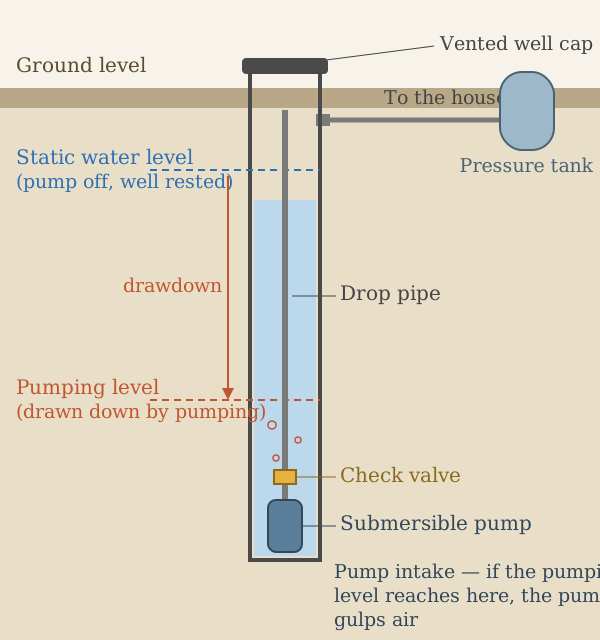
Air in Your Water Lines: Why Faucets Sputter on a Well
A sputtering faucet on well water is a symptom with a short list of causes — drawdown, a leaking check valve or drop pipe, a tired pressure tank, or dissolved gas. How the timing of the sputter tells you which one, the tests to run, and what each fix costs.
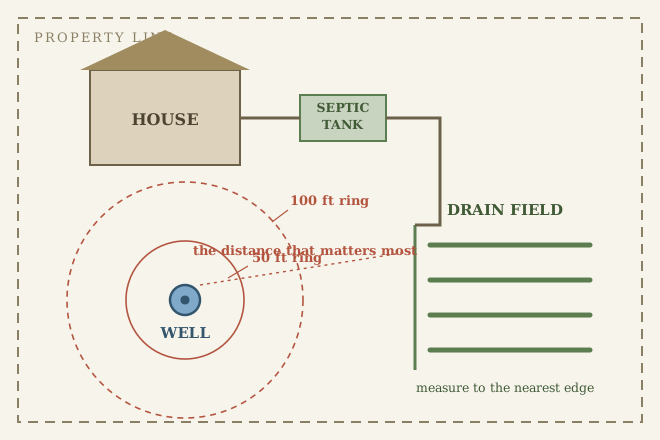
How Far Should a Well Be From a Septic Tank? Setbacks, Explained
Most states want 50 feet between a well and a septic tank and 100 feet to the drain field — but the field is the distance that actually protects your water. How to measure yours, and what to do if it comes up short.
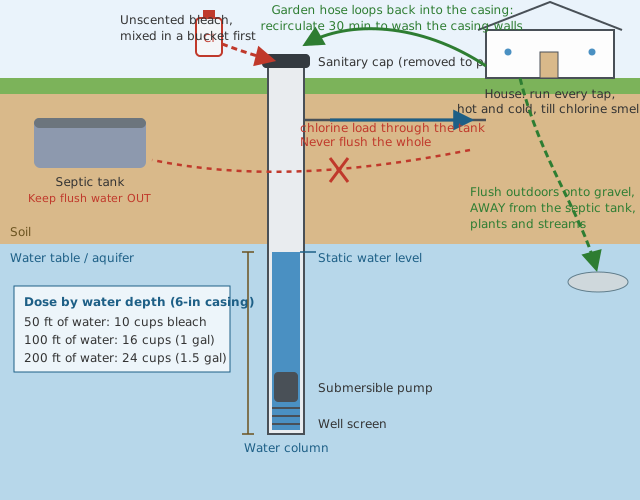
How to Shock Chlorinate a Well: Dose, Steps, and the Retest That Proves It Worked
The full shock chlorination procedure: work out your bleach dose from the well log, bypass the softener, recirculate, hold, flush without wrecking your septic, and retest at 10 to 14 days.