 Keep
How Long Does a Septic System Last? Lifespan by Part, and How Much Life Yours Has Left
 Daniel Mercer · Editor & Researcher·
Published November 16, 2026·
Updated November 16, 2026
Search "how long does a septic system last" and you will collect a different number from every page you open: 15 years, 20 years, 25 to 30, 40, sometimes 50. If you have just bought a house with a system of unknown age, that spread is not reassuring. It sounds like nobody actually knows.
The truth is less mysterious. Every one of those numbers is a real answer, but they are answers about different things. A septic system is not one object with one lifespan, the way a water heater is. It is a tank, a set of pipes, a field of soil doing biological work, and (on many systems) a pump and controls, and each of those parts wears out on its own clock. Ask "how long does it last" about the tank and the honest answer may be half a century. Ask it about the drainfield and the honest answer is closer to a generation. Ask it about the pump and you are down to a decade or two.
This guide goes part by part, so you can see which clock each number belongs to. Then it does the thing the averages cannot do: it walks you through dating your own system and reading its condition, so you end with a realistic band of remaining years for the system buried in your yard, not a national average for somebody else's.
Why every source gives you a different number
Start with the awkward fact that the authorities do not agree with each other, or even with themselves. The EPA's homeowner guide to septic systems puts a well-maintained system's life at roughly 15 to 40 years. The EPA's own septic FAQ, asked the same question, advises homeowners to plan on upgrading or replacing a system at around 25 to 30 years. Texas's environmental agency (TCEQ) has published a figure as low as 15 years. None of these is a typo, and none of them is lying to you.
They are measuring different things. The 15-to-40-year range is a design-life statement about conventional systems as a class, from the shortest-lived installations on poor soil to the best-sited ones. The 25-to-30 figure is planning advice: the point at which a prudent owner should expect major work and have money set aside, which is a different question from when a system physically gives up. And the pessimistic numbers usually describe systems as they are actually treated, not as they are supposed to be treated. A system that is never pumped and is flooded with laundry water every weekend does not live as long as the design life on the permit, and statistics gathered from real failures reflect that.
There is a second source of confusion. When a system "fails," it is almost never the whole system. What fails is a part: the drainfield clogs, the pump burns out, a steel tank rusts through. The rest is often fine. So one owner's "my septic lasted 22 years" means the field gave up at 22, while the tank from that same system might have served another two decades under a new field. Once you separate the parts, the contradictions mostly dissolve. The question stops being "how long does a septic system last" and becomes "how long does each part last, and which one will end mine."
Lifespan by part: four clocks, one system
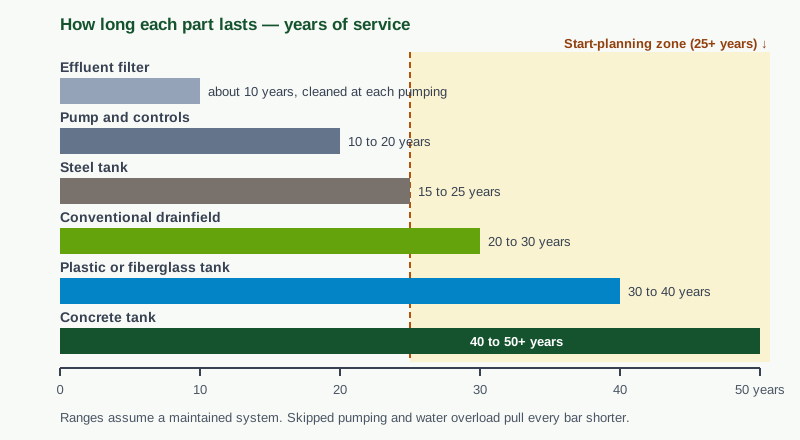
Here is the whole picture on one chart. The rest of this section explains each bar, because the reasons behind the numbers are what let you judge your own system.
The tank, by material. The tank is the longest-lived part of most systems, and its material sets the ceiling. Concrete is the marathon runner: a sound concrete tank commonly lasts 40 to 50 years and often longer, because there is little in sewage that attacks good concrete quickly. Plastic and fiberglass tanks run 30 to 40 years; they cannot rust, but they depend on careful bedding at installation, and a tank that was poorly bedded can deform or crack early. Steel is the sprinter, and not in a good way: 15 to 25 years is the usual range, and as the steel section below explains, important parts of a steel tank give up long before the shell does. If you take one fact from this guide, take this one: two systems installed the same year can have tanks with a 25-year difference in expected life, purely because of what the tank is made of.
The drainfield. The field is where treated water soaks into soil, and it is the part that ends most systems. A conventional field typically lasts 20 to 30 years. It does not wear out mechanically; it clogs. A living layer called the biomat forms where effluent meets soil, and in a healthy field it stays in balance, treating wastewater as it passes. Over years it thickens. Feed it extra solids from an unpumped tank, or drown it with more water than the soil can accept, and it thickens faster until the soil can no longer take water at the rate your house produces it. That is the failure nearly every "my septic died" story is actually describing, and it is why the field's clock runs on treatment, not just time.
Pumps, floats and controls. Systems that pump effluent uphill to the field, or dose it in timed amounts, carry mechanical parts on a much shorter clock: roughly 10 to 20 years for the pump, with floats, switches and alarm components often replaced sooner. These are wear parts, priced in hundreds rather than thousands, and replacing one is maintenance, not system failure. Owners sometimes panic when a 12-year-old pump dies on a 12-year-old system; the pump simply reached the end of its own shorter life on schedule.
The effluent filter. The smallest part has the shortest clock. The filter sits at the tank outlet and strains solids out of the water heading to the field. Figure on about a decade of service, with a cleaning at every pumping in between; a neglected filter clogs and causes backups that get misread as bigger problems. It is also, dollar for dollar, the best protection the drainfield has, which is why it appears again in the life-extension section below.
The remaining-life worksheet: how much life does yours have left?
Averages cannot tell you about your system. These four steps can. None of them requires digging, and together they take an afternoon of paperwork and a walk around the yard. Work through them in order; each step narrows the estimate the step before gave you.
Step 1: Date the system. You need a year, and there are more places to find it than most owners realise. The septic permit and as-built drawing sit at your county health or environmental department, and they carry the installation date, the tank size and usually the tank material. Your closing paperwork may include a septic inspection or a seller's disclosure naming the system's age. The house's own build year is a usable first estimate, since most systems go in with the house, though on older properties the system may be newer than the house (a replacement) or, occasionally, older than an addition. Pumpers' invoices count too: if the previous owner left any, the service company named on them keeps records and will often tell a new owner what they have on file. Write down the year and where it came from. A permit date is solid evidence; a neighbour's recollection is a hint.
Step 2: Identify the tank material. Age means different things depending on what the tank is made of, so this step converts your year into a position on the right bar of the chart. The permit often states the material outright. Age is a strong clue by itself: systems from before about 1980 are the steel era, and some are older still, including homemade tanks and even cesspools that predate modern rules. The 1980s and 1990s brought concrete to dominance, and concrete remains the most common material in the ground. Plastic and fiberglass appear mostly from the 1990s onward and dominate lightweight and difficult-access installs. If the lids are accessible, a pumper or inspector can confirm the material in minutes at the next visit, and the tank's condition at the same time. If your Step 1 date and Step 2 material give you "concrete, 2009," you already know the tank is a minor character in your planning. If they give you "steel, 1978," the rest of the worksheet is about the field, because the tank's story is nearly over.
Step 3: Read the pumping history. For the drainfield, history predicts the future better than age does. A field that has received effluent from a regularly pumped tank has been fed mostly clarified water, and its biomat thickens slowly. A field behind a tank that went 15 years unpumped has been fed solids it was never designed to take, and it will have used up its life faster than the calendar says. Look for pumping receipts in the house paperwork, ask the service company from Step 1 what their records show, and be honest about the pattern you find: pumped every three to five years, pumped occasionally, or no evidence of pumping at all. That third answer does not mean the field is dead. It means you should weight Step 4 more heavily and get a professional inspection sooner, because the field has been working under the harshest conditions.
Step 4: Score the drainfield's behaviour. The field tells you how it is doing, if you know what to look for. Walk the field area and ask four questions. Is any part of it soggy, spongy or wet when the weather has been dry? Is there effluent, meaning grey or dark water, surfacing anywhere, or a sewage smell over the field after heavy use? Does the grass over the field grow in suspiciously lush, green stripes while the rest of the yard is ordinary, a sign the field is feeding the lawn from below because it can no longer soak water down fast enough? And inside the house, do drains slow down or gurgle after rain or on heavy laundry days, then recover? Our guide to drain field failure signs walks through each of these in the order they usually appear. A field with none of these signs is behaving like a field with years left. A field with two or more is telling you its remaining life is short regardless of what its birthday says.
Putting it together: your remaining-years band. Now combine the four steps the way an inspector would. Start with the field's typical span, 20 to 30 years, and place your system in it by age. Then adjust: regular pumping and a clean Step 4 push you toward the long end; no pumping history or early warning signs pull you toward the short end. Then check the tank separately against its own material bar. A worked example: a system permitted in 2004 with a concrete tank, pumping receipts every four years, and a dry, unremarkable field. The field is 22 years in, well kept, showing nothing; a realistic band is another 8 to 15 years of field life, with the tank good for decades beyond that, and the sensible plan is an inspection now and a replacement fund aimed at the early 2030s. Contrast a system from 1998, material unknown, no records, and a lush stripe over the field: the honest band is "unknown, possibly short," and the worksheet's answer is to buy the inspection, because no paperwork exercise can substitute for measured sludge levels and a field check. That is the worksheet's real product. Sometimes it gives you a number of years. Sometimes it tells you the next three hundred dollars should go to finding out.
Why some systems beat the chart
Every neighbourhood has one: a system installed in the 1970s, still working, whose owner will tell you the whole lifespan question is overblown. They are not wrong about their system, and their system is not proof the chart is wrong. Long-lived systems tend to share the same few advantages, and naming them tells you which side of the averages your own system is likely to fall on.
The first is gentle use. A two-person household on a system sized for four has been running the field at half its design load for decades, and fields age by throughput as much as by time. Part-time and holiday homes stretch this further: a system used twelve weeks a year can outlive its owners' grandchildren, because the soil rests and recovers between visits. The second is soil. A field in deep, well-drained soil with the water table far below it has margin for error; a field in tight clay above a high water table has almost none, and identical maintenance produces very different lives in the two. The third is the unglamorous one: the long survivors were almost always pumped on schedule by owners who kept records, which is why their current owners inherited paperwork as well as plumbing.
There is also a catch hiding inside most of these stories. Ask what has been replaced along the way and the "original 1978 system" usually turns out to have its original tank and field wrapped around a newer pump, replacement baffles, a filter added in the 2000s and at least one field repair nobody counts as a replacement. That is not cheating; it is exactly how a system is supposed to be kept. But it means the honest reading of a 50-year-old system is not "they last 50 years untouched." It is "a system maintained part by part can serve for 50 years," which is the argument of this entire guide stated as a single sentence.
The steel-tank endgame: a safety story, not just a lifespan
Steel deserves its own section because its failure mode is different in kind, not just in timing. A concrete tank at the end of its life usually announces itself slowly. A steel tank corrodes, and corrosion attacks the parts in an order that matters.
The baffles go first. The inlet and outlet baffles inside a steel tank are thinner metal in the most corrosive position, and they commonly rust away within 5 to 7 years. Once the outlet baffle is gone, the scum layer is no longer held back, and solids that should have stayed in the tank wash into the drainfield with every flush. A steel tank can therefore be killing its drainfield while the tank itself still looks, from the surface, like it is working. The shell and top follow over the following years, rusting thin from the inside out. A tank top that has rusted to foil thickness is a collapse hazard in the most literal sense: people have fallen through corroded septic lids and tank tops, and the gases inside a tank can kill in seconds. This is why the advice for an old steel tank is not just "budget for replacement." It is: do not walk across it if you can avoid it, never drive over it, never stand on a rusted lid to test it, and never, under any circumstances, lean into or enter the tank.
If your house predates 1980 and the system's material is unknown, treat steel as the working assumption until an inspection proves otherwise. The inspection itself is safe and quick: a professional opens the lids from the surface, checks the baffles and the shell's condition, and measures the layers. What you do with the answer is a planning decision, covered below. What you should not do is nothing, on the theory that it has lasted this long. With steel, lasting this long is the warning, not the reassurance.
What shortens a system's life the most
If the chart above is the schedule, these are the things that tear pages out of it. They are ranked by how much damage they do, and the ranking is not close at the top.
Skipped pumping is the single biggest life-shortener, and it works through the drainfield. Every year a tank goes unpumped past its interval, the sludge and scum layers grow toward the outlet. Once they reach it, solids begin leaving with the effluent, and the field's biomat thickens far faster than it was designed to. A clogged field cannot be pumped clean or flushed back to health; that is what makes this habit so expensive. It converts a few hundred dollars of routine service into the five-figure end of the cost table below.
Water overload is second. A septic system is sized for a daily flow, and the soil needs rest between doses to drain and breathe. The classic overloads are mundane: a toilet flapper leaking hundreds of gallons a day into a tank that never gets a quiet hour, seven loads of laundry run back to back on Saturday, a hot tub drained to the system in an afternoon, a house full of guests for a week on a system sized for two. Any one of these, once, is survivable. As a pattern, they keep the field saturated, and a saturated field clogs.
Physical abuse of the field comes third. Driving or parking over the drainfield compacts the soil and can crush pipes, and compacted soil does not recover its absorption. Building over it, planting trees whose roots hunt the moisture in the lines, and diverting roof gutters or surface water onto it all do the same work more slowly. The field needs to be the most boring part of your yard: grass, open sky, nothing else.
What goes down the drain rounds out the list. A garbage disposal adds a heavy load of ground food solids and shortens the pumping interval, which is a manageable cost if you pump on the shorter schedule and a field-killer if you do not. Harsh chemicals are worse. Solvent-based additives and drain chemicals can kill the bacteria the treatment process depends on and carry contaminants through the field toward groundwater; our guide to whether septic tank additives work covers what the EPA and the research actually found. The system's biology is not delicate, but it is not invincible either.
Life-extension moves, ranked by what a dollar buys
You cannot make a septic system immortal, but the spread between a neglected system's life and a kept system's life is routinely a decade or more, and most of that spread is bought cheaply. In order of cost-effectiveness:
1. Pump on schedule. A few hundred dollars every three to five years, set by your tank size and household, is the highest-value money in this entire guide because it protects the drainfield, the part whose replacement costs thousands. Our septic pumping guide works out your exact interval from the EPA table by tank size and household size, and gives the one-third rule that overrules the calendar when the two disagree. If you do nothing else in this section, do this.
2. Fit an effluent filter if your tank lacks one. For roughly $150 to $400 installed, the filter strains solids out of the water leaving the tank, which is a second line of defence for the field behind the pumping schedule. It needs cleaning at every pumping, a few minutes with a hose while the lids are already open. No other item on this list protects so much for so little.
3. Spread the water. Free, and worth years. Move laundry across the week instead of stacking it, fix the running toilet and dripping taps promptly, use water-saving fixtures when the old ones are replaced anyway, and keep roof and surface drainage pointed away from the field. You are not rationing water; you are giving the soil the recovery time the design assumed it would get.
4. Rest or rotate the field, if your lot allows it. Some properties have a designated reserve area, and some older systems were built with two fields and a diverter valve. Where that exists, resting a field for a season or more lets the biomat thin and the soil recover, and alternating fields can stretch the pair's combined life well past a single field's span. A septic professional can tell you whether your property has a reserve area on its permit. This is the one move that can genuinely give a tired field some of its youth back, and it costs little more than a valve turn where the hardware already exists.
5. Fix the small mechanicals on their own clocks. Pumps, floats, alarms and filters are wear parts with 10-to-20-year lives. Replacing a failing pump for a few hundred dollars when it starts to struggle is maintenance; ignoring it until the tank overfills and pushes solids to the field is how a cheap part takes an expensive one with it.
Notice what is not on this list: additives, treatments and miracle products. Nothing you pour into a toilet extends a system's life in any study the EPA recognises. The list above is short because the real list is short, and every item on it is either cheap or free.
Turning the estimate into a money plan
A remaining-life band is only useful if it changes what you do, and what it should change is a date in your budget. Take the band from the worksheet, take the replacement figures from our guide to how much it costs to fix or replace a failed septic system, and put the two together: if your field's realistic band is 8 to 15 years and a field replacement in your area runs $5,000 to $15,000, you are looking at a known expense arriving in a known window, which is the definition of something you can save for calmly instead of borrowing for in a panic. Owners who get destroyed by septic costs are almost never the ones whose systems failed. They are the ones whose systems failed as a surprise. The worksheet exists to make sure yours is not one.
Two timing notes. First, a system in the start-planning zone, past 25 years or showing early field signs, deserves an inspection every couple of years rather than the standard three, because the band narrows fast once a field starts to go and catching it early can mean a partial repair instead of a full replacement. Second, if you are selling, all of this inverts in your favour: a documented pumping history and a recent inspection are exactly what a buyer's lender wants to see, and they cost you a fraction of the price reduction an undocumented system invites.
What the verdict costs
The table at the top of this guide lists the prices that matter for this question. The inspection, at $150 to $350, is the pivotal one: it is the visit that converts your worksheet band into a professional verdict, with the sludge and scum layers measured, the baffles and filter checked, and the field examined. Effluent filters and pump replacements are the mid-life maintenance figures, the cost of keeping the shorter clocks on schedule. The two big numbers, a drainfield at $5,000 to $15,000 and a full conventional replacement at $6,500 to $15,000, are there so the planning maths above uses real figures rather than fears. Most owners who work the worksheet discover their number is the small one at the top of the table, payable now, against the large ones at the bottom, payable years later than they feared.
What you can judge yourself, and what needs a professional
Everything in the worksheet is yours to do: the records search, the material identification, the history, the walk over the field. None of it involves opening the tank, and that boundary is the whole rule. The moment a judgement requires looking inside the tank, at baffle condition, layer depths or shell corrosion, it belongs to a professional with the right equipment and training. Septic tanks contain gases that can overcome a person in seconds, and no inspection, photograph or curiosity justifies leaning into one. Hire the measurement; never improvise it.
The bottom line
A septic system does not have a lifespan. Its parts have four different ones: a filter at about a decade, pumps and controls at 10 to 20 years, a steel tank at 15 to 25, a drainfield at 20 to 30, and a plastic or concrete tank at 30 to 50-plus. The system's real life is set by the drainfield, and the drainfield's life is set less by its age than by how it has been fed. Date yours, identify the tank, read the history, score the field, and you will know more about your system's future than any national average can tell you. Then pump on schedule, spread the water, and let the cheapest habits in homeownership buy you the most expensive years.
Cost at a glance
| Item | Typical cost | Notes |
|---|---|---|
| Full system inspection | $150–$350 | The visit that turns this worksheet into a verdict; often discounted when bundled with pumping |
| Effluent filter, installed | $150–$400 | The cheapest life-extension there is; cleaned at each pumping after that |
| Septic pump replacement | $400–$1,200 | For pumped systems; pumps are wear parts on a 10 to 20 year clock |
| Drainfield replacement | $5,000–$15,000 | The part that usually ends a system's life; complex sites reach $20,000 |
| Full conventional system replacement | $6,500–$15,000 | New tank and new field on decent soil; most homes land between $7,000 and $13,000 |
Frequently asked questions
How long does a septic system last on average?
Averages hide more than they reveal, because the parts age at different speeds. A concrete tank commonly serves 40 to 50 years or more, plastic and fiberglass tanks 30 to 40, steel tanks 15 to 25, and a conventional drainfield 20 to 30. The EPA's own publications put the whole system at 15 to 40 years in one guide and advise planning an upgrade at 25 to 30 years in another. In practice the drainfield is the part that ends most systems, so a well-kept system is usually planned around a 25 to 30 year field, with the tank often outliving it.
How long does a drainfield last compared with the tank?
Shorter, in almost every case. A conventional drainfield typically lasts 20 to 30 years, while a concrete tank lasts 40 to 50 or more. The field fails by clogging: a biological mat that is supposed to live in the top of the soil slowly thickens and seals it, and solids carried over from an unpumped tank speed that up dramatically. This is why two houses built the same year can have systems in completely different shape, and why pumping history predicts a field's future better than its age does.
Can a septic system last 50 years?
The tank can. Concrete tanks installed in the 1970s are still in service all over the country, and a well-sited field on good soil with disciplined pumping and modest water use can also run far past the averages. What rarely survives untouched for 50 years is everything at once: pumps, floats, filters and baffles are replaced along the way, and most fields need at least partial work. Think of a 50-year-old system as a house with its original foundation but a replaced roof, not as a machine that never needed a part.
What shortens a septic system's life the most?
Skipped pumping is number one, because it lets solids escape the tank and clog the drainfield, the one part you cannot clean back to new. Close behind are water overload (a leaking toilet flapper, marathon laundry days, a hot tub drained to the tank), driving or parking over the field, and diverting roof or surface water onto it. Garbage disposals shorten the pumping interval by adding solids, and harsh chemical or solvent additives can damage the treatment biology and, in the solvent case, the field itself.
How can I tell how much life my septic system has left?
Work through four things: the system's age from the permit or closing records, the tank material (steel is the short-lived one), the pumping and inspection history, and the drainfield's current behaviour, meaning no soggy ground, no surfacing, no slow drains after rain. Combine them and you get a realistic band rather than a guess. A professional inspection, with the scum and sludge layers measured and the field checked, turns that band into a firm answer for a few hundred dollars.
Does pumping really extend a septic system's life?
Yes, and the mechanism is specific. Pumping removes the sludge and scum before they reach the outlet and migrate into the drainfield, where they accelerate the clogging that ends the field's life. Pumping does almost nothing for the tank itself, which would last for decades either way; it protects the most expensive and least repairable part of the system. It is the cheapest life-extension available, a few hundred dollars every three to five years against a drainfield replacement in the thousands.
My house was built in the 1970s and has a steel tank. Should I replace it now?
Plan on it, and get it inspected soon. Steel tanks typically last 15 to 25 years, so a 1970s steel tank is well past its design life. The baffles inside steel tanks often rust away within 5 to 7 years, letting solids reach the field, and the lids and tank top rust thin enough to become a genuine collapse hazard. Do not walk or drive over it, and never step on a rusted lid to test it. An inspection will tell you whether replacement is a this-year job or a budgeted next-year job, but it is coming either way.
Checked November 16, 2026. This guide is general information, not a substitute for a licensed professional.
Related guides
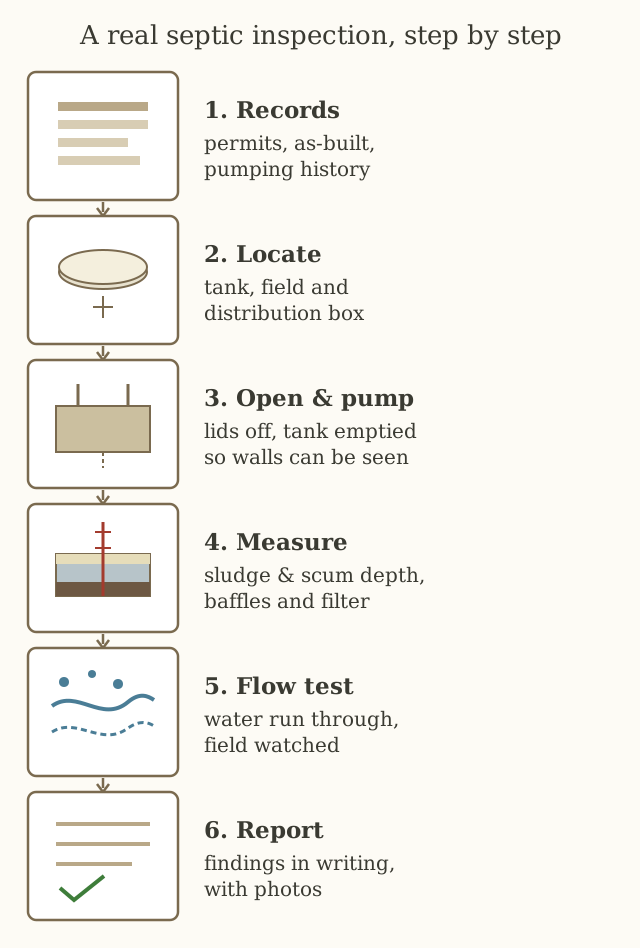
Buying a House With a Septic System? The Inspection That Can Save You $20,000
A standard home inspection barely touches the septic system. Here's what a real septic inspection includes, what it costs, the records to demand, and the contract wording that protects you.
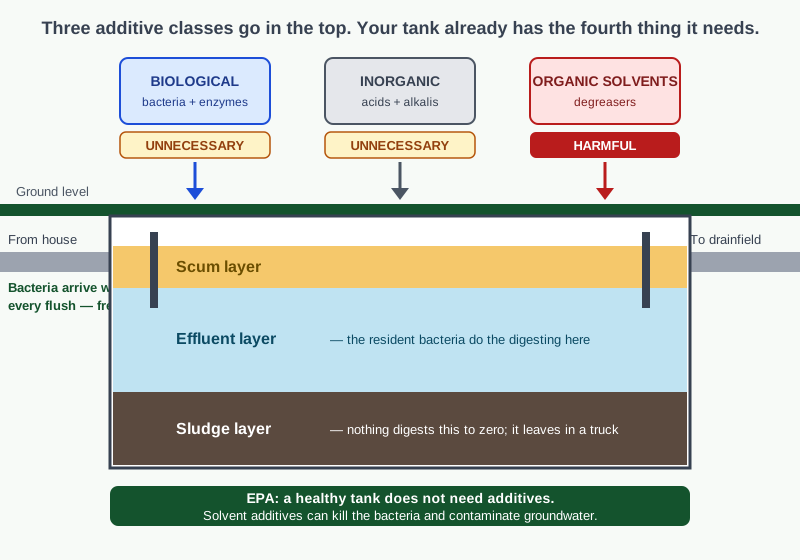
Do Septic Tank Additives Work? What the EPA and the Studies Actually Found
The EPA does not recommend septic additives, a 48-tank double-blind study found no measurable benefit, and one additive class is actively harmful. The evidence, the money maths, and the one narrow exception.
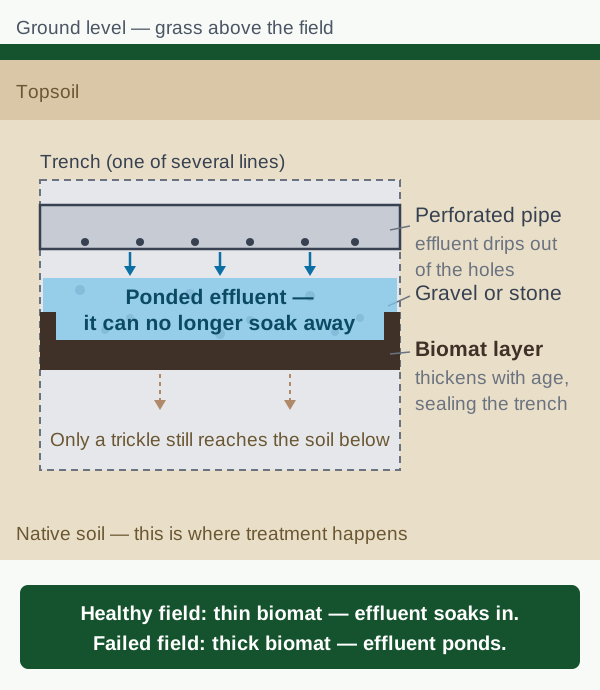
Drain Field Failure Signs: Soggy Ground, Green Stripes and Surfacing Effluent
A failing drain field announces itself in the yard first: lush green stripes, spongy ground, odors, then standing water. The early vs late signs, the look-alikes that aren't failure, a homeowner diagnosis sequence, and what repair or replacement really costs.