 Keep
Why Your Hot Water Runs Out So Fast — and the Bucket Test That Tells You Why
 Daniel Mercer · Editor & Researcher·
Published November 16, 2026·
Updated November 16, 2026
It rarely fails all at once. The shower that used to carry you through a long, unhurried wash starts signing off a little earlier each month. Then one morning it goes properly cold at the six-minute mark, and you are standing there soaped and betrayed, doing the arithmetic every new homeowner eventually does: the tank says 40 gallons on the label, a shower uses a couple of gallons a minute, so where is the rest of it going?
That gap between the number on the tank and the water in your shower is the whole mystery, and it is a measurable one. A storage water heater is a simple machine with a short list of ways to underperform, and almost all of them announce themselves in a single number: how many gallons of genuinely hot water the tank can actually deliver. Measure that number first, and the cause list sorts itself. Guess instead, and you will join the long line of owners who replaced a thermostat, then an element, then the whole heater, when the fault was a $15 plastic tube.
The bucket test: the twenty minutes that split the causes
Everything in this guide hangs off one measurement, and it costs nothing but a bucket and a bit of patience. Manufacturers and plumbers use versions of it because it converts a vague complaint, "we run out too fast," into a figure you can hold up against the tank's rating.
Set it up properly. The test only means something if the tank starts full and fully hot. Pick a moment when the heater has finished a heating cycle and sat idle for at least half an hour, with no showers, laundry or dishwasher in between. If someone draws water mid-preparation, wait and let it recover again.
Run the test. Take a 5-gallon bucket to the bathtub — the tub faucet is the best tap for this because it flows fast and unrestricted, unlike a showerhead with a flow limiter. Open the hot side fully and fill the bucket, again and again, keeping count. As each bucket fills, check the water with your hand or, better, a kitchen thermometer in the stream. Tank water stored at 120°F comes out hot enough that you cannot comfortably hold your hand under it. Keep filling and counting until the stream turns clearly lukewarm, the point where you would step out of a shower and call it cold. Stop there and total your gallons.
Read the result. Compare your count against roughly 70% of the tank's rated capacity. That 70% figure is not pessimism; it is how storage tanks behave. Hot water leaves from the top while cold enters at the bottom, and the two mix and stratify in ways that mean the outlet temperature starts sliding well before the tank is literally emptied of hot water. A healthy 40-gallon tank delivers about 28 gallons before it fades. A healthy 50 delivers about 35.
| Your bucket count | What it means | Where to look first |
|---|---|---|
| Near 70% of the tank's rating | The tank is healthy and doing its full job | Sizing: your household's peak hour has outgrown the tank (final section) |
| Roughly half of the rating | Half the tank is effectively out of service | Dead lower element (electric), broken dip tube, or a thermostat fault |
| A quarter or less, especially on an older tank | Volume has been physically stolen | Heavy sediment, a badly broken dip tube, or both together |
| Good count at the tub, but one shower still fades fast | The tank is fine; the loss is in the plumbing | Cross-connection at a single-handle faucet or mixing valve, or a hidden hot-water leak |
That last row matters more than people expect. The bucket test measures the tank at a tap. If the tank passes at the tub but a particular shower still runs cold, your problem lives between the two, and the cross-connection section below is yours. Test first, and you will not buy parts for a healthy heater.
What a healthy tank should actually deliver
Three numbers govern how much hot water a household gets, and first-time owners are usually only told the first one.
Capacity is the number in big print: 40, 50 gallons in the tank. It is a storage figure, nothing more.
The 70% rule converts storage into delivery. Because incoming cold water mixes and cools the tank as you draw, the usable hot water from a full tank is about 70% of capacity before the temperature at the tap drops off. Twenty-eight gallons from a 40, thirty-five from a 50. Every "but the label says 50" argument ends here.
Recovery rate is how fast the heater remakes hot water while you are using it and after. An electric tank with standard elements recovers roughly 20 gallons an hour through a full temperature rise. A gas burner, heating the whole tank floor at once, manages roughly 30 to 40 gallons an hour. Recovery is why the second shower suffers more than the first, and why gas tanks feel bigger than their labels in back-to-back use while electric tanks of the same size do not.
First-hour rating combines the three into the number that actually matters, and federal rules put it on the yellow EnergyGuide label of every tank sold: how many gallons of hot water the heater can deliver in its busiest hour, starting full. A typical 40-gallon gas tank carries a first-hour rating in the mid-60s to mid-70s. A typical 50-gallon electric sits in the high 50s to low 60s. In the sizing section at the end of this guide, this is the figure you will compare your household against, not the gallon count.
Cause one: a broken dip tube, the $15 part that shrinks your tank
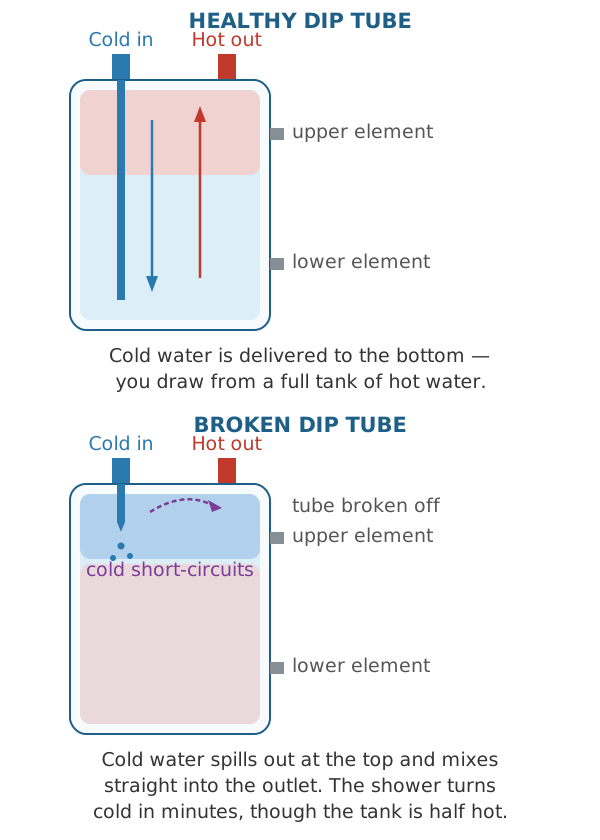
Inside every tank, hanging from the cold-water inlet, is a long plastic pipe called the dip tube. Its job is simple and essential: incoming cold water should enter at the bottom of the tank, down where the burner or lower element can heat it, while the finished hot water waits undisturbed at the top to be drawn off. A healthy dip tube reaches to within a few inches of the tank floor.
Dip tubes age, and on tanks from certain eras they age badly, going brittle and cracking. When the tube breaks off short, or splits along its length, the cold inlet now dumps its water at the top of the tank, right beside the hot outlet. Every time you open a hot tap, incoming cold water takes the shortcut straight across the top and out to your shower, mixing with and diluting the hot water on its way. The bottom two-thirds of the tank can be sitting there perfectly hot and it does not matter: the water actually leaving the tank is a blend that gets colder by the minute. Owners describe exactly what the bucket test finds, a tank that delivers half its rating or less, then fades.
The diagnosis has a pleasing piece of physical evidence. A disintegrating dip tube sheds. Check the aerators on your faucets (the little screens that unscrew from the spout tips) and the inlet screen of your showerhead for small white or pale-blue plastic fragments, like bits of a drinking straw. Plumbers have diagnosed broken dip tubes from a handful of those crumbs for decades. Their presence does not prove the tube has broken short, but fragments plus a halved bucket count is about as close to certainty as home diagnosis gets.
Note what a broken dip tube is not: it is not a dying tank. The steel vessel, the burner or elements, the controls are all fine. It is a broken pipe inside a healthy machine, which is why this cause tops the list of expensive mistakes. Owners who skip the diagnosis replace the whole heater over a part that costs less than the service call.
Cause two: a dead lower element, for electric tanks
An electric tank heats with two elements, and they do not share the work equally. The upper element heats the top of the tank first, so you get usable hot water quickly. Then control passes down, and the lower element heats the rest and does the bulk of the recovery work during heavy use. It is a sensible arrangement with a diagnostic gift built in: when the lower element burns out, the tank does not go cold. It goes half. The upper element keeps the top portion hot, the shower starts perfectly well, and then runs out at roughly the halfway point, which is precisely the bucket-test signature of a tank delivering around half its rating.
Elements fail from scale as much as from age. Hard water coats an element in mineral, the coating insulates it, the element runs hotter inside its own crust, and eventually it burns through. A lower element lives in the sediment zone at the bottom of the tank, which is why it is usually the first of the two to die.
The test is a multimeter job, covered step by step in the solutions section below: power off and verified off, wires lifted from the element, and a resistance reading across its terminals. A healthy 4,500-watt element reads around 13 ohms, give or take a couple. An open reading, infinity, is a dead element, and no continuity beep is the same verdict. While you are in there, the lower thermostat gets the same suspicion, because a failed lower thermostat produces the identical symptom with a healthy element: it simply never calls for heat. Testing both before replacing either is the difference between a $30 fix and a parts cannon.
Gas owners can skip this section with one exception: a gas tank that delivers half a tank and stops may have a burner that is firing weakly, or a gas control that is cutting out early. The symptom rhymes, but the parts are a plumber's.
Cause three: sediment, quietly stealing gallons
Sediment gets its own full guide elsewhere on this site for the noise it makes, but it belongs in this list for a different reason: volume. Every gallon of mineral grit settled on the tank floor is a gallon of water the tank no longer holds. A neglected tank in hard-water country can be carrying several gallons of it, an inch or more deep, and the bucket test finds the theft plainly: the delivery count falls short in proportion to what is sitting in the bottom.
Sediment steals twice, in fact. The layer insulates the tank floor from the burner on a gas heater, and coats the lower element on an electric one, so recovery slows at the same time as capacity shrinks. The tank holds less hot water and remakes it more slowly, a combination owners experience as a heater that has mysteriously become too small for a household that has not changed.
The age-and-history pattern is the tell. A tank that flushed clear on schedule does not lose meaningful volume. A tank that has never been flushed, in a house with white crust on the faucets and a kettle that furs up, is a prime suspect, particularly when the bucket count lands at a quarter to a third of the rating. The remedy is the drain-and-flush procedure, and on a tank this far gone, expect the discharge to run gritty for a long time before it clears, and expect the bucket count afterwards to tell you honestly how much you got back.
Cause four: the thermostat, set too low or quietly failed
The humblest cause on the list, and the one to check before spending anything. A tank's thermostat sets how hot the stored water is, and stored temperature is leverage: at 120°F, a shower mix draws heavily on the tank; stored hotter, the same shower sips. If the dial has drifted, been knocked during other work, or was simply set conservatively by a previous owner at 110°F or below, the tank delivers its full volume but the volume runs out sooner at the tap, because every gallon of shower water takes a bigger share of it. The bucket test catches this one in a specific way: the count of gallons is fine, but a thermometer shows the "hot" water was never that hot to begin with.
On electric tanks there is a second thermostat story. Each element has its own thermostat, behind the access panels on the tank's side. A lower thermostat that has failed open never switches its element on, and produces the half-tank symptom indistinguishable from a dead element until a meter separates them. On gas tanks, the temperature dial is part of the gas control valve on the front of the unit; a control that is misreading the tank temperature and shutting the burner down early gives the same lukewarm, runs-out-early complaint.
The setting itself deserves one honest paragraph. The Department of Energy recommends 120°F, and that recommendation is a safety line, not an efficiency tip: water at 140°F can scald in seconds, and children and older adults burn faster. If your tank is set below 120°F, bringing it up to 120 is free capacity. Going beyond it to stretch supply is a trade this guide does not recommend on the dial alone; the mixing-valve route in the FAQ is the safe way to buy that extra volume.
Cause five: a cross-connection or a hidden leak, stealing from outside the tank
Sometimes the tank is innocent. The bucket test says so: it delivers its full 70% at the tub tap, yet showers still fade, or the whole house's hot water seems to vanish into a household that is not using it. Two plumbing faults do this.
A cross-connection is a place where cold water can push across into the hot lines. The classic sites are single-handle faucets and shower valves with a worn cartridge, and thermostatic mixing valves that have failed. Cold water, at full mains pressure, bleeds into the hot pipework and dilutes everything downstream, so the water arriving at your shower was never purely the tank's hot water to begin with. There is a clean test: close the cold inlet valve at the water heater, then open a hot tap somewhere in the house. With the heater isolated, a hot tap should dribble and stop. If it keeps flowing steadily, cold water is reaching that tap by another route, crossing over somewhere in the house, and you have found your thief. Replacing the offending cartridge or valve is the fix, and it is a faucet repair, not a water-heater repair.
A hidden hot-water leak is the blunter theft: a hot line leaking under a slab, in a wall or in a crawlspace sends heated water out of the tank around the clock, so the tank spends its day reheating water nobody uses and has less stored when you ask. The water meter is the witness. With every tap and appliance off, a meter that keeps creeping is watching water leave somewhere. Warm patches on a floor over a hot line's route, the sound of running water in a silent house, and a heater that fires at odd hours with nobody drawing are the supporting evidence. This one stops being a DIY diagnosis quickly: finding and repairing a slab or in-wall leak is a plumber with a listening kit, and it is worth the call, because the leak is also quietly damaging the house while it steals your showers.
The solutions, in the order the test points you
Work from your bucket count, not from the internet's favourite cause. Half a tank points at the element, thermostat or dip tube. A quarter points at sediment. A full count points at sizing or the plumbing. Here are the fixes, in the order an owner should attempt them.
Fix one: set and verify the thermostat (free, ten minutes)
Find the setting and read it against reality. On a gas tank, the dial on the front control is approximate; verify with a thermometer at the nearest hot tap after the tank has heated and sat. On an electric tank, the two thermostats hide behind the upper and lower access panels, and this is your first encounter with the rule that governs all electric-tank work: switch the breaker off and prove the power is dead with a meter or a non-contact tester before a panel comes off. The terminals behind those panels carry 240 volts whether or not the tank is calling for heat. Both thermostats should read the same setting, 120°F. If one is set far lower than the other, you may simply have found your missing half-tank. Adjust with a flat screwdriver, restore power, let the tank recover fully, and re-run the bucket test before spending a cent.
Fix two: test and replace an electric heating element
If the settings were right and the bucket count says half a tank, test the lower element properly:
- Breaker off, and verify with a meter at the element terminals that no voltage is present. This step is not a formality.
- Remove the lower access panel and insulation, and pull the two wires off the element's terminals.
- Set a multimeter to resistance and touch the probes to the two terminals. A healthy 4,500-watt element reads roughly 12 to 14 ohms; a 3,800-watt element around 15 to 16. An open or infinite reading is a burned-out element. Also test each terminal against the tank itself: any continuity there means the element has shorted to ground and is done.
- Test the lower thermostat the same way while you are in there, checking that it passes continuity when the tank is cool and calling for heat. Replace whichever part failed the meter, not whichever part the internet suspected.
- To swap the element: close the cold inlet, drain the tank to below the element's level (a full drain is easier and doubles as a sediment check), and unscrew the element with an element wrench. It will resist; it has been hot-cycling in place for years.
- Fit the new element with its new gasket, snug it down, refill the tank completely and let water run from an open hot tap until the air stops sputtering. Only then restore power. An element switched on in air, even for seconds, overheats and burns out on the spot, and you will be doing this job twice in one weekend.
Parts cost is $20 to $60. A plumber doing the same job, with the testing included, runs $200 to $450, and on a tank of any age that professional hour is often money well spent, because the tech will test both elements and both thermostats and hand you a verdict on the whole machine.
Fix three: inspect and replace the dip tube
Suspect the dip tube when the aerators hold plastic crumbs, when an electric tank's elements both test healthy, or when a gas tank delivers half a tank with a strong burner. The inspection and the replacement are the same job, because the tube only comes out one way:
- Gas to Pilot, or breaker off for electric. Close the cold inlet and drain the tank down several gallons, or fully if you are due a flush anyway.
- Disconnect the cold-water connection at the top of the tank and unthread the inlet nipple. The dip tube hangs from that nipple, down into the tank.
- Draw the tube out. A healthy one comes up long, close to the tank's full depth. A failed one comes up short, cracked, split or crumbling, and sometimes the missing length is simply gone, dissolved into the fragments your aerators have been catching.
- Drop in the new tube, rethread the nipple with fresh thread tape or sealant, reconnect, refill, purge the air from a hot tap, and restore heat.
- Re-run the bucket test. A dip tube fix announces itself plainly: the count jumps back toward 70% of the rating.
The part is $10 to $25, and the job is within reach of a confident owner with the tank already drained. The honest caution is the nipple: on an older tank it may be corroded into place, and forcing it can turn a Saturday job into a tank replacement. That risk is exactly what the plumber's $250 to $550 buys you out of.
Fix four: flush the sediment out
If your count came in at a quarter to a third and the discharge history fits, the fix is the full drain-and-flush: power or gas off, hose on the drain valve, tank drained, then the cold inlet pulsed open and closed to stir the floor and carry the grit out until the water runs clear. It is the same procedure this site's sediment-noise guide walks through in full, and it pairs naturally with a dip tube inspection, since the tank is already drained and open. Measure again afterwards. Owners are often surprised how many gallons a thorough flush hands back.
What the pro does differently
A good plumber runs this same logic with better instruments: a meter on every element and thermostat before any part is condemned, a thermometer and a timed draw instead of a bucket, and a practiced eye on the parts of the story you cannot see from the symptom, the anode rod's condition, the state of the flue, rust weeping at the seams. What you are buying is not the part swap, it is the certainty that the part swapped was the part that failed, plus a straight answer on the question underneath all of this: whether this tank deserves another dollar at all. Ask for the quote to state what was tested and what failed. Vague quotes are how owners end up paying for three guesses.
The honest sizing section: when nothing is broken
Sometimes the bucket test comes back clean, the elements are healthy, the dip tube is whole, and the answer is the one nobody wanted: the tank is doing everything it was built to do, and your household has outgrown it. This happens constantly in first homes. The previous household was two people; yours is four, plus a dishwasher habit, plus a teenager. Or the house was built when a 40-gallon tank was the default answer to every question, and your mornings now ask a 55-gallon question.
Settle it with the label, not with feelings. Find the yellow EnergyGuide label on the tank and read the first-hour rating. Then add up your household's busiest hour honestly:
| Peak-hour use | Hot water it draws |
|---|---|
| Shower, 10 minutes | 12–16 gallons |
| Bath | 15–20 gallons |
| Shaving / handwashing at a basin | 2–3 gallons |
| Dishwasher cycle | ~6 gallons |
| Washing machine load (warm) | 10–15 gallons |
A worked example: two adults, two showers back to back in the morning peak, one basin in use, the dishwasher started on the way out. That is roughly 28 to 32 gallons for the showers, 3 for the basin, 6 for the dishwasher, call it 40 gallons in the hour, and a household that runs the laundry in the same hour adds 10 to 15 more and lands near 52. A 40-gallon gas tank with a first-hour rating of 67 handles that morning without breaking stride. A 40-gallon electric rated at 52 is living exactly at its edge, and the household experiences it as "we run out of hot water," because they do, every weekday, at the rating's limit.
If your peak hour beats your first-hour rating, no repair on earth fixes it, and the choices are behavioural or mechanical. Behavioural first, because it is free: stagger the draws, move the laundry out of the shower hour, fit a lower-flow showerhead and watch the hot fraction fall. Mechanical, when behaviour is not enough: replace with a tank whose first-hour rating clears your peak hour with room to spare, which sometimes means the same gallon size with a stronger burner or elements, not simply a bigger vessel. And read the rating plate while you are at it: decode the serial number for the manufacture date (most brands encode year and month or year and week in the first digits), because a tank that is both undersized and past ten years old is an easy replacement decision, while an undersized five-year-old tank might argue for staggering your mornings a while longer.
What the fixes cost, and how to choose
The cost table at the top of this guide tells the story in one glance: the diagnosis is free, the likely parts are cheap, and the labour is where the money sits. A thermostat correction costs nothing. An element costs less than a family takeaway; the plumber's visit to fit it costs $200 to $450 because you are buying the testing, the draining, the warranty on the work and the verdict on the tank. The dip tube is the extreme case of the same shape, a $10 to $25 part inside a $250 to $550 job.
Choose with the tank's age open in front of you. On a tank under eight years old, repair almost everything on this list without hesitation; the parts are cheap and the vessel has years left. Between eight and twelve, repair the cheap certainties (element, thermostat, dip tube) and decline anything that starts to stack. Past twelve, or past its warranty with rust showing, hold every quote up against the $1,200 to $2,800 cost of a new installed tank, and be honest that a third of a new tank's price spent on an old one buys you an old tank that works, for a while. The bucket test belongs in that conversation too: a fifteen-year-old tank that still delivers its full 70% has earned its repairs; one delivering a quarter of its rating is telling you where the money should go.
DIY or call a pro?
Yours: the bucket test, the thermostat check and adjustment, the flush, and (with the breaker discipline treated as sacred) element testing and replacement on an electric tank. The dip tube sits on the border: the procedure is simple, the seized-nipple risk is real, and your appetite for that risk on a tank of a given age should decide it. The pro's: anything involving the gas control, burner or flue on a gas heater, any cross-connection hunt that survives the inlet-valve test without an obvious culprit, any hidden leak, and any repair on a tank old enough that disturbing it might finish it. There is no shame line in that list, only the line between a machine that stores hot water and one that burns gas to make it.
Urgency, honestly stated
Running out of hot water will not damage your house, and it can wait for a weekend. What should not wait is the diagnostic habit: a sudden change in a machine that has behaved the same way for years is always information. The tank that fades this month and pops the next and shows rust at the base the month after is narrating its own decline, and the owners who hear it early replace a heater on a planned Tuesday instead of an emergency Saturday. Run the bucket test now, write the count and the date on the tank in marker, and you have given your future self the single most useful thing a homeowner can own: a baseline.
Cost at a glance
| Item | Typical cost | Notes |
|---|---|---|
| Bucket test and thermostat adjustment | $0 | A bucket, a thermometer and twenty minutes; this is the diagnosis, and it is free |
| Heating element swap, DIY (electric) | $20–$60 | Element plus a new gasket; an element wrench adds about $10 if you do not own one |
| Element or thermostat replacement (pro) | $200–$450 | Per visit; a good tech tests both elements and both thermostats before replacing anything |
| Dip tube replacement (pro) | $250–$550 | The part itself is $10–$25; you are paying for draining the tank and freeing the inlet nipple |
| New 40–50 gal tank, installed | $1,200–$2,800 | The right spend only when the test plus the tank's age say the household has genuinely outgrown it |
Frequently asked questions
How long should the hot water from a 40-gallon tank actually last in the shower?
Do the maths from the 70% rule: a healthy 40-gallon tank delivers about 28 gallons of hot water before the outlet temperature falls away. A modern showerhead flows 1.75 to 2.5 gallons a minute of mixed water, and roughly 1.2 to 1.6 of those gallons come from the hot side at a 120°F setting. So expect somewhere around 18 to 22 minutes of shower before the water starts to cool, longer with a low-flow head, less in winter when the incoming cold water is colder and every shower mix needs a bigger share of hot. If you are getting 8 minutes, the tank is not small — it is sick, and the bucket test will show it.
What exactly is the bucket test, and what do the numbers mean?
Let the tank heat until it has been idle and fully hot for at least half an hour, with nobody drawing water. Then run one hot tap — a bathtub faucet is fastest — into a 5-gallon bucket, checking the temperature as you go, and count the gallons that come out still properly hot before the stream turns noticeably lukewarm. Compare the count with about 70% of the tank's rated size: 28 gallons for a 40-gallon tank, 35 for a 50. Near the mark means a healthy tank and a sizing question. Around half means a failed part: a dead lower element or a broken dip tube are the usual finds. A quarter or less, on an old tank, usually means heavy sediment has eaten the volume. One test, twenty minutes, and the cause list cuts itself in half.
Can a broken dip tube be fixed, or does it mean a new water heater?
It can be fixed, and it is one of the cheapest saves in plumbing. The dip tube is a plastic pipe, usually $10 to $25, that hangs from the cold inlet and carries incoming cold water to the bottom of the tank. When it cracks or breaks off short, cold water spills in at the top and mixes straight into the hot outlet. Replacing it means draining the tank, unthreading the cold inlet nipple and dropping in a new tube — a plumber typically charges $250 to $550, mostly labour. The tank itself is usually perfectly healthy. One telltale sign before anyone opens anything: little white or pale plastic fragments caught in your faucet aerators and showerhead are often pieces of a disintegrating dip tube.
Why does the second shower run out so much faster than the first?
Because the first shower spends the stored hot water, and the second one lives on what the heater can recover in between. Recovery is where fuel type bites. An electric element of typical size raises roughly 20 gallons an hour through a full heating rise; a gas burner manages more like 30 to 40. So back-to-back showers with ten minutes between them ask the tank to have remade hot water it has not had time to remake, and the second shower fades first even on a healthy heater. Space the draws, shorten the first shower, or, if it is a daily war, treat it as the sizing question it is and compare your peak hour against the tank's first-hour rating on its EnergyGuide label.
Will turning the thermostat up give me more hot water?
In effect, yes, and it is worth understanding why before you reach for the dial. Hotter stored water goes further because every shower mixes it with more cold. Storing at 140°F instead of 120°F can stretch usable hot water by a fifth or more. The catch is scald risk: 140°F water can burn skin in seconds, and the Department of Energy's recommended setting is 120°F for exactly that reason. The safe version of this trick is a thermostatic mixing valve fitted at the tank outlet, which lets the tank store hot while delivering tempered water to the house. Turning the dial up alone, in a house with children or elderly occupants, trades a comfort problem for a safety problem.
Why does my hot water run out faster in winter than in summer?
Your tank did not change; your incoming water did. In much of the country, mains water arrives at 40 to 50°F in winter against 60 to 70°F in summer. Every shower mix then needs a larger share of hot water to reach the same comfortable temperature, so the tank drains faster per minute. At the same time the heater's recovery slows, because it has to lift each gallon through a bigger temperature rise. The result is a heater that feels smaller from November to March. A mild winter shortfall is physics, not failure. A sudden one, or one that appears in July, is a symptom — run the bucket test.
How do I know if my tank is simply too small for my household now?
Compare your busiest hour with the first-hour rating printed on the tank's yellow EnergyGuide label. Add up the hot water your peak hour uses: a 10-minute shower accounts for roughly 12 to 16 gallons of hot, a bath around 15 to 20, a dishwasher cycle about 6, a washing machine load 10 to 15 depending on the cycle. A four-person morning with two showers, shaving and a dishwasher start lands near 45 to 55 gallons. If your tank's first-hour rating sits comfortably above your peak hour and the bucket test says the tank is healthy, capacity is not your problem. If the rating is below your peak hour, no repair fixes that — the honest answers are staggering the draws or replacing with a higher-rated tank.
Checked November 16, 2026. This guide is general information, not a substitute for a licensed professional.
Related guides
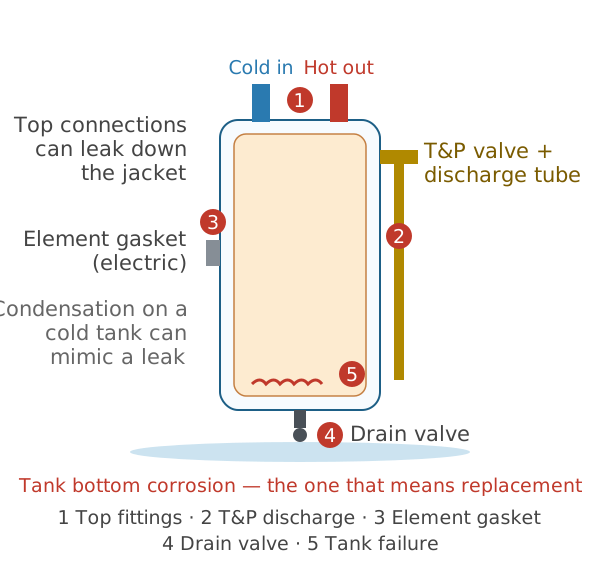
Water Heater Leaking From the Bottom? Find the Real Source Before You Replace It
Water at the base of a water heater has five possible sources — and only one of them means a new tank. The dry-and-trace test, the T&P warning, shut-off steps, and 2026 costs.
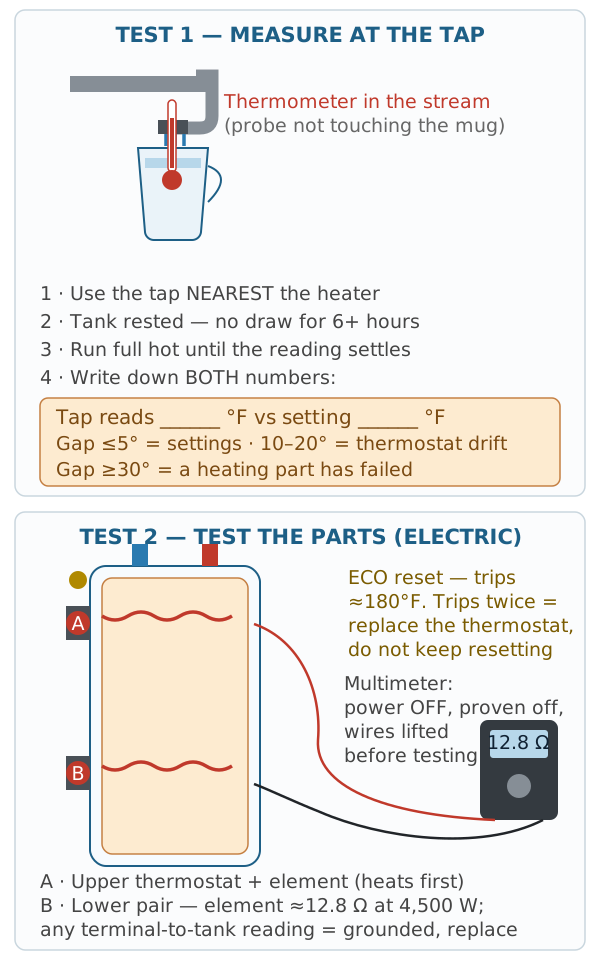
Water Heater Not Getting Hot Enough? Measure First — the Temperature Tests That Find the Cause
Warm but never hot, even on full hot? Measure at the tap before you touch a dial: the thermometer protocol, the 120-vs-140 setting decision, multimeter values for elements and thermostats, and the fix for every cause.
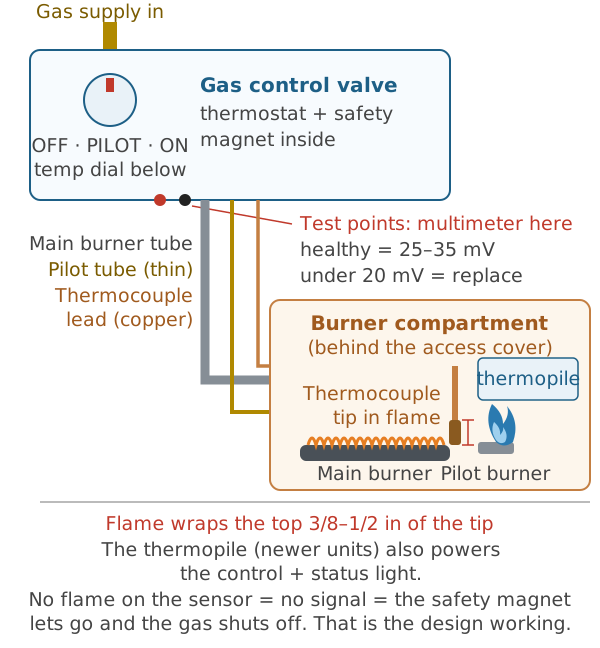
Pilot Light Won't Stay Lit? The Thermocouple Test Before You Replace Anything
The pilot lights, then dies when you release the knob — or hours later. Work through the timing triage, the correct relight, the millivolt test, and the thermocouple swap, in that order.