 Keep
How Much to Budget for Home Maintenance in Year 1: The 1% Rule, Tested
 Daniel Mercer · Editor & Researcher·
Published November 16, 2026·
Updated November 16, 2026
Somewhere in your first month as a homeowner, usually standing in front of a machine that's making a new noise, you will ask the most practical question in homeownership: how much is this house going to cost me, per year, just to keep it working? Not the mortgage. Not the taxes. The house itself — the roof, the furnace, the water heater, the pipes, the septic tank, and the long tail of small things that leak, clog, hum and stop.
The internet answers that question with a rule so tidy it fits in one line: budget 1% of your home's value every year. Bought a $400,000 home? Set aside $4,000 a year, $335 a month, and you're covered. It's the most repeated number in homeowner finance. The Consumer Financial Protection Bureau uses 1% in its home-buying budget worksheet. Fannie Mae's homeowner guidance is built around a percentage of value too, though a wider one than most people quote.
This guide does three things the one-line answer doesn't. First, it tests the 1% rule against the way houses actually fail, and shows you the two situations where it quietly falls apart. Second, it separates year one from every year after it, because your first year is not a typical year and budgeting it as one is the most common money mistake new owners make. Third, it gives you the worksheet that replaces the rule entirely: a sinking fund built from your own systems, their ages and their replacement costs — most of them priced in KeepDwell's own cost guides. By the end you'll have a monthly number that belongs to your house, not to a national average.
The 1% rule, stated fairly
The rule says: set aside 1% of your home's value each year for maintenance and repairs. It covers everything the house demands beyond the mortgage — routine servicing, small repairs, and saving toward the big replacements. Spend less than that in a quiet year and the surplus stays in the fund, because the rule is an average, not a prediction. Some years you'll spend $600. Some years the furnace will die in February and you'll spend $6,000. The 1% is meant to make the average come out right.
As a first approximation, it's genuinely decent. It scales with the size of the commitment, it's easy to remember, and it forces the single most important behaviour: money moved, monthly, into a separate pot, before anything breaks. An owner who follows the 1% rule imperfectly is in a far better position than an owner with a perfect method they never start. If you take nothing else from this page, take that: open the account this month, set the transfer, argue about the exact percentage later.
But the rule has a structural flaw, and once you see it you can't unsee it. It prices your maintenance off the value of your home — and your home's value is mostly land, location and market mood. Your furnace does not know what your house sold for.
Where the 1% rule breaks
It breaks at the bottom of the market. Consider a $150,000 home in a small town: older, modest, exactly the kind of house first-time buyers actually buy. One percent is $1,500 a year. Now price that house's systems. A furnace replacement costs roughly the same there as anywhere — the equipment and the labour don't discount themselves because the land was cheap. A water heater, a septic pump-out, a panel upgrade, a roof: all priced by the work, not by the postcode. One ordinary bad year — a furnace at $5,000–$6,500, or a septic failure running into five figures — erases three to ten years of 1% savings. At low home values, 1% is not a maintenance budget. It's a deposit on the first repair.
It breaks at the top of the market, in the opposite direction. A $900,000 home in an expensive suburb budgets $9,000 a year at 1%. But its roof is not three times the price of the $300,000 home's roof; it's maybe 30% more, for a bigger footprint and steeper pitch. Its furnace, water heater and appliances are the same machines in fancier company. The percentage rule, followed literally, has this owner over-saving for maintenance while the money could be working elsewhere — a pleasant problem, but a real distortion, and it's why the square-foot rule below exists.
It breaks on age, which is the variable that matters most. Two identical $400,000 homes, side by side. One was built in 2021: every system young, warranties alive, a decade before anything big is due. The other was built in 1988 and carries a 19-year-old roof, a 16-year-old furnace and a septic system of unknown vintage. The 1% rule gives them the same budget. Their actual maintenance futures have almost nothing in common. Age — specifically, how many systems are simultaneously in the last third of their lives — is the single best predictor of what a house will cost you, and a percentage of value can't see it at all.
And it breaks in year one, for reasons that have nothing to do with averages. That's important enough to get its own section below.
The rival rules, compared honestly
The 1% rule has two serious rivals, and one authority worth reading in the original.
The $1-per-square-foot rule budgets $1 per square foot of living space per year: a 2,000 sq ft home sets aside $2,000. It fixes the top-of-market problem — the number tracks the physical house, not its market value — and it has a rough logic, because bigger houses do have more roof, more pipe and more paint. But it inherits the age blindness in full, and it starves cheap, small homes: 1,300 sq ft at $1 gives $1,300 a year, which a single water heater replacement ($1,200–$2,800, from our guide "Water Heater Leaking From the Bottom? Find the Real Source Before You Replace It") can consume entirely. Some advisors suggest taking whichever rule gives the larger number. That's cautious, but it still never looks at your actual systems.
Fannie Mae's 1–4% band is the version almost nobody quotes in full. On its own homeowner page, "How to Build Your Maintenance and Repair Budget," Fannie Mae suggests budgeting 1% to 4% of the home's value per year depending on age: around 1% for newer homes, rising to about 4% for homes more than 30 years old. Read that again, because it quietly concedes everything above. The authority behind the famous rule doesn't actually endorse the flat version of it. It endorses a sliding scale where the variable is exactly the one the flat rule ignores: how old the house is. Most pages that cite Fannie Mae cite the 1% and drop the 4%, which is why the flat rule survives. The CFPB, for its part, uses 1% in its buying worksheet and separately tells buyers to be able to cover repairs from a leaky faucet to a roof replacement and to build an emergency fund for them — again, the percentage is presented as a starting estimate, not a law.
So the honest summary of the rules: use 1% as your floor in year one, lean toward 2% or more if the house is past 30 years or the inspection report is thick, prefer square footage if your home's price is inflated by its location, and then graduate to the method in the worksheet below as fast as you can. Percentages are training wheels. Your house deserves its own numbers.
Year one is not a normal year: the move-in spike
Every budget rule describes an average year. Your first year is not one, for a reason nobody warns you about: you inherit the previous owner's postponed decisions.
A house for sale is a house whose maintenance has been quietly winding down. Nobody books a furnace service for a home they're listing in spring. Nobody replaces the water heater that's "still working." The gutters, the softener salt, the septic pump-out that was due last year — all of it waits, rationally, for the next owner. Then you arrive, and the backlog arrives with you. Add the one-time costs of taking possession, and year one has a shape all its own: a spike in the first 90 days, on top of whatever the steady state turns out to be.
The spike has four parts. Security and safety, week one: rekeying every exterior lock or replacing the deadbolts, because you do not know who holds keys to your house; testing every smoke and CO alarm and replacing any that are past their ten-year life or missing entirely; locating and testing your shutoffs. First services: a furnace tune-up and an air-conditioning service if the seasons call for them, because you have no service history and no idea when either was last touched — a proper tune-up runs $75–$200, as our "Furnace Tune-Up Cost" guide breaks down. The inspection report's leftovers: your inspector gave you a list, sorted roughly by urgency, of everything the last owner deferred — the slow drain, the tired GFCI, the gutter that overflows, the panel with no spare spaces. The small end of that list is a few hundred dollars of parts and a few weekends; the honest move is to price all of it now rather than meet it one surprise at a time. Baseline testing, if you have a well or septic: a full well-water test and a septic inspection or pump-out to establish your starting point, because every future decision about those systems depends on knowing where they began.
Altogether, a typical move-in spike runs $600–$1,500 for a house in decent shape, before any genuine repair. Budget it as its own line, separate from the annual percentage. The owners who feel ambushed by year one are almost never the ones with broken houses; they're the ones who budgeted an average year and met the spike instead. Our "First-Time Homeowner Maintenance Checklist: The First 30 Days" walks the same first month task by task, and the two documents are designed to be used together: the checklist tells you what to do, this guide tells you what to set aside while you do it.
Worked examples: three houses, three answers
Rules only become useful when you watch them disagree. Here are the three houses from the cost table at the top of this page, with the reasoning filled in.
The $250,000 home, 1,400 sq ft. The 1% rule says $2,500 a year. The square-foot rule says $1,400. Trust the percentage, and consider going above it. At this price the home is likely older or in a low-cost market, and its systems are full-price items in a half-price house: $1,400 does not survive one water heater replacement plus a service call. $2,500 is a workable floor; $3,000–$3,500 is the honest number if the roof or furnace is past mid-life.
The $400,000 home, 2,000 sq ft. The 1% rule says $4,000. Square footage says $2,000 — a factor of two apart, which is exactly why rules alone can't settle this. The tiebreaker is the house itself. If it's a 2018 build with young systems, $2,500–$3,000 will feel generous. If it's a 1995 build whose roof, furnace and water heater are all in their final third, $4,000 is barely adequate and the worksheet below will probably tell you to save more. Same price, same size, wildly different correct answers — decided entirely by age.
The $600,000 home, 2,600 sq ft. The 1% rule says $6,000, and here the percentage has drifted away from reality: much of that $600,000 is land and location, and the house's systems are only modestly more expensive than the $400,000 home's. The square-foot figure of $2,600 is closer to the mark for a newer home, though a large older home at this price — big roof, two HVAC systems, a pool of ageing everything — can legitimately spend $4,000–$5,000. At this level, skip both rules and go straight to the worksheet.
Notice the pattern: the percentage rule errs low on cheap houses and high on expensive ones, the square-foot rule errs low almost everywhere except expensive ones, and both are blind to age. Which brings us to the method that isn't blind to anything.
The sinking-fund worksheet: your house, your numbers
A sinking fund is a saving method with a simple engine: for each big system, take what it will cost to replace, divide by the years of life it has left, and save that amount every year (or a twelfth of it every month). When the system dies, the money is there — not approximately, but by construction. It's how businesses budget for roofs and boilers, and it works on a house for the same reason: it prices your actual systems instead of a statistical average house that doesn't exist.
You need three numbers per system: what it is, how old it is, and what replacement costs. Ages come from the labels you photographed and logged when you moved in — the age log in our first-30-days checklist exists precisely to feed this worksheet — backed up by the inspection report. Replacement costs come from quotes where you have them and from cost guides where you don't. Here is the worksheet worked in full for a typical first home: bought for $400,000, systems at various mid-life points.
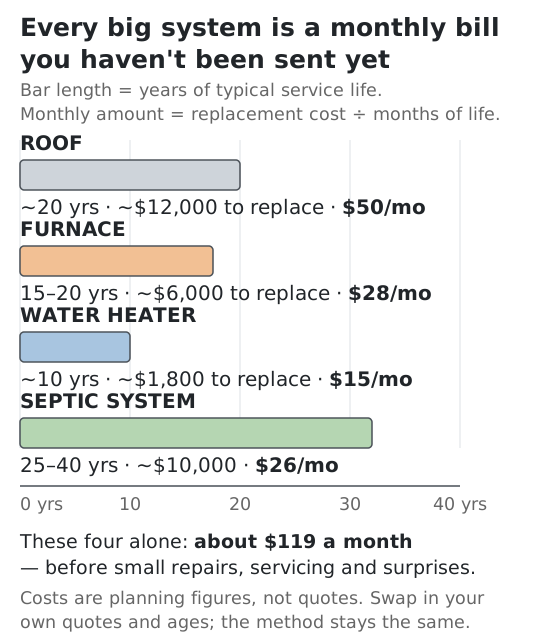
Roof. Asphalt shingles, typical life about 20 years. Say yours is 10 years old, so 10 years of life remain. Replacement planning figure: $12,000. $12,000 ÷ 10 years = $1,200 a year = $100 a month.
Furnace. Typical life 15–20 years; plan on 18. Say yours is 8 years old, leaving 10. Replacement planning figure: $6,000. $6,000 ÷ 10 = $600 a year = $50 a month. (The annual tune-up that keeps it alive to 18 is a servicing cost, counted separately below.)
Tank water heater. Typical life about 10 years — the shortest clock in the house. Say yours is 6 years old, leaving 4. Replacement, from our water heater cost coverage: $1,200–$2,800; plan on $1,800. $1,800 ÷ 4 = $450 a year = $38 a month. Notice what the worksheet just told you: this is your most urgent fund, not because the heater is expensive but because its remaining life is short. No percentage rule can surface that.
Septic system. Typical life 25–40 years for the system as a whole. Say yours is 15 years old against a 32-year planning life, leaving 17. Full replacement runs $6,500–$15,000 for a conventional system in our "How Much Does It Cost to Fix or Replace a Failed Septic System?" guide; plan on $10,000. $10,000 ÷ 17 ≈ $588 a year = $49 a month. Routine pumping every 3–5 years — $300–$600 a time in our "Septic Tank Pumping Cost" guide — is servicing, counted below, not part of this line.
Add the four: $100 + $50 + $38 + $49 = $237 a month, $2,844 a year — for a $400,000 home, about 0.7% of its value. Less than the 1% rule, because this particular house's systems still have life in them. Now change one input: make the roof 16 years old instead of 10, with 4 years left. The roof line alone becomes $250 a month and the total jumps past $380 — more than the 1% rule, correctly, because that house genuinely is heading for a five-figure year. The worksheet breathes with the house. That is the entire argument for it.
Two refinements once the basic version is running. First, add the second tier of systems when you're ready: well pump (our "Well Pump Replacement Cost" guide prices the job at $1,000–$2,500 for most homes), air conditioner, appliances, and the electrical panel if yours is old or full — a 100-to-200-amp upgrade runs $1,800–$4,500 in our "Electrical Panel Upgrade Cost" guide, and a panel with decades of life left needs no fund at all, which is itself useful information. Second, re-run the worksheet once a year, ideally when you do your seasonal maintenance review. Ages change, quotes change, and a system you replaced resets its own line to a small number for a decade. Ten minutes a year keeps the fund honest.
What the fund must carry every year: the recurring layer
The sinking fund covers deaths. A second, smaller layer covers birthdays: the recurring servicing that keeps systems alive long enough to reach their expected lifespan, and the steady drip of small repairs. ENERGY STAR's Home Check-Up makes the same point from the energy side — heating checked in fall, cooling in spring, filters checked monthly and changed at least every three months — and every item on that rhythm has a price.
Price the layer honestly for your house. A furnace tune-up at $75–$200 a year. An air-conditioning service at a similar figure. Septic pumping every three to five years, which annualises to roughly $75–$200 a year. Gutter cleaning once or twice a year if you hire it out. A well-water test annually if you're on a well — cheap insurance, and the baseline you set in year one is what makes later results meaningful. Then the unglamorous allowance for small repairs: the flapper, the faucet cartridge, the GFCI, the disposal, the tube of everything. Most owners find $300–$600 a year covers the drip in a normal year, and the years it doesn't are what the sinking fund's surplus is for. All told, the recurring layer typically adds $600–$1,200 a year on top of the sinking-fund lines. Add it to the worksheet total and you have your real number: for the worked-example house, $2,844 plus, say, $900 of servicing gives roughly $3,750 a year — close to the 1% rule's $4,000, reached from the opposite direction, and now you know what every dollar is for.
What the fund must not swallow
One boundary protects the whole system: the maintenance fund is for the house, and only the house. Property taxes and homeowners insurance are not maintenance, however house-related they feel. They're fixed obligations with their own due dates, they're usually already collected inside your mortgage escrow, and they belong in a different bucket of the budget. The CFPB's homeownership guidance makes the same separation in its own way: be ready to cover taxes, insurance and utilities as the standing costs of owning, and build an emergency fund for repairs on top of them — and Fannie Mae likewise suggests keeping the maintenance fund separate from a general emergency reserve, so that a job loss or a medical bill doesn't get paid out of the roof money, and a roof doesn't get paid out of the emergency money.
The practical failure mode is always the same: the fund is the only pot of savings in the house, so every large bill drinks from it, and it never accumulates. Three labelled buckets fix it — taxes and insurance (usually escrowed, so mostly a matter of not double-counting them), a household emergency reserve of three to six months' expenses, and the house fund, fed by the worksheet. The house fund will still get raided in a true emergency; that's what money is for. But it should be raided consciously, as the last resort, not casually, as the default.
Setting it up in one sitting
The whole system takes about half an hour to start. Open a separate savings account — separate matters, because money that sits in your everyday account gets spent by your everyday life — and name it something blunt. Set an automatic transfer for the day after payday, so the fund is paid before the month starts spending. For the amount, use the 1% rule divided by 12 for your first transfer this month; do not wait until the worksheet is perfect. Then build the worksheet: walk your age log and inspection report system by system, fill in ages and planning costs, and adjust the transfer to the worksheet number from next month. If the worksheet number is painfully higher than the percentage — the old-roof case — don't abandon it. Fund the most urgent line in full, the next at half, and step the total up over the year. An honest partial fund beats a perfect abandoned one, every time.
One more habit worth adopting from the start: treat windfalls as fund events. A tax refund, a bonus, the proceeds of selling the furniture the house came with — route a fixed share, even a quarter, into the house fund before it dissolves into general spending. The Consumer Financial Protection Bureau makes the same suggestion for emergency savings generally, pointing out that a single large deposit does more for a young fund than months of small ones. In year one especially, when the move-in spike is competing with the first transfers, one windfall can put the fund a full season ahead of schedule.
The bad-year reality
Sooner or later the fund meets a 3–5% year: the year the furnace and the water heater die in the same winter, or the septic system fails its inspection, or a roof that was "fine for five more years" starts leaking in year two. Property-autopilot's cost data and every long-term owner's experience agree these years exist; the rules of thumb are averages precisely because spending arrives in lumps.
The fund changes what a bad year is. With three years of transfers banked, a $6,000 furnace is a withdrawal and a worksheet revision, not a credit-card balance at 24% interest that quietly adds $1,500 to the real cost of the furnace. If the fund can't cover the whole hit, it covers the deposit and the first payments, which is still the difference between a problem and a spiral. After a bad year, resist two temptations: don't stop the transfer because "the fund is empty anyway" — restarting it is the entire recovery — and don't slash it to the old percentage if the worksheet now shows another system ageing into range. Re-run the numbers, grieve briefly, and set the new transfer. The owners who come out ahead are not the ones whose houses never break. They're the ones whose houses break on schedule, into a fund that was expecting them.
Reading the cost table at the top of this page
The table up top compresses the whole argument into five lines. The first three rows show the two rules disagreeing at three prices — by $1,100 a year at $250,000, by $2,000 at $400,000, by $3,400 at $600,000 — and the notes tell you which to trust in each case and why. The fourth row is the worksheet's answer for the mid-priced, mid-life house: $237 a month for the four big systems, deliberately lower than the 1% rule because that house's systems still have years left, and deliberately ready to rise above it the moment one of them doesn't. The fifth row is the one every other budget guide forgets to print: the move-in spike, $600–$1,500, sitting outside the annual figure entirely, because year one is not an average year and pretending otherwise is how new owners end up financing a rekey and a tune-up at credit-card rates.
And the DIY-or-pro question runs through all of it. A funded owner chooses: they hand the licensed, dangerous and warranty-sensitive work to professionals because the money exists, and spend their own weekends on the maintenance that rewards attention — filters, flushing, sealing, testing, looking. An unfunded owner has the choice made for them, in the worst order. That's the real return on the $237 a month. Not the roof, though the roof is nice. The return is that when something in your house makes a new noise, your first thought gets to be "what is that?" instead of "what will that cost me?" — and by the time you've finished this guide, you know roughly what it will cost you, because you priced it in advance, system by system, on purpose.
Cost at a glance
| Item | Typical cost | Notes |
|---|---|---|
| $250,000 home, 1,400 sq ft — 1% rule vs $1 per sq ft | $2,500/yr vs $1,400/yr | The percentage rule is the safer guide at this price: systems cost what they cost, and $1,400 rarely covers a year with one real repair in it |
| $400,000 home, 2,000 sq ft — 1% rule vs $1 per sq ft | $4,000/yr vs $2,000/yr | The two rules diverge by a factor of two. For a mid-priced home with mid-life systems, the sinking-fund worksheet below usually lands between them |
| $600,000 home, 2,600 sq ft — 1% rule vs $1 per sq ft | $6,000/yr vs $2,600/yr | At high prices in expensive neighbourhoods, value inflates faster than system costs. The square-foot rule and the worksheet both beat the percentage here |
| Sinking-fund method — $400,000 home, systems at mid-life | About $237/month ($2,844/yr) | Roof $100/mo + furnace $50/mo + water heater $38/mo + septic $49/mo, worked line by line in the worksheet section below. Add routine servicing on top |
| The move-in spike — typical first 90 days | $600–$1,500 | Rekeying or new locks, smoke and CO alarm replacement, first furnace and AC services, and the small deferred repairs from the inspection report. Budget it separately from the steady annual figure |
Frequently asked questions
What is the 1% rule for home maintenance?
It's the rule of thumb that says to set aside 1% of your home's value every year for maintenance and repairs: $3,000 a year on a $300,000 home, about $250 a month. It appears in the Consumer Financial Protection Bureau's home-buying budget worksheet, and Fannie Mae's homeowner guidance uses a wider band of 1% to 4%, scaled by the age of the home. Treat the flat 1% as a floor for a newer home in decent shape, not as a universal answer — the rest of this guide shows where it breaks and what to use instead.
How much should I save for repairs in my first year as a homeowner?
Budget the annual figure — start at 1% of the purchase price — and then add a separate move-in allowance of roughly $600–$1,500 for the first 90 days: rekeying or replacing locks, new smoke and CO alarms, the first furnace and air-conditioning services, and the small deferred repairs listed in your inspection report. Year one is not a typical year. The previous owner's postponed maintenance becomes yours all at once, and the homes that feel expensive in year one usually settle down once that backlog is cleared.
Is 1% enough for an older home?
Usually not. Fannie Mae's own guidance runs to 4% of value for homes more than 30 years old, and the reasoning is arithmetic, not pessimism: an older home has more systems in the last third of their lives at the same time. A 35-year-old house can plausibly need a roof, a furnace and a water heater inside five years. If your home is past 30, or your inspection report lists several ageing systems, budget 2% as a working minimum and build the sinking-fund worksheet in this guide to find your real number.
Is $1 per square foot a better rule than 1%?
It depends which way your home's price is distorted. The square-foot rule ignores value entirely: a 2,000 sq ft home budgets $2,000 a year wherever it sits. That makes it the better guide for expensive homes in high-price areas, where 1% of value overshoots what systems actually cost, and the worse guide for cheap homes, where $1,300 or $1,400 a year leaves no room for a single serious repair. Neither rule looks at your actual roof, furnace or septic system. The sinking-fund method does, which is why it beats both once you've lived in the house a few months.
Does a home maintenance budget include taxes and insurance?
No. Property taxes and homeowners insurance are separate obligations with their own due dates, and they're usually collected through your mortgage escrow account anyway. The maintenance fund has a different job: keeping the house itself working — servicing, repairs and eventual replacements. Fannie Mae's budget guidance makes the same split, suggesting one fund for maintenance and a separate emergency reserve for non-home shocks like a job loss. Mixing the buckets is how owners end up 'borrowing' from the roof fund to pay the tax bill, and then borrowing from a credit card to pay for the roof.
How much should I put aside each month?
Take your annual figure and divide by 12: $210 a month for a $250,000 home at 1%, $335 a month at $400,000. Then, once you've built the sinking-fund worksheet, switch to that number instead — it's the sum of your systems' monthly amounts, plus a servicing allowance. Automate the transfer for the day after payday, into a separate savings account you don't see in daily banking. A fund that depends on remembering to move money in a good month is not a fund; it's an intention.
What if my home is brand new — do I still need 1%?
Not in year one, and Fannie Mae's scale agrees: newer homes sit at the 1% end or below, because everything is young and the builder's warranty covers defects in the first year or two. Newer-home owners in cost surveys report spending closer to $2,000 a year, much of it on setup and small fixes rather than failures. But don't budget zero. Start the sinking fund at a reduced rate from day one — systems begin ageing the day they're installed, and the owner who starts the roof fund in year one pays $50 a month where the owner who starts in year twelve pays several times that.
Checked November 16, 2026. This guide is general information, not a substitute for a licensed professional.
Related guides
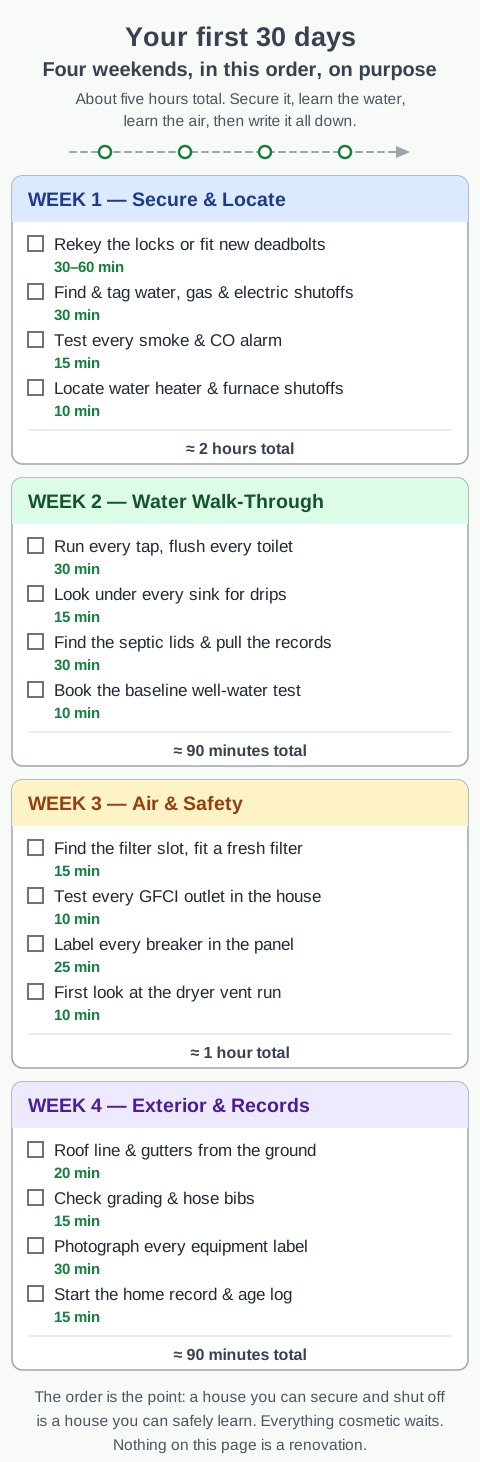
First-Time Homeowner Maintenance Checklist: The First 30 Days
The first 30 days in a new house, in the right order: rekey and locate your shutoffs in week 1, walk the water in week 2, learn the air in week 3, and build your home record in week 4 — with the time and cost of every task, and the list of what can safely wait 90 days.
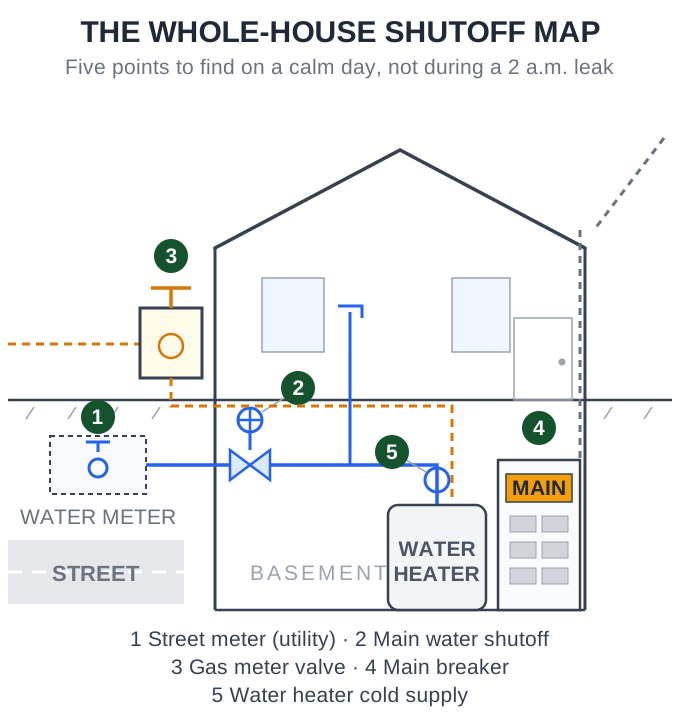
Find It Before You Need It: Your Main Water Shutoff, Gas Shutoff & Electrical Panel
Every house has five shutoffs that matter in an emergency: the street meter valve, your interior main, the gas meter valve, the main breaker and the water heater supply. How to find each one, test it, tag it, and fix the one that fails, before the 2 a.m. leak.
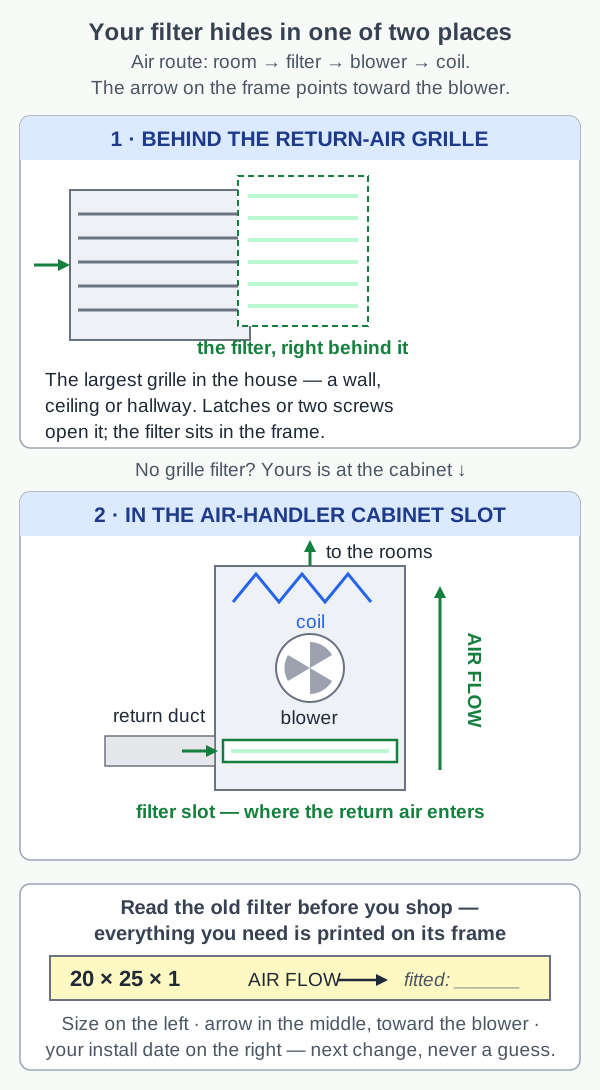
How Often to Change Your HVAC Filter (It Depends on the Filter You Have)
The honest filter schedule: check monthly and change at least every 3 months is only the floor. Fibreglass lasts about 30 days, thin pleated 60–90, deep media 6–12 months — plus how to find the slot, read the size, face the arrow the right way, and why a filter can be too good.