 Keep
How Often to Change Your HVAC Filter (It Depends on the Filter You Have)
 Daniel Mercer · Editor & Researcher·
Published November 16, 2026·
Updated November 16, 2026
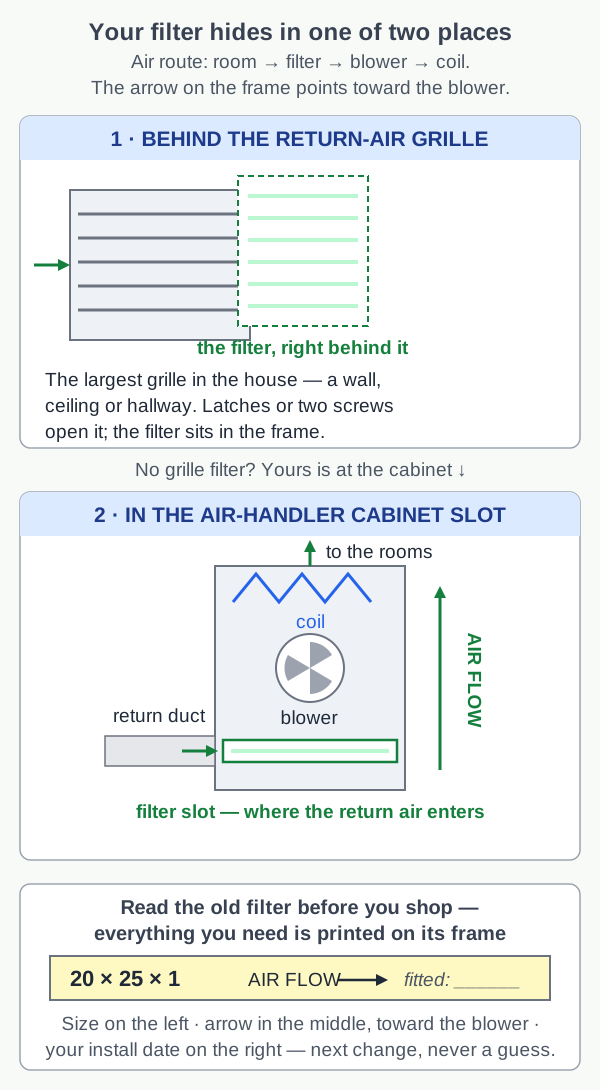
Ask ten homeowners how often to change the HVAC filter and you will hear ten versions of the same shrug: "every month?" "every three months?" "when it looks dirty?" The reason the answers never agree is that the question is missing its second half. Every schedule you have ever heard assumes a particular filter, and houses do not all run the same one. The filter in a deep media cabinet can be doing its job beautifully at ten months old, while the thin fibreglass panel in the next house was finished before its first month was out.
So this guide does two things. First, it answers the question properly, by filter type — because that is the variable that actually decides it. And second, it starts where first-time owners actually get stuck, which is not the schedule at all: finding the filter, reading the size off it, and putting the new one in facing the right way. Get those right once and the schedule takes care of itself.
First, find your filter
In most houses the filter lives in exactly one of two places. The first is behind the largest return-air grille in the house — a big louvered panel, usually on a wall, in a hallway, or in a ceiling. It opens with latches, a pair of screws, or sometimes just a firm pull, and the filter sits right there in the frame, the first thing the returning air meets. The second is in a slot at the air handler or furnace cabinet, where the return duct joins the machine — typically a thin slot at the base of the unit or along its side, sometimes hidden behind a removable panel or a slot cover held by a wing nut.
If you are not sure which you have, start at the grille, because it takes ten seconds to check. No filter behind it means yours is at the cabinet. Follow the big duct that brings air back to the furnace or air handler and look where it lands: the slot is right at that junction, because the filter's whole job is to be the last thing air passes through before it reaches the blower.
Read the size off the old filter
Once you have the old filter in your hand, do not throw it away yet. Printed on its cardboard frame are three numbers — something like 16×25×1 or 20×20×4. That is the size you buy, full stop. Take a photo of it with your phone before you shop, and you will never again stand in a store aisle trying to remember whether it was a 16 or a 20.
Two traps live here. The first is that the printed size is nominal: a filter sold as 20×25×1 actually measures a fraction under those numbers, because it has to slide into a slot built to the nominal size. This is normal, and it is why you match printed numbers to printed numbers rather than measuring the old filter's media with a tape and wondering why nothing matches. The second trap is an empty slot. If a previous owner ran the system with no filter at all — it happens — measure the slot itself: length, width, and the depth of the track it slides in. The track depth tells you the thickness your system was built for, and that number matters more than any other, because it decides which schedule below is yours.
The arrow points at the blower
Every filter frame has an arrow printed on it, labelled "air flow." The rule is one sentence: the arrow points toward the equipment, away from the room. Air travels from your living space, through the return duct or grille, through the filter, and then into the blower. The arrow simply follows that journey. Behind a return grille, the arrow points away from you, into the wall. In a cabinet slot, it points toward the blower and coil.
A pleated filter installed backwards filters worse and can shed fibres into the system. But the honest reason to get it right is simpler: it is the only instruction the manufacturer prints on the product, and it takes two seconds.
Write the date on the frame
The last habit, and the one that makes this whole guide work in practice: when the new filter goes in, write the date on its frame edge with a marker. Not on a calendar, not in an app you will abandon — on the filter itself, where the evidence cannot be argued with. Three months from now, when you pull it out and wonder how long it has been in there, the frame will tell you. Half of all neglected filters are neglected because nobody could remember when they went in.
The schedule, by the filter you actually have
With the filter found and identified, the calendar is straightforward. Thickness is the deciding factor, and thickness is really a stand-in for surface area: a deeper filter unfolds into far more pleated material, so it can hold far more dust before the air starts struggling to pass. Same house, same dust, same air — the deep filter just has more room to store what it catches.
1-inch fibreglass panel: about 30 days. The thin blue or white mesh panel is the minimum a system can run. It exists to keep lint and large debris out of the equipment, and it loads up fast because there is barely any material to load. A month is its honest life. If your slot holds one of these, monthly changes are not overkill; they are the schedule.
1-inch pleated filter: 60 to 90 days. The pleats multiply the surface area several times over the flat panel, and that buys real time. Two months is the safe default; three is fine in a low-dust household. This is where ENERGY STAR's floor rule comes from — check monthly, change at least every 3 months — and it is written for exactly this filter. Treat three months as the ceiling, not the target.
4–5 inch media filter: 6 to 12 months. The deep cartridge that lives in its own cabinet looks like a different product because it is one: a thick accordion of media with many times the surface area of a 1-inch filter. Six months is typical, a year is realistic in a clean household, and the change, when it comes, is one filter instead of four trips. If your system has a media cabinet, you already own the easiest version of this chore.
Washable filters: wash monthly, and be honest about them. A reusable filter only performs if it is washed every month and put back completely dry — a damp filter is a mildew farm in your airstream. Most washables are also low-rated, catching little beyond the largest dust. They protect equipment; they are not an air-cleaning strategy.
One more rule sits above all of these: the schedule is a prediction, and the filter itself is the fact. A filter that comes out grey and matted at six weeks was done at six weeks, whatever its category promised. Which brings us to what shortens the prediction.
What shortens the interval in your house
The schedules above assume an average house. Yours may not be average, and the difference is not subtle — a hard-working filter in a busy house can load up in half the time the same filter lasts across the street. Work through the list and shorten your interval for each one that sounds familiar.
Pets. A single indoor cat or dog adds a steady load of hair and dander; two or more animals, or a breed that sheds heavily, can halve a filter's life on their own. Pet households on 1-inch pleated filters should think six to eight weeks, not three months.
Allergies or asthma in the house. This shortens the interval for a different reason: not because the filter clogs faster, but because a loaded filter cleans worse. A fresh filter catches the most; as it mats over, more of what you care about gets past. If the filter's job in your house is health, change it on the early side of its range.
Dust sources. A dirt or gravel road, nearby fields, a wood stove, candles burned daily, or a smoker in the house all feed the filter a heavier diet. So does living with the windows open through a dusty summer.
Renovation and construction. This is the big one, and the one people miss. Drywall dust, sawdust and sanding debris can destroy a filter in days, not months. During any renovation, check the filter weekly — or better, ask the contractor whether the system should run at all while dust is being made, because a filter sacrificed to drywall dust is the cheap outcome; the expensive one is that dust packed into the coil behind it.
Runtime. A filter only works when air moves through it. A system that runs nearly around the clock through a heat wave or a deep cold snap ages its filter in weeks what a mild season spreads over months. After any extreme stretch, the monthly check matters more than the calendar.
MERV, in one honest section
Every pleated filter carries a MERV rating, and it is the number most likely to be misunderstood at the store shelf. MERV stands for Minimum Efficiency Reporting Value. It comes from an ASHRAE test standard and reports how well the filter captures particles between 0.3 and 10 microns — the range that runs from smoke and fine dust down through pollen and lint. Higher is finer: the filter catches smaller particles, and more of them.
In practice the scale sorts into bands. MERV 1–4 is fibreglass territory: it stops lint and large debris and protects the equipment, but it does almost nothing for the air you breathe. MERV 5–8 is the basic pleated band — pollen, dust mites, mould spores — and a reasonable floor for any home. MERV 8–11 is the sweet spot for most houses: it adds pet dander and finer dust without strangling airflow, and it is where the typical family should land. MERV 13 and above reaches into fine particles — smoke, some bacteria, the smallest dust — and it is genuinely better filtration, with a condition attached, which the next section is about.
The EPA's guidance points the same way: if you upgrade, choose at least a MERV 13, or as high a rating as your system fan and filter slot can accommodate. Read the second half of that sentence twice, because it is doing real work. The EPA also notes that most systems can accommodate MERV 13 — provided the filter is replaced frequently, and, critically, the accommodation question is mostly about the slot. A MERV 13 spread across a deep media cabinet asks little of the blower. A MERV 13 crammed into a 1-inch frame is a different proposition entirely.
Two practical footnotes. First, you will see rival scales on the shelf — FPR, MPR and others are proprietary brand ratings; MERV is the number that compares across brands, so compare on MERV. Second, no filter cleans air when the system is off: filtration happens only while the blower runs, which is why filter quality matters most in the seasons your system works hardest.
When a better filter makes things worse
Here is the trap, and it catches conscientious people — the ones who read the box, see that MERV 13 catches more, and buy the best filter on the shelf for a system that was never built for it.
A filter catches particles by making air push through a dense mat of fibres. The denser the mat, the more the air resists — that resistance is called pressure drop, and your blower has a fixed budget for it. In a deep media filter, the mat is spread over a huge area, so the resistance per square inch stays low. In a 1-inch frame, there is nowhere for the area to come from. A high-MERV 1-inch filter achieves its rating by packing the mat tighter, and the pressure drop climbs accordingly. Put one in an older system, or one with marginal ducts, and the blower simply moves less air. Not slightly less, sometimes — less, full stop.
What happens next follows a script. In summer, too little air across the cold coil lets the coil's temperature fall below freezing, and moisture from the air ices it over — airflow drops further, the ice grows, and the system can end up running all day while the house warms up; our guide "Heat Pump Icing Up? What's Normal Frost, What's a Problem, and What to Do" walks through that icing failure in full. In winter, too little air across the heat exchanger lets it overheat, and the furnace's safety limit switch shuts the burner down to protect it — then it cools, refires, overheats again, in the on-off pattern covered by "AC Short Cycling: Why Your AC Keeps Turning On and Off." Along the way you get the milder warnings: longer runtimes, rooms that drift off temperature, a whistle at the return grille as air forces its way through.
The fix is not to swear off good filtration. It is to match the filter to the slot. In a 1-inch slot, MERV 8–11 is the ceiling for most systems — all the filtration a typical house needs, at a resistance any healthy blower handles. If someone in the house genuinely needs MERV 13 air, the upgrade that works is the media cabinet: a deeper slot fitted beside the air handler, where MERV 13 comes with low resistance and a 6–12 month life as a bonus. And if you do try a step up in rating, treat the first weeks as a trial: if runtimes stretch, rooms lag, or the grille starts to whistle, step back down. The system will tell you.
The monthly look test
All of this reduces to one habit, and it takes about a minute. Once a month, turn the system off at the thermostat, slide the filter out, and hold it up to a light or a window.
A filter with life left in it looks like itself: you can still see light through the media, the pleats stand open, and the surface is dusty at worst. A finished filter is grey through and through, the pleats are matted flat with a felt of dust, and little or no light passes. That filter is done — today, not at the next calendar mark — and no schedule in this guide or anywhere else outranks what you are looking at.
The look test is the version of this chore that survives real life, because it asks for a glance instead of a memory. It is also why the filter check sits where it does in "Monthly Home Maintenance Checklist: The 15-Minute Routine" — one minute, once a month, alongside the alarm tests and the under-sink checks, on a date you already keep. Pair it with the date written on the frame and you have the whole system: the frame tells you how long it has been, your eyes tell you how much is left.
What a clogged filter quietly costs
Nobody ignores a filter out of malice; they ignore it because nothing visibly breaks. The costs arrive quietly, in three currencies.
The first is energy. A clogged filter forces the blower to work harder for every room it serves, and the system runs longer to do the same job. The US Department of Energy's guidance is that replacing a dirty, clogged filter with a clean one can lower an air conditioner's energy consumption by 5 to 15 percent. Run that against a summer of cooling bills and the filter has usually paid for itself several times over — the rare maintenance task where the consumable costs less than the waste it prevents.
The second is comfort, and it usually arrives disguised as something else: the bedroom that never quite cools, the system that seems to run all afternoon, the house that feels stuffy despite the thermostat's claims. Owners chase these with service calls. Sometimes a technician finds a real fault; sometimes the entire diagnosis is a filter that looks like a grey doormat. Check the filter before you pay anyone to check anything — it is the only five-minute, five-dollar test that rules out a whole family of symptoms.
The third is equipment life, and it is the one with real money in it. The icing and overheating cycles described above are not free: a compressor that runs against a frozen coil, a heat exchanger that overheats daily, a blower motor straining against a matted filter for seasons — each is a component spending its life early. Set the prices side by side. A year of filters costs somewhere between $25 and $140 depending on your slot. A blower motor replacement runs to several hundred dollars, a compressor failure into the thousands, and a full system replacement into five figures. The filter is the cheapest insurance in the entire system, and it is not close.
Changing it: the five-minute job, in order
- Turn the system off at the thermostat — set it to Off, not just to a temperature it will not call for. You do not want the blower starting while the slot is open and unfiltered, pulling unfiltered air (and anything loose nearby) straight into the machine.
- Open the slot or grille and slide the old filter out slowly. Slowly matters: a loaded filter sheds its dust cake if it is yanked or flexed, and the point is for that dust to leave the house, not redistribute.
- Read the old filter before it goes. Check the arrow direction it was installed with — worth knowing if it was backwards — and the date on the frame, if past you was diligent. Note the printed size one more time if this is your first change in this house.
- Bag the old filter or carry it straight outside. A dust-loaded filter held at arm's length through the house undoes a small part of the point.
- Check the slot. Shine a light in: loose debris, a stray instruction sheet, a child's toy in a floor return — all of it comes out now. If the grille itself is furred with dust, vacuum it; the grille is the first filter the air meets.
- Slide the new filter in, arrow toward the equipment. Say it as you do it: arrow at the blower, away from the room. Seat it fully so air cannot sneak around the edges — a gap at the frame is unfiltered air taking the easy path, and it defeats the rating you paid for.
- Write the date on the frame edge, close everything up, and turn the system back on. Then set the only reminder that works: a repeating monthly note on your phone, on a date you will actually see, that says "look at the filter." Not "change" — look. The look decides.
That is the entire job. The first time takes ten minutes because you are learning your house; every time after that takes five.
What a year of filters actually costs
The table above holds the detail, but the shape of it is worth stating plainly, because filter pricing is designed to confuse. Thin fibreglass looks cheapest and is, per filter — but it is bought twelve times a year, forever, and it barely cleans the air. The 1-inch pleated filter in the MERV 8–11 band is the value pick for most houses: a case of six, bought once, usually drops the per-filter price by a third or more against buying singles at the hardware store, and covers a year and a half of changes. The deep media cartridge looks expensive on the shelf and is frequently the cheapest per year of anything on this page — one $50 cartridge annually against a dozen of anything else — with the bonus that it is also the easiest to keep up with, because it asks so rarely.
Two buying traps to step around. Subscription filter services charge a premium for remembering for you; a phone reminder and a case in the closet do it for less. And media cartridges are brand-matched — the cabinet maker sells the refill dear, but third-party equivalents exist for most; match the part number and printed dimensions, not the logo.
DIY, pro, or somewhere between
This one is not really a contest. Changing a filter is owner work — five minutes, no tools, no risk beyond putting it in backwards, which this guide has now made unlikely. There is no version of this task where a service call to change a filter is money well spent; the call-out fee alone exceeds a year of filters for most slots.
Call a pro when the job stops being the job: when the slot is somewhere you cannot safely reach, when the filter comes out blackened or oil-stained rather than dusty (that is a symptom, not dirt), when the system misbehaves on a clean filter, or when you want a media cabinet fitted so you can run finer filtration without the pressure-drop trap. That last one is a genuinely good pro project — an hour or two of ductwork that upgrades every future year of the system's life.
The bottom line
Check the filter monthly. Change it when it is grey and matted, or at 30 days for fibreglass, 60–90 days for a 1-inch pleated, and 6–12 months for deep media — whichever arrives first. Match the size printed on the old frame, point the arrow at the blower, write the date on the edge, and stay at MERV 8–11 in a thin slot unless your system proves it can breathe through more. That is the whole discipline, and a house whose owner keeps it has cleaner air, lower bills and equipment that dies of old age instead of neglect.
Cost at a glance
| Item | Typical cost | Notes |
|---|---|---|
| 1-inch fibreglass panels (the thin blue or white mesh) | $2–$5 each | Sold in multi-packs for as little as $10–$20 for six. Changed monthly, the year costs roughly $25–$60 — cheap per filter, the most expensive in your time |
| 1-inch pleated filters, MERV 8–11 | $8–$20 each | The default choice for most homes. At three to four changes a year the annual total is roughly $30–$80; buying a case of six usually cuts the per-filter price by a third or more |
| 1-inch pleated filters, MERV 13 | $15–$30 each | Finer filtration in the same thin frame loads up faster and costs more: roughly $60–$120 a year, and only worth it if your system moves air through it happily — see the warning below |
| 4–5 inch media filters (the deep cabinet cartridges) | $35–$70 each | One or two a year, so roughly $35–$140 annually — often no more than the thin-filter habit, with a fraction of the effort. The size is specific to your cabinet brand, so match the part number |
| Washable reusable filters | $40–$100 once | Honest verdict: most are low-MERV, so they protect the equipment but clean the air poorly, and one put back damp grows mildew. The maths only works if you actually wash and fully dry it every month |
Frequently asked questions
How often should you change your HVAC filter?
Check it monthly and let the filter in your slot set the schedule. A 1-inch fibreglass panel lasts about 30 days. A 1-inch pleated filter lasts 60–90 days. A 4–5 inch media filter lasts 6–12 months. ENERGY STAR's floor rule — check every month, change at least every 3 months — is the longest any common filter should go, and pets, dust or a system that runs around the clock all pull those numbers down. The monthly look overrules the calendar: grey and matted means done.
Does filter thickness change how often you replace it?
Yes — thickness is the biggest single factor, because it is really surface area. A deeper filter unfolds into far more pleated material, so it can hold far more dust before the air struggles to get through. That is why a 1-inch pleated filter is finished in two to three months while a 4–5 inch media filter of similar rating runs six months to a year. Same house, same dust, same air — the deep filter simply has more room to store what it catches.
What MERV rating should a homeowner use?
For most homes, MERV 8–11 is the sweet spot: it catches pollen, dust and pet dander without choking airflow. MERV 1–4 fibreglass protects the equipment but barely cleans the air. MERV 13 catches much finer particles and the EPA suggests it where a system can accommodate it — the catch being the slot. In a deep media cabinet, MERV 13 is usually fine. As a dense 1-inch filter in an older system, it can restrict airflow enough to cause real problems, so step up cautiously and watch the system afterwards.
What happens if you don't change your furnace filter?
The system suffocates slowly. Airflow drops, so the blower works harder and longer, energy use climbs — replacing a clogged filter can cut air-conditioning energy use by 5 to 15 percent — and the equipment suffers: coils ice over in summer, heat exchangers overheat in winter, and motors wear out early. In the end stage the filter itself can bow or collapse and get pulled toward the blower. None of this arrives with a warning light; the first symptom is usually a comfort complaint or a repair bill.
How do I know what size filter my furnace takes?
Read the old one. The size is printed on the cardboard frame of the filter already in the slot — three numbers such as 20×25×1 — and that printed size is what you buy. Photograph it before you shop. If the slot is empty, measure the slot itself: length, width, and the depth of the track, then buy the filter whose printed size matches. Note that the printed size is nominal — a '20-inch' filter measures slightly less — which is normal and why you match printed numbers rather than your tape measure of the old media.
Which way should the filter arrow point?
Toward the equipment — toward the blower and furnace or air handler, away from the room and the return duct. Air flows from your rooms, through the filter, then into the machine, and the arrow printed on the frame must point in that direction of travel. Behind a return grille, the arrow points into the wall or duct, away from you. In a cabinet slot, it points toward the blower. A backwards pleated filter is less effective and can shed fibres downstream; a backwards fibreglass panel mostly just means you ignored the one instruction printed on it.
Can a filter be too good for your system?
Yes, and it is the most counterintuitive filter fact there is. A very dense filter — a MERV 13 or higher in a thin 1-inch frame — resists airflow. A system whose blower and ducts were not designed for that resistance moves less air: rooms drift off temperature, the cooling coil can freeze, and the furnace can overheat and shut itself off in a cycle of short runs. If you want finer filtration, the safe route is a deep media cabinet, where the same rating is spread over far more surface area and the resistance stays low. Finer is better only when the air can still get through.
Checked November 16, 2026. This guide is general information, not a substitute for a licensed professional.
Related guides
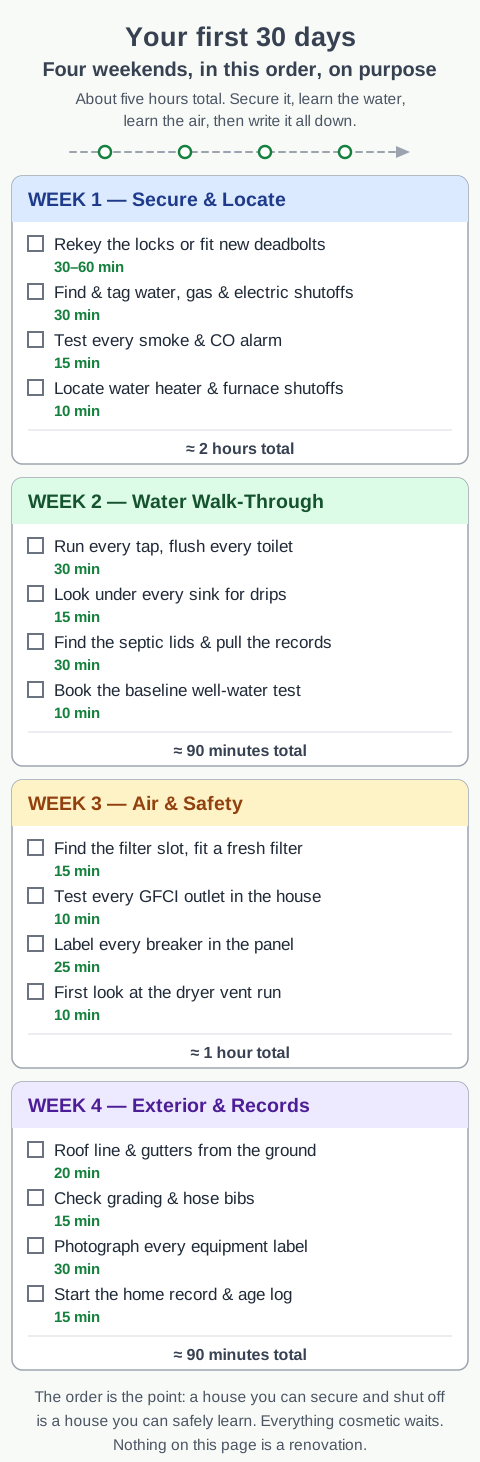
First-Time Homeowner Maintenance Checklist: The First 30 Days
The first 30 days in a new house, in the right order: rekey and locate your shutoffs in week 1, walk the water in week 2, learn the air in week 3, and build your home record in week 4 — with the time and cost of every task, and the list of what can safely wait 90 days.
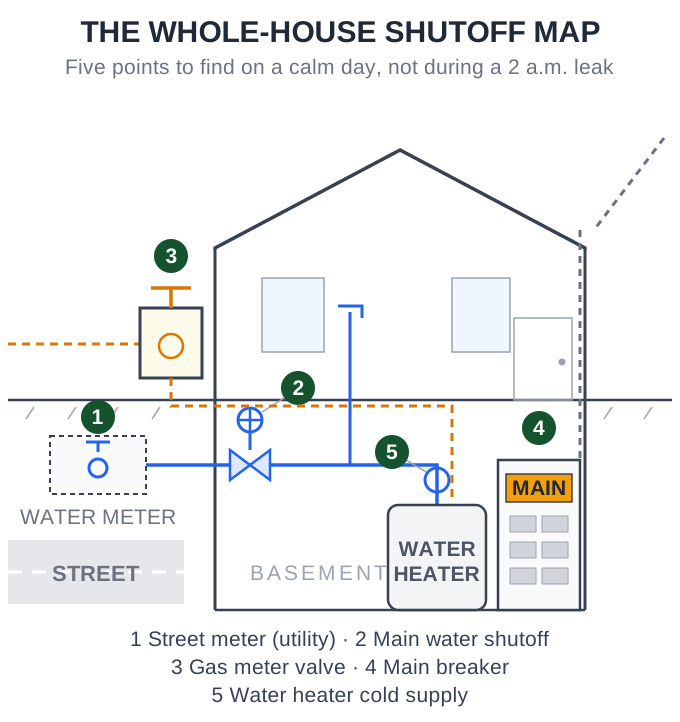
Find It Before You Need It: Your Main Water Shutoff, Gas Shutoff & Electrical Panel
Every house has five shutoffs that matter in an emergency: the street meter valve, your interior main, the gas meter valve, the main breaker and the water heater supply. How to find each one, test it, tag it, and fix the one that fails, before the 2 a.m. leak.
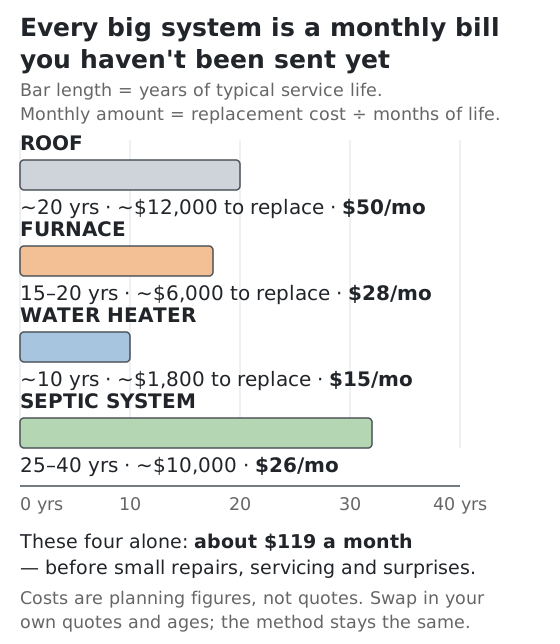
How Much to Budget for Home Maintenance in Year 1: The 1% Rule, Tested
The 1% rule says budget 1% of your home's value a year for maintenance. Here's where it works, where it breaks, what Fannie Mae actually recommends (1–4% by age), and the sinking-fund worksheet that replaces the guess with your own systems' numbers.