 Keep
Tankless Water Heater Error Codes, Decoded by Symptom (All Major Brands)
 Daniel Mercer · Editor & Researcher·
Published November 16, 2026·
Updated November 16, 2026
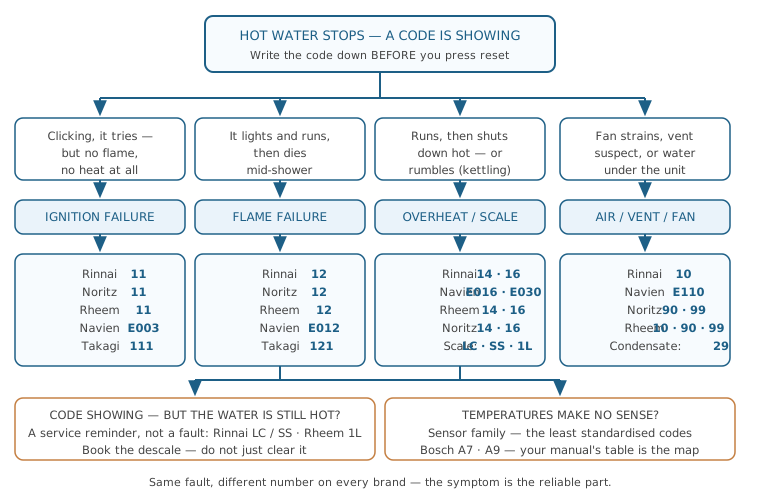
The shower is running cold, there is a number blinking on the water heater that was not there yesterday, and the number means nothing to you. That is the normal way to meet a tankless error code: mid-crisis, code first, understanding later. This guide reverses the order. Start from what the unit did — it clicked and never lit, it lit and died, it shut down hot, its fan sounded wrong — and the code turns into a name you can act on.
Two things are worth knowing before any specific code. First, a code is a symptom report, not a diagnosis. The unit can only tell you which of its monitored limits was crossed: no flame where flame should be, exhaust too hot, fan not proving airflow. Several different faults can cross the same limit, which is why every section below lists causes in the order to check them, not just the part the code seems to name. Second, every brand speaks its own language. Failed ignition is code 11 on a Rinnai, a Noritz and a Rheem, E003 on a Navien and 111 on a Takagi — and the numbering shifts again between product lines of the same brand. Anyone who quotes you a code meaning without asking your model is guessing. The faults, though, are universal, and they sort into five families. Learn the families and you can read any display in the country.
How to read your unit before you touch anything
Find the display. Most tankless units show codes on a small built-in display on the front panel or on a wired remote controller mounted nearby — often in a bathroom or utility room on units installed that way. If the display is dark, check the obvious first: the unit needs power to complain, so a tripped breaker or an unplugged cord means no code at all, which is its own clue.
Write down three things before resetting anything: the code exactly as shown, what the unit was doing when it appeared (starting up, ten minutes into a shower, on the coldest morning of the year), and whether it has happened before. A photo of the display takes two seconds and is worth more than your memory of it tomorrow. Resetting first and reading later destroys the evidence — many units clear the active code on reset, and the pattern of when it faults is often the most diagnostic fact there is.
Photograph the data plate too. Model and serial number live on a label on the side of the unit or inside the front cover. You will need the model for the manual (below), for any parts conversation, and for warranty checks — and if this heater came with the house, that plate is also how you learn its age and size, things the previous owner may never have told you. Many units also store a fault history — the last several codes with their sequence — which a technician can call up from the controller. It is one more reason not to power-cycle the unit repeatedly before a visit: you are shuffling the very record the diagnosis runs on.
Get the manual for your model. Manufacturers publish their installation and operation manuals as free PDFs keyed to model number, and the diagnostic table sits near the back. This guide covers the common codes across the major brands, but the table for your unit outranks any general guide, including this one — product lines differ, and a code that means condensate trouble on one line can mean something else on another.
One non-code worth naming: if the unit runs but cannot keep up, or cuts out when a second tap opens, and shows no code, that is usually not a fault at all. Tankless units need a minimum flow — roughly 0.4 to 0.5 gallons per minute — before they will fire, and low-flow fixtures or heavy mixing at a shower valve can drop the hot side below that threshold. No code appears because, as far as the unit is concerned, nobody asked it for hot water. That behaviour has its own guide on this site (the mid-shower shut-off problem); the point here is that silence from the display is information too.
Ignition failure: it clicks, tries, and never lights
The symptom. You open a hot tap and hear the unit wake up: the fan spins, there is a clicking or ticking as the igniter sparks, a pause, maybe a second and third attempt — and then it gives up, locks out, and posts its code. No flame was ever established. Of all the families, this is the one where the cause is most often outside the unit entirely.
The codes. Rinnai 11, Noritz 11, Rheem 11 (A011 on IKONIC models), Navien E003, Takagi 111. Bosch uses letter codes on most of its lines, where EA is the no-flame report.
Causes, in the order to check them:
- The gas is off or interrupted. The unit's own gas valve was closed during other work and never reopened, the meter was serviced, or supply was interrupted. This sounds too simple to be the answer and is the answer constantly — especially in a house you have recently moved into, where the heater's history is a blank page.
- Another appliance tells the story. If the stove burners and furnace light normally, gas is reaching the house and the problem is local to the heater. If nothing gas-fired works, the heater is innocent — call the gas company, not a plumber.
- Air in the gas line. After any gas work — a meter change, a new appliance, a repair — air sits in the line where gas should be, and the unit's first several ignition attempts are spent pushing it out. A heater that faults twice after gas work and then runs normally has usually just cleared its line.
- Low gas pressure or an undersized supply. The unit tries to light on pressure that sags below what its valve will accept. This one often travels with a pattern: ignition faults on cold mornings or at peak hours, when every gas appliance in the house (and the street) is drawing at once.
- A tired igniter or a dirty flame rod. The spark that lights the burner weakens with age and heat cycles, and the rod that must prove flame gets coated and stops reporting honestly. These are the first genuinely internal causes on the list, and the most common repair in this family.
Your safe checks: confirm the gas valve at the unit is fully open (handle parallel to the pipe), confirm other gas appliances work, note any recent gas work or outage, and then — once — reset and watch a full start attempt. Listening matters: fan, clicks, nothing is an ignition story; fan, clicks, a brief whoosh of flame and then death is the next section's story, not this one.
The stop-point. If the unit locks out again after that single reset with gas confirmed at the house, stop. Repeated ignition attempts on a unit that cannot light are not a strategy, and any smell of gas at any point ends the session entirely: out of the house, gas company from outside. Igniter and flame-rod work is inside the cabinet, on a gas appliance — a technician's job, and usually a quick one.
Flame failure: it lights, runs, then dies
The symptom. The burner lights — you may hear it, and the water starts warming — then the flame drops out: seconds later, or ten minutes into a shower. The unit may retry and repeat the cycle, which is why this family so often presents as a tankless that keeps shutting off. Timing is the diagnostic gold here. Dying within seconds of lighting points at flame proving; dying minutes in points at something that degrades as the run continues — heat, pressure sag, or a drain slowly filling.
The codes. Rinnai 12, Noritz 12, Rheem 12 (A012 on IKONIC), Navien E012, Takagi 121.
Causes, in the order to check them:
- A flame rod that can no longer prove flame. The burner lights, but the rod — coated with oxide or scale film — cannot sense it, so the control does exactly what it should: it closes the gas valve to a burner it believes is unlit. The commonest cause of die-in-seconds, and a cleaning or a rod is the fix.
- Gas pressure that sags under load. The unit lights happily alone, then loses its flame when the furnace kicks on or the gas dryer starts — the combined draw drops pressure below what a running burner needs. If your shut-offs coincide with other appliances firing, write that down; it is the single most useful sentence you can hand a technician.
- Venting gusts and downdraughts. Wind against certain terminations can disturb or snuff a flame, which is why some flame failures happen only on windy days, from one direction. A fault that keeps weather hours is telling you where to look.
- Condensate backing up. On condensing units, a clogged condensate trap or drain can flood toward the combustion chamber as a run continues — a die-after-minutes pattern with water where water should not be. Check under the unit and along the drain line.
- A failing gas valve or control. The valve that cannot hold itself open, or a board misreading its sensors. Last on the list because it is the least common and the most expensive — and the one your notes help prove or eliminate.
Your safe checks: time the failure (seconds or minutes), note what else was running, look at the vent termination outside for obstruction, and check the condensate drain is clear and actually draining. One reset after fixing something real is fair.
The stop-point. A unit that lights and dies repeatedly is cycling a gas burner against a safety system — let it rest after one honest retry. If flame failure arrives with any venting code from the next-but-one section, treat the pair as a combustion problem and call it in rather than experimenting.
Overheating and scale: the unit shuts down hot
The symptom. The unit runs, then shuts down as temperatures climb — sometimes with a rumble or popping from inside first (water trapped under scale flashing to steam, the kettling sound), sometimes with falling flow and swinging temperatures in the weeks beforehand. This is the family hard water built, and it is the one with a genuine maintenance cure.
The codes. Overheat shutdowns: Rinnai 14 (thermal fuse) and 16 (high temperature limit), Navien E016 (heat exchanger overheat) and E030 (exhaust temperature too high), Rheem 14 and 16, Noritz 14 and 16, Takagi 941 for exhaust over-temperature. Scale and service reminders — the soft codes that let the unit keep running: Rinnai LC on older condensing models and SS on Sensei models, Rheem 1L, and Navien's service-due E760.
What is actually happening. Scale plates onto the heat exchanger's inner walls and insulates them: the burner fires against metal that cannot pass its heat into the water, hot spots form, and the temperature sensors trip the unit off to protect the exchanger. The overheat code is the last report in a sequence that usually began with the soft scale reminder weeks or months earlier. This is why the two code types belong in one section: LC, SS and 1L are the polite early warning; 14, 16 and E016 are what arrives when the warning is cleared instead of answered.
Causes and checks, in order:
- Scale, first and always. If the unit has never been descaled — or you inherited it and simply do not know — assume scale until proven otherwise. The cure is the descale itself, and this site's guide to descaling a tankless water heater is the full procedure: vinegar, pump, isolation valves, 45 to 60 minutes. Do not repeat that work here; do the flush, then judge the code.
- A clogged inlet filter. The small screen where cold water enters the unit chokes on sediment and grit, flow through the exchanger drops, and slow water overheats where fast water would not. It is a five-minute check: power and water off per the manual, screen out, rinse, back in. Do this before concluding anything expensive.
- A setpoint set hotter than the house needs. Every degree of setpoint is work the exchanger does against its own scale. It is not a root cause, but a unit limping at 140°F may behave at 120°F while you arrange the flush.
- A sensor reading high, or an exchanger already damaged. If overheating codes return promptly after a proper descale with a clean filter, the story has moved past maintenance: a thermistor can drift and report heat that is not there, and an exchanger cooked by years of scale can carry permanent hot spots. Both are diagnosis jobs, not flushing jobs.
The stop-point. Code 14 on Rinnai and Noritz is a thermal fuse report — a one-shot safety device in many designs, not a self-healing limit. A unit that posts it belongs off until a technician has found what overheated it; resetting around a blown thermal fuse is defeating the device that exists for exactly this moment. Any overheating code that recurs after a descale gets the same respect.
Fan and venting: the unit cannot breathe
The symptom. The fan strains, cycles oddly, or the unit faults on start-up before flame is even attempted — the control proving airflow first, and failing to prove it. On condensing units this family also covers the water side of breathing: condensate that cannot drain will shut a unit down as surely as a blocked flue.
The codes. Rinnai 10 (air supply or exhaust blockage), Navien E110 (exhaust blockage / air pressure), Noritz 90 and 99 (combustion abnormality), Rheem 10, 90 and 99, Takagi 991 and 101. Condensate reports: 29 on Noritz and Rheem, and Rinnai 25 where a condensate pump is fitted.
Causes, in the order to check them:
- A blocked termination outside. Snow piled against the intake, a bird nest in the exhaust, mulch or a new shrub swallowing a low wall termination, a screen clogged with lint and cottonwood. This is the family's gift: the most common cause is outdoors, visible, and free to fix. Walk the terminations before you touch the unit.
- A condensate trap or drain that has clogged or frozen. Condensing units make water continuously; if the trap is gummed, the neutraliser spent and swollen, or the drain line frozen or sagging, the unit drowns its own airflow path. Look for water under the unit and along the drain route.
- Vent runs that were never right. Too long, too many elbows, wrong material, a sag collecting condensate — install faults that often announce themselves in the first hard winter, or the first winter after a remodel changed the room's air. These are installer-level corrections.
- A fan that is failing. Bearings wear, blades foul, motors weaken; the control asks for airflow the fan can no longer prove. A fan that sounds rough before the fault is the tell.
- Room air problems. A unit drawing combustion air from a room that has been sealed tighter, or competing with a powerful new range hood, can starve. If the fault arrived with a kitchen remodel, that is not a coincidence.
Your safe checks: clear the terminations, confirm the condensate drain runs freely, look for a frozen or kinked drain line, and listen to the fan on a start attempt — smooth spin-up is healthy; grinding or laboured surging is not.
The stop-point. Combustion abnormality codes (Noritz 90/99, and recurring 10/E110 on the others) involve the exhaust path that carries combustion gases out of your home. Clear the snow, check the drain, and if the code returns, the unit stays off until a technician has inspected the venting and combustion. This is the family where a carbon monoxide alarm earns its keep — if one ever sounds, leave and call it in; do not troubleshoot through it.
Sensors and controls: the readings stop making sense
The symptom. This family rarely announces itself with a dramatic failure. Instead: temperatures that swing without reason, a unit that reports overheating with a barely warm case, codes that appear and vanish, or a heater whose displayed temperature and the water at the tap plainly disagree. The burner and the plumbing are fine; the unit's picture of itself has gone wrong.
The codes — with a warning. Sensor codes are the least standardised family in this guide, and the one where your model's manual matters most. Bosch's letter system gives the clearest examples: A7 for a hot-water temperature sensor fault, A9 where the outlet sensor is not reading what it should, and E0 for an internal control or software fault. The other brands assign their thermistor, flow-sensor and board faults numbers that genuinely change between product lines, so treat any list — including this one — as a starting point and your manual's table as the verdict.
Causes, in the order to check them:
- A drifting or failed thermistor. Temperature sensors age, and a sensor reading 30 degrees high will shut a healthy unit down for overheating that does not exist — or, worse, reading low, let it run hotter than the setpoint. This is why sensor faults get diagnosed by comparison: what the unit believes versus what a thermometer at the tap says.
- Connections and condensation. Corroded sensor plugs, a chafed wire, moisture inside a cabinet mounted in a damp basement or garage. A visual check with the power off — and hands off anything gas or electrical — is as far as an owner goes, but it is worth doing: rodent damage to wiring is a real and unglamorous cause.
- Flow sensing faults. A flow sensor fouled with grit can under-report flow, making the unit short-fire or refuse to fire at low draws while behaving at full flow — a sensor fault wearing a plumbing costume. The inlet filter check from the overheating section is the owner's share of this one.
- The control board itself. Boards fail from age, heat and power surges; a unit whose faults began with a storm or an outage, and which now produces shifting, unrelated codes, is telling a board story. Boards are also the family's money pit, which is why the diagnosis has to be a proof, not a hunch — a good technician tests the sensors first and condemns the board last.
The stop-point. Anything that requires opening the cabinet and testing components is professional work, and be wary of any quote that replaces a board on a first visit without sensor tests in writing. Get the test results; they are the difference between a $200 sensor and a $700 guess.
The pattern is part of the code: when it faults changes what it means
The same code can indict different suspects depending on the circumstances around it, and owners lose money when the pattern goes unreported. Four patterns worth recognising:
Only in deep winter. A unit that faults only on the coldest nights is pointing outward: intake or exhaust terminations rimed with frost or buried by drifting snow, a condensate line frozen along an outside wall, or street gas pressure sagging when every furnace in the neighbourhood runs at once. Winter-only ignition and venting codes are rarely the unit dying; they are the season leaning on it.
Only at high demand. Faults that appear when two showers and the washing machine run together — but never for a single tap — are flow and supply stories: gas pressure that holds for one burner draw and sags at full fire, or a scaled exchanger that copes at half flow and overheats at full flow. Demand-pattern faults are why "it worked when the technician came" proves nothing; the technician needs the pattern, and ideally a test under load.
Only after other work. Codes that begin right after a remodel, a new range hood, a meter change or a roof replacement have a suspect list headed by the work, not the heater: air in the gas line, a vent termination altered or buried by new siding, combustion air sealed away by better insulation, debris in a line. Tell the technician what changed and when; it is the cheapest diagnostic fact there is.
Only on one fixture. If a single shower produces the complaint and every other tap runs hot and steady, be suspicious of the fixture — a mixing valve blending cold across, a low-flow head dropping the hot side under the firing threshold — before condemning the heater. Units get replaced for fixture faults more often than anyone in the trade likes to admit. Rule it in or out by testing a plain tap with a thermometer and a bucket before you pay for a diagnosis.
The reset rules: once, with a reason
Resetting is the most abused move in tankless ownership, so here is the whole protocol. Write the code down. Fix an obvious cause if one exists. Reset once. Watch a full cycle. If the unit runs and the code stays away, you are done — a blocked termination cleared, a valve reopened, a filter rinsed are real fixes, and the reset was just the unit being told to try again.
Never reset-and-retry these: any code accompanied by a gas smell; combustion and venting codes that return (Noritz 90/99, Navien E110, Rinnai 10); thermal-fuse and overheating codes that return after a descale; and any code paired with water leaking inside the cabinet. Each reset of a genuinely faulted unit also has a quiet cost: ignition systems wear on failed attempts, an overheating exchanger is heat-stressed again, and on many units you are overwriting the stored fault pattern the technician would have read first. The soft scale reminders are the designed exception — LC, SS and 1L let the unit run while you arrange the flush. They are a booking reminder with a deadline, not an all-clear.
What the professional does with your code
A good technician treats your written-down code as the start of the diagnosis, not the end of one. Expect: the stored fault history pulled from the controller (the sequence matters — venting codes before ignition codes tell a different story than the reverse); gas pressure tested static and under load with a manometer, which settles the sagging-supply question in minutes; the flame signal measured in microamps to prove or clear the flame rod; the fan and venting inspected, terminations included; on condensing units, the condensate path checked; and where sensors are suspects, readings compared against a thermometer rather than believed. A descale, when scale is the finding, is done with the unit's history in mind. If your technician does none of this and quotes a board or an exchanger from the code alone, that is a second-opinion situation — the code never named a part, and honest diagnosis is what the call-out fee buys.
What each family costs to fix
The front of this guide carries the summary table; here is the reasoning behind it. Diagnosis runs $100–$250 and is frequently credited toward the repair — you are paying for the history read and the tests above, and it is money well spent compared with parts roulette. Ignition and flame fixes are the family's bargains: igniters and flame rods are inexpensive parts, so $150–$400 is mostly access, testing and labour. Scale is the maintenance-priced family: $150–$300 for a professional descale, or the cost of vinegar and a pump if your unit has service valves and you follow the flush guide. Venting and fan work splits: clearing terminations is free, correcting vent runs is labour-priced, and a fan motor lands at $300–$800 fitted, in the same band as a gas valve. Sensors are cheap parts with diagnostic labour attached, while a control board at $400–$900 is where the age maths starts: on a unit past ten years, compare any big quote against replacement at $2,500–$5,500 installed — but check the warranty first, because heat exchangers commonly carry 10–15 years of cover and a failed exchanger on a nine-year-old unit may be a parts claim, not a purchase.
The owner's line, drawn once
Everything in this guide sorts into two piles. Yours: read and record the code, check the gas and water valves, walk the vent terminations, rinse the inlet filter, check the condensate drain, fix what is visibly wrong, reset once, and take notes that make a technician faster and cheaper. Theirs: anything inside the cabinet, anything involving gas components, venting corrections, combustion, and every code that survives your checks. A tankless unit that posts a code has done you a favour — it noticed a problem early, shut down safely, and wrote down what it saw. Meet it halfway: read the report properly, do the honest checks, and know exactly where your pile ends.
Cost at a glance
| Item | Typical cost | Notes |
|---|---|---|
| Diagnostic visit (code read + stored fault history) | $100–$250 | Often credited toward the repair; what you are paying for is the history read and the tests, not the code itself |
| Igniter or flame rod replaced | $150–$400 | The most common ignition and flame-failure fix; parts are cheap, access and testing are the labour |
| Fan motor or gas valve replaced | $300–$800 | The venting and flame families' expensive end; confirm with gas-pressure and fan tests before approving |
| Professional descale (scale codes LC, SS, 1L) | $150–$300 | The fix behind most overheating codes in hard water; DIY runs $15–$40 in vinegar if you have service valves |
| Control board replaced | $400–$900 | The sensor family's worst case; on an older unit, weigh it against replacement before approving |
Frequently asked questions
Can I just reset my tankless water heater when it shows an error code?
Once — after you have written the code down and fixed an obvious cause, such as a gas valve left off, a blocked vent termination or a clogged inlet filter. A reset tells the unit to try again; it does not repair anything. If the same code returns, the fault is real and further resets only erase the fault history a technician needs and, with ignition faults, repeatedly cycle a burner that is failing to light safely. Some codes should never be reset-and-retried at all: recurring venting or combustion codes (Noritz 90/99, Navien E110, Rinnai 10), overheating codes, and anything accompanied by a gas smell. The one family designed to be cleared and carried on with is the scale reminder (Rinnai LC or SS, Rheem 1L) — and even that one is asking you to book a descale, not to ignore it.
Why does the same fault have a different code on every brand?
Because there is no shared standard. Each manufacturer built its own diagnostic language, and even within a brand the numbering changes between product lines and generations: Rinnai's older condensing units flag scale as LC while current Sensei models use SS, and Rheem's newer IKONIC line prefixes its codes with an A, so 11 appears as A011. The faults themselves are universal — every gas tankless can fail to ignite, lose its flame, overheat, fail to vent or misread a sensor — which is why this guide is organised by symptom. Learn the five families and you can read any brand's display well enough to describe the problem accurately and judge the quote you are given.
My tankless shows a code but still makes hot water. Is that normal?
Yes, for one specific family: the service reminders. Rinnai LC (older condensing models) and SS (Sensei), Rheem 1L and Navien's service-due E760 are soft codes — the unit keeps running while telling you the heat exchanger needs descaling. They are the only codes designed to be lived with temporarily, and temporarily is the operative word: the scale causing them is also what produces overheating shutdowns, rumbling and exchanger damage if it is left. Book the flush within a few weeks. Every other code family stops the unit deliberately, so a code with hot water still flowing is either a soft reminder or a sensor reading so implausible that the unit has not yet decided to shut down — either way it deserves a note of the code and a plan, not a shrug.
What does it cost to fix a tankless error code?
The code is free to read; the fix is priced by family. A diagnostic visit runs $100–$250 and is often credited toward the repair. Ignition and flame faults usually land at $150–$400 for an igniter or flame rod. A professional descale behind scale and overheating codes is $150–$300 (or $15–$40 in vinegar as DIY). Fan motors and gas valves run $300–$800, and control boards $400–$900. The outlier is the heat exchanger itself at $1,000 or more in parts and labour — but heat exchangers carry long warranties (often 10–15 years on residential units), so check coverage before paying for one, and before letting anyone sell you a full replacement at $2,500–$5,500 installed.
The code came back after I reset it. What now?
Stop resetting and start recording. Note the code, what the unit was doing when it appeared (starting up, mid-shower, on a cold morning, when another gas appliance fired), and how many times it has occurred. Then run the owner checks for that family in this guide once, in order — valves, vent terminations, inlet filter, condensate drain. If the code survives those, the fault is inside the cabinet or the gas supply, and it is a technician's job. Hand them your notes: a unit that dies only when the furnace and dryer run together is pointing at gas pressure under load, and telling the tech that pattern can cut the diagnostic visit in half.
Where do I find what my exact code means?
In the manual for your exact model — which matters more with error codes than with almost anything else, because numbering shifts between product lines. Find the model and serial number on the data plate (usually on the side of the unit or inside the front cover), then search the manufacturer's support site for that model's installation or operation manual; the diagnostic table is normally near the back. If the unit came with the house and the paper manual is long gone, the PDF is the manual now. Keep a photo of the data plate and the code table page on your phone: the next time the display lights up, you will not be searching the internet standing in a cold shower.
Can a tankless error code be dangerous?
The code itself is the opposite of dangerous — it is the unit's safety systems working, shutting the burner down because something it monitors went out of bounds. The situations around codes that do demand respect: a smell of gas at any point (leave, call the gas company from outside, do not reset anything); venting and combustion codes that recur, because they involve the exhaust path that keeps combustion gases out of your rooms; and repeated overheating codes, which mean the exchanger is being heat-stressed. Carbon monoxide alarms belong near any gas appliance regardless — if one sounds, that is an emergency call, not a troubleshooting session. Treat codes as reports, respect the three situations above, and the system is on your side.
Checked November 16, 2026. This guide is general information, not a substitute for a licensed professional.
Related guides
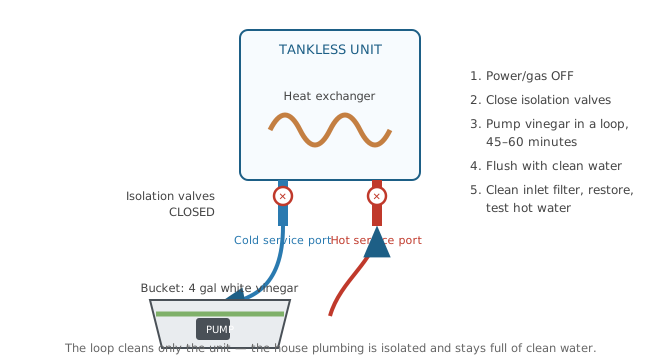
How to Descale a Tankless Water Heater: The Flush That Decides Whether It Lasts 8 Years or 20
Scale is what kills tankless heaters. The full DIY flush — vinegar, pump, isolation valves, 45 minutes — plus the schedule for your water hardness, the symptoms of overdue, and what a pro charges.
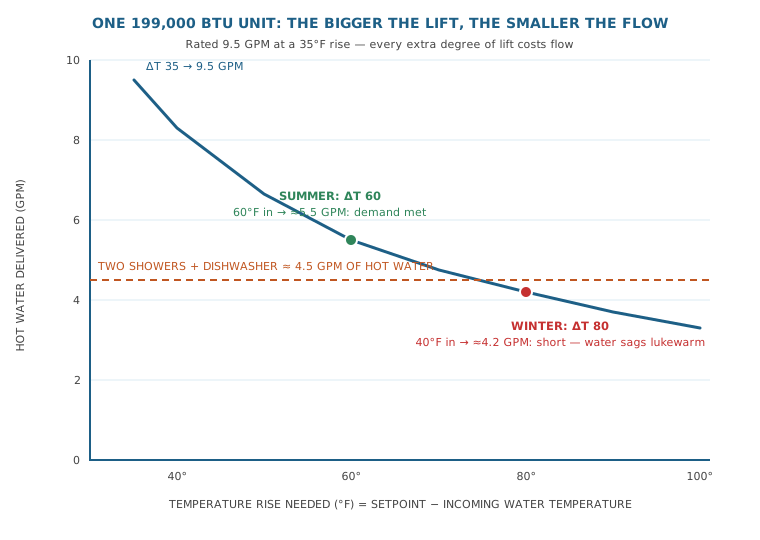
Tankless Water Heater Not Hot Enough? It's a Capacity Problem — Temperature Rise, Explained With Your Own Numbers
Your tankless runs, fires and shows no error — it just never gets properly hot, especially in winter or when two showers run together. That is a temperature-rise problem, not a breakdown. Work the worksheet with your own unit's numbers, split the symptom four ways, and fix the real cause: capacity, scale, gas supply or crossover.
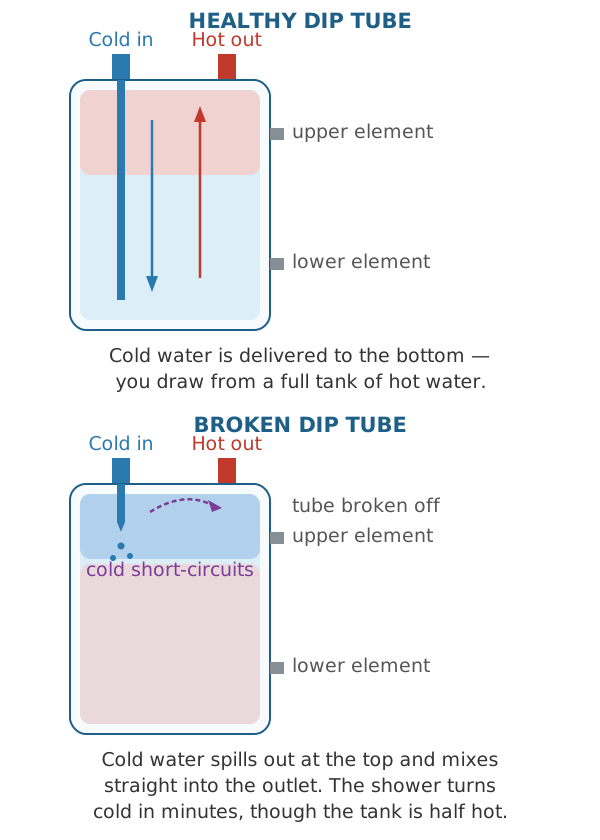
Why Your Hot Water Runs Out So Fast — and the Bucket Test That Tells You Why
Showers going cold in minutes? The bucket test measures how much hot water your tank actually delivers, then splits the causes: broken dip tube, dead lower element, sediment, thermostat, cross-connection, or a tank that is simply too small now.