 Keep
Signs Your Well Pump Is Failing: Constant Running, Sputtering and Climbing Bills
 Daniel Mercer · Editor & Researcher·
Published November 16, 2026·
Updated November 16, 2026
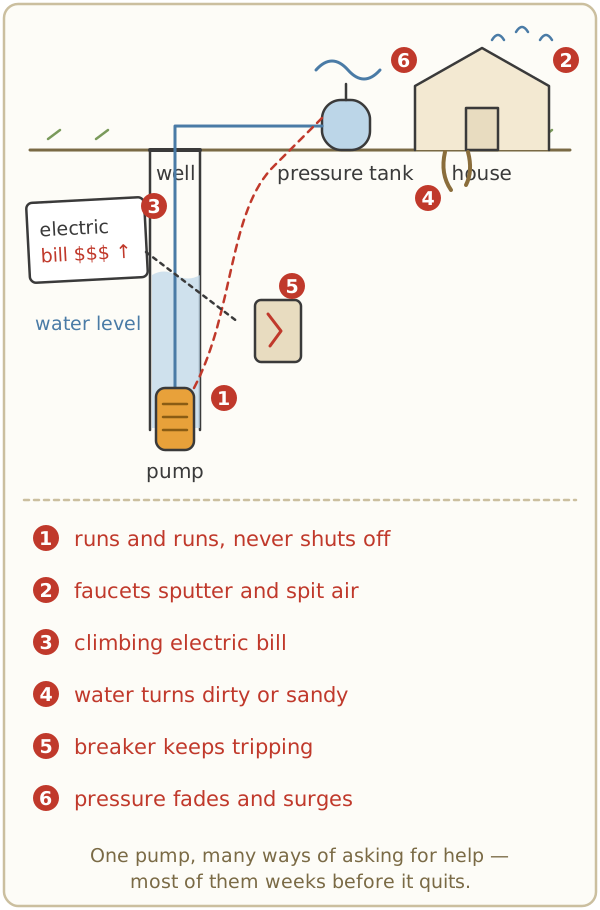
Well pumps have one kindness in them: they almost never die in silence. Long before the morning you turn a tap and get nothing, the pump spends weeks — sometimes months — asking for help in a language of rhythms, sounds and numbers. It starts running a little too often. The shower pressure fades in a way it never used to. The electric bill creeps up and you blame the weather. By the time the pump quits outright, it has usually told you five or six times that it was going.
This guide is about learning that language early, because the timing is where the money is. A failing pump caught at the symptom stage is a diagnosis visit and a planned repair, often a few hundred dollars. The same failure ignored until the pump seizes is an emergency call, no water in the house, and a replacement done on the contractor's schedule instead of yours. And there is a second reason to read symptoms carefully: most of what looks like a dying pump is not the pump at all. The pressure tank, the pressure switch and even a leaking toilet imitate pump failure convincingly, and they cost a tenth as much to fix. Replacing a sound pump because a $40 switch fooled you is the most expensive mistake in well ownership.
So work through the signs one by one. For each, you get what it means mechanically, and the check you can do yourself — watching, listening, timing, knocking — before anyone is paid to open anything. Then the impostors, then what a professional actually tests, then the honest repair-or-replace maths.
Sign 1: The pump runs constantly and never shuts off
A healthy pump has a simple working day. It runs until the pressure tank reaches cut-out pressure — commonly 50 or 60 PSI — then it rests, sometimes for hours, while the tank quietly supplies the house. A pump that runs and runs, through the night, when nobody has touched a tap in hours, has lost that cycle. It is the single most urgent sign on this list.
What it means: the pump cannot get the system to cut-out pressure, so the switch never tells it to stop. Either pressure is leaking away as fast as the pump builds it, or the pump has grown too weak to build it. The leak version is more common than the worn-pump version: a toilet flapper passing water all day, an irrigation valve stuck open, a leak in the underground line, or a hole in the drop pipe inside the well letting water spray back down instead of up. The weak-pump version is real too — impellers worn by years of water and fine grit simply move less water per minute than the switch demands.
Your check: first, confirm it is really running with no demand. Close every tap, stop the washing machine and dishwasher, and listen at the tank or watch the gauge: a system at rest should sit still. Then hunt the leak before you blame the pump. Put food colouring in each toilet cistern and wait twenty minutes without flushing — colour in the bowl means that toilet is running. Check the irrigation controller, the outside taps, and any spot in the yard that stays green or soggy over the buried line. Finally, watch the gauge with everything off: if pressure slowly falls while the pump rests, water is leaving somewhere; if the pump runs but the gauge never climbs past a certain point and stalls there, the pump itself is running out of strength.
The one thing to do today: if the pump is running constantly and you cannot find a leak quickly, switch it off at the breaker between uses. A submersible motor is cooled by water flowing past it. Run against a leak it may survive a while; run dry, or run for days at full stretch, it cooks. Constant running left alone converts whatever the original problem was into a definite pump replacement.
Sign 2: The pump short cycles — on, off, on, off
Short cycling is the opposite rhythm: the pump clicks on, runs for a few seconds, clicks off, then does it again a few seconds later, over and over, whenever water is being used. You may hear it as clicking from the pressure switch near the tank, see the lights dim faintly with each start, or watch the pressure gauge needle bounce like a metronome.
What it means: the pump is starting far more often than the system was designed for, and each start is the hardest moment of a motor's life — a surge of current several times the running draw, heating the windings. A pump is built for a limited budget of starts across its life; short cycling spends that budget in weeks. Here is the part that matters for your wallet: short cycling is usually a symptom of a failing pressure tank, not a failing pump — but left alone, it becomes a failing pump. It is the one sign that manufactures the very failure this article is about.
Your check: stand at the tank while someone runs a shower, and time it. A healthy system runs the pump for at least a minute or so of steady draw, then rests. Cycling every few seconds is the disease. Then do the knock test on the tank: tap it from bottom to top with your knuckles. The bottom should sound solid and full; the top third should ring hollow — that is the air cushion. Solid all the way up means the bladder inside has ruptured and the tank is waterlogged, with almost no air left to absorb pressure, so pressure spikes and crashes with every cup of water drawn. (There is a second, gauge-and-drain test for the tank's air charge, but it involves shutting off power and draining the system; the knock test plus the rhythm usually tells you enough to make the call.)
Sign 3: Faucets sputter and spit air
You open a tap and before the water comes, it coughs — bursts of air mixed with water, spitting and hissing, then settling into a stream. Air is getting into a system that should contain nothing but water, and there are only a few doors it can come through.
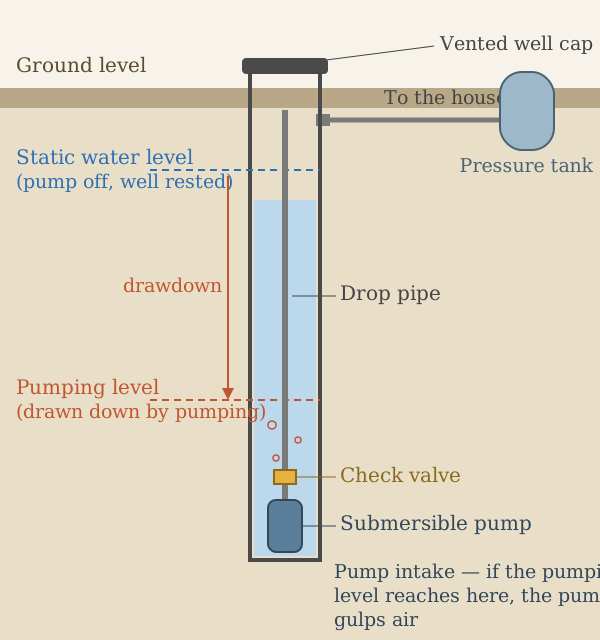
What it means: if the well's water level has dropped close to the pump's intake — in a dry spell, or after heavy use — the pump can gulp air along with water. A crack in the drop pipe inside the well lets air in on the suction side of the cycle. A failed check valve or worn pump seals can do the same. On an above-ground jet pump, sputtering usually means the pump is losing its prime. One episode of sputtering after a power cut or plumbing work is normal and clears itself; sputtering that keeps coming back, week after week, is a sign.
Your check: note the pattern. Sputtering at every faucet points back to the well equipment; sputtering at one faucet is that faucet — a clogged aerator or a local fitting. Sputtering worst first thing in the morning, or after the house has sat unused, suggests air accumulating while the system rests, which fits a drop-pipe crack or a check valve letting the column drain back. Sputtering that appears during long heavy use — the end of a long irrigation run — fits the well being drawn down to the pump. Write the pattern down; it is exactly what the contractor will ask, and it steers the diagnosis more than the sputtering itself does.
Sign 4: Pressure fades, surges, or dies at the end of a shower
The shower starts strong and fades to a dribble. Pressure is fine for one fixture and collapses when a second opens. Or the gauge sits at pressures it never used to. Pressure is the pump's report card, and a slow decline is often the earliest sign of a tiring pump: the motor still turns, the impellers still spin, but they move less water against the same head than they did five years ago, so the system lives at the bottom of its pressure range and any real demand exposes it.
A sudden pressure drop is a different animal — that is usually electrical or mechanical failure arriving at once, not wear. Wear fades; failure falls off a cliff. Noting which of the two you have is half the diagnosis.
Your check: read the pressure gauge by the tank while a tap runs, and again at rest. A common setup cuts in at 40 PSI and out at 60 (or 30/50 on older systems). Watch where the pump starts and stops: if the pump runs but cannot push the gauge past, say, 45 on a 40/60 switch, it can no longer make full pressure — a worn pump or a well problem. If the needle swings wildly up and down, think tank, not pump (that is Sign 2's territory). If pressure is steady but simply lower than it used to be everywhere, suspect the pump, a clogged filter if you have one, or a well screen slowly fouling. Also check the simple stuff: a whole-house filter cartridge months past its change can strangle pressure house-wide and has fooled many owners into pump shopping.
Sign 5: The water turns dirty, gritty or sandy
Well water has a character, and you learn yours within a few months of moving in. When water that ran clear for years starts arriving cloudy, gritty, or leaving sand in the aerators and the bottom of the kettle, something in the well has changed position or condition.
What it means: a pump works hardest at start-up, and a worn or failing pump can surge and stir the well in ways a healthy one does not. A failing check valve lets the full water column crash back down the well every time the pump stops, and that repeated hammering shakes sediment loose from the casing and the formation. A pump whose intake is now close to a dropping water level can pull from nearer the bottom, where sediment lives. And sand is not just a symptom — it is an abrasive. Every grain that passes through the pump grinds the impellers a little, so dirty water both signals wear and accelerates it.
Your check: fill a clean white bucket or a clear glass from the tap nearest the pressure tank, before any filter, and let it settle for an hour. Sand settles fast and feels gritty between your fingers; silt and clay stay cloudy much longer. Check the faucet aerators around the house — unscrew one and look for grains. Then ask the timing question: did the dirt arrive with another sign on this list, especially sputtering or constant running? Dirt plus a rhythm change is a system talking. Dirt alone, after a drought or after nearby well work or blasting, can be the aquifer rather than the pump. Either way, new sediment earns a water test as well as a diagnosis — a disturbed well deserves a coliform and nitrate check before you drink from it with confidence.
Sign 6: The electric bill climbs for no reason
Nobody opens the electric bill expecting news about the well, but the pump is one of the few appliances in a house that can quietly double its own consumption, and the bill is often where a failing pump shows up first — months before the water does anything obviously wrong.
The maths is plain. A pump motor draws a heavy surge at every start; a pump short cycling through hundreds of extra starts a day spends that surge hundreds of extra times. A pump that used to run ninety minutes a day and now runs four hours — fighting a leak, or straining to reach a cut-out pressure it can barely make — has multiplied its running hours. A typical submersible draws somewhere in the region of 750 to 1,500 watts while running, so extra hours and extra starts land on the bill as a real, visible rise: owners commonly report $20 to $60 a month with no other change in the house.
Your check: compare kilowatt-hours, not dollars, against the same month last year — rates change, usage is the truth. Then rule out the seasonal impostors honestly: a heat wave loads the air conditioning, a cold snap loads the heating, guests load everything. If the rise persists across two or three bills in mild weather, and it arrived alongside any other sign in this article — a rhythm change, a pressure change, new noises — put the pump system at the top of the suspect list and say so when you book the diagnosis. Contractors take the bill seriously; it is data, and it dates the problem.
Sign 7: The breaker trips — again
A tripped breaker is not a symptom to manage; it is a message to read once and obey. The breaker on the pump circuit trips when current goes somewhere it should not: a motor winding breaking down and shorting as the motor dies, wire insulation worn through somewhere down the well (the cable moves microscopically with every start, against the casing, for years), or a start capacitor failing in the control box above ground.
Your check: reset it exactly once. If it holds and the pump runs normally, note the date and watch — a single trip can follow a storm or a voltage sag. If it trips again, and especially if it trips instantly, leave it off. Note how it behaves, because the timing is diagnostic gold: an instant trip points to a dead short; a trip after several minutes of running points to a motor overheating under load; a trip at the moment of start points toward the starting components. Do not keep resetting it to squeeze the pump through the weekend. Every reset feeds current into a fault, and the possible outcomes run from a fried control box to damaged wiring in the well — each one adding parts to a bill that was already written.
Sign 8: Age itself — the silent sign
The last sign has no sound and no symptom: the calendar. Submersible pumps typically last 8 to 15 years. Jet pumps run about 8 to 12. A pump at year thirteen with two minor symptoms is not a pump with two minor problems; it is an old pump beginning its decline, and every decision you make about it should be priced with that in mind.
The trouble, if you have just bought the house, is that nobody may know the age. Sellers forget, records vanish, and the pump itself is at the bottom of a well where you cannot read its label. Hunt for the paper: the well completion report filed when the well was drilled, the closing documents, an installer's sticker on the pressure tank or control box, a date written in marker on the tank by a previous service visit. If the trail is cold, treat an undated pump as an old pump for budgeting purposes. That single assumption — this pump owes me nothing — will save you from the classic trap of spending repair money as if the pump were young.
The impostors: three cheap parts that fake a dying pump
Before the pro section, pin this to the wall: most "failing pump" symptoms are produced by parts that are not the pump, and the parts are cheap precisely because they sit above ground where hands can reach them.
The waterlogged pressure tank. The tank's job is to hold a cushion of compressed air that pushes water out between pump runs. When its bladder ruptures, the cushion vanishes. The result is short cycling (Sign 2), wild pressure swings (Sign 4), and a pump that seems to run all the time in tiny bursts. It is the most common impostor of all. The knock test — hollow at the top is healthy, solid all the way through is drowned — takes thirty seconds and no tools.
The failing pressure switch. The switch is the small box by the tank that reads pressure and starts and stops the pump. Its contacts pit and burn a little with every cycle — tens of thousands of cycles across a decade — until they stick, chatter, or fail to close. A stuck switch can run the pump constantly (Sign 1) or not at all. Ants and insects nesting in the switch are a genuinely common cause of failure in warm climates. The switch itself costs $20 to $50; fitted, $120 to $350. Do not open it yourself — the terminals are live — but do tell the contractor if the clicking at the tank has changed character.
The leaking toilet (and its cousins). A toilet flapper that passes water all day can call the pump hundreds of extra times, run it for hours, and inflate the bill — Signs 1 and 6 from a $10 part in a tank you can open with your bare hands. The food-colouring test costs nothing. The same family includes stuck irrigation valves, a dripping hose bib, and a water softener stuck in regeneration. Rule the house out before you condemn the well.
The order of suspicion, always: house leaks first, tank and switch second, pump last. It is the order of cost, and it is also the order of probability.
What the pro actually does: the tests behind the verdict
When a well contractor diagnoses a "failing pump," a good one does not start by pulling anything out of the ground. The visit is a sequence of measurements, each one ruling a suspect in or out, and understanding the sequence lets you tell a real diagnosis from a guess with an invoice attached.
Amp draw. The clamp meter goes around the pump's wire at the control box or switch, and the motor's current draw is compared against the nameplate rating for that pump. A motor drawing well above its rated amps is working against something — failing bearings, a pump end grinding with sand, low voltage, or a motor in the early stages of electrical failure. A motor drawing below normal while delivering little water suggests the pump end is worn and moving less water than it should. This single number, paired with what the water is doing, is the closest thing to a blood test a pump gets.
Flow and pressure test. The contractor runs water through a hose or a test outlet and measures what the system actually delivers: how many gallons per minute, and at what pressure. A healthy system makes its rated flow and climbs to cut-out. A pump that runs, draws reasonable amps, but produces a weak flow that fades as it runs is worn, or the well cannot feed it. Flow measured over several minutes also exposes a dropping well: strong at first, dying away, recovering after a rest.
Tank and switch checks. The tank gets the same knock test you did, done by someone who has knocked on ten thousand tanks, plus a check of its air charge with the system drained — the charge should sit about 2 PSI below the switch's cut-in pressure. The switch contacts get a visual: pitted, burned or ant-infested contacts explain a lot of bad behaviour for very little money.
Electrical checks down the well. With the pump circuit off, the contractor can measure the motor windings' resistance and test insulation with a megohmmeter — a "megger" — which pushes a test voltage through the insulation and measures how much leaks. Falling insulation resistance is a motor dying electrically before it dies mechanically, and it is the test that turns "the breaker trips sometimes" into a confident verdict. These readings also cover the cable down the well, which chafes slowly against the casing with every start and is a real, if less famous, failure point.
The verdict logic. Put together, the pattern resolves: normal amps + normal flow + bad rhythm = tank or switch, pump innocent. High amps + poor flow + an old pump = the pump is done. Good pump numbers + flow that fades = the well itself needs attention, and pulling a healthy pump would have fixed nothing. If a contractor wants to replace your pump without a clamp meter ever appearing, get a second opinion before you sign — the pull alone costs $300 to $600 in labour, and guessing wrong is expensive in both directions.
Repair or replace: the honest maths
Once the diagnosis is in, the decision is arithmetic, not sentiment. Two numbers decide it: the pump's age, and the repair's share of a replacement.
The age line. Below about 8 years, a pump has most of its expected life ahead of it, and a repair that addresses the actual fault is usually money well spent. Between 8 and 12, it depends on the repair's size. Past 12 to 15 years — the top of the normal lifespan — the pump is living on borrowed time, and every repair dollar should be interrogated hard.
The half rule. If a repair costs more than roughly half the price of a full replacement, replace. With Angi's 2026 average replacement at $1,897 across more than a thousand real jobs, the line sits near $950. Industry guidance says the same thing from the other direction: replace when the pump is past its lifespan, when it has failed twice in eighteen months, or when a rebuild estimate passes half of new.
The pull changes everything. Here is the trap specific to submersibles. On a jet pump sitting beside the tank, a motor repair is a bench job. On a submersible, reaching the pump means pulling the whole string — pump, pipe and cable — out of the well, and that pull-and-reset alone runs $300 to $600 before a single part is priced. So a "motor repair" quoted at $900 on a 13-year-old submersible is really $900 to own an old pump with a fresher motor, its impellers still worn, its cable still thirteen years chafed. The same $900-plus is most of the way to a new pump with a new warranty and another 8 to 15 years in front of it. This is why contractors so often recommend replacement once a submersible is out of the ground: not upselling, arithmetic.
What does not count in this maths: the above-ground parts. A switch, a capacitor, a control box or even a tank is not a repair to the pump — those parts serve whatever pump is in the well, including its replacement. Fixing them is almost always right, at almost any pump age, and a new tank bought this year will still be earning its keep behind the next pump.
The costs, laid out
The cost table at the top of this page runs from the cheapest impostor to the full replacement, and it is worth reading as a ladder: most failing-pump stories end on the first three rungs. A pressure switch fitted runs $120 to $350. A start capacitor — the part behind the pump that hums but will not start — is around $100 to $150 fitted, and a full control box $200 to $500. A pressure tank, the fix for most short cycling, is around $500 on Angi's numbers for a typical swap, with HomeGuide's installed range for larger tanks running $800 to $1,500.
The expensive rung is anything that requires the pull. Motor work on a pulled submersible lands around $800 to $1,600 all-in, which is exactly the territory where the half rule starts voting for replacement. And the replacement itself: Angi's 2026 data puts most jobs between $974 and $2,821, averaging $1,897. A shallow-well jet pump replacement sits at the bottom of the market at $400 to $1,000 installed; a standard submersible in a 100 to 300 ft well runs $1,000 to $2,500; deep or high-flow submersibles pass $1,500 and can run beyond $5,000. Depth, as always with wells, is destiny: the deeper the pump hangs, the more pipe, cable and labour every job carries.
One more line item to expect and respect: the diagnostic visit itself. Some contractors charge a call-out in the $100 to $250 range, often credited against the repair if you go ahead. Pay it gladly. It is the cheapest money in this entire article, because it is the difference between replacing the part that failed and replacing the part someone guessed at.
No water while you wait: the emergency plan
Diagnosis booked for Thursday, pump sulking or off, and the house still needs to function. A household uses roughly 50 to 80 gallons per person per day in normal life; in emergency mode you can run a careful house on a small fraction of that, and knowing the fractions turns panic into a plan.
Drinking and cooking come first, and they are cheap. Allow a gallon per person per day for drinking and basic cooking — a family of four needs four gallons a day, which is two supermarket cases of water or a couple of filled jugs, for several days. If your pressure tank holds any charge and the pump can run at all under supervision, fill every container you own during one careful run: jugs, the bathtub (for flushing water, not drinking), stockpots, the washing machine tub.
Flushing is the big spend, and it is optional per-flush. A modern toilet uses about 1.6 gallons a flush; an older one 3 to 5. The emergency rule — if it's yellow, let it mellow — cuts that spend by most of itself, and a bucket of bath or rainwater poured into the bowl flushes any toilet without the tank at all: pour about a gallon and a half in steadily and the bowl siphons itself.
Hygiene compresses well. A sponge bath takes a basin, not a shower. Handwashing can run from a jug with a helper or a sports bottle. Dishes: scrape, wash in one basin, rinse in another, and the whole day's dishes cost about two gallons. Laundry simply waits; nobody ever regretted a laundry backlog during a water outage.
If the pump runs but weakly, ration by schedule rather than by hope: one timed window in the morning and one in the evening when the pump runs under supervision to refill the tank and your containers, breaker off the rest of the day. A weak pump babied this way often survives to its appointment; the same pump left cycling against a leak for three days may not. And if the well itself was drawn down, rest is the treatment — a rested well recovers in hours, and rationing is what lets it.
Test before you drink with confidence if the system was opened, the pump pulled, or the well ran dry and came back gritty. The EPA and CDC both advise testing private wells for coliform bacteria after repairs and disruptions, and keeping bottled water for drinking until a test comes back clean is the cautious, cheap play.
The planned replacement beats the emergency one
Everything in this article points at one conclusion: the cheapest well pump replacement is the one you schedule. When a diagnosis says the pump is failing — amps climbing, flow fading, age past twelve — you hold a rare and valuable thing: a working-but-dying pump and time to choose.
A planned replacement lets you get two or three quotes instead of accepting the first truck that can come. It lets the contractor order the right pump for your well's depth and yield rather than fitting whatever is on the truck. It happens on a weekday at weekday rates, in daylight, with the water off for a planned few hours instead of an unplanned few days. It lets you bundle the sensible extras while the system is open — a tired tank replaced in the same visit, the switch renewed, the well water tested afterward — at marginal cost rather than as separate call-outs.
The emergency version of the same job inverts every one of those: one quote, weekend rates, the pump on the truck, and a house full of people who have not showered. The difference is commonly several hundred dollars and several days of misery, and it is bought entirely with attention — noticing the signs in this article while they are still whispers.
So the practical close: if your pump is past ten years old, book a diagnosis when the first sign appears, not the fifth. Ask for the amp draw and flow numbers and write them down. If the verdict is "failing, not failed," put the replacement on your calendar within the season, fill a couple of water jugs for the day of the swap, and let the old pump retire with dignity instead of drama.
Urgency summary: which sign, how fast
Today, breaker off: the pump runs constantly and no leak can be found; the breaker trips a second time; you smell burning at the control box or switch; the pump hums without starting and keeps humming. These are the signs that damage equipment or worse while you watch.
This week: short cycling (it is actively consuming the pump's remaining life), pressure that has dropped noticeably, sputtering that keeps returning, dirty water that is new. Book the diagnosis now; these are the signs with a planning window still open.
This month, on your schedule: a bill creep that lines up with subtle changes, a pump of unknown age with one mild symptom, anything you noticed only because you read a list like this one. Get the numbers measured, write them down, and decide with the maths rather than the fear.
A well pump that is looked after this way rarely surprises anyone. It gives its weeks of warning, the warning gets read, and the story ends with a planned visit and a reasonable bill — which is all any homeowner is really asking from the machine at the bottom of the well.
Cost at a glance
| Item | Typical cost | Notes |
|---|---|---|
| Pressure switch replaced | $120–$350 | The part is $20–$50; the rest is the visit. Above ground, pump stays in the well, usually under an hour |
| Start capacitor or control box replaced | $100–$500 | Capacitor alone around $100–$150 fitted; a whole control box $200–$500. The classic fix for a pump that hums but won't start |
| Pressure tank replaced | $300–$1,500 | Angi puts a typical tank swap near $500; HomeGuide's installed range runs $800–$1,500 for larger tanks. The fix for most short cycling |
| Pump pulled, motor repaired or replaced only | $800–$1,600 | Pulling and re-setting the pump alone runs $300–$600 in labour before any part is touched — which is why motor-only repairs on old pumps rarely win the maths |
| Full pump replacement, installed | $975–$2,821 | Angi's 2026 average across 1,339 real jobs was $1,897. Shallow jet pumps land at the low end ($400–$1,000); deep submersibles run $1,500–$5,000+ |
Frequently asked questions
How do I know if it is the well pump failing or just the pressure tank?
Watch the gauge and the rhythm. Short cycling — the pump clicking on and off every few seconds — with a gauge needle that swings wildly points at the tank: knock on it top to bottom, and if it sounds solid all the way through with no hollow ring at the top, the bladder has failed and the tank is waterlogged. Low pressure that is low all the time, steady rather than swinging, points more at the pump. No single symptom settles it, which is why a good contractor tests pump and tank together before quoting either.
How long do well pumps last?
Submersible pumps typically last 8 to 15 years; jet pumps about 8 to 12. Plenty reach 15 to 20 in clean, sandy-free water with a healthy pressure tank. The life-shorteners are short cycling (every start is a surge of heat in the windings), sand or sediment grinding through the pump, running dry, and low voltage. If you just bought the house and nobody knows the pump's age, ask the seller, check the well record, and look for a date on the control box or an installer's sticker on the tank — and budget as if an undated pump is an old one.
Why does my well pump run constantly and never shut off?
Because it cannot reach the cut-out pressure that tells it to stop. The causes, in rough order: a leak draining pressure as fast as the pump builds it (a running toilet, a stuck irrigation valve, a leak in the drop pipe down the well), a pump too worn to make full pressure, a well drawn down so the pump is partly running dry, or switch contacts welded shut. Whatever the cause, do not leave it running: a submersible motor is cooled by the water flowing past it, and a pump running dry or against a leak overheats. Switch it off at the breaker and treat the diagnosis as urgent.
Should I repair my well pump or replace it?
Run two numbers. First, age: past 12 to 15 years, the pump is at or beyond its expected life and any serious repair is money into a dying machine. Second, the share: if a repair costs more than about half the price of a replacement — roughly $950 against the $1,897 average replacement — replace. The trap is the pull: on a submersible, $300–$600 of any repair bill is just getting the pump out and back in, so a $900 motor repair on a 13-year-old pump buys you an old pump with a new motor. Above-ground repairs (switch, capacitor, tank) are different — those are cheap at almost any pump age.
Can a failing well pump really raise my electric bill?
Yes, and it is one of the earliest signs. A pump that starts 200 times a day instead of 40 draws a starting surge 200 times. A pump that runs an extra hour a day against a leak or because it can no longer reach cut-out pressure is a motor drawing several hundred watts for that hour. Homeowners often notice a $20–$60 monthly rise with no other explanation. Compare this month's bill with the same month last year — usage in kilowatt-hours, not dollars — and if the rise lines up with pressure changes or new pump noises, the pump system is the first suspect, ahead of the water heater and the HVAC.
Why is my well water suddenly dirty or sandy when it used to be clear?
A healthy well delivers the same water it delivered last year, so a change means something moved. A pump that is wearing or sitting lower relative to the water can stir up or draw in sediment it never used to reach. A failing check valve can let the water column slam back down the well at every shut-off, shaking sediment loose. Sand in quantity is also an abrasive grinding away inside the pump itself. Fit a sediment filter if you like, but treat new dirt as a symptom to diagnose, not just water to clean — and have the water tested, because a change in the well deserves a coliform and nitrate test.
The breaker for my well pump keeps tripping. Can I just keep resetting it?
Reset it once. A breaker that trips again is reporting a fault — most often a motor winding shorting as it fails, damaged wire insulation down the well, or a dying start capacitor — and it is refusing to feed power into that fault on purpose. Repeated resets force current into the fault and can turn a pump replacement into a wiring replacement as well. Leave it off, and tell the contractor how it trips: instantly, or after the pump runs a while. An instant trip suggests a dead short; a trip after minutes of running suggests a motor overheating under load. That timing genuinely helps the diagnosis.
Checked November 16, 2026. This guide is general information, not a substitute for a licensed professional.
Related guides
Air in Your Water Lines: Why Faucets Sputter on a Well
A sputtering faucet on well water is a symptom with a short list of causes — drawdown, a leaking check valve or drop pipe, a tired pressure tank, or dissolved gas. How the timing of the sputter tells you which one, the tests to run, and what each fix costs.
How Far Should a Well Be From a Septic Tank? Setbacks, Explained
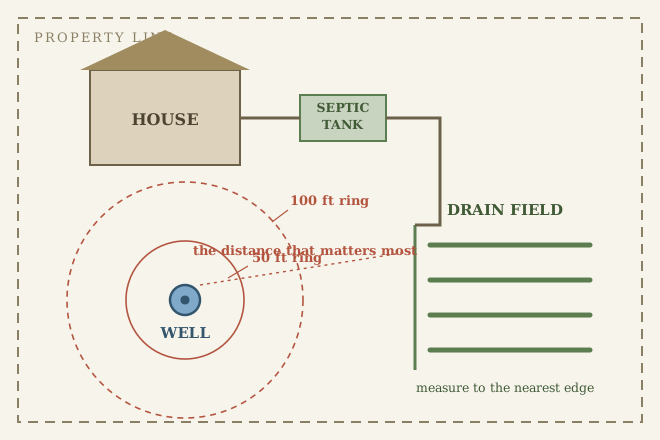
Most states want 50 feet between a well and a septic tank and 100 feet to the drain field — but the field is the distance that actually protects your water. How to measure yours, and what to do if it comes up short.
How to Shock Chlorinate a Well: Dose, Steps, and the Retest That Proves It Worked
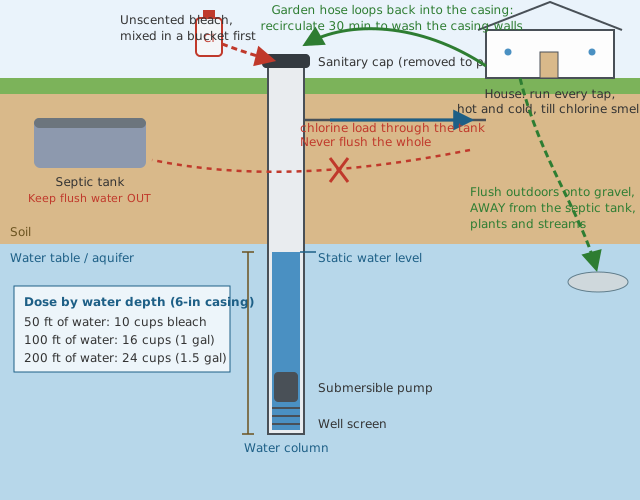
The full shock chlorination procedure: work out your bleach dose from the well log, bypass the softener, recirculate, hold, flush without wrecking your septic, and retest at 10 to 14 days.