 Keep
Signs Your Septic Tank Is Full — and How to Tell It From a Clog or a Failing Field
 Daniel Mercer · Editor & Researcher·
Published November 16, 2026·
Updated November 16, 2026
Here is the confusing thing about a septic tank: if you pried the lid off a perfectly healthy one tomorrow, it would look completely full. Full of liquid, right up to the outlet pipe — exactly the way it looked the day it was installed, and exactly the way it looks on the day it desperately needs pumping. A working tank is supposed to be full of liquid. It fills to the level of the outlet and stays there permanently, and everything you send down a drain displaces the same amount out to the drain field.
So when owners say a tank is "full," they cannot mean the liquid — and this one misunderstanding sends people wrong in both directions. Some panic over a healthy tank because someone lifted a lid and saw water near the top. Others ignore months of warnings because "the tank can't be full, we had it pumped six years ago and it holds a thousand gallons." Six years of sludge does not care how big the tank looks from above.
What "full" really means is narrower, measurable, and — once you know it — fairly easy to read from the surface, because a tank approaching its limit starts announcing itself through your drains, your yard, and your nose, in a rough order. This guide walks through what the word means, the signs in the order they appear, a triage you can run yourself in under an hour, and the one measurement that ends all arguments.
What "full" actually means: three layers and two numbers that matter
Everything that leaves your house enters the tank and sorts itself into three layers. Heavy solids sink and become sludge at the bottom. Grease, oils and light material float and become scum at the top. Between them sits the relatively clear liquid layer, and it is only this middle layer that is supposed to leave through the outlet to the drain field, where the soil finishes the treatment.
The tank's whole job is to protect that middle layer — to hold wastewater still long enough for the sorting to happen. Sludge and scum are not failures; they are the system working. The problem is arithmetic: both layers grow, the clear zone between them shrinks, and past a certain point the tank can no longer hold new wastewater long enough to sort it. Solids start riding the current straight through to the field, and the field — soil and pipe not built to digest solids — begins to clog. That is the moment the tank is "full" in the only sense that matters: full of solids, past the point where it can do its job.
The EPA turns that idea into measurements, taken against the outlet pipe:
- Pump when the bottom of the scum layer is within 6 inches of the bottom of the outlet.
- Pump when the top of the sludge layer is within 12 inches of the outlet.
- Pump when sludge and scum together take up more than about a quarter of the liquid depth — many pumpers and inspectors apply the same idea as a one-third rule, and either way the message is identical: when the solid layers claim roughly a third of the tank, the clear zone is too thin to trust.
Notice what is not on that list: any judgement based on the liquid level, the calendar alone, or how the surface looks. Two of the three triggers are distances from the outlet, because the outlet is where the damage happens — the closer a solid layer gets to it, the shorter the trip into your drain field.
It also helps to know the scale of what is at stake. A routine pump-out costs a few hundred dollars. A drain field clogged by years of escaping solids costs thousands to repair and well into five figures to replace. "Full" is the cheap problem. Everything in this guide is about catching it while it is still the cheap one.
The signs, in the order they usually appear
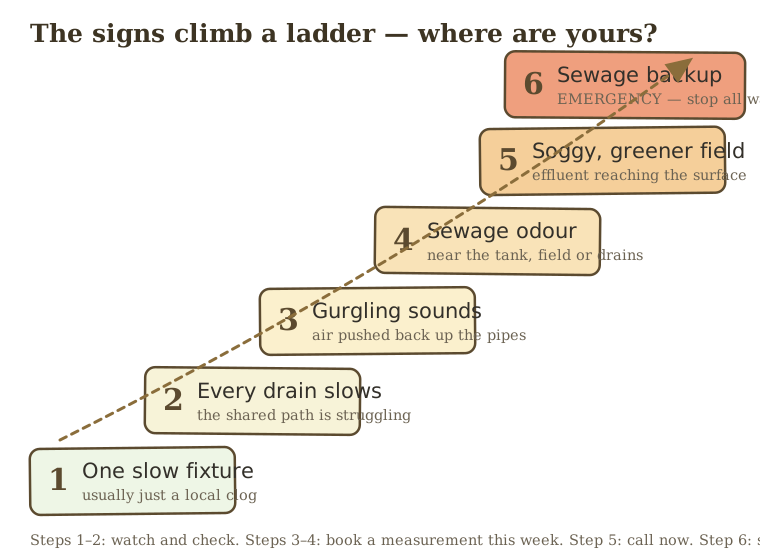
These symptoms escalate, and where yours sits on the ladder tells you how much time you have. One caution before the list: no single sign on it proves the tank is full. Each one also has other possible causes — which is exactly why the three-way split later in this guide matters. Read the signs as a pattern, not a verdict.
Sign 1: one fixture drains slowly
A single sink, tub or shower starts draining lazily while everything else in the house behaves. This is the first thing most owners notice and, on its own, the least likely to be the tank. One slow fixture is a problem the length of one branch line: hair and soap in that trap, a waste arm furred with buildup, a partly blocked vent for that bathroom. The tank cannot single out one sink. Treat sign 1 as a plumbing matter — clear the trap, watch it — and only start thinking septic when the slowness spreads.
Sign 2: every drain in the house slows at once
This is the earliest real sign, and the one most often missed because it creeps. Within the same few weeks, the tub drains a little slower, the toilets flush a little less decisively, the kitchen sink lingers. It is worst after heavy water use — laundry day, back-to-back showers, a houseful of guests — and better after the system rests overnight. That pattern is the signature of a shared bottleneck: every fixture drains into one path out, and that path is the tank. When the tank's clear zone is thin, it cannot accept water as fast as the house produces it, so the whole house queues up. One slow fixture is a branch problem; all fixtures slowing together is a destination problem.
Sign 3: gurgling from drains and toilets
You run the washing machine and the toilet across the hall burps. You drain the tub and hear the shower drain talk back. Gurgling is air being pushed through traps by water that cannot move freely — the displaced air escapes through whichever fixture is nearest, including ones nobody is using. Owners often describe it as the house "glugging" or the toilet "bubbling," and it tends to show up at the lowest fixtures first. Gurgling means the restriction is downstream of the whole house: a tank past its limit, a clogged filter or baffle at the tank's outlet, a blockage in the line between house and tank, or a field that has stopped accepting water. It rarely fixes itself, and it almost always arrives before anything backs up.
Sign 4: sewage odour near the tank or field
A healthy system vents its gases through the roof vent and treats its liquid underground; you should not be able to smell it doing either. A sewage smell in the yard — near the tank lids, over the drain field, or drifting from a floor drain indoors — means gases or effluent are reaching places they should not. Occasionally the culprit is innocent: a dry floor-drain trap in a basement can let sewer gas in and is fixed with a cup of water. But odour outdoors, over the field, or odour that keeps returning indoors belongs on the septic list. Smell plus any of the signs above it on the ladder is a strong pattern.
Sign 5: soggy ground or standing water over the drain field
Walk the field after a dry spell. Ground that is spongy underfoot, visibly wet, or holding standing water when it has not rained is effluent surfacing — liquid that the soil could not absorb, rising instead. This is a drain field sign more than a tank sign, but the two are connected: a full tank sends the field more liquid and more solids than it can handle, and a field already tired from years of that treatment gives up absorbing altogether. Soggy ground in dry weather is not a watch-and-wait symptom.
Sign 6: a greener, faster-growing stripe over the field
The lawn over the drain field turns a deeper green than everything around it and grows like it is on fertiliser — because it is. Effluent riding too close to the surface feeds the grass above it. On its own, in a wet spring, this is weak evidence: the soil over the field trenches is disturbed soil and sometimes grows differently anyway. Combined with sogginess, odour or slow drains, it stops being a coincidence. Think of the green stripe as the field's quiet early chapter of sign 5.
Sign 7: sewage backing up into the lowest fixture
The end of the ladder. Wastewater that cannot leave the house comes back into it, at the lowest opening it can find — a basement floor drain, a ground-floor shower or toilet. This is an emergency, not a diagnostic puzzle: stop running water entirely, including the dishwasher and washing machine, keep people and pets away from any standing sewage, and call a septic service the same day.
The solution first: an ordered triage you can run before calling anyone
You do not need to guess which rung you are on, and you do not need to open anything. Run these checks in this order — each result rules something in or out, and together they take less than an hour.
Step 1 — Test one fixture at a time. Fill the slowest sink and time how it drains. Then flush a toilet on the same floor, then run a tub. If only the first fixture is slow and everything else is brisk, you have a local clog in that branch — stop here, clear the trap or call a plumber if it resists, and take the tank off your worry list. If several fixtures in different rooms are slow, move on.
Step 2 — Run the lowest fixture test. Go to the lowest drain in the house — a basement floor drain, a ground-floor shower. Run a large volume of water upstairs (drain a full tub) and watch the low fixture. If water rises, gurgles or smells there, the restriction is downstream of the whole house: tank, line, filter or field. If the low point stays quiet while one upper bathroom struggles, the problem lives in between, in the plumbing.
Step 3 — Check the pattern against water use. Note whether symptoms worsen after laundry or several showers and ease after a quiet night. Worse-after-use and better-after-rest points at capacity — a full tank or a saturated field struggling to keep up. Symptoms that are identical no matter what you run point more at a fixed blockage, like a clog in the line or a choked filter.
Step 4 — Walk the yard. Find the drain field (the flattest, clearest stretch of yard the system serves — no trees, no parking, usually downhill or level from the tank). Look and feel for the three field signs: spongy or wet ground in dry weather, a greener stripe over the trenches, odour. Any of them means the field is part of the story, whatever the tank turns out to be doing.
Step 5 — Do the calendar check. When was the tank last pumped — actually, not approximately? If the honest answer is "more than five years ago," "the previous owner said something vague," or "no idea," weight every other result toward full. An overdue tank is the single most common cause of this entire symptom list, and it is the cheapest to fix.
Step 6 — Ease off and book the measurement. Until a professional measures the layers, spread out laundry, shorten showers, and fix any running toilet — a toilet that leaks all day can send hundreds of extra litres to a system that is already queuing. Then book an inspection with measurement, and tell the company what your triage found; the pattern you describe genuinely steers what they check first.
What this triage cannot do is measure the layers — and measuring is the only proof. What it does is sort you into the right one of three problems, which is the subject of the next section.
Full tank, clogged line, or failing field: the three-way split
The same handful of symptoms — slow drains, gurgling, odour, even a backup — can come from three different failures with three wildly different bills. Here is how they separate.
The tank really is full. The history fits: years since pumping, or no history at all. Symptoms build gradually over weeks, hit every fixture, worsen with water use and ease with rest. The yard may be completely innocent, because early on the field is still absorbing what reaches it. The separating check: open the tank and measure — scum and sludge past the EPA marks. The fix is a pump-out, a few hundred dollars, and the symptoms should unwind within days as the clear zone returns.
The line (or filter) is clogged. The history does not fit a full tank — it was pumped last year — but the symptoms arrived suddenly, sometimes on a single day. A blockage in the building sewer between house and tank, a clogged effluent filter at the outlet (the screen many tanks have to catch solids), or a crushed or root-invaded pipe all throttle the path out while the tank itself is fine. The separating check: the tank measures normal — layers well below the marks, liquid at the right level — while water still backs up. Sometimes the giveaway is at the surface: a filter can be pulled and hosed off, and a line can be cleared from a cleanout, and if the house drains freely the moment the filter is cleaned, you have found it. The fix is a line clearing or a filter cleaning, typically a few hundred dollars at most.
The field is failing. The tank may be recently pumped and the line clear, yet the yard tells the story: soggy ground, surfacing effluent, odour outdoors, the green stripe. Symptoms often improve for a few days after pumping (the tank acts as a holding tank while it refills) and then return — that relapse is one of the clearest field signatures there is. The soil under the field has clogged with biomat, the slimy layer that grows where effluent meets soil, or the pipes themselves are damaged or root-filled, and the liquid simply has nowhere to go. The separating check: a normal measurement at the tank plus a yard that stays wet, ideally confirmed by a professional inspection of the field itself. The fix is field repair or replacement — the expensive row of the cost table.
Two honest complications. First, these overlap: a tank left full for years causes the third problem by feeding solids to the field, which is why "it was the tank" and "it is now the field too" is a common sentence from pumpers. Second, a fourth suspect deserves a mention — water overload from inside the house. A running toilet, a leaking tap and four loads of laundry a day can push a healthy system into the same symptoms. If the triage pattern fits capacity but the tank measures fine and the yard is dry, count your water before you blame the field.
What the pumper measures: the sludge judge and the numbers
When a professional settles this question, the tool is unglamorous: a sludge judge — a long, clear tube with a check valve at the bottom. The technician lowers it slowly through the liquid to the tank floor, the valve traps a core sample of everything it passed through, and the tube comes up showing the tank's layers like a layer cake in a straw: scum on top, clear liquid in the middle, sludge at the bottom, each measurable in inches. A companion stick, often with a hooked or wrapped end, reads the scum layer from the top down. It takes minutes, and it converts "the drains seem slow" into numbers.
Here is how to read the numbers you are given:
- Scum: the distance from the liquid surface down to the bottom of the floating layer. What matters is the gap left between the bottom of the scum and the bottom of the outlet pipe. Six inches or less: due.
- Sludge: the height of the settled layer off the floor. What matters is the gap between the top of the sludge and the outlet. Twelve inches or less: due.
- The total: sludge plus scum as a share of the whole liquid depth. Past roughly a quarter to a third, the clear working zone is too thin — due, whichever of the other two triggered first.
Ask the pumper to write the depths down, along with the tank size and where the lids are. That scrap of paper is your baseline: from it, and your household size, your next pumping date is arithmetic rather than folklore. A good service visit also includes a look at the baffles or tees at inlet and outlet, the effluent filter if one is fitted, and the liquid level itself — a level sitting above the outlet hints at a blocked outlet or a flooded field, and one below it hints the tank is leaking. You are paying for a diagnosis, not just a vacuum truck; make sure you get one.
One safety note that is not boilerplate: never lean over an open tank, and never, under any circumstances, climb into one. Septic tanks produce gases that can overcome a person in seconds, and people die in them every year — including would-be rescuers. Measurements are taken from the surface, with the technician standing up. If a company treats that casually, choose a different company.
What each answer costs
The cost table at the top of this guide is really a map of the three-way split, and it is worth understanding before you book anything, because the first visit should be the cheap diagnostic one.
If the problem is a clogged filter or line, you are looking at the smallest numbers on the table — a filter cleaning is often folded into a service visit, and clearing the main line typically runs a few hundred dollars. If the problem is a full tank, the pump-out itself is the fix: roughly $300–$600 for a typical 1,000–1,250 gallon tank, varying with your region, how deep the lids are buried, and disposal fees. The inspection with measurement — $100–$250 on its own — is the money that makes sure you buy the right one of those, and many companies credit it toward the pump-out if you go ahead.
The field row is the outlier: partial repairs can land in the low thousands, and a full replacement runs from several thousand into five figures. Almost every expensive field story starts the same way — a tank that stayed full too long, sending solids out to clog soil that was never built to receive them. That is the entire financial argument for taking signs 2 and 3 seriously instead of waiting for sign 7.
The new-owner trap: no records means assume it is due
If you bought your house within the last few years, there is a specific way this problem ambushes you. Septic maintenance leaves almost no visible trace. The lawn looks the same whether the tank was pumped last spring or during a previous decade, the drains behave until quite late in the process, and unless your state or county required a septic inspection at sale — some do, many do not — nothing in a standard purchase forces the question. Sellers are not hiding anything, usually; many genuinely do not remember, or inherited the same silence from the seller before them.
So the rule for a first septic home is simple: unknown history is overdue history until a measurement proves otherwise. If you cannot produce a pumping receipt with a date and a company name, book the inspection-and-measurement visit in your first year and treat whatever comes back as year zero. If the layers are past the marks, pump, and the few hundred dollars buys you a known starting point and removes the most common cause of every symptom in this guide from your list of worries. If the layers are fine, you have bought something nearly as valuable: a dated baseline, the tank's size and location, and a next-due date you can put on a calendar. Either way, keep the paperwork somewhere your future self — or your future buyer — will find it.
What pumping fixes, and what it cannot
Pumping is the right medicine for exactly one diagnosis, so it pays to be clear about its limits. A pump-out removes the accumulated sludge and scum, restores the clear working zone, and stops solids from migrating to the field. If your symptoms came from a full tank, drains should run freely again, gurgling should stop, and indoor odour tied to the backup pressure should clear.
What pumping does not do: it does not clear a clog in the line from the house (that is a separate clearing job), it does not unclog a filter unless the filter is actually cleaned during the visit — ask — and it does not repair a drain field whose soil has already sealed over. A failed field may seem better for a week after pumping, because the empty tank temporarily stores everything the field cannot take; when the tank refills to the outlet, the symptoms return on schedule. If a company proposes a second pump-out a month after the first as the solution to a wet yard, you are being sold the wrong fix. And no additive changes any of this — the EPA's position is that a normal household system already has the bacteria it needs, and nothing poured down a drain dissolves sludge away to zero. The solids leave in a truck or they leave into your field. Those are the options.
Urgency, summed up
Match your speed to your rung on the ladder. One slow fixture: a plumbing job, watch it for a week or two. Every drain slowing, or gurgling: book a measurement within days, spread the laundry out, and fix any running toilet — you are likely looking at the cheap fix, and the cheap fix has a deadline written in solids. Odour outdoors, soggy ground, the green stripe: call now and cut water use hard; the field is involved, and fields do not heal while they are being fed. Sewage in the house: stop all water use and call today.
The thread running through all of it is the one from the start of this guide: a tank always looks full, so looks tell you nothing — patterns and measurements tell you everything. Learn the ladder, run the triage, and get the layers measured. Do that, and "is my septic tank full?" stops being a worry and becomes a number you know.
Cost at a glance
| Item | Typical cost | Notes |
|---|---|---|
| Inspection with sludge and scum measurement | $100–$250 | The visit that settles full tank vs clog vs field; often credited toward the pump-out if you proceed |
| Pump-out (1,000–1,250 gal tank) | $300–$600 | The fix if the tank really is full; national averages sit around $400–$450 |
| Main line clearing (house to tank) | $150–$450 | Snaking or jetting a blocked building sewer; the fix if the tank measures fine but drains back up |
| Effluent filter cleaning | $50–$150 | Often included in a pump-out; a clogged filter mimics a full tank almost perfectly |
| Drain field repair or replacement | $3,000–$15,000+ | Partial repairs at the low end, full field replacement at the high end — the bill the other four rows exist to avoid |
Frequently asked questions
Can I tell if my septic tank is full just by looking inside?
Not by the liquid level — a healthy tank is always full of liquid up to the outlet pipe, so it looks 'full' on day one and on the day it genuinely needs pumping. What you judge is the two solid layers: the floating scum on top and the settled sludge at the bottom. If the bottom of the scum is within about 6 inches of the outlet, or the top of the sludge within about 12 inches of it, the tank is due regardless of how the surface looks.
My drains are slow but only in one bathroom. Is the tank full?
Almost certainly not. A full tank slows every drain in the house, because they all share the one path out. A single slow sink, tub or shower is a problem in that fixture's own branch line — hair in a trap, a partly blocked waste arm, a vent issue for that bathroom. Treat it as a plumbing clog first; it becomes a septic question only when the slowness shows up in several rooms at once.
Why does my toilet gurgle when the washing machine drains?
Because the water leaving the washer has nowhere easy to go, so it pushes air ahead of it, and that air escapes through the nearest trap — often a toilet. Gurgling in a fixture you are not using means the shared line downstream is restricted: a full tank, a clogged effluent filter, a blockage in the line to the tank, or a field that is no longer accepting water. It is one of the most reliable early warnings a septic system gives.
The grass over my drain field is much greener than the rest of the lawn. Should I worry?
Pay attention to it, especially paired with ground that feels spongy. Grass over the field gets extra water and nutrients when effluent is rising too close to the surface instead of dispersing through the soil — which happens when the field is saturated or failing, or when a full tank is pushing solids and excess liquid out. Greener grass alone after a wet spring is weak evidence; greener grass plus odour or slow drains is a pattern worth a professional measurement.
If I pump the tank, will the soggy patch in my yard go away?
Only if the sogginess was caused by the full tank itself — a tank past its limit can hydraulically overload the field, and pumping sometimes lets a tired field recover once the flow of solids stops. If the field's soil is already clogged with biomat or the pipes are damaged, pumping changes nothing in the yard; the water still has nowhere to go. This is why the measurement visit matters: it tells you whether you are buying a $400 pump-out or looking at field work.
How long can I wait once the signs start?
Match the wait to the sign. One slow fixture: watch it for a week or two. All drains slowing or gurgling: book within days and spread out laundry and long showers meanwhile. Odour outdoors or wet ground over the field: call now, and cut water use hard — every gallon you send out has to go somewhere. Sewage in the house: no waiting at all. The risk curve is steep because continued use pushes more solids into the field, and field damage is the expensive kind.
We just bought this house and the drains are already slow. Did we inherit a full tank?
Quite possibly — it is one of the most common surprises in a first septic home. Sellers rarely pump before listing unless the state or the buyer requires it, and a tank can be years overdue behind an ordinary-looking lawn. Treat unknown history as overdue history: book an inspection with measurement, and pumping if the layers are past the marks. Whatever the pumper finds becomes your baseline, and from that visit you have real numbers and a real date instead of a guess.
Checked November 16, 2026. This guide is general information, not a substitute for a licensed professional.
Related guides
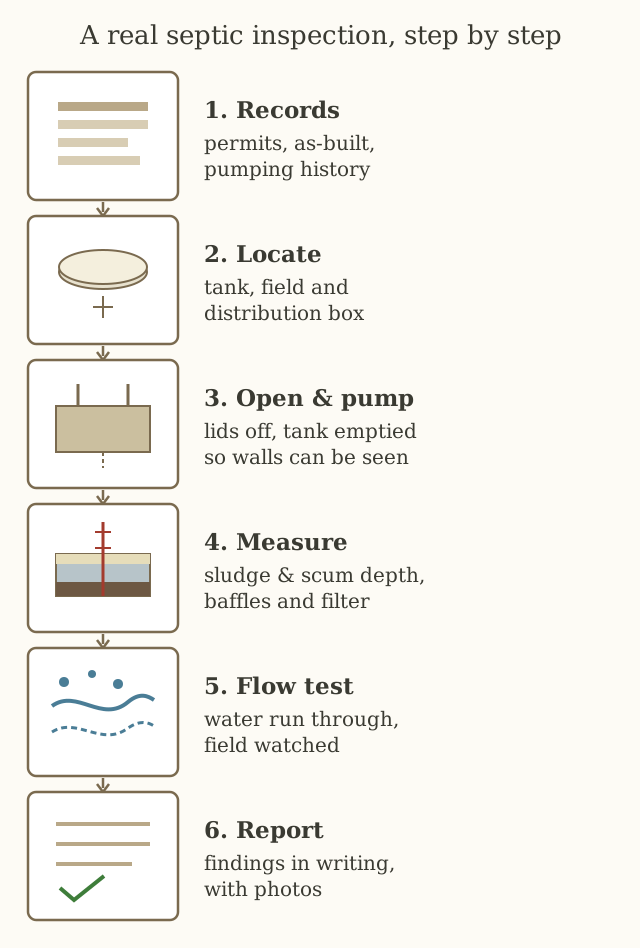
Buying a House With a Septic System? The Inspection That Can Save You $20,000
A standard home inspection barely touches the septic system. Here's what a real septic inspection includes, what it costs, the records to demand, and the contract wording that protects you.
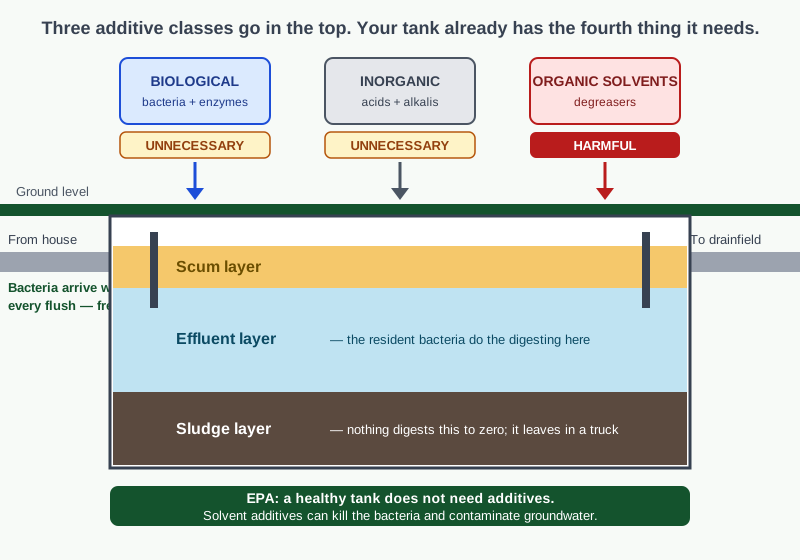
Do Septic Tank Additives Work? What the EPA and the Studies Actually Found
The EPA does not recommend septic additives, a 48-tank double-blind study found no measurable benefit, and one additive class is actively harmful. The evidence, the money maths, and the one narrow exception.
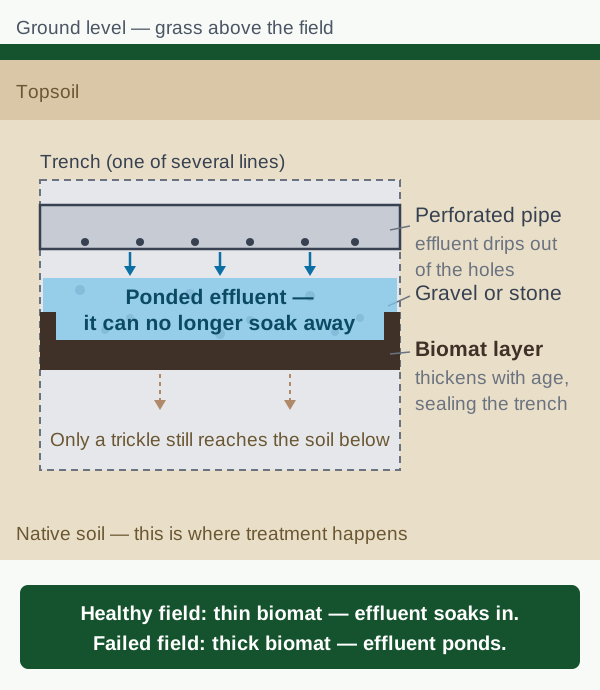
Drain Field Failure Signs: Soggy Ground, Green Stripes and Surfacing Effluent
A failing drain field announces itself in the yard first: lush green stripes, spongy ground, odors, then standing water. The early vs late signs, the look-alikes that aren't failure, a homeowner diagnosis sequence, and what repair or replacement really costs.