 Keep
Sewage Backing Up? One Fixture Is Plumbing — the Whole House Is Septic
 Daniel Mercer · Editor & Researcher·
Published November 16, 2026·
Updated November 16, 2026
There is a particular kind of dread that comes with finding sewage in a bathtub nobody has used. It feels random and filthy and expensive, and the instinct is to start flushing and plunging things to see what happens. Resist it. That tub is not the problem — it is the messenger, and it is delivering a very specific piece of information: wastewater leaving your house has run out of road, and it is rising to the lowest opening it can find.
Every drain in your house — every sink, toilet, shower, washer and floor drain — eventually joins one shared pipe that carries everything out to the septic tank. When that shared path is open, you never think about it. When it is blocked, full or overwhelmed, the water you send down does not disappear. It fills the main line from the bottom up, and the first place it can escape is the lowest drain connected to it: a basement floor drain, a ground-floor shower, the tub. That is why the backup always seems to pick the fixture that makes the least sense. It is not choosing. It is physics.
The good news buried in the bad evening is that a backup is one of the most diagnosable problems a septic home produces. Where the sewage appears, and what the rest of the house is doing at the same moment, tells a septic professional most of what they need to know before they even open the tank. This guide walks through the one distinction that routes the whole response, what to do in the first hour, the five causes in the order they usually turn out to be true, what the fix costs for each, and how to clean up safely once the water stops rising.
The one distinction: one fixture is plumbing, the whole house is septic
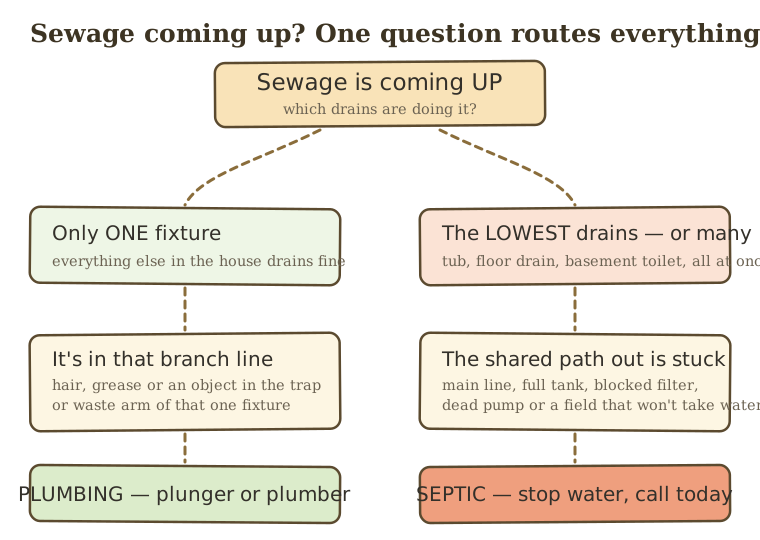
Before anything else, run this single test — carefully, and only once. Note which drains are affected.
If exactly one fixture backs up — one sink that will not drain, one toilet that overflows while the rest of the house behaves — the blockage is in that fixture's own plumbing: its trap, its waste arm, or the short branch line before it joins the main drain. Hair in a shower trap, grease in a kitchen line, something a toddler posted through the toilet. This is a plumbing problem. It is annoying, it is usually cheap, and it has nothing to do with your septic tank. A plunger, a trap cleanout, or a plumber with a small snake is the whole story.
If the lowest drains are involved, or several fixtures misbehave at once — sewage in the basement floor drain, the ground-floor tub filling when an upstairs toilet flushes, gurgling from fixtures nobody is using, every drain in the house running slow — the problem is in the shared path out: the main line between the house and the tank, the tank itself, or something just past it. That is a septic problem, and it is the subject of the rest of this guide.
Two patterns deserve special attention because they fool people. The first is the upstairs flush, downstairs flood: you flush a second-floor toilet, it seems to work, and twenty minutes later someone finds sewage in the first-floor tub. The flush did not work — the water went down, hit the blockage, and rose to the lowest opening, which happened to be in another room. The second is the washing machine tell: the washer is the largest single dump of water most houses produce, and a tub or floor drain that bubbles or fills only when the washer empties is showing you a main line with almost no spare capacity left. Both patterns mean the shared path, not any individual fixture.
One more check takes ten seconds and can save a phone call: look outside. Wet, spongy or unusually green ground over the tank or drain field, or a sewage smell in the yard, moves the drain field and the tank to the top of the suspect list. A dry, ordinary yard points more toward the line or the tank's outlet hardware. Tell whoever you call what you found out there — it genuinely changes what they bring.
The first hour: stop the water, protect the people, then call
A backup gets worse in exactly one way: more water. Everything in the first hour follows from that.
Stop all water use, completely. No flushing, no showers, no dishwasher, no laundry, no running taps to "check if it's cleared." Tell everyone in the house, including the person who is about to absent-mindedly flush. A household of four can send a few hundred gallons a day toward a system that has stopped accepting any of it, and every gallon arrives at the lowest drain. If it helps, shut off the main water supply to the house — it removes both the temptation and the automatic contributions from ice makers and softening equipment.
Keep people and pets out of the sewage. This is not ordinary dirty water. Sewage can carry bacteria, viruses and parasites, and health authorities treat contact with it as a genuine exposure, not a housekeeping issue. Children, older adults, pregnant women and anyone with a weakened immune system should stay out of the affected area entirely until it has been cleaned and disinfected. Close the door to the room if you can. If you must go in — to move belongings or reach a shutoff — wear rubber boots and gloves and wash thoroughly afterwards.
Mind the electricity. If sewage or standing water is near outlets, a furnace, a water heater or the electrical panel, do not wade in to investigate. Turn power off to that area from the panel only if you can reach the panel with dry feet. Wet basements and live electrics are a dangerous combination, and no diagnosis is worth it.
Do not pour anything down the drains. No chemical opener, no "septic shock" additive, no bucket of boiling water. Chemical openers cannot dissolve a full tank or reopen a saturated field; in a backed-up line they sit in the pipe as a corrosive puddle waiting for the plumber, and the EPA advises against them on septic systems generally. Additives cannot clear a backup either. And do not run the dishwasher or washer "just to test" — a test, at this point, is just more sewage in the tub.
Do not open the tank yourself. If you even know where the lids are, leave them. Septic tanks accumulate gases that can overcome a person leaning over an open lid in seconds, and no one should ever enter a tank for any reason. This is the brightest red line in the whole subject: the tank gets opened by a professional, from above, with the right equipment.
Take photographs before you touch anything. The drain, the water line on the wall, everything that got wet, from several angles. Five minutes with a phone now is the entire foundation of an insurance claim later, and it costs nothing. Then make the call: a septic service company for a whole-house pattern (tell them sewage is backing into the house, and when the tank was last pumped if you know — many run same-day or emergency service for exactly this), a plumber for a single-fixture pattern. While you wait, move what you safely can out of the affected area, and put down old towels at doorways to keep contaminated water from being tracked through the house.
The five causes, in the order to suspect them
A whole-house backup has a short list of usual causes. They are worth knowing in order, because the first two are cheap and common, and the last one is neither.
1. A clog in the main line between the house and the tank. Roots finding their way into pipe joints, a sagging section that collects grease and solids, wipes and paper products that were never going to break down — the pipe narrows over years until one flush too many closes it. The tell: the tank, when opened, is at its normal level, and the backup often follows a period of drains getting gradually slower. The check is a camera run down the line, which shows exactly where the blockage is and what it is made of, so nobody is guessing with a shovel.
2. A tank that is simply full. This is the commonest cause of all, and the most forgivable. Sludge and scum build up over years; once the solid layers crowd the outlet, wastewater leaving the house has effectively nowhere to go, and solids start escaping toward the field as well. The tells: no pumping record in five years or more (the EPA's typical interval is every three to five), every drain in the house slow at once, gurgling that has been getting worse for weeks. The check is the measurement taken when the tank is opened — the layers either are past their marks or they are not.
3. A blocked or crushed effluent filter or outlet baffle. Most tanks built since the 1990s have a filter in the outlet that catches solids before they reach the field. It is a genuinely useful device with one failure mode: nobody cleans it, it gradually seals over, and one day the tank cannot discharge at all — producing a backup in a tank that is not even full. A damaged outlet baffle can do the same job. The tell is a backup in a house with a recent pumping record, which is why this cause surprises people. The check takes a pumper five minutes once the lid is off, and rinsing or replacing the filter is the cheapest fix on this page.
4. A drain field that can no longer accept water. The field is where wastewater finishes its treatment, soaking into soil through a network of trenches. Fields fail slowly — soil pores clogging with the biological mat that grows where effluent meets soil, roots invading lines, ground saturated by a wet season — and then, from the house's point of view, suddenly: the tank fills, the field cannot take the outflow, and the system surcharges backwards to the lowest drain. The tells are outside: soggy or spongy ground over the field, patches of much greener grass, sewage odour in the yard, sometimes effluent pooling on the surface. This is the cause pumping cannot fix. Pumping a tank whose field has failed buys hours or days of capacity, and then the backup returns — a pattern that itself is diagnostic.
5. A failed pump, on systems that have one. Not every system is gravity-fed. If your field sits uphill from the tank, or you have a mound or pressure-distribution system, an effluent pump does the moving — and a dead pump, a stuck float or a tripped circuit means effluent stops leaving. The tells: a high-water alarm sounding (or an alarm that should have sounded), a silent pump chamber, a tripped breaker at the septic panel. The check is electrical and mechanical, and the fix ranges from a float to a full pump replacement.
Notice what the order means for your wallet. Causes one through three and five are same-day, few-hundred-dollar events in most cases. Cause four is the five-figure one. And the thread connecting them: causes two and three, left alone for years, are how cause four happens — a chronically overfull tank pushes solids into a field that was never built to digest them. Today's backup is worth fixing properly partly because it is also the cheapest field-protection you will ever buy.
What the professional does — and what each fix costs
On arrival, a good septic crew works the same logic you just read, from the tank backwards. They locate and open the tank, check the liquid level (high and rising points downstream; normal points at the line or the inlet), measure the sludge and scum layers, and inspect the outlet filter and baffles. If the tank measures full, they pump it — which is both the fix and, often, the moment the real cause becomes visible in an empty tank. If the tank is fine, attention moves to the line (camera, then a snake or a jetter for roots and grease) or to the field (surface inspection, sometimes test pits, and in many areas an evaluation involving the local health department before any field repair is permitted).
The pump systems get their own sequence: panel and breaker first, then floats, then the pump itself, tested and replaced if it has failed. Whatever they find, ask for it in plain terms before authorising the next step: what is blocked or broken, what the repair is, and what it costs. Reputable crews expect the question.
The realistic price picture, cause by cause:
- Clearing the main line runs about $150–$500 for snaking or jetting, with a camera inspection typically adding $250–$500 — worth it when the clog keeps coming back, because the camera is what finds the root mass or the crushed section instead of just poking a hole through it.
- Pumping the tank runs about $300–$550 for a typical 1,000–1,250 gallon tank. Emergency and weekend call-outs commonly add $100–$350 on top, which is the market's way of telling you this visit was always cheaper scheduled.
- Cleaning or replacing the effluent filter runs about $50–$350 — cleaning is often included in a pump-out visit, and even a replacement is the smallest bill on this page. If your system has a filter and nobody has ever mentioned it, assume it is overdue.
- Replacing an effluent pump runs about $500–$1,600 installed, with floats, wiring and labour inside that figure; grinder pumps and deep chambers push toward the top.
- Drain field work is the cliff edge: partial repairs start around $3,000, and a full field replacement commonly runs $5,000–$20,000 depending on soil, system type and permitting. It is priced like construction because it is construction.
One honest warning about the sequence of bills: pumping is sometimes sold as the answer before anyone has established the cause, because the truck is already there. Pumping is very often part of the answer — the tank usually needs it anyway, and an empty tank is how the other causes get inspected — but if your backup returns within days of a pump-out, you have not been unlucky. You have been diagnosed: the problem is downstream, and the next conversation is about the filter, the line or the field.
Cleaning up safely once the water stops
Cleanup starts only when the cause is fixed or the water has stopped rising — disinfecting a floor that sewage is still seeping onto is wasted work. Then the rules are straightforward, and they are stricter than for ordinary water damage, because this water is contaminated.
Gear up first: rubber boots, waterproof gloves, and eye protection as a minimum, and a mask if you will be agitating anything. Wash hands and any exposed skin with soap and clean water when you finish, and keep children and pets out until the area is cleaned and dry.
Sort what the sewage touched into two piles, honestly. Hard, non-porous surfaces — tile, sealed concrete, metal, glass — can be cleaned and disinfected and kept. Porous materials it soaked into — carpet and padding, upholstered furniture, mattresses, stuffed toys, cardboard, most drywall that wicked it upward — generally cannot be disinfected reliably and have to go. This is the rule homeowners resist and the one health guidance is consistent about: removal, not drying. Bag contaminated material, get it out of the living space, and check your local rules on disposal; never pump or dump sewage or wash-water onto the yard or into a storm drain, which is illegal in most places as well as a hazard to your own well.
For hard surfaces: remove solids, wash with detergent and clean water, then disinfect, keeping the surface wet with disinfectant for the time its label specifies. Never mix bleach with ammonia or other cleaners — the gas that produces is a genuine emergency of its own. Ventilate and dry the area thoroughly afterwards; lingering damp in wall cavities and under flooring is how a sewage problem becomes a mould problem two weeks later.
Know the line where DIY stops. A small, contained overflow onto a hard floor, caught early, is a reasonable homeowner cleanup with proper protection. Sewage across carpeted living space, into wall cavities, or over a large area of a finished basement is professional work: cleanup crews bring extraction equipment, containment and proper disposal, and — just as valuable — documentation your insurer will accept. If anyone in the house develops gastrointestinal symptoms after exposure, mention the sewage contact when you seek medical advice.
Insurance and paperwork: photograph first, argue later
Here is the part nobody believes until it happens to them: a standard homeowners policy usually does not cover sewage backup damage. It is one of the most common exclusions in the industry. Coverage typically exists only if you bought a specific water or sewer backup endorsement — a rider that usually costs around $40–$100 a year and covers something like $5,000–$25,000. Check your policy today, whichever side of that line you are on. If you have the rider, call the insurer the same day, before cleanup if you can do so without delaying it, and follow their documentation instructions. If you do not have it, this week is when you add it — knowing it will not apply retroactively to this incident.
Either way, the records that matter are the same: the photographs you took before cleanup, dated and from several angles; the septic company's invoice and their written note of the cause; receipts for cleanup, disposal and any damaged items you replace; and a simple written timeline of when you noticed it, when you called, and when it was fixed. Keep the pumping and inspection paperwork from this visit permanently, too. It becomes part of the house's maintenance history — the document the next buyer, or the next you, standing in this same spot in six years, will wish existed.
If you have just bought the house, this is the commonest story of all
It is worth saying plainly, because it takes the sting out: a backup in the first year of owning a septic home is rarely the new owner's fault. It is inherited neglect arriving on schedule. Sellers are seldom required to pump before a sale, a tank can be years overdue behind a tidy lawn, an effluent filter can go a decade without anyone knowing it exists, and a home inspection — unless a dedicated septic inspection was specifically ordered — does not open the tank or measure anything. The system you bought was probably already most of the way to this evening.
So once the immediate problem is cleared, convert the emergency into a baseline. Book the full version of the visit: pump the tank, have the layers measured and recorded, the filter cleaned, the baffles checked, and the field walked. Ask where everything is — tank, lids, field, any pump panel — and photograph or sketch the locations. Ask what the pumping interval should be for your household size and tank, and write the date of this visit on whatever file you keep for the house. From that appointment onward, the system's history is yours and it is known, instead of a surprise the previous owner left in the ground. Our guide to what a septic inspection should include when buying a house covers the pre-purchase version of the same checklist.
Keeping it from happening twice
Prevention for backups is unglamorous and almost entirely about not letting the cheap causes mature into the expensive one. Pump on schedule — every three to five years for a typical household tank, more often with a garbage disposal or a full house — and treat the appointment as the inspection it doubles as. If your tank has an effluent filter, have it cleaned at every pumping at minimum, and ask whether your household should do it more often. Keep the never-flush list honest: no wipes of any kind (including the ones labelled flushable), no grease down the kitchen sink, no paper towels or hygiene products. Spread laundry across the week rather than running six loads on a Saturday, especially if your field is older — hydraulic overload is how a tired field gets pushed over the edge. Keep vehicles and heavy equipment off the drain field, and keep tree and shrub roots in mind when planting anywhere near the line or the field. And respond to the early warnings — a gurgle, a slow drain that involves more than one fixture, a patch of suspiciously green grass — while they are still warnings. Every one of them is this same problem, photographed earlier and priced lower.
The urgency, in one paragraph
A sewage backup does not improve with waiting, and it does not stay contained: as long as water is being used, more sewage arrives, and as long as the cause is unfixed, solids keep moving toward the one part of the system that costs five figures to replace. So the sequence is today, in this order — stop the water, keep everyone clear of it, photograph, call, and let the diagnosis run from the tank. Most backups turn out to be a full tank, a clogged filter or a blocked line, and most of those are fixed in a single visit for a few hundred dollars. The minority that are field failures are exactly the ones where every day of delay adds damage. Either way, the right move is the same, and it is not next week.
Cost at a glance
| Item | Typical cost | Notes |
|---|---|---|
| Clear the main line (house to tank) | $150–$500 | Snaking or jetting a blocked building sewer; camera inspection to find roots or a break usually adds $250–$500 |
| Pump the tank (1,000–1,250 gal) | $300–$550 | The fix when the tank is full — and the diagnostic that reveals most other causes while the lid is open |
| Clean or replace the effluent filter | $50–$350 | The cheapest cause on this list; cleaning is often folded into a pump-out visit |
| Replace the effluent pump (pumped systems) | $500–$1,600 | Installed price including labour and floats; grinder pumps and deep chambers sit at the top of the range |
| Drain field repair or replacement | $3,000–$20,000 | Partial repair at the low end, full field replacement at the high end — the bill the other four rows exist to prevent |
Frequently asked questions
Why is sewage coming up in my bathtub when the toilet flushes?
Because the blockage is downstream of where the toilet and tub join the main drain. The flush water cannot get out, so it rises to the lowest opening it can find — and a tub or shower drain sits at floor level, lower than the toilet itself. Sewage in a tub nobody used is one of the clearest signs that the problem is the shared main line or the septic system, not either fixture.
Only the basement floor drain is backing up. Can we still use the upstairs bathroom?
No — and this is the mistake that turns a bad evening into a flooded basement. Everything you run upstairs drains through the same main line and will come up out of that floor drain. A backup at the lowest drain means the path out is blocked for the whole house, even if the upstairs fixtures still seem to drain. Stop all water use until the line is cleared and the cause is found.
Will pumping the tank fix a sewage backup?
If the tank is full, yes — pumping is the fix, and the house usually drains normally within the hour. If the cause is a blocked line, a clogged filter or a failing field, pumping buys time rather than a cure: the tank can accept water again, so the backup stops, but it returns once the tank refills to the blocked outlet — hours to days later depending on the cause. A good pumper checks the filter, the baffles and the field while the tank is open, precisely so you learn which situation you are in.
Is it dangerous to stay in the house after a sewage backup?
Sewage is genuinely hazardous — it can carry bacteria, viruses and parasites, which is why health guidance treats it as contaminated waste rather than dirty water. Most households can stay if the affected area is closed off, nobody walks through it, and cleanup starts promptly with gloves, boots and eye protection. Young children, older adults, pregnant women and anyone with a weakened immune system should stay out of the area entirely until it is cleaned and disinfected, and a large backup into living space is a reason to bring in a professional cleanup crew rather than handle it yourself.
Should I pour drain cleaner down, or try plunging it myself?
Neither. Chemical openers cannot dissolve a full tank, a blocked filter or a saturated field, and in a backed-up line they mostly sit in the pipe making the plumber's job more dangerous; the EPA advises against chemical drain openers on septic systems. Plunging a backed-up tub or floor drain just pushes contaminated water around and can force it out of another fixture. The one tool worth using in the first hour is the water shutoff — stop adding water, and let the diagnosis happen from the tank end.
Does homeowners insurance pay for sewage backup damage?
Usually not under a standard policy. Water and sewer backup is one of the most common exclusions in homeowners insurance; coverage normally comes from a specific backup endorsement or rider, which typically costs around $40–$100 a year and covers roughly $5,000–$25,000 of damage. If you have the rider, photograph everything before cleanup and call the insurer the same day. If you do not, this incident is the reason to add it — but note it cannot be applied to damage that has already happened.
Who do I call first — a plumber or a septic company?
Match the call to the pattern. One fixture misbehaving while the rest of the house drains fine: a plumber. Several fixtures, the lowest drains, gurgling across the house, or any sewage outdoors over the tank or field: a septic company — and if you know the tank has not been pumped in five years or more, say so on the phone, because that fact moves you up the list of likely causes. Many septic pumpers can also clear the line from the house, so on a whole-house backup the septic call usually covers both trades in one visit.
Checked November 16, 2026. This guide is general information, not a substitute for a licensed professional.
Related guides
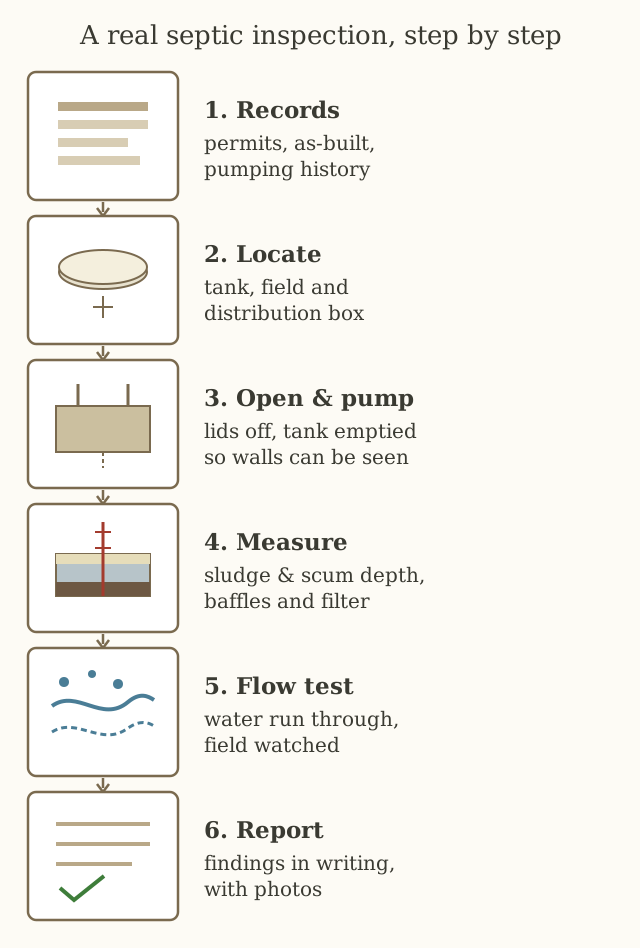
Buying a House With a Septic System? The Inspection That Can Save You $20,000
A standard home inspection barely touches the septic system. Here's what a real septic inspection includes, what it costs, the records to demand, and the contract wording that protects you.
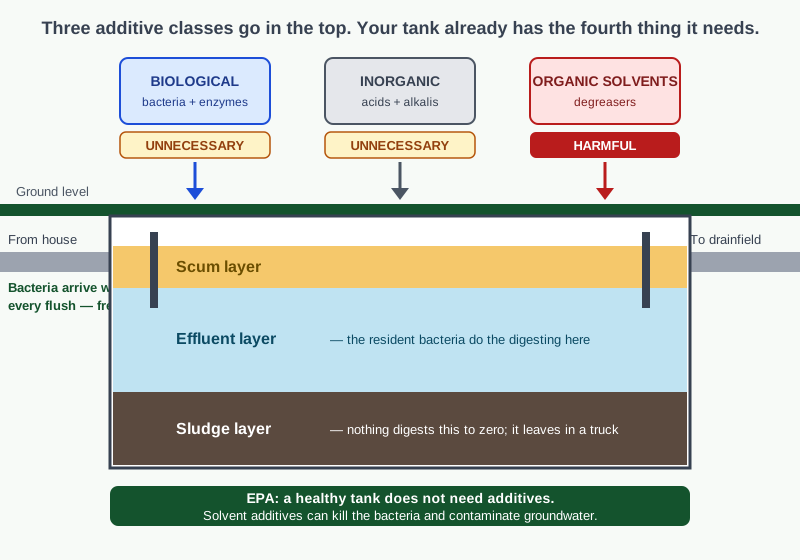
Do Septic Tank Additives Work? What the EPA and the Studies Actually Found
The EPA does not recommend septic additives, a 48-tank double-blind study found no measurable benefit, and one additive class is actively harmful. The evidence, the money maths, and the one narrow exception.

Drain Field Failure Signs: Soggy Ground, Green Stripes and Surfacing Effluent
A failing drain field announces itself in the yard first: lush green stripes, spongy ground, odors, then standing water. The early vs late signs, the look-alikes that aren't failure, a homeowner diagnosis sequence, and what repair or replacement really costs.