 Keep
Septic Tank Pumping Cost: What You'll Actually Pay
 Daniel Mercer · Editor & Researcher·
Published November 16, 2026·
Updated November 16, 2026
If you bought a house with a septic system, pumping is probably the first bill that lands on your kitchen counter with a number you can't judge. A neighbor says he paid $300. A company on the phone says $650, "depending on what we find." A website says the average is $428. All three can be telling the truth, and none of them tells you what your visit should cost.
That gap between quotes is exactly why this page exists. Pumping is not a mysterious service — it is a truck, a hose, an hour or so of work, and a disposal fee — and once you know what the price is made of, you can read any quote the way you'd read an itemized receipt. This guide gives you the real 2026 numbers, walks through what the technician actually does at your house step by step, shows you the handful of things that move the price up or down, and covers the situation nobody's price list mentions: you just bought the place, you have no records, and you don't even know where the tank is.
What a pump-out actually costs in 2026
Start with the honest range. For a standard residential pump-out — truck comes out, tank gets emptied, waste hauled away — most homeowners pay $300 to $600. The big national cost guides land in the same neighborhood: Angi's 2026 figures put the typical job between about $292 and $565 with an average around $428, and HomeGuide's range runs $300 to $700. The U.S. EPA, from the maintenance side, tells homeowners to budget $250 to $500 every three to five years for routine septic maintenance, which brackets the same service from the other direction.
At the extremes, a small tank with ground-level lids on a weekday can come in near $250. A big tank, buried lids, a long driveway and a Saturday backup can push past $1,000, and published ranges top out around $1,500 for the worst combinations. If a quote lands far outside $250–$1,000 for an ordinary house, it deserves questions — in either direction. A suspiciously cheap quote usually means something standard is not included, and you'll meet it later as an add-on.
The price by tank size
Tank size is the single biggest driver, because the truck is essentially charging you to haul gallons away. Pumping is commonly priced at roughly $0.30 to $0.70 per gallon, so the math scales directly:
- 750 gallons (typical for a 1–2 bedroom home): about $250–$550
- 1,000 gallons (the standard 3-bedroom tank): about $325–$700
- 1,250 gallons (4 bedrooms): about $375–$900
- 1,500 gallons (5+ bedrooms): about $450–$1,100
- 1,750 gallons: about $550–$1,250
Two-compartment tanks — common on newer systems — sit toward the top of their size band, because both compartments have to be opened and emptied. If you don't know your tank's size, don't guess from this table and book on the guess; further down, there's a section on finding out, because the size changes both the price and your pumping schedule.
Where you live moves the number too
Labor and disposal fees are local, so geography is the second driver. Homeowners in the Northeast and on the West Coast commonly pay $500–$900 for the same pump-out that runs $300–$550 in much of the Midwest and South. Urban and coastal counties tend to run 20–40% above rural areas nearby, mostly because disposal sites charge more and crews cost more. Rural owners sometimes pay a travel or mileage fee of $50–$150 instead — the truck has to come to you and then haul a full load to a treatment facility that may be a county away. None of this is negotiable in any real sense; it just means a quote should be judged against your area's range, not against a national average or a cousin's bill two states away.
What you're actually paying for
It helps to know what the money buys, because a pump-out is four costs wearing one coat. There's the crew's time and the truck — a vacuum tanker is specialized equipment that costs real money to run. There's the disposal fee: everything that comes out of your tank has to be unloaded at an approved treatment facility, and the facility charges the pumper by the gallon or by the load, which is one reason per-gallon pricing exists at all. There's travel, out to your property and then to the disposal site. And there's the licensed, insured business standing behind the work — in most states pumpers are licensed, and the paperwork they file on your load is part of what keeps your county's groundwater clean and your property out of trouble.
When you see a quote $150 below everyone else's, one of those four things is being squeezed, and the one that can be squeezed invisibly is disposal. A legitimate pumper can tell you where your waste goes. That is a fair question to ask, and a good company answers it without blinking.
The visit itself: what the technician actually does, step by step
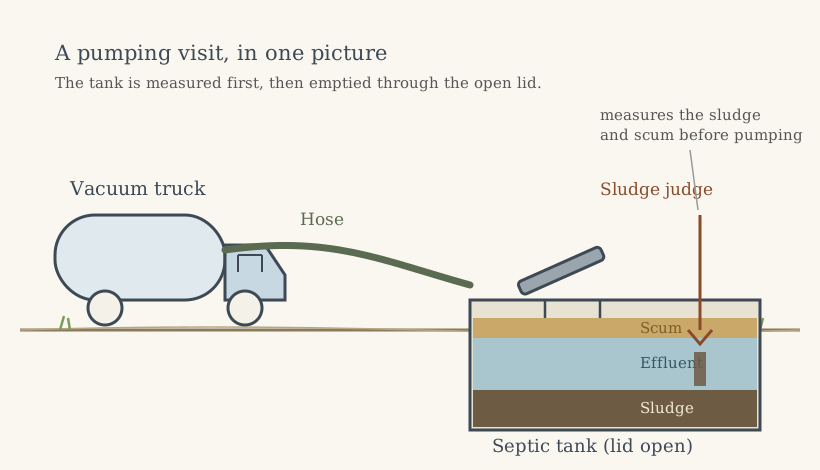
This is the part of the job nobody explains before your first time, and it's the part that lets you tell a thorough visit from a quick one. Pumping is a pro job — it needs the truck, the license and the disposal facility — but you should know exactly what you're watching. A proper pump-out goes like this.
1. The crew finds the tank and opens it. If your lids are at ground level under risers, this takes two minutes. If they're buried, the technician locates them — from your permit drawing, by probing the soil, or with a locator — and digs down to expose them. Digging is the wildcard in the whole visit: it can be five minutes with a shovel or the longest part of the job, and it's where the locating and excavation fees in the cost table come from.
2. The tank gets measured before it gets emptied. A good technician measures the sludge and scum layers first, usually with a sludge judge — a long clear tube lowered into the tank that comes up holding a core sample of exactly what's in there. This measurement is the whole point of the visit beyond the emptying itself. The EPA's rule: pump when the bottom of the scum layer gets within six inches of the bottom of the outlet pipe, when the top of the sludge layer gets within twelve inches of the outlet, or when sludge and scum together make up more than about a quarter to a third of the tank's liquid depth. Those numbers, written on your receipt, are how your next pumping date gets set — by measurement, not by guesswork. If a crew starts pumping without measuring anything, ask them to measure. You're paying for that information.
3. The tank is pumped out — all of it. The hose goes in and the vacuum pulls out the liquid, the floating scum layer and the settled sludge at the bottom. On a two-compartment tank, both compartments get opened and emptied; pumping only the first compartment leaves the solids that matter most sitting right where they were. The technician will work the hose around the bottom and may back-flush or stir the sludge to break it up so it actually leaves — on a tank that's gone too long, the sludge compacts into a dense layer that doesn't want to move, which is slower work and the reason overdue tanks carry a surcharge.
4. The effluent filter gets cleaned. Most tanks installed in the last few decades have a filter at the outlet that keeps solids from reaching the drain field. It should come out, get hosed off, and go back in during the same visit. Some companies include this; some charge $100–$200 for it as a separate service. Either way, it should happen — a clogged filter is a classic cause of slow drains that get blamed on everything else.
5. The tank gets a quick health check. With the tank empty, the technician can see things that are invisible the rest of the time: cracks in the walls, a baffle that's crumbling or missing, roots coming through a joint, water running into the tank from the drain field side (a bad sign — it means the field is saturated). This is not a full formal inspection, but it's the one moment every few years when the inside of your tank is visible, and a decent pumper will tell you what they saw.
6. Lids back on, paperwork in your hand. The lids get resealed, any dug-up soil goes back, and you should receive a receipt or service report: the date, the gallons removed, the sludge and scum measurements, the tank's condition, and anything the technician recommends. Keep it. That piece of paper is the start of your service record, and it's what the next section of this guide is about if you don't have one.
How long it takes
The pumping itself takes about 20 to 60 minutes for a standard residential tank once the lids are open. Start to finish, a typical visit with ground-level access runs about an hour. Buried lids, a tank that has to be located first, or heavily compacted sludge can stretch it to two hours or more. If a company quotes you a suspiciously fast visit, what they're really quoting is skipping steps 2 and 5 — the measurement and the look inside — which are the parts you'll miss later.
What a proper quote must include
Before anyone books, the quote — ideally in writing, even if it's a text or email — should state:
- The tank size the price is based on (and what happens to the price if the tank turns out bigger)
- Pumping of all compartments, not just the first
- Whether locating and digging are included, or charged separately, and at what rate
- Effluent filter cleaning — included or not
- Disposal — the haul-away is part of the job, and the company can name the facility
- The measurement and a written receipt with gallons removed and layer depths
- Any surcharges that could apply — overdue/compacted solids, extra hose length, after-hours — named in advance, not discovered on the invoice
A quote that is just a number, with none of this behind it, is not a low quote. It's an unfinished one.
What moves the price: the six levers
Two houses on the same street can get quotes $400 apart, and both quotes can be honest. These are the levers, roughly in order of how much they move the number.
Tank size. Covered above, but it anchors everything: at $0.30–$0.70 a gallon, the difference between a 750-gallon tank and a 1,500-gallon tank is the difference between a $300 job and a $700 job before anything else goes wrong.
Access and digging. This is the lever new owners feel most. Lids at ground level under risers: no charge, ever. Lids buried under a foot of soil and a flower bed: $50–$200 in digging, plus $50–$250 if the tank first has to be located because nobody knows where it is. There's a permanent fix — risers, which bring the lid up to the surface in a sealed neck. Installing them runs roughly $300–$600 per lid, and from then on every visit starts at the tank instead of at the shovel. Over two or three pumpings, risers usually pay for themselves in avoided digging fees alone.
How long it's been. A tank pumped on schedule empties like soup. A tank that went eight or ten years has sludge compacted to something closer to wet concrete, and it takes longer hose work, more water for back-flushing, and more truck time. Expect a surcharge of $100–$300 on a long-overdue tank, and know that it's legitimate — this one is real labor, not padding.
Distance and hose runs. Trucks carry a standard length of hose. A tank far from where the truck can park — down a slope, behind a fence, across a lawn the truck can't drive on — can mean extra hose sections and extra time, and rural properties may see the $50–$150 travel fee mentioned earlier. If your tank is in an awkward spot, say so when you book; a surprise hose fee is avoidable, an announced one is just a fact of your property.
Timing. A scheduled weekday pump-out is the cheapest version of this service that exists. The same job at 6 p.m. on a Sunday, with sewage at the floor drain, costs $150–$400 more, and emergency work commonly runs 50–100% above the scheduled rate. Almost the entire difference between "septic maintenance" and "septic emergency" as a budget line is whether you chose the date or the tank did.
Extras bundled into the visit. A full inspection ($150–$450 on its own, often less when bundled with pumping), filter replacement instead of cleaning, riser installation, and a second tank on the property (some homes have two, or a separate small tank for a grinder pump) all add to the ticket. Bundling is usually cheaper than separate trips — the expensive part of any visit is getting the truck to your house, and it only has to happen once.
Just bought the house? The inherited-tank problem
Every price guide quietly assumes you know your tank: its size, its location, when it was last pumped. If you closed on the house last month, you probably know none of that. Sellers are supposed to disclose what they know about the septic system, but "the previous owner handled it" is not a service record, and a surprising number of buyers inherit a tank with no paperwork at all. Here's how to close that gap, in order.
Start with the county. Your local health department or environmental office holds the permit and usually the as-built drawing for your system: where the tank sits, its size, and when it was installed. This is a phone call or a small records fee, and it can save you the $50–$250 locating charge on your first visit. Your closing paperwork and the home inspection report are worth a re-read too — inspectors often note the tank's location and the seller's disclosure may name the last pumping date or the company that did it. If a company is named, call them: pumpers keep records by address, and one call can hand you the tank's whole history.
Book a pump-out with inspection as your first visit. For an inherited tank of unknown age and unknown history, the right first service is not the cheapest pump-out you can find — it's a pumping combined with an inspection, where the technician measures the layers, empties the tank, and looks at the baffles, walls and filter while it's open. Budget for the top of the normal range. What you get for it is a baseline: the tank's real size, its condition, how full it actually was, and a next-pumping date calculated from the measurement and your household size rather than from a guess. Our guide to how often a septic tank needs pumping walks through that calculation by tank size and household.
Treat an unknown interval as overdue until proven otherwise. If nobody can tell you when the tank was last pumped, the safe assumption is that it's due. Sludge and scum build whether or not anyone is keeping track, and the cost of being wrong is asymmetric: pumping a tank that could have gone another year costs you a few hundred dollars early; waiting on a tank that was already past the line sends solids into the drain field, and drain fields are priced in the thousands. One more thing to check in your first year: whether the tank has risers. If your first visit involves digging, get risers quoted while the holes are already open — it's the cheapest moment to install them.
Start the record the seller didn't keep. From this visit on, keep every receipt in one folder: dates, gallons, measurements, company name. Three entries in that folder will tell any future technician — and any future buyer of your house — everything they need. A documented service history is also, not incidentally, a selling point when your turn to list the house comes.
Pumping, cleaning, inspecting: three services that get sold as one
These three words get used interchangeably on the phone, and they are not the same service. Knowing the difference is worth real money, because the prices differ and so does what you walk away with.
Pumping is the removal of the tank's contents — liquid, scum and sludge — by vacuum truck. It's the maintenance the EPA's every-three-to-five-years guidance is about, it's what the prices in this guide describe, and it's the one service on this list your tank genuinely cannot skip. A pump-out typically runs $300–$600.
Cleaning is pumping plus extra work inside the emptied tank: hydro-jetting or power washing the walls and floor to strip off hardened deposits that the hose alone won't shift. It typically costs 15–25% more than pumping the same tank — think $350–$750 for a 1,000-gallon tank. Cleaning earns its price on a neglected tank with compacted solids. On a tank that's been pumped on schedule, there's little hardened material to remove, and paying the premium buys you a cleaner version of an already-clean tank. If a company recommends cleaning, the fair question is: "What did the measurement show?" Compacted sludge is a finding, not a sales line.
Inspecting is an evaluation, not a removal: measuring the layers, checking baffles and filters, looking at the tank's structure, and often running water to watch how the system handles flow toward the drain field. A standalone inspection runs about $150–$450. The EPA recommends a professional inspection at least every three years, and it's the service that answers the questions pumping alone doesn't — is the baffle intact, is the field showing stress, how much time do I actually have? Many companies discount the inspection when it's bundled with a pump-out, since the tank is open anyway. For most owners, the rhythm that makes sense is: inspect on the EPA's schedule, pump when the measurement says so, and let cleaning be the exception for tanks that fell behind.
One more word that will come up: additives. Bacteria boosters, enzymes, and tablets that promise to stretch your pumping interval are a standing upsell in this industry. The EPA's position is that a normal household system already contains the bacteria it needs, additives have not been shown to reduce pumping frequency, and some products can do harm by loosening the scum layer and letting solids wash toward the drain field. Nothing you pour down a drain digests sludge to zero. Politely decline, and put the money toward the next actual pump-out.
How to compare quotes — and spot the upsell
Get two or three quotes; septic pricing is local enough that a single number tells you nothing about whether it's fair. But compare them on scope, not just on the headline figure, because the cheapest quote is often just the one with the most left out. When you call, give every company the same facts — tank size if you know it, lid situation, last known pumping — and ask each one the same questions: Does that price include both compartments? Locating and digging, or extra? Filter cleaning? Disposal? Will I get the measurements and a written receipt? The answers sort the quotes faster than the prices do.
Legitimate add-ons exist, and you'll meet them: risers, a replacement filter, an inspection bundled in, a cleaning charge on a genuinely compacted tank. The upsell pattern to recognize is different — it's urgency without evidence. "Your drain field is failing, we should schedule the replacement" from someone who has not measured your tank or looked at the field. "Your baffles are gone" before the lid is fully open. A treatment contract sold at the truck. The defense is the same in every case: ask what they measured and what they saw, and get it in writing. A failing drain field is a $5,000–$20,000 claim; it should come with findings, photographs and a second opinion, not a doorstep verdict. Good companies expect these questions — for many owners, the company you can interrogate comfortably is worth more than the cheapest quote in the county, because you'll be calling them every few years for decades.
Finally, keep the receipt. Gallons removed, layer measurements, date, company. It's your proof of maintenance for the county if it's ever asked for, your baseline for the next interval, and — when you sell — the document that turns your septic system from a buyer's question mark into a checked box.
The yearly math: the cheapest money in the whole system
A $450 bill feels like a lot until you spread it over the years it covers. Pumped every three to five years, a standard pump-out works out to roughly $60 to $200 a year — call it $120 a year at the national average. Set that against the numbers on the other side of neglect: a drain field replacement runs $5,000–$20,000, and a full system replacement can reach $15,000–$30,000 or more. One drain field costs about what forty years of scheduled pumping costs. That is why every version of the official guidance — the EPA's included — treats pumping as the bargain it is: it's the one maintenance task that protects the most expensive component you own underground.
The practical way to hold this in a household budget is to stop thinking of pumping as an occasional surprise and start treating it like the oil change it resembles. When your first visit gives you a measured interval — say, every three years at your household size — divide the expected price by the years and set that much aside annually. Owners who do this never face the emergency rate, because the money and the appointment both exist before the tank starts complaining.
Situations that bend the price
A few properties don't fit the standard range at all, and it helps to know if yours is one of them before the quotes confuse you.
Aerobic treatment units and other advanced systems. If your home has an aerobic unit, a sand filter or another advanced treatment system — common where soil or lot size rules out a conventional drain field — you likely have (and in many counties are required to have) a service contract with scheduled check-ins, often yearly. Pumping is one line item inside a more involved maintenance life, and quotes will reflect the extra components: aerators, pumps, alarms and filters that a conventional tank doesn't have.
A second tank or a pump tank. Some systems have two full tanks, and many have a smaller separate chamber holding an effluent pump or grinder pump that pushes wastewater uphill to the field. Each vessel that gets emptied adds time and gallons to the job. If your system has a pump chamber, ask whether the quote includes it — and whether the pump itself was checked, since a failed effluent pump is a repair in the $500–$1,300 range, separate from pumping.
Tanks in awkward places. A tank under a driveway, deck or patio, or one the truck genuinely cannot get hose-length to, can require extra labor, extra hose, or occasionally a smaller transfer setup. Frozen ground in northern winters does the same thing to digging that deep burial does — published cost guides add $50–$200 for buried lids or frozen ground. None of this makes your quote wrong; it makes your property one of the ones the averages weren't built from, and it's another argument for risers and a recorded tank location, which permanently move your house back toward the standard range.
When to call: the urgency ladder
Pumping is scheduled maintenance, and the best version of this purchase is a calm one: you pick a weekday, the crew picks an hour, and the price stays at the bottom of the range. Call to book when your interval from the pumping table is up, when an inspection or measurement has put your tank near the one-third mark, or in your first year in a house with no records.
Move faster — this week, not this season — if drains throughout the house are slowing together, if you hear gurgling when fixtures drain, if there's a sewage smell around the tank or over the drain field, or if the grass over the field is suddenly greener and lusher than the rest of the yard. Those are the tank telling you the layers have reached the outlet and solids are starting to travel.
And one true emergency: sewage backing up into the house. Stop running water — no laundry, no dishwasher, hold the showers — and call for an emergency pump-out today. It will cost the premium described above, and it is still the cheapest available outcome, because every gallon that goes down a drain from that point has nowhere to go but back up. Once the tank is emptied and the immediate problem is over, get the measurement and the inspection you skipped scheduled — the backup was the symptom, and the schedule is the cure.
Cost at a glance
| Item | Typical cost | Notes |
|---|---|---|
| Septic tank pumping (750 gal) | $250–$550 | Typical for a 1–2 bedroom home |
| Septic tank pumping (1,000 gal) | $325–$700 | The most common residential size; national average ≈ $428 |
| Septic tank pumping (1,500 gal) | $450–$1,100 | Larger and two-compartment tanks take longer to empty |
| Locating the tank and digging up buried lids | $50–$250 | One-time pain; risers end this charge for good |
| Emergency or after-hours pump-out | Add $150–$400 | Weekend and backup situations carry the premium |
Frequently asked questions
How much does it cost to pump a septic tank in 2026?
Most homeowners pay $300–$600, and the national average across the big cost guides is about $428. A small 750-gallon tank with easy access can come in near $250, while a large tank with buried lids, a long hose run or an emergency call can pass $1,000. Tank size is the biggest single factor, at roughly $0.30 to $0.70 per gallon pumped.
Why was my quote so much higher than my neighbor's?
Usually one of four things: your tank is bigger, your lids are buried and his are not, your tank has gone longer between pumpings so the solids are compacted and slower to remove, or you live farther from the company's yard and its disposal site. Regional pricing matters too — the Northeast and West Coast commonly run $500–$900 for work that costs $300–$550 in much of the Midwest.
Are there hidden fees I should ask about before booking?
Ask about five: a locating fee if nobody knows where the tank is ($50–$250), digging to expose buried lids ($50–$200), a surcharge for heavily compacted solids in an overdue tank ($100–$300), travel or mileage for rural properties ($50–$150), and whether the effluent filter cleaning is included or extra. None of these is a scam on its own — the problem is only when they appear on the invoice unannounced.
What's the difference between pumping and cleaning, and is cleaning worth it?
Pumping removes the liquid, the floating scum and the settled sludge — that is the service your tank actually needs on schedule. Cleaning adds hydro-jetting or power washing of the tank walls and floor to strip off hardened deposits, and typically costs 15–25% more. It is worth it on a long-neglected tank where sludge has compacted into something closer to pavement; on a tank pumped on schedule, standard pumping is enough.
Can I pump my own septic tank and save the money?
Realistically, no. You would need a vacuum truck, and the waste has to be hauled to an approved treatment or disposal facility — most states and counties also require the work to be done by a licensed pumper. There is a safety reason underneath the legal one: tank gases can overcome a person in seconds, and nobody should ever lean into or climb inside a tank. The money-saving version of DIY is doing the homework in this guide — knowing your tank, getting comparable quotes, and never paying the emergency rate.
How long does a pumping visit take, and do I need to be home?
The pumping itself takes about 20 to 60 minutes for a standard tank once the lids are open. Finding and digging up buried lids can take longer than the pumping. You do not strictly need to be home if the crew has access and knows where the tank is, but being there for a first visit is worth it: you can watch the measurement, ask about the tank's condition, and walk away with the numbers that set your next pumping date.
Is it cheaper to pump on a schedule or wait until there's a problem?
On a schedule, by a wide margin. A planned weekday pump-out is the $300–$600 version of this job. The emergency version adds $150–$400, and if waiting lets solids escape into the drain field, the bill stops being about pumping at all — drain field replacement runs $5,000–$20,000. The EPA puts routine septic maintenance at $250–$500 every three to five years, which is the cheapest line item in the whole system.
Checked November 16, 2026. This guide is general information, not a substitute for a licensed professional.
Related guides
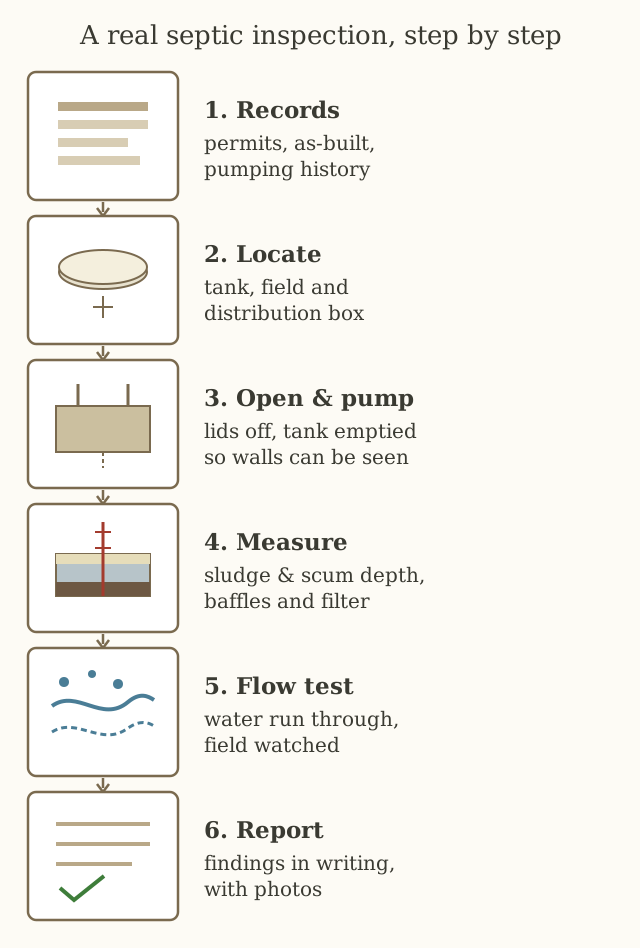
Buying a House With a Septic System? The Inspection That Can Save You $20,000
A standard home inspection barely touches the septic system. Here's what a real septic inspection includes, what it costs, the records to demand, and the contract wording that protects you.
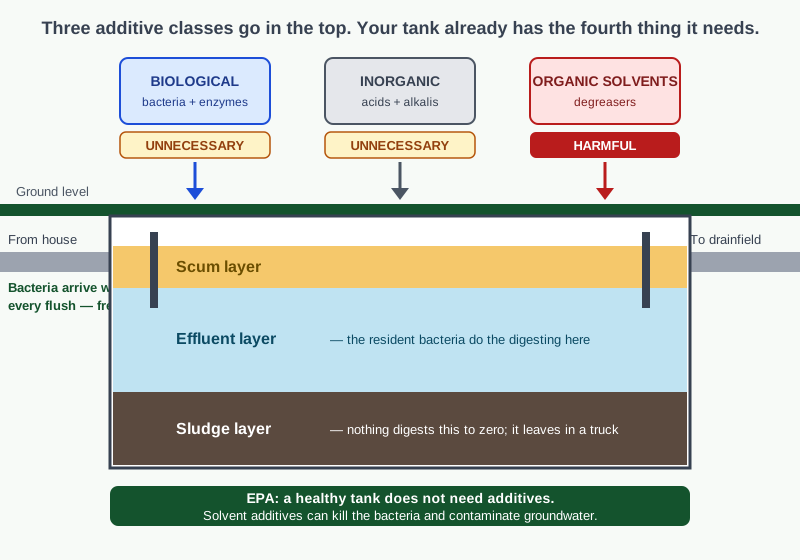
Do Septic Tank Additives Work? What the EPA and the Studies Actually Found
The EPA does not recommend septic additives, a 48-tank double-blind study found no measurable benefit, and one additive class is actively harmful. The evidence, the money maths, and the one narrow exception.
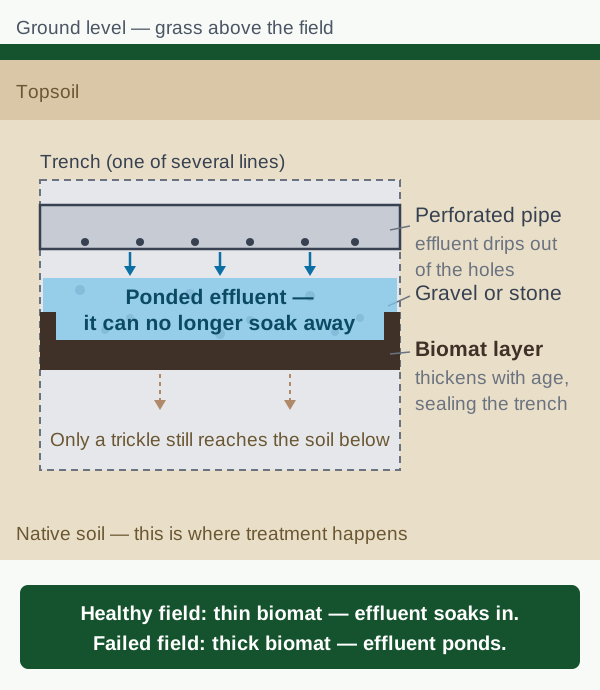
Drain Field Failure Signs: Soggy Ground, Green Stripes and Surfacing Effluent
A failing drain field announces itself in the yard first: lush green stripes, spongy ground, odors, then standing water. The early vs late signs, the look-alikes that aren't failure, a homeowner diagnosis sequence, and what repair or replacement really costs.