 Keep
How Much Does It Cost to Fix or Replace a Failed Septic System?
 Daniel Mercer · Editor & Researcher·
Published November 16, 2026·
Updated November 16, 2026
There is a particular kind of silence that follows a septic installer saying the words "your system has failed." Most owners hear one thing in that silence: a five-figure bill. Sometimes they're right. But "failed" is the most expensive-sounding word in the septic business, and it covers everything from a $400 baffle to a $40,000 engineered treatment system. Those are not the same problem, and they are not the same bill.
This guide separates the two. Fixing a septic system means repairing the part that broke — a pump, a baffle, a distribution box, a stretch of pipe. Replacing it means new hardware in the ground: a tank, a drain field, or both, with permits, inspections and a torn-up yard. The repair menu mostly runs from a few hundred dollars to about $5,000. The replacement menu starts around $3,000 for a tank alone and climbs past $30,000 on difficult sites. Everything below is about working out which menu you're actually on — before you sign anything.
One more thing, because it matters to a lot of readers: if you bought your house in the last few years, a failing system usually isn't something you caused. Septic systems wear out on a 20-to-40-year clock, and plenty of them were already old the day the previous owner handed over the keys. The bill lands on whoever owns the house when the clock runs out. That's you, unfortunately — but it also means you should feel no embarrassment about slowing down, asking basic questions, and making every contractor explain the numbers.
Before you price a replacement, confirm the failure
"Failed" is a conclusion, not a symptom — and the symptoms that trigger it are shared with much cheaper problems. Slow drains throughout the house, gurgling pipes, sewage smells and a soggy patch over the drain field can all mean a dying system. They can also mean a tank that simply needs pumping, a clogged effluent filter, a broken outlet baffle, or a blocked line between the house and the tank. Each of those fixes costs hundreds, not tens of thousands.
So the first money you spend should buy certainty, not digging. A proper septic inspection typically costs $250 to $500. The inspector pumps or opens the tank, measures the sludge and scum layers, checks the baffles and the tank walls for cracks or corrosion, runs water to watch how the drain field responds, and looks for ponding or surfacing over the field. You come away knowing which component failed — or that none has, yet.
Get that diagnosis from someone who doesn't only sell replacements, and get it in writing. If the first verdict is "full replacement," a second inspection is the cheapest five hundred dollars you will ever spend: opinions differ, and the difference between them can be $15,000. If your county health department has flagged the system — some owners find out from an official letter rather than a symptom — ask the department exactly what standard it failed. That definition shapes what you're allowed to repair and what must be replaced.
What can still be repaired, and what it costs
A septic system is a chain of parts, and most of the links can be swapped without touching the rest. Here is the repair menu at 2026 prices, from the tank outward.
Baffles, filters and lids: roughly $150 to $600. The inlet and outlet baffles steer flow inside the tank; when an outlet baffle rots or breaks off, solids escape toward the drain field and the whole system starts dying from a $300 part. Effluent filters clog and cause backups that feel exactly like total failure. Lids crack and let rainwater flood the tank. All of these are half-day jobs.
Effluent or sewage pump replacement: roughly $500 to $1,300. Systems that pump wastewater uphill to the field, and aerobic units, have a pump with a 10-to-20-year life. A dead pump triggers alarms and backups, and owners routinely assume the worst. The pump itself is a replaceable part, and swapping it is one of the most common repairs in the business.
Distribution box and pipework: roughly $800 to $5,000. The distribution box splits flow evenly among the field lines; boxes crack, tilt and clog. The pipes from house to tank and tank to field can be crushed by vehicles, invaded by roots or blocked by grease. Line repairs run toward the top of that range when digging is involved, but they're still repairs — the system itself survives.
Tank crack repair: roughly $500 to $5,000, with strict limits. A sound concrete tank with a localised crack can sometimes be sealed. A rusting steel tank cannot be saved, and a concrete tank whose walls are crumbling is a replacement, not a repair. Be suspicious of anyone who wants to patch structural damage.
Drain field repair: roughly $1,000 to $5,000. When only part of the field has failed, installers can replace a section of line, jet out clogged pipes, or rest one zone of the field while the other carries the load. What repair cannot do is restore soil that is saturated through. The slimy biomat layer that clogs a field's soil is a living mat, and no additive poured down a toilet dissolves it — the EPA does not endorse additives as a fix, and companies selling rejuvenation should be asked, in writing, what exactly they guarantee and for how long.
For context, Angi's 2026 analysis of over 1,700 real projects puts the average septic repair at about $1,828, with most homeowners paying between $627 and $3,041. If your "failed system" quote looks like a replacement price, ask which line of this menu the contractor ruled out, and why.
When repair stops making sense
Three tests separate a repairable system from a replacement, and you can apply all three yourself once you have an inspection report and two quotes.
The 50 percent test. When the repair quote climbs to roughly half the cost of replacing the system, replacement usually wins. A $6,000 field repair on a system that costs $12,000 to replace buys you an old tank, old pipes and a field that has already failed once. The new system resets a 20-to-40-year clock; the repair resets nothing.
The structure test. Some failures are not components but the bones of the system: a tank that is collapsing or rusted through, or a drain field whose soil is saturated across its whole area rather than in one corner. There is no part to swap. Structure failures are replacement by definition.
The age and repeat test. A system that has already had one major repair and fails again within a few years is telling you its age. So is the calendar: if the system is past 25 or 30 years, every repair dollar is spent on equipment near the end of its design life. And if the system is undersized for the house — a common discovery when bedrooms were added over the years — no repair makes it legal or adequate. It has to be redesigned, which means replaced.
What full replacement costs, piece by piece
Replacement is priced by the piece, so learn the pieces. Most "full replacements" are actually one of the first two items below — the tank and the field run on different clocks, and usually only one of them has stopped.
Tank only: $3,000 to $7,000. This is the bill when the tank is cracked, rusted or collapsed but the drain field still absorbs water properly. Surprisingly little of it is the tank: a concrete tank itself costs roughly $700 to $2,000. The rest is excavation, pumping out and disposing of the old tank's contents, removing or crushing the old tank, setting and levelling the new one, and reconnecting the pipes. Deep or oversized tanks, and sites where a crane truck can't get close, push toward $9,500.
Drain field only: $5,000 to $15,000. This is the most common big bill in septic work, because fields usually die before tanks do. The crew excavates the failed field, removes or abandons the old lines, and builds a new absorption area — trenches with pipe and gravel, or modern chamber systems — sized to your household. Straightforward fields on workable soil average around $10,000; large fields, difficult access and engineered designs reach $20,000.
Full conventional system: $6,500 to $15,000. New tank, new field, new distribution, on soil that passes a perc test. Most homeowners with decent soil land between $7,000 and $13,000. The EPA's own published figure for replacing a malfunctioning conventional system is $5,000 to $15,000, which matches what installers actually charge in low- and mid-cost regions.
Mound system: $12,000 to $25,000. When the soil is too shallow, too dense or too close to the water table, the field is built above ground in a raised bed of imported sand, with a pump to lift the effluent into it. You're paying for the sand, the trucking, the pump chamber and the extra labour, which is why a mound roughly doubles a conventional field's price.
Aerobic treatment unit: $10,000 to $20,000. An ATU treats wastewater mechanically, with an aerator, before it reaches a smaller field. It's the standard answer for small lots and poor soils, and it's mandatory in many environmentally sensitive areas. Nitrogen-reducing engineered systems — required near some coasts and waterways — run $15,000 to $30,000, and the hardest regulated jobs reach $45,000.
Then there are the extras that surprise people. Permit fees for a full replacement average $460 to $2,770 depending on the county. The old tank must be pumped before it can be removed or decommissioned — one more pumping bill, typically a few hundred dollars. Soil testing and system design are billed separately in many counties. And restoring the yard afterwards — topsoil, grading, seed — is excluded from a lot of quotes. When you compare two bids, compare what's inside them, not just the totals.
The replacement process, step by step
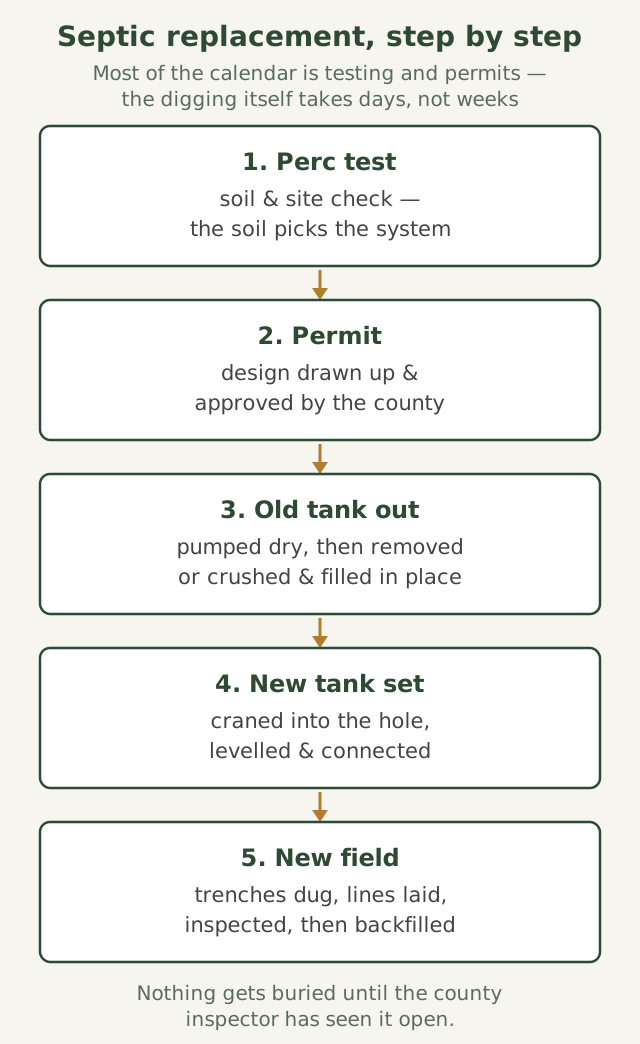
Here is the whole job in the order it actually happens, with a realistic sense of how long each stage takes. Knowing the sequence is your protection: a contractor who wants to skip steps is skipping the ones that protect you.
Step 1 — Diagnosis and confirmation (days). The inspection described above: tank opened, layers measured, field tested, verdict in writing. If the county is involved, this is also when you learn what standard the system failed and what scope of work the county will accept.
Step 2 — Perc test and site evaluation (a week or two to schedule). A soil evaluator digs test pits and runs percolation tests to measure how fast your soil absorbs water, and checks the depth to groundwater and bedrock. This is the most consequential step of the project: the soil's answers decide whether you get a $9,000 conventional system or a $20,000 mound. Nobody can give you a final, honest price before this is done.
Step 3 — Design (one to three weeks). A designer or engineer draws the new system: tank size based on your home's bedroom count, field size based on the perc results, layout fitted around wells, property lines and setbacks. In most counties the design must be submitted and approved as part of the permit.
Step 4 — Permit (often the longest wait). The county health department reviews the design against local code. Review queues run from a couple of weeks to a couple of months depending on where you live and the season. Nothing gets dug before the permit exists — work done without one can be ordered out of the ground.
Step 5 — The old system is pumped and decommissioned (half a day). On install day the crew starts by pumping the old tank dry. Then, depending on local code, the old tank is either pulled out of the ground or crushed and filled in place so it can never collapse and create a sinkhole later. Skipping this step is how abandoned tanks cave in under lawns years afterwards.
Step 6 — Excavation and the new tank is set (a day or two). The excavator digs the hole, beds it with gravel or sand, and the new tank is craned in, levelled, and connected to the house line. If your system needs a pump chamber or an aerobic unit, it goes in at this stage too, along with its electrical work.
Step 7 — The new field goes in (one to three days). Trenches are dug on contour, pipe or chambers are laid, and the distribution box is set level so every line gets an equal share. For a mound, this is when the sand bed is built up and the pressure lines are laid into it. This is the stage where workmanship matters most and shows least — in five years, the quality of these buried details is the difference between a field that lasts 30 years and one that lasts 12.
Step 8 — Inspection before backfill. The county inspector examines the open work — tank, lines, field — before anything is covered. If something fails, it's fixed now, while it's visible. A contractor who backfills before inspection is hiding the only evidence of how the job was done.
Step 9 — Backfill, grading and the yard (a day, plus a season of settling). Everything is covered, the site is graded so surface water runs away from the field, and the disturbed area is seeded. Expect the soil over trenches to settle over the first year; good installers tell you upfront whether a return visit to top up low spots is included. Keep vehicles off the new field permanently, and don't let anyone talk you into planting trees over it.
Add it up and the pattern surprises most people: the actual digging and installing usually takes two to five working days for a conventional system. The project around it — inspection, soil testing, design, permit, scheduling, weather — commonly runs four to ten weeks from first phone call to finished yard.
A proper quote should let you see all of this. In writing, it should name the system type and size, the tank's material and capacity, the field's size and construction, the permit and inspection fees, pumping and decommissioning of the old system, excavation and backfill, grading and any yard restoration, electrical work for pumps or aerobic units, the warranty terms, and a payment schedule tied to stages — never the full amount upfront. The red flags are the mirror image: a single lump-sum number with no breakdown, no mention of a permit, a price given before the perc test, or pressure to sign today because the crew "happens to be nearby."
Why your neighbour's replacement cost half of yours
Septic replacement might be the most location-dependent price in all of home repair, because three separate things change from one county — sometimes one street — to the next.
The first is soil. A conventional system is basically a hole, a tank and some trenches, and on land that percs well it's the cheapest wastewater treatment there is: $7,000 to $13,000 all-in across much of the rural South and Midwest. The moment the soil fails the test, you're buying engineering instead — sand trucked in for a mound, machinery for an aerobic plant — and the price doubles or triples on the same size house.
The second is regulation. Massachusetts is the extreme case: under the state's Title 5 rules, many sites require engineered or advanced-treatment systems, permitting is rigorous, and labour is expensive. Homeowners there report replacement quotes of $30,000 to $50,000 in 2026 — for houses that would cost $10,000 to fix in Georgia. Coastal and nitrogen-sensitive areas in states like Maryland, New York and Florida impose advanced-treatment requirements that push jobs into the $15,000 to $30,000 range. At the other end, rural counties with light permitting and strong competition among installers produce the cheapest conventional work in the country.
The third is plain labour and access. A job that needs a small excavator on a tight, landscaped lot, with the old system under a patio and the new field threaded between trees, costs more than the same system installed in an open field — sometimes thousands more, for the same hardware in the ground.
The practical lesson: a national average is useful for bracing yourself and useless for judging a quote. The only fair comparisons are other quotes for your lot, under your county's rules, in the same season.
How long the new system lasts, and the 25-year warning
A replacement is easier to swallow when you do the lifespan maths honestly. A conventional system is a 20-to-40-year asset. Its parts run on different clocks, and knowing the clocks tells you which failures to expect when:
- Concrete tank: 40 to 50 years, often more. The EPA notes a well-made concrete tank can pass the half-century mark. It is rarely the part that ends a system's life.
- Fibreglass and plastic tanks: 30 to 40 years. Lighter, rust-proof, and increasingly common in new installs.
- Steel tank: 15 to 25 years. Steel rusts from the inside out. If your house has a steel tank from the 1970s or 80s, it is living on borrowed time, and its failure is the one kind that can be sudden — a rusted lid or wall can collapse.
- Drain field: 20 to 30 years. The field is almost always the first major component to go. The biomat in the soil thickens with age, and the EPA notes that a drain field's effectiveness begins declining at around 25 to 30 years as that layer builds up.
- Pumps, floats and controls: 10 to 20 years. The moving parts of pumped and aerobic systems wear out on their own schedule, mid-life, without taking the rest of the system with them.
The EPA's advice follows directly from those numbers: if your system is more than 25 to 30 years old, start planning for its replacement before it becomes an emergency. A planned replacement is cheaper in every way that matters. You can collect three quotes instead of accepting the first. You can schedule the work in a dry season instead of the wet week your field chose to fail. You can arrange financing calmly, save toward the bill, and pick your installer instead of taking whoever answers the phone. Emergency replacements invert all of that — and if a county order or a home sale sets your deadline, you negotiate with no leverage at all.
The maintenance maths makes the same point from the other direction. The EPA puts routine care at $250 to $500 every three to five years for inspection and pumping, against $5,000 to $15,000 to repair or replace a malfunctioning system. Owners who treat a septic system like the asset it is often run a quiet sinking fund: a $12,000 replacement spread over 25 years is about $480 a year — $40 a month — set aside so the next failure is an inconvenience instead of a crisis. If you've just bought a house with an older system, the permit records at the county health department will usually tell you its age. That one phone call converts a surprise into a savings plan.
Insurance won't pay for it. Here's what actually helps
Every year, thousands of owners file a homeowners insurance claim for a failed septic system, and almost all of them learn the same sentence: the policy excludes it. Standard homeowners insurance covers sudden, accidental damage from named events. A drain field that wore out, a tank that rusted through, a system that reached the end of its 30 years — that's ageing and maintenance, the two things every policy excludes. The narrow exceptions are genuinely sudden events: a falling tree crushing a tank, fire, a vehicle strike. Even then, the claim covers the damage from that event, not a brand-new system. Some policies offer service-line endorsements, but read them carefully — they typically cover the pipe running from the house, not the tank or the field where the real money is.
So the bill is yours, and the realistic ways to carry it are these. Savings is cheapest, obviously, and the sinking fund above is how owners of older systems build it. A home equity loan or HELOC usually carries the lowest interest rate, because the house secures it — treat the paperwork with the seriousness that deserves. A personal loan is faster and unsecured, at a higher rate; for a $10,000 job the difference in total interest is real but sometimes worth the speed. Installer financing is convenient and occasionally subsidised, but read the APR after any promotional period ends.
Two less obvious doors are worth knocking on first. If you're a low-income homeowner in a rural area, the USDA's Section 504 home repair programme provides loans to remove health and safety hazards — a failed septic system is exactly that — and grants for homeowners 62 and older who can't repay a loan. And a number of states and counties run their own low-interest septic loan programmes or cost-sharing schemes, especially in protected watershed areas where the government has its own reasons to want your system working. Your county health department administers or tracks most of these; one phone call, before you borrow commercially, can be worth thousands.
If you're selling the house instead, know that several states and counties require a passing septic inspection at transfer — Massachusetts' Title 5 is the famous one — and a failed system usually has to be repaired, replaced, or priced into the deal with full disclosure. Hiding a known failure isn't a strategy; it's a lawsuit with a waiting period.
Living with a failed system while you wait
Between the diagnosis and the install date, most owners live with a system that sort of works. That in-between period has rules, and following them is the difference between an orderly project and a sewage cleanup.
Water is the lever you control. A struggling field fails by drowning: every gallon you send out has to soak into soil that's already saturated. So send less. Spread laundry across the week or take it to a laundromat for a while. Keep showers short, skip baths, fix the running toilet and the dripping tap today rather than eventually, and retire the garbage disposal — ground food waste loads the tank with solids it doesn't need. Stagger the dishwasher and the washing machine so they never drain at the same time.
Pumping can be a bridge. If the tank is structurally sound but the field is failing, pumping the tank dry buys it capacity to hold wastewater while the field rests. Some households pump every few weeks to get through the wait. It costs a few hundred dollars each time, which adds up — but it's still cheaper than one emergency cleanup, and your installer or health department can tell you whether it's a sensible bridge in your county.
Know the hard limits. Sewage surfacing in the yard is not a cosmetic problem: it's untreated wastewater where children and pets walk. Keep everyone off the area, don't mow through it, and don't let it reach a ditch, well or waterway. Sewage backing up into the house is a stop-everything event — stop running water and call. If your county has issued an order with a deadline, don't ignore it and don't panic either: a signed contract and a permit application usually demonstrate good faith, and health departments deal with this every week. The owners who get fined are the ones who go silent.
And two things not to do. Don't pour additives, bacteria boosters or miracle restorations into a failing field — at best you've bought expensive hope, at worst you've loosened solids that then clog the soil faster. And don't let anyone start digging before the permit exists, however persuasive the discount for starting Monday. Unpermitted work can be ordered removed, and then you pay for the same system twice.
A failed septic system is one of the worst bills in homeownership, and also one of the most predictable: a machine with a 20-to-40-year life, wearing out on schedule, underground. The owners who pay the least for it are the ones who confirm the diagnosis before pricing the cure, let the soil test decide the system, compare itemized quotes from their own county, and start planning at year 25 instead of year 31. Do those four things and the five-figure shock at the start of this guide becomes what it should be — a planned project with a known price, a known timeline, and a new system that will quietly outlast your mortgage.
Cost at a glance
| Item | Typical cost | Notes |
|---|---|---|
| Tank only | $3,000–$7,000 | When the tank is cracked, rusted or collapsed but the drain field still works |
| Drain field only | $5,000–$15,000 | The most common big bill; the tank survives and the field is rebuilt. Complex sites reach $20,000 |
| Full conventional system | $6,500–$15,000 | New tank and new field on decent soil; most homes land between $7,000 and $13,000 |
| Mound system | $12,000–$25,000 | For high water tables and shallow soils; includes the pump and trucked-in sand |
| Aerobic treatment unit | $10,000–$20,000 | Advanced treatment; engineered nitrogen-reducing systems in sensitive areas can reach $30,000–$45,000 |
Frequently asked questions
Can a failed septic system be repaired instead of replaced?
Often, yes — if the failure lives in one component. A broken baffle, a dead pump, a cracked distribution box or a blocked line can all be fixed for hundreds to a few thousand dollars. Replacement becomes the honest answer when the tank structure itself is failing, when the drain field's soil is saturated through, or when repair quotes add up to roughly half the cost of a new system. Get the diagnosis in writing before you accept either verdict.
How long does a septic replacement take from start to finish?
The digging is the short part: a conventional install usually takes two to five working days. The whole project, from the first inspection call to a finished, re-seeded yard, commonly runs four to ten weeks. Most of that calendar is waiting — soil testing, design, the county permit queue, the installer's schedule and the weather. Anyone who promises to start digging tomorrow has skipped steps the county requires.
Does homeowners insurance pay for septic system replacement?
Almost never for a system that has simply failed. Standard policies exclude wear, ageing and maintenance, and a worn-out drain field is the textbook example of an excluded loss. The narrow exceptions involve sudden, covered events — a falling tree crushing the tank, fire damage — and even then the policy usually pays for the damage from that event, not a whole new system. Read your policy, but budget as if the bill is yours.
Can I keep using my system while I wait for the replacement?
Usually, on a strict water diet. Spread laundry out or use a laundromat, keep showers short, fix running toilets, and stop using the garbage disposal. If the tank is sound but the field is failing, some households pump the tank every few weeks as a bridge — a few hundred dollars a time, still cheaper than a sewage cleanup. The hard limit is sewage surfacing in the yard or backing up indoors: keep children and pets away from it and treat that as stop-and-call, not wait-and-see.
Why did my neighbour pay $9,000 when my quote is $32,000?
Because the two jobs are probably not the same job. Good soil that passes a perc test gets a conventional system; failing soil, a high water table or shallow rock forces a mound or an engineered treatment system at two to three times the price. Regulation multiplies it further — Massachusetts homeowners report quotes of $30,000 to $50,000 under the state's Title 5 rules, while a conventional replacement on good soil in a low-cost county lands at $7,000 to $13,000. Compare quotes inside your own county, not against national averages.
How long will the new system last?
Plan on 20 to 40 years for the system as a whole. The parts run on different clocks: a concrete tank can last 40 to 50 years or more, fibreglass and plastic tanks 30 to 40, a steel tank only 15 to 25 before rust wins, and the drain field — usually the first part to go — 20 to 30 years. Pumps and other mechanical parts need replacing every 10 to 20 years. Pumping every three to five years is what keeps the field at the long end of its range.
Are there loans or grants that help pay for a septic replacement?
Sometimes. If you are a low-income homeowner in a rural area, the USDA's Section 504 programme offers loans — and grants for homeowners aged 62 and over — to remove health and safety hazards, and a failed septic system can qualify. Some states and counties also run low-interest septic loan programmes or cost-sharing in protected watershed areas; your county health department keeps the local list and is worth one phone call before you borrow anywhere else. Beyond that, the usual routes are savings, a home equity line, or a personal loan.
Checked November 16, 2026. This guide is general information, not a substitute for a licensed professional.
Related guides
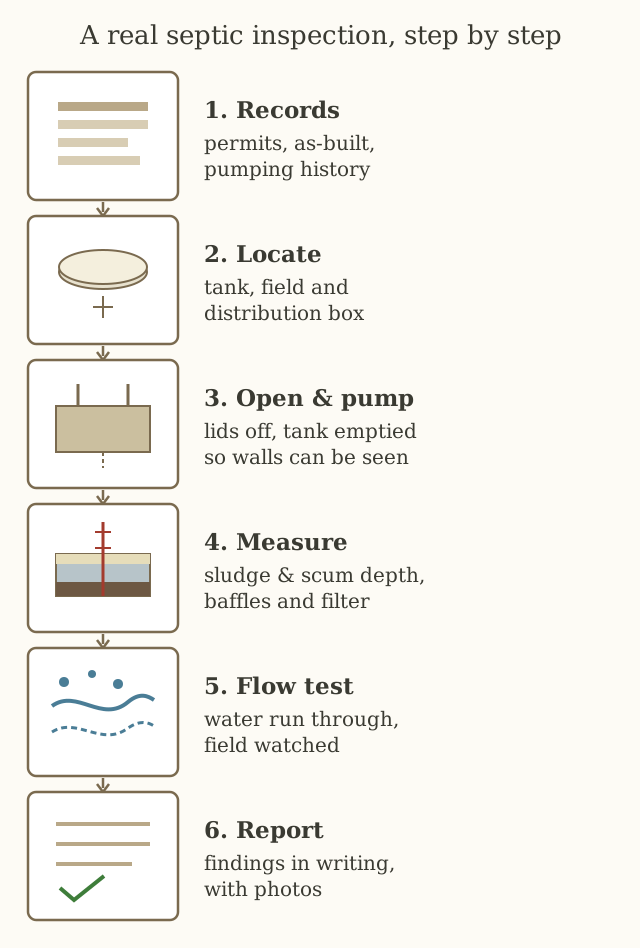
Buying a House With a Septic System? The Inspection That Can Save You $20,000
A standard home inspection barely touches the septic system. Here's what a real septic inspection includes, what it costs, the records to demand, and the contract wording that protects you.
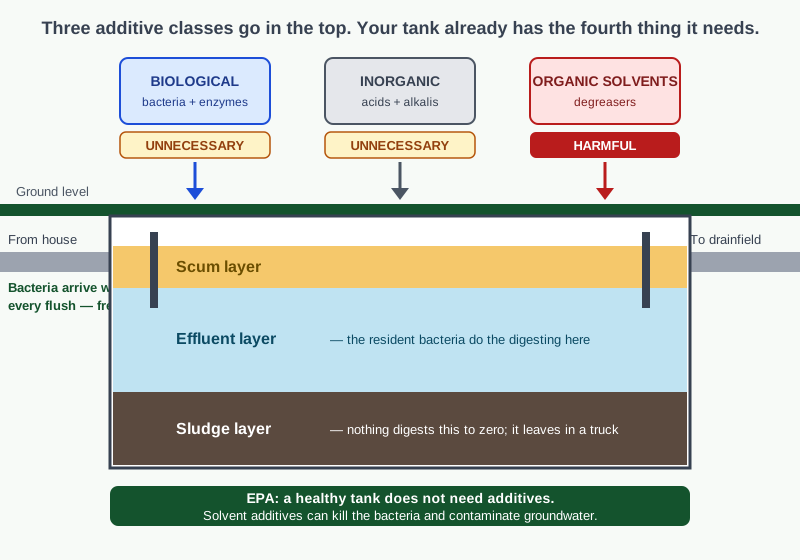
Do Septic Tank Additives Work? What the EPA and the Studies Actually Found
The EPA does not recommend septic additives, a 48-tank double-blind study found no measurable benefit, and one additive class is actively harmful. The evidence, the money maths, and the one narrow exception.
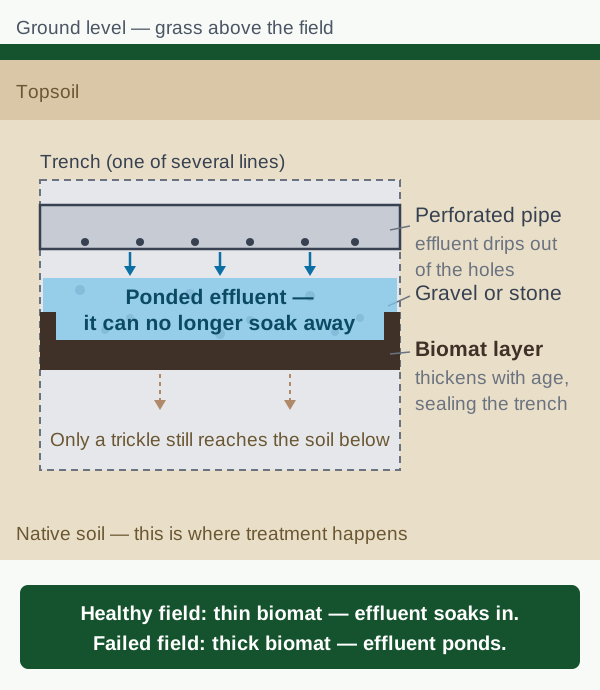
Drain Field Failure Signs: Soggy Ground, Green Stripes and Surfacing Effluent
A failing drain field announces itself in the yard first: lush green stripes, spongy ground, odors, then standing water. The early vs late signs, the look-alikes that aren't failure, a homeowner diagnosis sequence, and what repair or replacement really costs.