 Keep
Septic Smell in the House or Yard: Where It's Coming From
 Daniel Mercer · Editor & Researcher·
Published November 16, 2026·
Updated November 16, 2026
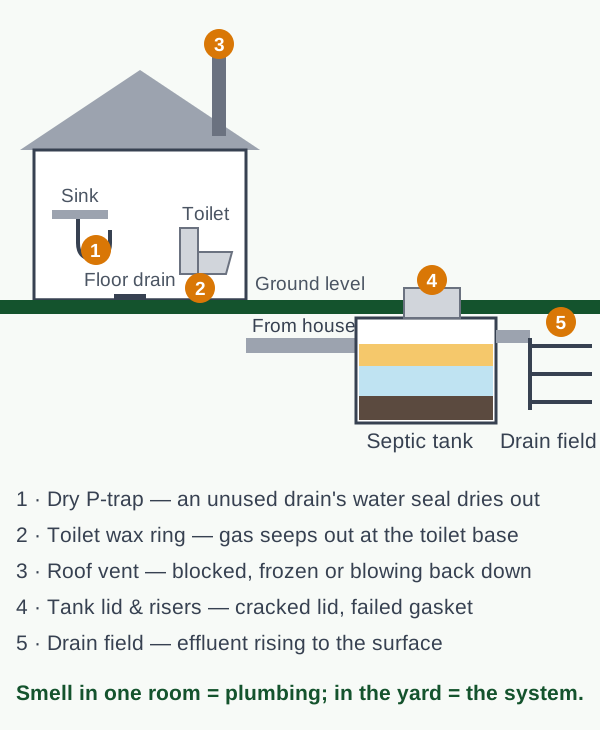
The first time most people smell their septic system, they assume the worst: the tank is full, the field is dead, a five-figure repair is coming. Sometimes that's true. Far more often, the smell is coming from a ten-dollar part inside the house — or from no part at all, just a cup of water that evaporated while nobody was looking.
Here's the thing worth understanding before you spend anything: a septic smell is information. Your system is sealed by design. Wastewater flows out through pipes, and the gases produced in the tank are supposed to exit in exactly one place — the vent pipe on your roof, above the roofline, where the wind takes them away. When you can smell those gases somewhere else, it means they found another opening. And the location of that opening tells you, with surprising accuracy, which component has failed. A smell is not one problem. It is five or six different problems wearing the same disguise, and they range in cost from zero dollars to a new drain field.
So this guide is organized the way a good plumber or septic technician actually works: not by listing causes in alphabetical order, but as a walkthrough, in the order you should check them, starting with the cheapest and most common and ending with the one that really does mean trouble. If you just bought your house — and septic systems are rarely explained at closing — this is also the tour of your system you never got. By the end you'll know every place gas can escape, how to test each one, what the fix involves, and what it should cost.
The one-sentence rule that sorts almost every smell
If you remember nothing else, remember this:
A smell in one room is plumbing. A smell in the yard, near the tank or over the drain field, is the septic system.
The logic is simple. Inside the house, every drain is guarded by a water seal — the trap under the sink, the water standing in the toilet bowl and its base seal. Gas from the tank reaches your rooms only when one of those seals fails or when the vent system pushes gas backward through them. Those are plumbing parts: traps, wax rings, vent pipes. They belong to the house, they fail for house reasons (disuse, age, weather), and most of them are cheap.
Outside, there are no water seals. The tank and the drain field sit in the ground, and the only things containing the gas are the tank's lid and the soil itself. A smell that hangs over the tank usually means the lid or its gasket is leaking gas at ground level instead of sending it up the vent. A smell over the field means effluent is reaching the surface — the soil has stopped doing its job somewhere. Those are system problems, and they belong to a septic professional.
There is one overlap to keep in mind: the roof vent belongs to both worlds. It is the system's official chimney, so a faint whiff near the roofline on a still day, or a smell that drifts into the yard when the wind pushes vent gas downward, can be perfectly normal behavior from a healthy system. What is never normal is a steady smell at ground level, inside or out, that you can find day after day.
Is septic gas actually dangerous?
Honest answer: the smell in your bathroom, no. The gas inside your tank, absolutely yes — and the difference matters, because it tells you where to be careful and where to relax.
The rotten-egg component of septic gas is hydrogen sulfide. It is famous in industrial safety for two reasons. First, your nose is absurdly sensitive to it: according to the ATSDR, the federal toxic-substances agency, hydrogen sulfide can be detected at around 0.5 parts per billion. Second, the levels that harm people are far higher. OSHA's ceiling for workplace exposure is 20 parts per million — on the order of forty thousand times the level you can smell. Between those two numbers lies an enormous safety margin, and the faint smell around a floor drain lives at the very bottom of it. A noticeable household smell is a nuisance and a diagnostic clue. It is not, by itself, poisoning you.
But the same ATSDR guidance carries the warning that makes septic tanks genuinely dangerous, and every homeowner with a tank should know it: at high concentrations, hydrogen sulfide shuts down your sense of smell. Above roughly 100 parts per million — the level NIOSH classifies as immediately dangerous to life or health — the olfactory nerve fatigues within minutes. The smell doesn't fade because the gas cleared. It fades because you can no longer detect it. At 500 to 700 parts per million, a person can collapse within minutes. Those concentrations do not occur in a living room. They occur inside the tank itself, in manholes, in pump chambers — confined spaces where gas accumulates undisturbed. That is why the standing rule of the septic trade is absolute: never lean into an open tank, and never climb into one, not even "for a second," not even to retrieve a dropped tool. People have died that way, including would-be rescuers who went in after them.
For the house, take the practical version: ventilate a room that smells strongly, and if anyone feels dizzy, nauseous or gets a headache alongside a strong smell, get outside and call a professional rather than investigating. And if a powerful smell seems to suddenly disappear while you're standing in it — treat that as a reason to leave, not a victory. Outside those rare situations, work through the walkthrough below calmly. The likely culprit costs less than lunch.
Before you start: know where your system actually is
The outdoor stops on this walkthrough assume you can find your tank and your drain field, and if you bought the house recently, there's a fair chance nobody showed you either. Sellers forget, records scatter, and septic components are buried precisely so you'll never think about them. Take ten minutes to fix that now, before you need the knowledge mid-problem.
Your paperwork is the first map: the septic permit and as-built drawing on file with your county health department usually show the tank and field locations and the tank's size, and the inspection report from your purchase may sketch them too. Physically, the tank is usually 5 to 25 feet from the house, along the line of the main drain leaving the foundation — a metal probe rod or even a thin screwdriver pushed into soft soil will thunk against the lid. Risers, if you have them, announce themselves as round or square lids sitting at the surface. The drain field lies beyond the tank, away from the house: a broad, flatter area of the yard, often marked by nothing at all, though in dry weather the grass over the trenches sometimes grows differently from the rest of the lawn. Sketch what you find on a piece of paper, note distances from two fixed points — a house corner, a tree — and keep it with your house records. Every future pumping, inspection and smell investigation starts with this map, and professionals charge by the hour for the digging you just saved them.
The smell-tracing walkthrough, in the order to check
Work through these five stops in order. The sequence is deliberate: it starts inside the house, at the source that causes more indoor septic smells than all the others combined and costs nothing to fix, and it moves outward and downward — literally following the gas's path in reverse — until it reaches the drain field, the one source that means the system itself is in trouble. Don't skip ahead. Homeowners regularly pay for a pump-out to cure a smell that a quart of water would have fixed, and pumpers regularly find, on arrival, that the tank was fine and the guest bathroom was the problem.
At each stop, the test is simple and the fix is spelled out — as a do-it-yourself procedure where that's realistic, and as a description of what the professional will do, and what it should cost, where it isn't.
Stop 1: The least-used drain in your house (the dry P-trap)
What it is. Under every sink, tub and shower, and built into every floor drain, there is a U-shaped bend of pipe called a trap. It holds a plug of water permanently — when you run the faucet, water flows through it, but the bend always keeps the last few inches. That plug of water is a door. Gas from the drain line, and ultimately from the tank, cannot pass through it. Every drain in your house is sealed by nothing more sophisticated than this.
How it fails. The water evaporates. A drain that gets used every day refills its trap constantly, but a guest bathroom, a basement floor drain, a laundry sink, a spare shower — drains that sit untouched — lose their seal in as little as three or four weeks, faster in a heated, dry house in winter. Once the plug is gone, the pipe is an open chimney from your septic tank to that room. The smell is usually strongest right at the drain, in one room, and it often appears after the house has sat empty — after a vacation is the classic timing.
The test and the fix — 30 seconds, $0. Run water into every drain you can find, especially the ones nobody uses: floor drains, guest showers, the utility sink, the rarely touched second bathroom. A quart of water per drain is plenty; for a shower or sink, just run the tap for half a minute. Then wait. If the smell fades over the next few hours and is gone by tomorrow, you have found your problem, and this is the entire repair.
One upgrade makes it last: after refilling a floor drain, pour a tablespoon or two of ordinary cooking oil into it. The oil floats on the water in the trap and slows evaporation dramatically, stretching the seal from weeks to months. Plumbers have used this trick in commercial buildings for generations. What you should not pour down drains is bleach or chemical cleaners as a smell treatment — they do nothing for a dry trap, and heavy chemical use works against the bacteria in your tank that do the actual treatment.
If it isn't this: the smell stays, or it returns within days even though the drain is being used. A trap that keeps losing its water despite regular use is being siphoned — which points at Stop 3, the vent. Move on.
Stop 2: The toilet base (the wax ring)
What it is. A toilet doesn't connect to its drain pipe with threads or a gasket you can see. It sits on a ring of wax — or, in newer installs, a rubber or silicone seal — pressed between the bottom of the bowl and the flange on the floor. That ring is the gas seal for the largest pipe opening in your house. It is also, being wax, a part with a lifespan: it can dry, crack, compress, or shift, typically after 15 to 20 years, and sooner if the toilet has ever rocked on an uneven floor.
The signs. The smell concentrates around one toilet, low, near the floor. The toilet may rock slightly when you grip the bowl and push it side to side — it should feel bolted to the earth; any movement means the seal has been flexing and is almost certainly broken. Sometimes there is a water stain on the ceiling below, or softness or discoloration in the floor around the base, from the small amount of flush water that escapes alongside the gas. But often there is no water sign at all: gas escapes far more easily than liquid, so a wax ring can leak smell for months before it ever leaks water.
The fix — a real DIY job, or $150–$300 for a plumber. Replacing a wax ring is one of the most satisfying repairs in a house: the part costs $5 to $15, and the job takes an hour or two the first time. The procedure, in outline: shut off the water at the valve behind the toilet and flush to empty the tank; disconnect the supply line and sponge out the remaining water; unbolt the two nuts at the base and lift the toilet straight up and off — it's heavier and more awkward than it looks, around 60 to 100 pounds for a one-piece, so get a second pair of hands; scrape every trace of the old wax off the flange and the toilet horn with a putty knife; check that the flange sits level with or slightly above the finished floor (a flange sunk well below floor level is why the old ring failed, and the fix is a flange extender or a double-height ring, not just fresh wax); set the new ring on the flange, lower the toilet straight down onto it using the bolts as guides, and press with your weight — do not rock it into place, which smears the seal; snug the nuts down firmly but not brutally, because the base is porcelain and cracks; reconnect, refill, flush several times, and check the base dry-eyed for leaks before caulking the front and sides — leaving the back uncaulked is deliberate, so a future leak shows itself instead of rotting the floor in secret.
A plumber charges $150 to $300 for the same job, parts included, and there is no shame in that number if the toilet is a heavy one-piece or the flange turns out to be corroded — a broken flange adds parts and time, and the plumber will spot it the moment the toilet comes up. What you should not do is caulk around a rocking toilet to "seal in" the smell. The gas isn't coming around the outside of the base; it's coming through the failed ring underneath, and caulk just hides the water evidence of the next failure.
Stop 3: The roof vent (blocked, frozen, or blowing back)
What it is. Every drain in your house connects, eventually, to a pipe that rises through the roof: the vent stack. It does two jobs. It gives tank gas its official exit, releasing it above the roofline. And it lets air into the drain system so that when water rushes down a pipe, it doesn't pull the trap seals out behind it — the same reason a can of juice pours smoothly only with a second hole punched in the lid.
How it fails, three ways. A vent can be blocked — leaves and debris washed down the open pipe, a bird or wasp nest, a dead squirrel (common enough that plumbers have a word for the call). It can be frozen shut: in cold climates, moist air rising through the stack condenses as frost on the inside of the exposed pipe, layer on layer, until a January cold snap closes it entirely — one reason septic smells mysteriously appear in northern houses only in deep winter. Or it can be working perfectly but short or badly placed, so that in certain winds the exiting gas is pushed back down along the roof and into the yard or an open upstairs window — the downdraft smell, which is a design nuisance rather than a failure.
The signs. Vent problems announce themselves differently from trap and ring problems: the smell comes and goes. It worsens on windy days or in severe cold. Drains gurgle — a toilet that glugs when the tub drains, a sink that burps air. And the signature clue: you refill the traps (Stop 1), the smell goes away, and days later it returns, because a blocked vent keeps siphoning the trap water back out. If you fixed Stop 1 and the problem came back, you are almost certainly standing at Stop 3.
The fix. If you're comfortable on your roof, a visual check is free: shine a flashlight down the vent from above. Soft blockages near the top can be cleared by running a garden hose down the pipe — the water breaks up leaves and nests and flushes them through. A plumber's auger handles deeper obstructions; expect $150 to $350 for a vent-clearing call. Frost closure is cured short-term with hot water poured down the stack and prevented long-term by insulating the attic section of the pipe or upsizing the exposed diameter, since a wider pipe takes far longer to frost shut. For the downdraft nuisance, the fixes are to extend the vent higher above the roof or fit a charcoal vent filter — a $40 to $120 canister that scrubs odor from the exiting gas — which is also the standard remedy when a perfectly healthy system perfumes a deck or patio that sits too close to the stack. One caution: roof work is the most dangerous DIY there is, and no smell justifies a ladder on an icy roof. That version of the job is a plumber's, in spring.
Stop 4: Outside — the tank lid and risers
If the indoor stops check out, take the search outside, and start at the tank. You are looking — smelling — for gas escaping at ground level around the lid.
What you're checking. Every septic tank has one or more access lids, either buried a few inches under the soil or brought to the surface on risers — the plastic or concrete chimneys added to many tanks so the lids sit at grade. The lid seals with weight, a gasket, or a ring of sealant. That seal is the only thing between several hundred gallons of working sewage and your backyard air. Concrete lids crack and crumble at the edges as they age. Gaskets flatten and rot. A lid that was set back carelessly after a pumping — or cracked by a mower or a vehicle crossing it — leaks gas steadily at ground level, exactly where people are. A faint smell right at the lid on a still, humid day can be normal seepage. A smell you can catch ten feet away, or one that drifts across the yard, is a failed seal or worse.
The fix. Resealing a sound lid is minor: lift or expose the lid (a shovel and patience if it's buried; this alone is why risers exist), clean the mating surfaces, and fit a new gasket or a bead of butyl sealant — $15 to $50 in materials. A septic service will do it for $100 to $400, usually combined with something else. A cracked or crumbling lid is a replacement, not a repair, and it jumps the queue from "maintenance" to "safety": a weakened lid is a fall hazard over a tank nobody should ever fall into, and it should be replaced promptly by a professional — and kept covered and off-limits until it is. While the lid is up, a good technician will also check the level and the baffles, because a tank that is overfull — past due for pumping, with sludge crowding the outlet — pushes gas and odor problems in every direction at once. If yours hasn't been pumped in five years or nobody knows when it was, the smell may simply be the tank asking.
The safety line, repeated because it matters: look at the tank from the surface, with the lid work done from ground level. Never put your head inside the opening to look or smell, and never enter the tank. The gas discussion earlier in this guide was not decoration.
Stop 5: The drain field — the one that means the system
The last stop is the drain field: the network of perforated pipes in trenches where treated wastewater soaks into the soil for its final cleaning. A healthy field is invisible — no smell, no wetness, grass like the rest of the lawn. A smell over the field means effluent is getting to the surface faster than the soil can absorb and treat it, and the gas you're smelling is the byproduct of sewage sitting where it shouldn't.
The pattern to look for. Walk the field on a dry day. Smell alone is a clue; smell plus any of these is a diagnosis forming: ground that feels soft, spongy or wet underfoot when it hasn't rained; standing water or actual surfacing effluent in the low spots of the trenches; a strip of grass over the field that is conspicuously greener and faster-growing than the rest of the lawn (it is being fertilized from below); and, back inside, drains that have begun to run slow throughout the house or a toilet that gurgles. The field doesn't fail all at once — it loses capacity over years as the soil's treatment layer thickens and clogs, and it often copes in dry weather long after it has started failing in wet. Which is why the timing patterns in the next section matter so much for this stop.
What the professional does, and what it costs. There is no DIY fix for a surfacing field, and anyone who sells you one in a bottle is selling you a delay. The professional sequence starts with measurement, not machinery: pump the tank ($300 to $600, often bundled with the inspection), check sludge and scum levels, inspect the baffles and any effluent filter, and assess the field itself — in some cases with a load test, running a known volume of water and watching how the field takes it. Sometimes the verdict is merciful: a tank so overfull it was drowning the field, a clogged effluent filter (a $20 part, hosed off in minutes, that causes a remarkable share of "failing field" panics), a crushed pipe between tank and field. Those are repairs in the hundreds. If the field itself has failed, replacement is a construction project — excavation, new trenches or an alternative system design, permits — at $5,000 to $20,000 and beyond, depending on soil, lot and local rules. That spread is exactly why the measurement step matters and why you should never accept a field-replacement quote from someone who hasn't pumped and inspected first.
What each fix costs, side by side
The table at the top of this guide pulls the five stops together, and it's worth pausing on what it shows, because cost guides usually quote the septic work and the plumbing work in different articles, leaving homeowners to guess which trade — and which price range — their smell belongs to. Read it as a ladder. The first three fixes, which between them account for the large majority of smells, cost between nothing and a few hundred dollars, and two of the three are well inside DIY territory. The fourth is a modest service call. Only the fifth opens the door to serious money, and it announces itself with the soggy-ground pattern rather than hiding among the cheap causes. This is why the order of the walkthrough matters more than any single step: every homeowner who starts at the tank instead of the trap is volunteering to pay system prices for a plumbing problem. Trace first, spend second.
Patterns that change the answer
Sometimes the smell's schedule identifies it faster than its location. Four patterns come up constantly:
Only after heavy rain. Points outside, to the field and the tank. Saturated soil can't absorb effluent, a field at the edge of its capacity surfaces, and a lid with a tired gasket admits rainwater that raises the tank level and stirs up odor. A smell that reliably fades as the ground dries is a system working at its limit — worth an inspection and a pumping if it's due, not yet an emergency. One that stops fading is the failure pattern below.
Only on laundry day, or with a house full of guests. A water-volume problem. A septic system processes a limited flow per day; several loads of laundry back to back, long showers and a running dishwasher can hydraulically overload a tank, stirring the layers and pushing partially treated effluent — and its smell — toward the field. If the smell tracks your biggest water days and the system is otherwise healthy, the fix is behavioral: spread laundry across the week, fix the running toilet and the dripping faucet (a leak adds hundreds of silent gallons), and make sure roof and surface water aren't draining toward the field.
Right after the tank was pumped. Usually temporary, and it surprises people. Pumping stirs the system, and a freshly emptied tank takes a little time to re-establish its working layers; a day or two of stronger odor near the tank or vents is common. What pumping sometimes reveals is a lid that didn't get reseated well — check Stop 4. A smell that starts after pumping and persists past a week deserves a call back to the pumper.
Only in deep winter. Think vent, think frost. The stack frosts closed (Stop 3), or a trap in an unheated space dries or its water thickens with cold — and cold, dense air also holds odor low to the ground instead of dispersing it, so an outdoor smell that exists faintly year-round becomes noticeable. A winter-only indoor smell in a cold-climate house is the vent until proven otherwise.
What will not fix it: additives, bleach and masking products
Every septic smell eventually meets a product promising to end it from a bottle — bacterial additives, enzyme treatments, odor eliminators poured down the drain. The EPA's position is straightforward: a normal household system already contains all the bacteria it needs, additives have not been shown to solve problems like odor, and some actively cause harm — certain products work by breaking up and suspending the tank's scum and sludge layers, which sends solids out toward the drain field, the most expensive component you own. Bleach and heavy chemical cleaners poured down drains in the name of freshness kill the tank's treatment bacteria outright. And scented masking products do the one thing you least want: they hide the signal. A septic smell is diagnostic information — it is telling you which seal failed. Covering it doesn't repair the seal; it just lets a $0 trap problem mature quietly into a $300 wax-ring problem, or a tired field into a failed one. The walkthrough above is the fix. The bottle is a postponement with a price tag.
When the smell is the system failing — and how fast to move
Everything above this section is, in the end, reassurance with instructions: most smells are small. This section is the exception, and it deserves its own heading because the pattern is specific and the stakes are different.
A failing system rarely announces itself with smell alone. It announces itself with a combination: a sewage smell in the yard, over ground that stays soft or wet; drains throughout the house running slower than they used to; gurgling from toilets or the lowest fixtures; and, at the end of the sequence, sewage backing up into a tub, shower or floor drain. Any one of those alone has cheaper explanations, which is what the walkthrough is for. Together, they describe a system that can no longer move wastewater out of the house and into the soil — the tank is overwhelmed, the field is saturated or clogged, or both — and no trap refill or wax ring is going to change it.
If you recognize that combination, the sequence is: cut your water use to the minimum today — every gallon you run has to go somewhere, and right now there is nowhere good for it to go; keep people and pets off any surfacing effluent, which is untreated sewage regardless of how mild it looks; and get a septic professional out for the pump-and-inspect sequence described at Stop 5, this week rather than this season. Do not wait for a full backup to confirm the diagnosis. A backup into the house converts a system problem into a system problem plus a cleanup, a flooring bill and a genuine health exposure, and it is the one outcome in this entire guide that is unambiguously an emergency.
Short of that combination, calibrate by the ladder you've just climbed. A smell you've traced to a trap, a toilet or a vent is a weekend project. A smell at the lid is a service call to schedule. A smell over the field — even alone, even intermittent — earns a professional inspection, because the field is the one component whose repair bill grows while you watch it. And the smell that comes with dizziness or nausea skips the ladder entirely: out of the house, then the phone call.
New septic owners tend to make one of two mistakes with a smell: panic and price out a new system over what turns out to be a dry floor drain, or ignore a yard smell for a year because the drains still work. The walkthrough exists so you don't have to do either. Follow the gas backward — trap, toilet, vent, lid, field — and it will tell you which problem you have, what it costs, and how fast it needs you. Start at the least-used drain. It takes thirty seconds, and most of the time, that's the whole story.
Cost at a glance
| Item | Typical cost | Notes |
|---|---|---|
| Dry drain trap — refill with water | $0 | DIY, 30 seconds per drain; a spoonful of cooking oil floated on top slows evaporation for months |
| Toilet wax ring replacement | $10 DIY · $150–$300 pro | The ring itself costs $5–$15; the pro price covers pulling the toilet, scraping the flange and resetting it |
| Roof vent clearing or carbon vent filter | $0–$120 DIY · $150–$350 pro | Soft blockages hose out from the roof; a charcoal vent filter ($40–$120) stops odors that blow back down into the yard |
| Tank lid or riser reseal | $15–$50 DIY · $100–$400 pro | A new gasket or a bead of sealant around a sound lid; a cracked concrete lid is a replacement, and that is pro work |
| Pump-out and system inspection (smell over the field) | $300–$600 | The diagnostic step when the source is the system itself; if the drain field has failed, replacement runs $5,000–$20,000+ |
Frequently asked questions
Why does my house smell like septic when all my drains work fine?
Because the most common indoor sources have nothing to do with drainage. A dry trap lets gas through while water still drains perfectly, a failed wax ring leaks gas at the toilet base without leaking a drop of water, and a blocked vent pushes gas indoors while everything still flushes. Good drainage rules out a backup — it does not rule out a broken gas seal, and the smell is a gas problem, not a water problem.
Is a septic smell in the house dangerous?
A faint smell at the levels you notice around a drain is unpleasant long before it is dangerous. You can detect hydrogen sulfide at about 0.5 parts per billion; the workplace ceiling set by OSHA is 20 parts per million — roughly 40,000 times higher. The real hazard is inside the tank itself and in confined spaces, where gas can reach lethal levels, which is why nobody should ever open a tank and lean in. Indoors, treat symptoms as the warning: headaches, dizziness or nausea with a strong smell means ventilate, get out, and call a professional.
Why does the septic smell come and go?
Intermittent smells have intermittent causes. A vent that is partly blocked misbehaves on windy days or when a lot of water drains at once. A trap that is slowly drying out smells worse each week until someone uses that drain again. A drain field that is struggling copes in dry weather and surfaces after rain. Note when the smell appears — the timing is often a better clue than the smell itself, and this guide has a section on the common patterns.
Why does my yard smell like septic after rain?
Rain saturates the soil around the drain field, and saturated soil cannot absorb effluent at the normal rate, so wastewater lingers near the surface and the odor rises with it. A smell that fades as the ground dries is usually a field working at its limit. A smell that is there in dry weather too, especially over soft or soggy ground, points to a field that is failing rather than merely busy — that pattern needs a professional inspection.
Will septic additives, bleach or odor products fix the smell?
No. The EPA's position is that a household septic system already contains the bacteria it needs, and additives have not been shown to fix odor problems — some can make things worse by breaking up the scum layer and pushing solids toward the drain field. Bleach poured down drains kills the bacteria doing the treatment. Masking products cover the symptom while the cause — a dry trap, a failed seal, a saturated field — keeps developing. Fix the opening the gas is using and the smell stops at the source.
How much does it cost to fix a septic smell?
It depends entirely on which source you find, which is why tracing it in order matters. The most common fix costs nothing: refilling a dry trap. A wax ring is about $10 in parts or $150–$300 fitted. Vent work runs $0–$120 yourself or $150–$350 for a plumber. Resealing a tank lid is $15–$50 in materials. Only the last source on the list is expensive: a smell coming from a failing drain field starts with a $300–$600 pump-out and inspection, and field replacement runs $5,000–$20,000 or more.
When should I call a professional about a septic smell?
Call when you have worked through the trap, the toilet and the vent and the smell is still there; when the smell is in the yard over the tank or field rather than in a room; when it arrives with slow drains, gurgling or any sign of backup; or when the ground over the field is soft or wet. Call immediately — and stay out of the area — if the smell is strong enough to cause dizziness or nausea. A septic service can measure the tank, test the field and tell you which problem you actually have, usually in one visit.
Checked November 16, 2026. This guide is general information, not a substitute for a licensed professional.
Related guides
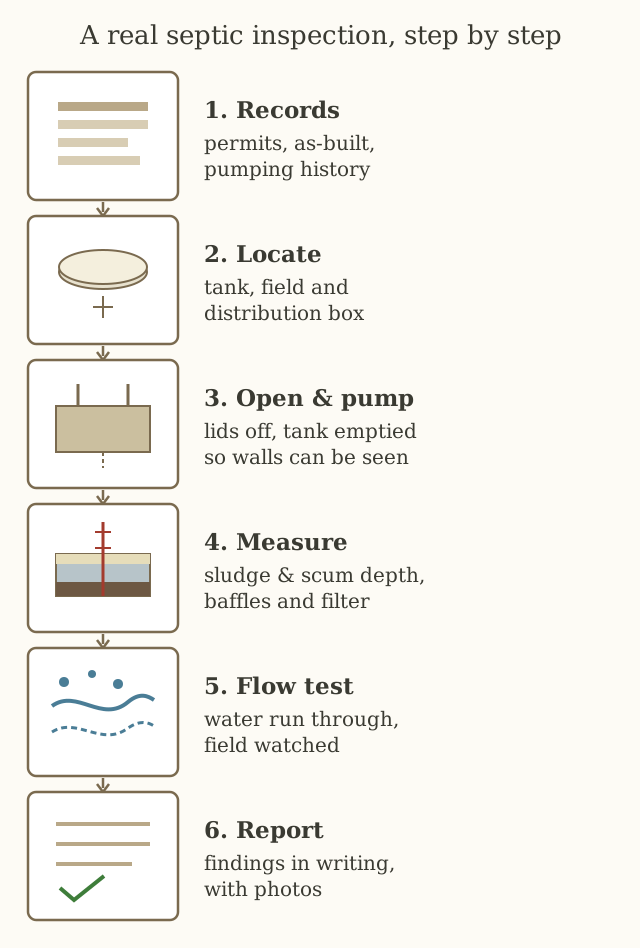
Buying a House With a Septic System? The Inspection That Can Save You $20,000
A standard home inspection barely touches the septic system. Here's what a real septic inspection includes, what it costs, the records to demand, and the contract wording that protects you.
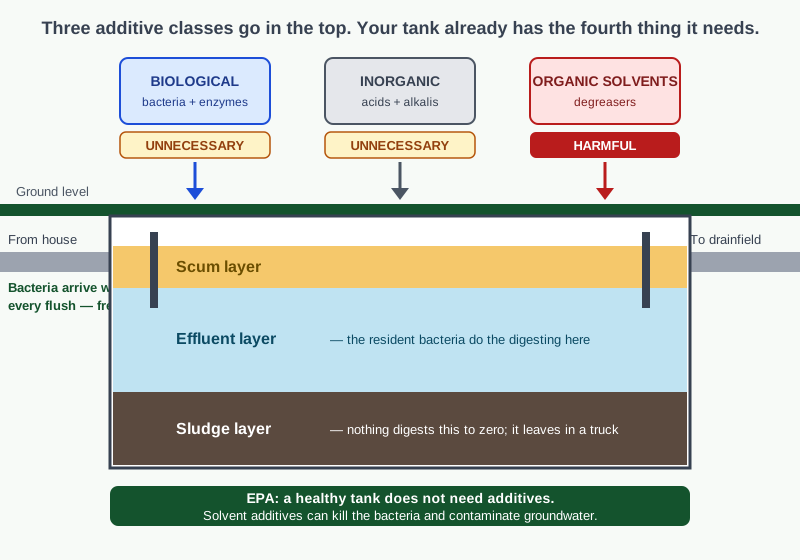
Do Septic Tank Additives Work? What the EPA and the Studies Actually Found
The EPA does not recommend septic additives, a 48-tank double-blind study found no measurable benefit, and one additive class is actively harmful. The evidence, the money maths, and the one narrow exception.
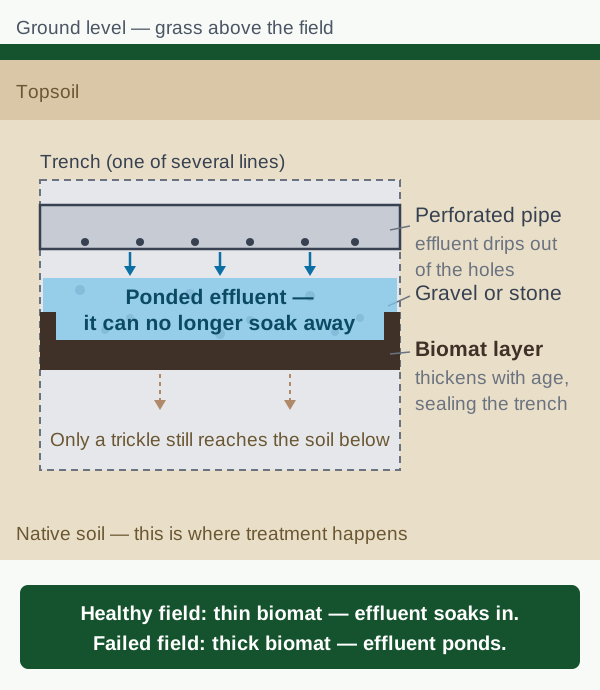
Drain Field Failure Signs: Soggy Ground, Green Stripes and Surfacing Effluent
A failing drain field announces itself in the yard first: lush green stripes, spongy ground, odors, then standing water. The early vs late signs, the look-alikes that aren't failure, a homeowner diagnosis sequence, and what repair or replacement really costs.