 Keep
Septic Alarm Going Off? What It Means and What to Do in the Next 24 Hours
 Daniel Mercer · Editor & Researcher·
Published November 16, 2026·
Updated November 16, 2026
It is 2 a.m. and the house is making a noise you have never heard before. A buzzer — not the smoke alarm, not the alarm clock — is sounding from the garage, the utility room, or a post out by the driveway, and when you find the little grey box it belongs to, a red light is glaring at you. If you bought this house recently, there is a fair chance nobody ever explained what that box is. If you've lived here for years, there's an equally fair chance you've never had to think about it.
Take a breath. That buzzer is doing exactly what it was installed to do: warn you early, while the problem is still small, cheap, and underground where it belongs. A septic alarm going off does not mean sewage is about to come up through your shower drain. It means the water level in one part of the system has climbed higher than it should, the pump that moves that water has fallen behind for some reason, and you have a window — normally a day or two — to find out why before anything backs up.
This guide walks you through that window in order: what the alarm means, what to do in the first ten minutes, what to check over the next two hours, how to stretch your reserve, the six causes behind nearly every alarm and how to tell them apart, what a professional will do when they arrive, and what each repair honestly costs — including the repair-price table most alarm guides oddly refuse to publish.
What the alarm actually means
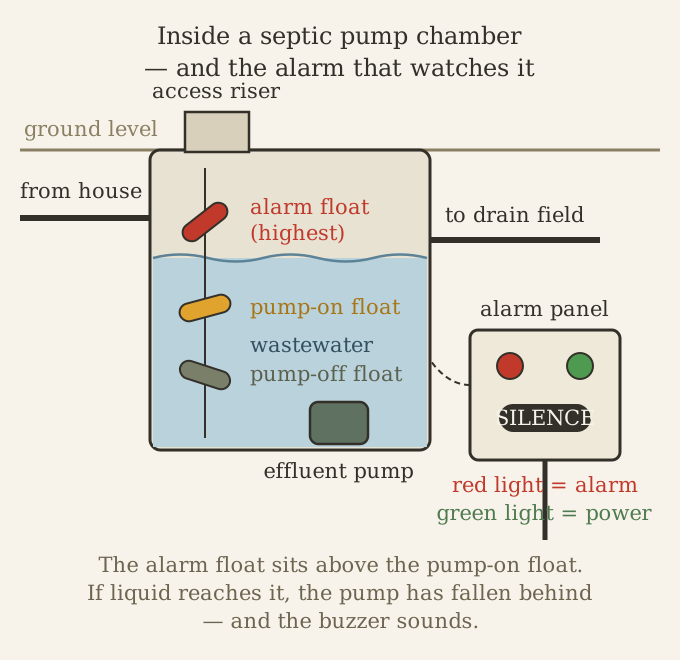
Start with the geography, because the alarm makes no sense without it. If your home has a septic alarm, your system has a pump. In a plain gravity system, wastewater flows downhill from tank to drain field and there is nothing electrical to alarm. But if your drain field sits uphill from the tank, or across a long flat stretch, or your system is an aerobic treatment unit, the treated water collects in a separate compartment — the pump chamber, sometimes called a pump tank or dosing tank — and an effluent pump pushes it out to the field in doses.
Inside that chamber hangs a small stack of floats, like fishing bobbers on cords, each set at a different depth. The lowest float tells the pump when to stop. The middle float tells it when to start. And the highest float — set above the pump's normal working range — is connected to nothing but the alarm. It has one job: if liquid ever rises high enough to reach it, something is wrong. The pump has lost power, the pump has failed, a float has stuck, or water is arriving faster than the pump can move it. When that top float tips, the buzzer sounds and the red light comes on.
Two details in that design are worth understanding, because they shape everything you do next.
First, the alarm float is deliberately set below the top of the chamber. The space above it is reserve storage, and on a typical residential system it amounts to roughly 24 to 48 hours of normal household use. The alarm is not a last-second warning; it is an early one, engineered to go off while you still have time. Some state codes spell this out — North Carolina's rules, for example, require the alarm to run on its own float and to keep working even when the pump is dead, which is why killing power to the panel to stop the noise is exactly the wrong move. Second, what the alarm reports depends on your system type:
- Conventional pump-dose systems (the most common): the alarm is a high-water alarm, full stop. Liquid too high in the pump chamber. Everything in this guide applies directly.
- Aerobic treatment units (ATUs): these have an air pump feeding oxygen to the treatment tank, and their panels commonly watch two things — high water, and low air pressure. A red light with the water level normal often means the air pump has failed or an air line is blocked: a treatment problem rather than a flooding problem, but still one to fix promptly, because without air the unit stops treating properly. Your panel may have separate lights for each fault; the label inside the panel door will say which is which.
- Low-water alarms: a smaller number of systems also alarm on a level that is too low — usually a leak in the chamber, a stuck float, or a pump that has run the chamber dry. If your drains work, the yard is dry, and the alarm is sounding, mention this possibility when you call.
The first 10 minutes
You do not need tools for this part. You need to do four things, in this order.
1. Silence the buzzer. Find the alarm panel — a small grey or beige box, usually on an exterior wall near the tank, on a post by the driveway, or inside the garage or utility room. It will have a red light (alarm), a green light (power), and a button or switch marked silence, mute, or test/silence. Press it. The buzzer stops. Understand precisely what just happened: you have muted the noise for a set period, commonly 12 to 24 hours, after which it will sound again if the condition is still there. The red light stays on — it is now your dashboard. Silencing does not reset anything or fix anything; it buys a quiet house to think in. Do not unplug the panel, and do not switch off its breaker to stop the noise: the alarm is required to stay alive when the pump isn't, and a dark panel tells you nothing.
2. Stop the water. From this moment until the light goes out, your house is on a water budget. No laundry. No dishwasher. Showers short and only as needed; baths are out — a bath can send 40 gallons at once. Flush when necessary rather than by reflex. If you have guests, tell them plainly: water is rationed until it's fixed. Every gallon you keep out of the drains is a gallon the struggling pump doesn't have to move, and it comes straight off the clock. While you're at it, walk through the house and listen: a toilet that runs intermittently, a dripping tap, a water softener stuck in regeneration — any of these can be quietly feeding the chamber hundreds of gallons a day, and finding one may be finding your whole problem.
3. Check the breaker. Go to your electrical panel and find the circuit for the septic pump — it may be labeled septic, pump, sewage, or nothing useful at all, which is its own lesson for later. If it has tripped, reset it once: push it fully off, then on. Many systems also have a GFCI outlet in the circuit, sometimes at the panel or near the tank, with its own reset button — check it too. A tripped breaker or GFCI is the single most common cause of a septic alarm, and resetting it costs nothing. But respect the limit: reset once. If it trips again straight away, or within the hour, stop. A breaker that won't hold is reporting an electrical fault — a shorted pump motor, damaged wiring, water where it shouldn't be — and that is now a professional's job. You've also just learned something valuable to tell them.
4. Note the time and the lights. The green light should be on (the panel has power) and the red light is on (the alarm condition is real). Note when the alarm started and anything unusual about the last 24 hours — heavy rain, a houseful of guests, a power cut, a marathon laundry day. This sounds trivial at 2 a.m.; it is the first thing a service technician will ask you at 9 a.m., and the pattern of answers is often the diagnosis.
If the breaker was tripped and now holds, there is a decent chance you have already fixed it. The pump will start clearing the backlog. Give it time — the next section explains how long, and what to watch.
The first 2 hours: read the panel, then walk the yard
With the house quiet and the water stopped, the next two hours are about gathering evidence. None of this involves opening anything.
Decode the panel. Panels vary by brand, but the vocabulary is small. Green light: the panel has power. Red light: alarm condition — high water (or, on aerobic units, possibly low air). Some panels have a pump-run light that lights while the pump is actually running; watch it for a few minutes. A pump that runs, stops, and runs again at intervals is cycling and working. A pump-run light that never comes on while the red light glares means the pump is being told nothing, or is getting power and doing nothing — either way, useful information. If the panel door has a wiring diagram or the previous owner's service sticker, photograph it. That sticker, if it exists, names the company that knows your system.
Listen at the tank. Stand roughly over the pump chamber (often the second lid from the house, or a separate smaller tank) and listen. A working effluent pump makes a low hum for a minute or two at a time, then stops. Silence over 15–20 minutes in a quiet house suggests the pump is not running at all: no power, a dead float, or a dead pump. A hum that never stops suggests a pump running against a blockage, or a float stuck on — which will burn the pump out if it goes on for days. A hum that starts and stops every few minutes, constantly, is short-cycling, also hard on the pump. You are collecting the sentence you'll say on the phone: "The red light is on, the breaker holds, and I can't hear the pump run at all" gets you the right technician with the right parts faster than "the alarm is beeping."
Look at the yard. Walk the area over the tank and drain field with a torch if it's dark. Look for standing water or soggy, spongy ground over the field, any sewage smell outdoors, and — in winter — a suspicious patch of melted snow or green grass. Any of these shifts the picture from "pump problem" toward "the field isn't accepting water," the one cause that isn't a quick parts swap. If it has rained hard for two days, the field may simply be saturated, and the honest treatment is time and a water fast while the soil drains.
Check the house drains. Notice the lowest fixtures — the basement shower, the ground-floor tub. Any gurgling from drains or toilets, anything draining slowly? That means the reserve is already being consumed at the house end, and your timeline shortens. Everything draining freely means the problem is still contained in the chamber, where it belongs.
By the end of two hours you should know: whether the panel has power, whether the breaker holds, whether the pump audibly runs, whether the yard shows water, and what the last day looked like. That is a complete first report.
The 24–48 hour reserve — and how to stretch it
The reserve is the storage space between the alarm float and the top of the chamber, and it is why this guide is measured in hours rather than minutes. At normal use — the EPA's planning figure is around 50–70 gallons per person per day — it typically lasts one to two days. Halve your water use and you roughly double your time.
Stretching the reserve means knowing where household water goes. Toilets are the biggest steady draw — an older toilet uses 3.5 to 5 gallons a flush, and one with a leaking flapper can pass 200 gallons a day untouched, which is why the listening walk in the first ten minutes matters. A washing machine sends 25 to 40 gallons per load, all at once. A ten-minute shower is 20 to 25 gallons; a bath, 35 to 45; a dishwasher run, 6 to 10.
So the reserve-stretching list, in order of gallons saved: fix or shut off anything that runs on its own (running toilet, dripping tap, softener stuck mid-cycle); stop the laundry entirely — if this drags into a second day, use a laundromat without a shred of guilt; paper plates and minimal washing-up; showers to two or three minutes, or a sponge bath for a day; flush for solids every time, for liquids when needed. A family that does all of this can live on a quarter of its normal water without real hardship, and a two-day reserve becomes four.
Know the signs that the reserve is running out, because they change what you do next: drains that gurgle when another fixture is used; the lowest shower or tub draining slowly; a toilet that flushes weakly or rises higher than normal; any sewage smell inside the house. If you see those, stop using water almost entirely and make the call an emergency call — you are no longer preventing a backup, you are postponing one by hours.
And one rule that surprises people: do not "solve" the reserve problem by having the tank pumped and calling it fixed. Pumping empties the chamber and silences the alarm — and if the cause is a dead pump, the chamber refills on the same schedule and the alarm returns, because nothing was repaired. Pumping is a legitimate way to buy time — before a weekend, while waiting for a part — and a good technician may suggest exactly that. But it is a pause button, not a repair, and any quote that consists of pumping alone, with no diagnosis, should prompt a second phone call.
The six causes, worked through one by one
Nearly every septic alarm traces back to one of these six. They are ordered roughly from cheapest to most serious, and each has a check you can do — or a tell you can report — before anyone lifts a lid.
1. The breaker tripped, or the power was cut
The most common cause, and the only free one. The pump is an ordinary appliance at the end of an ordinary circuit, and it stops for ordinary reasons: a breaker trips on a surge, a GFCI outlet pops, a storm cuts power while the house keeps sending water in, or — more often than anyone admits — somebody switches the circuit off for unrelated work and forgets it. The alarm, running on its own float and often its own circuit, tells you.
Your check: the one you already did in the first ten minutes. Breaker found tripped, reset once, holds, pump audibly runs, red light clears within several hours of low water use — done, and the total bill is $0. The only follow-up: if the same breaker trips again in the coming weeks with no obvious cause, get it looked at — a pump that is starting to fail often announces itself by drawing too much current before it stops entirely.
2. A float switch has stuck or failed
Floats are simple, moving parts living in a hostile place. They hang in the chamber for years, tipping up and down thousands of times, and they fail in unglamorous ways: the cord tangles or catches on the pump or chamber wall, grease and sludge build up until the float can't tip freely, the internal switch wears out, or something flushed that shouldn't have been — a wipe, dental floss, hair — wraps around the works. A float can fail in either direction. Stuck down or dead, it never tells the pump to start, the level rises, and the alarm float reports it. Stuck up, it can run the pump without stopping, emptying the chamber and burning out a pump that runs dry — some systems alarm on that condition too.
Your check: you can't inspect floats yourself — they're inside the chamber, and the chamber stays closed (tank gases are genuinely lethal). What you can do is notice the pattern: an alarm after the pump audibly ran a lot, a pump that hums without pausing, an alarm that has cried wolf twice before. Floats are the prime suspect in all three stories, and the fix is one of the cheaper ones in the table below.
3. The pump itself has failed
Effluent pumps are durable but not immortal: a typical service life is 7 to 15 years. They die of worn impellers, seized motors, failed seals that let water into the motor housing, and the slow accumulation of starts — every start is the hardest moment in a pump's life, which is why short-cycling floats kill pumps early. A pump can also be alive but crippled, keeping up on quiet days and falling behind whenever the house gets busy — the maddening pattern of an alarm that sounds after guests visit and clears by Tuesday.
Your check: listen. Panel powered, breaker holding, floats presumably calling — and no hum, ever, over a couple of hours of a quiet house. Or the opposite signature: the pump runs and runs but the level never falls and the light never clears. Age is evidence too: if the pump is 12 years old, a failure is not bad luck, it's a schedule arriving. Pump replacement is the biggest routine bill in this guide and still, in the scheme of septic work, a modest one — hundreds to around fifteen hundred dollars, not the five figures of drain field work.
4. The effluent filter is clogged
Many systems have a filter at the tank outlet or in the line to the pump chamber — a slotted cylinder that keeps solids from travelling onward. It is meant to be pulled and hosed off periodically, and on a great many systems it has never once been touched. As it blinds over with biofilm and fine solids, everything behind it slows down: drainage gets sluggish, levels rise, and eventually the alarm has something to say. This cause is the great imitator — it can look like a full tank, a failing field, or a tired pump.
Your check: ask yourself, or the records, when the filter was last cleaned. If the answer is "what filter?" or "never, in nine years," put it high on the list to hand the technician. Cleaning or replacing a filter is minor work, often folded into a pumping visit — which is why a pumping visit that includes inspection and filter cleaning is worth more than one that doesn't.
5. The drain field is saturated — or failing
This is the cause that turns on the weather. A drain field doesn't store water; it passes effluent into soil, and soil has a rate limit. After days of heavy rain, or during snowmelt with a high water table, the soil can be too wet to accept more, and the system backs up to the chamber, where the alarm float does its job. The same pattern without the rain is the early signature of a field genuinely failing — its soil interface clogged with the biological mat that grows over decades, or damaged by solids that should never have reached it.
Your check: correlation. Did the alarm follow heavy rain or snowmelt, and does the light clear within a day or two of dry weather once you cut water use? That's saturation; the cure is patience and a water fast, and it may recur every wet season without meaning the field is dead. Does the yard stay wet and smelly in dry weather, the grass over the lines greener than the rest of the lawn, the alarm returning in ordinary conditions? That pattern is failure, and it needs a professional assessment, not another reset. This is the one cause whose bill runs to thousands or five figures — exactly why the other five get checked first.
6. Too much water, too fast
Sometimes nothing is broken. The system has a daily capacity — often designed around a few hundred gallons — and a household can exceed it honestly: a houseful of guests all showering, four loads of laundry in a morning, a long bath, a hot tub drained into the system (never do this; drain it to the yard, slowly, away from the field). The pump falls behind not because it failed but because arithmetic did. A slow plumbing leak belongs in this category too — a running toilet is "too much water" arriving one gallon at a time, all night.
Your check: the diary test. If the alarm followed an unusual water day and clears after 8–12 hours of restraint with the pump cycling normally, you have your answer, and the fix is habits: spread laundry across the week, fix the running toilet, stagger showers when the house is full. If alarms start appearing after ordinary days, the overload story no longer fits — a healthy system handles ordinary days with room to spare, and something on the list above is quietly shrinking its capacity.
Notice what this list means for your wallet. Causes 1 and 6 cost nothing. Causes 2 and 4 are small-parts jobs. Cause 3 is a real but bounded bill. Only cause 5 opens the five-figure door, and it is the least common reason for a first alarm. The odds are heavily on your side — a reason to work the list calmly instead of bracing for the worst.
When the pro comes: what they'll do, and what it costs
If the light is still on after the breaker check and several hours of water restraint, it's time to call — your system's operator if it has one (many aerobic systems run under a service contract that names one), otherwise a septic service company. Here's what a competent visit looks like, so you can recognise one.
They will start where you started, but with instruments: confirm power at the panel, check the breaker and any GFCI, and test whether the pump is drawing current. A pump that draws nothing is dead or disconnected; a pump that draws too much is seizing; a pump that draws normally but doesn't move water has a hydraulic problem — a blockage, a broken line, a failed check valve. They'll operate the floats by hand (with the chamber open, which is their job and never yours), check the filter, and look at the main tank level and the field. A good diagnosis names a specific failed part and the test that proved it; ask for it in writing, with the quote itemised the same way. That one habit separates the trade's professionals from its guessers, because replacing a healthy pump does not fix a wiring fault, and you should not pay pump money for a float problem.
Now the part most guides leave out: honest 2026 ranges from published cost guides and service companies. Your region will move them, rural call-outs cost more, and an emergency weekend visit carries a premium on top.
| Repair | Typical cost (installed) | Notes |
|---|---|---|
| Service call & diagnosis | $100–$250 | Sometimes credited toward the repair |
| Float switch replacement | $150–$400 | Part is $20–$80; you're paying for the visit |
| Effluent pump replacement | $900–$1,500 typical | Full range roughly $500–$2,500 by size, depth, access |
| Control panel replacement | $300–$600 | Complex timed-dose/aerobic panels can reach $1,800–$3,500 |
| Alarm box replacement | $200–$500 | Rarely the actual fault — the alarm is the messenger |
Read the table the way a technician would: the alarm almost never indicts the expensive part first. The most common outcomes of an alarm call are a float (a few hundred), a filter cleaning folded into a service visit, or a pump at the end of its 7-to-15-year life. And hold the proportions: even the pump, the biggest routine number here, is a fraction of the $5,000–$20,000 that drain field replacement runs, and small next to cleaning up a sewage backup inside the house, which restoration companies price in the thousands. The alarm, caught at the alarm stage, is the cheap version of every one of these stories.
Two money details worth knowing. First, like-for-like swaps — same pump, same float, same panel — generally don't need a permit in most states; you're maintaining, not modifying. Changing pump size, float heights, or timer settings is different and may need the health department's involvement, so a quote that quietly includes "upgrading" your settings deserves a question. Second, if your aerobic unit is under a service contract, check it before paying anyone: alarm response, and even some parts, may already be covered.
If the power goes out: outages and battery backup
Every cause list above quietly includes an event that needs no broken part at all: the power cut. The pump is electric. In an outage the chamber fills on whatever water still arrives — toilet flushes from stored pressure, melting ice, a generator-powered anything — and in a long outage a pumped system will eventually alarm; if the panel has no battery, it may not even be able to do that. The rules are simple. Use as little water as possible — the chamber is now a bucket with no one emptying it, and everything in the reserve section applies with double force. If your panel has a battery-backed alarm (many do), an alarm sounding during an outage is information, not a new failure: silence it, note it, and wait for power. When power returns, give the system a few hours of restraint while the pump clears the backlog. If the light is still on several hours later, treat it as a fresh alarm and work the list — outages occasionally take a pump or control board with them when power surges back.
Battery backup deserves one maintenance habit: that little battery dies quietly, typically in two to five years, and it only ever gets tested by the outage you needed it in. Put it on the same list as smoke alarm batteries. And if you run a generator, ask whether the septic circuit is on the generator's panel; in many homes it isn't, and hour nine of an outage is the wrong time to discover it.
Just bought the house? Finding everything with no records
Everything above assumes you know where your panel is, where your tank is, and who services your system. Many first-time owners know none of the three. Here's how to close those gaps, alarm or no alarm.
Find the panel. It's a small grey box with (usually) a red and a green light, living where the wiring run from the tank was shortest: an exterior wall facing the tank, the garage, the utility room, or a post in the yard. Walk the side of the house the bathrooms are on. If the alarm is sounding, follow your ears — the buzzer is in or on the panel.
Find the tank and chamber. Start with paper before digging. Your county health department holds the permit and usually an as-built drawing showing the tank, chamber, and field locations — for many owners this is a phone call or an online records search, and it's the single most useful document you can own. The seller's disclosure and your purchase inspection report are the next best sources. In the yard, the clues are lids (sometimes at surface level, often buried a few inches to two feet down) and the simple geometry that tanks usually sit 10–20 feet from the foundation on the side where the main drain leaves the house. A septic company can locate everything with a probe in a single visit — worth bundling with a first pumping and inspection, which a no-records system needs anyway. Have them mark the lids, note the tank size, and tell you the pump's age if they can read it.
Find your operator. Some systems — most aerobic units and many newer pumped systems — have a named certified operator on the operation permit, and some county health departments monitor compliance and can tell you who that is. Otherwise, try the sticker inside the alarm panel door, the name on any old invoice, or the health department's list of licensed local pumpers. Choose a company before the 2 a.m. alarm, put the number in your phone, and tape it inside the panel door. Then start the septic file the last owner didn't: permit, as-built, pumping receipts, pump age, filter-cleaning dates, alarm events and what fixed them. Every unanswered question in this guide is unanswered because nobody kept that file.
Prevention: making the alarm rare
You cannot make a pump immortal, but you can move your alarms from "2 a.m. surprise" to "scheduled maintenance," and most of it is cheap.
Test the alarm twice a year. Panels have a test button or procedure for the alarm circuit — use it when you do the smoke alarms. You want to hear the buzzer and see the light on your terms, because an alarm that has silently died is worse than none: the first warning of trouble becomes the backup itself. Replace the backup battery on the same rounds.
Get the filter cleaned and the floats checked on a rhythm. The natural moment is the pumping visit — the EPA's baseline is inspection at least every three years and pumping every three to five for the main tank — with the chamber inspected at the same time: floats exercised, alarm tested, pump run and listened to. A float caught sticking at a scheduled visit is a small line item; discovered by the alarm, it's a service call.
Spread the water. The biggest behavioural cause of nuisance alarms is stacked water use: laundry spread across the week, showers staggered when the house is full, leaks fixed when noticed — a running toilet can quietly double a household's daily flow, and no chamber was designed for double.
Keep the wrong things out. Wipes of any kind, including the ones labelled flushable, grease down the kitchen sink, and anything on the never-flush list — these don't just threaten the tank; they tangle floats and blind filters, the exact parts this guide is about.
Know your pump's age. Past ten years, treat replacement as a planned expense: money set aside in the house fund turns the biggest bill in the cost table into a scheduled weekday job instead of an emergency call in the rain.
Urgency, summed up
A septic alarm is a warning with a clock on it, and the clock is generous if you respect it. Here is the whole guide in the order you'll actually use it.
In the first 10 minutes: silence the buzzer, put the house on a water budget, check the breaker once, and note the time and the lights. Most people, doing this, have either fixed the problem (a tripped breaker) or stabilised it.
In the first 2 hours: read the panel, listen for the pump over the chamber, walk the yard for wet ground and smell, and check whether the lowest drains are behaving. You now have the report a technician needs.
Across the next 24–48 hours: live inside the reserve — no laundry, short showers, flush with intent — and watch the light. If it clears, note what caused it and get back to normal. If it hasn't cleared after several hours of restraint with power confirmed and the breaker holding, or if it clears and returns, make the call the same day; you're choosing the appointment instead of letting the backup choose it for you. It becomes an emergency — call now, stop all water — when: sewage or wastewater appears at any fixture or floor drain; the lowest tub or shower stands full or drains upward; there's standing effluent or a strong sewage smell in the yard; or the alarm is joined by every drain in the house slowing at once. At that point the reserve is spent and the problem is in the house, where it's measured in cleanup bills, not parts.
And the sentence to keep, for the next time it happens at 2 a.m.: the alarm is not the emergency. It's the message that arrived early enough to prevent one — and nearly everything it reports is a breaker, a float, a filter, or a pump, in roughly that order of price.
Cost at a glance
| Item | Typical cost | Notes |
|---|---|---|
| Service call & diagnosis | $100–$250 | What you pay to find out which part failed; often credited toward the repair |
| Float switch replacement | $150–$400 | The part itself is only $20–$80 — most of the bill is the visit |
| Effluent pump replacement (installed) | $900–$1,500 | Typical range $500–$2,500 depending on pump size, depth and access |
| Control panel replacement | $300–$600 | Standard panels; complex timed-dose or aerobic panels can run $1,800–$3,500 fitted |
| Alarm box replacement | $200–$500 | Buzzer/light unit and alarm float; rarely the actual problem |
Frequently asked questions
Why is my septic alarm going off when nothing seems wrong?
Because the problem is underground and silent until the alarm speaks. The liquid in the pump chamber has climbed to the high-water float, which means the pump is not moving water out as fast as the house is sending it in. The house feels normal because the chamber still has 24–48 hours of storage above that float. The alarm is an early warning doing its job, not a false alarm — treat it as real until you've checked the breaker, the panel lights and your recent water use.
Does pressing the silence button fix the problem?
No. The silence button only mutes the buzzer, usually for 12–24 hours. The red light stays on until the water level drops back below the alarm float, and if the level is still high when the mute period ends, the buzzer will sound again. Silencing buys you quiet to think and work in — it changes nothing inside the tank. Never unplug the panel or switch its breaker off to stop the noise: health codes require the alarm to keep working precisely when the pump doesn't, and a disabled alarm removes your only warning before a backup.
How long do I have before sewage backs up into the house?
Typically 24–48 hours of normal use, because the alarm float is deliberately set below the top of the chamber, leaving reserve storage above it. How long that reserve lasts depends entirely on how much water you use. A household that stops laundry, dishwashing and long showers can stretch it well past two days; a house that carries on as normal — or has a running toilet — can burn through it in under a day. If drains start gurgling or the lowest shower or tub drains slowly, the reserve is nearly gone.
My septic alarm went off after heavy rain. Should I worry?
It's one of the most common patterns, and often the least serious. Saturated soil can't absorb effluent at the normal rate, so the drain field slows down and the chamber level creeps up; groundwater can also seep into older tanks. Cut water use, watch the panel, and in most cases the light clears within a day or so of the rain stopping as the field dries. Worry if it happens with every moderate rain, if the yard over the field stays soggy in dry weather, or if the alarm starts joining in with slow drains and odors — that pattern points to a drain field that is failing rather than merely wet.
The alarm stopped on its own. Am I fine now?
Probably, but find out why it sounded before you file it away. If it followed a weekend of guests, four loads of laundry and a tripped-and-reset breaker, the pump simply fell behind and caught up — that's the system working as designed. If you can't name the cause, have the floats and pump checked at the next service visit, because a float that sticks once tends to stick again, and a pump that is losing capacity will announce it this way several times before it quits completely. An alarm that clears is information; an alarm that repeats is a diagnosis waiting to happen.
Who do I call for a septic alarm — a plumber, a pumper, or an electrician?
Start with a septic service company or your system's operator — the company named on your permit or service contract if you have one. They work on pumps, floats and panels every day and carry the parts. A pumper can empty the chamber to buy time and inspect while they're there. Call an electrician instead if the breaker trips again the moment you reset it, which points to a wiring fault rather than a septic part. A general plumber is the right call only if the problem turns out to be inside the house — a running toilet flooding the system with water, for example.
Can I just turn the alarm off and deal with it later?
You can silence the buzzer, and that's all you should turn off. The alarm exists because a pump chamber gives no other sign of trouble until wastewater is backing into the house or surfacing in the yard — repairs that cost a few hundred dollars at the alarm stage become a cleanup bill in the thousands after a backup, and a stressed drain field can be damaged permanently by being hydraulically overloaded. Later is fine measured in hours, inside the 24–48 hour reserve. It is not fine measured in days with the light still on.
Checked November 16, 2026. This guide is general information, not a substitute for a licensed professional.
Related guides
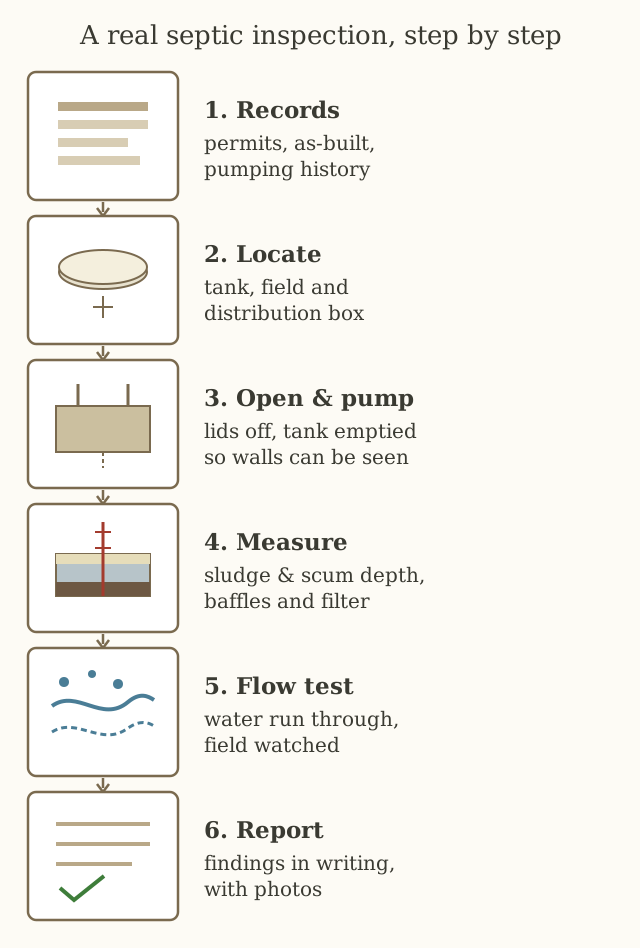
Buying a House With a Septic System? The Inspection That Can Save You $20,000
A standard home inspection barely touches the septic system. Here's what a real septic inspection includes, what it costs, the records to demand, and the contract wording that protects you.
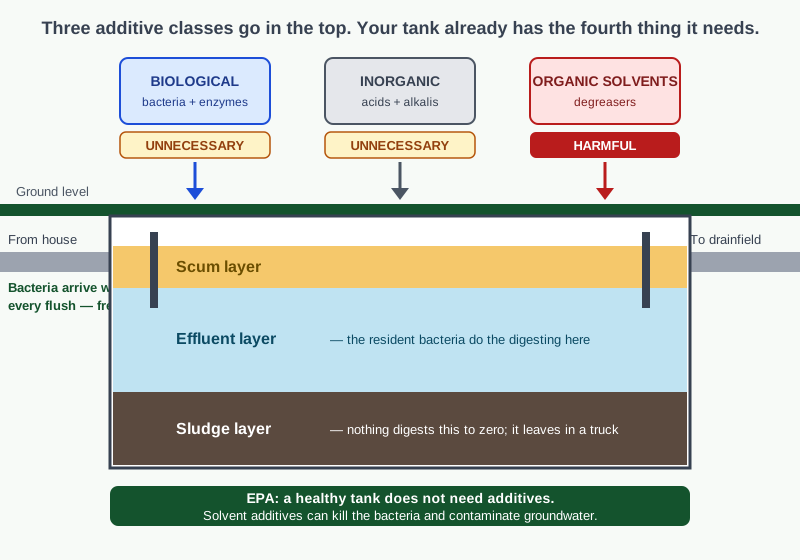
Do Septic Tank Additives Work? What the EPA and the Studies Actually Found
The EPA does not recommend septic additives, a 48-tank double-blind study found no measurable benefit, and one additive class is actively harmful. The evidence, the money maths, and the one narrow exception.
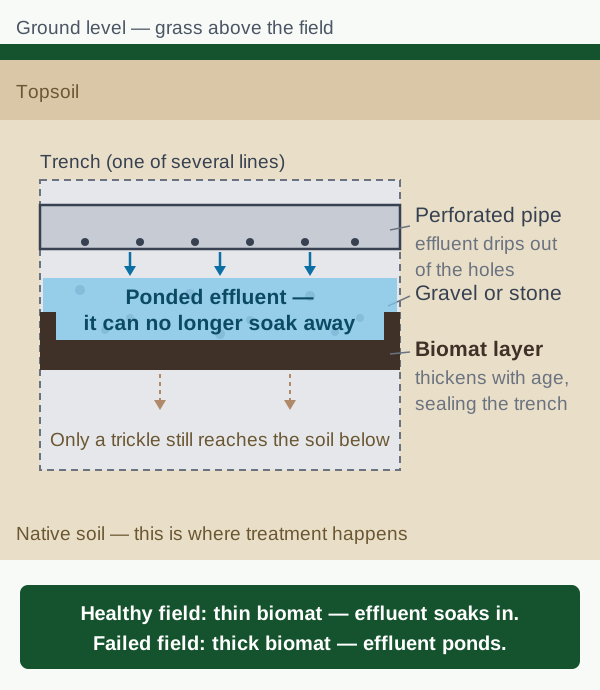
Drain Field Failure Signs: Soggy Ground, Green Stripes and Surfacing Effluent
A failing drain field announces itself in the yard first: lush green stripes, spongy ground, odors, then standing water. The early vs late signs, the look-alikes that aren't failure, a homeowner diagnosis sequence, and what repair or replacement really costs.