 Keep
Seasonal Home Maintenance Calendar: Spring, Summer, Fall, Winter
 Daniel Mercer · Editor & Researcher·
Published November 16, 2026·
Updated November 16, 2026
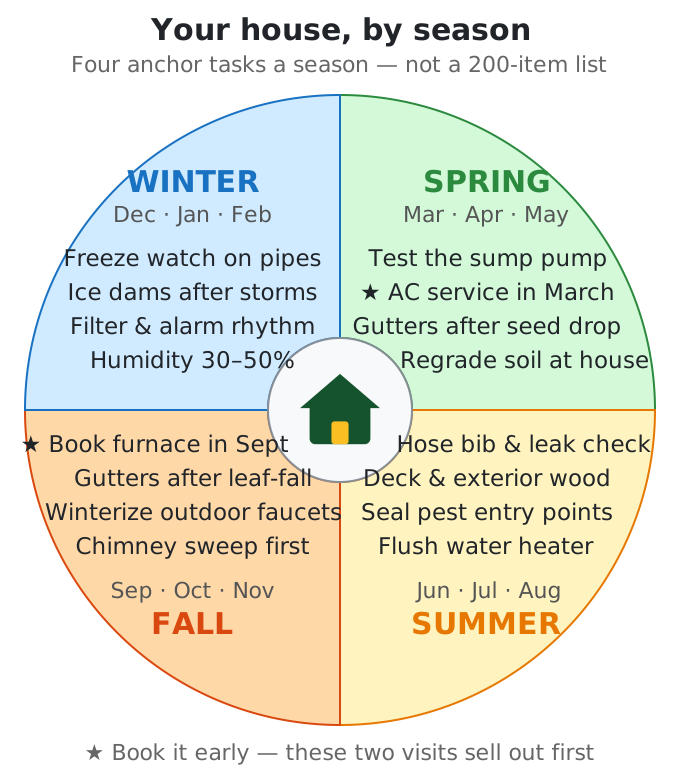
A house does not wear out evenly across the year. It fails in seasons. The air conditioner quits on the first hot Saturday in June, not in April when a tune-up was cheap and the diary was empty. The outdoor faucet splits in the first hard freeze, silently, and announces itself in January. The gutter does its worst damage in the two weeks when the leaves come down, and the sump pump chooses the heaviest rain of spring to reveal that it died quietly sometime in February. Almost every expensive home repair has a cheaper seasonal version of itself, scheduled a few months earlier.
That is the whole argument for a seasonal calendar. Not a 200-item master list that makes a new owner feel behind by March, but four short lists of anchor tasks, each tied to the season that punishes you for skipping it. Five tasks a season. Twenty across the year. If you do only those, on roughly the right dates, you will prevent the large majority of the failures that fill the rest of this site, and the monthly habits from our Monthly Home Maintenance Checklist: The 15-Minute Routine will carry everything in between.
This calendar is written for the whole country, not one state. Where a task only applies in some climates, it is flagged, and the climate key below tells you which version of each season is yours.
How to use this calendar: anchors, not homework
Each season below has four or five anchor tasks. An anchor is a job with a deadline built into the weather: it must happen in a specific window because the season after it is the one that collects the debt. Gutters after leaf-fall. The furnace serviced before the first cold night. The sump pump tested before the storms, not during them. Everything else a house wants, inspections, deep cleans, cosmetic work, can float to whenever you have a free weekend. Anchors cannot.
The climate key. Read the four lists through your climate's filter:
- Freeze belt (regular hard freezes, snow on the ground for weeks): run the calendar exactly as written. Your fall and winter lists are the longest in the country, and they are not optional.
- Mild climates (a freeze is news, snow is a rumour): delete pipe winterizing and the ice-dam watch. In exchange, your cooling season runs long, so the spring AC service matters more, filters load faster, and summer stretches from a season into half the year.
- Hurricane coast (Gulf and Atlantic storm exposure): keep the standard lists and add one late-summer block, detailed in the summer section, drainage, sump, trees and shutoffs, finished before storm season peaks rather than after a forecast names your county.
One more piece of equipment: a printable version of this calendar lives on our Maintenance Calendar page, alongside the first-year checklist. Print it, pin it inside a kitchen cabinet door, and write the two booking months, March and September, on it in marker. Those two phone calls are the highest-value items in this entire guide.
The year at a glance
For the fridge door, the whole calendar compressed. The sections that follow explain the why and the how; this is the when.
| Month | Anchor | Month | Anchor |
|---|---|---|---|
| January | Freeze watch; ice-dam watch after snow | July | Deck and exterior wood check |
| February | Humidity check; plan the March call | August | Hurricane-coast storm block; pest sealing |
| March | Book AC service; sump pump test | September | Book furnace service; weatherstripping |
| April | Well cap and septic walk after thaw | October | Chimney sweep; winterize faucets (late) |
| May | Gutters after seed drop; regrade soil | November | Gutters after leaf-fall; faucet check done |
| June | Hose-bib and irrigation leak hunt | December | Cold-snap routine ready; shutoffs known |
Spring: the reset, and the cheapest AC decision of the year
Spring maintenance is really two jobs: undo winter, and get ahead of summer.
Book the AC service in March. This is the single most mistimed task in home ownership. ENERGY STAR's guidance is a cooling check in spring, and most owners follow it in the way most people follow "spring": they call in May, or in the first June heatwave, when every HVAC company in the county is booked out a week and the visit has quietly become an emergency call at emergency prices. Call in March instead, when the same companies are in their slow shoulder season, and the tune-up costs the standard $75–$200, comes with a written report, and leaves time to replace a tired capacitor or a worn contactor before it fails under load. If your system is a heat pump, this visit matters twice: it has worked all winter and is about to work all summer.
Clean the gutters after the seed drop. Spring's debris is not leaves; it is the fine stuff, pollen tassels, maple helicopters, seed pods, blossom fall. It does not dam a gutter the way leaves do. It washes into the downspouts and packs their elbows, so a spring clean that skips the downspout flow test is half a job. Our guide How Often Should You Clean Your Gutters? The Schedule, the Signs You're Late, and What It Costs sets the full schedule by tree cover; the spring entry on it exists precisely because this debris is easy to miss and expensive to ignore.
Test the sump pump before storm season. A sump pump fails silently, in the dark, months before you need it. The test takes five minutes: lift the float or pour a bucket of water into the pit, watch it kick on, and confirm the discharge actually leaves the house and runs clear outside. A pump that hums but does not move water, or moves it slowly, is telling you its diagnosis early, while the basement is still dry. If the test fails, Sump Pump Not Working? Diagnose It by Sound, Then by Symptom walks the sound-by-sound diagnosis before you spend anything.
Walk the exterior as the ground thaws. Winter heaves and settles soil. Where earth has slumped against the foundation, spring rain will pond against the wall instead of shedding away from it, so regrade any low spots now, while the ground is soft and the fix is a wheelbarrow of soil. Clear the winter's wash-down of salt, grit and leaf sludge from walkways, the driveway apron and the garage floor, and check that downspout extensions survived the winter still attached and still pointing away from the house.
Septic and well homes: the spring checks nobody else lists. When the snow is gone, inspect the well cap. A cap cracked by frost or knocked loose is an open door for surface water, insects and debris straight into your drinking water, and spring melt is exactly when surface water is looking for a way in. Around the septic system, do the pre-thaw and early-thaw walk: look for pooling water, lush stripes or odour over the drain field while the ground is still saturated, because a field that struggles in spring's high water table is giving you a season's warning before it fails in front of guests. Both checks take ten minutes and appear on no state-specific rival calendar we have seen.
Turn the outdoor water back on, slowly. The mirror image of fall's winterizing belongs here. When you reopen the interior valves feeding outdoor faucets, do it with someone watching the interior wall behind each faucet, or check the wall and floor yourself immediately after. A faucet that froze and split during winter often leaks only while it is running, spraying water inside the wall cavity where nobody sees it until the damage is done. A dry wall after a minute of full flow means the pipe survived; a damp one means spring has handed you its first repair, cheap now, structural later.
Summer: water, wood, and the season of small leaks
Summer is the lightest season on the calendar, and the one where an hour of looking beats a weekend of repairing. Heat and water do the damage now, slowly and visibly, which makes summer the inspection season.
Hunt the hose-bib and irrigation leaks. The outdoor faucet that dripped in May is wasting real money by August, and a split irrigation line or a leaking bibb washer shows up first as a mysteriously green patch of lawn or a soft spot of soil that never dries. Walk every outdoor water point with the system running: hose bibbs, sprinkler heads, drip lines, the washing-machine supply hoses inside. Summer is also when the water heater works against the warmest incoming water and hides its problems, so glance at its base and its pressure-relief discharge pipe while you are in leak-hunting mode.
Check the deck and the exterior wood. Sun and rain take turns on horizontal wood. Look for boards that have gone soft at the ends, popped fasteners, railings that move when leaned on, and peeling paint on trim and window frames, because paint is not decoration on wood, it is the waterproofing. A scraper, a tube of filler and a paintbrush in July is a Saturday; rotted sill replacement in three years is a contractor and a four-figure invoice.
Seal the pest entry points. Ants, wasps and mice scout in summer and move in during fall. Caulk the gaps where pipes, cables and vents pass through walls, confirm screens are intact, check that the gap under exterior doors has a sweep, and look at the attic vents for chewed or missing mesh. You are not pest-proofing the house forever; you are closing the dozen obvious doors before the season when everything outside wants to live inside.
Give the attic ten minutes. On a hot afternoon the attic tells you the truth about your roof and your cooling bills. It should be hot, but not an oven noticeably worse than the day outside; a blast-furnace attic points at blocked soffit vents or a failed attic fan, and the heat radiates straight back into the rooms below. While you are there, look at the underside of the roof deck for the dark staining that means a slow leak has been running all spring, and check that bathroom fans actually vent out rather than into the attic space.
Clear the AC condensate drain. All summer, your air conditioner wrings gallons of water out of the indoor air, and all of it leaves through one small drain line that grows algae beautifully in the warm dark. When it clogs, the water goes where water goes: into the drain pan, then over it, into ceilings, walls and the air handler itself. A cup of water chased with a little vinegar through the drain's access point a couple of times a summer, and a check that the line drips freely outside while the system runs, prevents one of the most common and most pointless water-damage calls of the season.
Flush the water heater's sediment, hard-water homes especially. Sediment settles all year, but summer is the painless time to drain a few gallons from the tank's drain valve, or do the full flush, because the heater can be off for an hour without anyone's shower turning into an incident. In hard-water areas this is the difference between a tank that rumbles and pops its way to an early death and one that reaches its full life.
Hurricane coast: the late-summer block. Add four jobs before storm season peaks. Have dead or leaning limbs over the roof and lines assessed by a tree service while they can still schedule you. Confirm gutters, downspouts and yard drainage are clear, because a storm tests drainage at ten times normal load. Test the sump pump again, and any battery backup or generator, under load. And do the Ready.gov job: find and tag the water, gas and electric shutoffs now, in daylight, calmly, so that no one in the house is learning them from a phone torch in a storm.
Fall: the main event
Fall is the most important maintenance season of the year, and it is not close. Winter is when houses break; fall is when winter breakages are decided. Nearly every January emergency, the dead furnace, the burst pipe, the ice dam, the flooded basement corner, was a fall task that nobody did. Treat September to November as the season the whole calendar exists for.
Book the furnace service in September. Same logic as March, mirrored. ENERGY STAR calls for a heating check in fall; the owners who get the $75–$200 tune-up with a written report, combustion and carbon-monoxide testing, and time to fix what is found are the ones who called in September. Our Furnace Tune-Up Cost: What the Visit Should Actually Include (and What the Cheap Special Skips) lists what a real visit covers, so you can tell a proper tune-up from a coupon inspection. Heat pump owners: this visit is your system's second of the year, and the one that checks the defrost cycle and backup heat before they are load-bearing.
Clean the gutters after leaf-fall, not before. Timing is the whole game. A gutter cleaned in September is a gutter refilled by October. Wait until the trees are bare, then clean, and the system enters winter empty, which matters more than any other cleaning on the schedule: a gutter full of wet leaves in the first freeze holds water at the roof edge, feeds ice dams, splits seams with expanding ice, and pours meltwater at the foundation all winter. If your trees are heavy enough that one autumn clean cannot keep up, the mid-fall clean plus a final post-leaf-fall clean is the honest schedule, and it is still cheaper than the damage chain in How Often Should You Clean Your Gutters?
Winterize the outdoor faucets and hose bibbs. In the freeze belt this is the highest-value fifteen minutes of the year. Disconnect hoses (a hose left attached traps water in the pipe, frost-proof faucet or not), shut the interior valve feeding each outdoor faucet, open the outside tap to drain what remains, and drain or blow out irrigation lines. The pipe that bursts is almost never in the warm part of the house; it is the one in the exterior wall that someone meant to drain. If winter wins anyway, Frozen Pipes? Thaw Them Safely — and Catch the Split Before It Floods the House is the guide to have read before, not during.
Weatherstrip and seal, while you can still feel the drafts. On the first cool evening, walk the house with the back of your hand: window frames, door jambs, the attic hatch, outlets on exterior walls. Replace perished weatherstripping, re-caulk exterior gaps, and fit the attic hatch with insulation and a seal. This is the one fall task that pays you back monthly, on every heating bill from November to March, and it costs less than a single service call.
Check the attic insulation before the heating season, not during it. Heat rises, and in most houses the cheapest place it escapes is straight up. While the attic is still tolerable to be in, confirm the insulation lies even and undisturbed (raked flat by stored boxes and old repairs is common), that it has not been pulled back from the eaves where it also needs to leave the soffit vents breathing room, and that the hatch or pull-down stair, usually a bare sheet of plywood leaking warm air all winter, gets a layer of rigid foam and a proper seal. An hour in October's mild attic buys lower bills all winter; the same job in January's attic buys only regret.
Sweep the chimney before the first fire. If you burn wood, creosote has been building since last season, and the first cold-night fire of the year is the wrong time to discover how much. A fall sweep and Level 1 inspection ($150–$300) clears the flue and puts eyes on the cap, crown and flashing before the roof gets icy. Gas fireplaces need less, but an annual look at the venting and the pilot assembly belongs on the same appointment rhythm.
Winter: watch, don't fix
Winter is not a working season; it is a watching season. The fall work is done or it is too late, the ground is frozen, and the owner's job shrinks to four habits that catch problems while they are still small.
Run a freeze watch during cold snaps. When temperatures plunge well below freezing, switch to the cold routine: keep the thermostat at a steady temperature overnight instead of setting it back, open the cabinet doors under sinks on exterior walls so warm room air reaches the pipes, and let a vulnerable faucet drip slowly, a pencil-thin stream is enough to keep water moving. If you travel in winter, the house needs heat, a shutoff plan, and a neighbour with a key; more pipes burst in empty, cold houses than in occupied ones. Know your main water shutoff's location cold, before the night you need it.
Watch the roof edge for ice dams. After heavy snow followed by cold, look for the thick ridge of ice at the eaves and icicles that keep growing in the same spots. An ice dam means heat is escaping from the house into the attic and melting the snowpack unevenly, and the water pooling behind the dam can back up under shingles and into the walls. Our guide Ice Dams: How to Remove One Safely, What Removal Costs, and How to Stop the Next One covers safe removal and the air-sealing fix that prevents the next one; the winter job is simply to notice early, while the leak is still a stain and not a ceiling.
Hold indoor humidity in the 30–50% band. Too dry, and wood shrinks, floors gap and throats suffer. Too wet, and the moisture condenses on cold windows and inside wall cavities, quietly feeding mould. In most heated homes the winter problem is excess: steamed-up windows every morning mean the house is holding more moisture than the cold surfaces can handle. Run the bathroom fan longer, use the range hood, and resist the urge to run a humidifier against fogged glass.
Keep the monthly rhythm. Winter is when the monthly routine earns its keep: the filter check (a heating system running long hours loads a filter faster than at any other time of year), the alarm tests the U.S. Fire Administration wants done monthly, the under-sink look for the slow drip that freeze-thaw cycles start. Monthly Home Maintenance Checklist: The 15-Minute Routine is the drill; winter is simply when skipping it costs the most.
Give the heating system a mid-winter once-over, and take CO seriously. Sometime in January, stand in front of the furnace or boiler for two minutes while it runs. It should sound the way it sounded in October; new rattles, booms at ignition, or a burner flame that has gone lazy and yellow instead of steady blue are the system asking for a visit on your schedule rather than its own. Confirm the vents and returns are not buried behind holiday furniture and storage, because a starved system runs longer and hotter. And because winter is when fuel-burning appliances run hardest and houses are sealed tightest, test the carbon-monoxide alarms with the smoke alarms, and check their dates: CO alarms have a service life too, typically five to ten years, and an expired one is a decoration, not a detector.
The booking layer: the calendar behind the calendar
Here is the layer most seasonal lists never mention. Half the value of this calendar is not the tasks; it is when you make two phone calls.
HVAC companies, chimney sweeps, septic pumpers and gutter crews all live on the same seasonal tide you do. In March and September they are quiet, answering on the second ring, offering appointments this week at standard rates. Six weeks later they are booked out, triaging emergencies, and charging what a desperate market will bear. The March AC call and the September furnace call are worth making a month early for three concrete reasons: you get the standard $75–$200 tune-up price instead of a peak or after-hours rate; if the tech finds a failing part, there is time to order it and fit the repair around your life instead of your emergency; and you choose the company instead of taking whoever can come.
Put both calls in your phone as recurring reminders today, one in the first week of March, one in the first week of September, and add two more if they apply: the chimney sweep in early fall, before the first-fire rush, and the septic pumping in whichever year it falls due, booked in spring or summer when pumpers can schedule around the weather. Waiting has a price, and it is always quoted in the other direction.
A note on maintenance plans. Many HVAC companies will offer to solve the booking problem for you: a yearly plan, typically a few hundred dollars, covering both tune-ups and promising priority scheduling. Run the arithmetic against this calendar's own numbers. Two standalone tune-ups cost $150–$400 bought separately, so a plan priced in that band is roughly a wash on the visits themselves, and what you are really buying is the priority line in a heatwave and the fact that the appointments happen without you remembering. For a first-time owner still building the habit, that can be money well spent. A plan priced well above the two visits, loaded with inspections of systems you do not own and discounts on repairs you may never need, is a subscription wearing a calendar's clothes.
Septic and well: the year-round systems on a seasonal clock
Two systems ignore the calendar on the surface and obey it underneath. The septic tank takes waste every day of the year, but its clock is the pumping interval: most homes land on every three to five years depending on tank size and household, and How Often Should You Pump Your Septic Tank? (By Tank Size & Household) works out your number. Put the due year on this calendar the day you move in, because the bill ($300–$600 for a typical 1,000-gallon tank) is painless when it is budgeted at roughly $100–$150 a year and miserable when it arrives as a surprise alongside a drain-field symptom.
Seasonally, septic and well systems feel the water table. In spring, saturated ground and snowmelt stress the drain field (the pre-thaw walk in the spring list) and threaten the well cap. In summer, heavy irrigation and guests raise water use, which is when marginal systems show strain. In fall, get the pumping done before the ground freezes if it is due; a pumper working on frozen ground in January is a pumper you will pay extra. And once a year, in whichever season you will actually do it, test the well water: the annual bacteria-and-nitrate rhythm in How to Test Your Well Water: What to Test, How Often, and What It Costs is the cheapest health insurance a well owner can buy.
What the year costs, honestly
The pro visits on this calendar, the ones in the cost table with this guide, add up to roughly $400–$900 a year for a typical home: two HVAC tune-ups, two gutter cleanings if you hire them out, a chimney sweep if you burn wood, plus the septic sinking fund if you have a tank. The DIY consumables, filters, alarm batteries, weatherstripping, caulk, hose washers, add perhaps $100–$200. That is the whole bill for the calendar.
Set it against the alternative column. One burst pipe with water damage, one furnace replacement hurried through in a January cold snap at emergency availability, one season of clogged gutters quietly trenching water against the foundation: any single one costs more than a decade of calendars. Maintenance spending feels optional precisely because it works, nothing dramatic happens. Nothing dramatic happening is the product you are buying.
DIY or pro, season by season
The pattern repeats every season: the looking is yours, the licensed work is not. Spring's sump test, gutter check and regrading are owner jobs; the AC tune-up involves refrigerant, electrical and combustion-adjacent checks that belong to a tech. Summer is almost entirely DIY, inspections, sealing, flushing, except tree work anywhere near lines or roof height. Fall splits down the middle: weatherstripping, caulking and faucet winterizing are yours; the furnace's combustion and carbon-monoxide testing and the chimney's interior belong to pros with instruments. Winter is all owner: watching, dripping, noticing. And at any season, the standing rules apply: two-storey ladder work, anything on the roof surface itself, gas appliances beyond looking, and anything behind an electrical panel cover are professional territory, not because you lack the courage but because the failure modes are unforgiving.
Keep the calendar small, keep the two booking calls sacred, and let each season's five tasks be the whole job. A house does not ask for much. It asks for the right small things, slightly before they are needed, four times a year, and in exchange it mostly leaves you alone.
Cost at a glance
| Item | Typical cost | Notes |
|---|---|---|
| AC tune-up (spring visit) | $75–$200 | Book in March for the full inspection-and-cleaning visit at shoulder-season prices, not the July emergency rate |
| Furnace tune-up (fall visit) | $75–$200 | Book in September; the same visit in the first cold snap comes with a waiting list. See our furnace tune-up cost guide for what the visit should include |
| Gutter cleaning (per visit, twice a year) | $120–$235 | 2026 national range, average job about $170. One-storey DIY is free; two-storey ladder work is the case for paying |
| Chimney sweep (fall, if you burn wood) | $150–$300 | Level 1 sweep and inspection; creosote-heavy flues and Level 2 camera inspections cost more |
| Septic tank pumping (every 3–5 years) | $300–$600 | For the common 1,000-gallon tank, national average about $430 — budgeted yearly, that is roughly $100–$150 a year |
Frequently asked questions
What home maintenance should be done each season?
Four or five anchor tasks per season cover almost everything that actually fails. Spring: AC tune-up (booked in March), gutters after the seed drop, a sump pump test, and a post-thaw check of the well cap, septic area and grading. Summer: hose-bib and irrigation leak checks, deck and exterior wood, pest entry sealing, attic heat and ventilation, and a water-heater sediment flush in hard-water homes. Fall: furnace service (booked in September), gutters after leaf-fall, winterizing outdoor faucets, weatherstripping, and a chimney sweep if you burn wood. Winter: freeze watch during cold snaps, ice-dam watch after snow, indoor humidity control, and the monthly filter and alarm checks. Everything else on the internet's 200-item lists is either monthly (filters, alarms) or annual-but-flexible — the seasonal anchors are the ones with a deadline built in.
What is on a spring home maintenance checklist?
Spring is the reset after winter. Book the AC tune-up in March, before the first hot week fills every HVAC diary in town. Clean the gutters once the trees finish dropping seeds, pollen and blossoms — that fine debris washes into downspouts and packs their elbows. Test the sump pump by pouring a bucket of water into the pit before storm season, and confirm the discharge line runs clear. Walk the exterior: regrade any soil that settled against the foundation over winter so meltwater and spring rain shed away from the house. On well and septic homes, inspect the well cap once the snow is gone (a cracked cap is an open door for surface water and insects) and give the septic area a pre-thaw look for pooling or odour. Finish with the monthly basics: filter check and alarm tests.
Why is fall the most important maintenance season?
Because fall is the last exit before the two most expensive seasons. Almost every winter failure is a fall task left undone: the furnace that quits on the first cold night was the tune-up nobody booked in September; the burst pipe was the outdoor faucet nobody drained in October; the ice dam feeds on the gutter nobody cleaned after leaf-fall. Fall is also when heating costs are decided — weatherstripping and sealing gaps in October pay back on every heating bill from November to March. No other season concentrates so many deadline-driven jobs into so few weeks, which is why the calendar treats fall as the main event and spring as its rehearsal.
When should you book AC and furnace service?
A month before you need them: AC service in March, furnace service in September. ENERGY STAR's own guidance is a cooling check in spring and a heating check in fall — the trick is doing it at the front of those seasons, not the middle. In March and September, HVAC companies are in their shoulder season: appointments are easy, prices are the standard $75–$200 tune-up rate, and if the tech finds a dying part there is time to order it. Call in the first heatwave or the first cold snap instead and you join a queue measured in days, pay peak or emergency rates, and compete with every other house on the street that waited. Put both booking calls on the calendar as recurring March and September reminders.
What winter home maintenance prevents frozen pipes?
Prevention is mostly fall work — insulating exposed pipes in unheated spaces and draining outdoor faucets before the first hard freeze — but winter has its own watch list. During cold snaps: keep the thermostat at a steady temperature day and night, open the cabinet doors under sinks on exterior walls so room air reaches the pipes, and let a vulnerable faucet drip slowly when temperatures plunge well below freezing. Know where your main shutoff is before you need it at 2 a.m. After snowstorms, watch the roof edge for ice dams, which signal heat escaping into the attic. If a pipe does freeze, our guide 'Frozen Pipes? Thaw Them Safely' covers the safe thawing order and how to catch a split before it floods the house.
How do I make a seasonal maintenance calendar for my climate?
Start with the four anchor lists, then apply your climate key. Freeze-belt homes (regular hard freezes, snow load) run the full calendar as written, with the heaviest fall and winter lists. Mild-climate homes (rarely or never freezing) can delete pipe winterizing and ice-dam watch, but their cooling season is longer — the AC tune-up matters more, filters load faster, and summer stretches. Hurricane-coast homes keep the standard spring and fall lists and add a late-summer block: tree limbs near the roof and lines assessed, gutters and drainage confirmed clear before storm season, the sump pump and any backup power tested, and shutoffs located and tagged — Ready.gov's guidance — before a storm is forecast, not during one. Desert homes swap freeze tasks for heat ones: attic ventilation, AC shading and dust-loaded filters move up the list.
How much does a year of seasonal home maintenance cost?
For the bookable pro visits, budget roughly $400–$900 a year for a typical home: an AC tune-up ($75–$200), a furnace tune-up ($75–$200), two gutter cleanings if you hire them out ($120–$235 each), and a chimney sweep ($150–$300) if you burn wood. Septic homes should set aside about $100–$150 a year toward the $300–$600 pumping bill that lands every three to five years. DIY the gutter cleaning and the year's consumables (filters, batteries, weatherstripping, hose washers) run perhaps $100–$200 more. Set against the failures the calendar prevents — a burst pipe, a furnace replacement hurried in January, foundation water from a year of clogged gutters — it is the cheapest line in the home budget.
Checked November 16, 2026. This guide is general information, not a substitute for a licensed professional.
Related guides
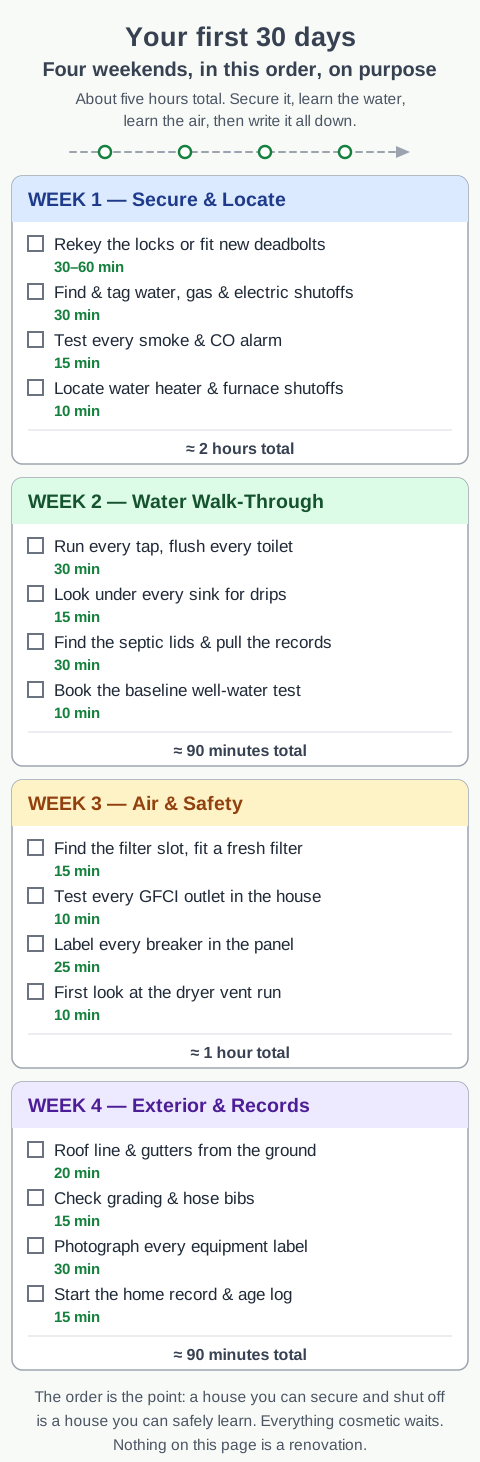
First-Time Homeowner Maintenance Checklist: The First 30 Days
The first 30 days in a new house, in the right order: rekey and locate your shutoffs in week 1, walk the water in week 2, learn the air in week 3, and build your home record in week 4 — with the time and cost of every task, and the list of what can safely wait 90 days.
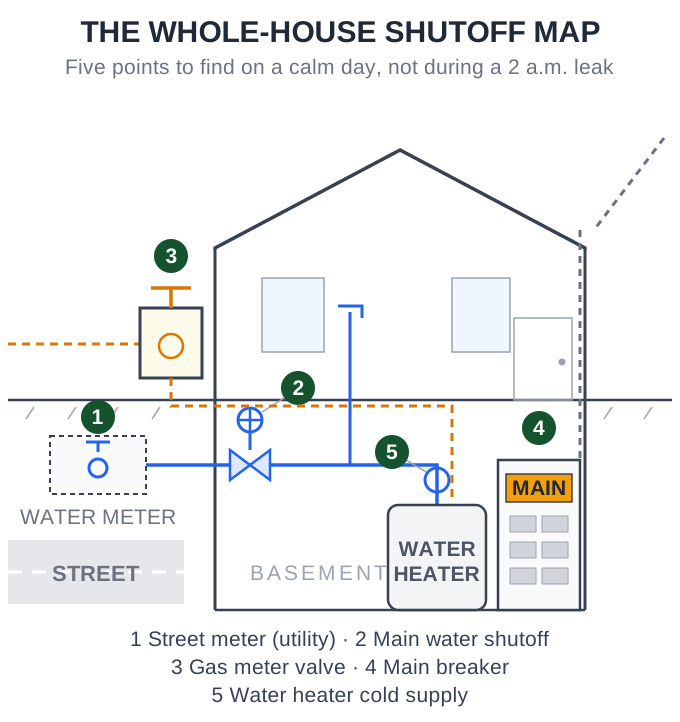
Find It Before You Need It: Your Main Water Shutoff, Gas Shutoff & Electrical Panel
Every house has five shutoffs that matter in an emergency: the street meter valve, your interior main, the gas meter valve, the main breaker and the water heater supply. How to find each one, test it, tag it, and fix the one that fails, before the 2 a.m. leak.
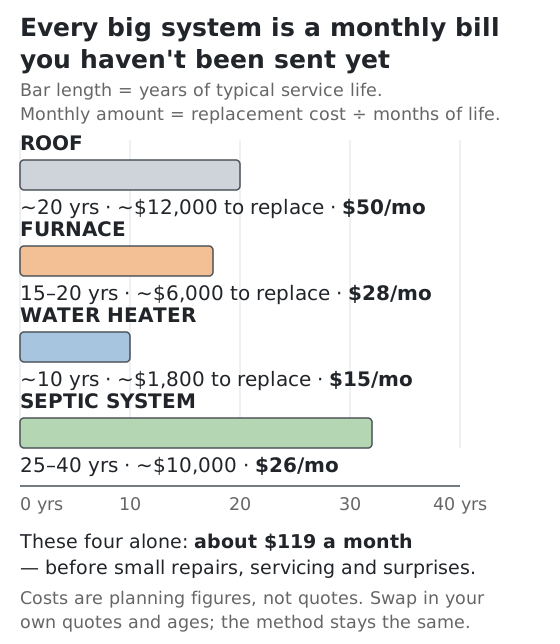
How Much to Budget for Home Maintenance in Year 1: The 1% Rule, Tested
The 1% rule says budget 1% of your home's value a year for maintenance. Here's where it works, where it breaks, what Fannie Mae actually recommends (1–4% by age), and the sinking-fund worksheet that replaces the guess with your own systems' numbers.