 Keep
Sand and Sediment in Your Well Water: Read the Grit, Find the Cause
 Daniel Mercer · Editor & Researcher·
Published November 16, 2026·
Updated November 16, 2026
Sand almost never announces itself at the kitchen tap first. It announces itself in the places where water slows down and sits. You lift the lid of a toilet tank to jiggle a flapper chain and find the bottom dusted with grit, like the inside of a beach bucket. The little mesh aerator on the bathroom faucet, which unscrewed clean last year, now plugs with grains every few weeks. The sediment filter cartridge you fitted in spring, rated for six months, is packed solid and rusty-looking by the second month. Somewhere along the line you fill a glass, hold it to the light, and watch grains spiral down and settle on the bottom.
If this house is your first on a private well, the discovery usually lands with a small jolt of dread: the well is making dirt. It helps to know two things at the outset. First, sand and silt are not a health problem — Wisconsin's Department of Natural Resources, which publishes symptom-by-symptom guidance for well owners, classifies sandy or gritty water as a nuisance with no health concern of its own. Second, it is not a problem to wave away either, because sand is information. Every well has sediment at the bottom; a healthy well keeps it there. When grit starts travelling up the pipe and into your toilet tank, the well is telling you that something down the hole has changed — and when it changed, and how the grit behaves, will tell you what.
The most important word in that last sentence is changed. Owners search for this problem when sand appears in a well that ran clean for years, and that change is precisely what makes the problem diagnosable. A well does not start pumping sand for no reason. It starts because a screen wore through, or clogged, or the pump began pulling harder, or the water table fell. This guide works the way a good well contractor works: prove what is in the glass, read the pattern of when it shows up, match the pattern to the cause, and only then talk about fixes — because the fixes range from a $150 filter to a $4,500 liner, and the pattern is what separates them.
First, prove it is sediment: the glass test
Before any diagnosis, confirm that what you are seeing is actually sand and not something else wearing a disguise. Three different things make well water look dirty in a glass, and they behave in three different ways when the glass sits still.
Fill a clean, clear glass from a cold tap — the bathtub tap works even better, because its high flow and lack of an aerator give you an honest sample — and set it on the counter. Then watch.
Sediment settles and stays. Grains of sand drop within seconds. Finer silt drifts down over minutes and forms a distinct layer or a dusty film on the bottom of the glass. An hour later the water above the layer is clear, and the layer is still there, undisturbed, when you pick the glass up. This is the signature of solid particles: sand, silt, or rust flakes.
Dissolved air clears from the bottom up, and vanishes. If the glass looks milky or cloudy but the cloudiness rises and disappears — clearing at the bottom first, with no layer left behind — that is not dirt at all. It is dissolved gas coming out of solution as the pressure drops at the tap, millions of microscopic bubbles working their way up and out. North Dakota State University Extension uses exactly this distinction: milky water that clears bottom-up is air, and air needs no filter. Owners regularly buy sediment filters for a gas problem; the glass test is what saves you from joining them.
Colour that never settles is neither. Water that stays tea-coloured or yellow in a glass overnight holds dissolved material — tannins, dissolved iron — not particles. That is a different problem with a different family of fixes, and no sediment filter will touch it.
One more refinement while the glass sits: look at what settled. Clean, pale grains that look like beach sand point at the formation around the well screen. Dark grit suggests mineral scale or manganese. Orange and rusty particles are often iron sediment or flakes of rust from inside the plumbing rather than fresh sand from the well — a useful distinction, because rust from your own pipes is a plumbing story, not a well story. Wisconsin DNR's version of this test asks the same question in the same way: fill a glass or the bathtub, let the water sit for a while, and see whether sand drops to the bottom. Simple as it is, this five-minute test is the fork in the road for everything that follows.
The pattern is the diagnosis
Here is the part most guides skip, and it is the most useful thing in this one. Two wells can produce identical grit in a glass and need completely different repairs, because the cause is written in when the grit appears, not in the grit itself. Before you call anyone, spend a few days being a detective. Check the toilet tank. Note whether the morning's first water is worse than the evening's. Watch a filter cartridge's first week. Then match what you saw to this table.
| When the grit appears | What it usually means | The fix that matches |
|---|---|---|
| A burst in the first seconds of a pump cycle, then the water runs clear | Loose sediment near the bottom of the well is stirred up at each start; the pump may sit a little close to it, or the well was never fully developed | A filter at the house, monitoring, and raising the pump if the burst grows |
| Constantly — every draw, all day, getting slowly worse | The well screen is worn, torn or corroded through, or so clogged that water jets through the remaining slots and carries sand with it | Driller work: redevelopment, a new screen, or a liner |
| Only in dry spells, or at the end of long, heavy water use | The water table has fallen and the pump is drawing the well down, pulling harder on the formation and dragging fines in | Spread out water use, flow control, and a driller's check of pump depth and well yield |
| Only for a week or two after the pump was serviced or replaced | Sediment disturbed by the work itself is being flushed out | Patience — it should fade day by day; call back only if it does not |
| In a brand-new well, from day one | The well was not fully developed after drilling — fine material near the screen was never cleaned out | Run the water for a couple of days; if it persists, the driller returns and develops it properly |
Read the table honestly against your own notes, because each row is a different bill. The first row is a filter and a watchful eye. The second row is a well rig in your yard. Owners who skip the pattern step tend to buy the second row's repair for the first row's problem — or worse, fit a filter for the second row's problem and let a failing screen keep failing behind it.
Two more observations sharpen the reading. Grit that appears at every tap is coming from the well or the pressure tank; grit at only one tap is usually local — a dying aerator, a section of old pipe shedding scale, or sediment that settled in a little-used branch. And grit that arrives with a change in the pump's behaviour — longer runs, weaker pressure, the pump cycling oddly — suggests the sand is already doing damage, which moves the whole question up a gear.
Cause 1: The pump sits too low
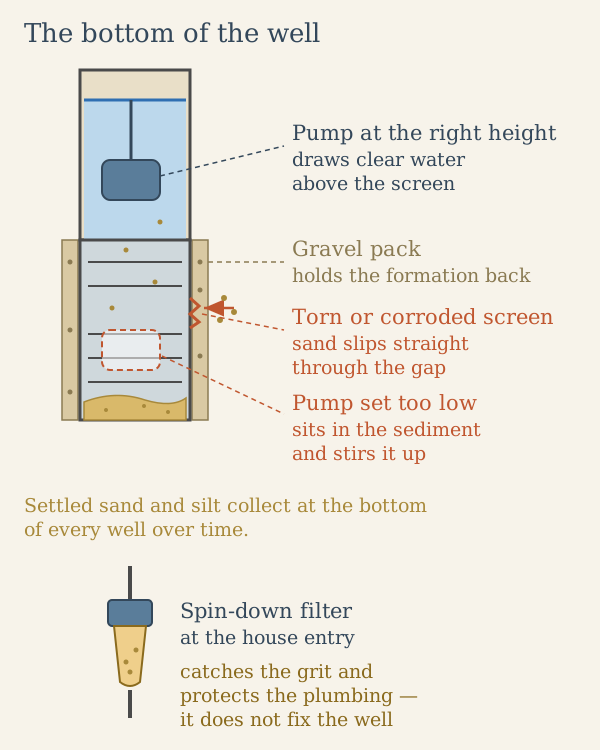
A submersible pump is meant to hang in open water, well above the screen and far above the sediment that collects on the bottom of the borehole. Sediment always collects — a well is a hole in rock and soil, and fine material slowly accumulates below the screen over the years. As long as the pump draws from clear water above it, that pile is harmless.
Problems start when the pump ends up too close to the pile. Sometimes it was set low from the day it was installed, by a driller working to a shallow well's limits. Sometimes the pile itself has grown up toward the pump over a decade. And sometimes a falling water table lowers the water column so the pump's intake works nearer the bottom than it used to. However it happens, the physics is the same: the intake's suction stirs the sediment, and each start of the pump lifts a dose of grit into the drop pipe. This is the classic mechanism behind the burst-at-start pattern, and behind grit that worsens in dry weather.
The fix is mechanical and, by well standards, straightforward: a driller pulls the pump, shortens the drop pipe, and resets the pump higher in the water column, clear of both the screen and the sediment. It only works when the well has room — enough water column above the screen to spare. Expect $600–$1,800, most of it the labour and equipment of pulling and resetting the pump rather than parts.
Cause 2: The screen is worn, torn, or clogged
The well screen is the gatekeeper of the whole system: a slotted or wire-wrapped section at the bottom of the casing, sized so water passes and formation sand does not, usually backed by a gravel pack that filters the water before it even reaches the slots. When the gate fails, sand walks through it. It fails in three distinct ways.
Corrosion and wear. Screens live in groundwater for decades, and groundwater is chemistry at work. Aggressive water eats metal screens slowly until a slot widens or a wire gives way — and a single widened slot is enough, because sand follows the path of least resistance and then erodes the opening further. This failure produces the constant pattern: grit at every draw, slowly worsening over months.
A sloughing formation. Some wells are drilled into sandstone that slowly crumbles. Wisconsin DNR describes this directly: in a sandstone well, water pumped hard can scour the open borehole wall, and the formation sheds material into the well. The remedy there is often a liner — a solid sleeve set inside the well to seal off the crumbling section so water enters only through the proper screen.
Incrustation — the screen clogs, and the clog causes the sand. This one is counterintuitive and worth understanding, because it means a clogged screen and a torn screen produce the same symptom by opposite routes. As mineral deposits and iron bacteria narrow the screen's slots, the same volume of water must squeeze through fewer, smaller openings — so it moves faster. Fast water at the screen face has the energy to pick up fine sand and carry it through the slots that remain open. DNR guidance for older wells makes exactly this point: a screen blocked by deposits raises entrance velocities until the water itself erodes its way in, sand and all. The fix is redevelopment — the driller works the well with surge blocks, jetting or air-lift pumping to break up the deposits and pull the accumulated fines out of the gravel pack, restoring the screen's open area so water enters slowly again.
Cause 3: The well is being pumped too hard
Water is supposed to enter a well gently. Every well has a rate it can sustain — set by the aquifer, the screen and the gravel pack — and a pump that asks for more than that rate changes the physics at the screen face. Velocities rise, the water level inside the casing drops (drawdown), and fine material that would normally stay put in the formation gets dragged toward and through the screen.
This is why sand so often appears after a change in the house rather than a change in the well: a bigger pump fitted during a replacement, a new irrigation system, a second bathroom, a stock tank that was not there before. Wisconsin DNR's troubleshooting questions for sandy water ask about precisely this — whether silt and sand increased after a larger pump went in, or after a fixture that uses a lot of water was added. The well did not fail; the demand outgrew the truce between the pump and the formation.
The answers, in order of cost: spread the demand out so the pump is not asked for everything at once; fit flow control so the pump's output is throttled to what the well can give; or accept a driller's verdict that the pump is oversized for the well and downsize it. All three beat the alternative, which is letting an oversized pump slowly mine the formation and fill the well with its own walls.
Cause 4: The ground and the water table move
The last cause is the one nobody in the house did anything to deserve. Aquifers are not static. In a dry year the water table falls, and Massachusetts drought guidance for well owners — echoed by drillers everywhere — notes that a falling water table draws more silt and sand toward wells and leaves water cloudy or discoloured. The pump, set for the old water level, now works closer to the bottom of its column and pulls harder per gallon. The same drought pattern explains grit that appears every summer and vanishes every spring: the well is reporting the weather, a year underground.
Formations shift too. A nearby new well, blasting or heavy construction in the area, even an earthquake states away can disturb a formation enough to change what a well produces for a while. These causes share a signature — they arrive with an external event and often ease as conditions settle — and they are the reason a good driller asks about timing and neighbours before quoting for parts.
When sand is normal: the patience cases
Not every grain is a symptom, and calling a driller for the two normal cases wastes money that the real cases will need later. Both exceptions share one test: normal sand fades. It is worst at the start and measurably better each day. Sand that holds steady or worsens is not in either category.
A newly drilled well. Drilling leaves the borehole full of disturbed material, and a new well must be developed — pumped and surged by the driller to pull the fines out of the gravel pack and the formation face until the water runs clear. Wisconsin DNR's advice for sand in a new well is to let the water run for a couple of days and see whether it clears; development sometimes finishes itself in early use. If it does not clear, the driller is required to come back and develop the well properly — that is part of the job you already paid for, not a new repair.
The week or two after pump work. Pulling a pump stirs everything. The column of water is dragged up and down the casing, sediment that sat quietly for years is suspended, and the disturbed well then has to settle again. A burst of grit for days after a pump replacement — fading steadily — is the well tidying up after the disturbance. Fit a filter if you have one, flush the pressure tank once the worst passes, and only call the contractor back if the grit is as bad in week three as it was on day one.
In both cases the discipline is the same: write down the date it started and a rough daily score — a glass left to settle each morning makes a surprisingly good record — so that "it is getting better" is a measurement rather than a hope.
What ignoring it costs
Sand's damage is slow, cumulative and almost entirely mechanical, which is why it is so easy to under-rate. Nothing floods. Nothing stops. The water still runs. Meanwhile every component the gritty water touches is being machined, gently, by an abrasive it was never designed to meet. North Dakota State University Extension lists sand pumping as one of the main signs that a well needs maintenance — this table is what that maintenance is preventing.
| What the sand reaches | What it does there | What it eventually costs |
|---|---|---|
| The pump | Impellers lose their edges, seals wear, output falls while energy use rises | A pump's life cut from 15 years toward 5; replacement $1,500–$4,000+ |
| The pressure tank | Sediment settles and buries the outlet; the bladder chafes against grit | Tank replacement $350–$1,100, plus gritty water at every draw |
| The water heater | A growing sediment bed insulates the water from the burner or elements | Rumbling, wasted energy, early tank failure: $1,200–$2,400 fitted |
| Faucets, valves and appliances | Aerators clog, valve seats score and weep, washing machine and dishwasher inlet screens pack with grit | Death by a dozen small repairs, plus appliances replaced early |
Set against that table, the arithmetic of acting early is not close. A filter that protects the whole house costs less than the deposit building in the water heater. A driller's diagnosis while the screen is merely clogged costs a redevelopment; the same screen two years later, torn through by the velocities its own clog created, costs a liner. Sand is one of the few well problems that reliably gets more expensive the longer you watch it — which is an argument not for panic, but for putting a date on the watching.
The solution: catch the symptom, then cure the well
Every honest fix for sand in well water has two halves, and they are not interchangeable. The first half protects your house from the grit. The second half stops the well from making it. Guides that sell you only the first half are selling you a mop for a leaking roof — useful, even necessary, and not the repair.
Half one: protect the house
Fit filtration at the point where water enters the house, after the pressure tank, sized for sand rather than for taste.
- A spin-down filter comes first. It is a reusable screen — typically around 50 microns — in a clear bowl with a flush valve at the bottom. Sand hits the screen, spins down, collects in the bowl, and you purge it with a quarter-turn of the valve every week or two. No cartridges to buy, nothing to replace. For most sand problems this single device ends the grit in the toilet tank and the aerators. Fitted by a plumber, expect $150–$450; the unit itself is a fraction of that if you fit it yourself.
- A cartridge stage follows it, if you follow it with anything. A fine cartridge (5 microns is the common choice) polishes out silt the screen passes. Order matters: cartridge first would blind it in days; the spin-down takes the heavy load so the cartridge can do the fine work.
- A centrifugal separator is the heavy-duty option. For wells producing sand by the spoonful, a separator spins the water so grit is thrown outward and dropped to a purge chamber — no screen to clog at all. Fitted, $400–$900.
What this half buys you is time and protection: the pump still pumps sand, but your water heater, pressure tank outlet, faucets and appliances stop eating it. What it does not buy is a fixed well, and the distinction matters, because the second half is where the money is saved.
Half two: fix the well
Match the cure to the cause your pattern pointed to.
- Pump too low → raise the pump. The driller pulls the pump on a hoist, shortens the drop pipe, and resets the pump higher in the water column. Half a day's work in most wells; $600–$1,800.
- Screen clogged → redevelop the well. The driller surges, jets or air-lifts the well to break up incrustation and draw the fines out of the gravel pack, restoring slow, even entry through the whole screen. $1,200–$3,500.
- Screen torn, or formation sloughing → new screen or a liner. A liner seals the failing section so water enters only through sound screen; a screen replacement swaps the failed part outright. This is the big job: $1,500–$4,500, and in many states it must be done by a licensed driller — Wisconsin's guidance, for example, is explicit that well screens and liners are licensed work.
- Overpumping → control the flow. A flow restrictor or a properly sized pump brings demand back inside what the well can give. The cheapest cure on this list, and sometimes the only one needed.
What the professional actually does, and how long it takes. A good driller's visit starts with diagnosis, not a quote: your pattern notes, a look at the toilet tank and filter, the well's age and construction from its log, and the pump's depth and history. For screen and sediment questions they may run the well and sample at intervals, or lower a camera — a downhole camera survey is often what turns "probably the screen" into a photograph of the tear. Pulling a pump is a hoist job of a few hours; redevelopment is typically a day; a liner or screen job one to two days. Water is off for hours at a time rather than days, and a driller working on a producing well will usually leave you with water each night.
What the quote must include. Get it in writing, and check for: the diagnosis and the evidence for it (camera footage if a screen failure is claimed); the exact scope — depths, liner or screen specification, pump reset depth; whether the well will be disinfected and the water tested after the work (standard practice after a well is opened, and it should be in the price); the permit and any state reporting, which is the driller's to file; and the warranty on both parts and labour. A quote that names a cure without naming the cause it is curing is a quote to get a second opinion on.
DIY or call a pro?
The dividing line is the well cap. Everything on the house side of it — the glass test, the pattern detective work, flushing a gritty pressure tank, fitting and maintaining a spin-down filter — is ordinary homeowner territory, and doing it yourself is how you arrive at the driller's visit already knowing your pattern, which saves real diagnostic money. Everything below the cap is pro work: the pump hangs on a pipe hundreds of feet down, the hoist is not a rental item, screens and liners are licensed work in many states, and a mistake down the hole is measured in thousands. The honest summary: diagnose it yourself, protect the house yourself, and pay a driller to cure the well.
Urgency, summarised
Sand in well water will not flood your house tonight, and it will not make anyone sick. Treat it as a maintenance clock that has started ticking, not an emergency and not a nothing. This week: run the glass test, check the toilet tank, and start your pattern notes. This month: fit a spin-down filter if grit is reaching the house, so the water heater and appliances stop paying for the delay. This season: if the pattern is constant, worsening, or arrived with the pump behaving differently, get a driller's diagnosis while the fix is still the cheap version. The wells that produce the horror stories are rarely the ones that failed suddenly — they are the ones that whispered for two years through a toilet tank nobody lifted the lid on.
Cost at a glance
| Item | Typical cost | Notes |
|---|---|---|
| Spin-down sediment filter, fitted | $150–$450 | Flushable screen (around 50 microns) installed after the pressure tank. Catches sand and protects the house; treats the symptom, not the well |
| Centrifugal sand separator, fitted | $400–$900 | For heavier sand loads that overwhelm a screen. Spins grit out to a purge valve; still a symptom-catcher, just a stronger one |
| Raising the pump in the well | $600–$1,800 | Pull the pump, shorten the drop pipe, reset it higher above the screen and sediment. Only works if there is room above the pump's current depth |
| Well redevelopment | $1,200–$3,500 | The driller surges, jets or air-lifts the well to clear a clogged screen and pull fine material out of the gravel pack |
| New well screen or a liner | $1,500–$4,500 | For a torn or corroded screen, or a sloughing sandstone formation. A liner seals off the bad section; a screen swap replaces it |
Frequently asked questions
Why is there sand in my well water all of a sudden?
Because something at the bottom of the well changed. The common triggers are a well screen that has finally corroded or torn through, a screen so clogged with mineral deposits that water now jets through the open slots fast enough to carry sand with it, a pump that is drawing the water level down further than it used to, or a dry spell lowering the water table so the pump pulls harder on the formation. A well that ran clean for ten years and starts gritting is not being mysterious — one of those four things happened, and the pattern of when the grit appears tells you which.
Is sand in well water harmful to drink?
Sand and silt themselves, no. Wisconsin DNR treats them as a nuisance problem with no health concern of their own — the grains are inert rock, not a contaminant. The damage sand does is mechanical, not medical: it wears the pump, clogs aerators and valve seats, fills the pressure tank and water heater with sediment, and shortens the life of everything the water touches. The one caution is that a torn screen or a failing well can also be a pathway for surface water, so if sand arrives together with cloudiness after rain or a change in taste or smell, a bacteria test is worth the small cost.
Will a sediment filter fix sand coming from my well?
It will fix the sand in your house. It will not fix the sand in your well. A spin-down filter after the pressure tank catches the grit before it reaches faucets, appliances and the water heater, and that protection is genuinely worth having. But the well goes on making sand, the pump goes on pumping it, and the wear down in the borehole continues. Fit the filter to protect the plumbing — then still get the well looked at, because every cause of new sand (a torn screen, a clogged screen, a pump set too low) gets worse and more expensive with time, not better.
What does grit in the toilet tank mean?
It means the sand is travelling the full length of your system and settling wherever the water slows down — and the toilet tank is the best early-warning gauge in the house, because it fills, sits still, and lets everything drop out where you can see it. Lift the lid: a clean tank bottom says the grit is fine, occasional, or being caught upstream. A tablespoon of sand says the well is producing steadily. A layer you could scoop says act soon. The toilet tank also dates the problem — grit only in the tank you never use, in a house where the main bathroom's tank is clean, points at sediment that sat in a little-used branch line rather than fresh sand from the well.
Can pumping sand damage my well pump?
Yes — this is the main cost of ignoring it. A submersible pump moves water through tight impeller passages, and sand turns that water into liquid sandpaper. Impellers lose their edges, seals wear and start to leak internally, the motor works harder for less water, and a pump that should have run fifteen years can be tired in five. Sand also settles in the pressure tank, where it buries the bladder outlet and adds grit to every draw, and in the water heater, where a growing sediment bed causes rumbling, wasted energy and early tank failure. North Dakota State University Extension lists sand pumping as one of the main signs a well needs maintenance — the pump is where that maintenance bill lands first.
Why is there grit only when the pump first starts, then it clears?
Because between cycles, fine sediment drifts and settles around the screen and the pump intake, and the first seconds of a start stir it up and carry it into the pipe. Once the well is flowing steadily, the water coming through the screen runs clearer — until the pump stops, the column settles, and the grit gathers again. That start-up burst pattern usually points at loose sediment near the bottom of the well, a pump set a little too close to it, or a well that was never fully developed. It is the mildest pattern there is, but it is still worth a filter at the house and a note of the date: if the burst gets longer or stops clearing, the cause has moved from 'sediment nearby' to 'screen failing'.
How much does it cost to fix sand in a well?
Protection at the house is the cheap end: a fitted spin-down filter runs $150–$450 and a centrifugal separator $400–$900. The cures at the well cost more because they all start with pulling equipment out of a hole. Raising a pump that sits too low runs $600–$1,800. Redeveloping a well to clear a clogged screen is $1,200–$3,500. Replacing a failed screen or fitting a liner is $1,500–$4,500. That spread is exactly why the diagnosis matters: the pattern of when your grit appears is what tells the driller which of those jobs you actually need.
Checked November 16, 2026. This guide is general information, not a substitute for a licensed professional.
Related guides
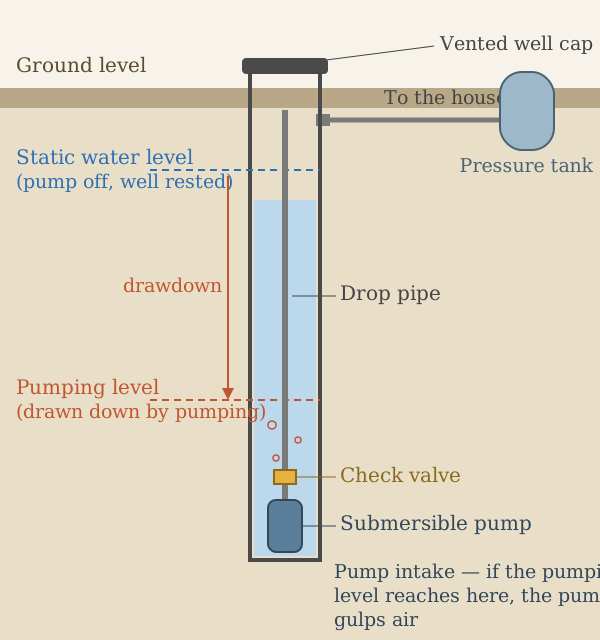
Air in Your Water Lines: Why Faucets Sputter on a Well
A sputtering faucet on well water is a symptom with a short list of causes — drawdown, a leaking check valve or drop pipe, a tired pressure tank, or dissolved gas. How the timing of the sputter tells you which one, the tests to run, and what each fix costs.
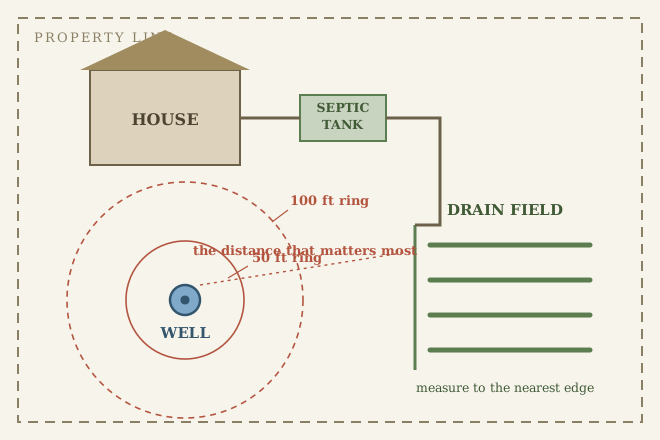
How Far Should a Well Be From a Septic Tank? Setbacks, Explained
Most states want 50 feet between a well and a septic tank and 100 feet to the drain field — but the field is the distance that actually protects your water. How to measure yours, and what to do if it comes up short.
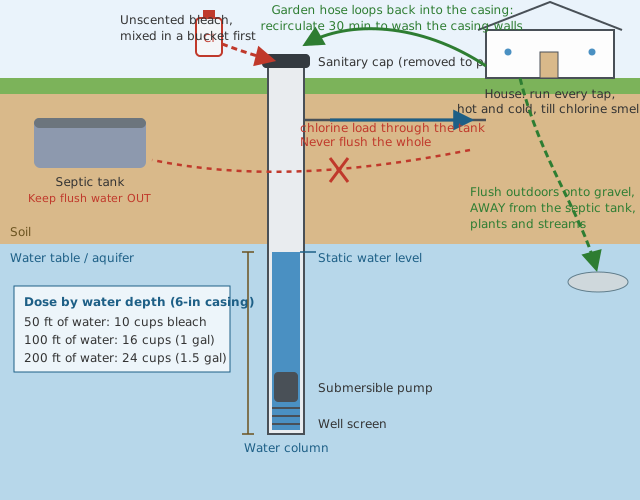
How to Shock Chlorinate a Well: Dose, Steps, and the Retest That Proves It Worked
The full shock chlorination procedure: work out your bleach dose from the well log, bypass the softener, recirculate, hold, flush without wrecking your septic, and retest at 10 to 14 days.