 Keep
Tankless Water Heater Not Hot Enough? It's a Capacity Problem — Temperature Rise, Explained With Your Own Numbers
 Daniel Mercer · Editor & Researcher·
Published November 16, 2026·
Updated November 16, 2026
The shower is warm. Not cold — you could not call it cold with a straight face — but warm in the way a cup of tea goes warm when you forgot it: disappointing, and nothing like the temperature you set. The unit is running. You can hear it fire, the display shows no error, hot water of a sort is clearly being made. It just never arrives hot. And it has tells: it is worse in January than it was in July, worse when your partner starts the second shower, worse again when the dishwasher is filling. Alone, on a mild evening, one shower can be almost fine.
That pattern — works, but cannot keep up — is the most misdiagnosed complaint in tankless ownership, because it feels like a fault and usually is not one. Owners book repair visits for it. Technicians who would rather sell than explain sometimes sell parts for it. But a unit that runs cleanly and produces warm water short of setpoint is, in the majority of cases, doing exactly what physics allows and no more. It is a capacity problem, and capacity is arithmetic, not mystery. This guide gives you the arithmetic: one idea (temperature rise), one worksheet you fill in with your own unit's numbers, and a four-way split that separates a genuinely undersized heater from the four fixable causes that imitate one.
First, make sure yours is this problem
Three neighbouring faults wear similar clothes, and each has its own guide on this site. If your unit produces nothing at all — cold water only, a dead or silent unit, or an error code that stops it lighting — that is the zero-output problem, covered in "No Hot Water From Your Tankless? The 10-Minute Triage Before You Call". If the water starts hot and the unit cuts out partway through a shower, that is a flow-threshold problem, covered in "Tankless Water Heater Keeps Shutting Off Mid-Shower? Test the Flow First". And if a single shower swings hot, cold, hot in bands, that is the cold water sandwich, a different behaviour again.
Your problem, the one this page owns, is narrower and stranger: the unit lights, runs steadily, shows no code, and delivers water that plateaus below the temperature you set — everywhere, or only under load, or only in winter, or only at one tap. Those four versions have different causes, which is why the symptom split below matters. But all four are explained by, or measured against, the same piece of physics. Learn that first and the rest of the page is just applying it.
Temperature rise: the one idea that explains everything
A tank water heater is a warehouse: it keeps 40 or 50 gallons hot around the clock, and when you draw, you spend inventory. A tankless is a kitchen that cooks to order. It owns no hot water at all — it owns a burner, and the burner has a fixed maximum rate at which it can pour heat into water passing through. Everything about your complaint lives inside that sentence.
Temperature rise — written ΔT, spoken "delta T" — is the size of the job you hand that burner. It is the setpoint minus the temperature of the water arriving from the ground:
ΔT = setpoint − incoming water temperature
Set the unit to 120°F on a day when the incoming water is 60°F and you are asking for a 60°F rise. Same house, same setting, in a northern January, when the incoming water may arrive at 40°F: now the job is an 80°F rise. The burner has not changed. The job grew by a third.
Here is the trade the burner makes, and it makes it instantly and without negotiation: the bigger the rise, the less water it can do it to. Heat is a budget spent per gallon. Lifting each gallon by 80 degrees costs a third more heat than lifting it by 60, so at full fire the unit can only push about three-quarters as many gallons per minute through the bigger lift. Ask for more flow than that and the unit does not refuse, stall or post a code — it compromises. It spreads the same total heat across all the water you are demanding, and every tap gets water that is warm instead of hot. That compromise, felt in a shower, is your entire symptom.
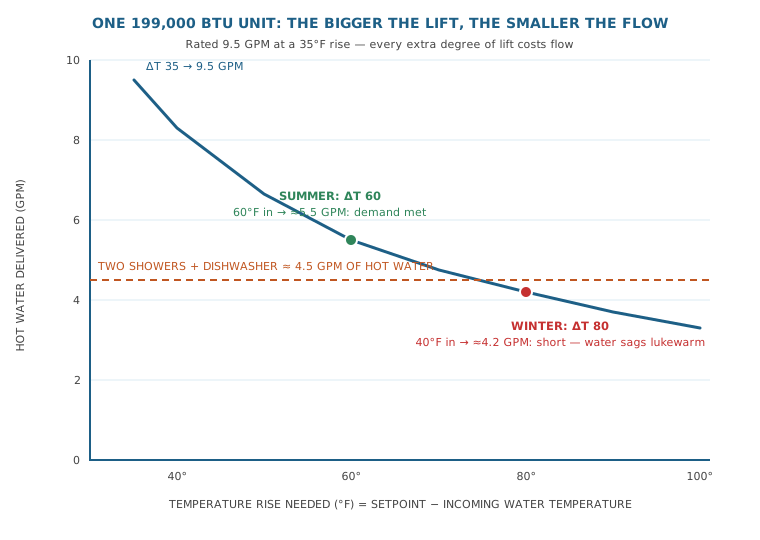
This is why the nameplate number misleads almost every owner who reads one. Tankless units are advertised and rated by flow at a stated rise, and the stated rise in the headline figure is a gentle one — commonly 35°F, a lift you would only need in a warm climate with a modest setpoint. A unit wearing a proud "9.5 GPM" badge earns that badge at a 35°F rise. At the 80°F rise of a cold-climate winter it is, by simple proportion, a 4.2 GPM unit. Neither number is a lie. They are the same machine at different jobs — and the second number, the one nobody prints on the box, is the one your January shower lives with.
Two consequences follow, and both show up in real houses. First, season is a capacity change. Groundwater temperature is not a detail: across the US it ranges from the high 30s and 40s in northern winters to the low 70s year-round in the deep South, and it swings through the year everywhere in between. A heater sized with summer margins can be a heater short of capacity all winter without anything breaking. Second, demand is counted in hot water, not tap water. A shower mixed to a comfortable 105°F from 120°F hot and 40°F cold is about four-fifths hot water; the same shower in summer, with 60°F cold, is three-quarters. Winter raises your requirement from both directions at once — the unit produces less while each fixture consumes more of what it produces. Hold that thought, because it is the whole worksheet.
The worksheet: your unit, your water, your busiest hour
You need four numbers. None requires opening the unit, and the whole exercise takes fifteen minutes with a thermometer, a bucket and a watch.
Number one: your unit's rated flow and its stated rise. Find the data plate on the unit (or search the model number's spec sheet) and look for the flow rating expressed with a temperature rise — phrasings include "9.5 GPM at 35°F rise" or a small table of flows at several rises. If the sheet gives a table, take the row nearest your winter rise and skip the maths in step three. If it gives one headline figure, that figure and its rise are your anchor. Write down both halves; the flow alone is meaningless.
Number two: your incoming water temperature. Run a cold tap — the one nearest where water enters the house, or the unit's own cold side if it has a test point — for a full minute, then read a kitchen or thermometer probe in the stream. Do it in the coldest month for the honest worst case, or use these planning figures: high 30s to high 40s for the northern tier in winter, 50s through the middle of the country, 60s to low 70s in the deep South, adding roughly 10–15°F to any of them for summer. This is the number most owners have never known about their own house, and it is half the answer.
Number three: your unit's real capacity. One line of arithmetic:
Your flow = rated flow × (rated rise ÷ your rise), where your rise = setpoint − incoming temperature.
Worked example, the one drawn in the chart: a 199,000 BTU unit rated 9.5 GPM at a 35°F rise, setpoint 120°F. In summer, incoming 60°F, your rise is 60: 9.5 × 35 ÷ 60 ≈ 5.5 GPM. In winter, incoming 40°F, your rise is 80: 9.5 × 35 ÷ 80 ≈ 4.2 GPM. Same unit, same house, a 1.3 GPM difference — roughly one whole shower's worth of hot water, appearing and disappearing with the seasons.
Number four: your busiest hour's demand, in hot water. List what genuinely runs together in your house — not everything plumbed, the realistic worst fifteen minutes. Use these draws: a modern showerhead flows 2.0 GPM (older and rainfall heads 2.5), a tub filler 4 GPM or more, a kitchen faucet about 1.5–2, a dishwasher 1–1.5 GPM while filling, a washing machine 2–3 while filling. Then convert each mixed fixture to its hot fraction with this shortcut:
Hot fraction = (shower temperature − cold temperature) ÷ (setpoint − cold temperature)
At 105°F showering, 120°F setpoint and 40°F winter cold, that is (105 − 40) ÷ (120 − 40) ≈ 0.8 — four-fifths of every shower gallon is hot water the unit must supply. Two winter showers at 2.0 GPM therefore draw about 3.2 GPM of hot; add a filling dishwasher at roughly 1.3 GPM of hot and the house is asking for 4.5 GPM against a 4.2 GPM capacity. Short by a third of a gallon a minute — and a third of a gallon a minute is exactly the difference between hot and lukewarm. In summer the same scene asks about 4.3 GPM (the hot fraction falls as the cold warms) against a 5.5 GPM capacity, and nobody complains. If your numbers land like these, you have your diagnosis, and it is not a repair: your heater is undersized for your house's winter worst hour, or your worst hour has outgrown the heater that was sized for a previous owner's life.
If, instead, your capacity clears demand by a comfortable margin and the water still will not reach setpoint, the shortfall is being lost somewhere — and that is a fault with a fix. The split is next.
Two adjustments before you trust your number
Altitude quietly shrinks a gas unit. Burners breathe air, and above a few thousand feet the air is thin enough that a gas appliance cannot burn at its sea-level rating. Manufacturers publish elevation limits and derates for exactly this reason — a common rule of thumb is roughly 4% of capacity lost per 1,000 feet above about 2,000 feet unless the unit has an altitude setting or kit fitted. A heater that worksheets out at 4.2 GPM on paper may be a 3.6 GPM heater at a 5,000-foot house in the mountains, with nothing whatsoever wrong with it. If your home sits high, find the elevation line in your model's manual and apply its derate to your worksheet result before you conclude anything — mountain owners are the one group for whom "the spec sheet says it should cope" is routinely, innocently false.
Electric tankless units obey the same law, harder. Nothing above depends on gas: an electric unit's elements are its fixed heat budget, and the rise-versus-flow trade is identical, usually with less total budget to trade with. Whole-house electric models that advertise high flows are quoting the same gentle-rise conditions, and in a cold-groundwater climate their winter numbers fall further and faster than a big gas unit's. If yours is electric, the worksheet matters more, not less — and the gas-line section below is the only part of this guide that does not apply to you.
The symptom split: four patterns, four cause families
"Lukewarm" is not one complaint. Before you touch a tool, pin down which of these four patterns is yours, because each one indicts a different suspect — and two of them are not the heater's fault at all.
| Your pattern | What it usually means | First move |
|---|---|---|
| Lukewarm everywhere, all the time — even one tap, run gently | Capacity the unit used to have has been lost: scale, gas starvation, or a failed mixing valve blending everything down | Thermometer test at the nearest tap, then the causes below |
| Lukewarm only when two or more fixtures run together | Plain demand-versus-capacity mismatch — the worksheet case | Your worksheet numbers; the fix is demand, or more heater |
| Lukewarm only in winter, fine all summer | Groundwater temperature grew the rise past the unit's margin | Worksheet with winter incoming temperature |
| Lukewarm at one fixture only, hot elsewhere | A local problem at that fixture: crossover in a single-handle valve, a point-of-use mixing valve, a restricted outlet | Fixture-level tests below; the unit is innocent |
One measurement disciplines the whole table: the temperature at the tap nearest the unit, after a full minute's run, with nothing else drawing. If that tap reaches setpoint (or within a few degrees — long pipe runs shed a little), the unit is making its temperature and the loss is downstream: crossover, mixing valve, or sheer simultaneous demand. If even that tap plateaus well short with a modest single draw, the unit itself cannot do the job it is being asked — and the causes below are where its capacity went.
The other causes, in depth
Scale on the heat exchanger. The exchanger is a coil of finned tubing with the burner underneath; in hard water, mineral plates onto its inner walls a fraction at a time. Scale is an insulator. Heat that should cross into the water instead climbs the flue, so the unit's effective capacity — the flow at which it can hold setpoint — shrinks season by season while its nameplate stays the same. The signature is gradual: a heater that kept up for years and now does not, in a hard-water house, with no descale on its record, often with kettling or rumbling sounds and sometimes a flow that has thinned as passages narrow. This is the one cause on the list that is also quietly spending the appliance's life, which is why the descale in the solutions below is maintenance, not cosmetics.
A choked inlet screen. Where the cold line meets the unit there is a small cylindrical mesh screen, the unit's only defence against grit, solder beads and sediment. Furred up, it caps the flow the heater can draw. At a single gentle tap you may notice nothing; open a tub filler or a second shower and the stream goes weak and under-heated, because the burner can only work with the water it is given and modulates down to a flow that cannot satisfy the tap. Owners experience this as "not hot enough" at exactly the high-demand fixtures, which is why it hides inside the capacity story. It is also the cheapest item on this page: the fix is twenty minutes and a toothbrush, detailed below.
An undersized gas line. A tank heater sips gas — a typical one burns around 40,000 BTU. The tankless that replaced it, at full fire, demands 150,000 to 199,000 BTU, and it demands it through whatever pipe the house already had. A half-inch line that fed the old tank happily over a long run may deliver enough gas for one shower and sag below the burner's needs at two — or when the furnace, a gas dryer or the range joins in and the shared supply pressure drops under the combined load. The pattern is the tell: temperature that collapses in step with other gas appliances, in a house where the heater arrived as a tank-to-tankless conversion and nobody touched the pipework. Proving it takes a manometer reading at the unit under full fire, which is licensed-gas-fitter work — but recognising the pattern costs nothing and turns a vague complaint into a precise one.
Crossover: cold water leaking into the hot line. Somewhere in the house, a worn single-handle shower or faucet cartridge — or a recirculation crossover valve under a sink — can let cold water bleed across into the hot pipework. The unit makes properly hot water; by the time it reaches your shower it has been diluted with cold that never went near the heater. The signature is lukewarm at one fixture or one branch while a tap near the unit runs properly hot, sometimes with the odd detail that the "hot" arrives warm quickly and then refuses to climb. There is a clean test: close the unit's hot outlet valve (or its cold inlet), then open a hot tap. With the heater isolated, a hot tap should dribble and stop. If it runs on steadily, cold is crossing into the hot line somewhere, and the hunt is for the cartridge or valve doing it.
A mixing valve blending too far. Some houses have a thermostatic mixing valve on the unit's outlet — fitted to let the heater run hotter while taps receive tempered water — and some fixtures have their own anti-scald mixers. A valve that has drifted, scaled or failed can blend in more cold than it should, delivering the whole house (or one bathroom) water that is permanently a few degrees short no matter what the unit does. The thermometer test catches it: full temperature at the unit's outlet pipe or the nearest tap, lukewarm further along, means something between the two is adding cold — and between a mixing valve and a crossover, you have the complete list of suspects.
Note what is not on this list: a dying burner or a tired unit, in the abstract. Tankless heaters that light, run steadily and hold a stable (if low) temperature are rarely expiring; they are being out-asked, under-fed, insulated by scale, or diluted downstream. Each of those has a price, and none of the prices starts at replacement.
The setpoint trap: why turning it up cannot work
Every owner tries it, usually mid-shower-week, hopping out to push the control from 120°F to 130 or 140. It feels like asking the heater to try harder. Run it through the worksheet and you can see why it fails: raising the setpoint raises the rise. At 40°F incoming water, a 120°F setpoint is an 80°F lift; 140°F is a 100°F lift, and the example unit's capacity falls from 4.2 GPM to about 3.3. If the burner was already at full fire — and in every scenario on this page it was — the water at your tap arrives at the same temperature as before, or a shade worse, because the same total heat is now spread chasing a bigger lift. A higher setpoint only changes the delivered temperature when the unit had spare capacity to begin with, and spare capacity is precisely what your house has run out of.
What the higher setting does change is the danger at the tap, and it changes it fast. At 120°F, a serious burn takes minutes of contact — time to step out, time for a child to be pulled away. At 130°F the same burn takes roughly 30 seconds. At 140°F, a few seconds. Those are the consumer-safety figures behind the 120°F recommendation, and they are the reason "just turn it up" is the one fix this guide refuses to endorse. Two narrow exceptions deserve honesty: a very long, uninsulated pipe run can shed enough heat that a modest setpoint bump restores temperature at the far tap (insulating the run is the better fix), and a system deliberately built around a thermostatic mixing valve runs the heater hotter and blends down at the valve — an engineered arrangement, not a dial-twiddle. You may also meet advice about storing water hot to discourage Legionella; that guidance is about stored water in tanks. A tankless stores nothing, which removes the reason, though it does not remove the scald risk of copying the temperature.
The fixes, cause by cause
Clean the inlet screen (DIY, first, always). It costs nothing and it is the unit's front door — rule it out before spending anywhere else. Turn the unit's power off at its switch or breaker. Close the cold isolation valve feeding the unit (and the hot outlet valve too, if your installation has full service valves). Put a bucket under the cold inlet at the bottom of the unit and unscrew the screen cap on that fitting; a little water will escape. Slide the cylindrical screen out, noting which way round it sits. Rinse it under a tap and scrub the mesh gently with an old toothbrush; if it is furred with scale, fifteen minutes in white vinegar loosens it. A torn or crushed screen gets replaced — they are cheap and brand-specific. Refit the screen, snug the cap (hand-tight plus a fraction; an O-ring does the sealing), reopen the valves slowly, restore power, and re-run your worst-case test: two showers, winter rules. If the temperature now holds, you have had the cheapest repair in this entire guide.
Descale the exchanger (DIY with service valves, or a pro service). If the pattern is gradual decline in a hard-water house, the cure is the flush detailed step by step in "How to Descale a Tankless Water Heater: The Flush That Decides Whether It Lasts 8 Years or 20" — a pump, a bucket of vinegar solution, and the service valves your installer hopefully fitted. Without service valves, or if the unit has never been flushed and is deep in scale, a professional descale at $150–$300 usually folds in the screen clean and an inspection. Expect the improvement, if scale was the thief, to be obvious on the first two-shower test.
Spend demand down (DIY, free, unglamorous). If the worksheet says mismatch, the honest options start with using less at the peak: stagger the dishwasher and laundry out of the shower window; fit 1.75 GPM showerheads, which cut each shower's hot draw by roughly a fifth against a 2.0 and a third against an older 2.5; and for the classic worst case — filling a soaking tub — open the filler partway. A tub filled at 3 GPM arrives at setpoint and fills a few minutes slower; a tub filled wide open at 5 GPM in winter arrives lukewarm and never recovers. None of this is the upgrade brochure's promise, but it is real capacity, recovered tonight, for nothing.
Fix the dilution (pro for the valve, DIY for the hunt). A crossover found by the isolation test is a cartridge replacement at the guilty fixture — a competent DIY in many cases, a modest plumber visit otherwise. A failed whole-house mixing valve is a plumber's swap at the $200–$500 mark, after which the valve should be set, and its setting written down, rather than left at a factory guess.
Feed the burner (pro, licensed). If the gas pattern fits, the technician proves it with a manometer under full fire, and the fix is pipework: upsizing the run to the unit, occasionally the meter or regulator with the utility involved. Budget $400–$1,500 depending on length and access, half a day to a day of work, permit included. What the quote must state: the new pipe size and route, the pressure test result before and after, and whether the meter set is part of the job or the utility's.
Add capacity (pro, the real cure for a true mismatch). When the worksheet condemns the sizing itself, the options are a second unit plumbed in parallel or replacing the unit with a larger model — $2,500–$5,500 installed, and the conversation to have properly. Before signing anything, require the installer's math in writing: the new unit's rated flow at your winter rise, your incoming temperature as measured (not assumed), and your stated worst-hour demand. A quote that only repeats the headline GPM is quoting you the summer number for a winter problem. Permits, gas sizing and venting belong itemised in the same document, along with warranty terms for parts and labour.
What it costs, and who should do the work
Read the cost table as a ladder, because that is how this fault behaves. The front door is $0: the worksheet, the thermometer test, the screen clean. The next rung is maintenance money — a descale at $15–$40 in vinegar as DIY or $150–$300 as a service — which is also the rung that protects the appliance's lifespan, so it is rarely wasted even when capacity turns out to be the headline problem. The middle rungs are plumbing money: a mixing valve at $200–$500, a gas line at $400–$1,500. Only the top rung, adding or replacing the unit at $2,500–$5,500, is replacement money — and it is the only rung that cures a true sizing mismatch, which is why the fifteen-minute worksheet matters: it tells you whether you are shopping for a toothbrush or a water heater.
Do the diagnosis yourself, all of it — worksheet, thermometer, screen, crossover test. Do the screen clean and, with service valves and the descale guide, the flush. Hand over everything touching gas, everything inside the cabinet, and the installation work. And when you hand it over, hand over your numbers too: a technician told "4.2 GPM capacity at an 80-degree rise against 4.5 of demand, screen clean, no descale history" starts at the answer instead of at the beginning.
Urgency, and keeping the answer
Nothing in this guide is on fire. A capacity shortfall damages nothing; it merely disappoints, daily, at the same hour. Work it as a this-month project: worksheet this week, screen on the weekend, descale or service call booked with the numbers in hand. Escalate only if the picture changes — error codes joining the lukewarm water, a gas smell, water inside the cabinet — because those are different faults wearing your fault's clothes.
Last, write your winter numbers down: incoming temperature, your rise, your unit's real capacity, and the date of the screen clean and descale, on a strip of tape on the unit itself. Capacity problems return disguised as new mysteries — a growing family, a rainfall showerhead, a colder-than-usual January — and the owner who can say "we had 0.3 GPM of margin in 2026" solves the next one in minutes. The worksheet is not just this year's diagnosis. It is the baseline every future version of this complaint gets measured against.
Cost at a glance
| Item | Typical cost | Notes |
|---|---|---|
| Inlet screen cleaned | $0 DIY | Twenty minutes with a bucket and a toothbrush; if a plumber does it inside a service visit, it is usually folded into the $100–$250 call |
| Professional descale | $150–$300 | DIY runs $15–$40 in vinegar if you have service valves and a pump kit; restores heat transfer on a scaled exchanger |
| Thermostatic mixing valve replaced or fitted | $200–$500 | Fixes a valve that is blending the hot down too far and adds scald protection; it does not add capacity |
| Gas line upsized | $400–$1,500 | Short, accessible runs sit at the low end; long or concealed runs — or a new line where none exists — can approach $2,000 |
| Second unit in parallel, or a step up to a larger model | $2,500–$5,500 installed | The only true capacity cure; get the installer's rise-and-flow math in writing before you sign |
Frequently asked questions
Why does my tankless give lukewarm water when two showers run at once?
Because two showers ask for more hot water than the unit can produce at temperature. A typical 199,000 BTU unit rated at 9.5 GPM at a 35°F rise can only manage about 4.2 GPM when it has to lift 40°F winter water to a 120°F setpoint — an 80°F rise. Two 2.0 GPM showerheads mixed to 105°F draw roughly 3.2 GPM of hot water between them, and a dishwasher filling at the same time takes the total past 4.5 GPM. The unit does the only thing it can: it spreads its heat across all the water passing through, and the temperature at every tap sags below setpoint. Nothing is broken; the arithmetic is. The worksheet in this guide lets you run the same numbers for your own unit and your own fixtures.
Why is my tankless water noticeably colder in winter than in summer?
Because the water arriving at your house is far colder. Groundwater in the northern states can reach the unit in the high 30s or 40s in winter, against the 60s in summer, while your setpoint stays at 120°F. The lift the heater must perform — the temperature rise — grows from about 60°F to about 80°F, and a tankless trades flow for lift: the same example unit that delivers roughly 5.5 GPM in summer delivers roughly 4.2 GPM in winter. A house whose simultaneous demand sits between those two numbers is comfortable in July and lukewarm in January with nothing wrong at all. The fix is on the demand or capacity side, not the repair side.
What is temperature rise, and how do I work out what my unit can actually deliver?
Temperature rise (ΔT) is the gap between the water coming into the unit and the setpoint you ask for: 120°F out minus 45°F in is a 75°F rise. Every tankless is rated in flow at a stated rise — commonly something like 9.5 GPM at a 35°F rise — and the rating scales in a straight ratio. Your flow at your rise equals the rated flow multiplied by the rated rise, divided by your rise. So that unit at a 75°F rise gives 9.5 × 35 ÷ 75, about 4.4 GPM. Find your model's rating on the data plate or in its spec sheet, use your winter incoming temperature (a thermometer under a cold tap after it has run a minute is close enough), and compare the result with the hot water your busiest hour draws. That one comparison settles most 'not hot enough' complaints.
Can a clogged inlet filter or scale make the water less hot, not just slower?
Yes, both, by different routes. The inlet screen is a mesh filter where the cold line meets the unit; furred with grit and sediment it caps the flow the unit can draw, so high-demand fixtures get a weak, under-heated stream and the burner hunts instead of settling. Scale is worse: a layer of mineral on the heat exchanger insulates it, so heat that should enter the water goes up the flue instead, and a unit that once held setpoint at a given flow quietly loses that ability over a season or two in hard water. The tells are a gradual decline rather than a sudden one, kettling or rumbling sounds, and a house with hard water and no flush history. The screen clean is free; the descale is the cure for the exchanger.
Should I just turn the setpoint up to 130–140°F to fix it?
No — it does not buy you what you want, and it costs you safety. Raising the setpoint increases the rise the unit must perform, which lowers the flow it can deliver at temperature; at a fixed demand the water arrives no hotter, because the burner was already at full fire. What does change is the risk at the tap: water at 120°F takes minutes to cause a serious burn, at 130°F roughly 30 seconds, and at 140°F only a few seconds. There are narrow legitimate reasons for a higher setpoint — a long pipe run losing heat, or a thermostatic mixing valve installation designed around one — but as a cure for lukewarm showers it is a trap. Work the flow, scale and gas-supply levers instead.
How do I check whether my gas line is too small for the unit?
Start with the pattern, because it is a strong tell: a full-size tankless demands 150,000–199,000 BTU at full fire — roughly five times what the tank heater it replaced drew — and a line sized for the old load may keep up at a single tap and starve at two. If the temperature sags specifically when the furnace, gas dryer or range is also running, suspect the shared supply. The proof, though, is instrumental: a technician reads gas pressure with a manometer at the unit while it fires at full rate and watches for the pressure sagging below the maker's minimum under load. That test is pro work — gas piping is not a DIY diagnosis — but arriving with the pattern written down ('fine alone, sags when the furnace runs') points the visit straight at it.
Is 'not hot enough' a sizing problem or a dying unit — and how do I tell?
Run the worksheet first. If your busiest-hour demand is larger than your unit's winter capacity on paper, the unit is healthy and undersized for the house as it is now lived in — a very common discovery for owners who inherited a unit chosen by a smaller household, or who added a bathroom. If the paper capacity comfortably exceeds demand and the water still sags, something has been lost: scale on the exchanger, a choked screen, gas starvation, or a crossover diluting the hot line, all covered in this guide. A unit that was adequate for years and declined gradually is almost always the second story, and its fixes are priced in hundreds. Reserve the replacement conversation for units that fail the worksheet or are deep into their teens with hard-water history.
Checked November 16, 2026. This guide is general information, not a substitute for a licensed professional.
Related guides
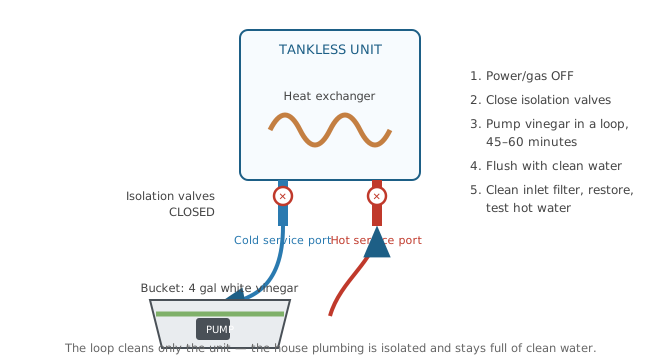
How to Descale a Tankless Water Heater: The Flush That Decides Whether It Lasts 8 Years or 20
Scale is what kills tankless heaters. The full DIY flush — vinegar, pump, isolation valves, 45 minutes — plus the schedule for your water hardness, the symptoms of overdue, and what a pro charges.
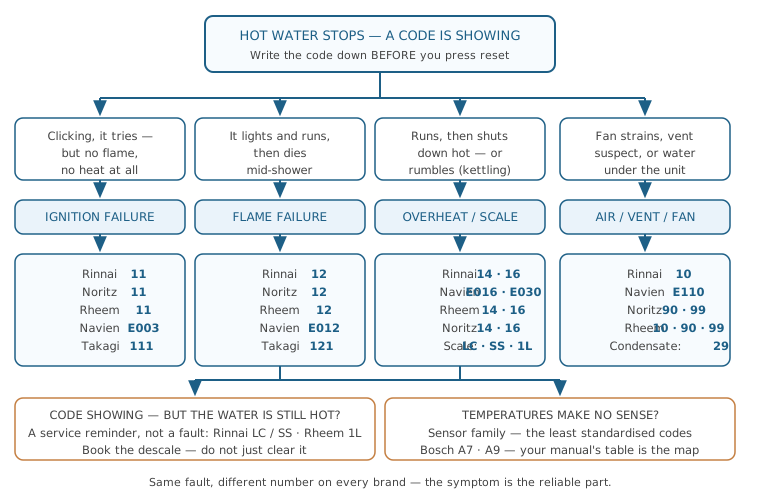
Tankless Water Heater Error Codes, Decoded by Symptom (All Major Brands)
The code on the display is a symptom report, not a diagnosis. Find your fault by what the unit did — no ignition, flame loss, overheating, venting trouble, bad sensors — with the Rinnai, Navien, Noritz, Rheem and Takagi codes for each family, the safe owner checks, the reset rules, and what each fix costs.
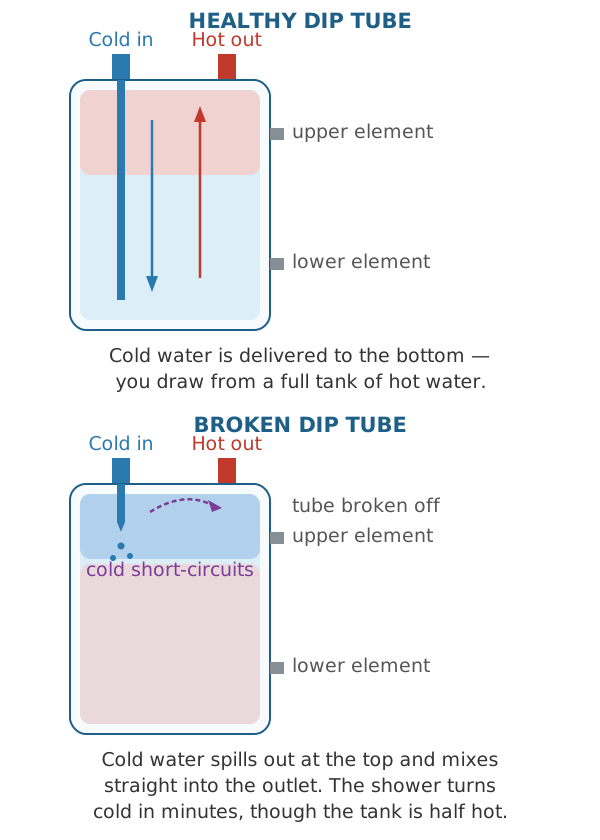
Why Your Hot Water Runs Out So Fast — and the Bucket Test That Tells You Why
Showers going cold in minutes? The bucket test measures how much hot water your tank actually delivers, then splits the causes: broken dip tube, dead lower element, sediment, thermostat, cross-connection, or a tank that is simply too small now.