 Keep
Pipes Bang When the Water Shuts Off? Water Hammer, Fixed in Order of Cost
 Daniel Mercer · Editor & Researcher·
Published November 16, 2026·
Updated November 16, 2026
The washing machine finishes filling, the valve closes, and somewhere inside the wall there is a bang solid enough to feel through the floor. Or the dishwasher clicks off and the pipes knock twice, like someone rapping on them from inside. Or the toilet tank tops up and the last second of filling ends in a thud.
If your house does this, you have water hammer, and you are hearing it at the exact moment the water stops, which is the clue to everything. It never bangs while the water is running. It bangs at the shut-off, and usually at one particular shut-off: one appliance, one toilet, one fixture, repeating on schedule. That pattern is good news. Water hammer is one of the most fixable noises a house makes, and the fixes form a ladder, free at the bottom and still cheap most of the way up. This guide works that ladder in order, but first it is worth understanding what the bang actually is, because it is not really a noise problem. The noise is just the part you can hear.
What water hammer actually is
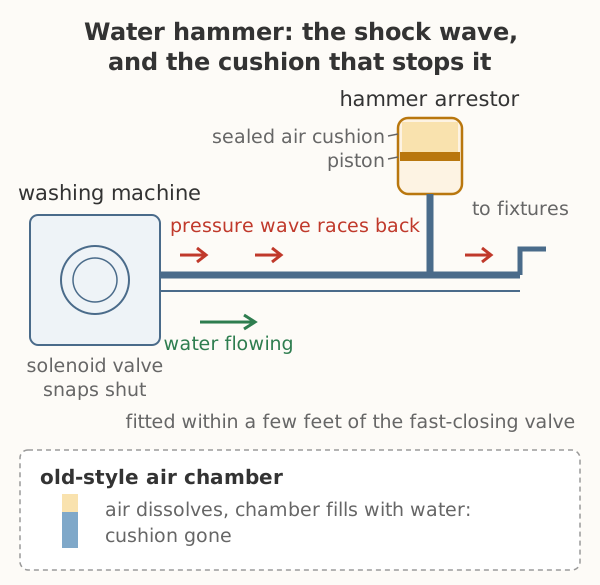
Water is heavy and it does not compress. A washing machine filling at full flow has several pounds of water per second moving through your pipes, all of it with momentum. A hand-operated tap closes over a second or two, easing that column of water to a stop. A solenoid valve, the kind modern washers, dishwashers and many toilet fill valves use, closes in a fraction of a second.
The moving water cannot stop that fast, so it piles up against the closed valve and its momentum converts into pressure: a spike that can momentarily reach several times the system's normal working pressure. That spike does not stay at the valve. It becomes a shock wave that races back through the pipes at the speed of sound in water, bouncing off elbows and tees until its energy is spent. Wherever a pipe is loose in its hangers or free to flex, the wave shoves it against the framing, and that shove is the bang. One bang is a single wave arriving. A rapid series of knocks, the classic bang-bang-bang that fades over a second, is the wave ricocheting back and forth, weaker each time.
This is why the plumbing codes take it seriously rather than treating it as a nuisance: both major US model codes require certified hammer arrestors (built to the ASSE 1010 standard) wherever quick-closing valves are installed. The requirement exists because of what the spike does on its way through, which is the next section.
Why it is not just a noise
Nobody's pipe bursts from one bang. The damage model is repetition: the same spike, through the same joints, every wash cycle, every dishwasher run, every toilet flush, for years. Each spike flexes soldered and threaded joints a fraction, works pipe hangers a little looser (which makes the next bang louder, which flexes things more), and hammers the inlet valves of the appliances themselves. Fill valves, ice-maker solenoids and washing machine inlet valves all live downstream of spikes they did not create. Flexible supply lines, the braided hoses under sinks and behind toilets, age faster under repeated surging. On older plumbing with tired solder joints, chronic water hammer is a recognised contributor to the pinhole leak that appears in a wall one day for "no reason."
There is also a diagnostic reason to care: a house that suddenly starts banging is telling you something changed. A new appliance, a regulator drifting upward, an air chamber that finally filled. The sections below treat the bang as information first and a noise second.
Not every pipe noise is water hammer
Before climbing the ladder, spend one minute ruling out the impersonators, because they have different fixes:
- A single loud bang, exactly at shut-off. True water hammer, the subject of this guide. The timing is the signature: silence while water runs, bang the instant it stops.
- A rapid machine-gun chatter as a tap closes or a toilet fills. Usually a worn washer or a failing fill valve fluttering rather than closing cleanly. The fix is the valve or washer itself, a few dollars in parts, not an arrestor.
- Ticking or creaking as hot water runs, or just after it stops. Thermal expansion: hot pipes lengthening and rubbing against framing or their own hangers. It follows hot water use rather than shut-off, and the fix is cushioning and room to move, not pressure control.
- A constant rattle whenever any water runs. A loose pipe vibrating under flow, worst at one spot along the run. That is the strapping rung below, on its own.
- Banging only when the heating runs. That is the boiler or radiators, a different system and a different guide entirely.
If your noise matches the first description, and especially if it arrived with a new appliance or appeared in a house that used to be quiet, proceed. The rest of this guide assumes true hammer.
Step one: find the fixture that triggers it
Do not start by buying parts. Start by naming the culprit, because every fix after this one is aimed at a specific valve. The isolation test takes one pass through the house and about ten minutes:
- Stand where the bang is loudest and have a second person (or a phone recording in the room) work through the fixtures. If you live alone, run each test and listen; the bang is loud enough to locate by ear in most houses.
- Run the washing machine and let it fill, then stop it mid-fill (most machines stop the water when you pause the cycle or lift the lid on a top-loader). Bang on shut-off: found it.
- Run the dishwasher through a fill, then open the door to halt it. Same test, same listen.
- Flush each toilet and stand by it as the tank finishes filling. A fill valve snapping shut at the end of the refill is a classic toilet bang, often felt in the wall behind the bathroom.
- Run and shut each tap briskly. Hand taps rarely trigger true hammer, but a single-lever mixer closed fast can, and a worn washer in an old tap can chatter instead, which is a different, cheaper problem.
Note which fixtures bang and which do not. One fixture banging points at that fixture's line. Everything banging points away from the fixtures entirely, toward house pressure, which is step two.
If you have just moved in, or just replaced an appliance: this is the commonest version of the story, and it confuses people because the house "was fine before." It was, with the old machine. Newer washers and dishwashers close their valves faster than the appliances they replaced, and a system that absorbed the old valve's gentler stop now gets hit with a snap. The plumbing has not deteriorated; the trigger got quicker. The fix is still aimed at the new appliance's supply line, and it is the cheap rung of the ladder below.
Step two: check the pressure
High static pressure is the root cause behind a large share of water hammer, and it makes every other cause worse: faster-moving water carries more momentum, so the spike at shut-off is bigger. If several fixtures bang, or the bang is house-wide, pressure is the first suspect.
The test is the same gauge procedure we use in our low water pressure guide, so we will not repeat it in full here: a hose-bib gauge on an outdoor spigot or the washing machine tap, everything else off, read the resting pressure. You are looking for one number. Between 40 and 80 psi is the normal band, with 50–60 psi the comfortable middle. Above 80 psi, you have found a cause, not just a clue: code expects a pressure-reducing valve (PRV) at that level, and a house running at 90 or 100 psi will bang at fixtures that would be silent at 55.
Also watch what the gauge needle does when the trigger fixture shuts off, if you can arrange to see both. A needle that kicks hard at the bang confirms the spike is pressure-driven and sized for the fix: the bigger the kick, the more an arrestor (and possibly lower pressure) matters.
If pressure is normal and one fixture bangs, skip the pressure rungs and go straight to arrestors after the free fix. If pressure is high, fix pressure first, because arrestors fitted to an over-pressured system are being asked to absorb spikes they were not sized for; Sioux Chief's own sizing guidance says to go one arrestor size up when flow pressure exceeds 65 psi, which tells you how much pressure changes the maths.
Three patterns worth recognising before you spend anything
It only bangs at night. Street pressure is not constant. When the whole neighbourhood stops drawing water in the small hours, pressure at your gauge climbs, sometimes by 10–20 psi over the daytime reading. A system that sits just under the banging threshold at 6 p.m. crosses it at 2 a.m., which is why the toilet's last refill of the night is the one that wakes the house. If your bang keeps night hours, take your pressure reading at night too, and judge the regulator by the worst number, not the convenient one.
It started after plumbing work or a repipe. New pipe is smooth inside, water moves faster through it, and faster water spikes harder. A repipe that also replaced lazy old gate valves and slow fixtures with modern quarter-turn and solenoid valves can hand a quiet house a hammer problem it never had, with every individual part working exactly as designed. The answer is arrestors at the fast valves, fitted as part of living with the new system rather than as a repair of it.
Only the new extension or addition bangs. Long branch runs are wave corridors: the spike has distance to build and few branches to bleed into. This is the case the midpoint rule in the arrestor section exists for, and it is also the case where strapping matters most, because new work is often the least-supported pipe in the house. Check the hangers in the new run before assuming the spike itself is unusually strong.
The fix ladder, in order of cost
Work down this list and stop when the bang stops. Most houses are cured on rung one, two or four.
Rung 1: Drain the system and recharge the air chambers ($0)
Many houses, especially those built before piston arrestors became standard, rely on air chambers: short vertical stubs of pipe, capped at the top, teed into the supply lines near fixtures. Trapped air in the stub is the cushion that absorbs the spike. The flaw is physics: air slowly dissolves into pressurised water, the chamber fills, and one day the cushion is simply water, which cannot compress. The bang arrives, seemingly from nowhere, on a house that was quiet for years.
Draining the whole system lets air back into every chamber at once:
- Shut off the main water supply.
- Open the highest tap in the house (an upstairs basin) and the lowest (a basement tap, the water heater drain, or an outdoor spigot at the low point) and let the system drain fully. Open the other taps as the flow slows.
- When the water stops, close everything.
- Turn the main back on and let the system refill. Air will spit from the first tap you open; run each tap until it flows smoothly.
Total cost: nothing but half an hour. Honest limitation: this is a recharge, not a repair. If your chambers waterlogged once, they will do it again over the following months, and the bang will creep back. Treat a successful drain-down as a diagnosis as much as a fix: it proves the problem is a missing cushion, and it tells you the permanent version of the same fix, a sealed arrestor, is rung four.
Rung 2: Strap the pipes that are slapping ($5–$30)
Sometimes the spike is modest but the noise is enormous, because a long pipe run is hanging loose and the wave throws it against a joist or a stud. Get under the house or into the basement while someone triggers the bang upstairs, and watch and listen. A pipe that visibly jumps is a pipe that needs support.
The fix is pipe straps or hangers every few feet on the moving run, snug but not crushing, with a strip of foam pipe insulation or a rubber cushion anywhere the pipe touches framing, so metal stops striking wood. This rung does not reduce the pressure spike at all; it removes the drum. If the bang becomes a dull, distant thud after strapping, the spike itself may still be worth cushioning with rung four, but the house will be livable.
Rung 3: Bring the pressure down (free to adjust, $350–$700 to replace)
If step two found static pressure over 80 psi, this rung is not optional, and it may cure the banging by itself. Most houses already have a PRV, a bell-shaped valve on the main line near where water enters, and most are adjustable: loosen the lock nut on the stem and turn the bolt (clockwise raises pressure, anticlockwise lowers it on most models), checking with your gauge between adjustments. Aim for 50–60 psi.
Two failure modes to recognise. If the gauge reading does not change when you adjust, or the pressure creeps back up overnight (check it early in the morning before anyone uses water), the regulator has failed and adjustment is theatre. A failed PRV is a replacement job: $350–700 fitted by a plumber, or a confident-DIY swap where the existing valve sits on threaded unions. Either way, fix pressure before arrestors; every rung after this one assumes a sane starting pressure.
Rung 4: Fit a hammer arrestor at the trigger fixture ($15–25 DIY)
This is the permanent cushion, and for the classic single-appliance bang it is usually the whole answer. A modern arrestor is a small sealed cylinder with a piston (or bellows) separating a factory-charged air cushion from the water. The spike pushes the piston, the air compresses, the wave dies in inches instead of ricocheting through the house. Because the air is sealed behind the piston, it cannot dissolve away like an old air chamber, which is the entire point.
Placement matters more than size at this scale: the arrestor goes as close to the quick-closing valve as you can get it, on that fixture's supply line, because it has to meet the wave where the wave is born. Manufacturer sizing tables (the fixture-unit system in the Sioux Chief guide in our sources) matter for commercial work and long branch lines; for a single household appliance, the residential AA/A sizes are the standard answer, one size up if your flow pressure is over 65 psi.
For the two commonest triggers, the job is genuinely hand-tool work:
Washing machine. Buy two hose-thread laundry arrestors (they are sold singly and in pairs). Shut off the washer valves, unscrew each supply hose, screw an arrestor onto each valve outlet, and reconnect the hoses to the arrestors. Hot and cold both, because the machine snaps both valves shut. Ten minutes, no pipe cutting, and reversible if you ever move.
Dishwasher. The same style of arrestor goes on the dishwasher supply, either at the shut-off valve under the sink (often a tee-style fitting that the supply line then connects to) or at the appliance inlet, depending on access. Shut off the supply and the breaker, work the connection over a towel, restore, and run a fill cycle while watching for drips.
Toilets and in-wall lines. Toilet supply arrestors exist in the same screw-on family and fit between the stop valve and the fill valve hose. Where the trigger line is buried in a wall with no access, or the pipe is sweat copper or PEX with no threaded point, the arrestor becomes a cut-in job: that is the plumber rung, $200–500 with access opened and closed, and it is worth asking the plumber to fit arrestors at any other quick-closing valve on the same branch while the wall is open.
If the bang survives a correctly placed arrestor, the remaining suspects are a failing check valve or meter assembly chattering, or a spike generated somewhere you have not isolated. That is a diagnostic visit, not more parts.
Arrestor types, sizes and placement, in a little more depth
Because this rung is where most people spend money, it is worth knowing what you are buying. Arrestors come in three connection families. Hose-thread tee types are the laundry and dishwasher fittings above: they screw between the shut-off valve and the appliance hose, need no tools beyond hand strength and a towel, and are the correct first purchase for almost every owner. Threaded, compression and push-fit in-line types go into a copper or PEX run at a tee, near the fixture; a confident DIYer with the right fittings can fit them, and they are the usual choice for a toilet line or a bathroom branch. Sweat (soldered) types are plumber territory for most owners.
Inside, the working part is either a piston with O-rings sliding in a cylinder or a bellows/diaphragm, and both do the same job of keeping the air charge permanently separated from the water. That sealed charge is the difference between an arrestor and an air chamber: the chamber is the same idea with no separation, which is why it drowns.
Sizing for a house is simpler than the commercial tables suggest. Arrestors are graded AA (single fixture) through F (large commercial groups) using fixture units; a washing machine, dishwasher or toilet is squarely AA/A territory. The placement rules from Sioux Chief's guideline are the ones that matter at home: put the unit at the end of the branch, between the last fixtures served, and as near the quick-closing valve as the plumbing allows; on a branch run longer than about twenty feet, add a second unit around the midpoint; and go one size up when flow pressure runs over 65 psi. An arrestor also has a working life rather than an eternal one: pistons eventually wear, so if a house that was cured for a decade starts banging again at the same fixture, suspect the arrestor itself before re-diagnosing the whole system.
The toilet that bangs: a special case worth its own paragraph
Toilets deserve a footnote because they generate a large share of "mystery bang" reports and the cause is often inside the tank rather than in the wall. A fill valve that is worn or fouled with sediment can slam shut at the end of the refill cycle, or shudder closed over a second, producing a bang or a foghorn groan that travels surprisingly far through the pipes. The test costs nothing: lift the tank lid, flush, and watch and listen at the valve itself as the tank tops up. If the noise is born at the valve, the fix is a replacement fill valve, an inexpensive part and one of the most DIY-friendly jobs in plumbing, or a modern quiet-fill valve designed to close gently. Fit the arrestor on the toilet supply too if the bang is sharp; the two fixes attack the same event from opposite ends, the valve softening the stop and the arrestor absorbing what spike remains.
What it costs, rung by rung
The table at the top of this guide is the whole economics of the problem, and it is why the order matters: the ladder is sorted so the free and nearly-free fixes get their chance before anyone cuts a pipe. The realistic outcomes break down like this. Houses with waterlogged air chambers: fixed for $0, at least for a season. Houses with one modern appliance and normal pressure, which is the largest group of all: fixed for $15–50 in screw-on arrestors. Houses with high pressure: the regulator is the bill, $350–700, but that purchase also ends the wear that high pressure was causing everywhere else, so it is not money spent on a noise. The plumber-installed in-wall arrestor is the only rung that feels expensive relative to the symptom, and it is mostly labour and access, not parts.
DIY or pro?
Everything up to and including screw-on arrestors is squarely DIY: no pipe is cut, nothing is soldered, and every step reverses if you change your mind. Strapping pipes is DIY with a drill and a ladder. Adjusting a PRV is DIY with a wrench and your gauge.
Call a plumber when the fix involves cutting into sweat or PEX lines, when a failed PRV is seized or buried in a manifold you do not recognise, or when the bang persists after pressure and arrestors are sorted, because what remains needs diagnosis rather than installation. And one hard boundary: if banging arrives together with a leak, a bulging flexible hose, or a water heater discharge pipe dripping after spikes, skip the ladder and make that call now.
If you do hire it out, the quote should name four things before you agree to it: the arrestor model and size, with ASSE 1010 certification stated (this is the standard the codes point to, and it separates a real arrestor from a length of capped pipe); exactly where it will be fitted, which should be near the trigger valve, not wherever is easiest to reach; whether opening and patching the wall or ceiling is included in the price or billed as an extra; and a before-and-after static pressure reading, so the visit leaves you with a number on record as well as a quieter house. A quote that just says "fit water hammer device" with none of that detail is a quote for the cheapest possible interpretation of the job.
Keeping it fixed: three habits for a house that has banged once
A cured house can relapse, and the relapses are predictable. First, every new appliance is a new trigger test: when a washer, dishwasher or fridge with an ice maker goes in, run it through one fill cycle and listen before the installer leaves, while moving an arrestor across is still a two-minute job. Fast valves are now the default, so assume any replacement appliance closes faster than the one it replaced.
Second, write your static pressure on the water heater with its install date and re-check it once a year with the same gauge. Regulators drift upward as they age, and a house that creeps from 60 to 85 psi over five years will re-develop hammer at fixtures that were silent, with no single day when anything "broke." Catching the drift at the gauge is the difference between adjusting a bolt and replacing valves.
Third, if you drained the system as rung one, put a date on it. Air chambers that waterlog in eight months are telling you the recharge is a subscription, not a solution, and the next quiet-to-loud cycle is your cue to fit the sealed arrestor instead of draining again. Owners who inherit a house with a banging problem and no history get the same advice compressed: do the isolation test in your first week, while the pattern of which fixture bangs is still new information rather than background noise you have learned to ignore.
How urgent is it, honestly?
Water hammer sits in the middle of the urgency scale. It will not flood your house tonight, and a week of banging while you wait for arrestors to arrive costs you nothing measurable. But it is not a "live with it forever" noise either. The wear is cumulative and one-directional: joints, valves and hoses do not recover between spikes, and the eventual failure, a split supply line or a joint letting go inside a wall, is a genuinely expensive day. Put it on this month's list. Move it to this week's list if your pressure is over 80 psi (that is its own problem, hammer or no hammer), if the bang is new and getting louder fast, or if it comes with any sign of leaking. Fixed in order, most houses go quiet for the price of a takeaway dinner, and stay quiet.
Cost at a glance
| Item | Typical cost | Notes |
|---|---|---|
| Drain-and-refill to recharge air chambers | $0 | Thirty minutes and a bucket; the first thing to try on any house with capped air chambers |
| Pipe straps, hangers and foam cushioning | $5–$30 | Stops pipes slapping against framing; fixes the noise amplifier, not the spike itself |
| Screw-on hammer arrestor (washer or dishwasher) | $15–$25 each | Hose-thread tee fitting, installs by hand in minutes; washers often need one on each supply |
| In-wall / in-line arrestor fitted by a plumber | $200–$500 | For sweat or PEX lines and hidden pipe runs; includes opening and closing access |
| Pressure regulator (PRV) replacement — pro | $350–$700 | The fix when high static pressure is the root cause and the old regulator has failed or won't adjust |
Frequently asked questions
What causes pipes to bang when the water shuts off?
Water hammer. Water moving through a pipe has momentum; when a fast-closing valve — a washing machine solenoid, a dishwasher valve, a toilet fill valve — stops it instantly, that momentum converts into a pressure spike that races back through the system and rattles the pipes. Slow hand-operated taps rarely cause it, because they close gradually. The bang is the shock wave arriving, and any loose pipe along its path turns it into noise.
Can water hammer damage my plumbing?
Yes, slowly. A single bang does nothing, but the spike can momentarily reach several times normal working pressure, and it repeats every wash cycle, every day. Over months and years that flexing loosens joints and hangers, wears appliance inlet valves and fill valves, stresses flexible supply lines and can contribute to pinhole leaks. It's cumulative wear, which is why the fix matters even though the house won't flood tonight.
Why did the banging start after I got a new washing machine?
Because the new machine's valves are faster. Modern washers and dishwashers use solenoid valves that snap shut in a fraction of a second, where older appliances closed more gently. The plumbing didn't change; the trigger did. The same thing happens right after moving into a house whose previous owners had slower appliances. The cure is an arrestor at that appliance, not a different machine.
Where should a water hammer arrestor be installed?
As close as practical to the valve that causes the bang — manufacturer guidance (Sioux Chief) puts it within a few feet of the quick-closing valve, on the supply line serving it. For a washing machine that usually means a hose-thread arrestor on each shut-off valve, hot and cold, right behind the machine. An arrestor at the water heater does almost nothing for a bang triggered at the far end of the house.
Why did draining my pipes fix the bang, then it came back months later?
Your house likely has old-style air chambers — short capped vertical pipes near fixtures, meant to hold a pocket of air as a cushion. Air slowly dissolves into the water, the chamber fills, and the cushion is gone. Draining the system lets air back in, so the fix works until the chambers waterlog again, typically over a few months. If the bang keeps returning on that cycle, a sealed piston arrestor is the permanent version of the same idea.
Can high water pressure cause water hammer?
It makes it far more likely and far louder. The higher the pressure, the faster the water moves and the bigger the spike when it stops. If your static pressure reads above 80 psi you have a root cause to fix first — plumbing code expects a regulator at that point — and lowering pressure to the 50–60 psi range sometimes cures the banging on its own. Sioux Chief also advises sizing arrestors one size up when flow pressure exceeds 65 psi.
How much does it cost to fix water hammer?
Anywhere from nothing to about $700, depending on which rung of the ladder your house needs. Recharging air chambers is free, straps are a few dollars, screw-on arrestors run $15–25 each fitted by hand, a plumber installing in-wall arrestors typically lands between $200 and $500, and replacing a failed pressure regulator runs $350–700. Most single-fixture cases are solved for under $50.
Checked November 16, 2026. This guide is general information, not a substitute for a licensed professional.
Related guides
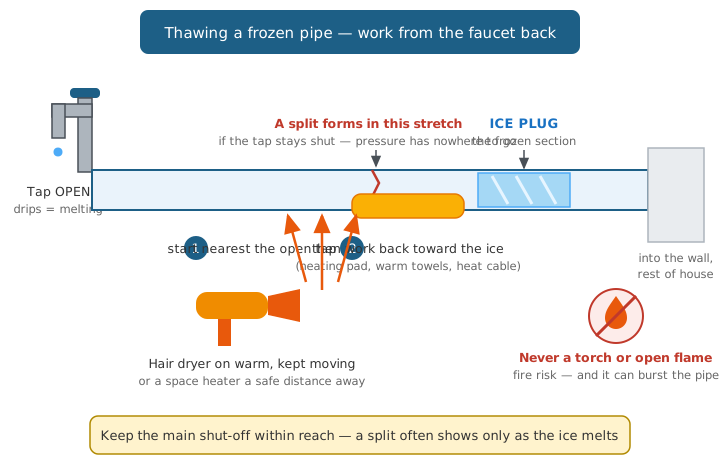
Frozen Pipes? Thaw Them Safely — and Catch the Split Before It Floods the House
No water from one tap on a freezing morning? Find the frozen section, thaw it safely with the faucet open, spot the split as the ice melts, and prevent the next freeze — with real costs.
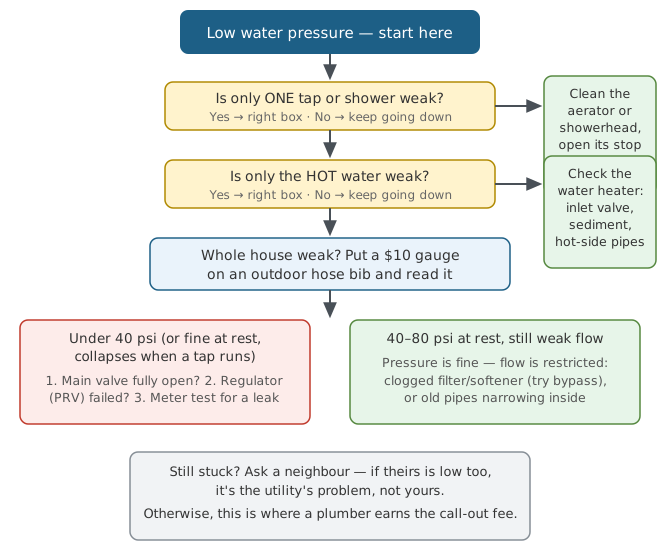
Low Water Pressure in the House: How to Find the Cause (and Fix It)
Weak showers and slow-filling tubs? Start with three questions and a $10 gauge. Every common cause of low water pressure — valves, regulator, leaks, corroded pipes — with fixes and costs.
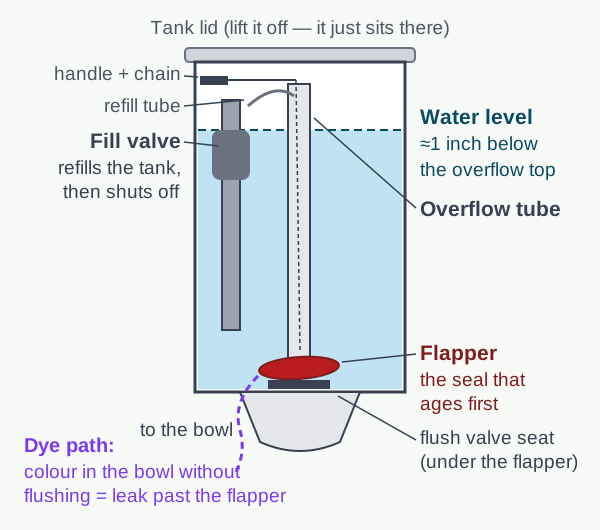
Toilet Keeps Running? The Dye Test Finds the Guilty Part in 15 Minutes
A toilet that refills by itself is leaking from tank to bowl, and one part is almost always to blame. Run the dye test, find it in 15 minutes, and fix it for the price of a coffee.