 Keep
What Not to Flush on a Septic System: The Never-Flush List
 Daniel Mercer · Editor & Researcher·
Published November 16, 2026·
Updated November 16, 2026
If your last home was on city sewer, the toilet felt like a magic disappearing hole: flush it, forget it. A septic system doesn't work like that. Everything you send down a drain in this house ends up in a tank buried in your own yard, where a living colony of bacteria has to deal with it — and what the bacteria can't handle doesn't disappear. It stays in the tank, rides out to the drainfield, or poisons the colony itself.
That's the thing most first-time septic owners never get told at closing: your septic tank is less like a sewer and more like a stomach. Feed it what it evolved to digest and it will quietly work for decades. Feed it the wrong things and the bill arrives later, with interest, usually as a pump-out you didn't budget for or a drainfield quote with five figures in it.
The good news is that the rules are short. This guide gives you the one rule, the complete never-flush list room by room, what to do with each item instead, and — because it happens in every house — what to do when something on the list has already gone down.
The one rule: only the 3 Ps
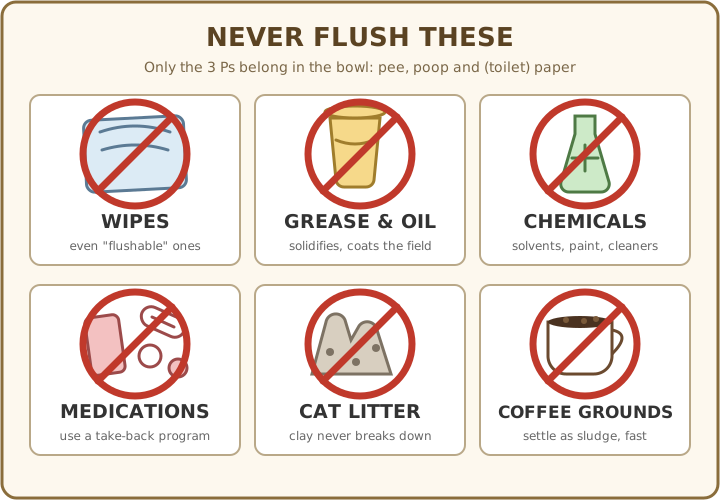
The whole system rests on a rule simple enough for a sticky note: pee, poop and (toilet) paper — the 3 Ps. That's the complete list of what belongs in a septic toilet. Toilet paper makes the cut for one specific reason: it's designed to disintegrate almost immediately in water, so by the time it reaches the tank it's already breaking apart into fibers the bacteria can process.
Everything else fails in one of three ways, and it's worth knowing which, because it explains the whole list that follows:
- It won't break down. Wipes, plastics, clay litter, floss and grounds don't digest. They sit in the tank as permanent solids, filling the space that was supposed to hold wastewater, until a vacuum truck removes them — at your expense, on a shorter cycle than you planned.
- It kills the workforce. Bleach in bulk, antibacterial cleaners, solvents, drain openers and some medications damage the bacterial colony that does the actual treating. A wounded colony means solids pass through half-digested.
- It slips through to the field. Grease, oils and fine particles that neither settle nor float properly get carried out with the effluent and clog the soil pores in the drainfield — the one part of the system you can't clean, only replace.
Every item below is on the list because of one of those three failures. Most are guilty of two.
Reading labels like a septic owner
Two phrases on store shelves cause most of the damage, because both sound like permission.
"Flushable." There is no government standard a wipe has to meet to carry this word. In practice it means the product is physically capable of passing through a toilet trap — a test your plumbing passes and your septic system fails. Regulators and water utilities have spent years pushing back on the term precisely because wipes labeled flushable show up intact in tanks, pumps and treatment plants. When you see it on anything that isn't toilet paper, read it as "bin."
"Septic-safe." This one is softer but nearly as empty: there's no EPA certification behind it either. Plenty of products wearing the label are genuinely fine in normal doses — and plenty of products without it are fine too. The label tells you almost nothing that dose and category don't. A septic-safe solvent is still a solvent. A septic-safe wipe still doesn't break down. Judge the item, not the badge: does it dissolve in water, is it a chemical killer, and how much of it are you sending down? Those three questions sort the whole store.
One more label worth knowing: "biodegradable" describes what happens eventually, often in industrial composting conditions — not what happens in a cold, oxygen-free tank on your schedule. Corn-based plastics and "biodegradable" wipes can persist in a septic tank for years. The tank's test is stricter than the marketing department's: if it doesn't fall apart in a glass of water within a day, treat it as a solid.
The bathroom: where the worst offenders live
Wipes — the number one problem, full stop. Baby wipes, cleaning wipes, makeup wipes, and wipes sold as "flushable" all belong in the trash. The flushable label is the most misleading word in the cleaning aisle: it describes the wipe's ability to leave the bowl, not to break down afterward. Toilet paper falls apart in seconds; a wipe is woven to stay intact while wet, and in tank after tank, pumpers pull them out months later looking nearly new. In the tank they pile up as solids. In the pipes they snag and mat together. In pumped systems they wrap around the effluent pump until it jams or burns out. Put a small lined bin next to every toilet and the temptation disappears.
Paper towels and tissues. Both are made with wet-strength resins — the opposite of what a tank wants. They break down eventually, but slowly, and in the meantime they're sludge. Trash or compost, every time.
Cotton balls, cotton swabs, bandages, hair. None of these digest. Swab sticks and bandages are part plastic; hair mats with floss and wipes into the ropey clogs plumbers charge $150–$450 to pull out. All of it goes in the bin.
Dental floss. It looks harmless — it's a thread. But floss doesn't break down, and it's strong, so it acts as the net that catches everything else and builds clogs around baffles and pump intakes. Trash it.
Feminine hygiene products and condoms. Tampons are designed to absorb liquid and expand; pads contain plastic layers. Neither degrades in a tank. Condoms are latex or polyurethane — effectively permanent. Bin, never bowl.
Diapers. It hopefully goes without saying, but disposable diapers are plastic and absorbent gel built to hold liquid, not release it. Never.
Cat litter. Even litter marketed as flushable is a problem for septic: clay-based litter never breaks down at all, and clumping litter is engineered to form solid masses on contact with liquid — precisely what you don't want in a pipe or tank. Litter also can carry Toxoplasma eggs that a septic system isn't designed to kill. Bag it and trash it.
Medications. Don't flush expired or leftover medicine. Drugs pass through a septic system largely untreated — the tank was never designed to neutralize them — and antibiotics in quantity can also knock back the bacterial colony. The right route is a take-back program: many pharmacies and police stations host drop boxes year-round, and national take-back days run twice a year. If there's genuinely no take-back option near you, the FDA's fallback is to mix the medicine into used coffee grounds or litter, seal the bag, and trash it — still better than the toilet.
Cigarette butts. Filters are plastic fiber that persists, and the chemicals leaching out of a butt do the bacteria no favors. Ashtray, then trash.
And the toilet paper itself? Ordinary toilet paper of any common brand is fine — it's all engineered to disperse. Two soft cautions. Ultra-plush, quilted and lotion-infused papers break down more slowly than the basic kind; in an older system with a history of slow drainage, the simpler paper is the safer default, and you can test any brand by shaking a few sheets in a jar of water — good paper falls apart in seconds. And whatever the brand, quantity matters: the wad of half a roll per flush, common with kids, is a volume problem before it's a material one.
The kitchen: grease is the quiet one
The bathroom items cause the dramatic clogs, but the kitchen sends the drainfield its slowest killer.
Fats, oils and grease. Bacon fat, cooking oil, butter, sauces, salad dressing — all of it. The old advice to run hot water and dish soap while pouring grease down "so it stays liquid" is a myth worth unlearning: the water cools within a few feet of pipe, the grease solidifies anyway, and in the tank it joins and thickens the scum layer. What escapes the tank coats drainfield soil and seals the pores the field needs to absorb water. Grease is unusually resistant to bacterial breakdown, so almost none of what goes in ever gets digested. Pour cooled grease into a can or jar, let it solidify, and trash it. Wipe greasy pans with a paper towel before washing — that one habit keeps most of it out.
Coffee grounds. Grounds don't dissolve and don't digest; they sink and become sludge, measurably faster than most food solids. A daily pot's worth of grounds is a steady tax on your pumping interval. Compost bin or trash.
Food scraps and the garbage disposal. A disposal isn't forbidden on septic, but be honest about what it does: it turns food that could have gone in the trash into a slurry of fine particles, much of which doesn't settle or digest well and instead adds to the solids load or rides toward the field. Systems on heavy disposal use need pumping significantly more often. Scrape plates first, compost what you can, and treat the disposal as an occasional convenience — or skip having one entirely.
Egg shells, bones, rinds, corn husks. Slow or non-degrading. The disposal may chew them; the tank can't. Trash or compost.
Rice, pasta and other swell foods. Dry rice and pasta absorb many times their weight in water and keep expanding after they leave the disposal — a trait that has clogged plenty of kitchen lines before the tank even gets a say. Scrape the pot into the trash first; the rinse water that follows is fine.
Pet waste and aquarium water. Dog waste belongs in the trash, not the toilet: it can carry parasites a residential septic system isn't designed to neutralize, and it's usually accompanied by litter, gravel or bag fragments. Aquarium gravel and filter media never go down a drain. Plain aquarium water in bucket quantities is mostly a volume question — spread it on the garden instead and the plants will thank you.
Laundry and cleaning chemicals: dose makes the poison
Here's where septic advice often gets overcautious, so let's be precise: your bacteria are tougher than the internet suggests, and normal cleaning will not kill your system. The danger is concentrated doses and the genuinely toxic shelf — not a regular load of laundry.
Bleach. A standard laundry dose of chlorine bleach, diluted across a full wash and the tank's thousand-plus gallons, is fine; the colony dips and recovers within a day or two. What hurts: several bleach-heavy loads back to back, bleach-based cleaner dumped by the bucket, or using the toilet as a disposal point for leftover solution. Spread bleach loads across the week and use the smallest amount that does the job.
Antibacterial soaps and disinfectants. Used normally at the sink, these are a minor load. Used as the default for every surface, every day — plus automatic toilet-bowl disinfectant tablets dosing the tank with every flush — they become a constant drip of bacteria-killer into a bacteria-powered system. Keep one disinfectant for genuine jobs (raw chicken, a sick kid) and let ordinary soap and water handle the rest. Skip the in-tank toilet tablets entirely.
Detergents. Liquid laundry detergent beats powder: some powders use clay-based fillers that don't dissolve and add inert solids to the tank. Use the measured dose, not a hopeful glug — excess detergent of any kind is just extra chemical load, and high-efficiency machines need surprisingly little.
Chemical drain openers. The lye- and acid-based gels are bad twice over: they're among the harshest bacteria-killers you can pour in, and if the clog doesn't clear, you're left with a pipe full of caustic water for the plumber to deal with. A slow drain on septic gets a plunger, a hand snake, or a phone call — not a chemical.
Paint, paint thinner, solvents, motor oil, gasoline, pesticides, herbicides. This is the never-ever shelf, no dilution argument applies. Even a gallon of paint thinner can effectively sterilize a 1,000-gallon tank, and solvents pass through into the soil and groundwater — which, on a well-and-septic property, can mean your own drinking water. None of it goes down any drain, ever. Every county runs household hazardous waste drop-off days or a permanent facility; that's where this shelf goes, usually free.
Pool and hot tub water. It's a double hit: a huge volume of water all at once, dosed with chlorine specifically chosen to kill bacteria. Drain it onto a suitable area of the yard away from the drainfield (and per local rules), never into the septic system.
The water itself can be the problem
Not everything harmful is a product. Two water sources should never be routed into a septic system:
Water softener and iron filter backwash. Each regeneration sends roughly 50–100 gallons of salty brine surging into the tank. The surge can stir and disturb the settled sludge and floating scum layers, pushing solids toward the field, and the salt load stresses the bacterial colony. Where your setup allows, regeneration discharge should be routed to a separate dry well or approved discharge point instead of the septic tank — worth asking about at installation or your next service visit, since local codes vary.
Sump pumps, roof drains and surface water. A septic system is sized for household wastewater, not stormwater. A sump pump or gutter line tied into the system can hydraulically overload it in a single rainy weekend, flushing untreated waste straight to the field. Clean water goes to the yard, daylighted well away from the drainfield — never into the tank.
And the simplest volume rule of all: spread laundry across the week. Five loads on Saturday is a flood; one a day is weather.
What to use instead
The never-flush list gets easier when the replacement is already in place:
- A small lined bin in every bathroom — solves wipes, floss, cotton, hygiene products and tissues in one move.
- A grease can by the stove — an old coffee can or jar; fill, freeze or cool, trash, repeat.
- A compost bucket or trash scrape for food — the disposal becomes optional instead of essential.
- A pharmacy take-back box for medicine — check the pharmacy counter or sheriff's office; keep a small bag in a cabinet and drop it off on a normal errand run.
- Household hazardous waste days for the chemical shelf — put the date on the calendar when you move in; most counties run them free.
- Soap, water and a plunger — for 95% of cleaning and slow-drain moments that used to get chemicals.
Other people will use your toilets
Here is the part nobody warns first-time owners about: you can learn the 3 Ps perfectly and still lose, because a septic system serves everyone who walks into the house — and most of them have spent their lives on city sewer, where none of this matters.
Guests flush wipes because that's what the wipes are for, in their world. The fix isn't a lecture; it's architecture. A lidded bin beside every toilet, visible and empty, converts the decision into the path of least resistance. If a rental property or an in-law visit is involved, a small framed note in the guest bath — "We're on septic: please, nothing but toilet paper in the bowl" — saves everyone's embarrassment, including yours when the line clogs on day two of their stay.
Kids flush experiments: toys, socks, a whole roll unspooled for fun. You can't septic-train a four-year-old, but you can keep the bathroom bin obvious, the wipes stored out of toddler reach, and your response to the first incident calm — a single toy is a plumber story, not a system failure, as long as it comes out rather than being flushed repeatedly "to check."
Cleaners and contractors are the stealth risk. A house cleaner working fast will dump a bucket of strong solution down the nearest drain because that's standard practice on sewer. A painter will want to rinse brushes in your sink. Tell them up front: buckets get dumped outside away from the drainfield or taken with them, brushes get cleaned off-site, and nothing from a paint can touches a drain in this house. Professionals hear this from septic owners regularly; it costs you one sentence per visit.
The previous owner's habits are the final unknown. If you just bought the house, assume the tank contains some history you didn't create — one more reason the first-year inspection and pumping baseline matters. You're not paying for their wipes specifically; you're buying a known starting point.
Already flushed it? What actually happens next
Every septic household has done it — a guest flushes wipes for a weekend, a teenager dumps paint water in the sink, somebody's whole bottle of cleaner goes down during a move-out scrub. Here's the honest sequence of events, because the internet will try to sell you a panic product and you don't need one.
Stop the habit; that's the whole fix, most of the time. A 1,000-gallon tank dilutes a single household mistake enormously. A wipe joins the solids and waits for the next pumping. A load of grease joins the scum layer. A harsh cleaner knocks the bacterial colony back, and the colony regrows — typically over a few days, up to a couple of weeks after a heavy chemical hit — fed by the normal waste arriving every day.
Do not "fix" it with additives. Dumping bacteria packets, yeast, or sugar products into the tank after a mistake is the classic move, and the EPA's position is that a normally functioning system doesn't need additives and some can do harm — a few types break up the scum layer and let solids wash toward the field. The colony that belongs in your tank is already there. Time and normal use restore it; products don't.
The exceptions worth a phone call: a large quantity of solvent, paint, paint thinner, oil or fuel went in (call your septic service, tell them what and roughly how much — they may advise an early pump-out before it reaches the field); the system is showing symptoms — slow drains everywhere, gurgling, odors, a soggy patch over the field — in which case the flush may have been the last straw rather than the cause; or a pumped system's alarm is sounding. In those cases the call is about the symptom, not the sin.
When it truly doesn't matter: a single wipe, one flushed tissue, a normal bleach load, the medication your body has already processed (that's unavoidable and expected — never stop prescribed medicine over septic concerns), a cup of coffee grounds once. Note it, change the setup so it's easy to do right next time, and move on.
A rough recovery timeline, so you can stop worrying on schedule. After a single heavy bleach or cleaner dose, bacterial activity typically rebounds within 48 hours to a few days as fresh waste reseeds the tank. After a genuinely large chemical hit — a gallon-scale spill of something harsh — give it up to two weeks of normal use, and go easy on further chemicals in the meantime. Solid mistakes don't recover at all, but they don't spread either: a flushed wipe sits in the sludge layer, inert, until the next pumping removes it, which is why one wipe is trivia and a daily wipe habit is a shortened pumping interval. Grease is the slow middle case: each addition thickens the scum layer a little, and only the pumping truck reverses it. In other words, liquids forgive, solids accumulate, and your habits decide which story your tank tells.
The fridge checklist
Print this section and stick it on the fridge — it's the version guests and teenagers actually read:
- Flush only the 3 Ps: pee, poop, toilet paper.
- All wipes go in the bin — even the ones that say flushable.
- No grease down the sink. Jar it, cool it, trash it.
- Coffee grounds and food scraps: compost or trash, not the drain.
- Medicine: take-back box at the pharmacy. Never the toilet.
- Paint, solvents, oil, pesticides: hazardous waste drop-off. Never a drain.
- Bleach is fine in a normal load — not by the bucket, not every day.
- No drain-opener chemicals. Plunger, snake, or call.
- Spread laundry across the week.
- Sump and softener water never enter the septic.
What the never-flush list is really protecting you from
None of this is about being precious with the tank. It's about the price ladder in the table above, and how each habit maps to a rung. Non-degrading solids — wipes, litter, grounds — buy you an early pumping at $300–$600 because tank space is tank space, whether it's filled with sludge or last year's wipes. Stringy material buys a $150–$450 clog call or, on a pumped system, a $600–$1,500 pump replacement. Grease and escaped solids buy the rung nobody wants: drainfield work from $3,000 to $15,000, and a full system replacement at $5,000–$20,000 if the field is done.
Set against that, the entire prevention program costs one bathroom bin, one grease can, and a calendar note for hazardous waste day. It is the cheapest insurance on the whole property.
There's a spending trap to dodge while you're at it: the septic additive aisle. Monthly bacteria packets, enzyme treatments and "never pump again" formulas run $50–$200 a year, forever, and the EPA's assessment is that a normally working system doesn't benefit from them — your tank seeds itself with every flush. Some solvent-based additives actively damage the field by dissolving the scum layer and sending solids outward. The money that aisle asks for is better spent on the one service that provably works: pumping, on schedule.
The urgency, honestly
For a system that's draining fine, nothing in this guide is urgent — it's habit-building, and this week is a great time to start. The habits protect you on a years-long timeline.
Two things do change the clock. If your drains are already slow throughout the house, gurgling, or smelling of sewage, the system may already be overloaded or the tank overdue — stop the heavy water use and book a septic service rather than adding a cleaning spree on top. And if sewage is backing up into tubs or floor drains, that's a call-today problem: stop running water entirely and get a pumper out.
Otherwise: put the bins in place, brief the household, and let the 3 Ps do their quiet work.
Cost at a glance
| Item | Typical cost | Notes |
|---|---|---|
| Early pumping (tank filled with non-degrading solids) | $300–$600 | Wipes, litter and grounds don't digest — they just take up tank space until a truck removes them |
| Plumber call to clear a wipe or floss clog | $150–$450 | Higher if the clog is deep in the line or has reached the tank inlet baffle |
| Effluent pump replacement (jammed by wipes/floss) | $600–$1,500 | Applies to pumped systems; stringy material wraps and burns out the pump |
| Drainfield repair or replacement (solids carryover) | $3,000–$15,000 | The big one: solids and grease that escape the tank clog the soil the field depends on |
| Full system replacement | $5,000–$20,000 | Where a failed field can't be repaired or the site needs a redesigned system |
Frequently asked questions
Are flushable wipes really that bad for a septic system?
Yes — they are the single worst item on this list. Toilet paper is engineered to fall apart within seconds of hitting water; wipes are engineered to stay strong while wet, and they do. In a septic tank they don't dissolve, they accumulate as solids, snag on baffles and inlet tees, and wrap around effluent pump impellers. The EPA's SepticSmart guidance names wipes — including ones labeled flushable — as a do-not-flush item, and county health departments across the US repeat the same warning. 'Flushable' only means it will clear the bowl. Bin them.
Can I flush tissues or paper towels instead of toilet paper in a pinch?
Once, in a genuine pinch, a tissue won't kill your system — but don't make it a habit. Tissues and paper towels are made with wet-strength resins so they hold together, which is exactly the wrong property for a septic tank. They break down far more slowly than toilet paper, add to the sludge layer, and shorten your pumping interval. Paper towels especially should always go in the trash or compost. Keep a spare roll of toilet paper in each bathroom instead.
Is a garbage disposal okay on a septic system?
It works, but it costs you. A disposal grinds food into fine particles that mostly don't settle or digest well, and studies behind the EPA's guidance suggest it can increase the solids load enough to shorten your pumping interval noticeably — many septic professionals suggest pumping up to twice as often. The honest setup: scrape plates into the trash or compost first, treat the disposal as a backup for scraps, and budget for more frequent pumping if the household uses it daily.
How much bleach is too much for a septic tank?
Normal laundry use is fine — the small amount of chlorine bleach in a typical wash load is diluted across hundreds of gallons and the bacterial colony recovers within a day or two. The problem is volume and concentration: multiple bleach-heavy loads back to back, a gallon of bleach poured down a drain, or daily disinfectant-everything cleaning. Space bleach loads out across the week, use the smallest effective amount, and never use a drain or toilet as a disposal point for leftover cleaner.
What should I do with old or expired medications?
Don't flush them — pharmaceuticals pass through a septic system largely untreated, can disturb the bacteria doing the treating, and end up in the soil and groundwater your own well may draw from. The best option is a drug take-back program: many pharmacies and police stations have drop boxes, and the DEA runs national take-back days twice a year. If no take-back is available, the FDA fallback is to mix the medicine with something unpalatable like used coffee grounds or cat litter, seal it in a bag, and put it in the household trash.
I already flushed wipes / poured grease / dumped cleaner. Is my system ruined?
Almost certainly not. A septic tank holds 1,000 gallons or more and handles the occasional mistake the way it handles everything: the item joins the solids, the bacteria take a short hit and recover over days to a couple of weeks. What damages systems is the daily habit, not the one-off. Stop the habit, don't pour anything else in to 'fix' it, skip the additive products, and if the item was a large amount of solvent, paint or oil, call your septic service and tell them exactly what went in and roughly how much — that's the one case worth a phone call.
Do I need special septic-safe cleaning products?
Mostly no. Regular detergents and cleaners used in normal amounts are fine; the label 'septic-safe' is largely a marketing term, and the EPA requires no certification behind it. What matters is dose and type: choose liquid detergents over powders (powders can contain clay fillers that add solids), avoid making antibacterial products your default for every surface, and keep the genuinely dangerous list — solvents, paint, drain opener crystals, motor oil — out of the drains entirely and headed to household hazardous waste collection instead.
Checked November 16, 2026. This guide is general information, not a substitute for a licensed professional.
Related guides
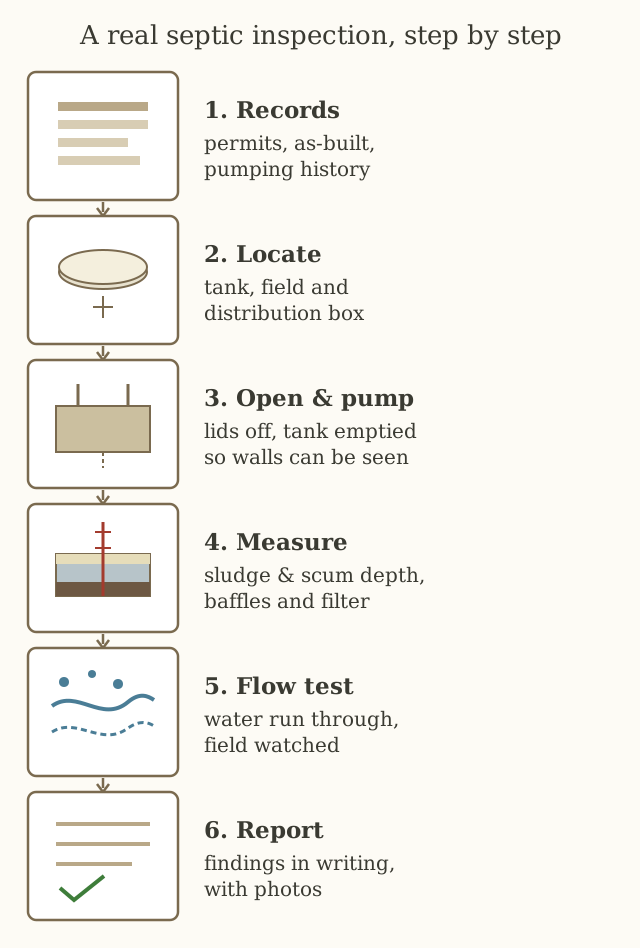
Buying a House With a Septic System? The Inspection That Can Save You $20,000
A standard home inspection barely touches the septic system. Here's what a real septic inspection includes, what it costs, the records to demand, and the contract wording that protects you.
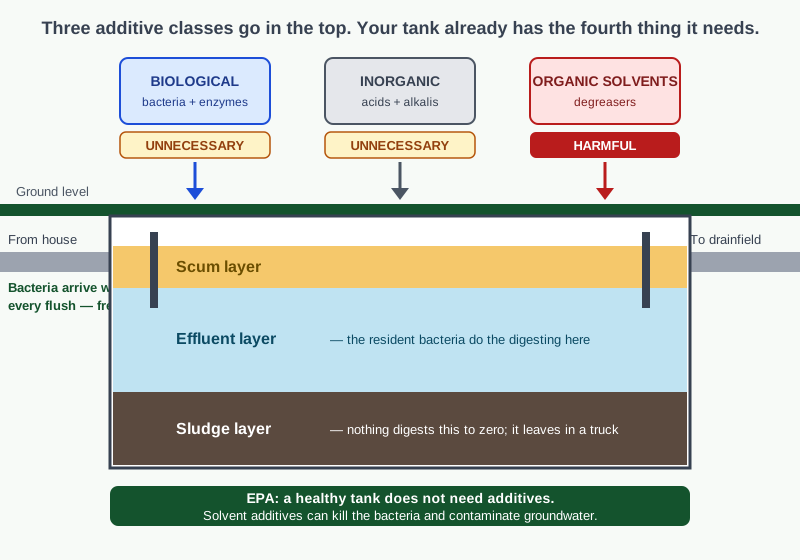
Do Septic Tank Additives Work? What the EPA and the Studies Actually Found
The EPA does not recommend septic additives, a 48-tank double-blind study found no measurable benefit, and one additive class is actively harmful. The evidence, the money maths, and the one narrow exception.
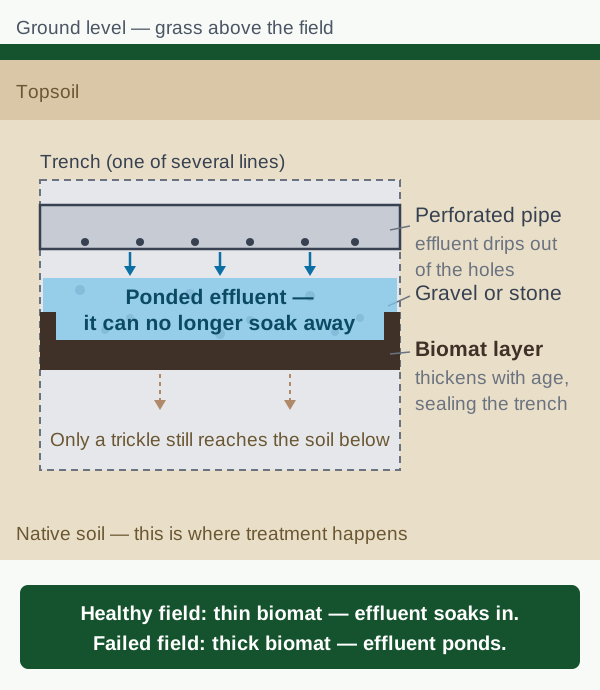
Drain Field Failure Signs: Soggy Ground, Green Stripes and Surfacing Effluent
A failing drain field announces itself in the yard first: lush green stripes, spongy ground, odors, then standing water. The early vs late signs, the look-alikes that aren't failure, a homeowner diagnosis sequence, and what repair or replacement really costs.