 Keep
Well Water Smells Like Rotten Eggs? Run the Hot-vs-Cold Test First
 Daniel Mercer · Editor & Researcher·
Published November 16, 2026·
Updated November 16, 2026
It usually arrives with the first shower. You turn the handle, the bathroom fills with steam, and underneath the steam is a smell you know from science class and swamps: rotten eggs. Or it greets you at the kitchen sink, in a glass of water you were about to hand a guest. Either way, if your house is on a well and the water smells like that, you have hydrogen sulfide — a gas, dissolved in your water, escaping the moment the water meets air.
Here is the part that saves you money: "hydrogen sulfide" is a description of the smell, not a diagnosis. That gas can be manufactured in three completely different places — inside your water heater, by bacteria living in your well and plumbing, or deep in the groundwater before it ever reaches your pump. The three fixes cost about $30, about $30 and a Saturday, and somewhere between $700 and $3,500 respectively. Owners get in trouble when they buy the third fix for the first problem. So before you price a single filter, run the test in the next section. It takes two glasses and five minutes, and it sorts nearly every case.
The hot-vs-cold test: run this before anything else
Hydrogen sulfide behaves differently depending on where it's made, and the difference shows up at your taps. Let the water sit unused for a few hours if you can — first thing in the morning is ideal, because the smell is strongest after water has been standing in the pipes and the tank.
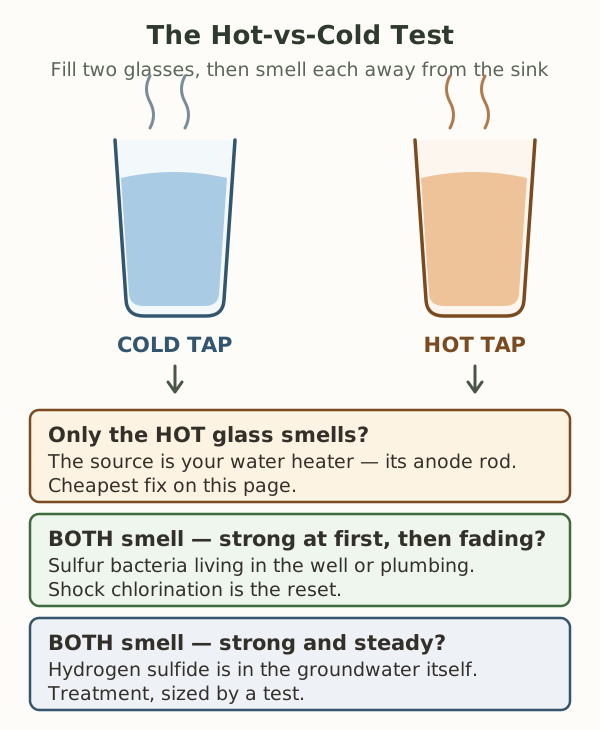
- Fill a clean glass from the cold tap. Walk it away from the sink — this matters, because a smelly drain will fool you — and smell it in another room.
- Fill a second glass from the hot tap, take it to the same spot, and smell that one.
- If both smell, run the cold tap for two or three minutes and fill a third glass. Note whether the smell is fading or holding steady.
Now read the results:
Only the hot glass smells. The gas is being made inside your water heater. Your well water is almost certainly fine. Skip to the anode rod section — this is the cheapest outcome on the page.
Both glasses smell, but the third glass is weaker. The smell is strongest in water that has been sitting still and fades as fresh water moves through. That's the signature of sulfur bacteria living in the well, the plumbing, or the heater — they produce gas while the water stands, and running the taps dilutes it. This is the pattern that's also worse after a vacation and first thing in the morning. Shock chlorination is your fix.
Both glasses smell, strong and steady, no matter how long the water runs. The gas is dissolved in the groundwater itself, arriving at full strength around the clock. No amount of cleaning the plumbing will change it. You'll need treatment, sized by a test — the last solution section below.
Two edge cases worth knowing. If the smell is at one sink only, and the water in a glass smells fine away from that sink, the source is usually biofilm in that drain, not your water — a drain cleaning problem, not a well problem. And if the smell is only on the softened water while the outside tap smells clean, bacteria have colonised the water softener — it needs disinfection, and the well may be innocent.
The three real sources of the smell
Source 1: your water heater's anode rod. Every tank water heater has a metal rod hanging inside it, designed to corrode so the tank doesn't have to. In most heaters that rod is magnesium, and magnesium does an unfortunate piece of chemistry: it helps convert sulfate — a harmless mineral present in much well water — into hydrogen sulfide. The warm, still water inside a tank is also a comfortable home for sulfur bacteria, which can run the same reaction. The result is a heater that manufactures rotten-egg gas all day and delivers it to every hot tap. The well gets blamed; the well is innocent.
Source 2: sulfur bacteria in the well or plumbing. Sulfate-reducing bacteria live wherever water is low in oxygen: down the well, inside the pressure tank, in the slime layer (biofilm) that coats pipes, inside water heaters and softeners. They feed on sulfate and give off hydrogen sulfide as waste. They are not a health threat in themselves — Penn State Extension and state health departments are consistent on that — but they are persistent, they slime up equipment, and they often travel with iron bacteria, the organisms behind orange slime in toilet tanks. Wells drilled into shale and sandstone seem to host them most, and a well that sits unused — a guest house, a slow season — gives them undisturbed time to multiply.
Source 3: the groundwater itself. Some aquifers simply carry hydrogen sulfide. Sulfur-bearing rock, buried organic matter, and nearby coal or oil formations can all load groundwater with the gas before it reaches any well. It may be there year-round or show up seasonally as water levels change. This is the source no cleaning can reach: the bacteria aren't in your plumbing, and the gas isn't made in your heater — it's in the water arriving at your pump, and the only answers are to oxidise it, filter it, or strip it out continuously as the water enters the house.
Is it dangerous? The honest version
Mostly, no — and it's worth being precise about why, because "rotten eggs" sounds like poison. Hydrogen sulfide is a poisonous gas at industrial concentrations, but in drinking water it has a built-in protection: your nose. Most people can smell it well below 0.5 mg/L, and it makes water so unpleasant that nobody can keep drinking it anywhere near a harmful dose. That's why there is no federal drinking-water standard for hydrogen sulfide at all — the EPA doesn't regulate it even as a secondary (taste-and-odor) contaminant, because the water rejects itself first.
Three honest cautions, though. First, the gas is harder on your house than on you: from about 1 mg/L it corrodes copper and brass, blackens silverware and fixtures, and stains laundry and porcelain. Second, in rare cases hydrogen sulfide in a well can be a fingerprint of sewage contamination — particularly in shallow or poorly sealed wells near a failing septic system — so a new smell, or one that suddenly gets stronger, earns a coliform bacteria and nitrate test, not just an odor fix. Third, the one situation to treat seriously is the smell in the air, away from running water. Natural gas is odourised to smell like rotten eggs on purpose. If a room smells of it and no tap is running, don't investigate — get everyone out and call the gas utility or 911 from outside.
The fixes, source by source
If only the hot water smells: swap the anode rod
This is the best deal in home repair. The part costs about $30, the job takes under an hour, and it permanently removes the reaction that makes the gas.
What to buy: an aluminium/zinc alloy anode rod (often sold as an "aluminium anode rod" — the zinc content is small, typically a few percent, and helps against the smell). Measure your heater's clearance above the tank before ordering: rods are 42–54 inches long, and if a ceiling or shelf is in the way, buy a flexible segmented rod instead. Check your tank's thread size too — most are 3/4-inch NPT, and the hex head is usually 1-1/16 inch.
The job:
- Turn the heater's breaker off (or set a gas heater to pilot). Close the cold-water supply valve to the tank.
- Open a hot tap somewhere in the house and drain a few gallons from the tank's drain valve — just enough to drop the water level below the rod, not a full drain.
- Find the rod's hex head on top of the tank. Break it loose with a 1-1/16-inch socket and a breaker bar. Factory rods are installed tight; this is the one step where a helper holding the tank steady earns their keep. (If there is genuinely no headroom, this is the step where a $200–$400 plumber visit is money well spent.)
- Pull the old rod out. If it's eaten down to a wire with knobs on it, it was due anyway.
- Wrap the new rod's threads with thread-seal tape, thread it in, and snug it down firmly.
- Close the drain valve and the open hot tap, reopen the cold supply, let the tank fill until water runs smooth from a hot tap (that purges the air), then restore power or relight the burner. Never power an electric heater before the tank is full — a dry-fired element dies in seconds.
While you're at it, disinfect the tank itself, because bacteria may be living in it independently of the rod: many owners drain and flush the tank fully at the same visit, and health departments describe flushing the heater with a chlorine solution for stubborn cases. And one firm warning: do not simply remove the rod and leave the hole plugged. The rod is what corrodes instead of your tank lining. Penn State Extension is explicit that running without one shortens the heater's life and will likely void its warranty. The alloy rod keeps the protection and stops the gas — that trade has no downside.
Give it two or three days of normal use. A hot-only smell that survives a new alloy rod and a tank flush is telling you the bacteria are upstream after all — move to the next section.
If both taps smell and it fades: shock chlorinate the well
Shock chlorination means flooding the well and every pipe in the house with a strong chlorine solution — extension services target roughly 50–200 mg/L of chlorine in the well water — holding it there long enough to kill sulfur bacteria in the casing, the pump, the pressure tank and the biofilm, then flushing it all out. It is the full procedure below, the one most guides gesture at and few print completely. It is a reset, not a cure: it kills what's there today, and if the groundwater keeps reseeding bacteria, the smell can return in months. Done carefully, though, it is the correct first move — and sometimes it holds for years.
Safety first, before any bleach:
- You will have no usable water for about 24 hours. Fill buckets and bottles for drinking, cooking and flushing first.
- Turn the well pump breaker off before opening the well, and keep it off whenever the cap is open and you're working.
- Bypass or switch off water treatment equipment — softener, carbon filters, RO units. Chlorine at this strength damages softener resin and carbon media. Check each unit's bypass valve now, not mid-job.
- Never mix bleach with anything except water — no vinegar, no ammonia, no descalers. Work outdoors or with ventilation, wear gloves and eye protection, and use fresh, unscented, plain household bleach (no "splash-less" or fragranced types; check the label says sodium hypochlorite, ideally around 8.25%).
- Plan the flush-out: hundreds of gallons of chlorinated water shouldn't go through your septic system in one slug or onto garden beds. The flush step below routes it through an outdoor hose to a driveway or gravel area.
Work out your dose. The standard extension recipe is about 3 pints of 8.25% bleach per 100 gallons of water standing in the well. To estimate that volume: a 6-inch casing holds roughly 1.5 gallons per foot of water column; a 4-inch casing about 0.65 gallons per foot. If your well is 200 feet deep with water standing 50 feet down, that's 150 feet of water — about 220 gallons in a 6-inch casing, so roughly 6½ pints (a little over 3 quarts) of bleach. Your well record or the cap sticker often lists depth and static water level. Don't agonise over precision — hydrogen sulfide and iron consume chlorine as it works, so err slightly high, and the recirculation step below tells you if you under-dosed.
The procedure:
- Prep the well. With the pump off, remove the well cap or seal. If the inside of the casing above the waterline is slimy or crusted, scrub it with a stiff brush — biofilm up there reseeds the well if you skip it. Inspect the cap and its seal; a cracked cap is an open door for bacteria, and replacing it may be why you're doing this twice.
- Dilute and pour. Mix your measured bleach into a clean 5-gallon bucket of water. Pour it slowly into the casing, splashing it down the inside walls so it washes the casing as it goes.
- Recirculate. Attach a garden hose to the nearest outdoor spigot, put the other end into the well casing, turn the pump back on, and run water from the hose back down the well for at least 30 minutes. This mixes the chlorine through the whole water column. Smell the water coming from the hose: you want a strong chlorine odour, like a swimming pool turned up. If you can't smell chlorine after 30 minutes, the well's sulfur and iron have consumed it — add another half-dose of bleach and recirculate again.
- Chlorinate the house plumbing. With the hose still in place, go inside and open each cold tap, one at a time, until you smell chlorine, then close it. Repeat with every hot tap (this draws chlorinated water into the water heater too), every shower, the washing machine (run it briefly on a fill cycle), the dishwasher, and any fridge line. Don't forget the tap farthest from the pressure tank.
- Let it sit 12–24 hours. Turn the pump off or simply don't use the water. This contact time is what kills bacteria inside biofilm; rushing it is the main reason shock treatments "don't work." Keep children and pets away from taps, and tag them if your household is forgetful.
- Flush the well out — outdoors. After the wait, run an outdoor hose (not into the septic system, not onto plants or lawn you care about) until the chlorine smell is gone from the water — this can take a few hours and several hundred gallons. Chlorine test strips from a pool store take the guesswork out: flush until they read zero.
- Flush the house. Open indoor taps, cold then hot, until no chlorine smell remains at each one. Run the washing machine and dishwasher empty for a cycle. Take the softener and filters out of bypass.
- Retest on a delay. Don't judge by the first glass — judge in a week. If you want lab confirmation (worth it if bacteria were the reason for shocking), wait 7–14 days after the chlorine is fully gone before sampling for coliform; testing too early can give a false clean result because residual chlorine is still suppressing bacteria.
If the smell is gone and stays gone, you're done for $15–$30 in supplies. If it returns within a few weeks, the bacteria are being continuously supplied — either a damaged cap or casing is letting surface organisms in (inspect, or have a well company inspect), or the groundwater itself carries the gas, which is the next section's problem. Repeated shocking more than a couple of times a year is a sign to stop bleaching and start treating.
If both taps smell, strong and steady: treat the groundwater
When the gas arrives dissolved in the groundwater, no cleaning helps — you have to remove gas from every gallon, continuously, as it enters the house. That means a treatment system, and the right system depends on how much hydrogen sulfide you have. So the first purchase is not a filter; it's a number.
Testing hydrogen sulfide has one quirk: it's a gas, and it escapes from a sample bottle on the way to the lab, so a standard mail-in panel will report little or nothing. The test has to be done in the home (a technician or a home test kit designed for H2S) or the sample must be chemically stabilised at collection. Ask any lab directly how they handle it before paying. While you're at it, get iron, manganese, pH and hardness on the same visit — sulfur rarely travels alone, and every treatment choice below depends on those numbers too.
With a concentration in hand, the extension-service ladder looks like this:
- Under about 1 mg/L — carbon. Activated carbon adsorbs low levels of the gas. A whole-house carbon filter (catalytic carbon lasts longer on sulfur duty) handles the smell at this level; a drinking-water-only cartridge is a stopgap that leaves the showers and laundry smelling. Expect to replace or re-bed the media every few years.
- About 1–6 mg/L — oxidation. The standard approach is to oxidise the gas into solid sulfur particles, then filter them out. Air-injection oxidation systems do this with a pocket of air in the tank and are commonly rated up to about 10 mg/L; manganese greensand filters are the older technology, effective up to roughly 2–3 mg/L on Penn State's figures and needing periodic regeneration with potassium permanganate. Oxidation also removes iron and manganese in the same pass, which is why it's the most common answer for real well water.
- Above about 6 mg/L — chlorination. A chemical feed pump doses chlorine (or hydrogen peroxide) into the water ahead of a retention tank, the gas and bacteria are destroyed, and a carbon filter then removes the particles and the chlorine taste. Penn State's guidance is that chlorination can handle any concentration and is the usual choice above 6 mg/L — and it's also the answer when bacteria keep returning after repeated shocks, because it disinfects continuously, not once.
One sizing warning from bitter experience: vendors quote the level their system handles under ideal conditions — low iron, neutral pH. High iron consumes oxidiser before the sulfur gets any, and low pH slows everything down. That's what the full test panel is for. A system quoted from a smell alone is a guess with a four-figure price tag.
What the fixes cost, side by side
The cost table at the top of this page is worth reading as a story: the price of the fix rises by a factor of a hundred depending on which of the three sources you have, and the test that tells them apart is free. An anode rod is about $30 in parts (a plumber will charge $200–$400 for the visit, the socket work and the guarantee). Shock chlorination is $15–$30 of bleach and strips if you do it yourself, $300–$600 if a well company does the same job — you're paying for the well-volume maths, the labour, and someone else spending the Saturday. Treatment is where the real money sits: $700–$1,800 for carbon at low levels, $1,200–$2,800 for an oxidation system in the middle range, $1,800–$3,500 for chlorine injection at the top — plus media replacement, salt-free but not maintenance-free, every few years. Every one of those numbers is a reason to run two glasses of water before you run a credit card.
The cost of waiting: what the gas does while you decide
Rotten-egg water won't poison you, which tempts people to file it under "someday." Meanwhile the gas is doing slow, billable damage, and it starts earlier than most owners expect.
Weeks: silverware and silver jewellery tarnish black. White laundry comes out of the wash faintly grey or yellow, and black specks can appear on fabrics where the gas reacts in the wash water. Guests notice the shower. You stop inviting them, or stop noticing — both are costs, just not invoiced ones.
Months: from about 1 mg/L upward, hydrogen sulfide is corroding copper pipe and brass fittings from the inside — the same chemistry that blackens a silver spoon thins a pipe wall. Fixtures pit and stain: black and green-black marks on porcelain and chrome that no cleaner fully removes, because the surface itself is etched. Inside the water heater, the gas and the bacteria that make it accelerate the anode rod's consumption — which is protective, that's its job — but once the rod is gone the tank itself starts corroding, and a heater that should have lasted twelve years is replaced at eight.
Years: pinhole leaks in copper lines, especially at joints and in the hot-water runs where the gas is most active. A pinhole behind a wall is no longer a water-quality problem; it's a water-damage problem with a plumber, a drywaller and possibly an insurance claim. Treatment equipment bought later also inherits the damage: sulfur bacteria established in biofilm throughout the plumbing take longer to clear, and the first shock or system install works less well than it would have in month one.
None of this is a reason to panic this weekend. All of it is a reason the two-glass test belongs on this week's list rather than next year's.
What will not fix it
A short list, because money is wasted here every day:
- A water softener alone. It doesn't remove hydrogen sulfide, the gas passes through, and bacteria can colonise the resin and make the softener itself the source. (A softener can sit after proper sulfur treatment. It just can't be the treatment.)
- A fridge filter or filter pitcher. These are small carbon cartridges meant for taste in city water. At well-water sulfur levels they exhaust in days to weeks, and they do nothing for the showers, the laundry or the pipes — where most of the damage happens.
- Removing the anode rod. Covered above: the smell may stop, the tank starts dying, the warranty likely goes with it. Swap the rod, don't delete it.
- A single jug of bleach poured down the well. Without the dose calculation, the recirculation and the 12–24 hours of contact through every pipe, you've perfumed the top of the water column and killed almost nothing. The procedure is the treatment; the bleach is just the ingredient.
- Scented anything, and "sulfur sticks" dropped in the toilet tank. Masking a smell that is also a corrosion warning doesn't stop the corrosion. You'd be paying to not know.
So how urgent is this, really?
Run the test this week. If the answer is the anode rod, you've found the cheapest real fix in this entire guide series, and an hour on Saturday ends it. If it's bacteria, shock chlorination is a planned weekend job, not an emergency call. If it's the groundwater, get the test done and get quotes with the numbers in hand — a month of smelly showers while you choose properly is better than a decade of the wrong system.
The two things that move this from "annoying" to "act now" are a change — a smell that's new, or suddenly much stronger, which earns a bacteria and nitrate test — and a smell that exists in the air with no water running, which is a gas-leak problem until proven otherwise. Everything else is a nuisance with a known cause, a known fix, and a price you now know how to keep at the low end of the table.
Cost at a glance
| Item | Typical cost | Notes |
|---|---|---|
| Water heater anode rod (DIY) | About $30 | The aluminium/zinc rod itself; a plumber charges $200–$400 to do the same swap |
| Shock chlorination (DIY) | $15–$30 | Unscented bleach, test strips and a Saturday; a well company charges $300–$600 |
| Whole-house carbon filter | $700–$1,800 installed | For low levels, under about 1 mg/L of hydrogen sulfide |
| Oxidation filter system | $1,200–$2,800 installed | Air-injection or greensand; the working range for roughly 1–6 mg/L |
| Chlorine injection + filtration | $1,800–$3,500 installed | For levels above about 6 mg/L, or bacteria that keep coming back |
Frequently asked questions
Why does my well water smell like rotten eggs?
The smell is hydrogen sulfide gas, dissolved in the water and released at the tap. It gets there three ways: a magnesium anode rod in your water heater converts sulfate in the water into the gas; sulfur bacteria living in the well, plumbing or heater produce it as they feed; or the groundwater itself carries it from sulfur-bearing rock and decaying organic matter underground. The hot-vs-cold test in this guide tells you which of the three you have — and each has a different fix.
Is rotten-egg water dangerous to drink?
At the levels found in almost all wells, no. Hydrogen sulfide has no federal drinking-water standard because it makes water smell and taste so bad that nobody can drink it long before it could reach a harmful dose — most people can smell it well below 0.5 mg/L. The honest cautions are different: the gas corrodes copper and brass plumbing, and in rare cases a new sulfur smell can accompany bacterial contamination, which is why a sudden change is a reason to test for coliform bacteria and nitrate, not just to fix the smell.
Why does only my hot water smell like rotten eggs?
Because the gas is being made inside your water heater, not in your well. The sacrificial anode rod in most tanks is magnesium, and magnesium reacts with sulfate in the water to produce hydrogen sulfide — especially in a warm tank where sulfur bacteria may also be living. Swapping the magnesium rod for an aluminium/zinc alloy rod, and disinfecting and flushing the tank, fixes the large majority of hot-only cases for about $30 in parts.
Will a water softener fix a rotten-egg smell?
No. A softener exchanges hardness minerals for sodium; hydrogen sulfide passes straight through it, and sulfur and iron bacteria can actually foul the resin bed and make the softener itself a source of odor. If your smell is present in both hot and cold water but only on the softened side, the bacteria are likely growing in the softener. A softener can sit after the right sulfur treatment in a treatment train, but on its own it is not a sulfur fix.
Can I just take the anode rod out of my water heater?
You can, and the smell may stop — but don't. The rod is sacrificial: it corrodes so your tank doesn't. Penn State Extension warns that removing it speeds up tank corrosion, shortens the heater's life and will likely void the warranty. Swapping magnesium for an aluminium/zinc alloy rod keeps the protection and removes the reaction that makes the gas. It's the same job with a $30 part, so there's no saving in leaving the hole empty.
I shocked my well and the smell came back. Why?
Because shock chlorination kills the bacteria that are in the well and plumbing today, and bacteria are very good at moving back in — from the aquifer, from biofilm the chlorine didn't fully penetrate, or from a heater or softener that wasn't disinfected with the rest of the system. Penn State Extension is blunt that the bacteria and the odor usually return. If one careful shock doesn't hold for more than a few months, the source is usually the groundwater itself, and continuous treatment (oxidation or chlorination) is the honest next step rather than a third and fourth bleach treatment.
How much does it cost to fix a rotten-egg smell in well water?
It depends entirely on the source, which is why the two-glass test comes first. A hot-only smell is usually a $30 anode rod. Bacteria in the well cost $15–$30 in bleach to shock chlorinate yourself, or $300–$600 to have done. Groundwater hydrogen sulfide needs treatment: roughly $700–$1,800 for a carbon system at low levels, $1,200–$2,800 for an oxidation filter at moderate levels, and $1,800–$3,500 for chlorine injection at high levels. Owners who skip the diagnosis routinely spend the $2,000 first and the $30 later.
Checked November 16, 2026. This guide is general information, not a substitute for a licensed professional.
Related guides
Air in Your Water Lines: Why Faucets Sputter on a Well
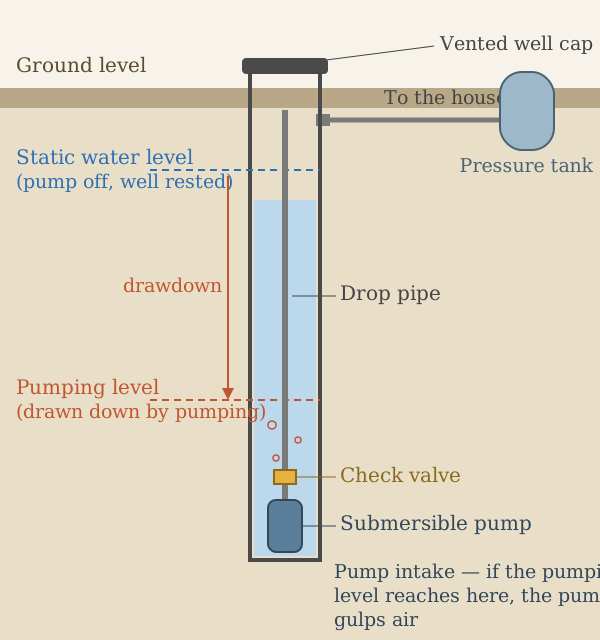
A sputtering faucet on well water is a symptom with a short list of causes — drawdown, a leaking check valve or drop pipe, a tired pressure tank, or dissolved gas. How the timing of the sputter tells you which one, the tests to run, and what each fix costs.
How Far Should a Well Be From a Septic Tank? Setbacks, Explained
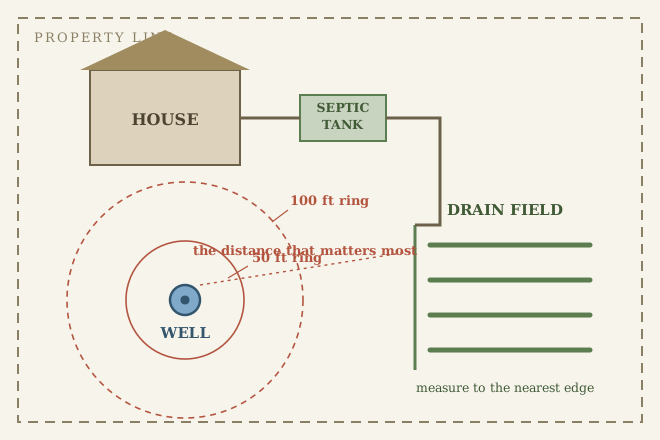
Most states want 50 feet between a well and a septic tank and 100 feet to the drain field — but the field is the distance that actually protects your water. How to measure yours, and what to do if it comes up short.
How to Shock Chlorinate a Well: Dose, Steps, and the Retest That Proves It Worked
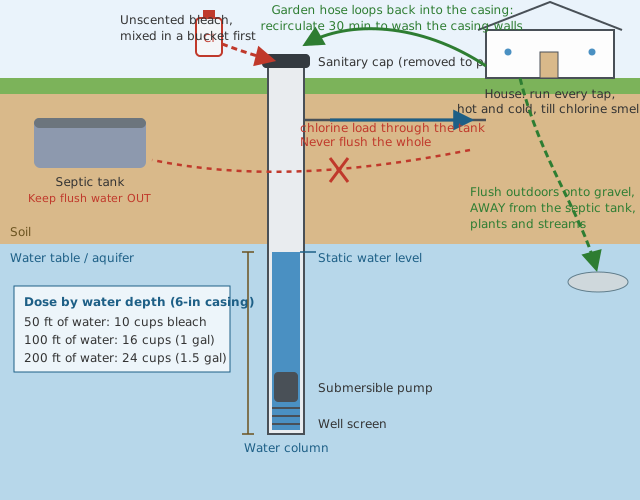
The full shock chlorination procedure: work out your bleach dose from the well log, bypass the softener, recirculate, hold, flush without wrecking your septic, and retest at 10 to 14 days.