 Keep
Well Water Turned Brown or Yellow After Rain? What Changed, and Whether It's Safe
 Daniel Mercer · Editor & Researcher·
Published November 16, 2026·
Updated November 16, 2026
It rarely happens on a calm Tuesday. You run the tap the morning after a night of heavy rain — the kind of storm that filled the ditches and left the yard shining — and the water comes out the colour of weak tea. Or you fill the bathtub for a child and the water against the white porcelain is plainly yellow. Last week it was clear. Nothing in the house changed, nobody touched the plumbing, and yet the water is brown.
If this is your first year in a house on a well, this moment has a particular flavour of dread, because a well is the one system nobody explained to you at closing. There is no water company to call. The good news is that this specific symptom — colour that arrives with a storm — is one of the most patterned events in well ownership. It has a short list of causes, a free test that separates most of them, and a clock that tells you whether you are watching weather or looking at a defect. What follows is that pattern, in the order you should work it: understand what the storm did, read the colour, decide the safety question, and only then spend anything.
What a storm actually does to a well
Your well does not draw from an underground lake sitting still beneath the house. It draws from water moving slowly through soil, sand, gravel and fractured rock, and a heavy rain changes that movement in three ways that all show up at your tap.
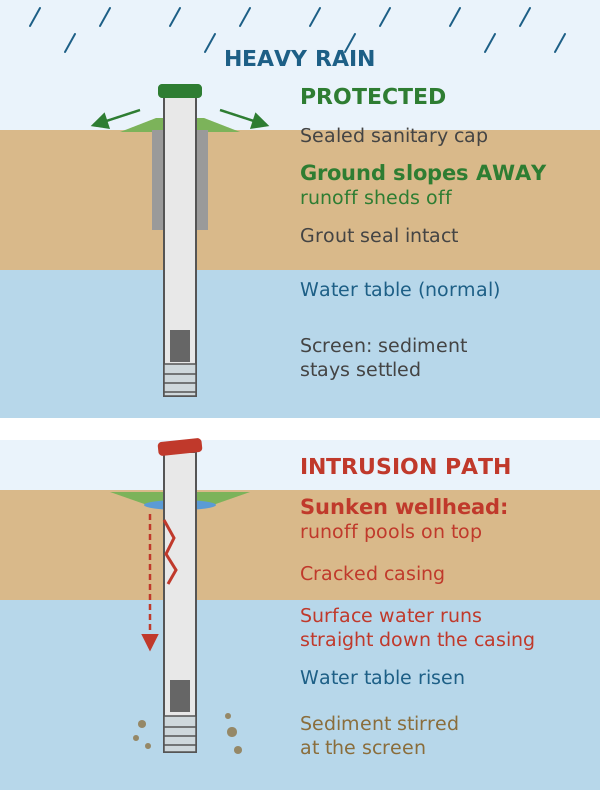
First, the water table rises. A long, soaking rain can lift the level of groundwater by feet, not inches, and your pump suddenly pulls from a zone that was above the water line last week — a zone where fine sediment, iron-rich water and tannin-stained water have been sitting undisturbed. Second, the water moves faster. Groundwater that normally creeps begins to flow with something closer to purpose, and flow scours. Fine silt and sand that had settled against the well screen get stirred up and pulled through it, the same way a creek runs muddy after rain while a pond stays clear. Third, and most important for the safety question further down, rain puts water on the surface that wants to go down. Runoff sheets across the yard, pools in every low spot, and presses on every opening the well has: the cap, the joint where the casing meets the ground, any crack in the casing above the water line. A well is a pipe into your drinking water with the top of the pipe in your yard. A storm is the one time of year that pipe is under real pressure from above.
Hold those three mechanisms apart, because they have different meanings. The first two — a risen, stirred aquifer — happen inside a perfectly healthy well and are no one's fault. The third is an intrusion path, a defect, and it is the one that can carry bacteria. The rest of this guide is mostly a method for telling which mechanism you are looking at.
The wells that answer every storm
Not every well reacts to rain, and knowing whether yours is the type that does will calibrate your worry before the next storm arrives. Shallow wells — and older dug or bored wells especially — draw from close to the surface, so they feel recharge within hours and show colour changes that a deep drilled well in the same neighbourhood never notices. Wells in low ground have the surface problem as well as the aquifer problem: the yard itself drains toward them, and every storm tests the cap and the grading. Wells with older steel casing carry a corrosion clock that plastic and stainless casing do not; a casing that was sound for thirty years can begin to admit water along a rusted seam in the thirty-first, which is why a colour change that starts in a well's later life deserves more suspicion than the same change in a young well. And wells downhill of a slope, a driveway or a neighbour's drainage inherit other people's runoff. None of these types is doomed — plenty of shallow wells run clear for decades — but if your well matches two or more of them, treat the wellhead inspection in the fix ladder below as an annual chore rather than a one-time check, and keep a bacteria test on your regular schedule instead of waiting for a symptom.
Season matters too, and it can save you a fright. Spring storms arrive on ground already saturated by snowmelt, so the water table is high before the rain starts and colour events are at their strongest and longest. Autumn storms wash through a season of fallen leaves, which is why tannin colour — the even tea shade in the decoder below — peaks in October and November on wooded lots. A mid-summer thunderstorm after a dry month, by contrast, mostly runs off hard ground and often changes nothing at the tap. Reading the season alongside the glass is part of reading the event.
The colour decoder: what the shade is telling you
Before any test, the colour itself is evidence — if you know how to read it. Fill a clear glass at the tap and look at the water against a white sink or a sheet of paper. Four patterns cover nearly every after-rain event:
| What you see | What it usually is | What confirms it |
|---|---|---|
| Yellow or pale gold, perfectly even, no particles | Dissolved iron, still in its invisible-until-air form, or tannins | The glass test below: it stays mixed and may darken slowly over hours as the iron meets air |
| Tea or weak-coffee colour, even, no sediment | Tannins — natural colour leached from decaying leaves and roots in shallow groundwater | Common after autumn storms and in wooded, low-lying lots; a lab panel shows low iron with colour present |
| Orange-brown or rusty, slightly cloudy | Oxidized iron particles, or silt stirred off the screen | The glass test: a fine rusty layer settles on the bottom of the glass within 20 minutes |
| Brown with visible grit, sand or flakes | Sediment — the well is pulling solids, not just colour | Grit you can feel between your fingers; sediment collecting in the toilet tank and faucet aerators |
| Black or grey-black specks | Manganese dropping out of solution | Specks that smear dark on a paper towel; the full picture is in our guide "Orange Stains, Black Specks, Brown Water: Iron and Manganese in Well Water" |
Two things about this table are worth saying plainly. The first is that yellow and tea colours that stay evenly mixed are dissolved substances — there is nothing solid in the water to settle out, which is why the glass test below separates them from the particle cases so cleanly. The second is that this post is about a change: water that has always run slightly yellow in a house with known iron is a chronic mineral question, and the iron and manganese guide above is the right tool for it. Water that was clear for months and turned with one storm is an event, and events are read with the safety branch and the clock, not with a treatment catalogue.
The glass-settle test, done properly
This is the same test well drillers use as a first sort, and it takes one glass and twenty minutes. Done carelessly it tells you nothing, so do it in this order:
- Sample the right water. Use the cold tap closest to where the well line enters the house — often a laundry tub or an outside spigot — and let it run one minute first, so you are testing well water and not water that sat in the pipes. Fill a clear glass or jar completely.
- Read it immediately. Note the colour and whether it is even or cloudy, and whether anything is visible floating or swirling. Photograph it against something white if you want a record to compare tomorrow; after-storm diagnosis is much easier with day-one evidence.
- Let it stand, undisturbed, for 20 minutes. Then read it again. A layer of fine sediment or rusty dust on the bottom means particles — silt or oxidized iron — and points to stirring at the screen. Colour that is unchanged and perfectly even means dissolved iron or tannins. Water that started clear and slowly clouds orange from the top down is dissolved iron oxidizing in the glass, which is normal behaviour for iron-rich water and not, by itself, a storm defect.
- Run the comparison. Fill a second glass from the same tap after running the water for five minutes. If the second glass is noticeably clearer, the colour lives in the water near the well or in the first draw — consistent with a stirring event that pumping is already clearing. If both glasses are identical after long running, the aquifer zone you are drawing from is coloured throughout, or something is entering continuously.
- Check the toilet tank. Lift the lid of the toilet nearest the entry point. Sediment and grit collect there quietly over days, so the tank shows you the average of what the well has been delivering, not just this morning's sample. A clean tank with a brown glass points to a brief event. A tank with a layer of grit says solids have been arriving for a while.
That is the whole diagnostic kit for step one. It costs nothing, and its results decide which of the next two sections matters more: the safety branch, or the clock.
The safety branch: the one question that outranks the colour
Here is the fact that should organise your thinking: an after-rain colour change is the classic first signal of surface water entering a well. Not proof — the stirred-aquifer explanation is more common — but the classic signal, and surface water is the one route by which coliform bacteria, including E. coli, reach a private well. The EPA's guidance for household wells after flooding runs on exactly this logic: when floodwater has been in contact with a well, you inspect the well, test the water for bacteria, and disinfect if the test or the flooding says you should. A colour change after a storm deserves the same decision tree, scaled to what actually happened at your wellhead.
Test for bacteria now — do not wait for the clock — if any of these is true:
- Floodwater, a flooded yard, or pooled runoff stood over or against the wellhead during the storm.
- The well cap is cracked, loose, missing screws, or buried at or below soil level.
- The colour arrived with grit, cloudiness, or a swampy or earthy smell that is new.
- Anyone in the house has stomach cramps, diarrhoea or nausea that began after the storm.
- The colour is getting worse with pumping rather than better.
The test to order is a total coliform and E. coli test from a state-certified lab or your county health department — typically $25 to $75, sampled exactly as the lab instructs, usually from a cold tap with the aerator removed. If it comes back positive for E. coli, stop drinking the water, use bottled water or water boiled for one minute, and disinfect the well — the full procedure is in our guide "How to Shock Chlorinate a Well: Dose, Steps, and the Retest That Proves It Worked" — then retest before drinking it again. If coliform shows up without E. coli, disinfect and retest the same way; coliform is the warning light even when it is not yet the fire.
Flush and watch instead if all of these are true: the wellhead stayed dry and visibly above any pooling, the cap is sound, the colour is the even yellow-brown kind with no grit and no new smell, and it is already improving hour by hour. Flushing means running an outside spigot or the tub tap for 15 to 30 minutes to pull the stirred water through — if your house is on a septic system, use an outside hose bib and let the water run onto the ground well away from the drainfield rather than sending hundreds of gallons through the tank. Then repeat the glass test. Improvement confirms the weather explanation; you can fold a routine bacteria test into your next scheduled testing, the way every well should be tested annually anyway, as laid out in "How to Test Your Well Water: What to Test, How Often, and What It Costs."
What you should not do is split the difference by buying a filter. A filter removes colour you can see and does nothing about bacteria you cannot, and in the intrusion case it deletes your warning sign while leaving the doorway open. Test first; filter later, if at all.
The 24–72 hour clock: when weather becomes a defect
A healthy well follows a predictable recovery after a storm, and the schedule is your cheapest diagnostic instrument. During the rain and for the first hours after, colour peaks — the water table is at its highest and the aquifer at its most stirred. Over the first day it should lighten noticeably, especially with normal household use, because every shower and flush pulls the stirred water out and draws in water from further away. By 48 hours most wells are nearly clear, and by 72 hours a sound well is back to its normal water entirely. Improvement does not have to be dramatic hour to hour; it has to be steady and in one direction.
The clock convicts a defect when any of these happen instead: the colour is the same or worse at the 72-hour mark; it clears, then returns in full after the next merely moderate rain; pumping makes it worse rather than better, which points at the screen or the pump stirring a failing zone; or grit keeps arriving in the toilet tank week after week. Any of those means something about the well itself has changed or was never right, and the candidates are a short, inspectable list. The cap may be cracked or its seal gone. The casing may be cracked above the water line, where you can sometimes see it, or the grout seal between the casing and the borehole may have failed, which you cannot see but which lets surface water run down the outside of the casing exactly as the diagram shows. The ground may have settled or been graded, by a previous owner or by years of erosion, so it now slopes toward the wellhead and ponds against it. Or the screen at the bottom may be deteriorating, letting formation sand and silt through in quantities the well never passed before. Every one of these is a known repair with a known price range, which is what the next section is for.
Keep a two-line storm log
If this is the first time your well has changed colour, start a log today — a note on the phone is fine — because a single event is an anecdote and three events are a diagnosis. For each storm, write down the date and roughly how much rain fell, when you first noticed the colour, what the glass test showed, and when the water ran clear again. Add one line for anything you found at the wellhead. That is all, and it takes a minute.
The log earns its keep in three ways. First, it runs the 72-hour clock honestly: memory compresses a worrying week into "it took forever," while the log shows whether clearing actually took 30 hours or 90, and that number is the difference between weather and defect. Second, it exposes the pattern that convicts an intrusion path — colour after every moderate rain, always starting within hours, always with the same grit — far more convincingly than any single bad morning. Third, if you do end up calling a well contractor, the log is the document that separates a targeted repair from an exploratory bill. A contractor who hears "it turns brown sometimes" starts from zero; a contractor handed dates, clearing times and glass-test results starts at the seal and the casing, which is where the answer usually is. Keep the log with your annual bacteria test results, and the two together become the maintenance history of the well — a file the next owner of your house will be quietly grateful for.
The fix ladder: match the repair to the cause
Work this ladder from the top; the rungs are ordered by cost, and most after-rain colour problems are solved on the first two.
Rung 1 — the wellhead itself. Walk out with a flashlight. The sanitary cap on top of the casing should be intact, tight, and vermin-proof, with its seal unbroken; caps crack with age and freeze-thaw cycles, and a replacement costs $15 to $50 and installs with basic tools in under an hour — it is the cheapest intrusion repair in all of well ownership. The casing should stand at least a foot above the ground; if soil, mulch or a garden bed has been built up around it, dig back to grade. Soil around the wellhead should slope away in every direction, and if it ponds, regrading that small area so water sheds off is a weekend job with a shovel and a load of fill. While you are there, look down the casing with the flashlight for a visible crack or a separated joint above the water line.
Rung 2 — the seal you cannot see. If the wellhead is sound and the clock still convicts the well, the likely path is down the outside of the casing: the grout seal that should fill the gap between casing and borehole has shrunk, cracked or was skimped at drilling. A well contractor confirms this with an inspection, sometimes including a down-hole camera, and reseals or repairs from the surface where the failure is shallow. Expect $500 to $1,500 depending on depth and access, and expect the job to take half a day to a day. A casing cracked deeper down is the serious version of the same repair, and in the worst case — an old, corroded steel casing — the honest quote may be for a liner or a new well; a contractor who raises that possibility should be able to show you the camera footage that justifies it.
Rung 3 — the screen and the pump. Colour that worsens with pumping and grit that never stops suggest the screen or the formation around it. A contractor can redevelop the well — surging and cleaning the screen to restore its filter action — or reset the pump higher if it sits too close to a silty bottom. This is firmly pro work: it involves pulling the pump, and a day of it typically runs within the same range as the grout repair.
Rung 4 — treatment, last and only for the chronic case. If the well is sealed, sound, and tests free of bacteria, but the water carries dissolved iron or tannins as its normal character, then and only then is treatment the answer: a sediment filter for particle cases, an oxidation filter for dissolved iron, sized from a lab panel. That decision, and the ladder of systems, is the whole subject of the iron and manganese guide linked earlier, and it starts with the same lab numbers you may already have from the safety branch.
Whatever rung you end up paying for, the quote should name the specific defect being repaired, the part or seal being replaced, and whether a bacteria retest is included afterward. "Well service, $800" on a single line is not a quote; a contractor who has actually diagnosed your well can itemize it without being asked twice.
What it costs, in the order you will actually spend it
The spending order in this guide is deliberate, and it is worth seeing whole. The glass test and the wellhead walk-around are free. The bacteria test, at $25 to $75, is the first money out and the purchase that decides whether this is a safety problem or a nuisance. Disinfection, if a test demands it, is $15 to $30 in bleach done yourself. The cap and grading fixes that close most intrusion paths sit between $15 for a DIY cap and roughly $800 for a contractor to regrade and extend a casing. The deep repairs — grout, casing, screen work — run $500 to $1,500, and they are the rung where getting a second quote pays for itself. Notice what is not on this list: a treatment system. In the after-rain scenario, treatment is the most expensive item on the menu and the one least likely to address the cause, which is why it sits at the bottom of the ladder instead of the top.
DIY or pro?
Everything in the diagnostic half of this guide is yours: the glass test, the toilet-tank check, the wellhead inspection, the flush, the cap replacement, the regrading. None of it touches the sealed parts of the well, and all of it is reversible. The line to respect is the casing itself. Opening the well, working on the pump, resealing grout, or repairing casing belongs to a licensed well contractor — partly because the tools are specialised, but mostly because a well is drinking-water infrastructure: a repair done with the wrong materials or without disinfecting afterward can seal contamination in as effectively as the original crack let it in. If you do open the cap for any reason, even just to look, the well should be disinfected before it goes back into service, which is one more reason the bacteria test comes first in every branch of this guide.
So, in what order should you act?
Run the glass test today and check the toilet tank while it settles. Walk out to the wellhead with a flashlight and read the cap, the casing height and the slope of the ground. Then let your two findings choose the branch: any sign of intrusion, flooding or illness means a bacteria test today; a clean wellhead and improving colour mean flush, watch, and hold the 72-hour line. If the clock runs out and the colour is still there, you are no longer dealing with weather — book the well contractor, hand over your glass-test notes and your photographs, and expect the conversation to start at the seal and the casing. Storms will keep coming every year of your life in this house. A well that shrugs them off in a day is doing its job; a well that answers every storm with brown water is telling you, in the only language it has, exactly where to look.
Cost at a glance
| Item | Typical cost | Notes |
|---|---|---|
| Coliform / E. coli bacteria test (certified lab) | $25–$75 | The first purchase after any suspicious colour change; many county health departments test for less. This decides whether you have a nuisance or a safety problem |
| Shock chlorination after a positive test | $15–$30 DIY / $300–$600 pro | Unscented bleach and a day of your time, or a well company's visit; only worth doing after a test says bacteria are actually present |
| Replacement sanitary well cap | $15–$50 DIY / $150–$350 pro visit | The cheapest intrusion repair there is. A pro visit usually includes a wellhead inspection, which is where the real value sits |
| Regrading soil and extending the casing above grade | $300–$800 | Well contractor work: soil built up to shed water, casing raised so the cap sits at least a foot above the ground and above flood level |
| Casing crack repair or grout reseal | $500–$1,500 | Depends on depth and access; a cracked casing that cannot be sealed is the rare case that points toward a liner or a new well |
Frequently asked questions
Why does my well water turn brown after heavy rain?
Rain recharges the aquifer fast. The water table rises, groundwater starts moving faster through the soil and rock, and that moving water stirs up fine sediment and carries extra dissolved iron and tannins toward your well screen. Your pump then pulls in water that looks brown or yellow even though nothing in the house changed. In a well with a sound cap, casing and grout seal, this is the aquifer reacting to weather, and it settles back to clear as the water table drops — usually within one to three days.
Is brown well water after rain safe to drink?
The colour itself is usually iron, sediment or tannins, none of which is a health hazard at these levels. The real question the colour raises is whether surface water is getting into the well, because surface water can carry coliform bacteria, including E. coli. If the wellhead stayed dry and above any pooling, the cap is intact, and the water clears within 72 hours, most owners keep using it while they arrange a routine bacteria test. If the wellhead was submerged, the cap is damaged, or anyone has stomach symptoms, do not drink it until a certified lab test comes back clear.
How long until well water clears on its own after a storm?
In a healthy well, expect the worst colour during the storm and the day after, then steady improvement each day, with clear water back within 24 to 72 hours. Light use speeds it along, because you are pumping the stirred water out and drawing fresher water in. Colour that is unchanged or worse after 72 hours, colour that returns after every moderate rain, or colour accompanied by grit is not clearing — it is telling you the well has an opening or a failing part, and the clock section of this guide walks through which ones to check.
Does brown water after rain mean surface water is leaking into my well?
Not always — a rising water table can stir sediment inside a perfectly sealed well. But it is the classic first sign of surface intrusion, so treat it as a prompt to check rather than a verdict. Walk out to the wellhead: is the cap cracked, loose or buried? Does soil slope toward the casing or pool around it? Is there a visible crack in the casing above ground? Any yes answer, or floodwater that covered the wellhead, moves you from watching to testing for bacteria right away.
Should I test my well water after flooding or very heavy rain?
Yes, if any of three things happened: floodwater or pooled runoff reached or covered the wellhead, the colour or taste change lasts beyond 72 hours, or the water changed in a new way — grit, a swampy smell, cloudiness that was never there before. Order a total coliform and E. coli test from a state-certified lab or your county health department, and sample from a cold tap after removing the aerator, following the lab's instructions. The EPA's after-flood guidance for household wells follows the same logic: inspect, test, and disinfect only when a test or flooding says you should.
Why is the water yellow but the colour stays in the glass instead of settling?
Because what you are seeing is dissolved, not solid. Yellow that stays evenly mixed in the glass is usually dissolved iron that has not met enough air to turn to rust particles yet, or tannins — natural colour from decaying vegetation, the same thing that makes tea brown. Neither settles, because there is nothing solid to settle. Orange-brown water that drops a layer of sediment in the glass is the opposite case: particles, usually oxidized iron or silt. The two cases point to different causes and different fixes, which is why the glass test comes before any spending.
Can I just put a filter on it and stop worrying?
A filter treats the symptom you can see, and if the cause is chronic dissolved iron, the right filter is a genuine fix — that is covered in our iron and manganese guide. But filtering first is a mistake when the colour arrived suddenly with a storm, because a filter does nothing about bacteria entering through a cracked cap or casing, and it can hide the colour change that was your only warning. Test first, fix any opening in the well, and filter last, once you know the colour is minerals and not a doorway.
Checked November 16, 2026. This guide is general information, not a substitute for a licensed professional.
Related guides
Air in Your Water Lines: Why Faucets Sputter on a Well
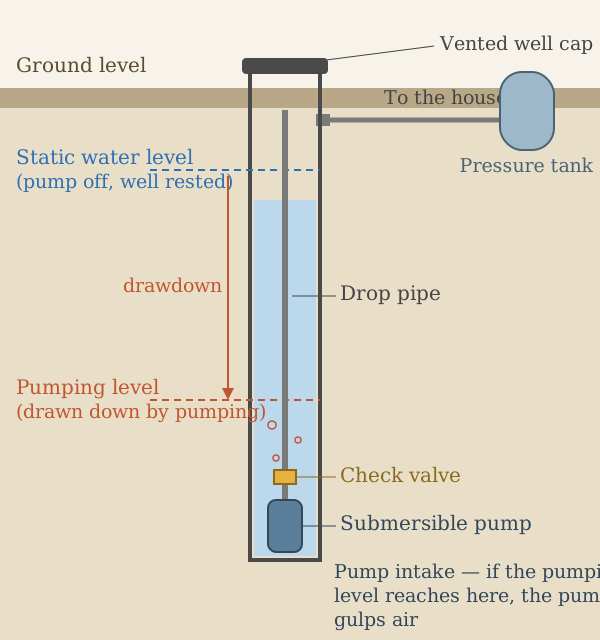
A sputtering faucet on well water is a symptom with a short list of causes — drawdown, a leaking check valve or drop pipe, a tired pressure tank, or dissolved gas. How the timing of the sputter tells you which one, the tests to run, and what each fix costs.
How Far Should a Well Be From a Septic Tank? Setbacks, Explained
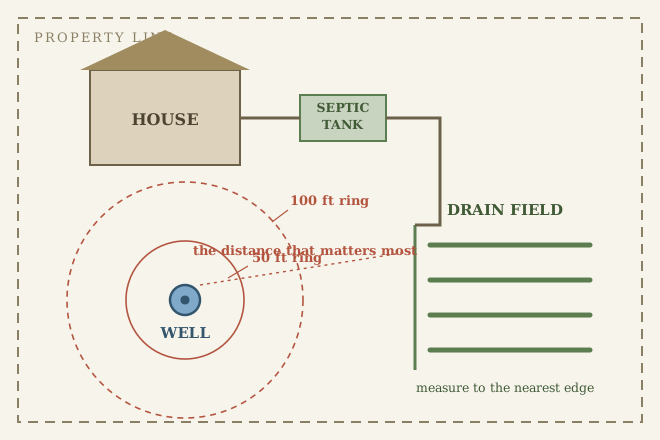
Most states want 50 feet between a well and a septic tank and 100 feet to the drain field — but the field is the distance that actually protects your water. How to measure yours, and what to do if it comes up short.
How to Shock Chlorinate a Well: Dose, Steps, and the Retest That Proves It Worked
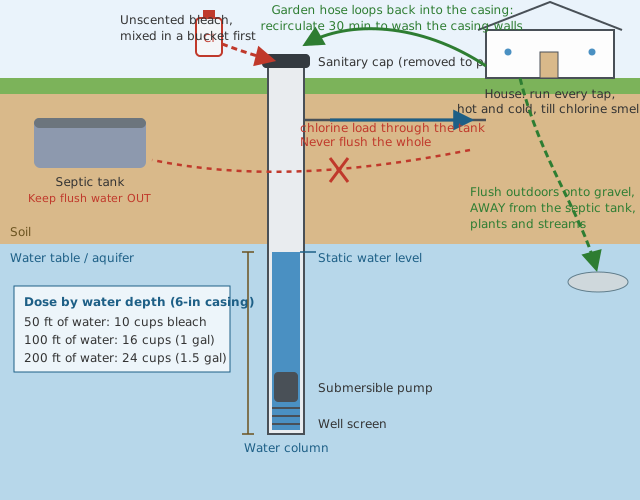
The full shock chlorination procedure: work out your bleach dose from the well log, bypass the softener, recirculate, hold, flush without wrecking your septic, and retest at 10 to 14 days.