 Keep
Well Pump Short Cycling: The Waterlogged Pressure Tank Test
 Daniel Mercer · Editor & Researcher·
Published November 16, 2026·
Updated November 16, 2026
Stand near your pressure tank when someone runs a shower and listen. Click — the pump starts. A few seconds of hum. Click — it stops. A pause shorter than the hum was. Click — it starts again. If your well system sounds like that, you don't have a quirky pump. You have short cycling, and it is quietly eating the most expensive part of your water system.
This is the failure pattern well technicians see more than almost any other, and the good news is real: the cause is usually not the pump. It's the tank — a part that costs a few hundred dollars, sits in plain sight in your basement or utility room, and can be tested in about a minute with nothing but a tyre gauge. In roughly six out of ten short-cycling cases, the tank has lost its air charge or its bladder has failed outright.
This guide walks the whole problem in order: what a healthy cycle sounds like, why the rapid-fire version destroys pumps, the causes ranked from most to least likely, and the fixes — starting with a test that takes sixty seconds and a repair that can cost nothing at all.
What a healthy cycle actually looks like
Your pump is not trying to feed your faucets directly. It's trying to keep a tank charged between two numbers, and a small grey box — the pressure switch — enforces them. The low number is the cut-in: when pressure in the tank falls to it, the switch closes and the pump starts. The high number is the cut-out: when the pump has pushed pressure up to it, the switch opens and the pump stops. Nearly every home system runs one of three pairs: 30/50, 40/60, or an older 20/40. The 20-point spread between the numbers is standard.
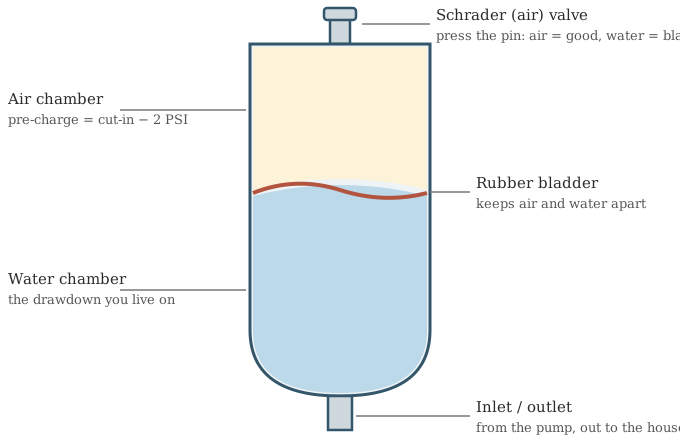
The tank is what makes the system civilised. Inside a modern tank is a rubber bladder. Water lives on one side of it, a cushion of compressed air on the other. The pump pushes water in and squeezes the air; you open a tap and the squeezed air pushes water back out — no pump required. The amount of water the tank hands you between cut-out and cut-in, before the pump has to start again, is called drawdown. A healthy tank delivers several gallons of it.
So a healthy cycle sounds like this: a tap opens, water flows from the tank's stored pressure, and for a while nothing happens at all. Then the pump starts, runs for a minute or more — filling the tank while you keep using water — clicks off, and rests. Someone flushing a toilet might start the pump on a smaller tank, and that's fine. Starts are measured in minutes, not seconds.
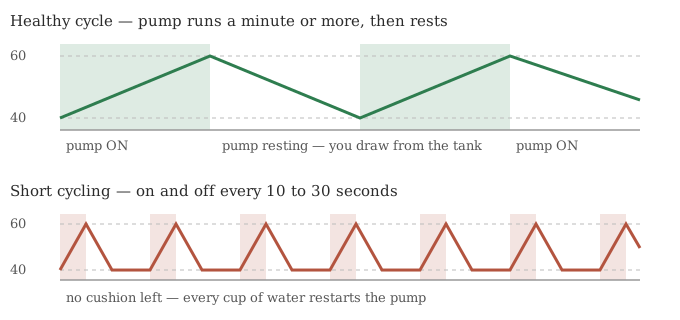
Short cycling is what happens when the drawdown collapses to nearly nothing. The pump pushes pressure to cut-out in seconds because there's no air cushion to compress. You draw a cup of water, pressure falls straight back to cut-in, and the pump fires again. On, off, on, off — every 10 to 30 seconds, for as long as water is being used anywhere in the house. The faucets may pulse or spit along with it, and the lights can flicker faintly with each start.
That distinction matters, because owners often describe two different problems with the same words. "The pump runs every time we use water" can be perfectly normal. "The pump starts and stops every few seconds while the water is running" never is.
Measure your own cycle before you touch anything
Five minutes of watching saves most of the guessing in this guide, and it gives you the two numbers everything else depends on. You need the pressure gauge — a round dial on the pipe at the tank tee — and your phone's stopwatch.
Stand at the tank and have someone open a tap somewhere in the house, a bath tap ideally, since it draws hard. Watch the needle fall. The pressure at which the pump clicks on is your cut-in; write it down. Keep watching as the pump runs and the needle climbs: the pressure at which it clicks off is your cut-out. Now time two things — how long the pump ran, and how long it rests while the tap is still open before it has to start again.
A healthy system gives you a run of a minute or more and a rest of a minute or more. A short-cycling system gives you runs and rests you can count on your fingers. Also count starts over one full shower if you want the number that concentrates minds: a system starting forty times for one shower is doing in a morning what a healthy system does in a week.
Write the cut-in number on a strip of tape and stick it on the tank. Every test that follows — the pre-charge target, the switch settings, a future technician's first question — starts from that number, and six months from now you will not remember it.
Why every start is wear — and this is how pumps die young
A pump motor's hardest moment is the instant it starts. For a fraction of a second it draws several times its running current, the windings heat sharply, and the whole assembly takes a small mechanical jolt. Motors are built to shed that heat during the run that follows — which is why manufacturers expect a minimum run time of about a minute per start, and why a system is sized so the tank's drawdown guarantees it.
Short cycling breaks the bargain twice over. The starts come dozens of times an hour instead of a handful of times a day, and each run is too short to cool what the start heated. The motor cooks slowly. Meanwhile the pressure switch — a set of electrical contacts snapping open and closed under load — arcs a little at every cycle, pitting and blackening the contact faces until the switch itself starts to chatter or weld. The check valve takes a hammering of pressure reversals. Nothing about the pattern is sustainable; something in the chain is on a countdown.
The arithmetic is why this guide keeps calling a tank problem cheap and a pump problem not. A pressure tank runs a few hundred dollars. A submersible pump replacement, pulled from the well and refitted, typically runs $1,500 to $3,500 or more — and over $2,500 is common as of 2026. A pump that should have lasted 10 to 15 years can be finished in a single season of being started every twenty seconds. Short cycling is the tank asking for help in the only language it has, before the bill moves down the well.
To put a scale on it: motor manufacturers rate their well motors for a maximum number of starts per day — on the order of a hundred for smaller motors, fewer for larger ones, spread across the day with cooling time between. A healthy household system starts perhaps ten to thirty times a day and never thinks about the limit. A short-cycling system can pass a hundred starts before breakfast. Stand at the tank during one shower and count, if you want to know which household you are: every start you hear is a withdrawal from an account that does not refill. The pressure switch keeps a parallel account of its own — its contacts are typically rated in the tens of thousands of operations, a budget that normal service spends over a decade and short cycling spends in a season. When owners say a short-cycling system "ate a switch, then ate the pump," that is not bad luck. It is the same arithmetic, collected twice.
The causes, ranked — start at the top
Short cycling is a symptom with a short list of causes, and the order below is deliberate: most likely first, and cheapest to check first. It matches the list in the pump manufacturers' own service manuals — Goulds' manual, under "pump starts too frequently," names a waterlogged tank, a broken check valve, improper switch settings, leaks in the piping, and a tank too small for the pump.
1. A waterlogged tank (the large majority of cases). The air cushion is gone. In a bladder tank, the rubber ruptures or develops a pinhole after years of flexing, and water floods the air side until the tank is essentially a steel can full of water. In an older galvanised tank with no bladder, air and water sit in direct contact and the air slowly dissolves into the water and gets carried away down the pipes. Either way: no spring, no drawdown, instant cycling.
2. A low air pre-charge. The bladder is intact but the air charge has drifted below where it belongs. Cycling is faster than it should be but not the every-few-seconds extreme. This is the free fix — if the tank then holds its charge.
3. A failing pressure switch. Pitted or burnt contacts can make the switch chatter. A switch whose cut-in and cut-out have drifted too close together shrinks the drawdown from the other direction. The part is cheap ($15–$50) and near the top of the "most replaced component in the system" list.
4. A tank too small for the pump. Classic after a pump replacement: a stronger new pump refills the old small tank in seconds. The system was mismatched the day the pump went in.
5. A leak. A leaking toilet flapper, a dripping line, a failed check valve letting water bleed back down into the well — the pump cycles to replace water nobody used. The tell: cycling when every tap in the house is closed.
6. A failing check valve. The valve that's supposed to hold pressure in the system lets it fall backward toward the well, so pressure decays and the pump restarts to make it up — again, often with nobody using water.
Causes 1 and 2 live in the same place and are separated by one test. Do that test before you buy anything.
Two impostors to rule out first
Two complaints get mistaken for short cycling constantly, and both send owners shopping for tanks they don't need.
The pump starts every time someone flushes. On a small tank — and builders fit small tanks — one flush can use most of the drawdown, so the pump starting for each flush is arithmetic, not failure. The difference is what the pump does next: a healthy start is followed by a run of a minute or so, then quiet. If every start is a proper run, your system is undersized at worst, not broken. (Undersized is still worth fixing at replacement time, but it's a preference, not a countdown.)
Pressure fades at the tap but the pump runs steadily. If the pump starts and then runs continuously while pressure stays low, that's not cycling at all — the pump is working and losing. Suspects live elsewhere: a worn pump, a falling water level in the well, a clogged screen or filter. This guide won't fix it, and the tank tests below will all come back normal, which is itself the clue.
Step 1: The Schrader test — sixty seconds, no tools but a fingernail
On top of your pressure tank is a small air valve under a plastic cap. It's a Schrader valve, identical to the valve stem on a car tyre, because the air side of your tank is, in effect, a tyre that never rolls anywhere.
Unscrew the cap. Press the little pin in the centre, briefly — a fingernail, a key, the tip of a pen. Just a split second.
- Dry air hisses out. Good news. The bladder is probably intact and still separating air from water. Your problem is likely a low charge (cause 2), and the re-charge procedure below is your fix.
- Water spits or sprays out. The bladder has ruptured. Water is never supposed to be on the air side of that valve. No adjustment fixes this; the tank is replaced. Skip to the replacement section — and don't feel bad about it: a bladder tank that dies this way at ten-plus years old has done its service.
Two supporting checks while you're standing there. Knock on the tank, working up the side with your knuckles: a healthy tank sounds dull at the bottom, where the water is, and rings hollow toward the top, where the air sits. A waterlogged tank sounds dull and dead all the way up. And rock it gently / judge its weight — a tank that feels like a solid block of water, far heavier than its size suggests, is telling you the same story. Neither check is proof on its own. Together with water at the valve, they're conclusive.
One caution before you go further, because it runs against instinct: if the tank has lost its charge, don't just pump air in and walk away satisfied. Amtrol's manual for the Well-X-Trol line is explicit that a tank which has lost charge and started cycling fast should be checked properly, not blindly topped up — a bladder with a pinhole will take air, behave for a week or two, and be flat again. The re-charge below includes the follow-up check that separates "drifted low" from "dying."
Step 2: The full re-charge procedure
This is the correct sequence, in order. Skipping steps is how people get nonsense readings — the single most common mistake is putting a gauge on a tank that's still full of water and reading the plumbing pressure instead of the air charge.
What you need: a tyre pressure gauge (a dial or digital one reads more accurately than a pencil stick), a bicycle pump or small compressor, a garden hose, and a bucket's worth of patience.
- Find your cut-in number first. Watch the pressure gauge near the tank while someone runs water. Note the pressure at the moment the pump clicks on — that's cut-in. Note where it clicks off — cut-out. If nobody's home to run water, the switch cover often has the rating printed inside (30/50 and 40/60 are the usual suspects). Your target pre-charge is cut-in minus 2 PSI: 28 for a 30/50 system, 38 for 40/60, 18 for 20/40.
- Turn the pump off at the breaker. Not the switch on the wall — the breaker. You're about to drain the system and work around a pressure switch with live contacts.
- Drain the tank. Attach a hose to the drain valve at the tank tee (or open the lowest faucet in the house) and run the water out. Open a nearby faucet to break the vacuum and let it drain fully. Wait until the flow stops and the system pressure gauge reads zero. The tank should now feel noticeably lighter, and knocking near the bottom should sound less dead.
- Read the air charge. Press the tyre gauge firmly onto the Schrader valve. Whatever it says now is the true pre-charge — this is the only moment in the whole procedure when the number means what you think it means.
- Set it to cut-in minus 2. Reading low? Add air with the pump or compressor, a little at a time, re-checking as you go. Reading high (it happens, usually someone else's earlier guess)? Press the pin and bleed air off. Land on your number — 28, 38, or 18 for the common switches.
- Close the drain, restore power, and watch a full cycle. Close the faucet you opened, shut the drain valve, flip the breaker. The pump will run to refill the tank — this first run should be a long one. Then have someone draw water slowly and time the cycle: you want a run of at least a minute, and a rest while water is drawn. If the rhythm diagram at the top of this guide now looks like the top timeline instead of the bottom one, you've fixed it.
- Mark the date on the tank with a marker, and re-check in two weeks. This is the step that separates a fix from a reprieve. Repeat the drain-and-read on a day you choose, two weeks out. Charge still at your number? It had simply drifted — done, and put an annual check on the calendar. Charge fallen again? The bladder has a pinhole. The tank is on its way out; plan the replacement on your schedule instead of the pump's.
Why 2 PSI below cut-in, rather than equal to it? If the air charge matched or exceeded cut-in, the tank would push its last water out and sit empty of usable water right around the moment the pump starts — you'd get a gulp of air-side hesitation and a pressure sag at the taps on every cycle. Two pounds below keeps a small cushion of water in the tank at cut-in, so the handoff from tank to pump is seamless.
Step 3: Inspect the pressure switch
If the tank holds its charge and the cycling persists, the next suspect is the switch — the small grey or black box on the pipe near the tank, with the wires going in. Switches are wear items; a service life around ten years is normal, and they are the most frequently replaced component in the whole system.
Safety first, and this part is not decoration: the switch carries full mains power on exposed terminals under its cover. Turn the breaker off before the cover comes off, every time.
With the cover off and the power off, look for:
- Contacts blackened, pitted or rough. Every cycle arcs a little; a switch that has lived through months of short cycling may be visibly burnt. Pitted contacts chatter — they make and break contact erratically — and chattering looks exactly like short cycling because it is short cycling, caused electrically instead of hydraulically.
- Ants and debris. It sounds like a joke until you've seen it: insects nesting in switch housings are a genuinely common cause of erratic switching in rural installations.
- A clogged sensing nipple. The switch reads pressure through a small pipe stub beneath it. Sediment and rust can plug that stub, so the switch sees pressure late and wrong. If the gauge on the tank tee and the switch's behaviour disagree, this is a prime suspect.
- Drifted settings. Watch the gauge through a cycle with the power back on and the cover still off (hands clear). Cut-in and cut-out should sit about 20 PSI apart — 30/50, 40/60. A spread that has narrowed to 10 points will cycle fast on a healthy tank.
Adjustment, if you must: the large nut on the main spring raises or lowers both numbers together; the smaller nut on the differential spring changes the cut-out only. Turn in quarter-turns, and re-check the tank's pre-charge afterwards, because moving cut-in moves your target. Honestly, though: a standard switch costs $15 to $50, and a switch old enough to be misbehaving has usually earned retirement. Replacement — same rating, power off, wires photographed before you touch them — is the repair most well owners rate as an easy DIY, and $150–$400 if a pro does it on a call-out.
Step 4: The leak hunt, if the tank and switch are innocent
The pattern that points here is specific: the pump cycles when nobody is using water. A healthy system at 3 a.m. is silent for hours. If yours clicks on through the night, water is leaving the pressurised side somewhere, and the pump is replacing it.
Work through the cheap suspects in order:
- Toilets. A silently leaking flapper is the number-one indoor water thief. A toilet that refills itself briefly every so often is not a well problem at all — but it will cycle your pump exactly like one. Lift the tank lid and watch, or put food colouring in the tank and check the bowl in twenty minutes.
- The check valve. This one-way valve holds system pressure from bleeding back down into the well. Watch the pressure gauge with everything off and nobody drawing water. If the needle sinks steadily toward cut-in with the house using nothing, pressure is escaping backward (failed check valve or a leak in the drop pipe) or outward (a plumbing leak). A failed check valve down in the well means pulling the pump to reach it — that's where this stops being DIY.
- The pipes themselves. Walk the visible plumbing — under the house, along the basement ceiling, out to any barn or outdoor tap — looking for damp, drips, and the green crust of a slow copper leak. Check the yard line too: a soggy patch between house and wellhead in dry weather is a confession.
- The tank tee fittings and the drain valve. A weep at the tank's own manifold loses pressure inches from the switch.
A note on what the gauge is telling you, because it separates causes 5 and 6 from causes 1 and 2: tank problems cycle the pump while water is running. Leaks and check valves cycle it while nothing is running. Half of diagnosis is just standing there long enough to learn which one you have.
When the tank itself has to be replaced
If water came out of the Schrader valve, or the tank won't hold a charge across two weeks, the verdict is in: bladders in sealed tanks cannot be repaired or replaced in the field. The tank gets swapped.
The job itself is straightforward plumbing — drain the system, disconnect the tank tee, set the new tank, set its pre-charge to cut-in minus 2 before it's plumbed in (manufacturers ship tanks pre-charged to a standard figure that may not match your switch), reconnect, refill, watch a cycle. A pro typically has it done in about two hours. Realistic money: a 20–32 gallon tank runs $200–$450 for the part and $400–$900 installed; step up to 44–86 gallons and you're at $450–$1,100 for the part, $800–$2,200 installed at the top end. A quality bladder tank should then give you 10 to 15 years.
Sizing, briefly, because this is the moment to get it right. Tanks are sold by total volume, but what you live on is drawdown — the water delivered between cut-out and cut-in, roughly a quarter to a third of the sticker size on a typical 20-point spread. The working rule is drawdown enough to guarantee the pump at least a minute of run time: a 10 GPM pump wants at least 10 gallons of drawdown, which means roughly a 40-gallon-class tank, not a 20. If your old tank was marginal and the pump is strong, replacing like-for-like rebuilds the same problem with newer parts. Upsizing at replacement time is the cheapest pump-life insurance in the whole system — the difference in part price between sizes is small next to a pump replacement.
Also check the obvious while the system is drained: if your old tank was a galvanised non-bladder type, the replacement will be a bladder tank, and it will need its charge checked on the annual cycle rather than the old tank's habit of slowly dissolving its air away.
Three questions worth asking whoever quotes the job. First: will you set the pre-charge to my switch, on the record? A tank installed at its factory charge on the wrong switch setting recreates fast cycling with brand-new parts, and it happens more often than it should. Second: what drawdown does this size actually give me at my pressures? — a question that separates installers who size from installers who swap. Third: what's the warranty, and is it parts-only or parts-and-labour? Tank warranties commonly run five to seven years on the vessel; the difference between a parts warranty and one that includes the return visit is real money in year four. Get the model, the charge setting and the date written on the invoice, and copy the date onto the tank itself with the same marker you used for your cut-in number.
The upgrade nobody mentions: cycle-stop valves and constant pressure
If you're tired of the whole start-stop bargain, there is a different way to run a well, and short cycling is often the moment owners discover it.
A cycle-stop valve (CSV) is a mechanical valve fitted between the pump and the tank that holds pressure nearly constant while water is being used. Instead of the pump charging the tank, banging off, and restarting with every draw, the valve throttles the pump's output to match what the house is using, so the pump starts once, runs steadily for the whole shower, and stops when the taps close. Run time stretches from seconds to minutes — exactly what the motor wants. Because the valve does the pressure-holding work, it pairs happily with a much smaller tank. The valve itself runs $100–$250, and $400–$800 fitted is a fair expectation. For a house whose tank has just died, "small tank plus CSV" is a legitimate alternative to "big tank," often at similar money.
The electronic version of the same idea is a constant-pressure system: a variable-frequency drive (or a pump with one built in) that speeds the pump up and down to hold one steady pressure, soft-starting every time — no start-up jolt at all. These run more like $1,500–$3,500 installed, sometimes as part of a pump replacement, and they suit owners who hate pressure swings in the shower, run irrigation, or are replacing the pump anyway and want the next one to live an easy life.
Who shouldn't bother: if your tank simply drifted low and a free re-charge restored a lazy, minutes-long cycle, your system is fine as designed. The upgrades earn their money on houses with big demand swings, undersized tanks that can't practically be upsized, or owners replacing equipment anyway.
What a pro does if your checks come up empty
Suppose the tank holds air, the switch is clean and correctly set, nothing leaks — and the pump still cycles fast. You've eliminated the causes that live above ground, and what remains lives down the well or in the numbers: an oversized pump on an undersized tank (a sizing verdict, reached with the pump's flow rate and the tank's actual drawdown), a check valve down the hole that's bleeding pressure back, or a pump whose output has changed. A well technician will put an ammeter on the pump, time cycles against a measured draw, test the down-hole check valve by watching pressure behaviour under isolation, and calculate the drawdown your tank actually delivers versus what its label promises. If the down-hole check valve is the culprit, the pump has to come up — expect that job to run $800–$1,500, most of it labour for the pull. This is the point where the diagnosis is worth paying for: the parts cannon gets expensive fast down a well.
Keeping it fixed: the ten-minute annual check
Every failure in this guide announced itself in the air charge months before it announced itself in the cycling. Bladders don't usually go from perfect to ruptured overnight; the charge drifts, a pinhole starts, the cycles shorten by degrees. An annual check catches the drift while the fix is still free.
Once a year — pick a date you'll remember, the same weekend you check the septic filter or change the smoke-alarm batteries — do the short version of the re-charge procedure: breaker off, drain the tank, gauge on the Schrader valve, compare against the number on your tape. At target? Close up and you're done in ten minutes. A couple of PSI low? Top it up and note it; a tank that needs a little air every year is ageing normally. Five or more PSI low, or low again after last year's top-up? That's the pinhole pattern, and you can start pricing a replacement on your own schedule, in daylight, instead of during a no-water weekend with the pump already damaged.
Amtrol's guidance for its own tanks is the same idea from the manufacturer's side: have the pre-charge checked yearly rather than waiting for symptoms. Ten minutes, once a year, is the entire maintenance contract for the hardest-working cushion in your house.
The costs, all in one place
- Re-charge the tank air yourself: $0. A tyre gauge and a bike pump; $100–$300 if a pro's call-out does it.
- Pressure switch: $15–$50 for the part; $150–$400 installed.
- New tank, 20–32 gal: $400–$900 installed.
- New tank, 44–86 gal: $800–$2,200 installed.
- Cycle-stop valve: $400–$800 fitted.
- The bill you're avoiding — a pump killed by cycling: $1,500–$3,500+.
Read that list from the bottom up. Short cycling is one of the rare home problems where the diagnosis is free, the most likely fix is free, the second most likely fix is a few hundred dollars — and the cost of ignoring it is the most expensive line on the page. There is no version of this problem where waiting saves money.
Urgency: this week, not this quarter
Nothing here is flooding your basement, and your water still runs — that's exactly why short cycling gets ignored for months, and why pumps die of it. The honest timeline: a pump in good health will tolerate a few days of this while you run the tests. It will not tolerate a season. Every day of rapid cycling spends motor life at perhaps fifty times the normal rate, and the failure it causes doesn't arrive as a warning — it arrives as no water at all, usually at the least convenient moment, followed by the $1,500–$3,500 conversation.
So: do the Schrader test today; it takes a minute. Re-charge this week if air is all you find. If water comes out of that valve, book the tank replacement while the pump is still healthy enough to forgive you. And once it's fixed, write the date on the tank and check the charge once a year — drained, gauge at zero, cut-in minus two. Ten minutes annually is the whole price of never hearing that click-click-click again.
Cost at a glance
| Item | Typical cost | Notes |
|---|---|---|
| Re-charge the tank air (DIY) | $0 | Tyre gauge plus a bike pump or compressor. A pro service call to do the same thing runs $100–$300 |
| Pressure switch replacement | $150–$400 installed | The part alone is $15–$50 (a standard Square D switch); the rest is the call-out and labour |
| New pressure tank, 20–32 gal (installed) | $400–$900 | Part $200–$450. The size range most houses actually need |
| New pressure tank, 44–86 gal (installed) | $800–$2,200 | Part $450–$1,100. Bigger drawdown, fewer starts, longer pump life |
| Cycle-stop valve fitted | $400–$800 | The valve itself is $100–$250; makes a small tank behave like a large one |
Frequently asked questions
How do I know if my pressure tank is waterlogged?
Three quick signs. The pump starts and stops every few seconds while water is running. The tank feels heavy and sounds dull when you knock on it all the way up the side — a healthy tank rings hollow near the top, where the air sits. And the giveaway: press the pin on the Schrader valve on top of the tank. If water sprays or spits out instead of dry air, the bladder has ruptured, water has flooded the air side, and the tank is waterlogged beyond repair. It gets replaced, not fixed.
What should the air pressure in my well pressure tank be?
Exactly 2 PSI below the pressure switch's cut-in pressure, measured with the tank drained and the pump off. On a 30/50 switch that's 28 PSI; on a 40/60 switch, 38 PSI; on an older 20/40 system, 18 PSI. The measurement only means anything with the water drained out — check it with the system gauge at zero, because a gauge reading taken on a full tank just shows you the water pressure, not the air charge.
Can I just add air to a waterlogged tank and carry on?
Only if the bladder is still intact and the charge simply drifted low — that does happen, and re-charging fixes it. But if water comes out of the air valve, no amount of air helps; the bladder is torn and the tank is done. And if you re-charge a tank and it has lost the air again within a few weeks, the bladder has a pinhole leak. Amtrol, which makes the Well-X-Trol line, warns against repeatedly topping up a tank that has lost its charge for exactly this reason: a tank that won't hold air has failed inside.
How long should a well pump run each time it starts?
At least a minute, and ideally longer. Pump manufacturers build motors expecting a minimum run of about a minute to shed the heat a start generates, and a healthy system usually runs one to several minutes, then rests while the household draws water from the tank. A pump that runs for five or ten seconds at a time is starting dozens of times an hour — a workload no motor is built for.
Is short cycling an emergency?
Not a call-someone-tonight emergency — your water still works, and nothing is flooding. But it is actively destroying equipment while you watch. Each start is the hardest moment in a motor's life, and a pump that would have lasted 10 to 15 years can burn out in a season of short cycling. Treat it as a this-week problem. If the pump starts cycling even when nobody is using water, move faster: that pattern points to a leak or a failed check valve, and the pump may be running far more than you hear.
How long do well pressure tanks last?
A quality bladder tank typically lasts 10 to 15 years. Cheaper tanks and tanks on hard, corrosive water die younger; older galvanised tanks without a bladder lose their air charge gradually as the air dissolves into the water and need re-charging as routine maintenance. If your tank is past ten years old and the bladder has failed, replacement is not a surprise — it's the schedule.
Will a bigger pressure tank fix short cycling?
Only if an undersized tank is actually the cause — which happens, for instance, when a stronger replacement pump was fitted on the old small tank. A bigger tank does nothing for a ruptured bladder, a bad switch or a leak. Diagnose first. That said, if you are replacing a failed tank anyway, upsizing is usually money well spent: more drawdown means fewer starts per day, and fewer starts is precisely what makes pumps live longer.
Checked November 16, 2026. This guide is general information, not a substitute for a licensed professional.
Related guides
Air in Your Water Lines: Why Faucets Sputter on a Well
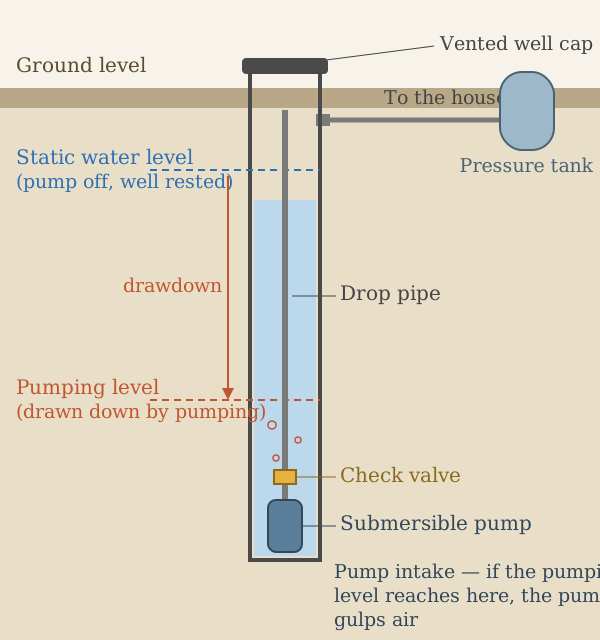
A sputtering faucet on well water is a symptom with a short list of causes — drawdown, a leaking check valve or drop pipe, a tired pressure tank, or dissolved gas. How the timing of the sputter tells you which one, the tests to run, and what each fix costs.
How Far Should a Well Be From a Septic Tank? Setbacks, Explained
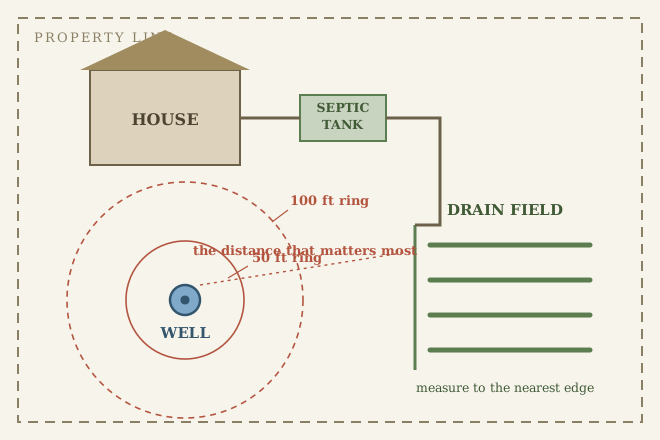
Most states want 50 feet between a well and a septic tank and 100 feet to the drain field — but the field is the distance that actually protects your water. How to measure yours, and what to do if it comes up short.
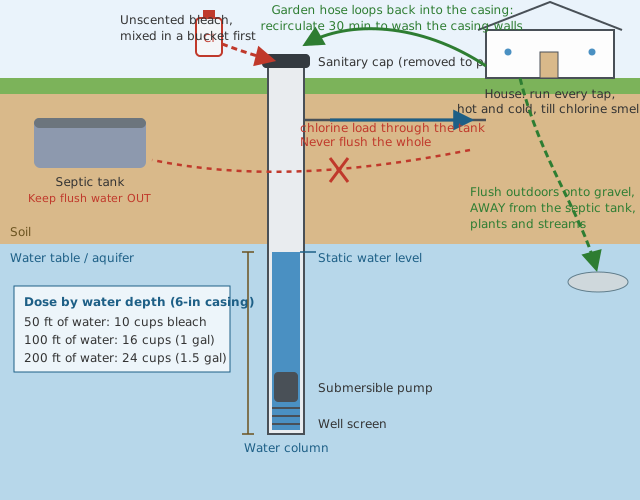
How to Shock Chlorinate a Well: Dose, Steps, and the Retest That Proves It Worked
The full shock chlorination procedure: work out your bleach dose from the well log, bypass the softener, recirculate, hold, flush without wrecking your septic, and retest at 10 to 14 days.