 Keep
Well Pump Replacement Cost: Why Depth, Not the Pump, Drives the Bill
 Daniel Mercer · Editor & Researcher·
Published November 16, 2026·
Updated November 16, 2026
The call usually goes the same way. Your water stopped — or it sputters, or the pressure has been dying for a week — and a well contractor drives out, listens, tests, and gives you a number. The number is somewhere between fifteen hundred and four thousand dollars. And your first thought, if this is your first house on a well, is completely reasonable: the pump itself only costs a few hundred dollars. You have seen them online. So what is the rest of the money for?
It is a fair question, and it has a precise answer. You are not really buying a pump. You are buying the work of getting the old one out and the new one in — and that work is measured in feet. A submersible pump does its job sitting at the bottom of your well, often 150, 250 or 400 feet underground, hanging on the end of a pipe and a cable. Everything about the replacement bill — the crew size, the hours, the new pipe, the new wire, even the size of the motor — scales with that distance. Two neighbours can replace functionally identical pumps in the same week and pay bills that differ by two thousand dollars, purely because one well is 120 feet deep and the other is 380.
This guide breaks the bill down the way the contractor builds it: what the headline range actually includes, why depth is the lever that moves everything, what each pump type costs and why, what a proper replacement job involves step by step, and how to decide between repairing the pump you have and replacing it. It also covers the two things quotes almost never mention — disinfecting the well afterwards, and how your household is supposed to manage without water in the meantime.
The headline range, and what it actually includes
Start with the honest national picture. Angi's 2026 cost guide, built from 1,339 real replacement projects, puts the typical bill at $974 to $2,821 installed, with an average of $1,897. This Old House gives a similar typical range of $900 to $2,500. Cost guides that split the work by pump type, like HomeGuide's, show where the spread comes from: a shallow-well jet pump installed for $400 to $1,000, a standard submersible for $1,000 to $2,500, and a constant-pressure system for $2,000 to $5,000.
Those are planning figures, not promises, and two things stretch them at both ends. At the low end, a shallow well with the pump sitting in your basement can come in under the published ranges — the swap is an hour or two of ordinary plumbing. At the high end, deep wells break out of the ranges entirely. Angi's own depth breakdown shows why: wells over 150 feet carry published ranges of $2,000 to $10,000 or more, because at that point the job stops being a pump swap and becomes a small construction project. Regional labour matters just as much. One national guide lists an average replacement at $5,110 in Portland, Oregon and $1,050 in Manhattan, Kansas — the same job, priced by two different labour markets and two different typical well depths.
So what does "installed" actually buy? A complete replacement quote normally covers five things. The pump itself. The labour to pull the old pump and set the new one. New drop pipe and new submersible wire for the full depth of the well — reputable contractors replace both rather than reusing them, for reasons covered below. The small hardware that hangs on the pipe string: check valve, torque arrestor, safety rope, fittings. And the reconnection and testing at the top — pressure switch settings, tank pressure, and a run of water to confirm the system holds pressure.
What it often does not include, and what you should ask about before the work starts: a new pressure tank if yours is failing ($300 to $700 for the tank alone, more fitted), electrical work beyond reconnecting what exists, a diagnostic fee if you decline the repair, and well disinfection after the job. None of these are scams — they are genuinely separate work — but a quote that looks cheap sometimes looks cheap because half the job is missing from it. The last section of the step-by-step below lists exactly what an itemised quote should show.
One more number to hold in your head before we go further: the pump unit itself. A jet pump costs $100 to $745. A submersible costs $250 to $1,200 for the sizes most houses use. On a $2,800 deep-well bill, the pump might be $600 of it. The other $2,200 is the subject of the next section.
Why depth, not the pump, drives the bill
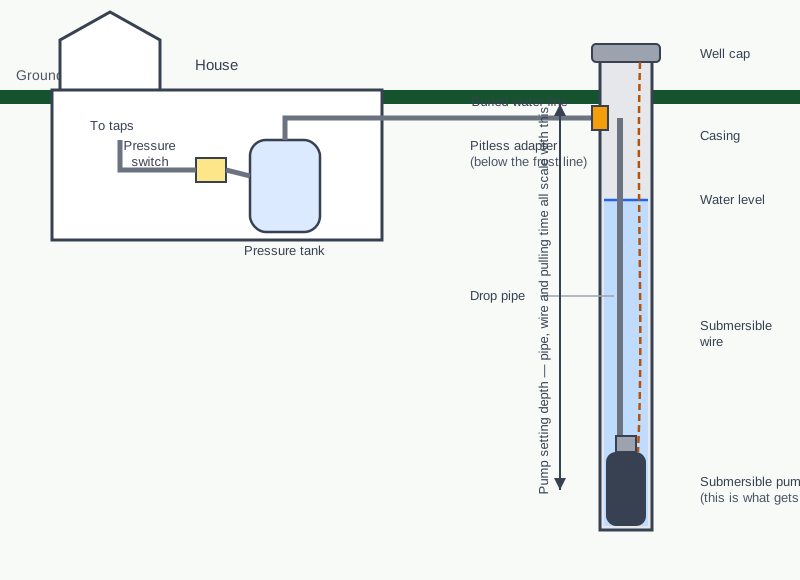
Look at the cutaway at the top of this page. The pump hangs at the bottom of the casing, below the water level. Between it and your kitchen tap sit a drop pipe full of water, an electrical cable, and a connection through the casing wall — the pitless adapter — to the buried line running to your house. Replacing the pump means unmaking and remaking that entire string, foot by foot. Depth enters the bill four separate times.
The pulling labour. A jet pump sits in your house; a mechanic unbolts it. A submersible has to be lifted out of the well, and the deeper it is, the slower and heavier that lift gets. Pipe comes up in sections or on a reel, with a hoist truck doing the work and a crew member guiding it. A 150-foot well might take a crew about three hours end to end; a 500-foot well can take seven. Licensed well contractors charge roughly $95 to $140 an hour in much of the country, so crew time alone separates a shallow bill from a deep one by a thousand dollars or more.
The pipe and wire are bought by the foot. When a pump comes out, the drop pipe and cable that carried it almost always get replaced — old pipe is brittle, old wire insulation has spent a decade underwater, and no contractor will warranty a new pump hanging on tired materials. Drop pipe runs about $2 to $8 a foot depending on material; submersible wire runs roughly $1 to $3.50 a foot. At 100 feet, that is a few hundred dollars of materials. At 400 feet, it is $1,200 to $4,000 of materials before anyone has turned a wrench. Add the fittings that go on the string — a check valve at $35 to $120, torque arrestors at $25 to $60, safety rope by the foot — and the pattern holds: every line item is multiplied by depth.
The motor gets bigger. Lifting water 100 feet takes less pump than lifting it 400. A shallow well might run a half-horsepower pump; a deep one needs 1.5 or 2 horsepower, and pump prices climb with size — from around $480 for a half-horsepower unit to roughly $1,700 for a 3-horsepower one at national mid prices. This is the one place the pump itself genuinely costs more on a deep well, and it is still usually the smallest of the four effects.
The risk goes up. The deeper the string, the more chances for something to go wrong on the way out: a corroded fitting lets go, a swollen old pump wedges in the casing, pipe that has gone brittle snaps. Contractors price deep work with that risk in mind, and when something does go wrong, fishing a dropped pump out of a well is billed as what it is — extra work nobody wanted.
Put together, the industry rule of thumb is that every additional 100 feet of depth adds roughly $500 to $1,000 to a submersible replacement. The chart below shows what that does to real bills.
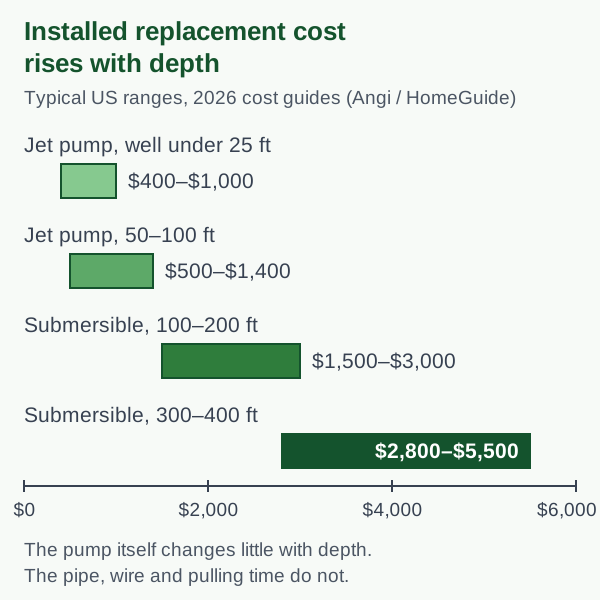
A worked example makes it concrete. Take two real-shaped jobs. The first well has its pump set at 140 feet. The pump, a 1-horsepower unit, is about $650. The pipe run is 140 feet at roughly $3 a foot — $420. The wire, another 140 feet at about $2 a foot — $280. Fittings, check valve and safety rope, around $150. Labour for a pull and reset that takes a crew half a day — $500 to $700. Total: roughly $2,000, right on the national average. Now move the same house onto a well with the pump set at 380 feet. The pump is a 1.5-horsepower unit at about $950 — more, but not dramatically. The pipe is now 380 feet — $1,300 or so. The wire is 380 feet — $850. The fittings are much the same, $200. But the labour is a longer, heavier pull with more that can go wrong — $900 to $1,400. Total: roughly $4,200 to $4,700. The pump grew by $300 between the two jobs. The bill grew by well over $2,000. That gap is the entire subject of this guide, and it is why a quote cannot be judged until you know the setting depth it was written for.
One clarification that saves confusion when you talk to contractors: "depth" can mean three different numbers. Total well depth is the bottom of the hole. The static water level is where water sits in the casing. The pump setting depth — where the pump actually hangs, usually a little above the bottom — is the number that drives your bill, because pipe, wire and pulling time are all measured to the pump. Your well record, filed by the driller when the well was completed, lists all three. If you bought the house and never got the record, your state or county health department usually has a copy, and it is worth having before you collect quotes: a contractor who knows the setting depth over the phone can give you a far tighter estimate.
What each pump type costs, and why
Depth decides how much work a replacement is. Pump type decides what kind of job it is in the first place. There are three you are likely to meet, plus one upgrade worth knowing about.
Shallow-well jet pump — $400 to $1,000 installed. The jet pump is the one you can see: a motor and pump housing mounted above ground, in a basement, utility room or well house, drawing water up through a suction pipe from a well no deeper than about 25 feet. Because nothing has to be pulled from the well, replacement is close to ordinary plumbing — unbolt, swap, re-prime, done. The unit itself is $100 to $500. If your house has one of these, you hold the cheapest ticket in well ownership, and a careful DIY swap is genuinely possible.
Deep-well jet pump — $500 to $1,400 installed. Same above-ground idea, stretched: a two-pipe system with an ejector down in the well lets a jet pump work to about 100 feet. The pump still lives in the house, so replacement stays comparatively cheap, though the downhole ejector sometimes needs attention too. These are common in older homes. They are noisier and less efficient than submersibles, which is why many owners use a failure as the moment to convert — but conversion is a bigger job than a like-for-like swap, and the quote will show it.
Submersible pump — $1,000 to $2,500 installed at typical depths, $1,500 to $5,000 or more in deep wells. The pump and motor are one sealed unit that lives underwater at the bottom of the well, pushing water up rather than sucking it. This is what most drilled wells use, and it is the replacement this guide mostly describes: quiet, efficient, long-lived, and entirely dependent on a hoist and a crew to service. The unit runs $250 to $1,200 for common sizes. Everything above that figure in the quote is the pull, the pipe, the wire and the reset described in the solution section below.
Constant-pressure (variable-speed) systems — $2,000 to $5,000 installed. Instead of banging on at full speed whenever pressure drops, a variable-drive pump adjusts its speed to hold pressure steady — no more shower going weak when a tap opens elsewhere. The pump costs more, there is a controller to buy and mount, and the system is less forgiving of sloppy installation. Owners who have lived with pressure swings often choose it deliberately at replacement time, since the pulling labour is already paid for and the upgrade premium is only the equipment difference. It is the one moment in well ownership when upgrading is cheap, because the expensive part — getting down the well and back — is happening anyway.
A note on horsepower, because quotes sometimes mystify it: the replacement should normally match the pump that came out, sized for your well's depth and your household's demand — typically 8 to 15 gallons per minute for a family home. A contractor proposing a much bigger pump than the old one should be able to say why in terms of your water level and usage, not just "more is better." An oversized pump can over-pump a modest well, dragging the water level down to the intake and shortening its own life.
The solution: what a replacement job actually involves, step by step
A proper pump replacement is not "swap the unit." It is a sequence, and knowing the sequence is how you judge both the contractor and the quote. Here is the job done properly, in order.
Step 1 — Diagnose before anyone sells you a pump. A dead pump and a dead pump system look identical from the kitchen tap, and several parts of the system fail far more cheaply than the pump. Before a pump is condemned, a good contractor checks, in roughly this order: the breaker and the power supply to the well; the pressure switch, the small box near the tank whose contacts tell the pump when to run — a switch is a $25 part, $75 to $150 fitted, and it fails on a 10-to-15-year rhythm just like pumps do; the pressure tank, because a waterlogged tank makes a healthy pump cycle itself to death and can imitate pump failure; and the control box on larger submersibles, whose capacitor and relay are replaceable wear parts. A diagnostic visit typically runs $250 to $500 and is often credited against the repair if you go ahead. If a contractor quotes you a full replacement in the first five minutes without touching a multimeter, get a second quote. A meaningful share of "failed pumps" are a switch, a tank or a control box wearing a pump costume.
The checks you can run yourself before the truck rolls. You do not need a multimeter to do the first round. Find the well breaker in your panel — if it has tripped and will not hold, that is an electrical fault to report, not a pump verdict. Find the pressure tank, usually in the basement or utility room, and knock on its side from top to bottom: the top should sound hollow and the bottom solid; a tank that sounds and feels solid all the way up is waterlogged, and it is a far cheaper fix than a pump. Watch the pressure gauge near the tank while a tap runs — a needle that crashes and a pump that clicks on and off every few seconds is the short-cycling pattern of a dying tank or a failing switch. And stand by the tank when someone opens a tap: the pressure switch should click once as the pump starts and once when it stops. A switch that chatters, or one whose contacts you can see are burned and pitted when the cover comes off (power off first — the switch carries full line voltage), is confessing. None of this replaces the contractor's diagnosis, but arriving at the phone call able to say "the tank sounds waterlogged and the switch chatters" changes the visit you get — and makes it much harder for anyone to sell you a pump you do not need.
Step 2 — Pull the old pump. The crew sets up the hoist over the wellhead, removes the well cap, and lifts the whole string — pump, drop pipe, wire, safety rope — out of the casing. This is the slow, physical heart of the job, and the moment of truth for the well itself: the condition of what comes up tells the story. Corroded fittings, wire with cracked insulation, a pump caked in iron bacteria or sand — each explains symptoms you may have been living with, and each argues for replacing the full string rather than hanging a new pump on old materials.
Step 3 — Inspect the well while it is open. With the pump out, the contractor has the only clear look down your well that anyone gets for a decade. Expect them to check the casing for damage, note the water level, and flag obvious problems — a failing pitless adapter, a cap that no longer seals, sediment that suggests the well itself needs attention. Most wells need nothing. But this inspection is free information you cannot get any other way, and it belongs in the conversation before the new pump goes down, not after.
Step 4 — Build the new string. The new pump is fitted with a new check valve (many pumps have one built in; a second on the string is cheap insurance), torque arrestors to keep it centred, a safety rope or cable, new drop pipe and new wire spliced with waterproof connections. On most jobs the pressure switch is replaced or at least tested, and if the pressure tank is waterlogged or near the end of its own life, this is the moment to replace it too — the crew is already there, the system is already drained, and a dead tank will kill the new pump's warranty period enthusiasm by short-cycling it. Tank and pump together is the most common "while you're in there" decision in well work, and unlike most upsells, it has real logic behind it. Ask for the tank price as a separate line so you can judge it on its own.
Step 5 — Set the pump and recommission the system. The new string is lowered to the setting depth, the pitless adapter reconnected, the cap sealed, and the electrical connections made. Then the system is run: air purged, pressure switch cut-in and cut-out checked, tank pre-charge verified (it should sit about 2 PSI below the switch's cut-in pressure), and the taps run until the water clears. The crew should also check the drawdown — that the well recovers while the pump runs — because a new pump on a weakening well needs a different conversation.
Step 6 — Disinfect and confirm. The final step is the one most often skipped, and it gets its own section below: after any work inside the well, the system should be disinfected and the water retested before it goes back to drinking duty.
How long it all takes. A straightforward swap is 3 to 6 hours on site. Deep wells, difficult access — a wellhead buried, hidden in a crawlspace, or surrounded by landscaping — and extra work like a tank replacement stretch it toward a full day. If your wellhead is hard to reach, say so when you book; access surprises are a common source of day-of price changes.
What an itemised quote must show. Get the quote in writing, in lines, before work starts. It should separate: the pump, by brand, model and horsepower; drop pipe and wire, by the foot, with the setting depth stated; the fittings and small hardware; labour, ideally as a flat job price or an hourly rate with an hour estimate; the pressure tank and switch, priced separately if included; the diagnostic fee and whether it is credited; disposal of the old pump; disinfection, included or not; and the warranty — parts and labour stated separately, because they are often different lengths. A single lump sum with no breakdown is not automatically dishonest, but it leaves you nothing to compare against the second quote you should also get. Two or three itemised quotes on a $3,000 job is not paranoia; it is the normal way this trade is bought.
Repair or replace? The age-and-cost decision
Not every failing pump needs replacing, and not every repairable pump deserves repairing. The trade works on two numbers: how old the pump is, and what the repair costs next to a replacement.
Well pumps live about 8 to 15 years. If yours is under 8 to 10 years old and has one identifiable fault, repair is usually the smart money. The faults that live above ground or at the top of the system are genuinely cheap: a pressure switch at $75 to $150 fitted, a control-box capacitor or the whole control box for a few hundred, a check valve, a section of damaged wire. Even some motor-side repairs run $175 to $500. Against a $2,000 replacement, a $300 repair on a six-year-old pump is an easy call.
The maths flips with age, for a reason specific to wells: most of a replacement bill is the pull, and a repair that requires pulling the pump pays most of that same labour anyway. If a 13-year-old pump needs its motor rebuilt, you will pay to pull it, pay for the repair, pay to reset it — and own a 13-year-old pump with one new part, in a well you will probably pay to open again within a couple of years. That is why the working rule is: if the pump is past 10 to 12 years, or the repair quote passes about half the cost of replacement, replace it. The new pump resets the clock, carries a fresh warranty, and hangs on new pipe and wire that will not strand it.
Two more signals push toward replacement. First, pattern: a pump that has needed two repairs in two years is telling you it is done, whatever each individual fault was. Second, symptoms in the water itself — sand and grit coming through, which can mean the pump is wearing or the well is deteriorating — deserve a replacement conversation that includes the well's condition, not just another patch.
And one signal pushes the other way: if the "failure" is actually short cycling, weak pressure that comes and goes, or a pump that runs constantly, check the pressure tank before you price pumps at all. A waterlogged tank is a $300 to $700 part, and it manufactures pump symptoms so convincingly that tanks are behind a large share of misdiagnosed pumps. Replacing a healthy pump because its tank died is the most expensive diagnostic error in well ownership.
One last piece of the decision: paperwork. A replacement pump should come with a manufacturer's warranty — commonly one to five years depending on brand and model — plus the contractor's own labour warranty, which is separate and often shorter. Ask for both in writing, and keep the invoice with your well record, noting the new pump's model, horsepower and setting depth. That piece of paper is the starting point for every future diagnosis, the first thing a buyer of your house will want to see, and the document that settles any argument about what was installed. Owners who inherit a house with no well records at all learn quickly how much harder every conversation with a contractor becomes; do not pass that problem on.
After the new pump: disinfect the well, then retest before you drink
Here is the step that separates a complete job from a finished-looking one. Your well is a drinking water supply, and it has just been opened to the world: the cap came off, a crew handled pipe that lay on the ground, tools went down the casing, and a new pump — warehoused, shipped, handled — went into the water your family drinks. Standard public-health guidance, from the CDC and state health departments alike, is that a well should be disinfected after the pump is replaced or the well is opened for any repair, and the water tested before it returns to drinking use.
The disinfection itself is shock chlorination: a measured dose of chlorine is introduced into the well, circulated through the house plumbing until every tap smells of chlorine, left to sit — typically 12 to 24 hours — and then flushed out until the chlorine is gone. Some contractors include it in the replacement price; some leave it to you; some, regrettably, never mention it. Ask which of those your quote assumes, because the answer changes what you do on the day. If you are doing it yourself after the crew leaves, follow your state health department's worksheet for the dose — it is calculated from your well's depth and water volume, and too little does nothing while a wild excess just takes longer to flush.
Then test. The test that matters after well work is total coliform bacteria, with E. coli as the finding that changes behaviour: coliform present means a pathway into the well still exists; E. coli present means stop drinking the water until a follow-up test is clean. Many counties test bacteria cheaply or free through the health department, and a certified lab panel runs $50 to $200. Timing matters — test after the chlorine has fully cleared, or the chlorine itself masks the result. This is also the natural moment to restart the annual testing habit every well owner is supposed to keep: bacteria and nitrate every year, whether or not any work has been done. A pump replacement you have already paid for is the cheapest possible reminder.
No water while you wait: the interim plan
The part no quote mentions: between the pump dying and the new one running, your house has no water at all, and that is a bigger practical problem than most first-time well owners expect. A household gets through a few hundred gallons a day without thinking — every toilet flush is over a gallon and a half, a shower is two gallons a minute, and the washing machine wants forty gallons a load. You cannot bucket your way back to normal life, but you can run a household for two or three days on a plan.
Drinking and cooking first. Budget a gallon per person per day and buy it — bottled water is the one line item in a pump failure that is both cheap and non-negotiable. Keep a couple of cases in the house from today onward; well owners who have lived through one failure all seem to.
The toilet problem, solved plainly. Toilets flush without a pump if you pour water into the bowl or fill the tank by hand — a bucket from any source works, including a neighbour's hose, a rain barrel, or the creek of last resort. Fill a bathtub or a couple of large bins while you still can if the failure gives warning signs; if it does not, a neighbour's outside tap and two five-gallon buckets cover a family's flushing for a day.
Borrow water shamelessly. Well failures are a known rural emergency, and neighbours with wells are almost universally generous with a hose run across the fence — it costs them pennies. Many small towns also have a municipal fill station or a water hauler who will fill a tank in your yard for a fee; for a failure stretching past a few days, a hauled tank feeding your pressure tank through a hose is the difference between discomfort and a hotel bill.
Cut the optional water. Laundry goes to a laundromat or waits. Showers become the gym, a friend's house, or a sponge bath. Dishes become paper plates for two days, and nobody in the history of pump failures has regretted that trade. Tell the contractor when you book that the house is dry — crews triage, and a house with no water at all legitimately jumps the queue ahead of a house with weak pressure.
The emergency premium: what urgency costs
Well pumps do not check the calendar, and a failure on a Saturday night is priced differently from the same failure on a Tuesday morning. Expect an emergency or weekend surcharge of roughly $300 to $900 on top of the standard job, or 25 to 50 percent added to the labour portion, depending on how the company structures it. Rural addresses can add a travel charge on top, particularly for after-hours calls.
This is not pure opportunism — a two-person crew pulled out at midnight costs the company real money — but it does create one genuine decision. If your pump dies on a Friday evening and the household can run on the interim plan above for two days, waiting for a Monday-morning slot can save you several hundred dollars on an identical job. If it dies in a freeze with pipes at risk, or the house cannot function at all, the premium is simply the price of water, and most owners pay it without a second thought. What you should not do is let urgency talk you out of the diagnosis step: the emergency version of a $25 pressure switch is still a pressure switch, and a rushed "replace everything" quote at 9 p.m. deserves the same scepticism as one at noon. Ask for the diagnostic finding before you authorise the replacement, even on an emergency call.
One legitimate emergency extra to expect: if the well has to be opened and the water made safe again quickly, disinfection on a compressed schedule sometimes means the crew returns or you manage the flushing yourself. Clarify who is doing it before they leave, not after.
Insurance and financing: the honest version
New well owners often assume the pump is covered somewhere. Usually, it is not. A standard homeowners policy excludes normal wear and tear and mechanical breakdown — and a pump that dies at the end of a 12-year life is the textbook example of both. The replacement bill, in the ordinary case, is yours.
There are three exceptions worth checking before you pay. First, sudden accidental damage: a lightning strike that fries the pump motor, or a power surge event, may be a covered claim, because the cause was a sudden event rather than age. If your pump died during a storm, that detail belongs in a call to your insurer. Second, equipment-breakdown or service-line endorsements: many insurers sell these cheaply as policy add-ons, and well pumps are exactly the kind of equipment they exist for. If you added one when you bought the house — plenty of owners did, bundled into the closing paperwork — this is its moment. Third, home warranties, if you received or bought one with the house, sometimes cover well pumps, though with caps and service fees that make them worth reading carefully rather than assuming.
Beyond that, the financing is the ordinary kind: contractors in many areas offer payment plans or accept cards, and a $2,000 to $4,000 job is a classic use for a home-equity line if you have one. The cheapest financing, though, is the one arranged before the emergency. A pump gives warning signs for weeks or months in most cases — sputtering, cycling, climbing electric bills, falling pressure. An owner who spots them early gets to collect three quotes, choose a contractor calmly, book a weekday slot, and skip the emergency premium entirely. The pump will still cost what it costs. It just will not cost the panic surcharge on top.
The longer view is worth taking while this bill is fresh in your mind. A well pump is not a once-in-a-lifetime purchase; it is a consumable with an 8-to-15-year fuse, and every well owner who stays in a house long enough buys two or three of them. Owners who treat it that way — setting aside $150 to $250 a year in a house fund, the way you might for a roof — meet the next failure as an inconvenience. Owners who meet it as a surprise pay the emergency premium, take the first quote, and finance it at card rates. The pump costs the same either way. Only the stress is optional, and it is bought off cheaply, a little at a time, starting now.
How urgent is it, really?
No water is a genuine emergency — a house cannot run without it — but it is a manageable one, and the management is mostly about not letting a dry tap rush you into the most expensive version of the job. The order of operations that serves owners best: confirm it is really the pump (breaker, switch, tank, control box first — thirty minutes of checks that can save you thousands); get the diagnosis in plain terms before authorising anything; if the household can bridge a day or two on bottled water and buckets, use that time to collect a second itemised quote, especially on a deep well where bills vary by thousands; and when the new pump is in, close the job properly with disinfection and a bacteria test before the water goes back in the kettle.
Budget with the depth ladder in mind — around $1,900 on average nationally, under $1,000 for a shallow jet pump, and $3,000 to $5,500 for a deep submersible — and the quote shock that starts most of these jobs loses its power. The pump was never the expensive part. The 300 feet between it and your tap is. Once you understand that, you can read any quote the way a contractor wrote it, line by line, and know exactly what you are paying for.
Cost at a glance
| Item | Typical cost | Notes |
|---|---|---|
| Shallow-well jet pump, installed | $400–$1,000 | Pump sits above ground in the house or well house; wells under about 25 feet |
| Deep-well jet pump, installed | $500–$1,400 | Still above ground, but with a two-pipe system and a downhole ejector; wells to about 100 feet |
| Submersible pump, installed (100–300 ft) | $1,000–$2,500 | The most common residential job — pump, new drop pipe and wire pulled and reset |
| Submersible pump, installed (300 ft or deeper) | $1,500–$5,000+ | Bigger motor, longer pipe and wire runs, more crew time on the hoist |
| Constant-pressure system, installed | $2,000–$5,000 | Variable-speed pump and controller; steady pressure, highest upfront cost |
Frequently asked questions
How much does it cost to replace a well pump?
Angi's 2026 data from 1,339 real projects puts the typical range at $974–$2,821 installed, with an average of $1,897. This Old House gives $900–$2,500. Where you land depends mostly on how deep the pump sits: a shallow jet pump can be under $1,000, while a submersible at 300 feet or more can pass $5,000 once new pipe, wire and labour are counted.
How long does a well pump last?
Plan on 8 to 15 years, with around 15 often quoted for a good submersible that isn't short-cycling. Jet pumps tend to live at the shorter end. The biggest life-shortener is rapid on-off cycling from a waterlogged pressure tank — a pump that starts forty times an hour wears out years early, which is why the tank matters as much as the pump.
Can I replace a well pump myself?
A shallow jet pump, yes — it sits above ground, the plumbing is ordinary, and the main skills are priming it and wiring it safely. A submersible is a different matter: you are lifting 100 to 400 feet of water-filled pipe, and dropping the pump down the well turns a replacement into a drilling bill. Most owners sensibly leave submersibles to a crew with a hoist, and do the diagnosis themselves instead.
How long does it take to replace a well pump?
A straightforward swap usually takes 3 to 6 hours once the crew is on site — most of it spent pulling the old pump up and lowering the new one, not fitting the pump itself. Deep wells, stuck or corroded pipe, or a tank and wiring that also need replacing can stretch the job to a full day. Add time afterwards for disinfecting the well before the water is used for drinking again.
What are the signs my well pump is failing?
The classic set: no water at all, weak or fluctuating pressure, faucets sputtering air, the pump running constantly or clicking on and off every few seconds, dirty or sandy water, and an electric bill that climbs for no other reason. One caution — a failed pressure switch or a waterlogged tank imitates several of these, so the signs tell you to diagnose, not automatically to buy a pump.
Does homeowners insurance cover well pump replacement?
Usually not when the pump simply wears out — policies exclude normal wear and mechanical breakdown, and a pump dying of old age is exactly that. Damage from a covered sudden event, such as a lightning strike frying the motor, may be covered. Some insurers sell equipment-breakdown or service-line endorsements that do cover pumps; if you have one, this is the claim it exists for.
Should I repair my well pump or replace it?
Age decides most of it. Under about 8 to 10 years old with one clear fault — a capacitor, a check valve, a control box — repair usually wins at $150–$500. Over 10 to 12 years old, or when the repair quote passes roughly half the cost of replacement, replace: you are paying most of the pulling labour either way, and a worn motor that gets a partial fix often fails again within a year or two.
Checked November 16, 2026. This guide is general information, not a substitute for a licensed professional.
Related guides
Air in Your Water Lines: Why Faucets Sputter on a Well
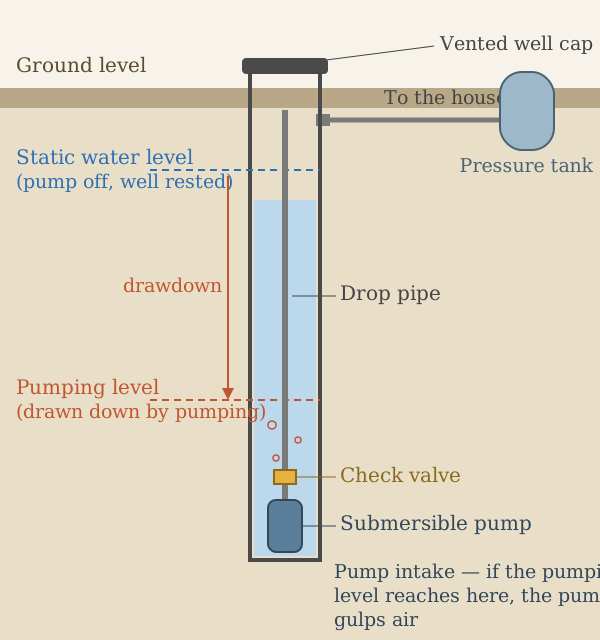
A sputtering faucet on well water is a symptom with a short list of causes — drawdown, a leaking check valve or drop pipe, a tired pressure tank, or dissolved gas. How the timing of the sputter tells you which one, the tests to run, and what each fix costs.
How Far Should a Well Be From a Septic Tank? Setbacks, Explained
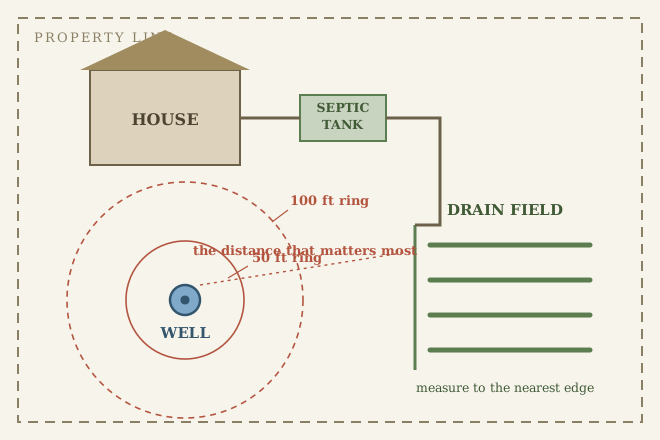
Most states want 50 feet between a well and a septic tank and 100 feet to the drain field — but the field is the distance that actually protects your water. How to measure yours, and what to do if it comes up short.
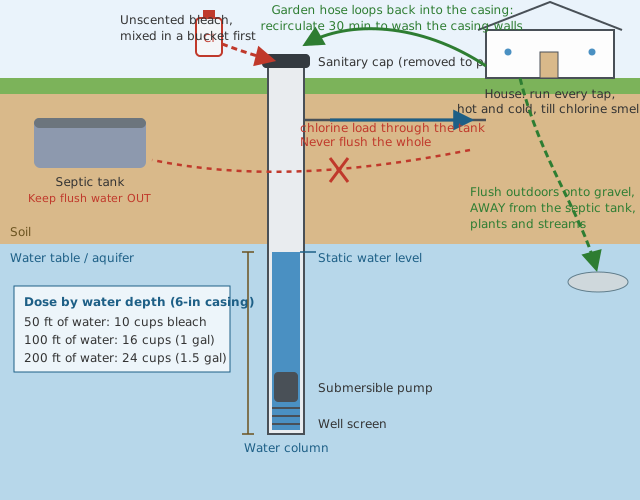
How to Shock Chlorinate a Well: Dose, Steps, and the Retest That Proves It Worked
The full shock chlorination procedure: work out your bleach dose from the well log, bypass the softener, recirculate, hold, flush without wrecking your septic, and retest at 10 to 14 days.