 Keep
Orange Stains, Black Specks, Brown Water: Iron and Manganese in Well Water
 Daniel Mercer · Editor & Researcher·
Published November 16, 2026·
Updated November 16, 2026
It starts as a ring. A faint orange line around the bathtub at the waterline, a rusty blush in the toilet bowl that comes back a few days after you scrub it, white towels that slowly turn the color of weak tea. Then the black specks show up in a glass of water, and the dark streaks on laundry you were sure you washed clean. If your house is on a well — especially a house you have just bought, where nobody handed you a water report with the keys — this is usually your first meeting with the two most common troublemakers in well water: iron and manganese.
Here is the reassuring part before anything else. Of all the things that can be wrong with well water, this is the most fixable. Iron and manganese are minerals, not contaminants that arrive from a spill or a failing septic field. They dissolve out of the rock and soil the water passes through, which means they are stable, measurable, and removable with equipment that has been standard for decades. The owners who spend too much on this problem almost always make the same mistake: they buy treatment based on the stain instead of the number. This guide works the other way — read the evidence, run one simple test, get one lab panel, and then climb only as far up the treatment ladder as your water actually requires.
Reading the evidence: what the colors are telling you
Iron and manganese announce themselves differently, and the difference matters because manganese is the harder of the two to remove. Learn to read the signs and you already know most of your diagnosis before any test comes back.
Orange, rust-red, or reddish-brown stains are iron. This is the classic picture: orange rings in tubs and toilet bowls, rust-colored streaks under faucets, white and light laundry coming out with a yellow-orange cast, ice cubes with a rusty tint. Underground, with no oxygen present, iron dissolves into water as ferrous iron — completely invisible. The moment that water meets air, the iron oxidizes into ferric iron, which is quite literally rust: a solid particle that settles on porcelain, fabric, and anything else the water touches. Visible staining usually begins once iron passes the EPA's secondary standard of 0.3 mg/L, and above about 1.0 mg/L most people can taste it too — a metallic, inky flavor that ruins coffee and tea before it ruins fixtures.
Black, dark brown, or gray specks and stains are manganese. Manganese is iron's chemical neighbor and travels with it in most aquifers, but it behaves differently. Dissolved manganese oxidizes slowly, so instead of a rusty film it tends to drop out as a fine black or dark brown solid: black grit that settles in a glass, dark specks and streaks on laundry, a black ring in the toilet bowl, a dark coating inside the toilet tank that looks like grime or mold but wipes off as mineral. Manganese stains are noticeably harder to scrub away than iron stains, and they appear at much lower concentrations — the EPA secondary standard for manganese is 0.05 mg/L, one-sixth of the iron number.
A metallic taste with clear water usually means dissolved iron or manganese that has not oxidized yet — the minerals are present and measurable even though nothing is staining yet, or staining only where water stands, like the toilet tank.
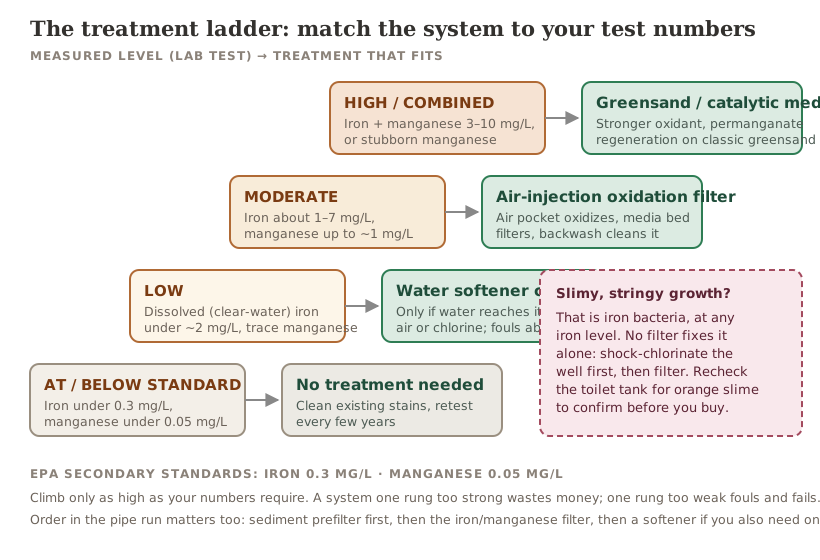
Slimy, stringy, reddish-brown growth is iron bacteria. This is the version owners most often misdiagnose. Iron bacteria (genera like Gallionella and Leptothrix) are harmless organisms that feed on dissolved iron and build gelatinous, rusty-orange slime. The giveaway is texture: lift the toilet tank lid and look for orange slime coating the walls and hardware, stringy growth that waves when you disturb the water, or an oily-looking sheen on standing water. A related clue is a rotten-egg smell alongside black flecks, which points to hydrogen sulfide traveling with manganese. Iron bacteria matter out of proportion to their looks, because no filter handles them well — they grow inside filter beds and foul softener resin. If the slime is there, bacteria treatment comes before any equipment decision, which is why the diagram in this guide gives them their own box.
One more pattern worth reading correctly: where the stain shows up. Stains in every fixture, hot and cold, point to the water itself. Stains only in one bathroom, or only from the hot tap, suggest something local — an aging water heater shedding rust, or one run of old galvanized pipe. Whole-house minerals stain everywhere water sits still, and the toilet tank, which holds untreated water quietly around the clock, is the most honest witness in the house. Check there first.
The 20-minute glass test — and why a lab number decides everything
Before you spend anything, run the oldest diagnostic in well work. Fill a clean, clear glass from a cold tap — ideally an outside faucet or the tub spigot, somewhere the water has not passed through a softener or filter — and set it on a white surface, undisturbed.
If the water pours clear and then clouds and turns orange over the next 20 minutes to a few hours, with rust-colored sediment settling at the bottom, you have ferrous (dissolved, clear-water) iron. This is the most common form and the easiest to treat, because dissolved iron can be exchanged by a softener at low levels or oxidized on purpose inside a filter.
If the water comes out of the tap already yellow, orange, or brown and stays that way, you have ferric (oxidized, red-water) iron. The iron has already become particles, which means a softener cannot grab it and will foul trying. This water needs oxidation plus filtration, or filtration alone if the particles are coarse enough.
If dark specks settle instead of orange sediment, manganese is dropping out — remember it oxidizes slowly, so give the glass a few hours, and check the toilet tank for the dark coating that confirms it.
If a slimy film forms on the surface or stringy material settles, suspect iron bacteria and plan on chlorination before equipment.
The glass test sorts the form of the problem. It cannot tell you the amount, and the amount is what treatment is sized on. A softener that handles 1.5 mg/L of iron beautifully will be destroyed by 5 mg/L. An air-injection filter sized for 3 mg/L will blow through untreated water at 9 mg/L. This is why the one non-negotiable purchase in this whole guide is a certified lab panel, and why reputable installers refuse to quote without one.
Order the right panel. You want total iron, manganese, pH, and hardness at minimum, and ideally ferrous iron and an iron-bacteria screen if the glass test or toilet tank suggests them. pH is not a formality: oxidation of manganese barely proceeds below pH 7.5 without catalytic help, and low-pH water changes which media an installer can use. Hardness matters because it decides whether a softener belongs in the layout at all. State health departments and university labs typically run a metals panel for $50 to $150; a full private panel including bacteria runs $150 to $300. Take the sample from a cold tap before any treatment equipment, run the water a few minutes first, and follow the lab's bottle instructions — a sample pulled after the softener tells you about your softener, not your well.
Is it a health problem? The honest version
Mostly, no — and the one real exception deserves precision rather than alarm.
Iron has no health-based drinking water limit at all. The EPA classifies it as a secondary contaminant: its 0.3 mg/L standard exists because of staining, taste, and plumbing damage, not toxicity. Your body regulates iron absorption, and the amounts in even very orange well water are not a poisoning risk. Iron is a wallet problem and a laundry problem.
Manganese has two numbers, and confusing them causes most of the anxiety around it. The first is the EPA secondary standard of 0.05 mg/L — again an aesthetic line, set where black staining and bitter taste begin. The second is the EPA's lifetime health advisory of 0.3 mg/L, based on effects on the nervous system from sustained exposure well above what most wells carry, with the strongest concern for infants, whose developing nervous systems absorb manganese more readily. The advisory is guidance, not an enforceable limit, but it is the right action line: above 0.3 mg/L, treat the water, and use bottled water for drinking and formula until a retest comes back lower. Minnesota's Department of Health goes further for the youngest children, advising 0.1 mg/L or below for any baby under one year old who drinks tap water or formula made with it.
So the honest summary: iron at any level you are likely to meet is a nuisance, not a danger. Manganese between 0.05 and 0.3 mg/L is a staining problem worth fixing on your own schedule. Manganese above 0.3 mg/L — uncommon, but real — moves to the front of the queue, especially with a baby in the house. And if your water changed recently — clear for years, orange this spring — test for coliform bacteria alongside the minerals, because a sudden change can mean surface water is reaching the well, which is a different and more serious conversation.
The solution: climb the ladder only as high as your numbers require
Every treatment below does one of two things: it grabs the mineral while it is dissolved, or it deliberately oxidizes the mineral into particles and then filters the particles out. Which rung you need is set by your lab numbers and by the form the glass test showed. Here is the ladder, rung by rung.
Rung 0: At or below the standards — do nothing but clean
If your panel comes back under 0.3 mg/L iron and 0.05 mg/L manganese, you do not have a treatment problem; you have old stains from a previous chapter of the well's life, or a single fixture shedding rust. Clean the fixtures (the stain-removal section below), and retest every few years or whenever the water changes. Wells drift, and a cheap retest every three to five years is the whole maintenance plan at this rung.
Rung 1: Low dissolved iron — a water softener can cope, within limits
A standard salt-based softener exchanges dissolved minerals for sodium on a resin bed, and ferrous iron — still dissolved — exchanges along with hardness. If your house needs softening anyway, this can solve a small iron problem for free, which is why it is worth understanding precisely where it stops working.
Penn State Extension's conditions are the honest boundary: the iron must be dissolved (clear-water iron from the glass test), the pH should be above about 6.7, and the water must reach the softener before it meets air or chlorine — a pressure tank arrangement or a chlorinator upstream will oxidize the iron first, and oxidized iron does not exchange; it coats the resin beads and cements them into a fouled bed. In practice, most installers put the softener's iron ceiling at roughly 2 mg/L, with only a trace of manganese — manganese exchanges poorly and accumulates in the bed. Iron bacteria disqualify a softener outright until they are dealt with.
Cost: $1,000 to $3,000 installed for a standard residential softener (national guides put the average near $1,500–$2,500), plus $100 to $200 a year in salt and an iron-cleaner resin additive if you are running it near its iron limit. Upkeep is light — keep the brine tank filled, clean the resin with an iron-out treatment once or twice a year — but respect the ceiling. A softener asked to handle 4 mg/L of iron is not a bargain; it is a $2,000 lesson that arrives over about eighteen months of declining performance.
Rung 2: Moderate iron, some manganese — air-injection oxidation
This is the standard answer for most wells with a real iron problem: iron roughly 1 to 7 mg/L, manganese up to about 1 mg/L, and it is the rung most first-time owners end up on. An air-injection oxidation (AIO) filter is a single tank with a control valve. The valve maintains a pocket of compressed air at the top of the tank. Water passing through that air pocket oxidizes — dissolved iron and manganese convert to particles — and a media bed below (commonly Birm, Katalox Light, or Filox-type media) strains the particles out. Every few nights the system backwashes, flushing the trapped rust to a drain and recharging the air pocket. No chemicals, no salt, nothing to refill.
What it costs installed: $1,500 to $3,000, with the spread driven by tank size (sized to your household's peak flow, not just the iron number) and local labor. A standard install takes half a day. Upkeep is genuinely small: the system uses some water and a little electricity for backwashing, the air pocket needs no attention, and the media bed lasts roughly 5 to 10 years before a media change that runs a few hundred dollars. Two honest limits. First, manganese removal in an AIO system depends on pH — at pH below about 7.5, manganese oxidizes sluggishly even with air, and your installer may specify a catalytic media or a pH correction step ahead of it. Second, like every filter, it is not a bacteria treatment: iron bacteria will grow in the bed and must be chlorinated away first.
Rung 3: High or combined levels — greensand and catalytic media
When combined iron and manganese climbs into the 3 to 10 mg/L range, or manganese alone is stubborn, the ladder's top rung is a stronger oxidant paired with a catalytic bed. The classic version is manganese greensand: a glauconite media coated with manganese oxide that both oxidizes dissolved minerals on contact and filters the result, regenerated periodically with potassium permanganate — a purple chemical oxidant you store and the system doses during regeneration. Newer catalytic carbon and Katalox-type media cover much of the same territory with lighter handling. Above roughly 10 mg/L combined, the standard approach becomes chemical oxidation — chlorine or peroxide injection ahead of a filter — because no passive bed keeps up.
Cost: $1,500 to $3,500 installed, plus, for classic greensand, permanganate refills and a little more owner attention than an AIO system asks. This is the rung where a pro's sizing earns its fee most visibly: the installer is balancing iron, manganese, pH, and flow rate together, and an undersized bed here does not degrade gracefully — it passes black water on high-demand mornings. If a quote for high combined levels comes back suspiciously cheap with a small tank, ask what flow rate it was sized at.
The bacteria branch: chlorination comes before any rung
If the toilet tank shows orange slime, or the glass test grew a film, stop climbing and deal with the bacteria first. Shock chlorination — introducing a strong chlorine dose into the well, circulating it through every fixture, letting it stand, then flushing it out — kills the iron bacteria in the well and plumbing. Done yourself with unscented bleach, a hose, and care around the well cap, it costs $15 to $30 and a day of interrupted water use; a well company charges $300 to $600. Iron bacteria commonly return over the following years because the aquifer still hosts them, so treat shock chlorination as a reset, not a cure: reset, then install the filter your numbers call for, and re-shock if slime reappears in the tank. Where bacteria are relentless, a continuous chlorination system ahead of a filter is the durable version — a pro-sized job in the same price territory as the top rung.
Getting the layout right
However high you climb, three layout rules protect the money. Put a sediment prefilter first if your well makes any grit, so the expensive media is not doing a cartridge's job. Put the iron and manganese filter before the softener, never after — the filter's whole purpose is to keep iron off the resin. And size for flow rate as well as concentration: two bathrooms showering while the washer fills is the moment undersized systems confess. A quote that never mentions your household's peak gallons-per-minute is a quote to question.
Removing the stains you already have
Treatment stops new stains. The ones already on your fixtures and clothes need their own chemistry, and the rules are simple once you know them: acid-based rust removers dissolve iron and manganese deposits; chlorine bleach is the enemy, because it oxidizes dissolved iron on contact and can set a stain that was still removable.
Fixtures — porcelain, enamel, and fiberglass. Use a rust remover built for the job — products based on oxalic or citric acid are sold as iron-out style powders and ready-made rust stain sprays in any hardware store. Wet the surface, apply, and let it dwell for the label's full time rather than scrubbing immediately; the acid needs minutes, not muscle. Rinse thoroughly. On fiberglass and acrylic tubs, skip abrasive powders and scouring pads entirely — the scratches they leave give the next stain a texture to grip, and the ring returns faster each time. For the toilet bowl, lower the water level by turning off the supply and flushing, apply the remover below the waterline, wait, and brush. The dark manganese coating inside the tank does not need scrubbing at all — it is your diagnostic surface, and once treatment is running it gradually stops renewing itself.
Laundry rescue. If a load has come out with orange blotches or black specks, do not put it in the dryer — heat sets mineral stains — and never reach for chlorine bleach, which locks iron stains in permanently. Instead, soak or rewash the load in warm water with a rust-remover laundry additive (the same iron-out style products make a laundry version) following the label dose, then check before drying. Badly stained whites may need a second soak. Going forward, the real fix is treated water; until then, a rust-remover additive in loads of whites buys you time.
Dishwashers and glassware. A cloudy orange film on glasses responds to a citric-acid dishwasher cleaner run empty on the hottest cycle. If the dishwasher's interior walls are stained orange, that same cycle usually takes the walls with it.
What waiting costs: the damage timeline
Iron and manganese damage is slow, which is exactly why owners underestimate it — nothing breaks dramatically, so nothing gets budgeted. Here is roughly how it accumulates in an untreated house.
The first months are cosmetic: rings in the tub and toilet, towels going dingy, metallic-tasting coffee, guests politely not mentioning the water. Annoying, cheap, fully reversible.
By the end of the first year or two, the minerals are working inside the machines. Iron sediment settles in the bottom of the water heater, where it insulates the burner from the water and feeds the rumbling, popping sounds of an aging tank — and shortens the tank's life. Washing machine inlet valves and dishwasher fill valves begin to clog with iron particles and bacteria slime, showing up as slow fills and mid-cycle faults. Aerators and showerheads need constant cleaning as deposits narrow them.
Over years, the plumbing itself narrows. Iron deposits and bacterial slime build on pipe walls, and in older galvanized lines the combination can measurably cut flow — the shower that weakens year over year is often this, not the well. Iron bacteria masses can slough off and plug sections outright. Industry estimates for the accumulated cost of untreated iron — stained fixtures replaced, appliances retired early, plumbing repairs — run into the $3,000 to $8,000 range over twenty years, which is why even the top rung of the treatment ladder usually pays for itself: the comparison is not treatment versus nothing, it is treatment versus a slow drip of damage that never sends one big bill.
Manganese writes its own line in the timeline: black deposits coat the inside of pipes and the toilet tank early and keep building, and because manganese stains are harder to remove than iron's, the cosmetic damage alone tends to outlast a casual cleaning routine.
What will not work
A few popular purchases fail for predictable reasons, and knowing them saves real money.
A carbon pitcher or fridge filter improves taste by adsorbing chlorine and some organics. Dissolved iron and manganese pass through essentially untouched, and oxidized iron fouls the cartridge early. It will make treated water taste better; it does nothing for staining water.
A sediment cartridge alone catches particles, and only particles. The dissolved iron that does most staining flows straight through a 5-micron cartridge, oxidizes in your tub, and stains exactly as before. Sediment filtration has a real job — protecting the equipment downstream — but it is a supporting player, not the treatment.
A softener beyond its limits is the expensive failure: iron above roughly 2 mg/L, oxidized iron at any level, or iron bacteria will coat and cement the resin bed. The softener keeps "working" — regenerating, using salt — while quietly passing more and more iron, and by the time staining returns in force the bed often needs replacement rather than cleaning.
Magnetic and electronic descaler gadgets make claims about altering mineral behavior that no standard test supports for iron or manganese removal. Whatever they do to hardness scale, they remove nothing from the water; the iron is still in it when it reaches your tub.
Reading your lab report: three worked examples
Numbers on a page are abstract until you watch them turn into decisions. Here are three realistic panels and what each one buys.
Panel A: iron 0.8 mg/L, manganese 0.03 mg/L, pH 7.1, moderate hardness. The glass test clouds slowly. This is Rung 1 territory: the house needs a softener for hardness anyway, the iron is dissolved and under the softener's practical ceiling, and manganese is below its standard. The owner buys one softener, adds an iron-cleaner additive to the salt routine, and is done. Total damage: the softener alone.
Panel B: iron 3.2 mg/L, manganese 0.4 mg/L, pH 6.9, low hardness. Orange stains everywhere, black specks in the laundry. A softener here would foul within a couple of years — and notice that manganese at 0.4 mg/L is above the EPA health advisory of 0.3, so this is not a cosmetic-only case. The pH of 6.9 is also low enough that manganese oxidation will be sluggish in a plain air-injection tank. The right quote is an AIO filter with catalytic media (or a small pH correction step ahead of it), sized for the household's peak flow — and no softener at all, because the hardness does not justify one. An installer who quotes a softener first for Panel B is selling inventory, not reading the report.
Panel C: iron 6.5 mg/L, manganese 0.9 mg/L, pH 7.4, plus orange slime in the toilet tank. Top-rung water, and the slime changes the sequence: shock-chlorinate the well first, confirm the slime is gone, then install the greensand or catalytic system the combined load requires. Skipping the chlorination step is how owners end up with a $3,000 filter bed colonized by bacteria within the year.
The pattern across all three: the same stains, three different bills, and the panel — not the stain — is what separated them.
Keeping the system honest: upkeep and retesting
Treatment equipment is not install-and-forget, but the upkeep is modest if you know the calendar. A softener wants its brine tank kept at least half full of salt and, if it is also carrying iron duty, a resin-cleaner treatment once or twice a year. An air-injection or media filter mostly wants to be left alone: confirm it backwashes on schedule (you will hear it at night), keep the drain line it flushes to clear, and budget for a media change every 5 to 10 years at a few hundred dollars. Greensand adds permanganate refills to that list. Across system types, plan on roughly $50 to $400 a year in consumables and minor service, with the low end for a plain AIO filter and the high end for a softener-plus-filter combination eating salt and cleaner.
Retest the water annually for bacteria — that is the standard advice for every private well — and repeat the iron and manganese panel every few years, or sooner if the water changes character: stains creeping back after years of clean water usually mean the media bed is exhausted or the well's chemistry has drifted, and the panel tells you which before you buy anything. Keep every report. A folder of dated results is the single most useful document you can hand a new installer, a homebuyer when you eventually sell, or yourself in five years when the tub ring comes back and you are trying to remember what the number used to be.
So, in what order should you act?
Run the glass test today; it costs a glass of water. Check the toilet tank for slime while you are at it. Order the lab panel this week — iron, manganese, pH, hardness — and clean the existing stains whenever you like, knowing they will return until the water is treated. If manganese comes back above 0.3 mg/L, move treatment up the list and use bottled water for infant formula meanwhile; if bacteria show up in the panel or the tank, shock-chlorinate before buying any equipment. Then buy exactly one rung of the ladder — the one your numbers point to — and no higher. That sequence, test before equipment and bacteria before filters, is the whole secret. The stains were never the problem. They were the message, and now you can read it.
Cost at a glance
| Item | Typical cost | Notes |
|---|---|---|
| Certified lab panel (iron, manganese, pH, hardness) | $50–$300 | State and university labs sit at the low end; a full private panel with bacteria runs $150–$300. This is the purchase that sizes everything else |
| Water softener (low dissolved iron only) | $1,000–$3,000 installed | Works on clear-water iron up to roughly 2 mg/L if the water reaches it before air or chlorine; add $100–$200 a year for salt |
| Air-injection oxidation (AIO) filter | $1,500–$3,000 installed | The standard answer for iron around 1–7 mg/L plus moderate manganese; no chemicals, media lasts 5–10 years |
| Greensand or catalytic media filter | $1,500–$3,500 installed | For high or combined iron and manganese, roughly 3–10 mg/L; classic greensand also needs potassium permanganate refills |
| Shock chlorination for iron bacteria | $15–$30 DIY / $300–$600 pro | Unscented bleach and a day of your time, or a well company's visit; the required first step whenever slimy iron bacteria are present |
Frequently asked questions
What causes orange stains in my bathtub, sink and toilet?
Dissolved iron in the well water. Underground, iron sits in the water invisibly as ferrous iron; the moment the water meets air — in a tub, a toilet tank, a glass — it oxidizes into ferric iron, which is rust, and rust settles on every surface the water touches. Staining typically starts once iron passes the EPA secondary standard of 0.3 mg/L and gets heavier from there. Scrubbing removes the deposit, but it returns within days until the water itself is treated.
Are iron and manganese in well water harmful to drink?
Iron, no — the EPA has no health-based limit for it, and its 0.3 mg/L standard is about staining and taste. Manganese is the one to take seriously: its 0.05 mg/L standard is also aesthetic, but the EPA also publishes a lifetime health advisory of 0.3 mg/L based on effects on the nervous system at sustained high exposure, with particular concern for infants. Minnesota's health department advises keeping water for babies under one year at or below 0.1 mg/L. If your manganese is above 0.3 mg/L, treat it and use bottled water for infant formula in the meantime.
Why is my water clear at the tap but turns orange in the glass?
That is ferrous, or clear-water, iron — iron dissolved in the water in a form you cannot see. It only becomes visible rust after oxygen reaches it, which is why the glass clouds and settles orange over 20 minutes to a few hours while the running tap looks fine. The good news hidden in that behavior: dissolved iron is the easiest form to treat, because a softener can grab it at low levels and an oxidation filter is designed for exactly it. Water that pours out already orange is ferric iron, and it must be filtered, not softened.
Will a water softener remove iron and manganese?
Sometimes — within narrow limits. Penn State Extension's conditions: dissolved iron only, pH above about 6.7, and the water must reach the softener before it meets air or chlorine, or the iron oxidizes and coats the resin instead of exchanging with it. In practice a softener copes with clear-water iron up to roughly 2 mg/L and only a trace of manganese, and it will foul — sometimes permanently — on oxidized iron or iron bacteria. If your iron is higher, the standard layout is an iron filter first and the softener after it.
What are the black specks in my water and on my laundry?
Almost always manganese. Dissolved manganese oxidizes much more slowly than iron, then drops out as a fine black or dark brown solid — black grit in the glass, dark specks and streaks on laundry, a black ring in the toilet bowl and dark coating inside the tank. It appears above the EPA secondary standard of 0.05 mg/L, stains harder than iron, and needs stronger oxidation to remove, which is why manganese, not iron, usually decides which treatment system a well needs.
How do I get iron stains off fixtures and out of laundry?
On porcelain and fiberglass, use a rust remover built on oxalic or citric acid (sold as iron-out style products or rust stain removers), let it dwell, and rinse — avoid abrasive scouring on fiberglass. For laundry, never use chlorine bleach: it oxidizes dissolved iron and sets the stain permanently. Wash stained loads with a rust-remover laundry additive in warm water, and do not put them in the dryer until the stain is gone, because heat sets what chemistry didn't. Full step-by-step instructions are in the stain-removal section of this guide.
How much does it cost to remove iron and manganese from well water?
Start with the $50–$300 lab panel, because the number decides the bill. Low dissolved iron can ride on a water softener at $1,000–$3,000 installed. Moderate iron with some manganese takes an air-injection oxidation filter at $1,500–$3,000 installed. High or combined levels need a greensand or catalytic system at $1,500–$3,500 installed. Iron bacteria add a shock chlorination first — $15–$30 in bleach if you do it yourself. Owners who skip the test routinely buy the $3,000 system for a $50 problem, or the softener that fouls in a year.
Checked November 16, 2026. This guide is general information, not a substitute for a licensed professional.
Related guides
Air in Your Water Lines: Why Faucets Sputter on a Well
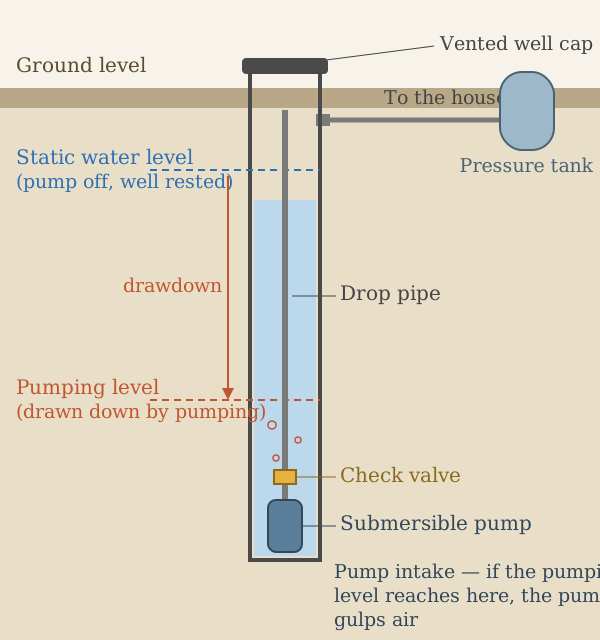
A sputtering faucet on well water is a symptom with a short list of causes — drawdown, a leaking check valve or drop pipe, a tired pressure tank, or dissolved gas. How the timing of the sputter tells you which one, the tests to run, and what each fix costs.
How Far Should a Well Be From a Septic Tank? Setbacks, Explained
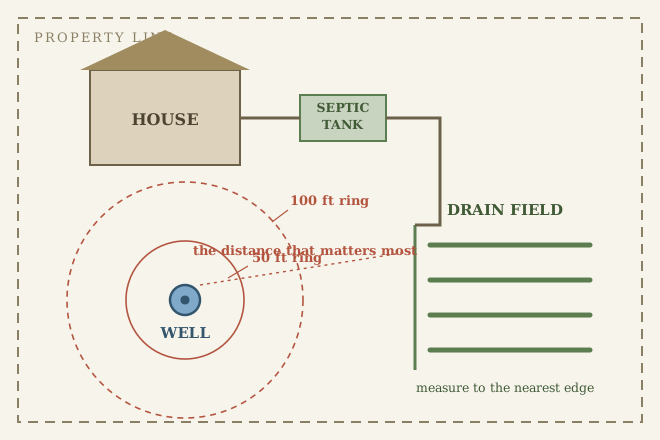
Most states want 50 feet between a well and a septic tank and 100 feet to the drain field — but the field is the distance that actually protects your water. How to measure yours, and what to do if it comes up short.
How to Shock Chlorinate a Well: Dose, Steps, and the Retest That Proves It Worked
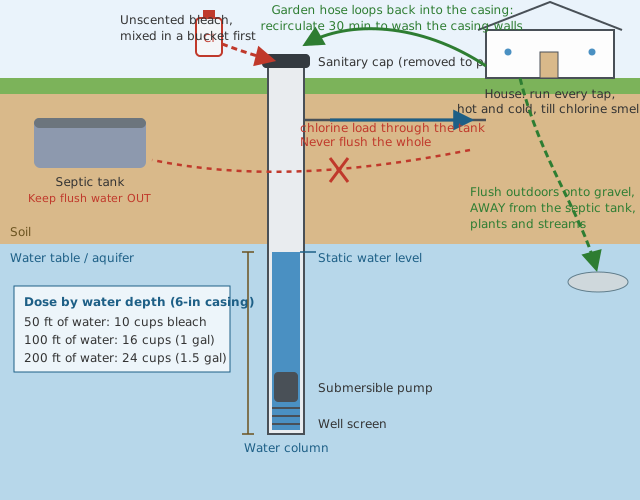
The full shock chlorination procedure: work out your bleach dose from the well log, bypass the softener, recirculate, hold, flush without wrecking your septic, and retest at 10 to 14 days.