 Keep
No Water From Your Well? Check These 5 Things Before You Call
 Daniel Mercer · Editor & Researcher·
Published November 16, 2026·
Updated November 16, 2026
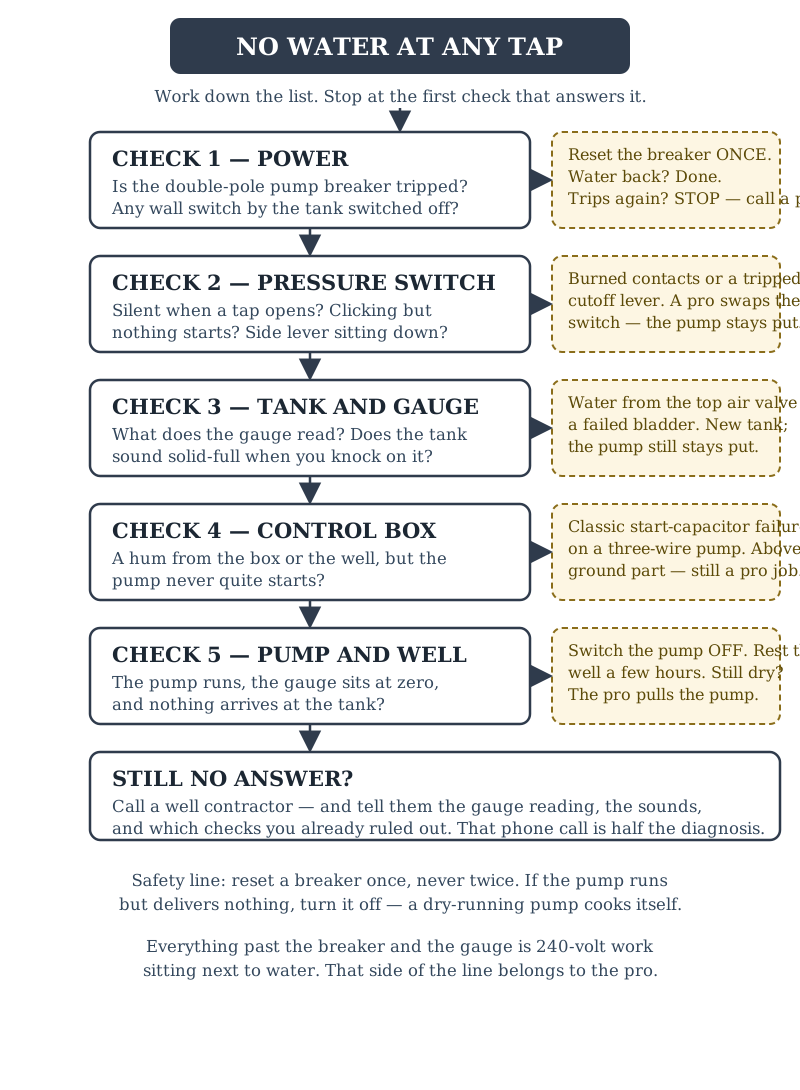
You turn the tap, and nothing happens. Not a sputter, not a sad trickle — nothing. If this is your first house on a well, the thought arrives fully formed within about ten seconds: the pump is dead, the well has run dry, and this is going to cost thousands.
Take a breath, because the odds are better than that thought suggests. A well system is a chain — power from your panel, a switch that tells the pump when to run, a tank that holds pressure, and only then the pump itself, sitting at the bottom of the well. The chain can break at any link, and it breaks most often at the cheap end. A tripped breaker is the single most common cause of a dead pump. The next links up — a worn pressure switch, a tired start capacitor, a waterlogged tank — are all parts that live above ground, in your basement or utility room, where a contractor can reach them in minutes. The pump at the bottom of the well is the last suspect, not the first, and a well that has genuinely run dry is rarer than a switch that has given up.
That is why the checks in this guide go in a strict order, cheapest and commonest first — the flowchart at the top of this page is the whole method. Fifteen minutes with a flashlight and your ears will either fix the problem outright or tell you, and the contractor you phone, roughly where the break is. It can be the difference between a free breaker reset and a $150 call-out to be told your breaker had tripped.
Before anything: two questions
Before you touch a single switch, answer two questions. They take a minute, and they quietly rule out a third of the possibilities.
Is it every tap, or just one? Walk the house: kitchen, bathrooms, the outside hose tap. If one faucet is dry and the rest are fine, your well is innocent — a shut-off valve closed under that sink, a clogged aerator, or a failed line to that one fixture. This guide is for the other case: every tap dry, or nearly, which means the system supplying the whole house has stopped, somewhere in the shared chain.
What just happened? Think back over the last day or two, because no-water problems love a trigger. A thunderstorm or a power cut, even a brief one, points straight at the breaker and the switch — surges and restarts are hard on both. A day of heavy water use — three loads of laundry back to back, a long irrigation run, a houseful of guests all showering — points at the well itself being drawn down faster than it can refill. A cold snap points at a frozen line. A plumber, an electrician, or a family member "fixing" something near the tank points at a valve or a wall switch left in the wrong position. None of these is proof. All of them tell you where to look first and what to tell the pro later.
Three safety rules before the checks
A well pump runs on 240 volts, and it runs next to water and metal pipe. That combination deserves respect, and it sets the boundary for everything in this guide.
Reset a tripped breaker once — never twice. The first reset is a test. If it trips again, it has found a fault and it is protecting your house and the pump motor. Leave it off.
Look and listen, but do not open boxes. The pressure switch and the control box both contain live terminals, and a control box capacitor can hold a charge even with the breaker off. In this guide you will read gauges, listen to switches, and knock on tanks. You will not remove a cover with wires behind it. Extension services are blunt about this for a reason: Nebraska Extension's well guide tells homeowners not to adjust the pressure switch at all, and Minnesota's health department warns that water and electricity together can be deadly.
Never let a pump run dry. A submersible pump motor is cooled by the water flowing past it. A pump that runs while delivering nothing is a pump slowly cooking itself. If you find the pump running with no water arriving, switch it off at the breaker first and investigate second. That one habit saves more pumps than any other in this article.
Check 1: Power — the breaker, and the switch nobody remembers
Go to your electrical panel. Somewhere in it is a double-pole breaker — a wide one, taking two slots — labelled, if you are lucky, "well," "pump," or "well pump." If you have just moved in and the panel is a archaeology of faded pencil marks, the pump breaker is usually 20 or 30 amps and is one of the few double-width breakers that isn't the stove, the dryer, or the air conditioner.
A tripped breaker rarely sits fully in the OFF position. It sits in the middle, slightly out of line with its neighbours, sometimes showing a sliver of orange or red. Push it firmly all the way to OFF first — this resets the mechanism — then push it firmly back to ON. Half-hearted resets that never quite reach OFF are the reason many "I already tried the breaker" stories end with a contractor doing exactly this, successfully, for $150.
Now go and open a tap and wait. If the breaker held, you should hear the pump start within seconds — a click at the pressure tank, then the sound of the pump running and the pressure gauge climbing. Run the tap for a full minute. Water back, gauge climbing steadily to its usual top number and stopping there? You are done, and the whole repair cost you a walk to the panel.
Then ask yourself why it tripped. A breaker that trips once after a storm or a power blink may never do it again. A breaker that trips again — immediately, or an hour later — is reporting a fault: a motor starting to fail, a damaged wire, a control box problem. That is no longer a check, it is a call. And if the breaker was never tripped at all and the pump sits silent, walk to the pressure tank before concluding anything, because most well systems hide a second power switch: an ordinary-looking wall switch or disconnect box near the tank, installed for servicing. It gets bumped by stored paint cans and leaned-on brooms. If it is off, switch it on and see whether the system wakes up.
What the gauge does during this check is your first hard evidence, so look at it before and after: a gauge sitting at zero with a silent pump and a live breaker moves you to Check 2. A gauge holding a normal reading — say 40 or 50 — while no water reaches the taps means the pump side is fine and something downstream is closed or clogged: a main shut-off partly shut, a whole-house filter plugged solid, or a frozen section of pipe. That is a different and usually cheaper problem, and it is not the well at all.
Check 2: The pressure switch — the small gray box that runs the show
The pressure switch is the conductor of the whole system. It watches the pressure in the tank and closes its contacts to start the pump when pressure falls to the cut-in setting — commonly 30 or 40 pounds per square inch — and opens them to stop the pump at the cut-out, commonly 50 or 60. Every cycle of your well, every day, for years, those contacts make and break a 240-volt circuit. They pit, they burn, they corrode. Ants and other insects find the warm little box inviting and die across the terminals. The small tube or port through which the switch senses pressure can clog with sediment and iron. Switches are, in short, built to wear out, and when they do, the pump never gets told to start.
You will find the switch on the pipe tee at the base of the pressure tank: a small gray box, roughly the size of a deck of cards, with a cable running in from the panel and another running out toward the well. The diagram further down this page shows exactly where it sits.
Diagnosing it is a listening job. Stand by the tank and have someone open a tap wide, or open one nearby yourself. A healthy system answers a falling gauge with a distinct click as the pressure crosses cut-in and the pump starts. Now match what you hear:
- Silence, gauge at zero, breaker on. The switch is not closing, or power is not reaching it. This is the classic dead-switch picture.
- Clicking, but the pump never starts. The switch is trying. The fault is downstream — the control box or the pump — and Check 4 is your next stop.
- A switch that starts the pump only after its housing is tapped. Burned contacts, hanging on by habit. It will strand you again, usually at a worse moment; it needs replacing, not tapping.
- Rapid clicking, on-off-on-off every few seconds. That is short cycling, and it usually indicts the tank, not the switch — continue to Check 3.
One special feature catches out new owners constantly. Many switches have a small lever on the side: a low-pressure cut-off. When pressure falls far below cut-in — because a pipe burst, a tap was left running for hours, or the well ran low — this switch shuts the pump off and stays off, deliberately, so the pump cannot run itself dry. If your switch has the lever and it is sitting down, that may be your entire problem. The reset is done with the cover closed: hold the lever in the start position and watch the gauge. If the pump starts and the needle climbs steadily past cut-in, let go — the switch will take over. If the needle will not climb, let go and stop: the switch is telling you the well or the pump genuinely cannot build pressure, and holding it longer just runs a pump dry.
What you do not do is open the switch and file, sand, or bend the contacts, however many old forums suggest it. The contacts are live at 240 volts whenever the breaker is on, and a switch costs $25 to $50 as a part. A contractor will typically fit a new one for $100 to $300 all-in, pump untouched, in under an hour. This is the best-value repair in the whole well system, and it is the one to hope for.
Check 3: The pressure tank and the gauge — your two best witnesses
The pressure tank is the big steel or fibreglass vessel the well pipe runs into, usually in the basement, utility room, or a pit or outbuilding near the well. Inside it, a rubber bladder separates water from a cushion of pressurised air. The pump's job is not really to feed your taps — it is to refill this tank. The air cushion is what pushes water to your shower and gives the pump long, healthy runs instead of frantic short ones.
Everything at the tank — tank, gauge, switch, and the pipe tee they share — is shown in this diagram. It is worth a minute of study before you start, because the next two checks both happen within arm's reach of this spot.
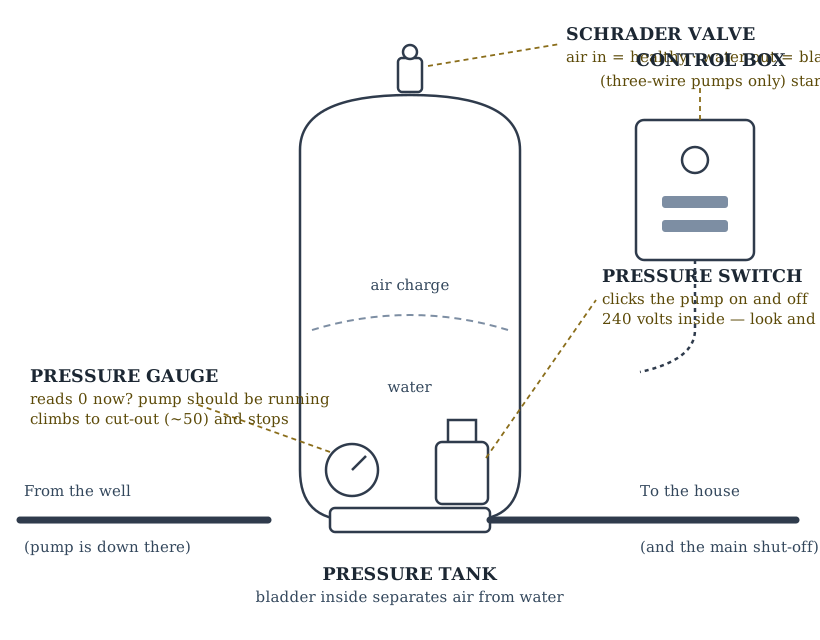
Start with the gauge, the round dial on the tee at the tank's base. It is the single most informative instrument in the system, and it costs you nothing to read. With no water being used, note the number. Then open a tap and watch. A healthy gauge falls slowly as the tank drains, the switch clicks at cut-in, and the needle climbs back to cut-out and stops. For this check, three readings matter:
- Zero, and it never moves. No pressure is being made at all. With a silent pump, you are back at power or the switch; with a running pump, you are at Check 5.
- A normal reading that falls and never recovers when a tap opens. The pump is not refilling the tank even though pressure was there — switch, control box, or pump.
- A needle that bounces or flutters wildly as water runs. Often a gauge problem or air in the system; note it and mention it, but keep checking.
Gauges themselves fail, especially old ones — a needle frozen at 40 through every test is a liar, not a comfort. If every other sign says the system is dead but the gauge insists all is well, believe the taps, not the dial, and tell the pro the gauge is suspect.
Now the tank itself. Knock on its side, top to bottom, with your knuckles. A healthy tank sounds hollow and drum-like in its upper half — that is the air cushion — and duller toward the bottom, where the water sits. A tank that sounds solid and dead all the way up has lost its air: the bladder has failed or the charge has leaked away, and the tank is waterlogged. Minnesota's Well Owner's Handbook names waterlogging as the usual cause of the symptom that goes with it — the pump clicking on and off every few seconds whenever a tap runs, because a waterlogged tank gives the pump no cushion to work against.
There is a confirming test, and it is the one careful owners can do: the small Schrader valve — it looks exactly like a tyre valve — on top of the tank. Press the pin briefly. Air should hiss out. If water spurts or spits out instead, the bladder has ruptured and the tank is finished; no amount of recharging will save it, because the air and water are no longer separated. If only air comes out, the charge may simply be low, and that is a service item — a pro will drain the tank and reset the air charge to the correct figure, which is 2 pounds below the switch's cut-in setting (28 pounds for a 30/50 switch, 38 for a 40/60). Extension guidance is cautious here, and so is this guide: checking what comes out of the valve is a ten-second diagnosis anyone can make; recharging a tank properly involves draining the system, and some manufacturers take a dim view of owners removing valve caps under warranty. Diagnose it yourself; let the pro set it.
A failed tank alone rarely causes a total no-water stoppage on day one — it causes short cycling, pressure that pulses at the tap, and a pump being worked to death. But a tank that has been waterlogged for months is very often the reason the switch contacts burned out or the pump failed, which is why it earns its place in the sequence. Replacement, fitted, typically runs $450 to $1,500 depending on size — and if your no-water problem does end at the pump, ask whether the tank's condition helped kill it, because replacing a pump without replacing the tank that murdered it is a bill you will pay twice.
Check 4: The control box — the hum that gives it away
If your pump is a three-wire submersible — very common — its starting components live not down the well but in a control box on the wall near the tank, about the size of a shoebox. Inside are a start capacitor and a relay: the capacitor gives the motor its starting shove, and the relay takes it out of the circuit once the motor is spinning. Two-wire pumps keep these parts down in the motor, which is why the presence or absence of this box changes the diagnosis completely.
The signature symptom is one of the most useful sounds in this whole guide: a hum, and no start. You open a tap, the switch clicks, and somewhere — the box, or faintly through the pipework — the system hums, strains, and gives up, sometimes tripping the breaker, sometimes just sitting there humming until something clicks it off. That is a motor with power, willing to run, and no starting push. In a three-wire system, that is the capacitor or the box until proven otherwise.
This is genuinely good news disguised as a breakdown. The part is above ground. Nobody pulls the pump. A start capacitor fitted typically runs $75 to $200, and a complete control box $200 to $500 — real money, but a different universe from a pump pull. It is also a diagnosis a contractor can confirm in minutes with a meter, which makes it one of the fastest call-outs in the trade.
Your part in this check is deliberately small: hear the hum, note it, and then turn the pump off at the breaker. A motor that hums without turning is converting electricity into heat inside a sealed can at the bottom of your well, and left powered it can cook itself while you wait for the appointment — turning a $150 capacitor into a $2,000 pump. Do not open the box, even with the breaker off: capacitors hold charge, and the inside of that box is exactly the kind of surprise this guide exists to keep you away from. "It hums but won't start, and I've switched it off at the breaker" is a complete and professional-grade report to give on the phone.
If there is no hum — silence from a system with a live breaker and a clicking switch — the break is more likely in the wiring down the well or in the motor itself, and you have arrived, by elimination, at the last check.
Check 5: The pump, and the well itself
Everything above ground has now been cleared, and the two remaining suspects are the pump and the water it stands in. They present differently, and telling them apart is the last piece of diagnosis you can do from the surface.
The pump runs, the gauge sits at zero, and nothing arrives. Or the pump runs and delivers a weak, sputtering flow that dies. Turn the pump off at the breaker — the dry-run rule again — and think about water, not machinery. A submersible pump can only lift what reaches it. If the water level in the well has fallen below the pump's intake, the pump spins in air and delivers nothing: a long dry spell lowering the water table, a day of exceptional demand, a modest well asked to run irrigation and laundry at once, or a leak between pump and tank quietly draining production. Penn State Extension lists a worn-out pump as the most frequent cause of lost water overall — but a water level dropping below the pump during heavy use sits right alongside the mechanical failures, and the test for that version is free.
The test is rest. Pump off, every tap closed, nobody uses well water at all — no flushing, no laundry, no "just one quick shower." Give it four to six hours; overnight is better. Then switch on and open one tap gently. If water returns at something like normal pressure, your well was drawn down and has recovered, and your problem is arithmetic, not equipment: the well makes water slower than your household spent it. The fixes are behavioural and cheap — spread laundry across the week, never run irrigation and the washing machine together — and a contractor can read your well's actual yield from its record if the pattern repeats. If the water does not come back, or dies again within minutes at modest use, the conversation changes to the pump, the drop pipe, or the well itself: a failed check valve or holed drop pipe letting water fall back down the well, a pump whose impellers have worn smooth, or a well that is silting up.
The pump does not run at all, and Checks 1 to 4 are clean. Then the failure is down the hole: the motor, or the cable feeding it. There is no surface test left that separates those two, and there is no surface fix. This is the pump pull — the contractor's hoist over the well head, the pump coming up on its pipe, and the diagnosis made on the grass. It is also the expensive outcome, $1,500 to $3,000 for a typical 100-to-200-foot well and $2,800 to $4,000 or more for deep wells, which is exactly why the four checks above exist: every one of them is a way this story ends without that hoist.
Two things worth knowing before you authorise a pull. First, age: submersible pumps live 8 to 15 years, and a twelve-year-old pump with a dead motor is a replacement, not a repair. Second, the trade's working rule: if a repair requiring a pull costs more than half the price of a new pump, replace the pump — the labour is the same either way, and it is the labour you never want to pay twice in one year.
What each fix costs, and how the bill builds
The table at the top of this page is the whole economics of this problem in five rows, and it explains the shape of the checks: each step down the list costs several times the step before it. A breaker is a $15 to $40 part and a reset is free. A pressure switch fitted is $100 to $300. A pressure tank is $450 to $1,500. A pump pull starts where the tank ends and climbs with the depth of your well, because past a certain point you are not really paying for a pump — the pump might be $400 to $900 of the ticket — you are paying for a crew, a hoist, and several hundred feet of pipe and wire coming up and going back down.
Before any of those numbers, expect one smaller one: the diagnostic call-out, typically $100 to $150 in normal hours, and often credited against the repair if the same firm does the work. Timing changes it. After-hours and weekend calls can add $150 to $300, and some firms effectively double the labour rate at midnight — which is worth knowing when you are deciding, at 11 p.m. with a house full of guests, whether this is a tonight problem or a tomorrow-morning problem. If the checks have left you with a silent, safely switched-off system and a tank that still holds some pressure, tomorrow morning is often the rational answer, and the emergency plan further down this page is how you bridge the gap.
Two habits protect you on any of these bills. Get the diagnosis in words before the repair in dollars: "the switch contacts are burned" is a sentence you can repeat to a second firm; "it's the pump, probably" is not. And when the pump itself is condemned, ask what test condemned it — a contractor who worked the same sequence in this guide will tell you the readings that forced the conclusion, and those readings are your receipt.
Just bought the house? Where this equipment actually lives
Everything in the checks above assumes you can find the equipment, and if you moved in recently, that assumption may be the whole problem. Sellers tour you through kitchens. Nobody tours you through the well gear. Here is the geography of a typical system, so you can find yours in the dark with a phone torch, which is how most owners first do it.
The well head is outside: a pipe sticking up out of the ground, usually 6 to 8 inches across with a cap on top, somewhere in the yard — sometimes landscaped into invisibility, sometimes inside a small pump house or a fake rock. You do not need it for these checks, but you need to know where it is before a contractor's truck arrives, and it should stand above grade with the cap intact; a buried or damaged cap is a contamination route as well as an eyesore.
The pressure tank is where the water enters the house's plumbing life: most often in the basement near the wall the water line comes through, or in a utility room, garage, or crawl space — rarely far from the water heater and the main shut-off. The gauge, the pressure switch, and usually the control box are all within a few feet of it. This little cluster is the nerve centre, and it is worth labelling once, on a calm day, with tape and a marker.
The breaker is in your main panel, wherever that is — garage, basement, laundry room — and the labelling expedition is worth doing before you need it: find the double-pole breaker for the pump and write "WELL PUMP" on the panel legend in ink. While you are there, find the main water shut-off for the house and the wall switch or disconnect by the tank, if there is one.
The paperwork matters more than any of it. Somewhere in your closing documents there may be a well record: the driller's log with the well's depth, its yield in gallons per minute, the pump's make and model, and the date it was set. That single sheet answers half the questions a contractor will ask — "the pump is fourteen years old" ends several arguments. If it doesn't exist, your state or county health department often holds a copy of the original well completion report, and an hour spent retrieving it is the cheapest diagnostic tool you will ever buy. Start a folder now: every invoice, every test result, every part replaced, dated.
No water for a day or three: the emergency plan
Suppose the checks have done their work, the diagnosis is "the pro comes Thursday," and today is Tuesday. A house without water is not a house without hope — it is a logistics problem with known numbers, and it helps to know them before you are standing in a shop doorway doing arithmetic from memory.
Drinking and cooking come first, and they are cheap. Plan on roughly a gallon per person per day — a case of bottled water is about three gallons, so a case a day covers a family of three, and two cases bought at once ends the daily shop run. The water already in your house is also yours: a standard water heater holds 40 to 50 gallons of good water, drawable from its drain valve into a clean pot, and the pressure tank may give a few more gallons at the tap. If the cause was purely electrical, that stored water is as safe as it was yesterday; if the well was opened or the water came back cloudy, boil it for drinking or stick to bottled until you have tested.
Flushing is where the gallons go, so plan it separately. A modern toilet uses about 1.6 gallons a flush, and it does not need the well to do it: pour a bucket of water directly into the bowl, briskly, and the siphon triggers exactly as the tank would do it. That bucket water does not need to be drinking quality. A bathtub filled the moment you suspect a long outage is a 40-gallon flushing reservoir; so is a neighbour's outside tap or a rain barrel. The household rule that makes this civilised is the old drought-camp one: if it's yellow, let it mellow; flush solids every time, liquids on a schedule.
Neighbours are infrastructure. A neighbour on the same aquifer can tell you whether their well is also down — which converts your breakdown into a neighbourhood water-table event, and is genuinely useful information for the contractor. A neighbour on city water, or with a working well, will usually fill your containers without a thought. But do not, under any circumstances, connect their supply to your plumbing with a hose: cross-connections can contaminate their system and are prohibited in most places for exactly that reason. Fill containers. Carry water. It is a day or two, not a siege.
Know when the hotel is the rational line item. Price the alternatives honestly: an emergency weekend call-out premium can run $150 to $300 on top of the repair, and a night in a mid-range hotel with showers and breakfast can cost less than the premium alone. If the repair is booked for Monday at normal rates and it is Friday night, the hotel is not surrender; it is arithmetic. The same goes for a laundromat run and a gym day pass for showers. Houses on wells occasionally need bridging, and bridging is not failure.
What the well pro does when they arrive
A good contractor's visit will feel familiar, because they run the same sequence you just did — faster, and with instruments. Knowing the shape of it tells you what you are paying for and what a thorough job looks like.
They will start with your report, which is why the details in this guide matter: the gauge reading, whether the pump was silent, humming, or running, whether the breaker tripped and how fast, and what happened just before the water stopped. Then they will verify power properly — not "is the breaker on" but voltage measured at the switch and at the control box, which separates a dead switch from a dead feed in a way eyes cannot. They will test the switch contacts under load, test the capacitor and relay with a meter rather than by reputation, and check the tank's air charge with the system drained, which is the version of the Schrader test that gives a number instead of a splash.
If the fault is above ground, most visits end within the hour, with a part swapped and the system cycled several times to prove it holds. If everything above ground passes, they will measure the pump's current draw and resistance through the wires — tests that can condemn a motor or a cable without pulling anything — and only then set up the hoist. On a pull, expect the pump, drop pipe, and wire to come up together, and the diagnosis to happen on the ground.
Two closing items separate a complete job from a quick one. After any repair that opened the well or replaced parts in it, the system should be disinfected and the water tested for coliform bacteria before you drink it — CDC guidance is explicit that repairs are testing triggers, because opening a well can introduce bacteria however careful the crew was. And you should leave with paperwork: what failed, what was fitted, and the readings that justified it, for the folder you are now keeping. If the invoice just says "fixed pump," ask for the long version. You are paying for the diagnosis as much as the part.
The one-page checklist
Print this page, or copy this section onto a card and tape it inside the panel door or beside the tank. When the water stops, work down it in order.
- Every tap dry — or just one? One tap is a plumbing problem, not a well problem.
- What just happened? Storm, outage, laundry day, guests, freeze, work near the tank.
- Panel: find the double-pole pump breaker. Tripped? Push fully OFF, then ON — once.
- Tap open for 60 seconds. Water back and gauge climbing? Done. Breaker tripped again? Leave it off, call a pro.
- Breaker fine? Check the wall switch or disconnect by the tank — is it on?
- Stand at the tank. Read the gauge and write the number down.
- Open a tap. Listen: click? hum? silence? pump running?
- Gauge at zero + silence = power or pressure switch.
- Click, then a hum, no start = control box capacitor. Breaker off while you wait.
- Pump running + gauge at zero = switch the pump OFF. Rest the well 4–6 hours, then one gentle try.
- Knock the tank top to bottom. Solid and dead all the way up = waterlogged.
- Press the tank's top air valve for one second. Water spurts out = bladder failed.
- Switch has a side lever sitting down? Hold it up, watch the gauge climb past cut-in, let go.
- Never: reset a breaker twice, open the switch or control box, or let a pump run dry.
- Call the pro and report: gauge reading, the sounds, the breaker behaviour, what happened before it stopped.
How urgent is it, really?
Completely urgent and rarely catastrophic — that is the honest summary. A house with no water needs a decision today: the checks take fifteen minutes, and if they clear the cheap causes, the call should go in today too, because every day of delay is a day of bucket logistics and because small electrical faults occasionally announce bigger ones. But the situation is seldom an emergency in the midnight-premium sense. A system that is switched off, not running dry, not tripping breakers, and not smelling of hot insulation will wait safely until morning at standard rates, and the water in your heater and the plan above will carry the house until then.
The exceptions that justify the after-hours call are few and specific: a breaker that trips instantly with a smell of burning, water where it should never be (a burst line filling a basement beats a dry tap for urgency every time), or someone in the house who depends on water for medical equipment or infant formula, with no stored supply. Outside those, take the breath the first paragraph asked for, and work the five checks in order. Most dry taps end at a breaker, a switch, or a capacitor — above ground, same day, and for the price of a nice dinner rather than a new pump.
Cost at a glance
| Item | Typical cost | Notes |
|---|---|---|
| Check 1 — Power: breaker reset or replacement | Free–$40 | Resetting costs nothing. A replacement double-pole breaker is a $15–$40 part; if it keeps tripping, the bill moves to whatever is tripping it |
| Check 2 — Pressure switch replaced | $100–$300 | The switch itself is a $25–$50 part. The pump stays in the well and the visit is usually under an hour |
| Check 3 — Pressure tank replaced | $450–$1,500 | Price follows tank size. Includes draining the old tank, setting the new one's air charge and disposal |
| Check 4 — Control box or start capacitor | $75–$500 | Capacitor alone $75–$200; a whole control box $200–$500. Above ground, pump stays in the well |
| Check 5 — Pump pulled and replaced | $1,500–$3,000 | For a typical 100–200 ft well. Deep wells run $2,800–$4,000+. A diagnostic call-out before any of this runs about $100–$150, often credited against the repair |
Frequently asked questions
Why did my well water stop all at once, with no warning?
Because most of the parts that stop it fail electrically, and electrical parts rarely fade — they let go. A breaker trips in an instant, switch contacts that have pitted over ten thousand cycles finally refuse to close, a start capacitor dies between one cycle and the next. The gradual failures (a tank losing its air, a pump wearing out) usually announce themselves for weeks first with pulsing pressure or short cycling. A truly sudden stop, with a silent pump and a gauge at zero, is most often power or the pressure switch — the two cheapest fixes on the list.
Can I keep resetting the breaker until the pump starts?
No — reset it once. A breaker that trips again is doing its job: it has found a fault, usually in the pump motor or the wiring running down the well, and it is refusing to feed power into it. Every extra reset forces current into that fault. Leave it off and tell the contractor exactly what it did ('tripped instantly' versus 'held for a minute, then tripped'), because that timing is a real diagnostic clue they will ask about anyway.
The pump hums but no water comes out. What does that mean?
A hum with no start usually means the motor wants to turn but can't get its starting push. On a three-wire pump, that points at the start capacitor or relay in the control box — an above-ground part costing $75–$500 fitted, which is why the hum is worth listening for. Turn the pump off at the breaker while you wait for the pro: a motor that hums without turning is heating itself, and leaving it powered can turn a capacitor bill into a pump bill.
How long does a well take to recover after it runs dry?
Most wells that were drawn down by heavy use recover in a few hours of rest; a well drawn down in a dry spell may need overnight, and a genuinely drought-stressed well can take days. Switch the pump off, use no well water at all, and try again after four to six hours — briefly. If the water comes back and holds, your problem is demand versus supply, and the fix is spacing out laundry and irrigation, not a new pump. If it never comes back, the problem is the pump or the well itself.
Is the water safe to drink once it comes back on?
If the cause was purely electrical — a breaker or a switch — the water never went anywhere and it is as safe as it was yesterday. If the well was opened, the pump pulled, or parts replaced, disinfect and test before drinking: the CDC advises testing for coliform bacteria after any well repair or replacement, because opening the system can let bacteria in. If the well ran dry and the returning water is cloudy or gritty, run an outside tap until it clears and test before you drink it.
How much does it cost to get a well pumping again?
It depends entirely on which check catches it. A breaker reset is free and a breaker part $15–$40. A pressure switch fitted runs $100–$300, a start capacitor $75–$200, a control box $200–$500, a pressure tank $450–$1,500. The expensive outcome is a pulled pump: $1,500–$3,000 for a typical 100–200 ft well, more for deep wells. A diagnostic call-out is usually $100–$150, often credited against the repair — and after-hours or weekend calls can add $150–$300.
How long do well pumps last? Should I replace an old pump while it is pulled out?
Submersible pumps typically last 8 to 15 years, jet pumps about the same, and pressure tanks 10 to 20. If a contractor has already paid the labour to pull a pump that is ten or more years old and the diagnosis is a worn motor, replacing rather than repairing is usually the right call — the standard rule is that if a repair involving a pump pull costs more than half the price of a new pump, replace it. Ask for the old pump's age from the well record before you decide; if nobody knows it, that itself argues for replacement.
Checked November 16, 2026. This guide is general information, not a substitute for a licensed professional.
Related guides
Air in Your Water Lines: Why Faucets Sputter on a Well
A sputtering faucet on well water is a symptom with a short list of causes — drawdown, a leaking check valve or drop pipe, a tired pressure tank, or dissolved gas. How the timing of the sputter tells you which one, the tests to run, and what each fix costs.
How Far Should a Well Be From a Septic Tank? Setbacks, Explained
Most states want 50 feet between a well and a septic tank and 100 feet to the drain field — but the field is the distance that actually protects your water. How to measure yours, and what to do if it comes up short.
How to Shock Chlorinate a Well: Dose, Steps, and the Retest That Proves It Worked
The full shock chlorination procedure: work out your bleach dose from the well log, bypass the softener, recirculate, hold, flush without wrecking your septic, and retest at 10 to 14 days.