 Keep
Monthly Home Maintenance Checklist: The 15-Minute Routine
 Daniel Mercer · Editor & Researcher·
Published November 16, 2026·
Updated November 16, 2026
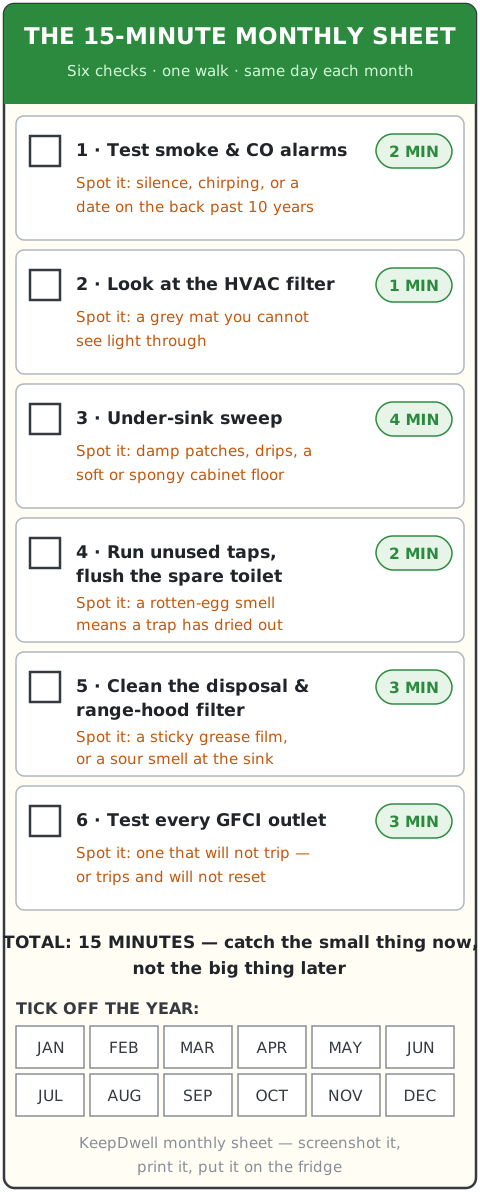
Search for a monthly home maintenance checklist and you will get two kinds of list, both of them wrong for a first-time owner. The first kind is so vague it is useless ("inspect your home monthly"). The second kind is a forty-item guilt document that quietly mixes in seasonal and annual jobs (clean the gutters, flush the water heater, service the furnace) until the "monthly" round looks like a full Saturday of work, at which point most people do the rational thing and stop doing it entirely.
Here is the truth about the monthly interval: almost nothing in a house needs monthly work. What a house needs monthly is monthly looking. The failures that cost real money (a supply line weeping into a cabinet, a toilet silently passing water day and night, a safety device that died months ago and told nobody) all share the same shape. They start small, they develop quietly in places you do not open, and they are cheap or free to deal with in the month they start. The monthly round exists to catch exactly those, and catching them takes about fifteen minutes.
The organising idea: six checks, each with a pass and a fail you can see
This routine is built on one rule: a monthly check only earns its place if you can perform it in minutes and judge it on the spot, pass or fail, with your own eyes. No gauges, no expertise, no judgement calls. Each of the six checks below is timed, and each one tells you precisely what "bad" looks like, because a checklist that says "check the filter" without saying what a failed filter looks like is not a checklist, it is a chore reminder.
You need three things: a step stool (for alarms and the range hood), your phone's flashlight, and one dry paper towel, which is the most sensitive moisture detector you own. Pick a route through the house and walk the same route every month; the routine gets faster every time because your hands learn where everything is. Here is the whole thing on one sheet, the way it should live on your fridge:
The bigger jobs are not missing from your life, they are filed where they belong. Seasonal work (gutters, exterior, heating and cooling changeovers) sits on the maintenance calendar, and each monthly check below names the one failure sign that should pull you out of the routine and into a real repair guide. Fifteen minutes of looking, once a month, is the entire commitment.
Check 1: Test the smoke and CO alarms (2 minutes)
Walk to each alarm, press and hold the test button, and listen for the full alarm, not a beep of acknowledgement. Do every smoke alarm and every carbon monoxide alarm in the house, including the one in the hallway you forget exists and the one the previous owner installed near the furnace.
The U.S. Fire Administration's guidance is plain: test alarms monthly, replace batteries at least once a year in alarms that take replaceable batteries, and replace the entire alarm when it reaches 10 years from the date printed on its back, because the sensing element ages out whether or not it has ever gone off. Sealed 10-year battery alarms remove the battery chore but not the test, and not the expiry date.
What bad looks like: silence when the button is pressed (dead battery, disconnected alarm, or an alarm at end of life), and chirping, which is the alarm announcing it can no longer be trusted, not a request to remove the battery at 2 a.m. and forget it. Also treat as failed: any alarm with no date you can find, and any house level or bedroom missing one entirely. This is the one check on the sheet where a fail gets fixed the same day, with a trip to the store if that is what it takes. Two minutes, and it is the highest-value line on the list by a distance that is not close.
Check 2: Look at the HVAC filter (1 minute)
Note the verb. This check is a look, not a change. Find the filter (either behind the large return grille, usually in a hallway wall or ceiling, or in a slot at the base of the furnace or air handler), slide it out, and hold it up toward a light or a window.
A filter you can still see light through, with the pleats or mesh visible under a light dusting, passes and goes back in. What bad looks like is a grey mat: a felted coating the colour of dryer lint that has closed the surface over, so the filter reads as a flat grey sheet and light does not come through it. That filter is done, whatever the calendar says, and it gets changed today, with the size (printed on the frame) noted in your phone for next time and the install date written on the new filter's frame in marker.
Why monthly, if filters last one to three months or longer? Because the interval depends on the filter you have, your pets, your dust and the season, and the look is what knows. ENERGY STAR's rule is exactly this: check the filter every month, change it at least every three months, and sooner when it looks dirty. A clogged filter is not a neutral thing: it starves the blower of air, raises energy use, and in summer it is a contributing cause of frozen AC coils. The full by-type schedule (thin fibreglass versus pleated versus deep media, and the MERV question) is covered in our guide "How Often to Change Your HVAC Filter (It Depends on the Filter You Have)". This check is just the sixty-second glance that tells you whether that schedule needs attention this month.
Check 3: The under-sink sweep (4 minutes)
This is the longest check and the one that saves the most money, because the most damaging common leak in a house is not a burst pipe, it is a slow drip under a sink that runs for months inside a closed cabinet. Open every sink cabinet you have: kitchen, each bathroom, laundry if there is one. Move the bottles enough to see the plumbing. You are examining four things.
First, the supply lines running up to the faucet, and their shutoff valves. Run the paper towel slowly along each line and around each valve stem and connection. The towel is the instrument: it shows a faint damp crescent where your fingers would argue about whether anything is wet. Second, the drain side: the trap (the U- or P-shaped bend) and its slip-joint nuts, which loosen over years and weep at the joints. Third, the lines themselves. Braided steel supply lines have a service life, and what bad looks like is specific: any bulge in the braid, fraying, or rust staining at the metal ferrules where the line meets its fittings. A line showing any of those gets replaced, both of them, as a pair, at the next opportunity, not monitored. A burst supply line can pass hundreds of gallons an hour into your kitchen; a $10–$25 pair of lines is the cheapest insurance in this entire guide.
Fourth, press your thumb hard into the cabinet floor. It should feel like wood. A floor that feels soft, spongy or punky has been absorbing water for a while, which reframes the job: the leak above it is probably small, but it has been leaking long enough to rot the cabinet, and the fix now includes finding how far the water travelled. A single drip you can see, on a hard floor, is a snug-the-fitting or replace-the-line job. A soft floor is a stop-and-investigate job, and it is the difference between month one and month three made physical.
Check 4: Run the unused taps, flush the spare toilet (2 minutes)
Every drain in your house seals itself against sewer gas with a simple device: a trap that holds a plug of water. In a fixture you use daily, that water is refreshed constantly. In the guest bathroom, the spare shower, the basement laundry sink, it evaporates, slowly and completely, over a few weeks. When it is gone, the drain is an open pipe to the sewer, and the house tells you in the least subtle way available: a rotten-egg or sewage smell in a room nobody uses.
So once a month, run every unused tap for twenty to thirty seconds and flush the spare toilet. That refills every trap in the house and resets the evaporation clock. What bad looks like: the smell itself (a dry trap, cured by the run you just did; if the smell persists after running water, the problem is elsewhere and worth chasing), a drain that gurgles or drains slowly, and, at the toilet, the giveaway of a silent leak: a toilet that briefly refills on its own when nobody has flushed it has a leaking flapper passing water from tank to bowl around the clock. A running toilet can waste a few hundred gallons a day, which on city water is a bill and on a septic system is worse, a constant hydraulic load your drainfield was never sized for. If the spare toilet shows that refill habit, our guide "Toilet Keeps Running? The Dye Test Finds the Guilty Part in 15 Minutes" walks the fifteen-minute test that identifies the guilty part.
Check 5: Clean the disposal and the range-hood filter (3 minutes)
Two kitchen items that fail by accumulation. For the garbage disposal: run cold water, switch it on, and feed it a tray of ice cubes, which scour the grind plate and splash zone, followed by a few citrus peels if you want the smell gone rather than masked. Listen while it runs. What bad looks like is a sour, swampy smell that survives the ice (food film built up above the waterline, cured by a bottle brush and dish soap around the splash guard's underside, with the power off at the switch and your hand never in the chamber), or a hum with no grinding, which is a jam or a dying motor and a different conversation.
For the range hood: the mesh or baffle filter above your stove is catching cooking grease so your walls and ducts do not. Pull it out (most slide or unclip) and look at it against the light. A filter you can see through passes; a filter coated in a sticky amber film is both a fan working against a blockage and a layer of fuel sitting directly over your burners. Most metal filters go in the dishwasher, or soak in hot water with dish soap and a degreaser, dry fully, and clip back. Three minutes, and you have removed one of the few genuine fire loads in a kitchen.
Check 6: Test every GFCI (3 minutes)
GFCI outlets, the ones with the two small buttons between the sockets, guard the places where water and electricity share a room: bathrooms, kitchen counters, the garage, the basement, outdoors. They only protect you if their sensing circuit still works, and the only way to know is to exercise it. Plug in something small that shows power (a phone charger with its light, a night light), press TEST: the button should pop with a click and the power should die. Press RESET: power returns. Walk every GFCI in the house; remember that one GFCI often protects several plain outlets downstream of it, which is why a dead bathroom outlet is so often a tripped GFCI in the garage.
What bad looks like comes in two forms, both serious. A GFCI that will not trip when tested is passing power with no protection at all. A GFCI that trips but refuses to reset is telling you its protection has failed internally (modern units are designed to lock out in exactly that case) or that there is a real ground fault or moisture somewhere on the circuit it guards. Unplug everything on that circuit, make sure nothing is damp, and try once. If it still will not reset, leave it off and bring in an electrician: the outlet itself is a $15–$25 part, and what you are paying for is certainty at the exact point where water meets wiring. If tripping and resetting problems start appearing at the breaker panel instead, with breakers that trip and will not hold, that is the pattern covered in "Breaker Keeps Tripping? Read the Timing, Do the Maths, Know When to Stop Resetting".
What is deliberately NOT on this list
Half the discipline of a monthly routine is keeping it monthly. The jobs below appear on other sites' "monthly" checklists constantly, and every one of them is real work that matters; they are simply not monthly, and letting them onto the sheet is how a 15-minute round inflates into a Saturday and then into abandonment.
Gutter cleaning is seasonal: typically twice a year, timed to leaf-fall and spring seed drop, and more often only under heavy tree cover. Water-heater flushing is annual, as is dryer-vent cleaning (a genuine fire-safety job, but a yearly one). Furnace and AC servicing is annual per system, best booked ahead of the season that stresses it. Septic pumping runs on a three-to-five-year interval set by tank size and household, not by the month. Well water testing is an annual lab job. Chimney sweeping, deck sealing, exterior caulk and paint touch-ups, and reversing ceiling fans all belong to the seasons.
The dividing rule is simple. If a job involves doing (cleaning out, flushing, servicing, sealing), it is almost never monthly. If it involves noticing (a sound, a smell, a drip, a date, a gauge), it probably is. The noticing jobs live here, on the fridge sheet. The doing jobs live on the seasonal maintenance calendar, one per season, where they can be planned, booked and budgeted like the projects they are instead of ambushing you twelve times a year in miniature. Owners who keep the two lists separate tend to still be doing both in year three. Owners who merge them tend to be doing neither by month four.
If your house has septic and a well: three extra lines (about 3 minutes)
The six checks above are the same for every house. A house that makes its own water supply and handles its own waste adds three short lines, because those two systems have no utility watching them: you are the utility.
Softener salt. If you have a water softener, lift the brine tank lid and look. Salt should sit visibly above the water level in the tank. A softener that runs out of salt stops treating quietly: no alarm, no noise, just hard water resuming its slow work of scaling the water heater and spotting everything it touches. Top the salt up when the level drops toward the waterline, and break up any solid salt crust (a "salt bridge") you find spanning the tank with empty space beneath it.
The septic glance. If your system has an alarm panel (many do, for the pump chamber), look at it: a lit or sounding alarm is the system asking for attention while the problem is still a service call. Know, too, where your effluent filter is and roughly when it was last cleaned; you are not pulling it monthly, you are keeping it on your mental map, because a clogging filter announces itself as slow drains throughout the house and gets misdiagnosed expensively. And if the spare toilet in check 4 has been silently running, remember it has been loading this system the whole time.
Listen at the pressure tank. End the round in the basement or utility space, near the well pressure tank, when no water is running anywhere. A healthy system sits silent. A pump that clicks on, runs a few seconds, clicks off, and repeats, or that kicks in briefly when nobody has drawn water, is short-cycling: the pressure tank has usually lost its air charge and become waterlogged, and the pump is destroying itself in instalments, one start at a time. It costs nothing to stand there for twenty seconds, and the full test is in "Well Pump Short Cycling: The Waterlogged Pressure Tank Test". While you are in the basement, one bonus act that takes ten seconds: if you have a sump pump, note whether the pit is dry and the float moves freely; the full diagnosis by sound and symptom is in "Sump Pump Not Working? Diagnose It by Sound, Then by Symptom", and the month you want to discover a dead sump pump is any month except the one with the storm.
When a check fails: where each failure goes
The routine's job ends at detection. Each failed check has a matching deep-dive on KeepDwell, and the pattern to learn is that the monthly find is always the cheap version of the problem:
- Filter grey and matted, or the system struggling despite a clean one → the by-type schedule and MERV guidance in "How Often to Change Your HVAC Filter (It Depends on the Filter You Have)".
- Toilet refilling on its own → the dye test in "Toilet Keeps Running? The Dye Test Finds the Guilty Part in 15 Minutes" finds whether it is the flapper, the fill valve or the flush valve, in about fifteen minutes.
- GFCI that will not reset, or breakers that trip and will not hold → "Breaker Keeps Tripping? Read the Timing, Do the Maths, Know When to Stop Resetting" for the panel side, and an electrician for a GFCI that stays locked out after the circuit is unplugged and dry.
- Taps that have lost pressure since last month → a change in pressure is a symptom with a short list of causes, worked through in "Low Water Pressure in the House: How to Find the Cause (and Fix It)".
- Well pump cycling oddly → "Well Pump Short Cycling: The Waterlogged Pressure Tank Test". And once a year, not monthly, the well needs its water actually tested: "How to Test Your Well Water: What to Test, How Often, and What It Costs".
Notice what is not on this list: a plumber or electrician on retainer for the routine itself. The checks are yours. The trades enter when a check fails into a repair, and because you found it early, they enter at the cheap end of the job.
Making it a habit that survives real life
A checklist you do twice and abandon is worth nothing, so design for the person you actually are. Anchor the round to a date that already exists: the first Saturday of the month, the day the mortgage payment leaves the account, the first of the month alongside the rent-era habits you already have. Put a recurring phone reminder on that date with the six items in the note field, so the list arrives with the prompt.
Then make the sheet physical. Screenshot or print the sheet at the top of this page and put it on the fridge; tick the month boxes along its bottom edge as you complete each round. Twelve boxes is the whole game: a visible row of ticks is a streak nobody wants to break, and a gap in the row is honest information about a busy month, not a failure of character. If two adults share the house, split the route (one takes alarms and GFCIs, the other takes sinks and taps) and the whole thing drops under ten minutes. The first round will take half an hour, because you are locating things and writing down filter sizes and GFCI locations. That is not the routine being slow; that is the routine being built.
One more habit, worth the thirty seconds it takes: keep a one-line log. A note on the phone or a card inside a kitchen cabinet door: the date, "all pass", or the one thing you found ("hall GFCI dead, electrician booked", "kitchen trap weeping, towel dry this week"). The log does two jobs. It turns a vague feeling that something changed into a dated observation you can act on (pressure lower than when, exactly?), and it becomes the maintenance history of the house, the document that makes your systems legible to the next owner and, not incidentally, to you in year four when you are trying to remember whether the softener has always sounded like that. Houses do not come with service records. The owners who fare best are the ones who start writing them.
The cost of skipping, and what the routine costs
The routine itself costs almost nothing: filters at $5–$20 as they actually wear out, alarm batteries once a year, the occasional $10–$25 pair of supply lines. The consumables in a normal year fit comfortably inside $100. Set that beside what the checks are standing guard over. A cabinet floor and the flooring beyond it, after a slow leak has run a season: $500–$2,500 and up. A supply line that bursts while you are on holiday: a five-figure water-damage claim is routine for insurers, and it starts from the bulge you would have seen in check 3. A toilet leaking 200 gallons a day for a quarter: a water bill with a surcharge on top, or a saturated drainfield on septic. A furnace blower straining against a matted filter for a winter: higher bills every month and life off the motor. The maths of this routine is not close. Fifteen minutes and under $100 a year is the premium; the table above lists the claims.
The DIY-versus-pro line is equally one-sided. Everything in the six checks is inspection: pressing buttons, holding a filter to the light, running a towel along a pipe. There is no version of this that requires a professional, and anyone offering a monthly "inspection plan" is selling you your own eyes. Pros appear in this system only downstream of a failed check, at the repair, where they belong: the electrician for the locked-out GFCI, the plumber for the soft cabinet floor, the well contractor for the waterlogged tank. And the urgency framing is the calmest on this site: do it monthly, forgive yourself the occasional missed month, and treat two missed months in a row as the signal to restart the streak today rather than next month. Your house is not asking for a work day. It is asking to be looked at, briefly and regularly, by the person who lives in it. Fifteen minutes is the whole ask.
Cost at a glance
| Item | Typical cost | Notes |
|---|---|---|
| Alarm batteries and replacement alarms | $10–$20 a year for batteries; $15–$50 per alarm | Alarms expire at 10 years whether they beep or not. Sealed 10-year battery models end the battery chore entirely |
| HVAC filters | $5–$20 each | Bought in multi-packs. How often you actually swap one depends on thickness, pets and dust: the monthly look decides, not the calendar |
| Braided steel supply lines (pair) | $10–$25 | What a failed under-sink check often leads to. Cheap insurance against the single most damaging leak in a house |
| GFCI outlet replacement | $15–$25 for the outlet; $150–$250 fitted by an electrician | The repair a dead GFCI turns into. The part is cheap; you are paying for certainty around water and electricity |
| Cabinet and floor water-damage repair | $500–$2,500+ | The bill the under-sink sweep exists to prevent: a slow leak found in month three instead of month one |
Frequently asked questions
What's on a monthly home maintenance checklist?
Six checks cover the failures that actually start small and monthly: test the smoke and CO alarms, look at the HVAC filter, check under every sink for moisture, run the taps and flush the toilet in rooms you rarely use, clean the garbage disposal and the range-hood grease filter, and test every GFCI outlet. Houses on septic and well water add three short lines: glance at the softener salt, check the septic alarm if one is fitted, and listen at the well pressure tank for rapid on-off cycling. Everything else people pile onto monthly lists (gutter cleaning, water-heater flushing, HVAC servicing) is seasonal or annual work wearing a monthly costume.
How long should monthly home maintenance take?
About 15 minutes once the route is familiar, and the first round is the slow one because you are finding things: where the filter lives, which outlets are GFCIs, which cabinet hides the spare bathroom's trap. Timed honestly, the six checks run 2 + 1 + 4 + 2 + 3 + 3 minutes. If your monthly round regularly takes an hour, you are not inspecting, you are repairing, which means the checks are surfacing real problems (good) or jobs that belong on the seasonal calendar have crept onto the monthly sheet (move them back).
Do smoke alarms really need testing every month?
Yes, and this is not checklist padding: the U.S. Fire Administration's guidance is to test every alarm monthly with its test button, replace batteries at least once a year in models that take them, and replace the whole alarm at 10 years from its manufacture date, because the sensor degrades whether the alarm has ever sounded or not. The monthly test also catches the two quiet failures: a battery removed after a 2 a.m. chirp and never replaced, and an alarm a previous owner painted over or disconnected. A chirping alarm is not asking for a battery slap; it is telling you it can no longer be trusted.
What should I check under my sinks?
Four things, in every kitchen and bathroom cabinet: moisture (run a dry hand or a paper towel along the supply lines, the shutoff valves and the trap joints; the towel shows damp your fingers argue with), drips or their white and green corrosion crusts, the braided supply lines themselves (any bulge, fraying or rust at the ferrules means replace the line, because a burst supply line is the most damaging common leak in a house), and the cabinet floor, which should be hard. A floor that feels soft or spongy under a press of your thumb means water has been arriving for a while, and the leak above it matters less than how long it has been leaking.
What happens if I skip monthly maintenance for a few months?
Nothing dramatic, and then one specific thing: every failure on this list keeps developing silently. A supply line weeps a little more each week until the cabinet floor is ruined. A toilet with a leaking flapper can pass a few hundred gallons a day into the bowl, which shows up as a water bill on city water and as a flooded, overworked drainfield on a septic system. A clogged filter makes the blower work harder and can contribute to a frozen AC coil in summer. The checks are cheap precisely because the failures compound; skipping a month is fine, skipping a season is how a $20 part becomes a $2,000 repair.
My GFCI won't reset after I tested it. What does that mean?
One of two things, and the distinction matters. If it trips with its test button but will not reset, there may be a genuine ground fault on the circuit it protects, moisture in a downstream outlet, or the outlet itself has reached the end of its life: modern GFCIs are designed to refuse to reset when their protection has failed, which is the device working as intended. Unplug everything on that circuit, dry out anything damp, and try once more. If it still will not reset, leave it off and call an electrician; do not replace it with a standard outlet, and do not keep forcing the button. A GFCI that will not trip at all when tested is the opposite failure and just as serious: it is passing power with no protection, and it should be replaced.
Is monthly maintenance different for a house with a septic system and a well?
The six core checks are identical, and three short lines get added. Check the water softener's salt level (keep salt above the brine level; a softener that runs dry stops treating, and hard water starts scaling the water heater). Glance at the septic tank's alarm panel if your system has one, and know where the effluent filter is and when it was last cleaned. And stand by the well pressure tank for a moment: a pump that clicks on and off rapidly, or runs in short bursts when nobody is drawing water, is short-cycling, usually a waterlogged pressure tank, and it wears the pump out fast. That sound is the well system's version of a chirping alarm: free information, if you are there to hear it.
Checked November 16, 2026. This guide is general information, not a substitute for a licensed professional.
Related guides
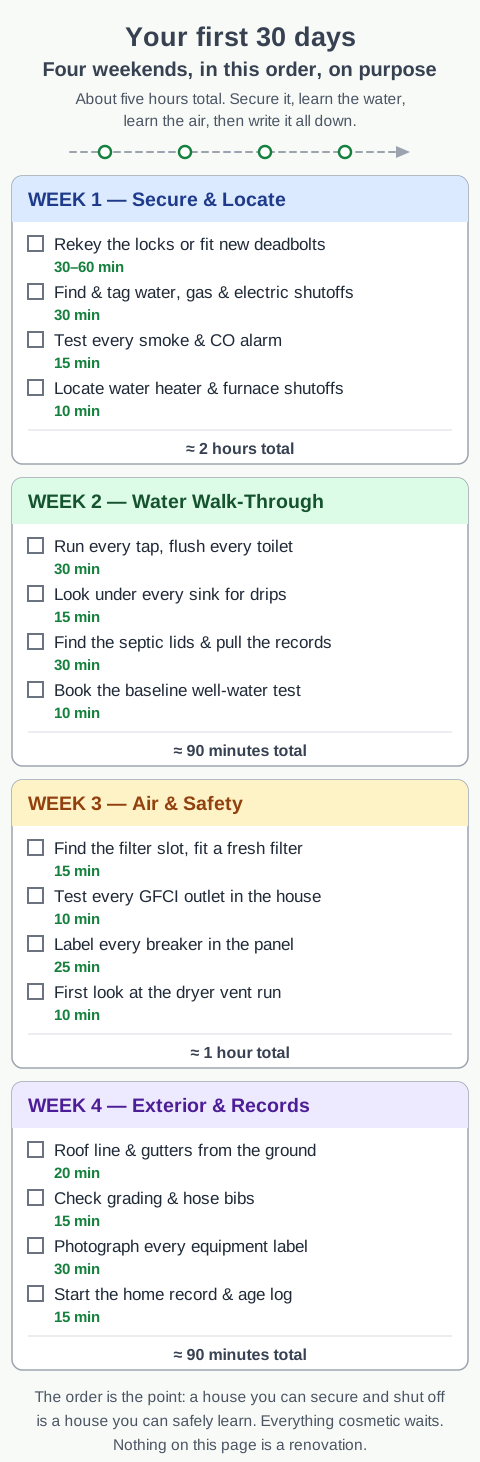
First-Time Homeowner Maintenance Checklist: The First 30 Days
The first 30 days in a new house, in the right order: rekey and locate your shutoffs in week 1, walk the water in week 2, learn the air in week 3, and build your home record in week 4 — with the time and cost of every task, and the list of what can safely wait 90 days.
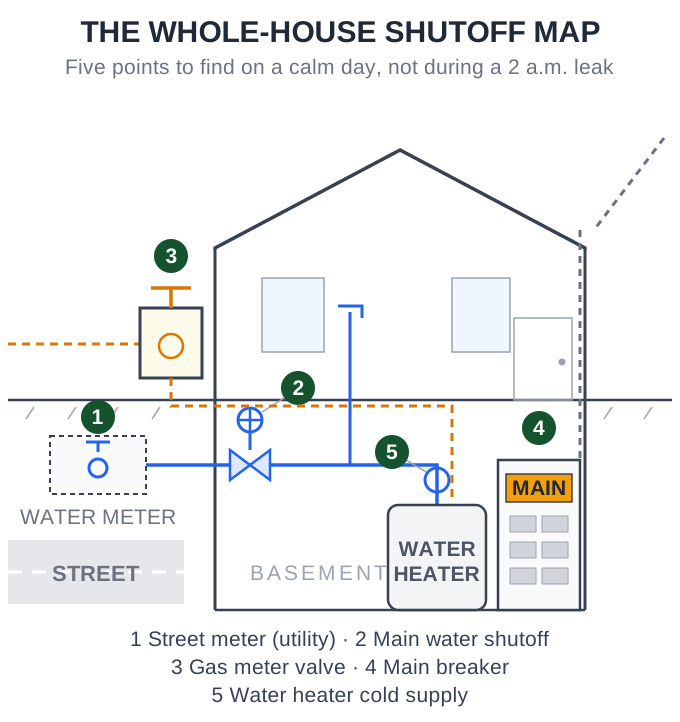
Find It Before You Need It: Your Main Water Shutoff, Gas Shutoff & Electrical Panel
Every house has five shutoffs that matter in an emergency: the street meter valve, your interior main, the gas meter valve, the main breaker and the water heater supply. How to find each one, test it, tag it, and fix the one that fails, before the 2 a.m. leak.
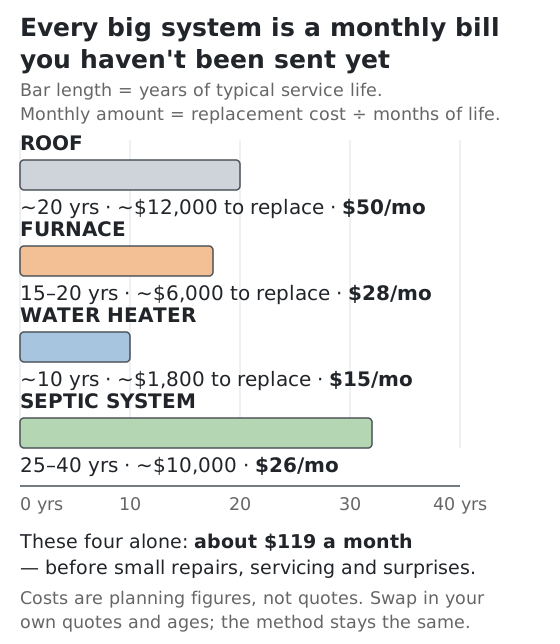
How Much to Budget for Home Maintenance in Year 1: The 1% Rule, Tested
The 1% rule says budget 1% of your home's value a year for maintenance. Here's where it works, where it breaks, what Fannie Mae actually recommends (1–4% by age), and the sinking-fund worksheet that replaces the guess with your own systems' numbers.